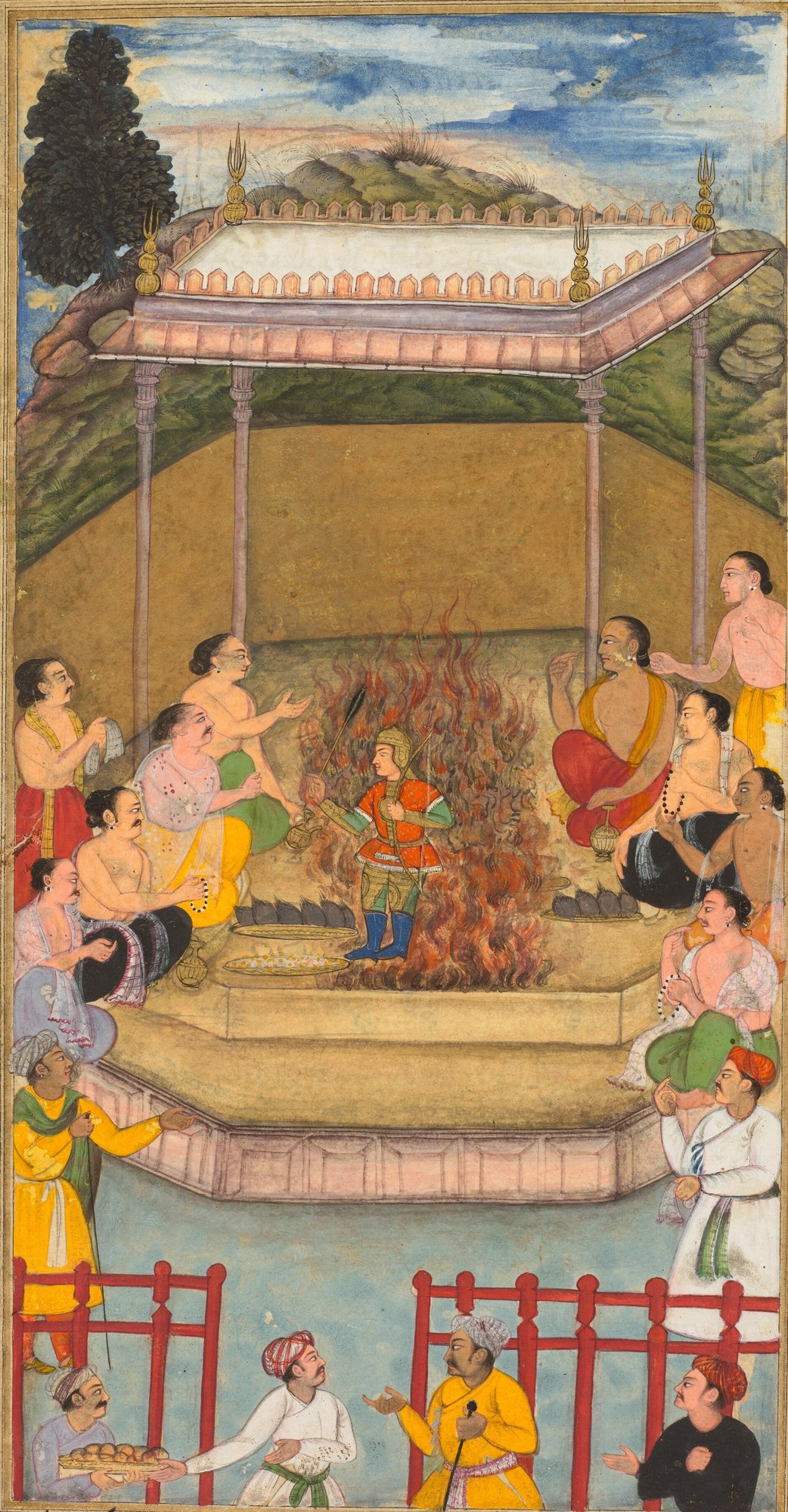
Before the offering can go up, a fire has to be carried out. A priest lifts a burning brand from the western hearth, the householder’s fire that never goes cold, and walks it eastward to a second hearth, then southward to a third, kindling each in turn from the first. Only now, with three fires alight in a fixed relation on the swept ground, can anything be given to the gods. This is the solemn shrauta sacrifice, the great public rite of the Vedic world, and it is not a prayer or a festival so much as a machine: an exact arrangement of fires, priests, ground and offering, built for one purpose, to get a gift from the hand of a mortal into the possession of a god. Nothing about it is casual. Every step is prescribed, because the whole religion turns on the step being done right.
At the centre of the machine is a plain, hard fact the tradition never lets the worshipper forget: no offering reaches the gods except through fire. The flame is the one courier that travels in both directions, the bearer of oblations and the caller of the gods, and so the physical business of the sacrifice is first of all the business of the fires. Get them wrong and the gift goes nowhere.
Three fires and their geometry
The ground is laid out around three hearths, each with its own place, name and work. To the west sits the Garhapatya, the householder’s fire, treated in the texts quite literally as a dwelling: the Garhapatya, one passage says, is a house. It is the domestic fire, the one from which the others are drawn, the still point the whole rite grows out of.
To the east sits the Ahavaniya, the offering-fire, and it is into this one that the oblations meant for the gods are poured; it is the mouth of the sacrifice, the eastern door through which the gift departs. To the south sits the third, the Dakshinagni, also called the Anvaharya-pacana, the cooking-fire, over which the boiled rice-mess for the priests is prepared.
The act of establishing them is called the agny-uddharana, the taking-out of the fire. The adhvaryu, the priest of the physical work, twice takes fire out of the Garhapatya and sets it in turn on the forepart of the Ahavaniya and the Dakshinagni hearths, and then two logs of fuel are laid on each of the three. The meaning is larger than the gesture: the eastern and southern fires are not lit independently but are the western fire itself, carried and multiplied, so that the three are one flame in three positions.
Even the order of laying that first fuel is not left to chance. The manuals preserve three different sequences for it, one beginning with the eastern fire, one following the mystic words for earth, air and sky, one in the fires’ order of origin, and the tradition records all three rather than flattening them to a single correct way.
The three-fire form is the full and proper one, but it is not the only one the texts allow. If a sacrificer is to keep no southern fire, the rule runs simply: they extinguish it. The reduced rite is still a rite. What cannot be dispensed with is the principle that the flame is the road, and that the road runs east.
Sweeping, smearing, and the three lines
Before a single log is laid, the hearths themselves must be made fit, and the preparation is startlingly concrete for a text usually read as abstract theology. Each hearth is swept three times, then smeared three times with cow-dung. Three lines are drawn across it with the wooden sword, from west to east or from south to north; the dust is lifted out of the lines with the thumb and the ring-finger; and the lines are sprinkled, three times, with water. Only then is the ground a place a god may be fed.
This is worth pausing on, because it tells you what kind of act the sacrifice is. It turns on procedure: an exact sequence of physical things done to a patch of earth, in the right order, the right number of times, with the right fingers. The gift to the gods begins in the dirt, with a besom, a lump of dung and a wooden blade, and the smallest error in the handling is a fault in the whole. Even the offering-cart that carries the materials in is addressed as a divine thing, hailed as the best carrying one, the most firmly joined, the most richly filled, the best caller of the gods. Nothing on the ground is merely equipment.
Four voices over one fire
Around the fires stand the priests, and in the developed solemn sacrifice there are four chief ones, each the master of a different Veda and a different kind of act.
The adhvaryu is the performer of the material part: he measures the ground, tends the fires and pours the oblations, and he belongs to the Yajur-veda, the Veda of the sacrificial formulas muttered as the work is done. The hotr is the reciter of the solemn prayers, the one who invokes the gods to the offering, and he is the priest of the Rigveda; his is reckoned the most ancient office of all, from a time when, one early authority held, every formula at the sacrifice was spoken by the hotr alone.
The udgatr is the chanter, who sings the melodies of the Sama-veda over the rite. And the brahman is the superintendent of the whole performance, the embodiment of sacrificial lore, seated to watch the entire act and to correct any priest who errs; his office is explicitly the latest of the four to develop, added when the rite had grown intricate enough to need an overseer of overseers. The full solemn sacrifice multiplies these into full teams of assistants, but the four chief voices, one for each Veda, are its frame.
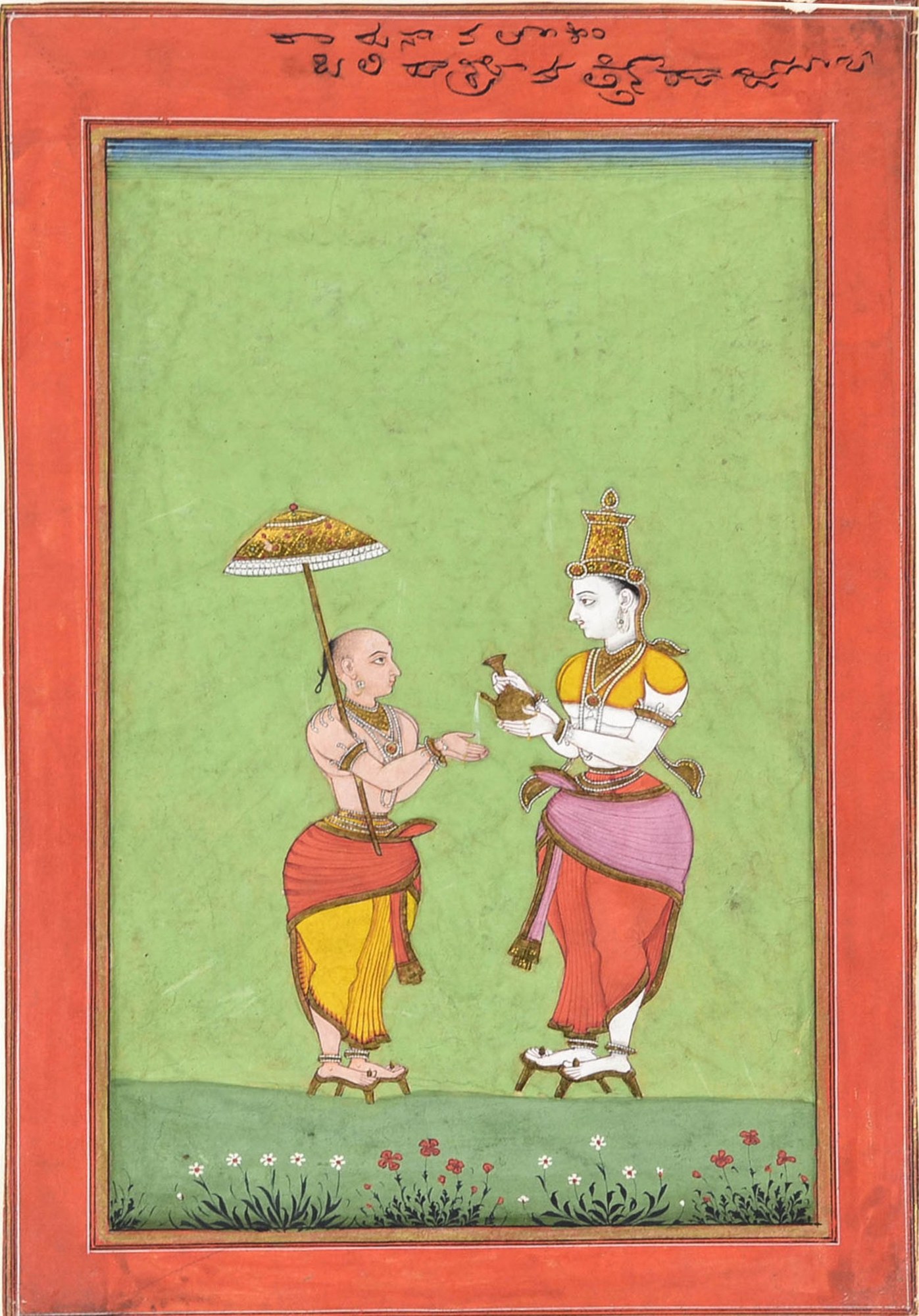
Above and behind them all stands the sacrificer, the yajamanaThe sacrificer, the patron for whom the whole rite is performed and whose gift it is; he acts together with his wife, who takes her own part in the offering., the lord of sacrifice for whom the whole thing is done, and he does not act alone: the rite requires his wife, girded and taking her own part in it. The priests are hired experts; the sacrificer and his wife are the ones whose gift it actually is.
What the gods did first
The Vedic thinkers did not treat this machinery as a human invention. They traced it to the gods themselves, and here the oldest layer of the tradition speaks. In the Purusha-sukta, a late hymn of the Rigveda, the gods perform the first sacrifice with the year itself for their materials: its oil was spring, the holy gift was autumn, summer was the wood, the seasons of the year poured on the fire because nothing else yet existed to offer.
Seven fencing-sticks they had, and thrice-seven layers of fuel were prepared. And the hymn ends on the line the whole later religion rests upon: the gods, sacrificing, sacrificed the victim, and these were the earliest holy ordinances, by which the mighty ones attained the height of heaven.
That is the claim in its starkest form: the gods won heaven by sacrificing, and every human sacrifice afterward re-enacts the act that made them gods. But a reader should hold two things apart that the tradition itself separates by centuries. The Rigvedic hymn is old, commonly placed around a thousand years before the common era, and the sacrifice it describes is a mental, archetypal one; the commentator Sayana calls it an imaginary sacrifice, with no three-fire liturgy in view at all.
The detailed machinery of fires and priests and hearth-lines comes from the Shatapatha Brahmana, a prose exposition composed several centuries later, in the eighth to sixth centuries before the common era. The gap between the archetype and the fully worked-out procedure is on the order of several centuries, and the concrete apparatus of the later ritual should not be read back into the older hymn as though the two were one system.
Why the way was hidden
The Brahmana tells the same exchange-logic as the hymn, but it adds a strange and revealing turn. By means of the sacrifice, it says, the gods obtained that supreme authority which they now wield. And then, having won their supremacy by it, they did not leave the method lying about for mortals to seize. They asked among themselves how this world of theirs might be kept unattainable by men, and their answer was to hide the sacrifice: they sipped its sap as bees suck honey, drained it dry, and effaced its very traces with the sacrificial stake, and then they disappeared.
That stake is the yupaThe sacrificial stake or post, which the Brahmana derives from the verb to efface, because the gods used it to wipe out the traces of their own first sacrifice., and the Brahmana turns its name into the moral of the story: it comes, the text says, from the verb to efface, because with it the gods wiped out the tracks of what they had done. The seers who came after had to gather the scattered sacrifice back together, just as the human rite gathers and reconstitutes it now. This is why the procedure has to be so exact. The worshippers are not improvising a way to please the gods; they are painstakingly reassembling a vanished divine act from which the gods deliberately rubbed out the instructions, and the smallest deviation risks getting the reconstruction wrong.
The heartbeat of the system
For all the grandeur of the solemn rite, the sacrifice that actually runs every day is small. It is the AgnihotraThe daily minimal fire-offering of fresh milk, poured just after sunset and again just before sunrise; the smallest recurring rite of the whole system., a burnt-offering of fresh milk poured into the fire twice daily, in the evening just after sunset and in the morning just before sunrise. A householder with his wife, two libations of milk, the sun going down and the sun coming up: that is the minimum, the steady pulse beneath all the elaborate occasional sacrifices, and it ties the whole fire-cult to the turning of the day.
The tie is not incidental. The Brahmana glosses the sacrificial light as fourfold, one thing seen four ways: it is the sacrifice, and the day, and the gods, and the sun. Fire on the altar, daylight, the gods above, the sun in the sky, the tradition folds them into a single shining thing, so that to feed the flame at dusk and dawn is to keep the whole bright order turning.
And every one of those offerings, from the daily spoon of milk to the grandest public rite, is addressed and consigned by name to the fire that carries it: to the Purpose, to the Impulse, to Agni, hail. The god named at each libation is the courier. The gift is spoken into his keeping, and he takes it up the one road that reaches the gods.
By means of the sacrifice the gods obtained that supreme authority which they now wield. They spake, “How may this (world) of ours be unattainable by men!” They then sipped the sap of the sacrifice, as bees would suck out honey; and having drained the sacrifice and effaced its traces by means of the sacrificial stake, they disappeared. (Shatapatha Brahmana III.1.4.3, tr. Julius Eggeling)
- Rigveda 10.90 (the Purusha-sukta; Griffith trans., The Hymns of the Rigveda, vol. II, 1897)used here ONLY for its archetype-of-sacrifice frame, not the dismemberment-creation narrative. The gods’ first sacrifice with the seasons as its materials,
Its oil was spring, the holy gift was autumn; summer was the wood
(vv. 6–7); theseven fencing-sticks
andthrice seven layers of fuel
of the primeval rite (v. 15); and the closing ordinance,Gods, sacrificing, sacrificed the victim: these were the earliest holy ordinances… The Mighty Ones attained the height of heaven
(v. 16). A late hymn of the tenth and last mandala, commonly dated c. 1000 BCE (a scholarly convention, not a claim of the text); Sayana glosses its sacrifice as a mental or imaginary one, not a manual of procedure. - Shatapatha Brahmana, Part I (Eggeling trans., Sacred Books of the East vol. XII, 1882)Books I–II and the Introduction — the three sacred fires and their geometry (Garhapatya west,
a house
; Ahavaniya east, the offering-fire; Dakshinagni / Anvaharya-pacana south, the cooking-fire) and the agny-uddharana that carries fire out from the Garhapatya to the other two; the three permitted sequences for laying the first fuel, and the rule that the southern fire may be extinguished where none is kept; the hearth-preparation of threefold sweeping, cow-dung, three lines drawn with the wooden sword and thrice sprinkled with water; the offering-cart hailed asthe best caller of the gods
; the twice-daily Agnihotra of fresh milk at sunset and sunrise; the fourfoldlight
(the sacrifice, the day, the gods and the sun); and the definitions of the four priest-offices — Adhvaryu (Yajur-veda, the material work), Hotr (Rigveda, the invoker, the most ancient office), Udgatr (Sama-veda, the chanter) and Brahman (the superintendent,doubtless the latest of all
) — together with the sacrificer (yajamana) and his participating wife. The claim that the hotr once spoke every formula, and that the offices are of unequal antiquity, is flagged in the source as the translator’s and Haug’s historical reconstruction, not the Brahmana’s own statement. - Shatapatha Brahmana, Part II (Eggeling trans., Sacred Books of the East vol. XXVI, 1885)Book III.1.4 —
By means of the sacrifice the gods obtained that supreme authority which they now wield,
their sipping and draining of the sacrifice and effacing of its traces so that it might beunattainable by men,
and the etymology of the yupa (sacrificial stake) from the verb to efface (yopaya); the seers whocollected the sacrifice, just as this sacrifice is collected
now; and the audgrabhana libations consigned by name to Agni,To the Purpose, to the Impulse, to Agni, hail!
- Ashvalayana Shrauta Sutra / Apastamba Shrauta Sutra (cited, not quoted)the terse performance-manuals that codify the solemn rite the Brahmanas expound, later still than the Brahmana layer (c. mid-first-millennium BCE). Named here as the class of procedure-sutras; no specific step, number or wording is attributed to them in this post.