HomeArchiveThemesAbout

#Creation

Cosmogony, origin of the world, gods, and humankind.

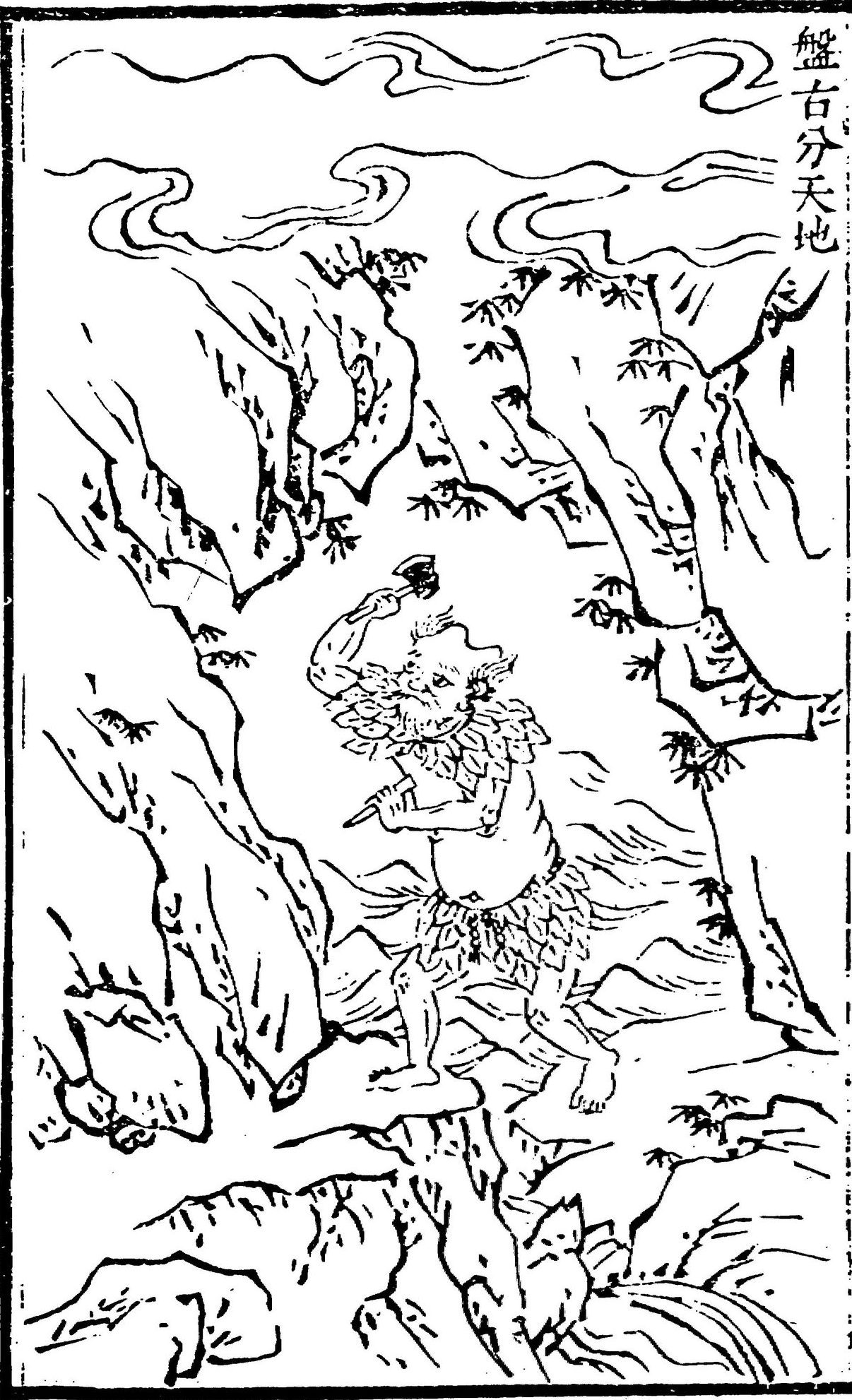
Chinese woodblock line-print of the primordial giant Pangu separating Heaven and Earth: a hairy, horned figure in a leafy skirt stands on a rocky ledge and swings a hatchet overhead with his raised right hand, cleaving apart the swirling cloud-scrolls of the sky above from the crags, bamboo and waves of the earth below; a title cartouche reading 盤古分天地 runs down the upper-right corner.
Chinese

Pangu and the Cosmic Egg

For eighteen thousand years a giant grew inside a shell of chaos, holding the raw sky and the raw earth apart with his own body; when at last he died, there was nowhere left for him to go but into the world.
6 minXu Zheng
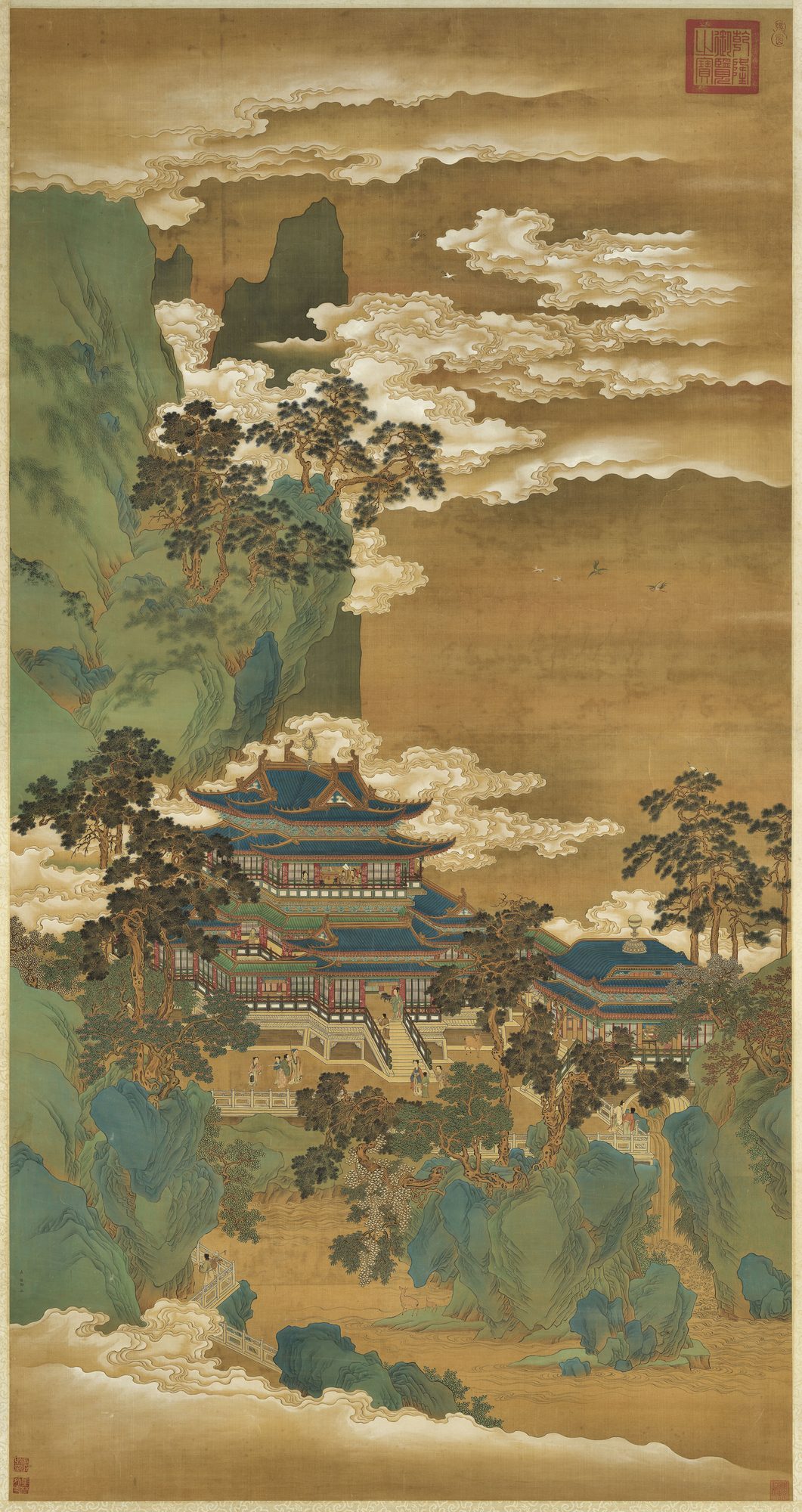
A blue-green Chinese silk landscape of an immortal mountain: jade-blue peaks wreathed in cloud rising above a many-tiered celestial palace with red pillars, blue-tiled roofs and jade balustrades, cranes in flight, deer among the rocks, and tiny figures climbing stone stairs and crossing bridges toward the heights.
Chinese

Mount Kunlun, Axis of the World

A jade-railed paradise in the northwest where four world-rivers rise, deathless trees grow and a stair of three tiers climbs out of the earth and into Heaven itself.
6 minShanhaijing
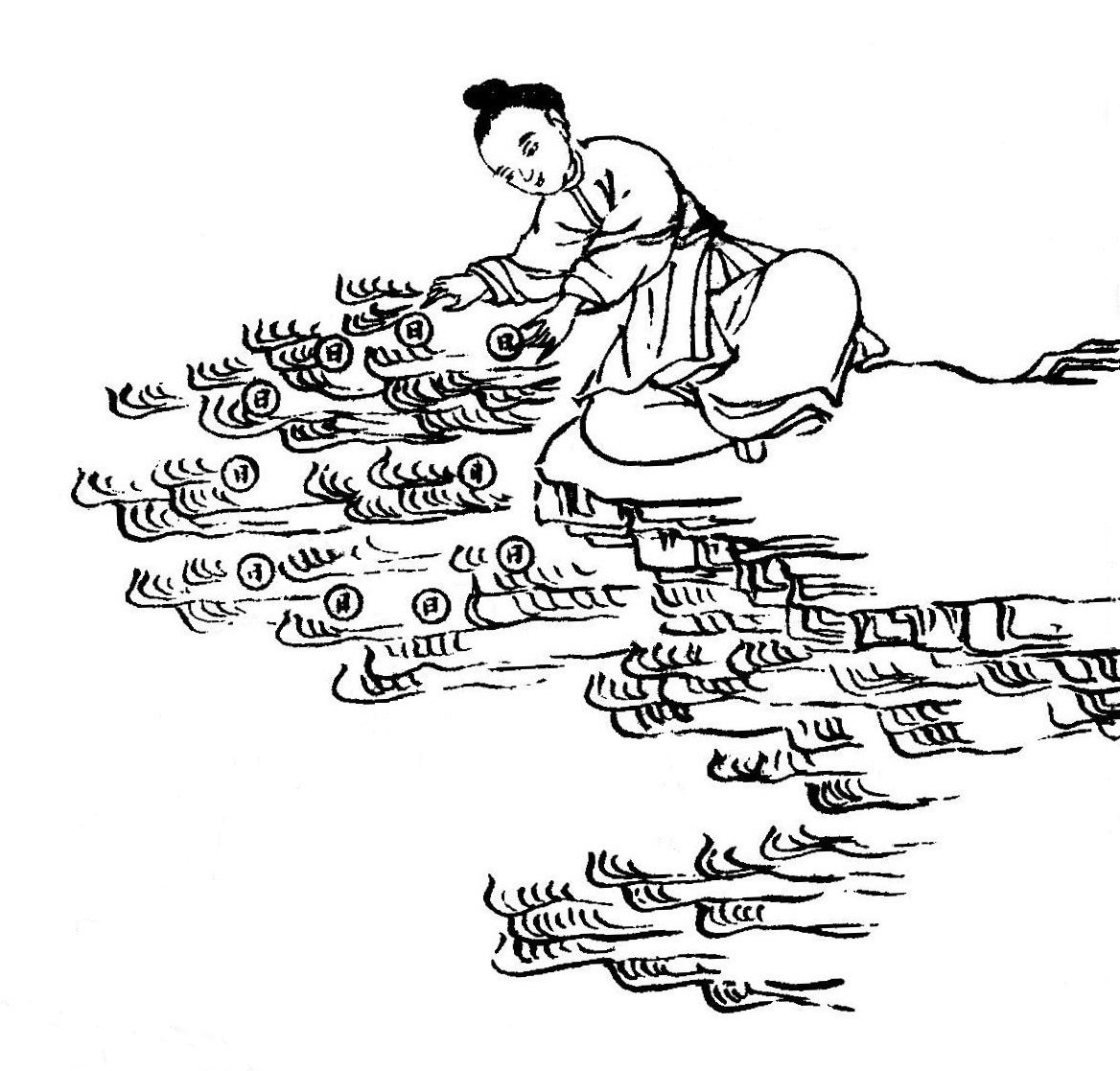
A traditional Chinese line drawing of the solar goddess Xihe kneeling at the water's edge and bathing the suns. She reaches both hands down into a gulf where the ten suns, each drawn as a small disc marked with the character 日 (sun), ride crested waves that fan out across the lower field; her hair is gathered in a topknot and she wears a long flowing robe.
Chinese

Xihe, Mother of the Suns

She had ten children and every one of them was a sun. In a gulf of sweet water at the edge of the world she bathed them, and sent them out one at a time to cross the sky.
5 minShanhaijing
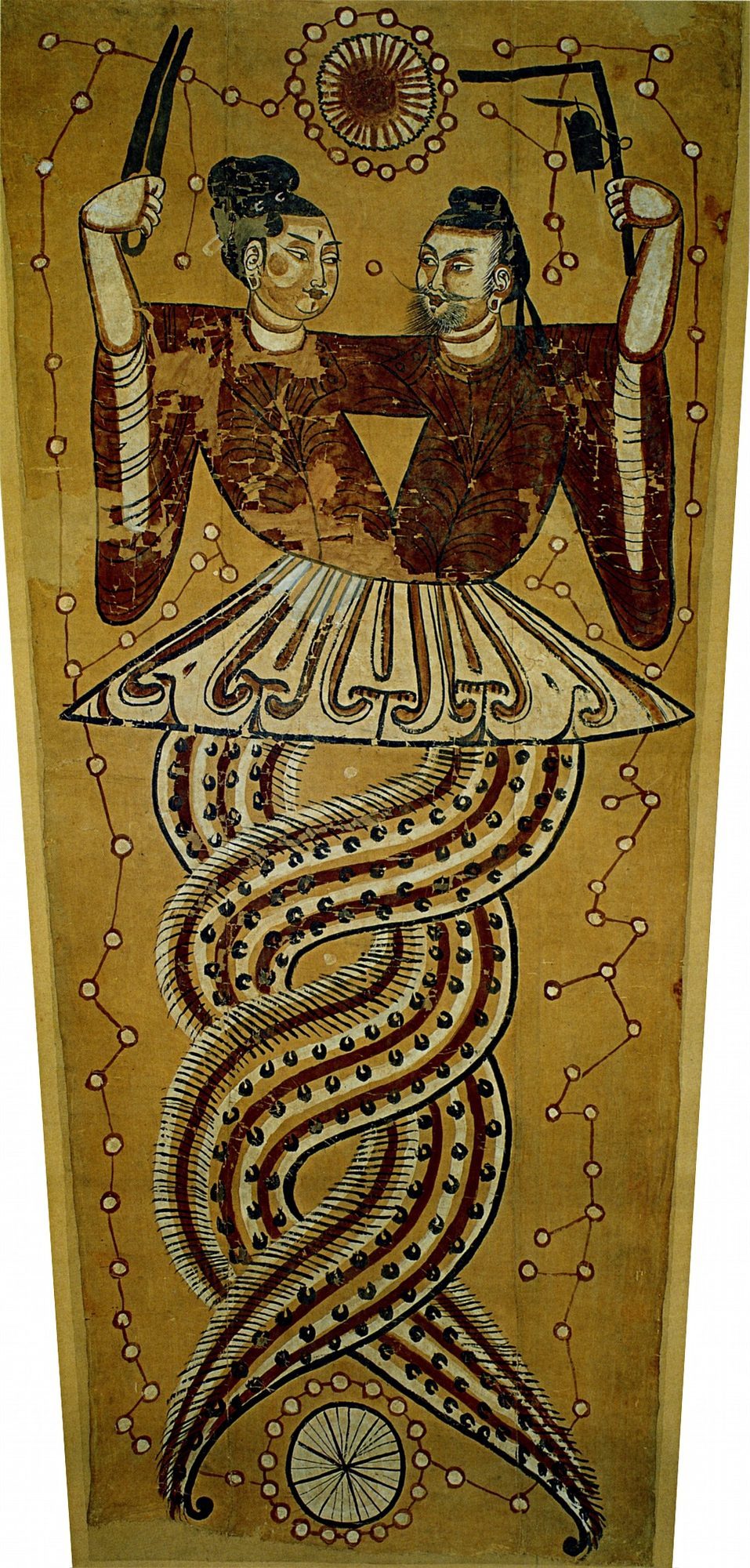
Tang-dynasty silk painting of Fuxi and Nüwa as a human-headed, serpent-bodied pair, their scaled tails entwined in a double helix below a shared white skirt. Nüwa at left raises a compass in her hand; the bearded Fuxi at right raises a carpenter's set-square with an ink-cord; a radiate sun-disc floats above their heads and a spoked moon-disc below the tails, the tan silk ground strewn with linked white dots for the constellations.
Chinese

Fuxi, Bringer of Civilization

He looked up at the images in heaven and down at the patterns on earth, and out of that reading drew the eight trigrams, the fishing-net, and the first law of husband and wife.
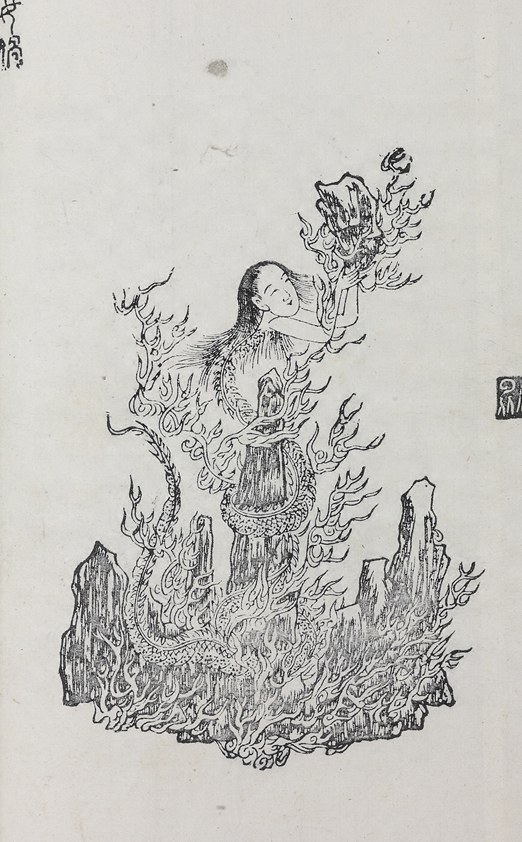
5 minYijing
Woodblock-print line drawing of the goddess Nüwa: a human-faced woman with long flowing hair whose lower body is a coiling serpent tail wound among jagged rocks and licking flames, one arm raised overhead holding aloft a stone toward the sky she is mending.
Chinese

Nüwa, the Creator Goddess

Serpent-bodied and human-faced, she patted the first people out of yellow mud, then smelted five-coloured stones to patch a sky that had split from pole to pole.
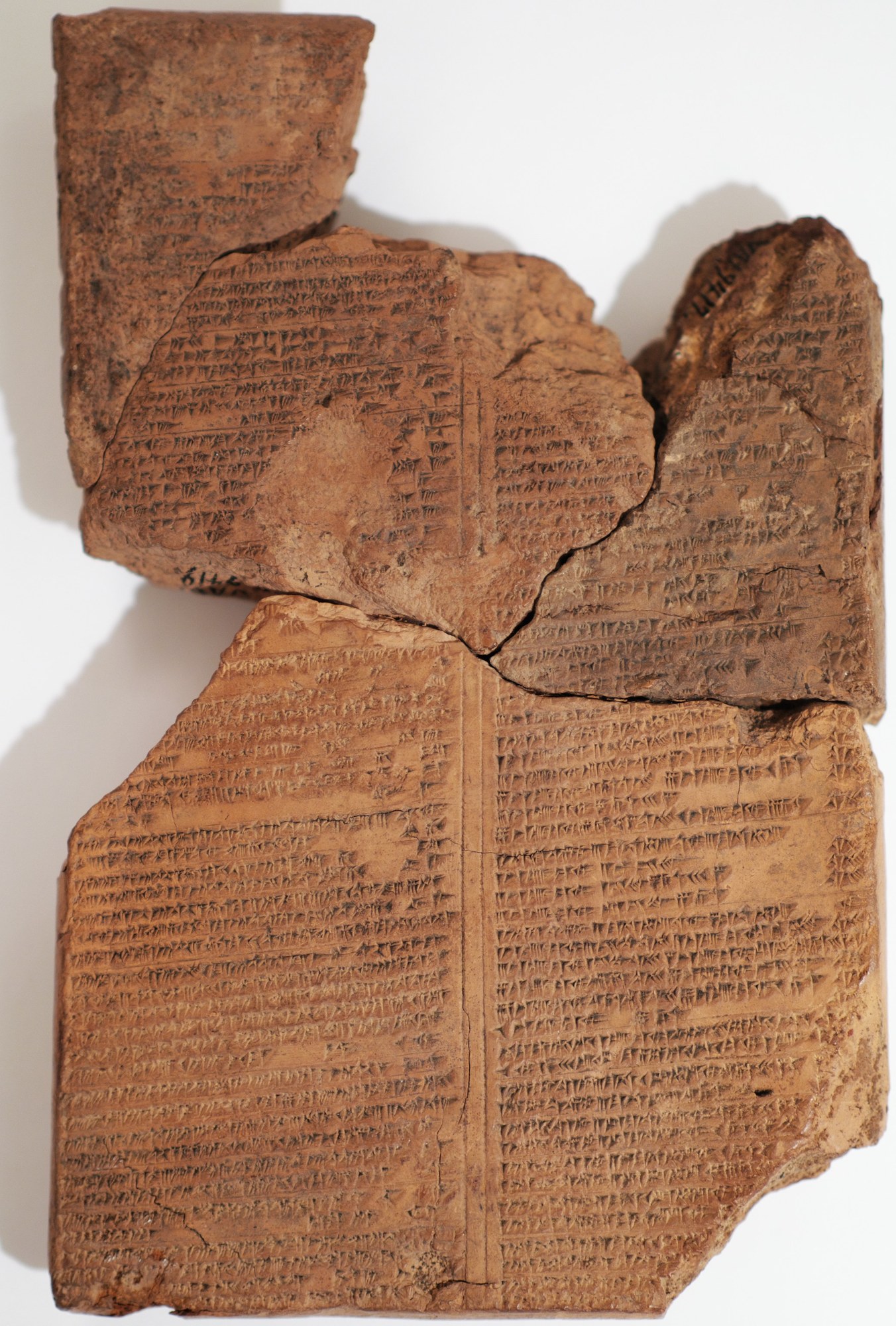
5 minHuainanzi
A large fragmentary Babylonian cuneiform tablet, joined from several broken pieces, its surface ruled into columns of dense cuneiform — a copy of the astronomical compendium MUL.APIN, the standard Babylonian handbook of the stars, the paths of the sky and the calendar.
Mesop.

Marduk Founds the Year and Sets the Moon in Its Course

With the sea dead beneath his foot, the champion turned to a quieter labour: fixing the stations of the sky, dividing the year, and handing the moon a monthly work-order. This is the creation of measured time, spoken into being at the world's first dawn.
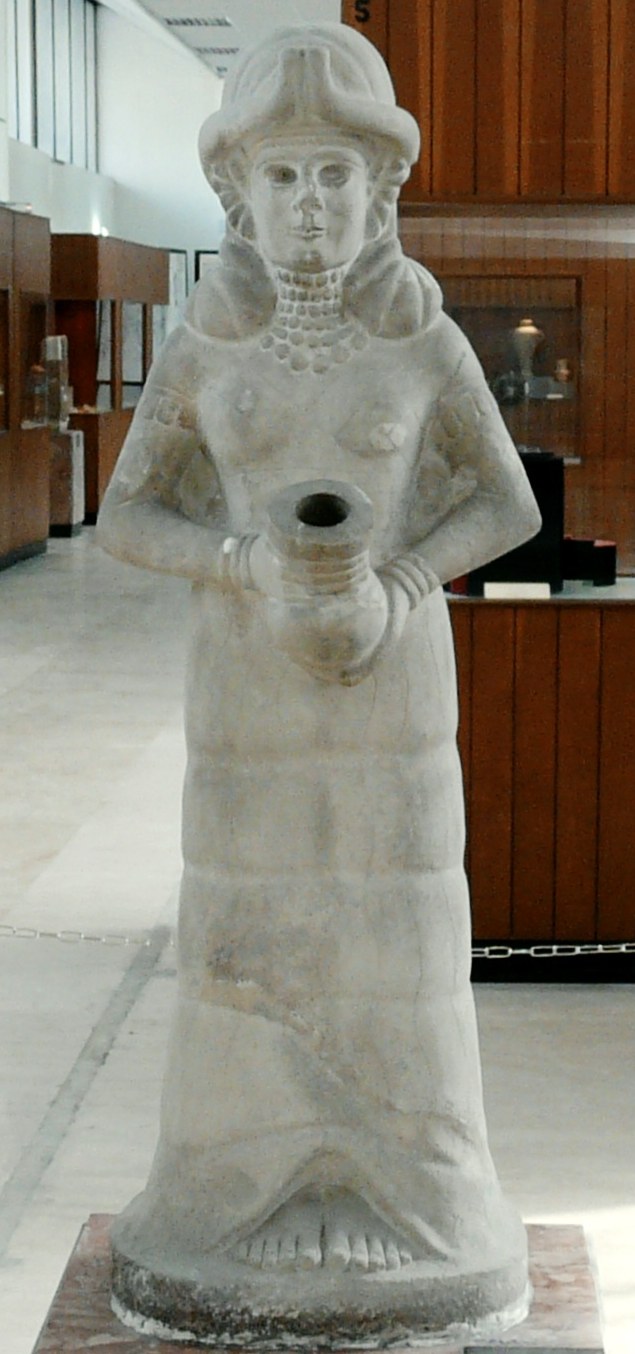
7 min*Enūma Eliš*
Weathered ancient limestone statue of a standing goddess in a horned headdress and a long flounced robe, a tiered bead choker and necklace at her throat, holding at her belly in both hands a round vase pierced through its centre — the vessel from which the life-giving waters were made to flow; displayed on a plinth in the National Museum of Aleppo.
Mesop.

Nammu: The Primeval Sea Who Bore Heaven and Earth

The gods are digging canals and weeping over the work when their oldest mother carries their tears down into the deep to wake her sleeping son. What she is called, and what she made, is a question two thousand years of clay cannot quite settle.
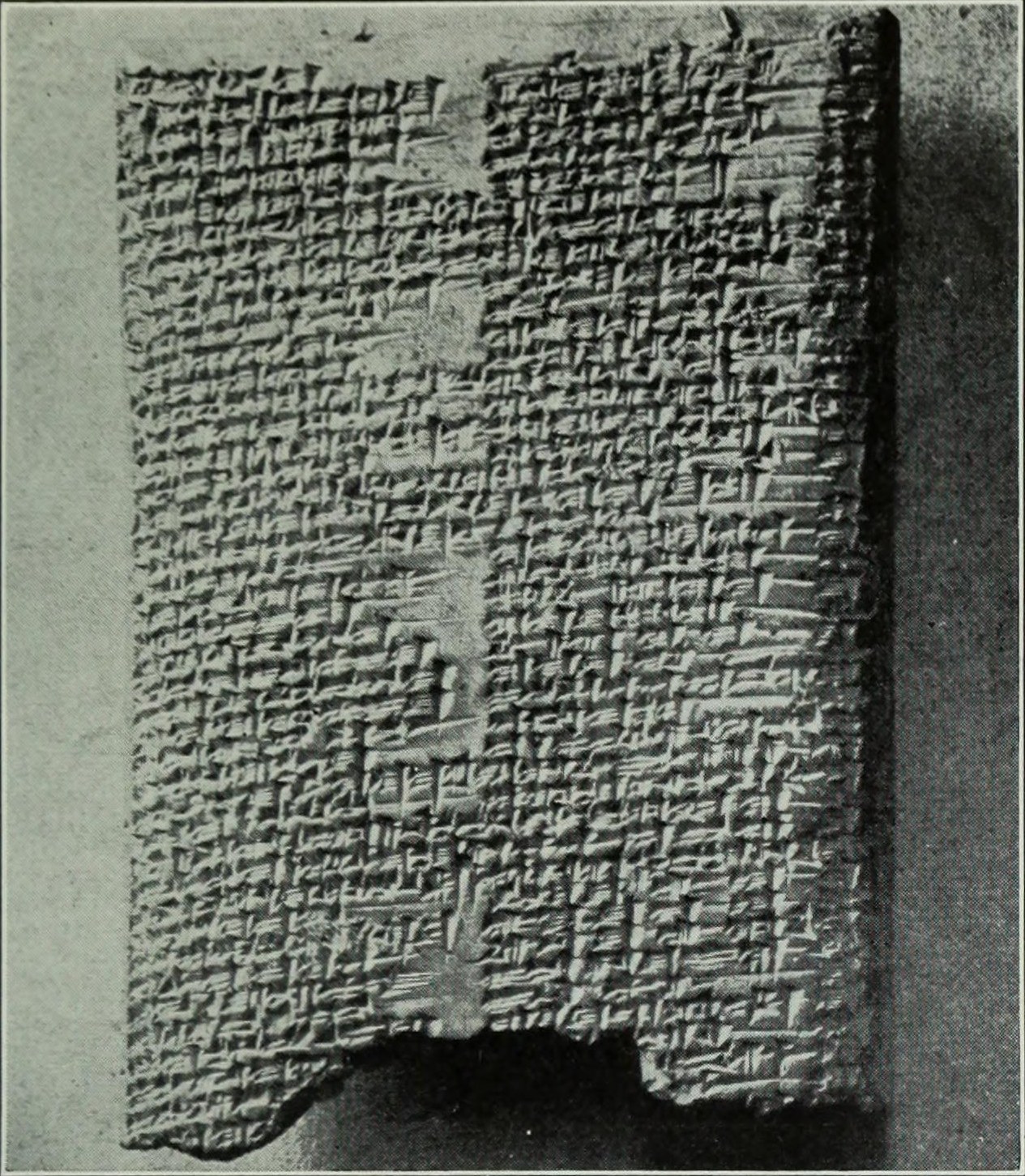
7 min*Enki and Ninmah*
A photograph of the actual ancient clay tablet of the Fourth Tablet of the Babylonian Epic of Creation (Enūma Eliš), British Museum 93016: a broken rectangular fragment densely covered in columns of impressed cuneiform wedges, lit to cast a shadow on a plain ground.
Mesop.

The Tablet of Destinies and the Ordering of Fates

A single clay writ, sealed and laid over the heart, carried the right to decree the fate of the whole created order. Whoever held it ruled the universe, so the history of Mesopotamian kingship is the history of who held it next.
7 min*Enūma Eliš*
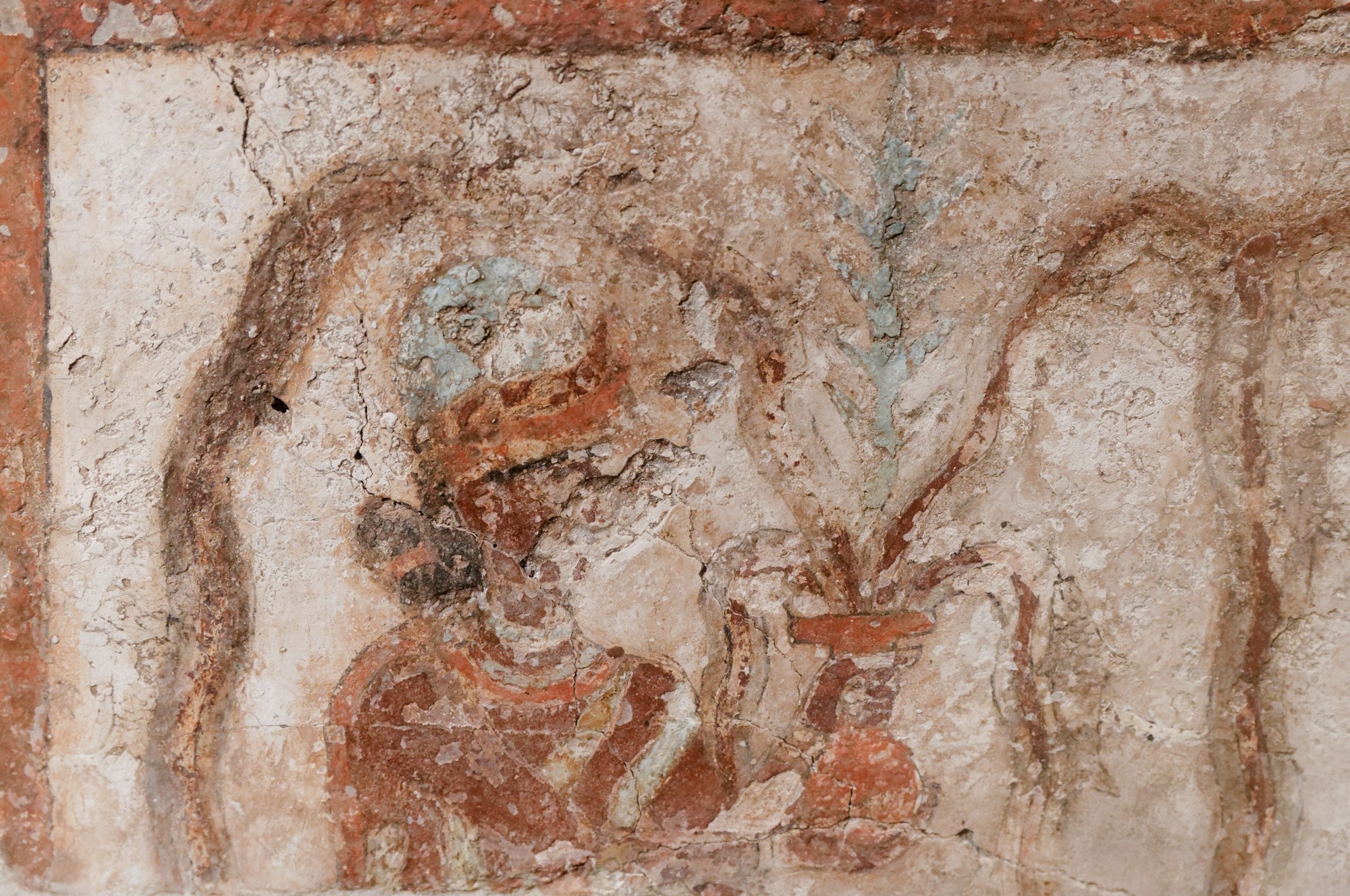
Detail of the Mari palace wall painting known as the Investiture of Zimri-Lim: a goddess in a blue-crowned headdress and a red-and-blue flounced robe stands within a painted red frame, holding a globular vessel from which a leafy plant and streams of water rise — the flowing-vase goddess who embodies the life-giving sweet waters, the abundance of the water-god Ea. The surface is a cracked, fragmentary tempera-on-plaster ground in ochre, red and turquoise.
Mesop.

Atrahasis: The Making of Humankind

Forty years the lesser gods dug the rivers by hand. Then they burned their tools and surrounded their master's house in the dark, and the only way to end the strike was to build a creature that could take the work off them.
7 min*Atra-hasis*
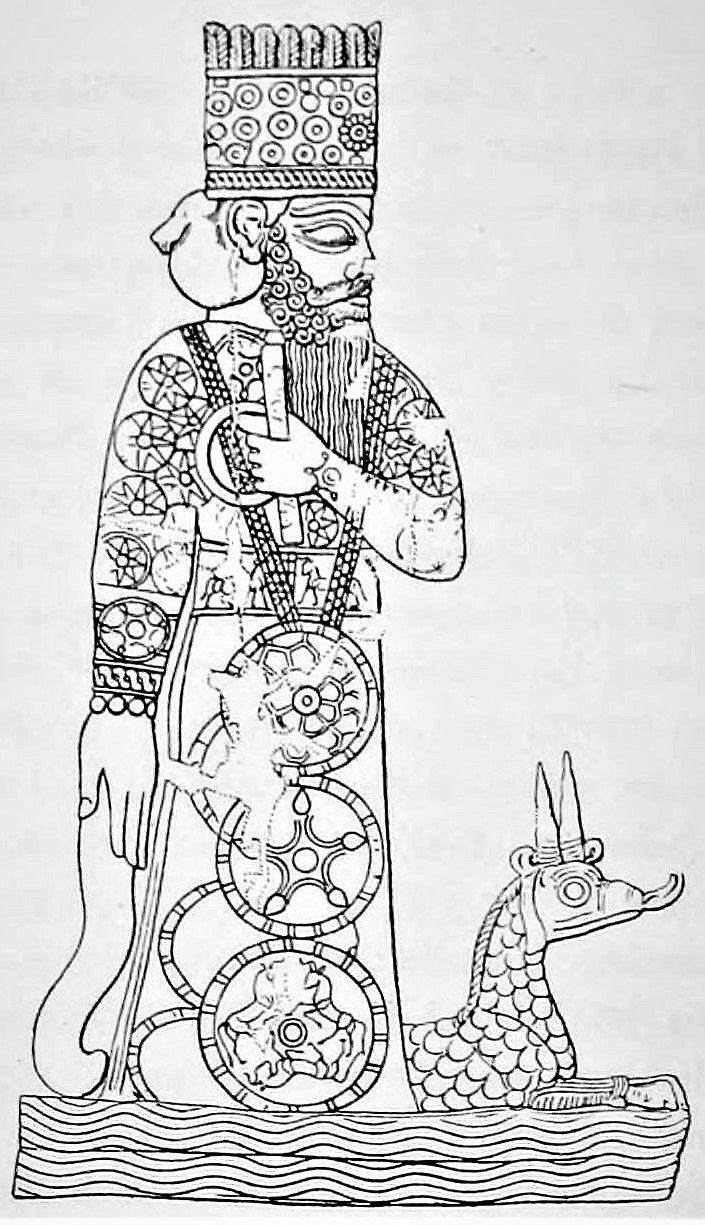
Line drawing of the Statue of Marduk: a bearded god in a tall crenellated horned crown and a long fringed robe covered in rosette-discs stands frontally, holding the ring-and-rod of kingship at his chest, while his scaled, horned snake-dragon (the mušḫuššu) crouches at his feet; both stand on a plinth of wavy lines — the split waters of the vanquished Tiamat.
Mesop.

Marduk, Champion of Babylon

The young storm-god who alone dared face the salt-water chaos, drove the winds down her throat and split her body into the sky, and traded a single victory for the kingship of all the gods.
6 min*Enūma Eliš*
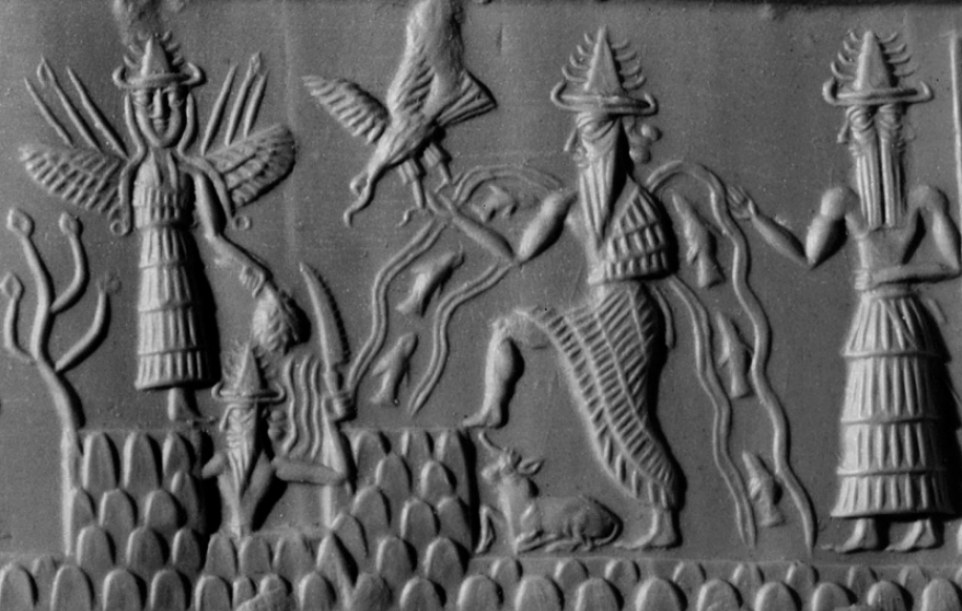
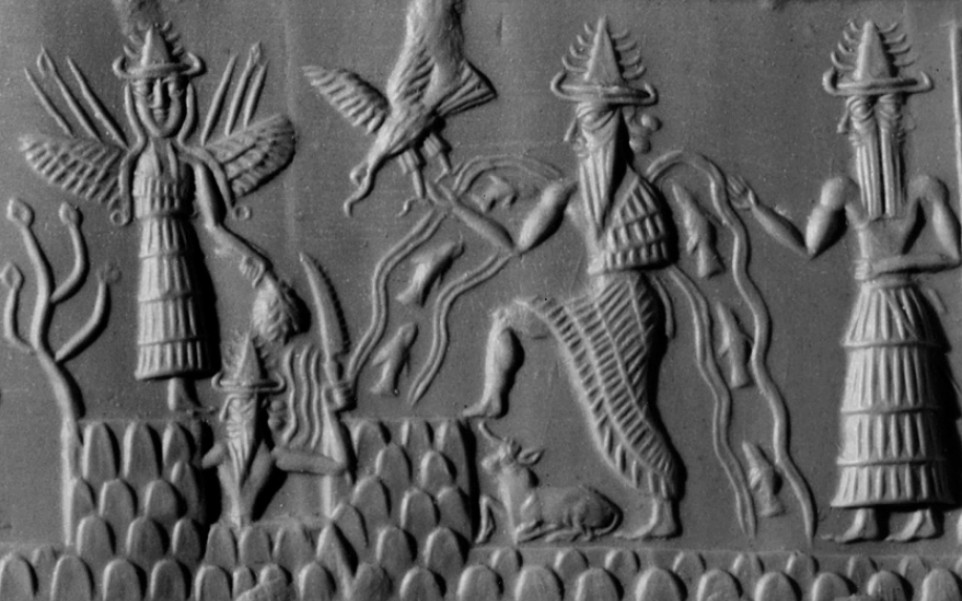
A modern grey clay impression rolled from an ancient Akkadian cylinder seal: four horned deities across a rolled-out frieze. At centre-right the water-god Ea (Sumerian Enki) strides forward with one foot raised on a mountain, two streams of water full of small fish flowing down from each shoulder; his two-faced vizier Usimu stands at the right edge, the winged goddess Ishtar at the far left, and the sun-god Shamash cuts through the mountains between them.
Mesop.

Apsu, the Sweet-Water Deep

The first being in the Babylonian cosmos was fresh water that did nothing but rest, until noise drove it to murder its own children. Then the poem killed it off the page.
6 minEnūma Eliš
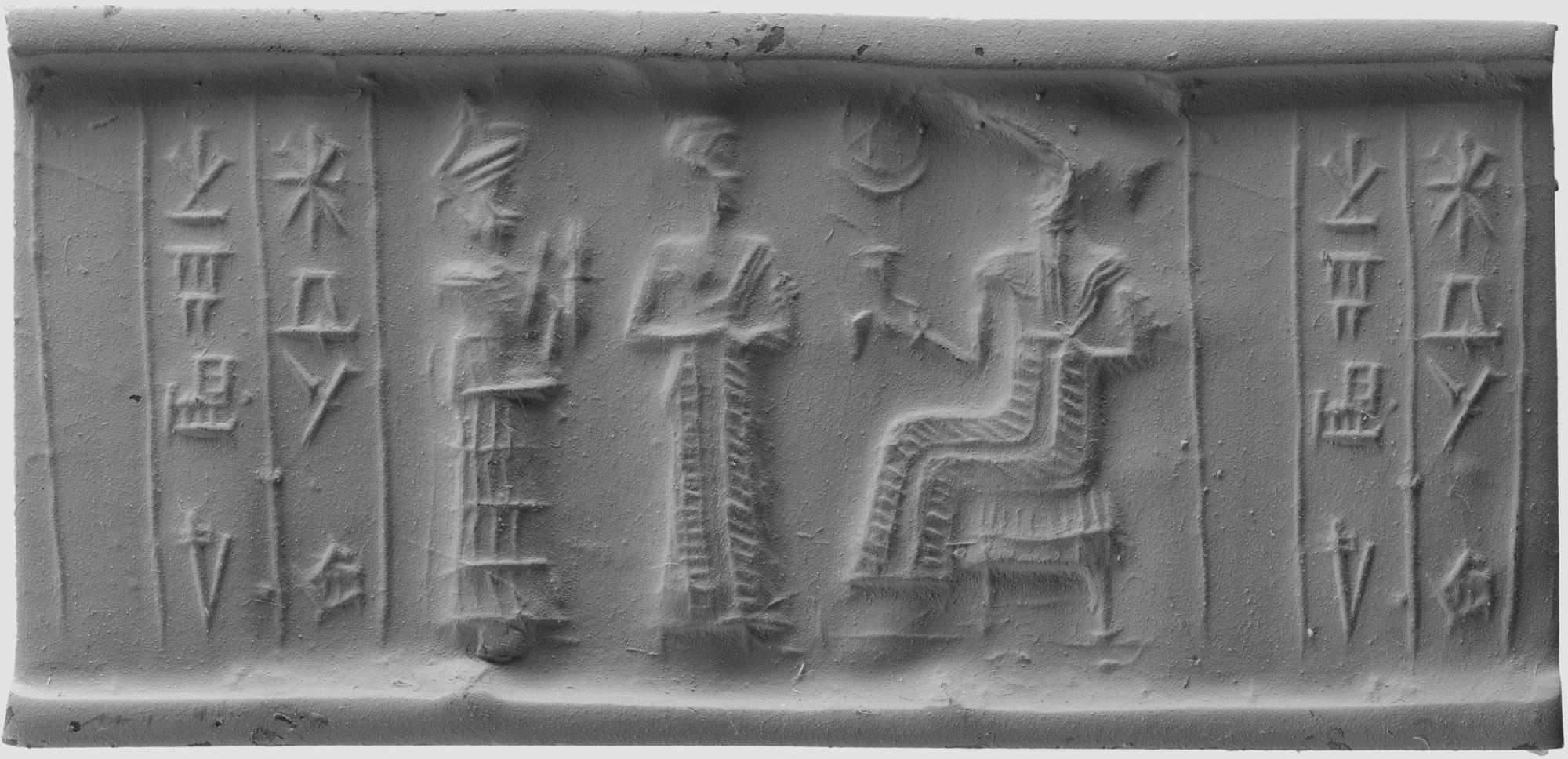
The modern grey rolled impression of a Mesopotamian cylinder seal: a standing worshipper and an interceding goddess with both hands raised approach a deity enthroned on a tiered throne, a crescent moon above, with panels of cuneiform to either side.
Mesop.

When An Carried Off Heaven and Enlil the Earth

The Sumerians never wrote the poem in which heaven and earth are torn apart. They only ever mention it, in the breath before a story begins: once, in the first days, the sky was prised off the ground and the two were shared out among the gods.
7 min*Gilgameš
Rolled-out impression of an Akkadian cylinder seal: a file of standing deities identified by their many-horned crowns — the winged goddess Ishtar at left, the sun-god Shamash rising through the mountains at centre, and at right the god Ea (Enki), lord of the sweet-water deep, with streams of water and fish flowing from his shoulders, his two-faced vizier Usimu beside him.
Mesop.

Apsu and Tiamat: The Sweet Water and the Salt Sea

Before heaven had a name there were two waters, and they mingled. Everything that followed, the gods, the quarrel, the war that split a body into a sky, began in that first commingling of the fresh and the salt.
6 minEnūma Eliš
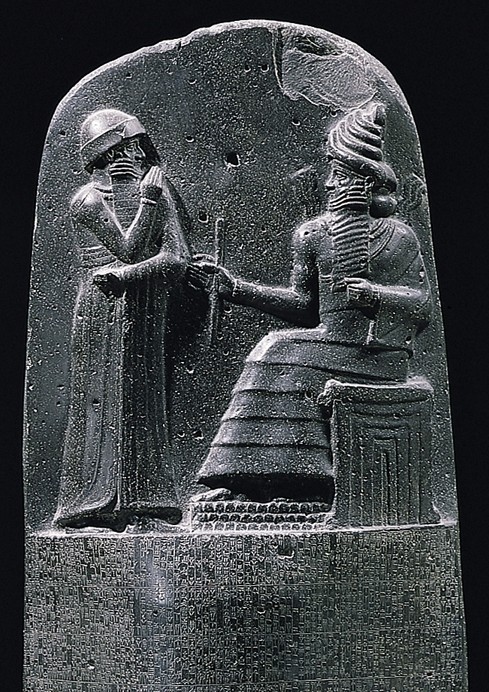
The relief at the top of the law stele of Hammurabi: at right the sun-god Shamash sits enthroned on a tiered temple-façade throne, wearing the many-tiered horned crown of divinity with flames rising from his shoulders, extending the rod-and-ring of just rule; at left the standing king Hammurabi raises one hand to his mouth in reverence to receive it. Carved in dark basalt, the figures set against a plain black ground above the opening lines of the cuneiform law-code.
Mesop.

The Decreeing of Fates at the New Year

Once a year the most powerful man in Babylonia was stripped of his crown, struck on the cheek and made to weep, so that a council of gods could settle his fate and the land's for the twelve months to come.
8 min*Enūma Eliš*
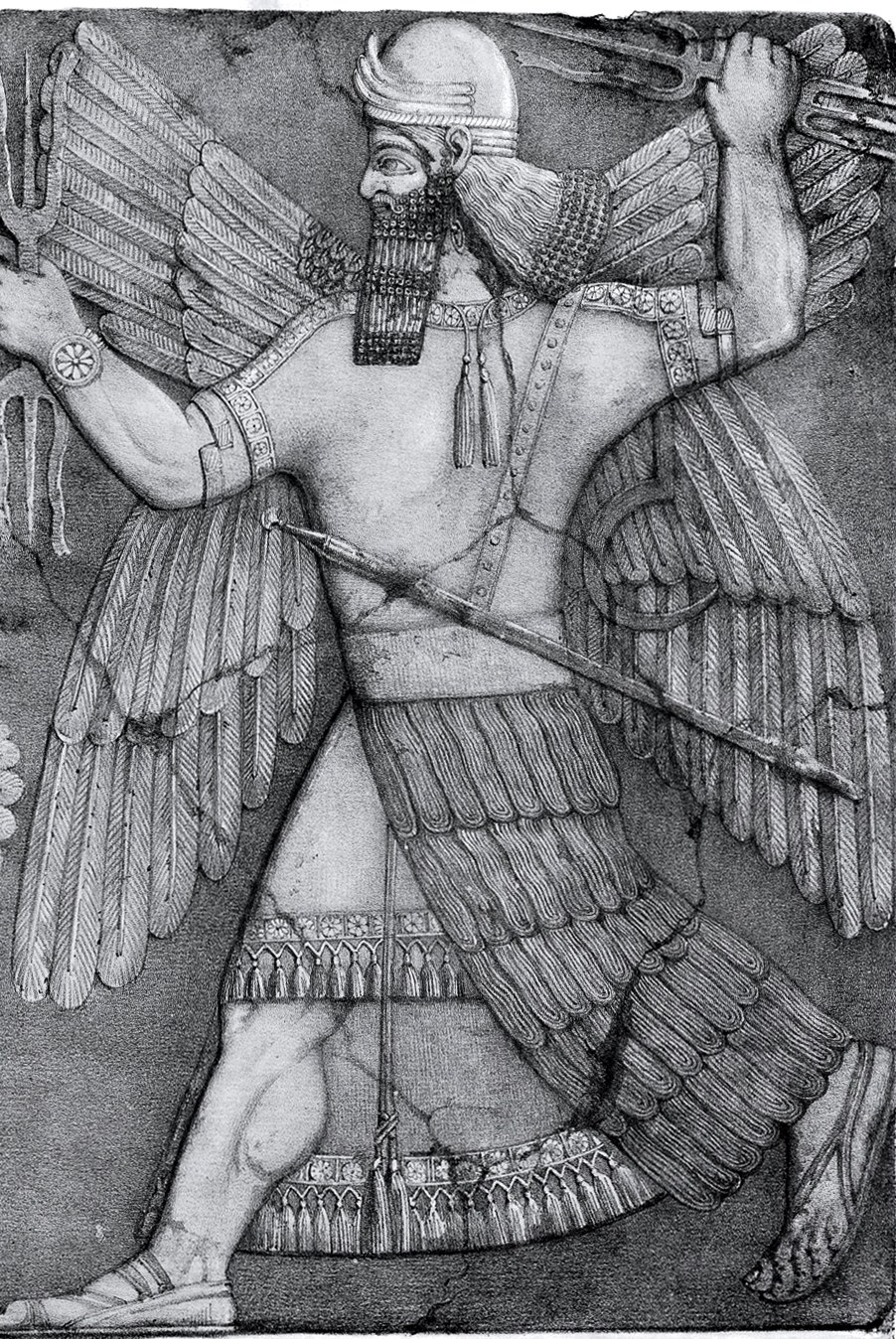
Neo-Assyrian carved stone relief: a four-winged, helmeted and bearded storm-god strides forward brandishing thunderbolts, the deity who in the tradition slays the chaos-monster Tiamat.
Mesop.

Tiamat, the Primeval Sea

She was the salt ocean before the ocean had a shore, the mother of every god, and the body a younger god would one day split open to roof the sky. This is Tiamat as a being: her names, her monstrous brood, and how her carcass became the world.
8 min*Enūma Eliš*
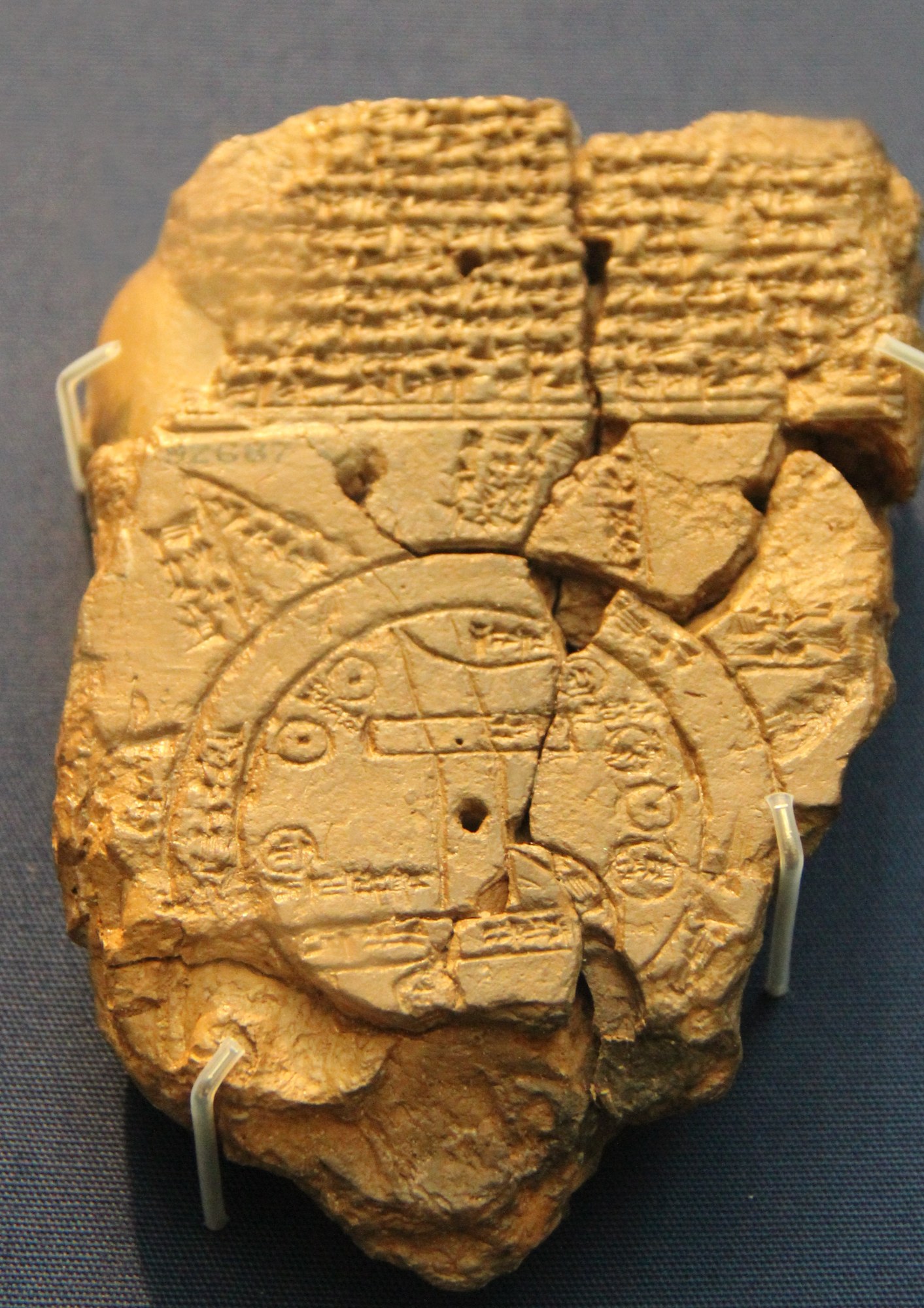
A broken Babylonian clay tablet, its upper half filled with lines of cuneiform and its lower half incised with a circular map of the world: the earth as a disc ringed by the ocean, with radiating triangular regions beyond it.
Mesop.

The Three Earths Beneath the Heavens

One short, forbidden tablet maps the Babylonian universe as six stone floors stacked in open air: three heavens above, three earths below, each a coloured slab laid down by a single arranging god. It is a diagram, not a story, and it argues with itself.
9 minKAR 307 obv. 30–38
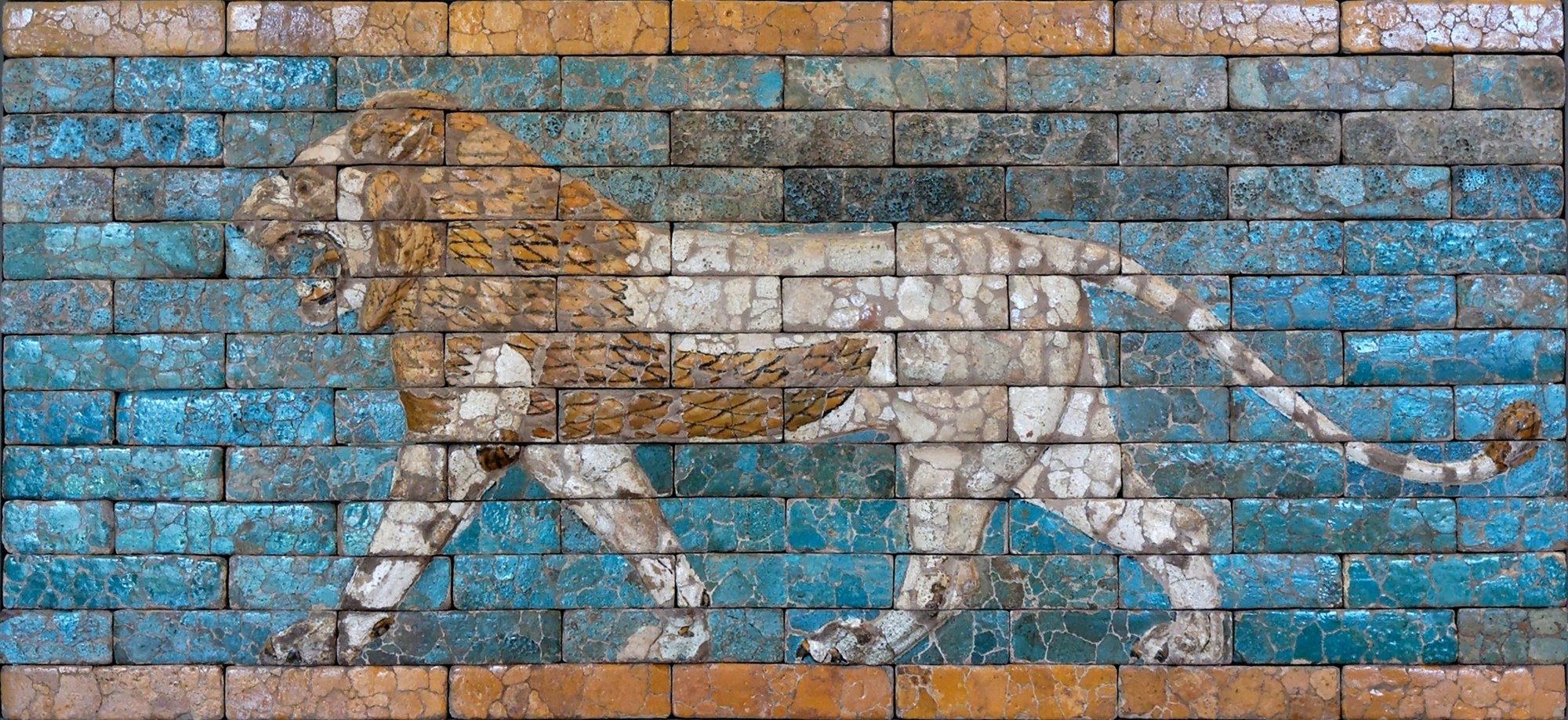
A striding, roaring lion in molded glazed brick — tawny mane, cream body, tail curling up behind — walking left to right across a turquoise-blue field bordered above and below by bands of ochre brick, from the Processional Way of Babylon.
Mesop.

The Akitu: Babylon's New Year Festival

For eleven days each spring the priests of Babylon washed a god, stripped a king of his crown and slapped him until he wept, then carried the whole company of the gods out through the glazed gate to renew the year.
8 minF. Thureau-Dangin
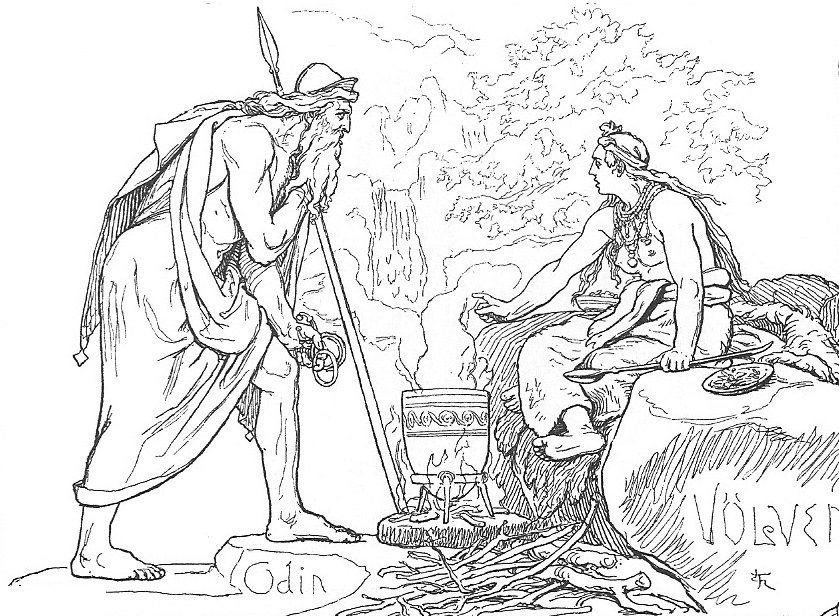
Pen-and-ink line engraving. At left the one-eyed Odin, in a winged cap and a long cloak, leans forward on his upright spear and his sword, his long beard falling; at right the seeress (the völva) sits on a fur-draped rock, one hand raised in speech, a shallow bowl in her lap; a steaming cauldron stands on a low fire between them, a leafy tree behind. The ground bears the incised labels "Odin" and "VÖLVEN".
Norse

The Seeress's Prophecy

Odin raises a dead wise-woman to make her speak, and she gives him the whole arc of the world: its making, his own hidden secrets, and the fire that ends it all.
7 minPoetic Edda
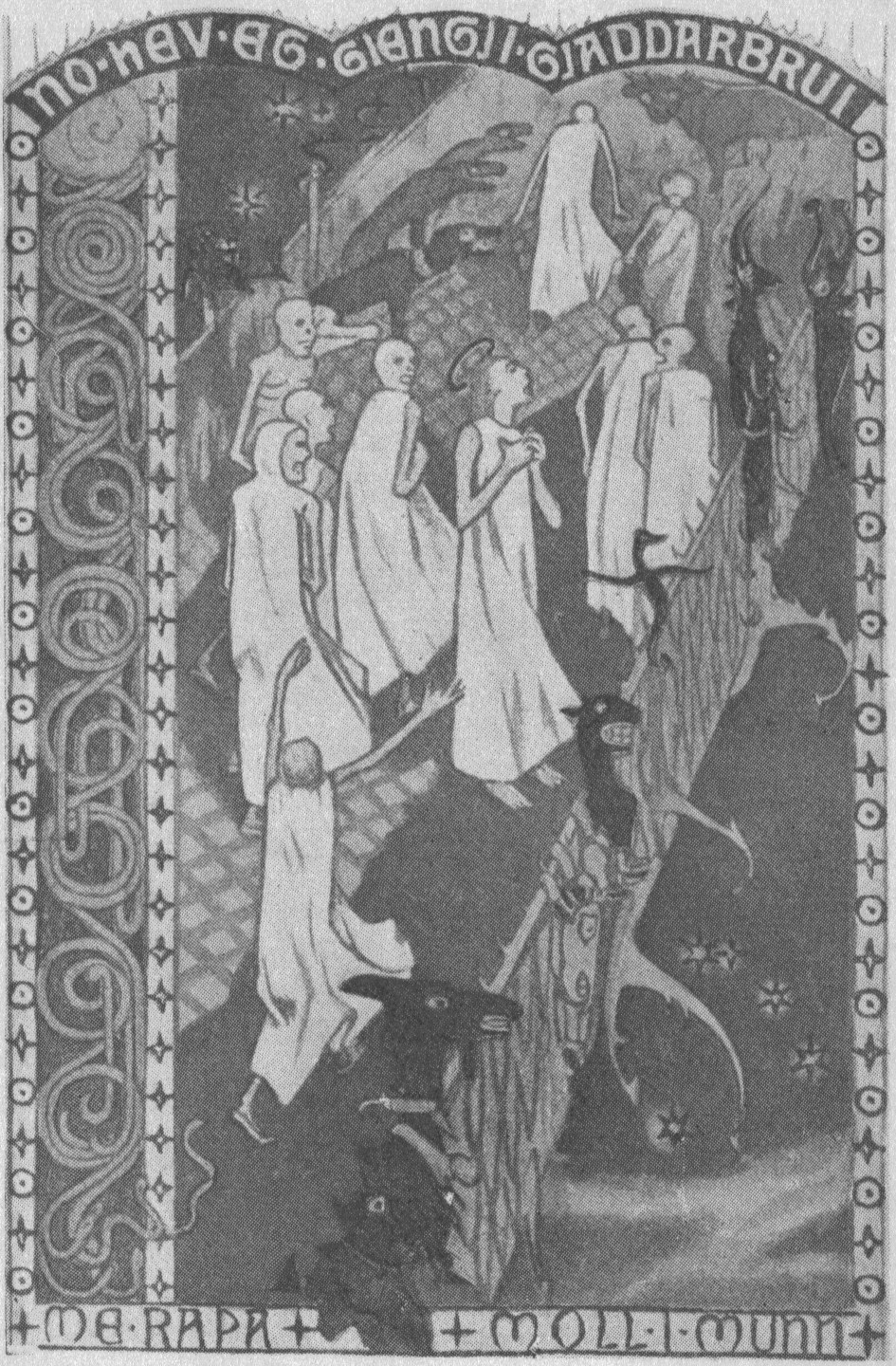
A tall decorative book-plate in the medieval-manuscript manner, worked in grey monochrome and framed by borders of interlaced serpents. A file of pale, shrouded dead climbs a narrow ledge toward a bridge at upper right, led by a haloed figure; dark horned beasts crouch in the shadowed lower reaches. A runic banner across the top reads 'NO HEV EG GJENGJI GJADDARBRUI' ('Now I have crossed the Gjallar-bridge').
Norse

Helheim, the Realm of the Dead Below

Downward and northward, under a root of the world-ash, lies the cold country that takes everyone who dies quietly: nine lightless valleys, a river that clangs, a gold-roofed bridge and a gate so high a god must leap it.
6 minSnorri Sturluson
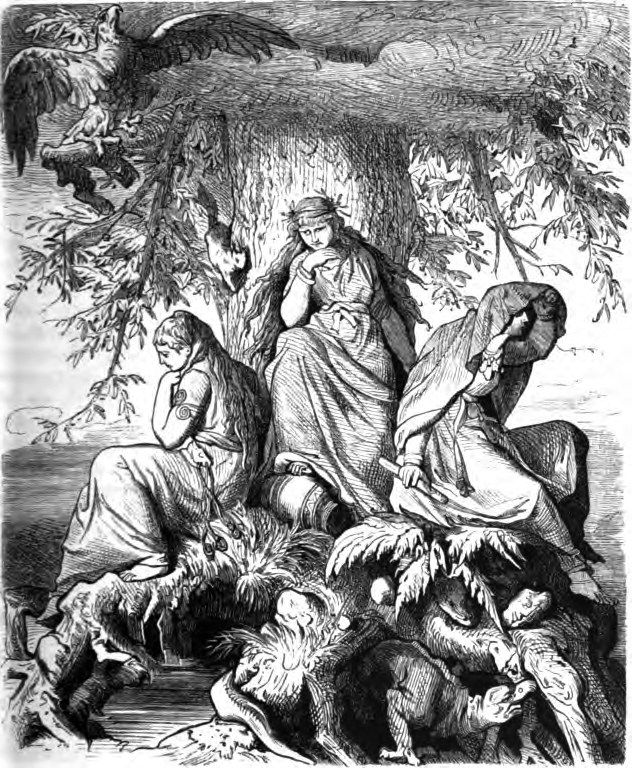
Wood-engraving of the three Norns beneath the world-ash Yggdrasil — three seated maidens in long robes under the great tree, an eagle perched in its crown above and a serpent and gnawing beasts coiling among the exposed roots below.
Norse

The Norns, Shapers of Fate

Three maidens mighty in wisdom come up from a dwelling beneath the world-ash, cut marks into wood, and lay down the lives of the sons of men.
5 minPoetic Edda
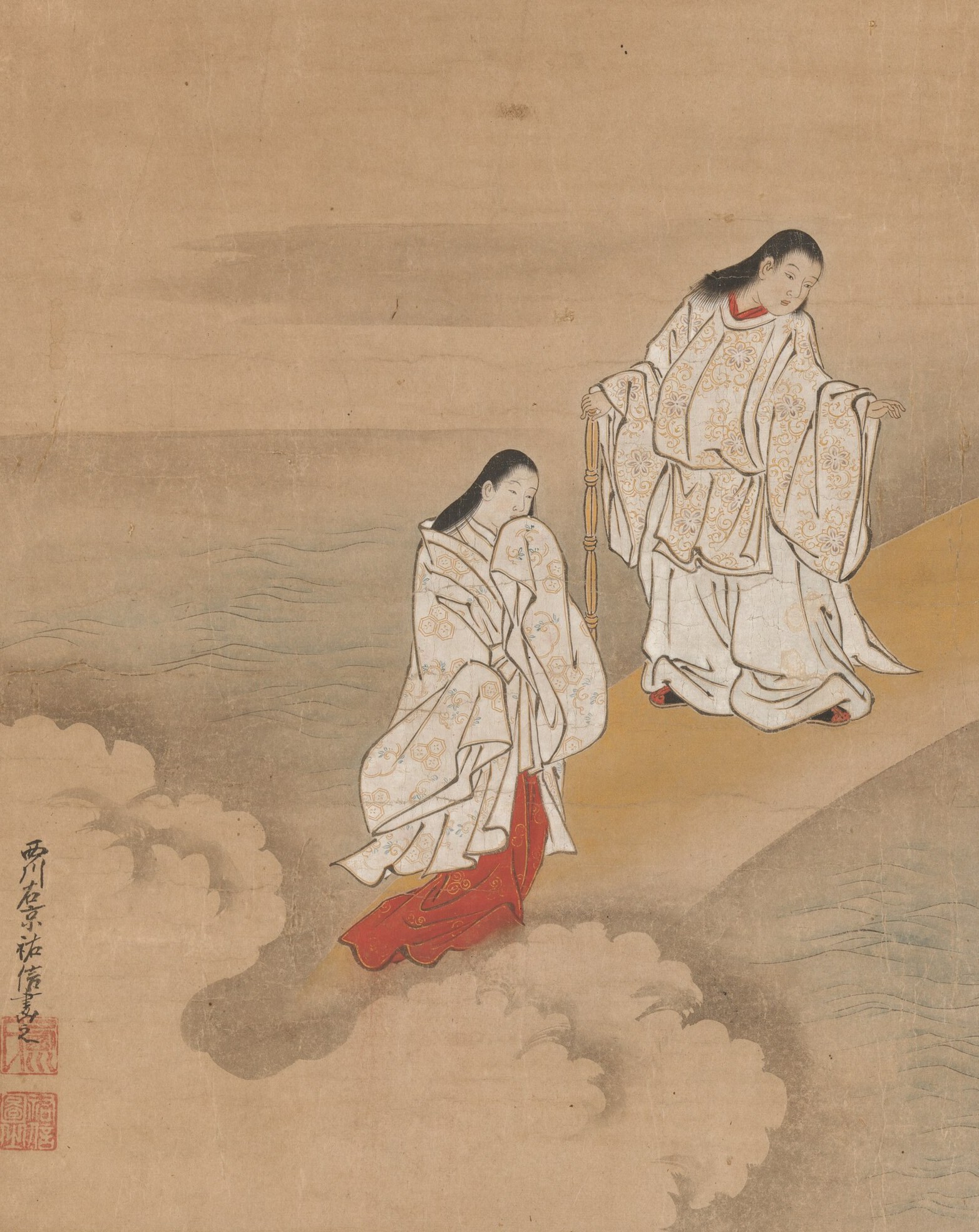
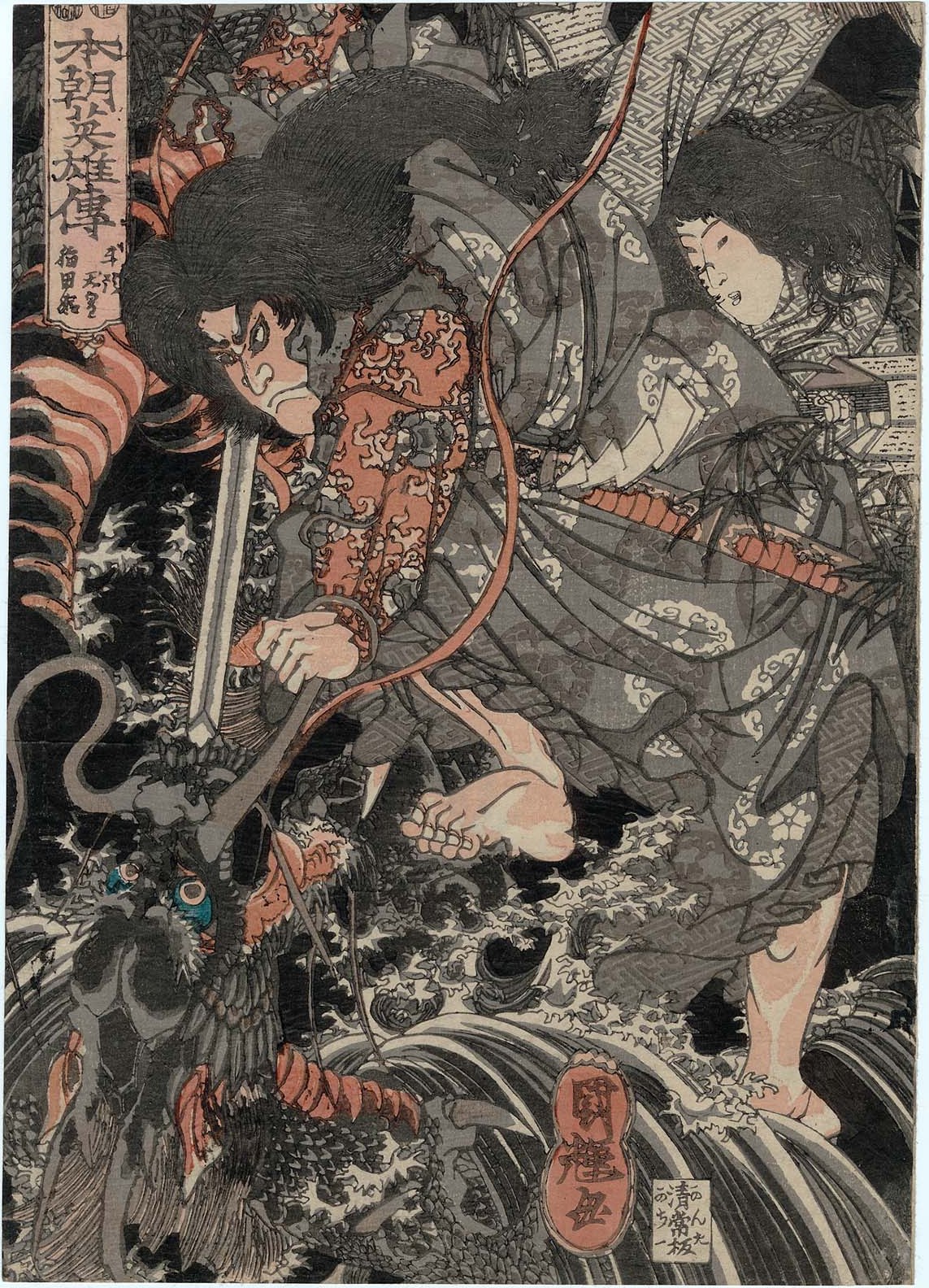
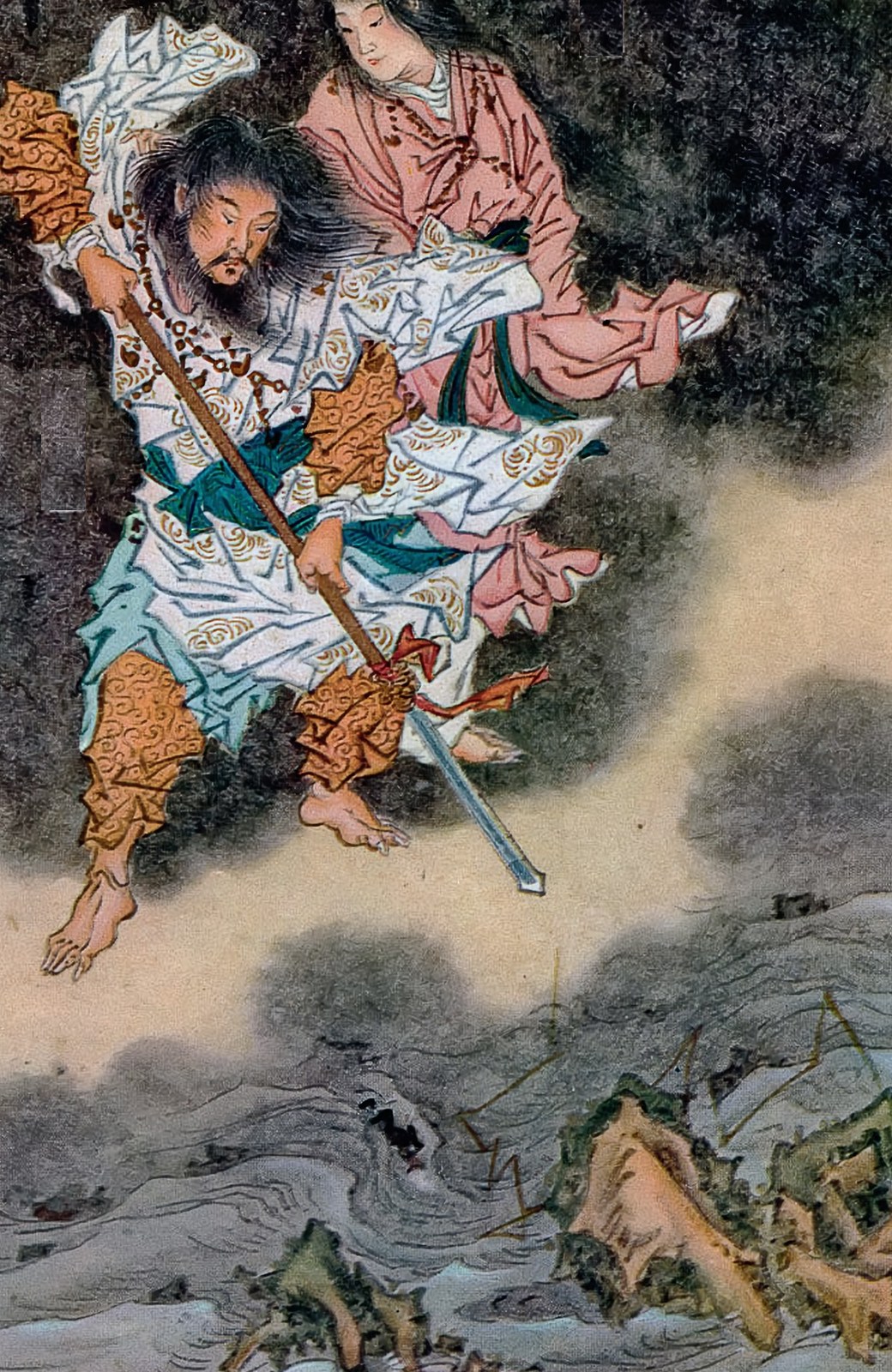
Japanese painting of the two creator deities afloat on cloud above a swirling sea. Izanagi, wild-haired and bearded in a white robe patterned with gold clouds, leans forward and grips the long heavenly jewel-spear in both hands, thrusting its blade down into the brine; Izanami, in a pink robe with long black hair and lowered eyes, stands close behind him. Below, rocky islets rise congealing out of the churning water.
Japanese

The Birth of the Islands

Two gods stand on a bridge above a formless sea, lower a jewelled spear into the brine and stir until it curdles: how the first island rose from the drippings, and how a botched courtship had to be done over before Japan could be born.
6 minKojiki
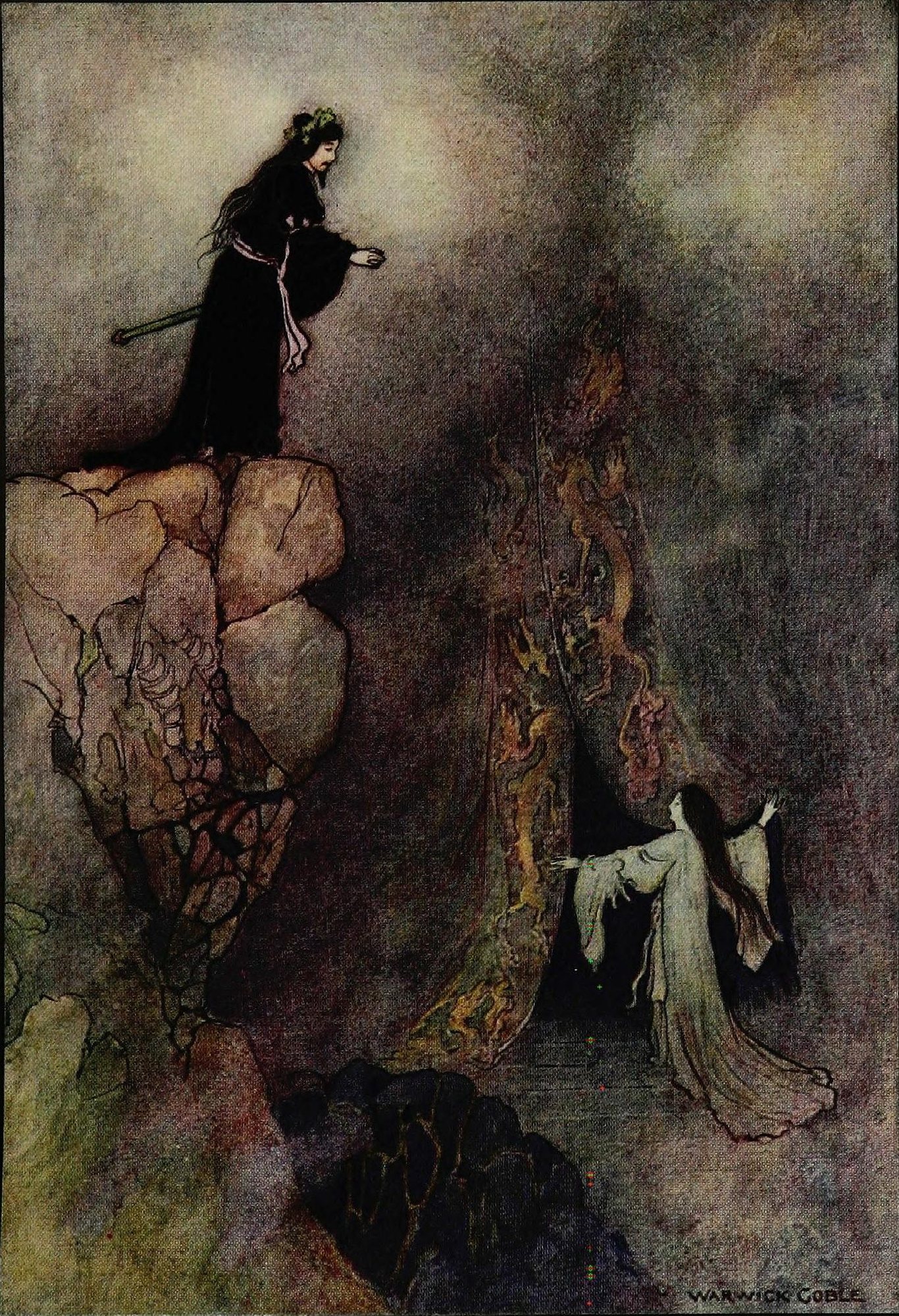
A dark, misty underworld chasm. At the top of a rocky crag on the left, Izanagi stands in a long black robe with a sword at his hip, looking down; at the lower right a pale, white-robed woman with long streaming hair, Izanami, rises from the fiery dark of Yomi with her arms flung up toward him, spectral shapes and flame climbing the rocks between them.
Japanese

Izanagi's Descent to Yomi

He followed his dead wife into the land of the dead to bring her home, lit a single forbidden light to look at her, and fled a rotting queen: the myth that gave Japan its death, its cleansing rite, and its three brightest gods.
6 minKojiki
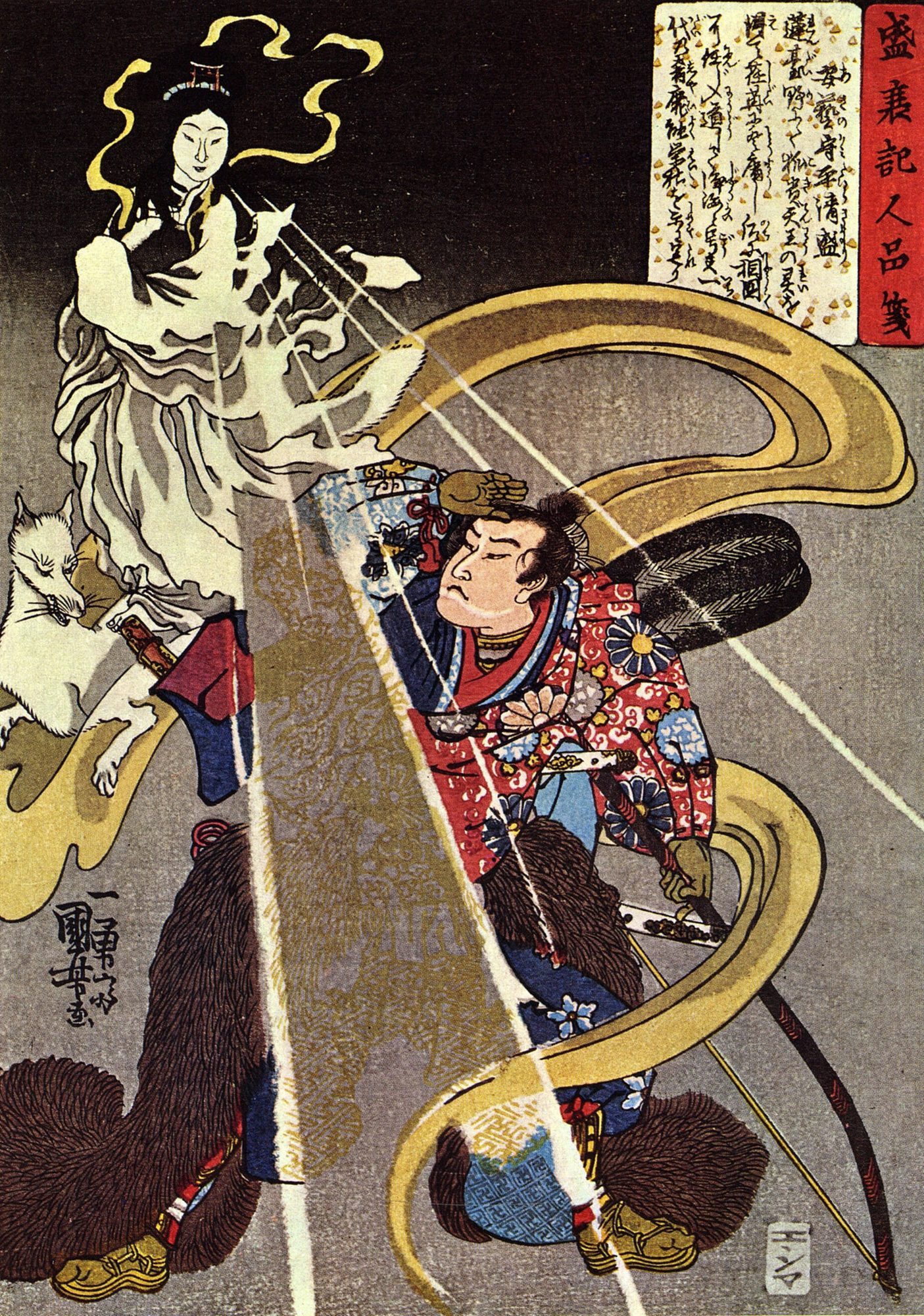
A Japanese woodblock print: a radiant white-robed fox-deity of Inari rises as a supernatural apparition, her streaming black hair haloed in golden fox-fire and a small red torii gate set at her brow, a white fox pressed to her side; before her a richly robed warrior recoils, his black-lacquer bow fallen from his hand and ribbons of gold light coiling through the dark.
Japanese

Inari, God of Rice

A rich man shot arrows at a rice-cake for sport, and the wasted rice rose up as a white bird and flew to a mountain where rice began to grow: the founding legend of Japan's most-worshipped kami, whose name means the rice becomes.
6 minNihon Shoki
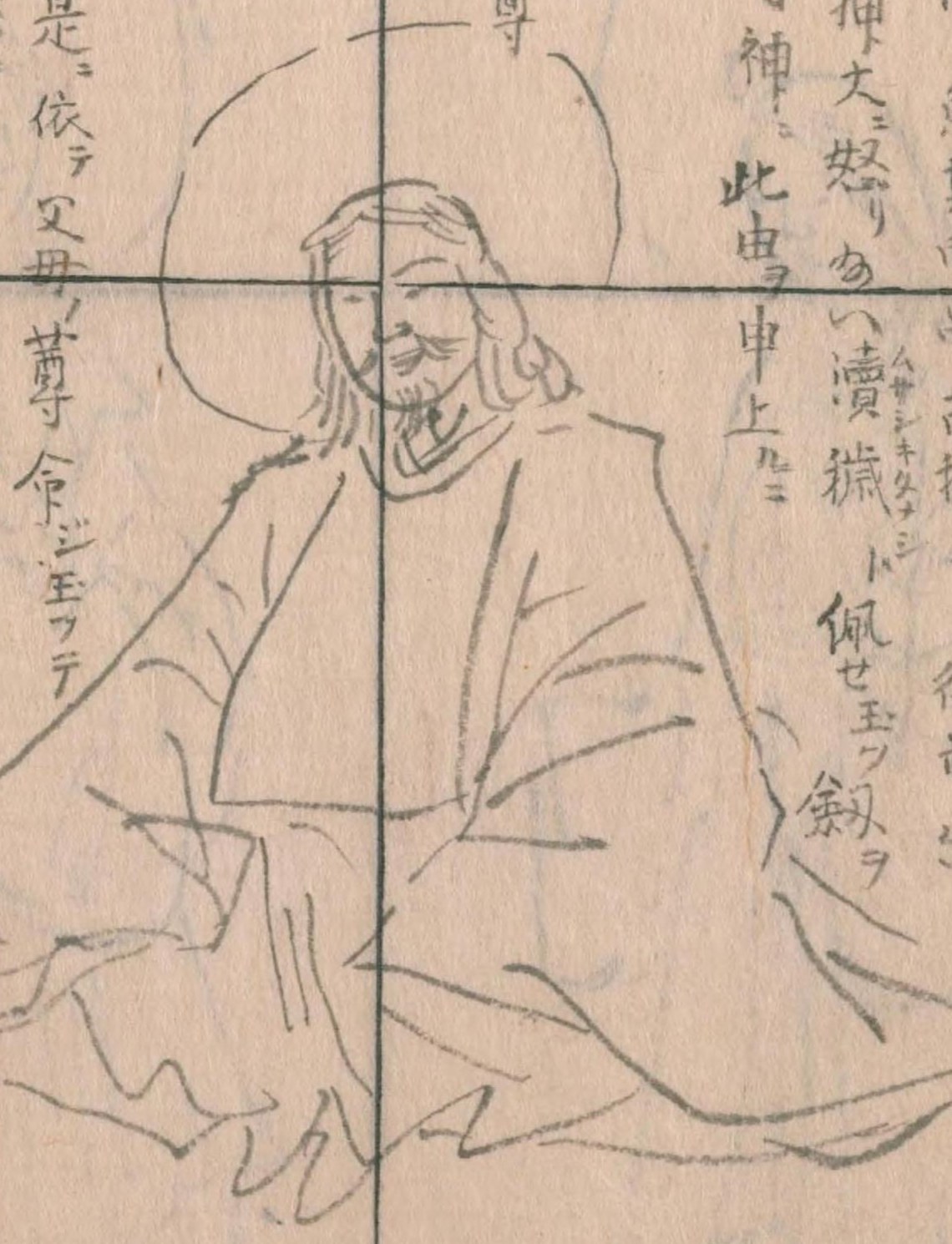
Edo-period Japanese woodblock book-illustration of the moon-god Tsukuyomi, a bearded deity in flowing court robes seated frontally with a full moon-disc halo behind his head, one hand raised to his brow, surrounded by columns of classical Japanese text.
Japanese

Tsukuyomi, the Moon God

Born from the right eye of a god washing himself clean of the dead, the moon drew his sword on a goddess who fed him from her mouth, and for that the sun turned her face away: the quiet god whose one act set the sun and moon apart.
5 minNihon Shoki
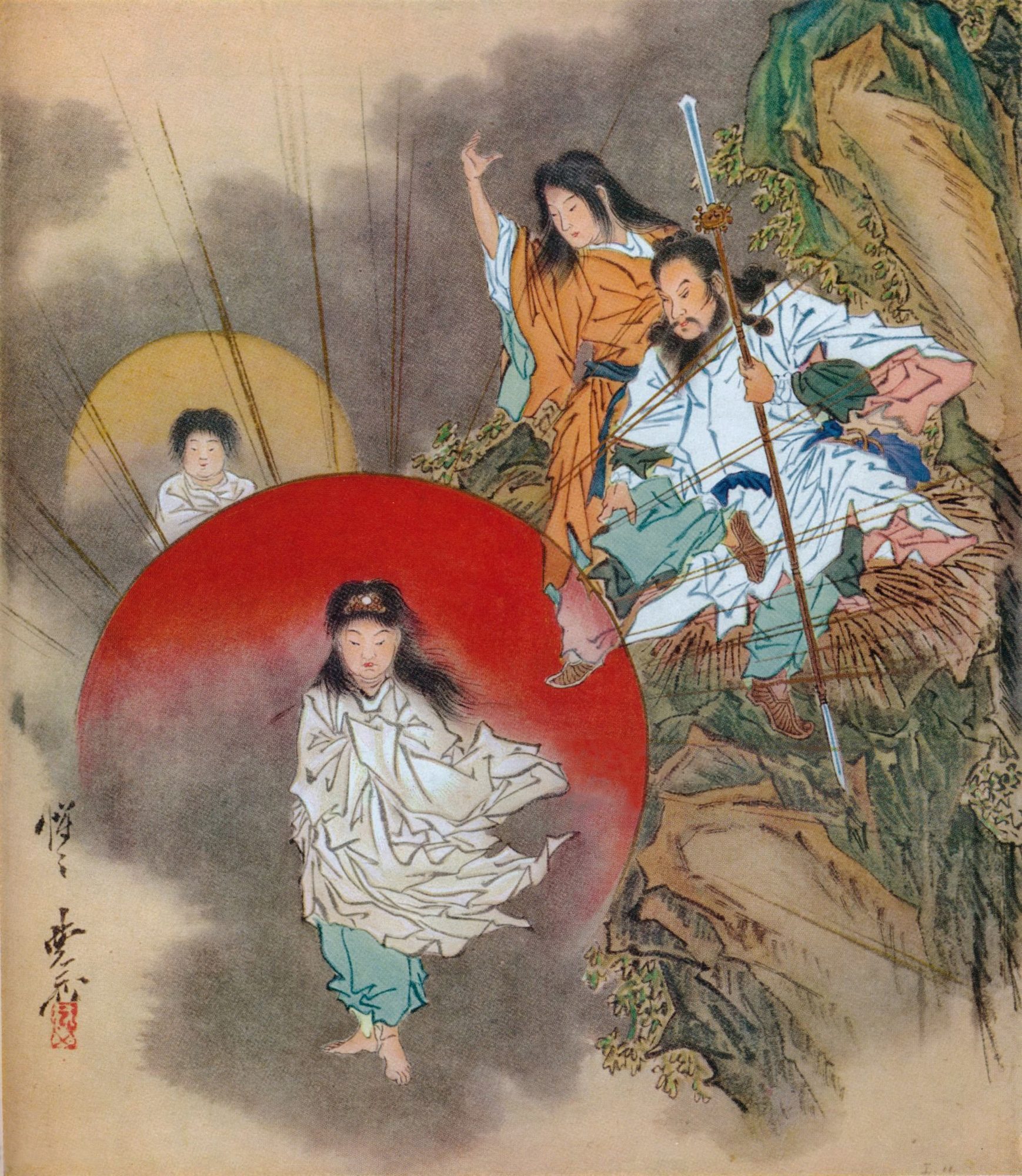
Richly coloured Japanese painting of the division of the cosmos among the first gods: the newborn sun-goddess Amaterasu rises white-robed inside a great red solar disc at the centre, a moon-child stands within a pale disc at the left, and on the heavenly cliff at the upper right the bearded creator-god Izanagi in white robes holds the heavenly jewel-spear beside the orange-robed goddess Izanami, whose arm is raised; grey cloud and streaming light fill the background.
Japanese

Takamagahara, the High Plain of Heaven

Not a mountain and not a sky-city but a plain: the celestial country of rice-fields and river-councils where the sun-goddess reigns, the cosmos opens, and the line of emperors takes its first breath.
7 minKojiki
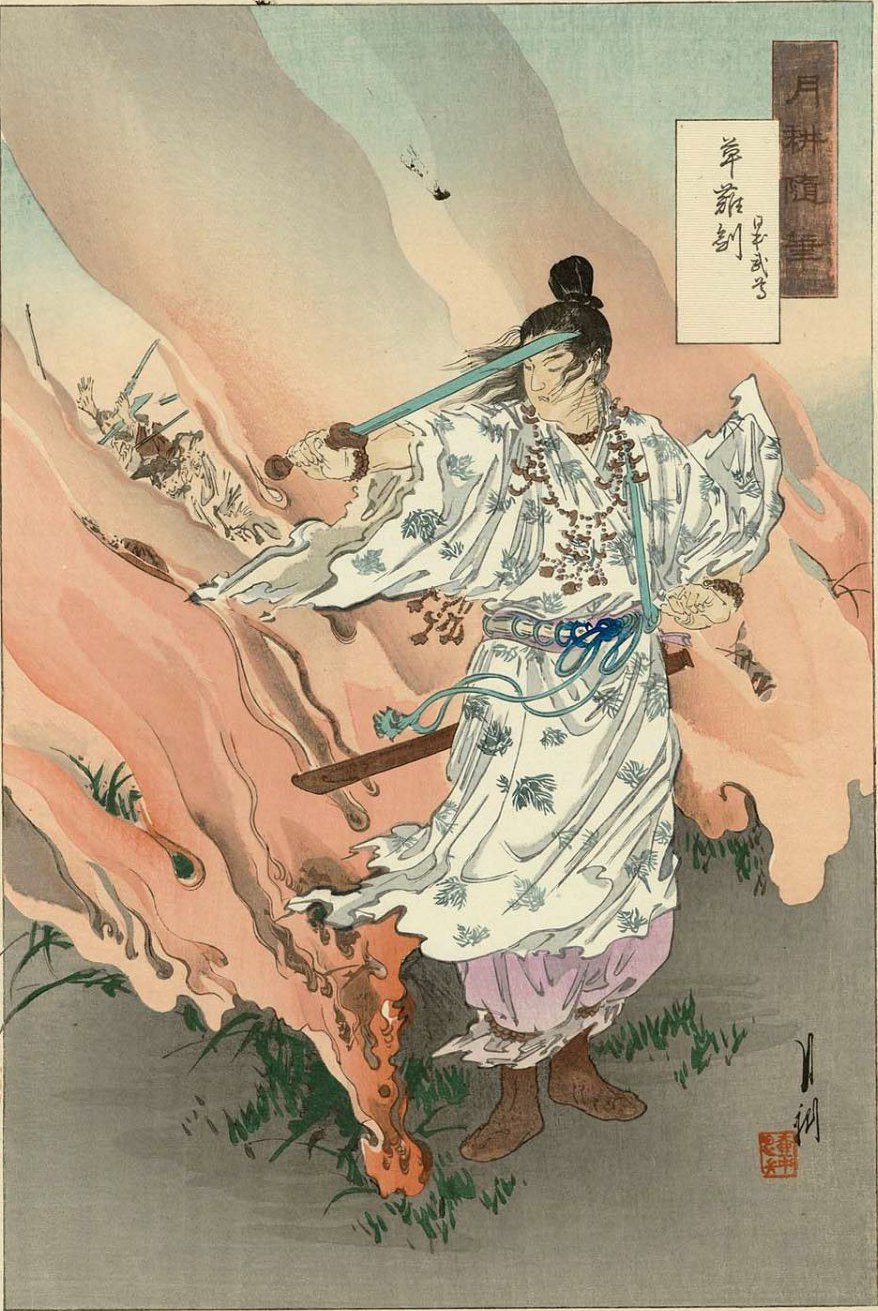
Japanese colour woodblock print of the hero Yamato-Takeru standing amid burning grass, a young man in a white robe patterned with pine-sprigs and hung with strings of curved jewels, drawing the blue-green Herb-Quelling sword Kusanagi across his body to cut back the flames sweeping up around him from the moor.
Japanese

The Three Sacred Treasures

A mirror forged to trap the sun, a sword drawn from a monster's tail, and a string of curved jewels: how three objects became the proof that Japan's emperors were born to rule.
7 minKojiki
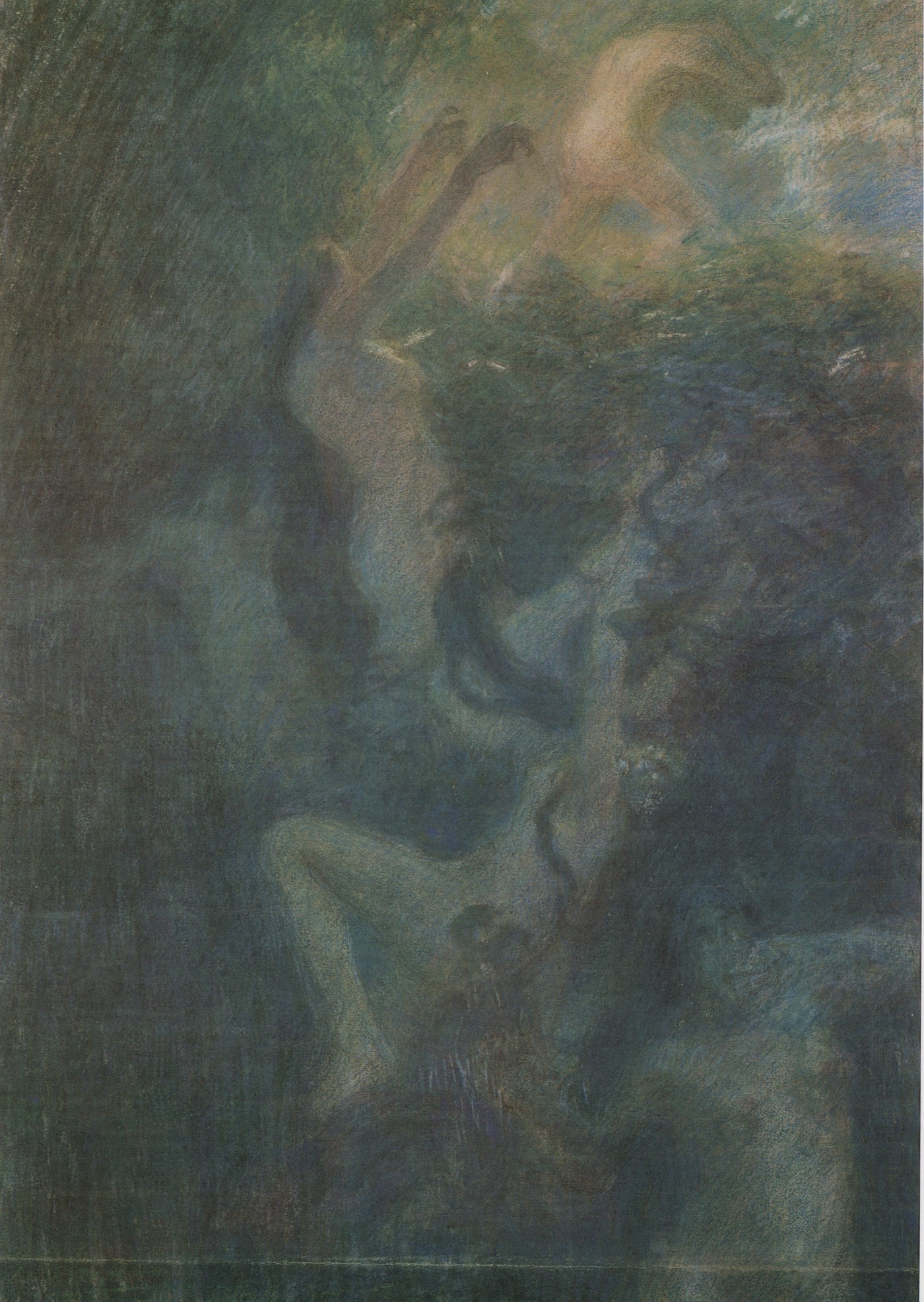
A dim blue-green watercolour of the Even Pass of Yomi. Pale, ghostly nude figures climb and struggle up out of the murky underworld dark: a lit figure escapes toward the upper right while others reach and clamber below, half-dissolved into the gloom of the pass between the living and the dead.
Japanese

Yomi, the Land of the Dead

A shadowy country of rot and gloom where a single mouthful of the dead's cooking binds you forever: the underworld of the Kojiki and Nihon Shoki, and the day it was sealed off from the living.
7 minKojiki
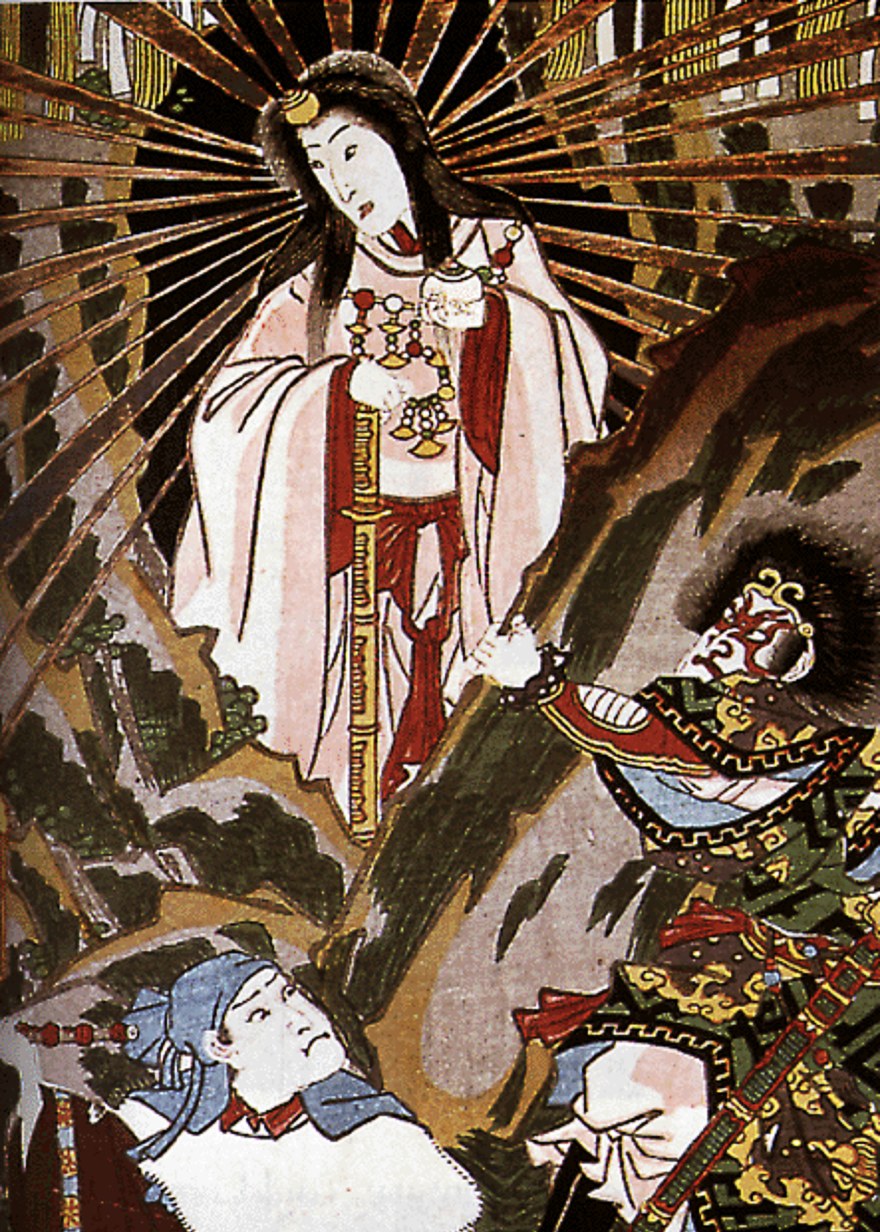
Japanese woodblock print of the sun-goddess Amaterasu, white-robed with loose black hair and gold rays streaming from her head, emerging from the mouth of the Heavenly Rock-cave; the fierce-faced strong-god Ta-jikara-wo grasps her hand to draw her out while another deity kneels gazing up at the returning light.
Japanese

Amaterasu, the Sun Goddess

The radiance that shone through all six quarters at birth, the goddess who armed herself like a warrior against her own brother and then shut the door on the world: ancestress of the emperors and light of the High Plain of Heaven.
6 minNihon Shoki
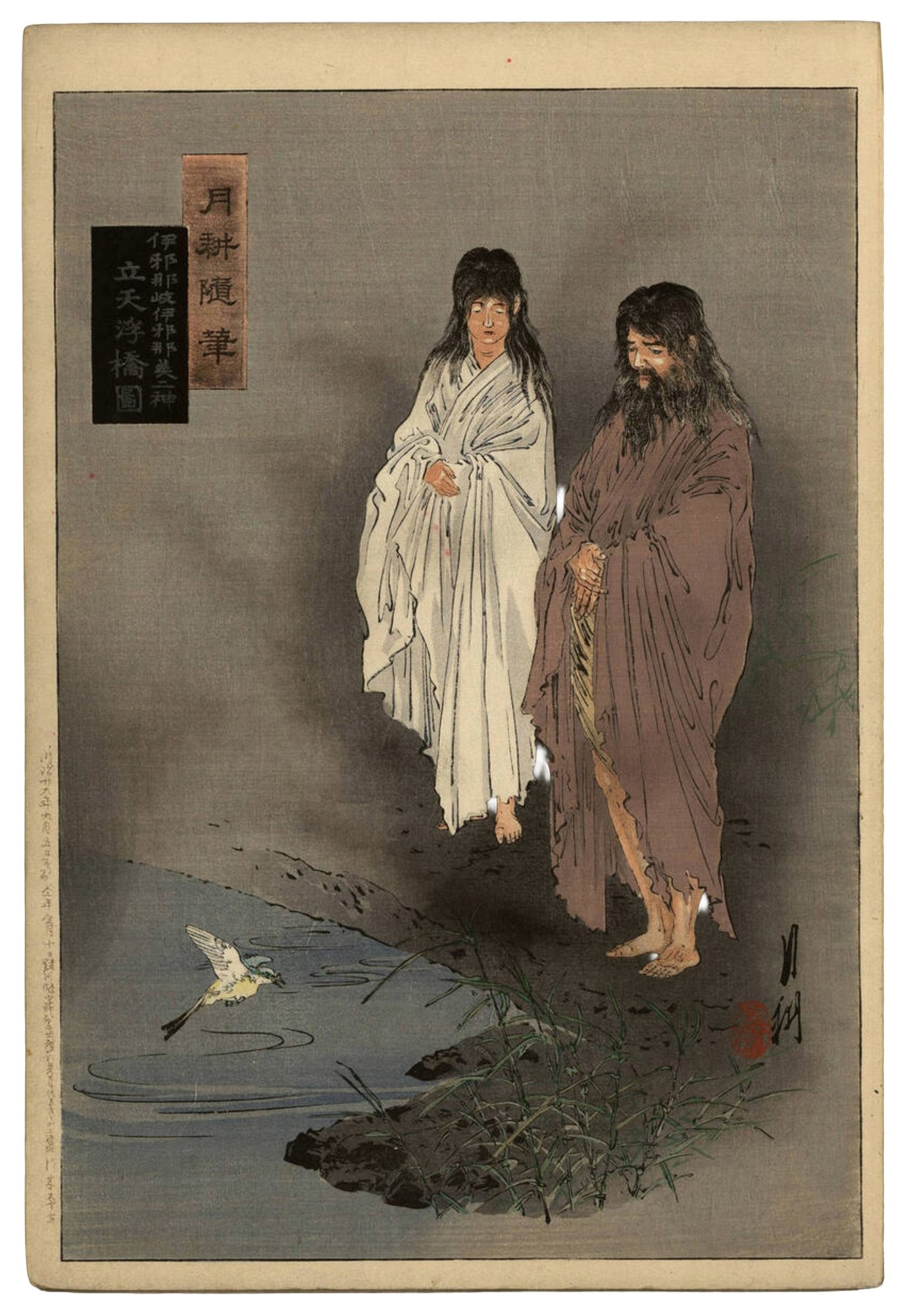
Japanese woodblock print of the two creator deities on the Floating Bridge of Heaven. Izanami in a loose white robe with long black hair and lowered eyes stands beside the wild-haired, bearded Izanagi in a brown robe, who holds the heavenly jewel-spear upright in his clasped hands; a kingfisher skims the water at the reed-fringed brink below them.
Japanese

Izanagi, the Male Who Invites

He stirred the sea to a curd and raised the first island from a spear-tip, then lost his wife to the underworld and came back to wash the pollution off: from the water of his cleansing were born the sun, the moon and the storm.
5 minKojiki
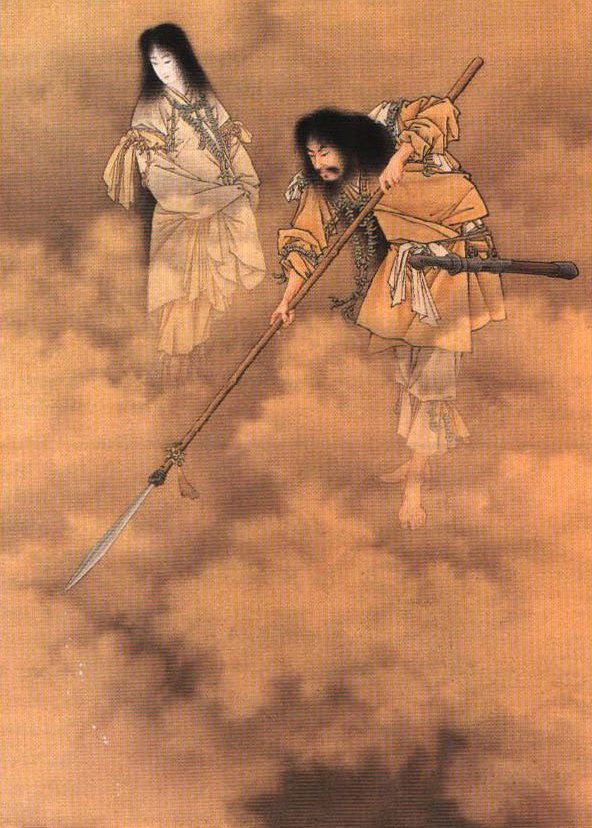
Japanese hanging-scroll painting of the two creator deities standing on cloud above a lone sea-wave. Izanami, at left in a pale robe with long black hair and lowered eyes, stands beside the wild-haired, bearded Izanagi, who leans out and lowers the long jewel-spear so its blade dips toward the water below.
Japanese

Izanami, the Female Who Invites

She spoke first at the pillar and bore the world a crooked child, then bore it right: the islands of Japan and the gods of sea and wind and fire, until the last birth killed her and made her queen of the dead.
5 minKojiki
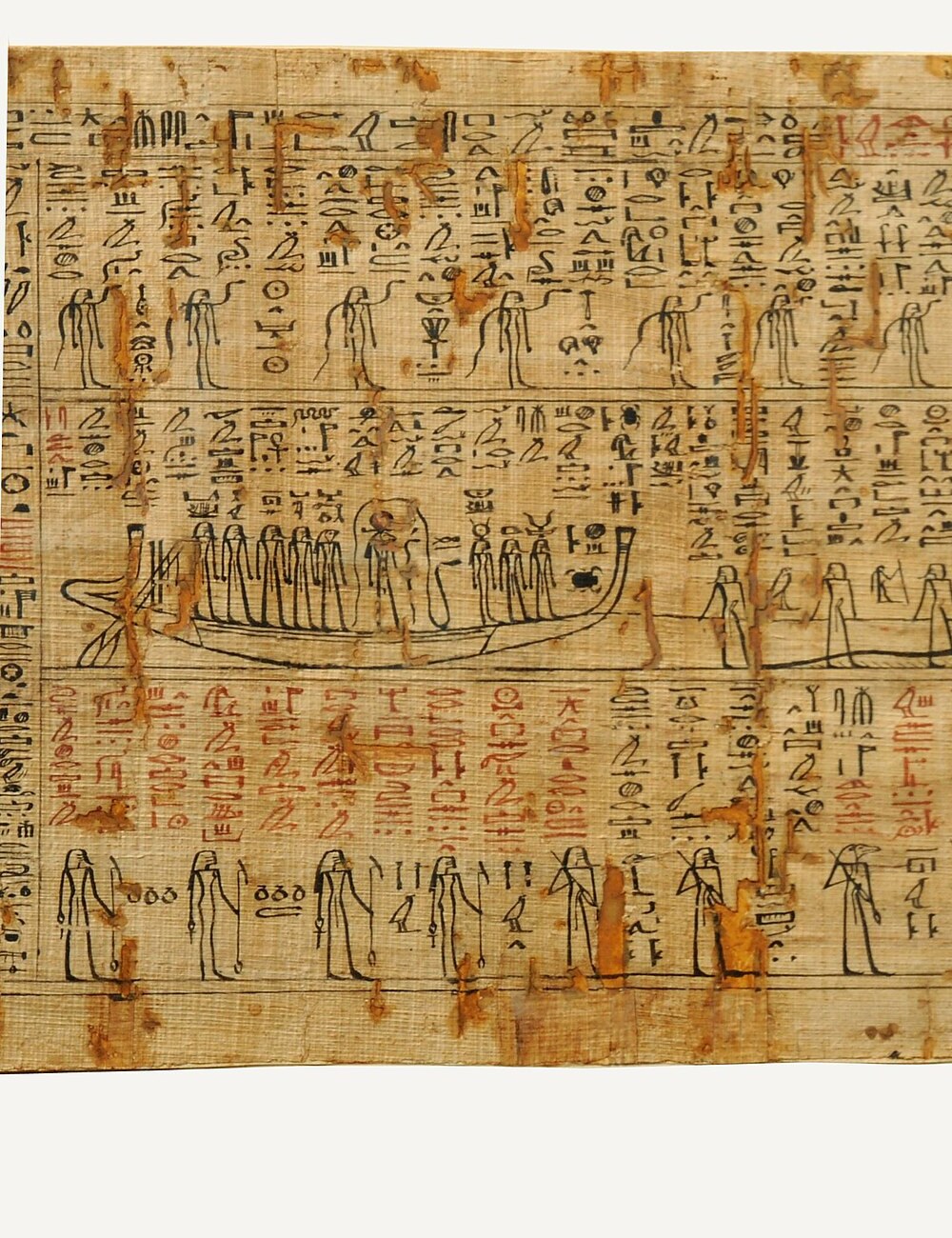
An ancient Egyptian funerary papyrus of the Book of the Amduat, its central register showing the sun-god's night-bark crewed by a file of standing gods, with columns of black-and-red hieroglyphs and rows of processional deities above and below.
Egyptian

The Duat and the Night Journey

A ram-headed sun hauled by ropes through a valley of the dead, a serpent staked with knives, a rebirth out of a monster's tail: the Egyptian underworld the sun and the dead must cross before dawn.
8 minThe Book of the Dead
A hand-coloured lithograph plate of Geb (Sèb), the earth god, enthroned and crowned, from Champollion's Panthéon égyptien.
Egyptian

Geb, the Earth Beneath

To bite the ground is to bite a god. He is the floor of the world, the judge at the head of the Nine, and the father who hands the throne of Egypt down to his son.
5 minPyramid Texts
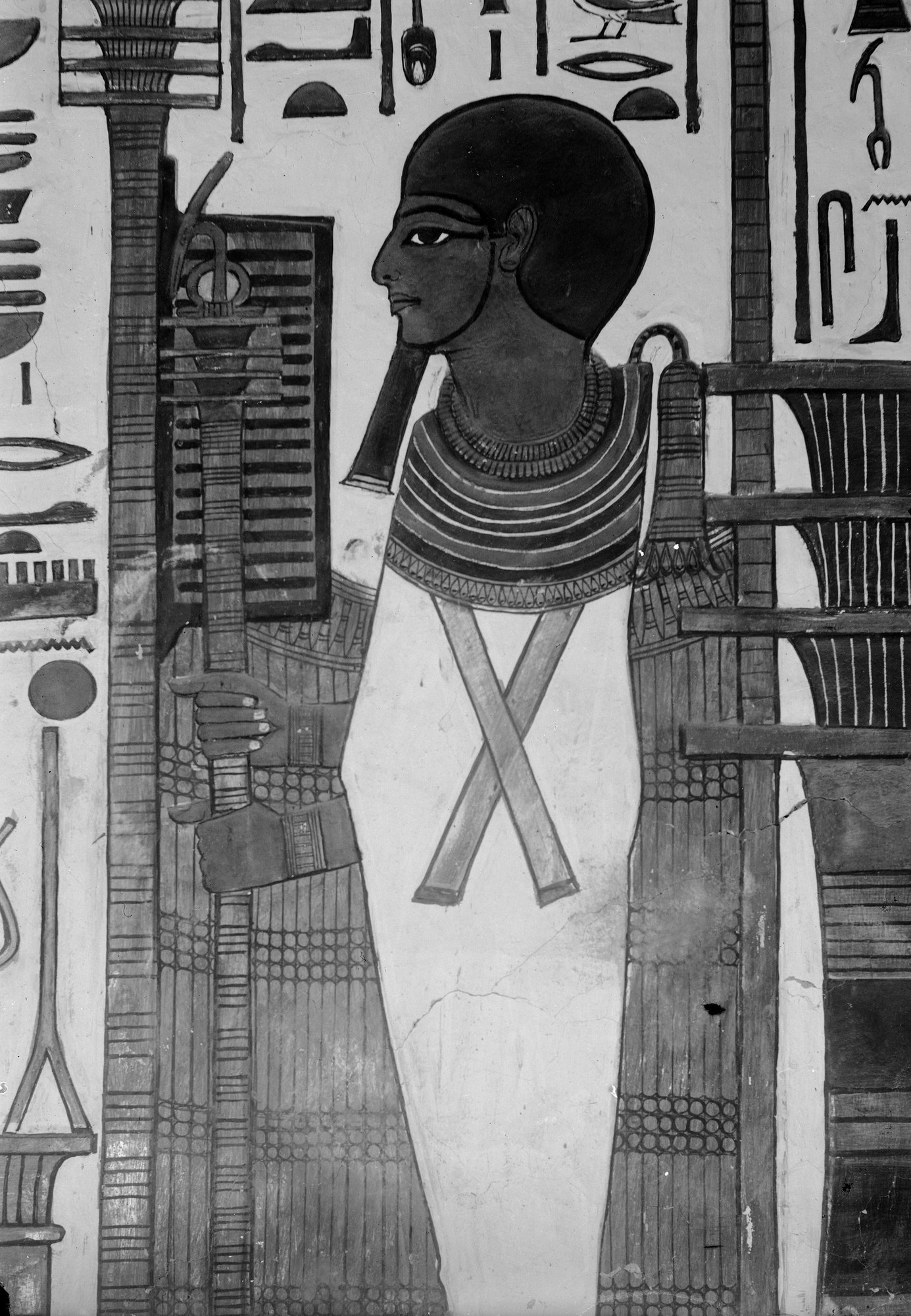
Wall-painting of the god Ptah in his shrine: a mummiform figure in a close skullcap and straight divine beard, a broad beaded usekh collar over his shoulders, his hands emerging from the wrapped body to grip a tall composite was-djed-ankh staff, standing within a kiosk framed by djed-pillars and columns of hieroglyphs. Black-and-white archival photograph of the ancient painting.
Egyptian

Ptah: The Craftsman Who Thought the World

The god of Memphis made no clay and spilled no seed. He devised the cosmos in his heart and spoke it with his tongue, then built the very bodies the other gods would live inside.
6 minMemphite Theology
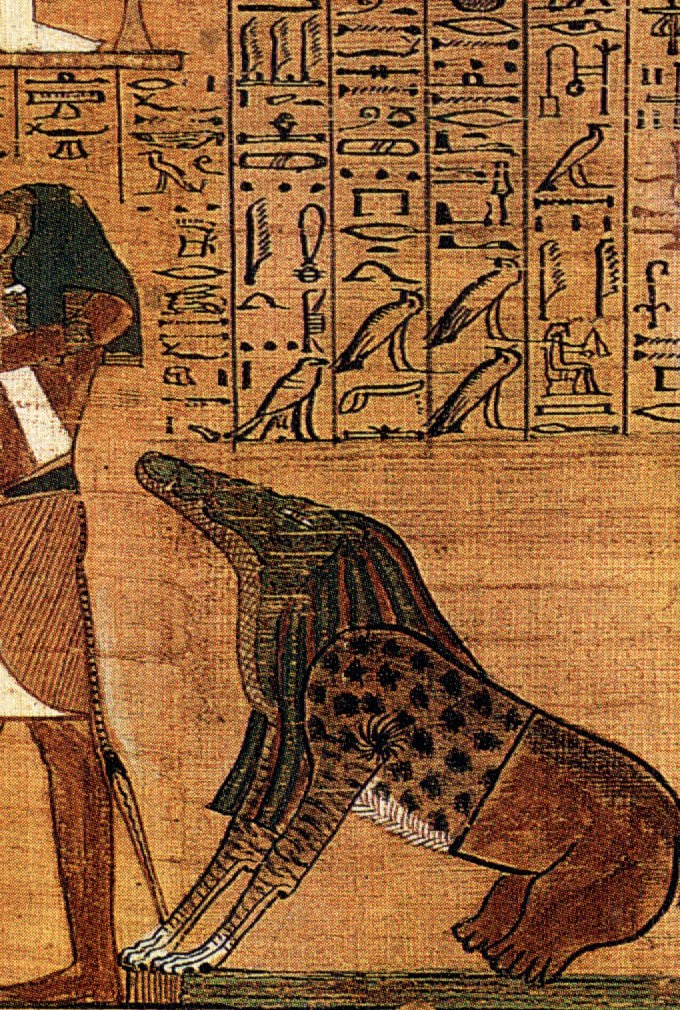
Detail from an ancient Egyptian funerary papyrus: the devourer Ammit crouched on the ground beside the judgment scene — a composite beast with the open-jawed head and scaly neck of a crocodile, the spotted-leopard mane and forequarters of a lion, and the heavy hindquarters of a hippopotamus, her four feet resting on the green ground-line; the ibis-headed scribe-god Thoth stands at left with his palette, and columns of hieroglyphs run along the top.
Egyptian

Ammit, Devourer of the Dead

She never lifts a claw and never speaks a line: the beast who crouches by the scales in the Hall of the Two Truths does one thing only, and it is the worst thing the Egyptian afterlife could imagine.
5 minThe Egyptian Book of the Dead
A hand-coloured lithograph plate of Amun-Ra, l'esprit des quatre éléments: the god in composite form with plumed crown, from Champollion's Panthéon égyptien.
Egyptian

Amun, the Hidden One

Felt like wind through feathers and never seen, the self-made creator of Thebes whose very name means concealment: how a local city-god rose to become Amun-Re, king of all the gods.
6 minHymns to Amun
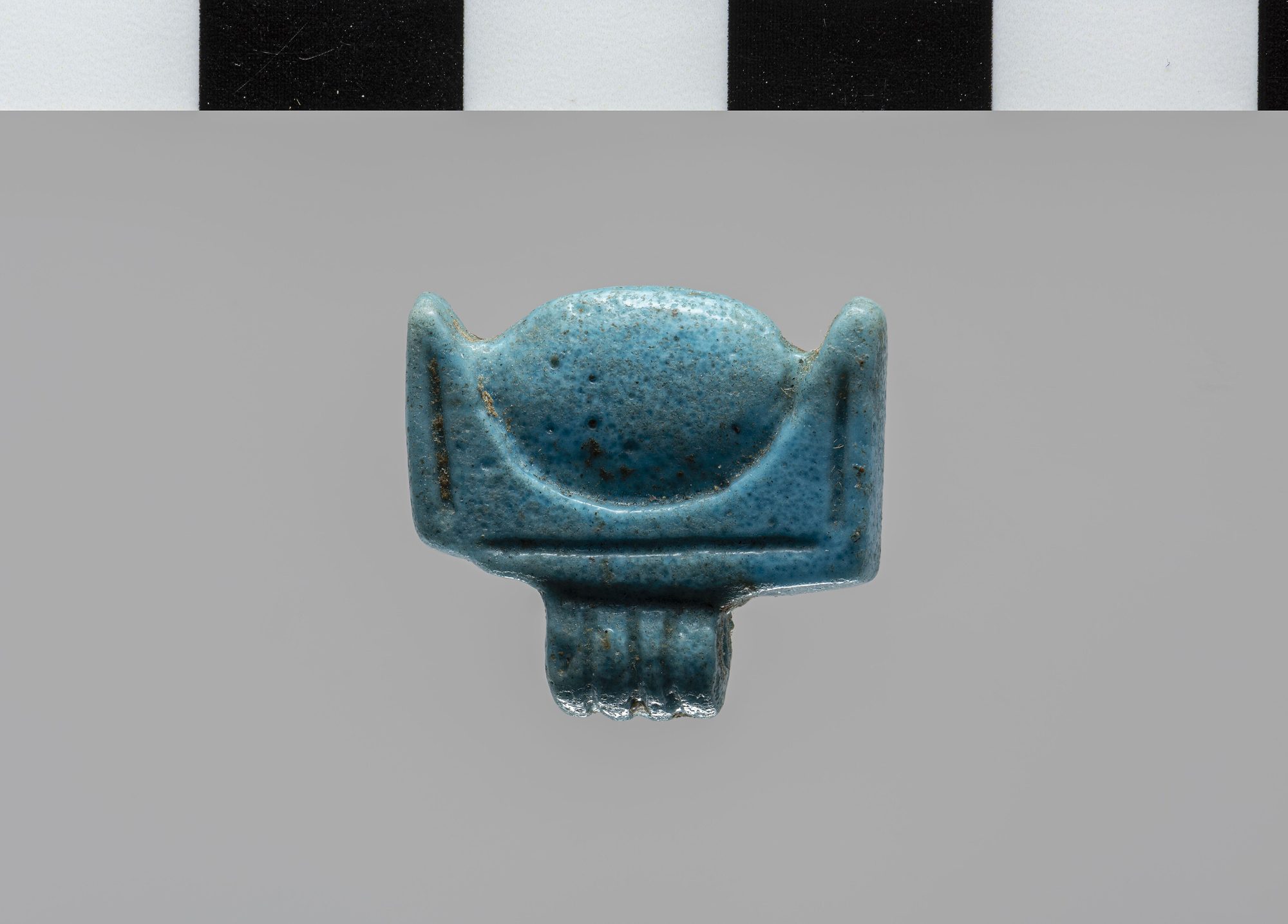
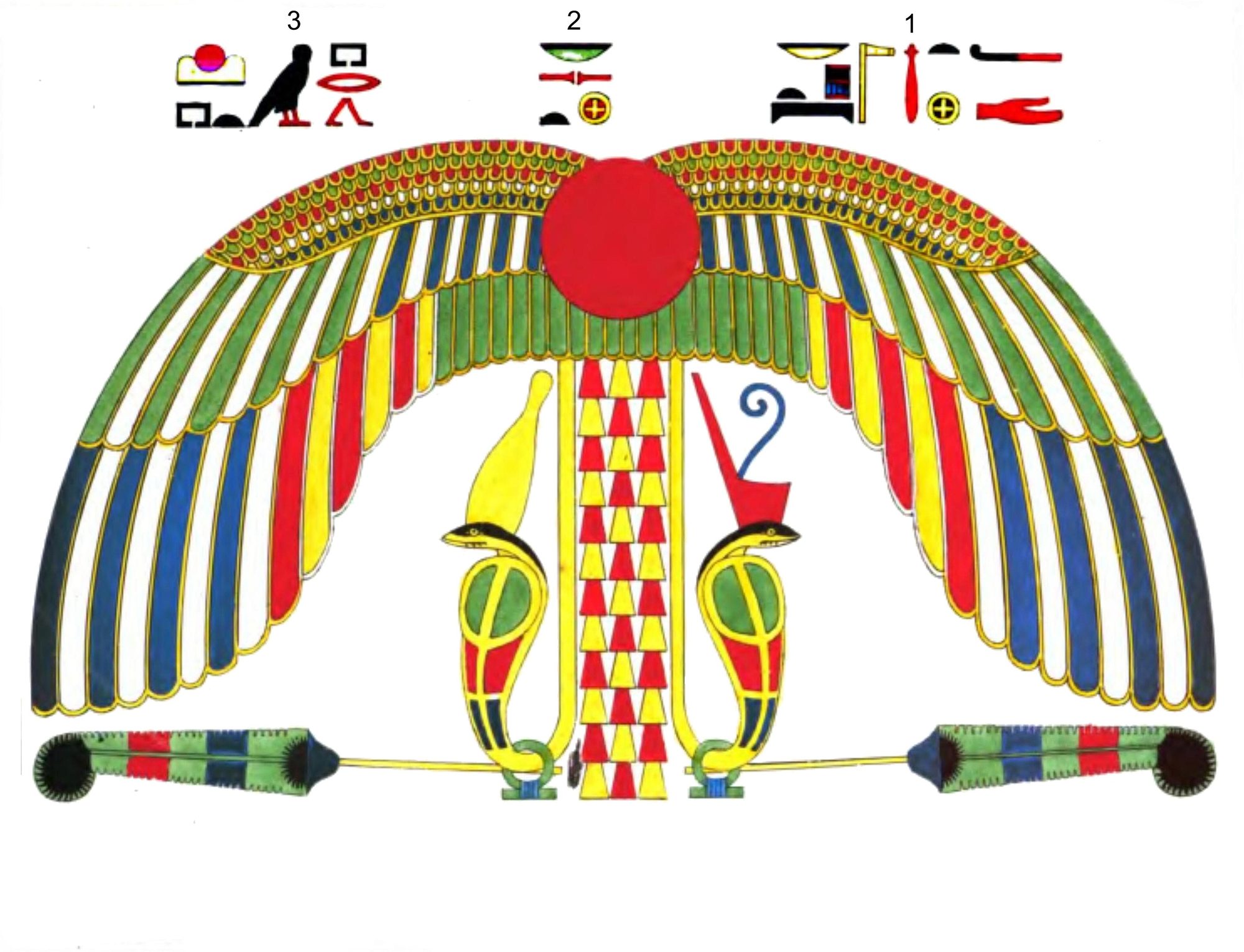
An ancient Egyptian faience amulet in the shape of the akhet — the sun disk cradled between the two hills of the horizon.
Egyptian

The Akhet: The Cosmic Horizon

A sun-disk cradled in the notch between two hills: the Egyptian sign for the horizon was also a place, the gated seam where sky, earth and the underworld meet and the sun goes in and out of the world.
7 minPyramid Texts
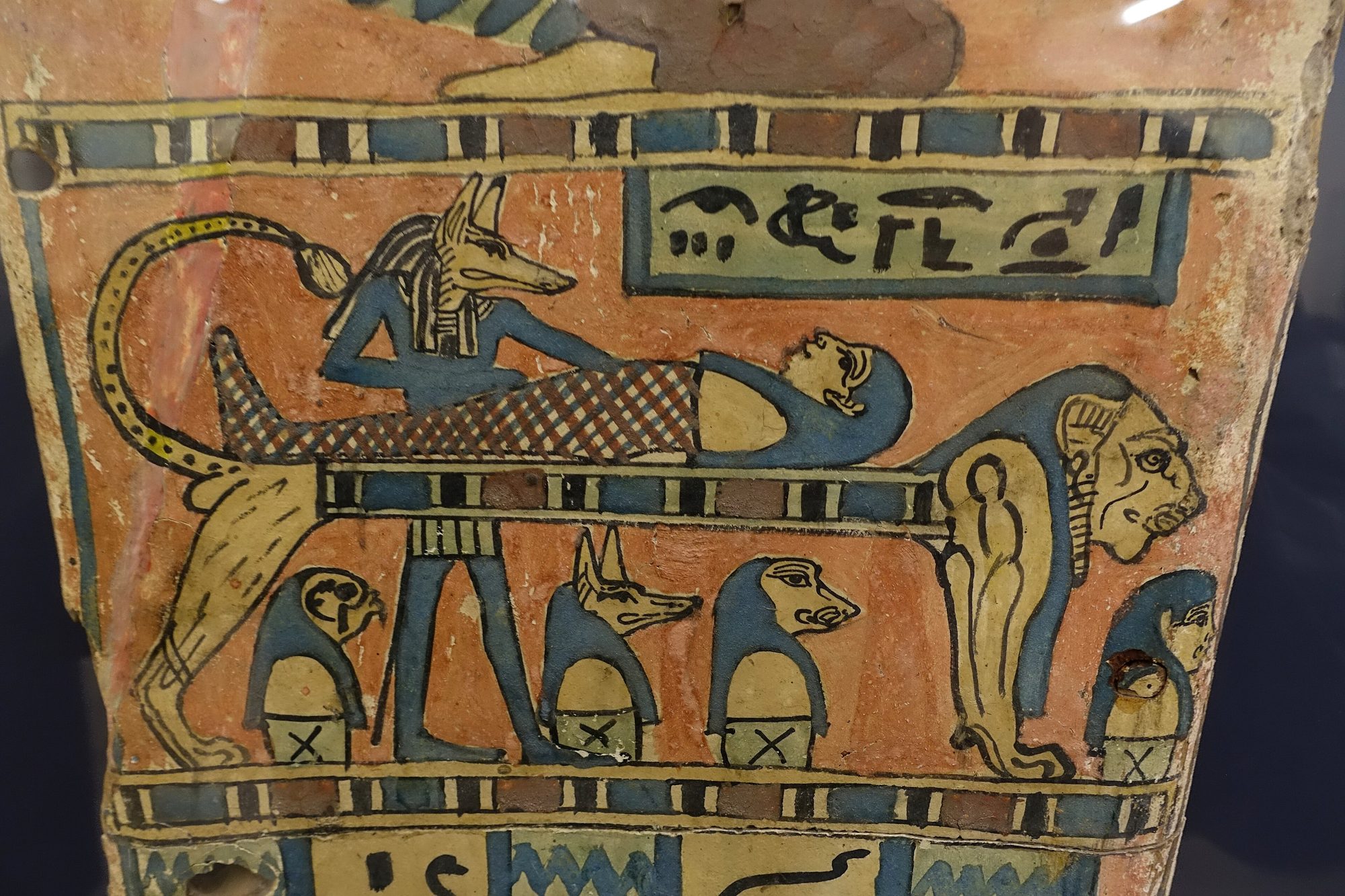
An ancient Egyptian painted coffin fragment: the sky-goddess Nut spreads her feathered wings above the mummy tended by jackal-headed Anubis, hieroglyphs around them.
Egyptian

Nut: The Overarching Sky

She arches over the whole earth and holds it in her arms; the dead king is her firstborn, the stars are her thousand souls, and each night she swallows the sun to give it back at dawn.
6 minPyramid Texts
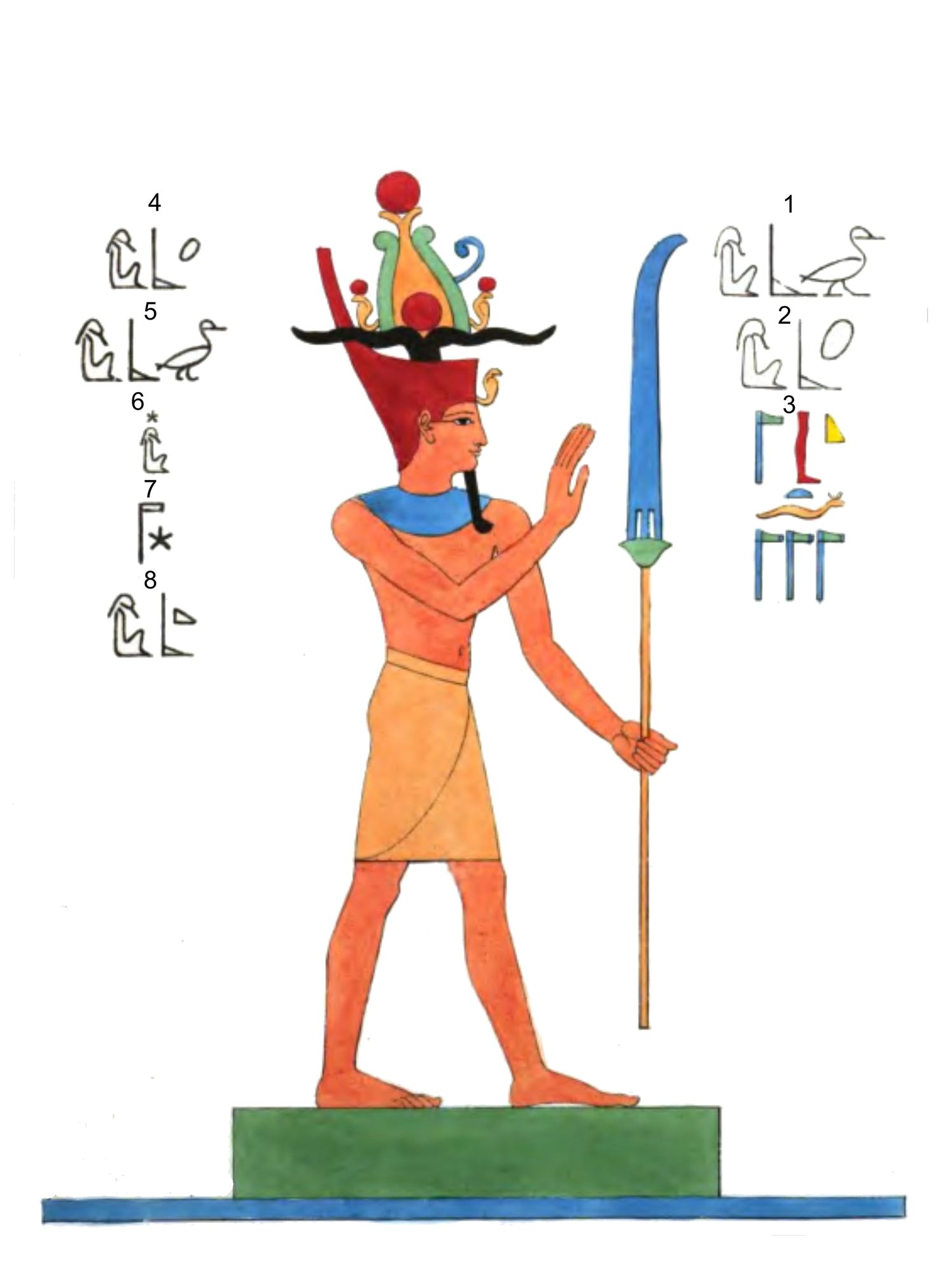
A hand-coloured lithograph plate of Atum (Atmou), the Heliopolitan creator god, crowned and striding in profile, from Champollion's Panthéon égyptien.
Egyptian

Creation at Heliopolis

Before the world there was only dark water, and one god who made himself: how Atum rose on the first dry hill, spat the twins Shu and Tefnut from his own body, and fathered the Nine gods of Heliopolis.
6 minPyramid Texts
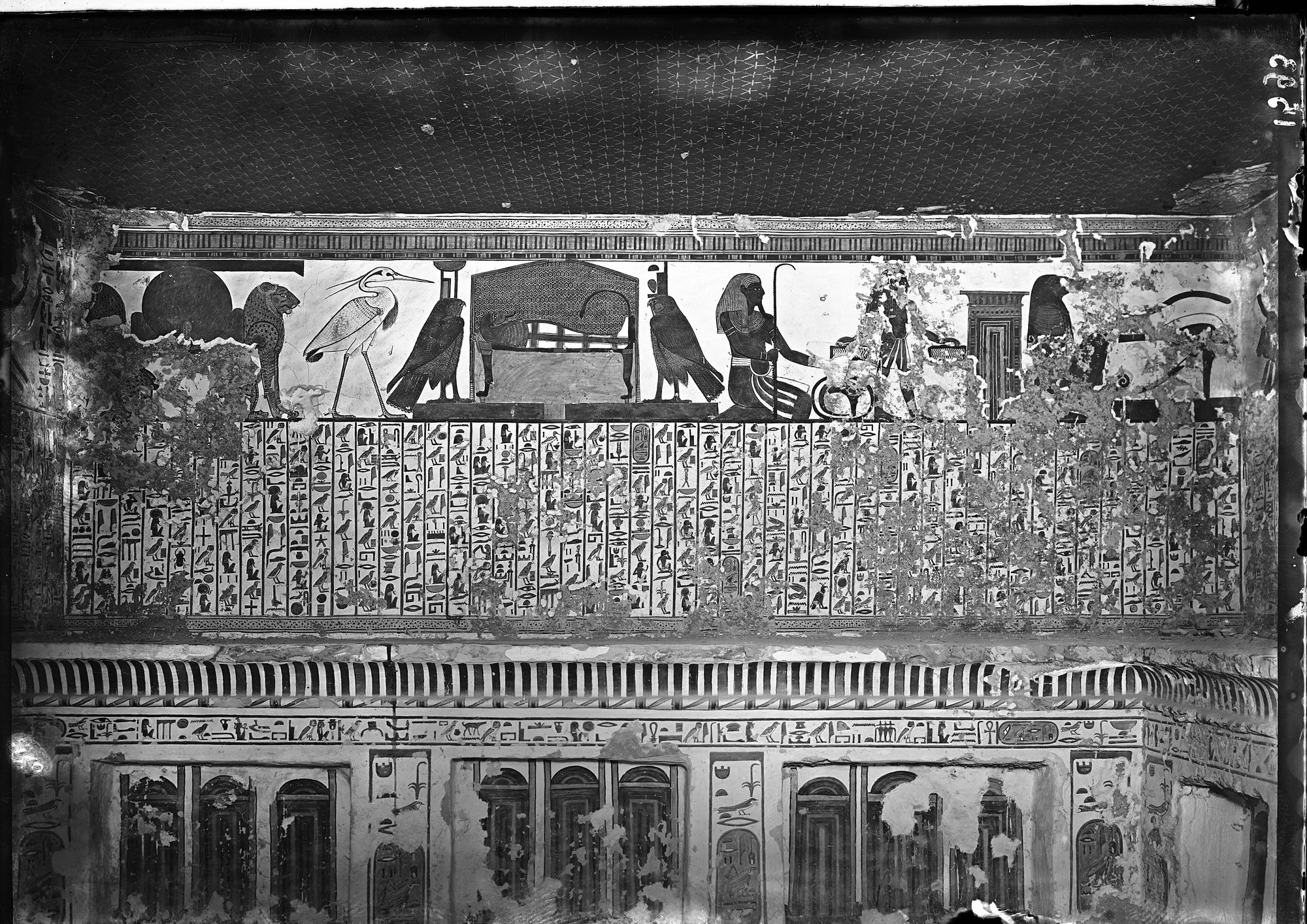
An ancient Egyptian tomb painting from the tomb of Nefertari: Atum seated between two lions with the Benu bird above, the mummy of the queen on a bed between two falcon-headed goddesses.
Egyptian

Atum: The Self-Created One

The completed sun going down, whose name means both 'finished' and 'not-be': the Heliopolitan creator drawn as a pharaoh, who lifts the dead king to the sky and will one day draw the whole world back into the flood.
6 minPyramid Texts
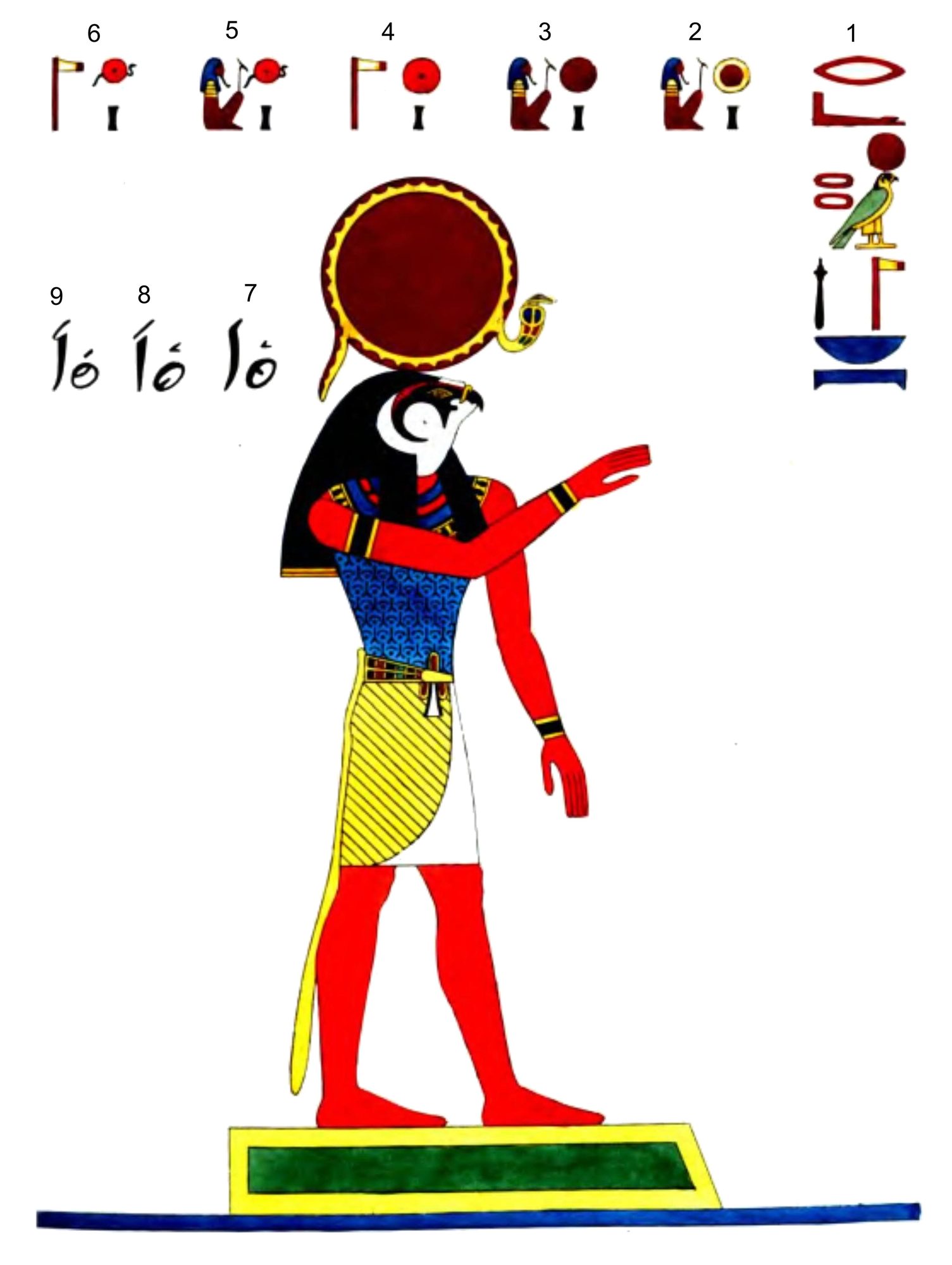
A hand-coloured lithograph plate of the sun-god Re: falcon-headed, crowned with the solar disk, striding in profile, from Champollion's Panthéon égyptien.
Egyptian

Ra, the Sun God

Beetle at dawn, blazing disk at noon, a tottering old man sinking into the west: the creator sun-god of Heliopolis who sails the sky by day and fights his way through the underworld by night.
6 minPyramid Texts
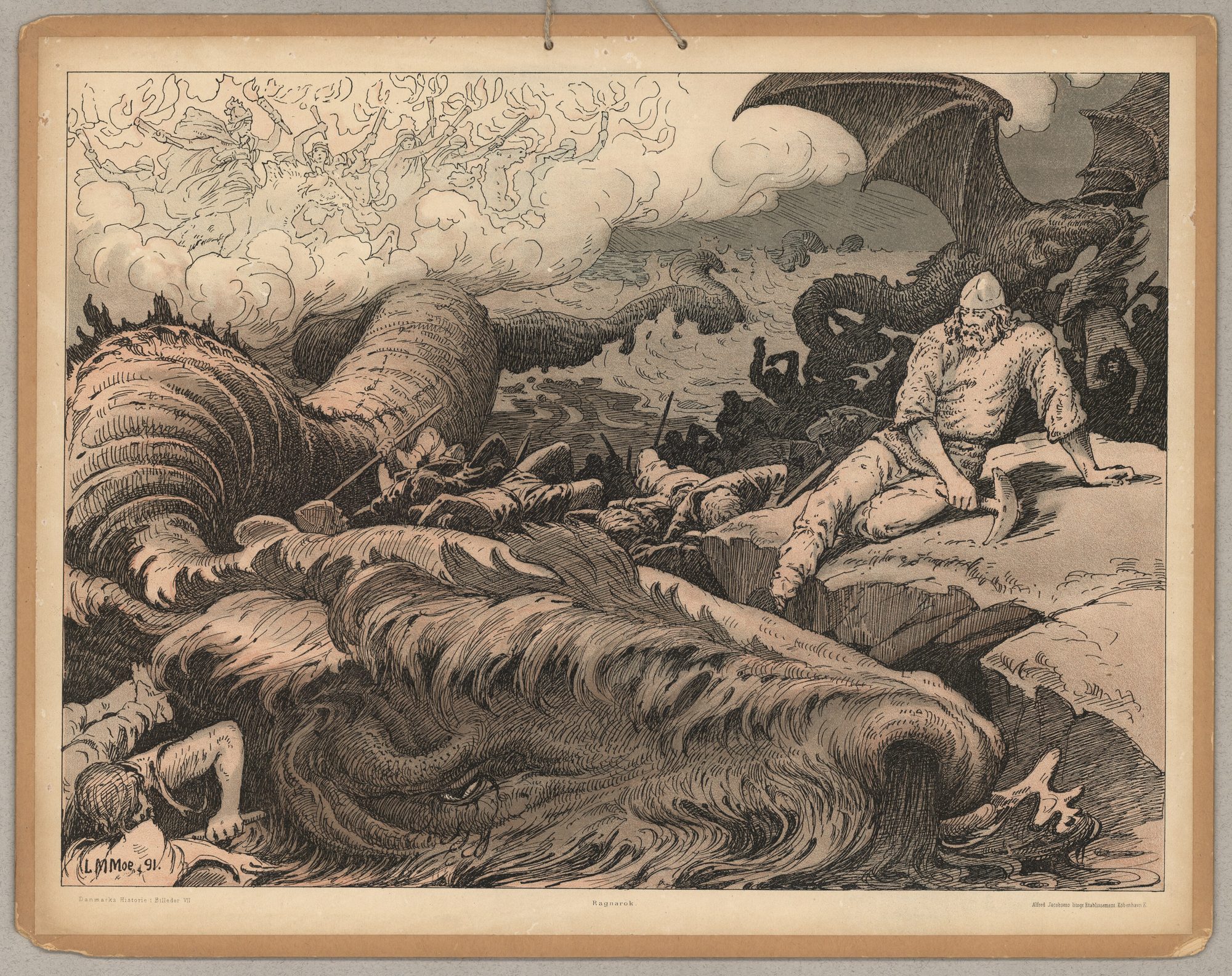
A colour lithograph of Ragnarok: the world consumed in fire and collision, figures and beasts falling amid a blazing sky, in Louis Moe's symbolist register.
Norse

Ragnarök, the Doom of the Gods

Not a twilight but a doom: the wolf runs free, the serpent floods the land, a ship of dead men's nails breaks loose, and the gods ride knowingly to a battle the prophecy says they cannot win, on a field a hundred miles square.
8 minPoetic Edda
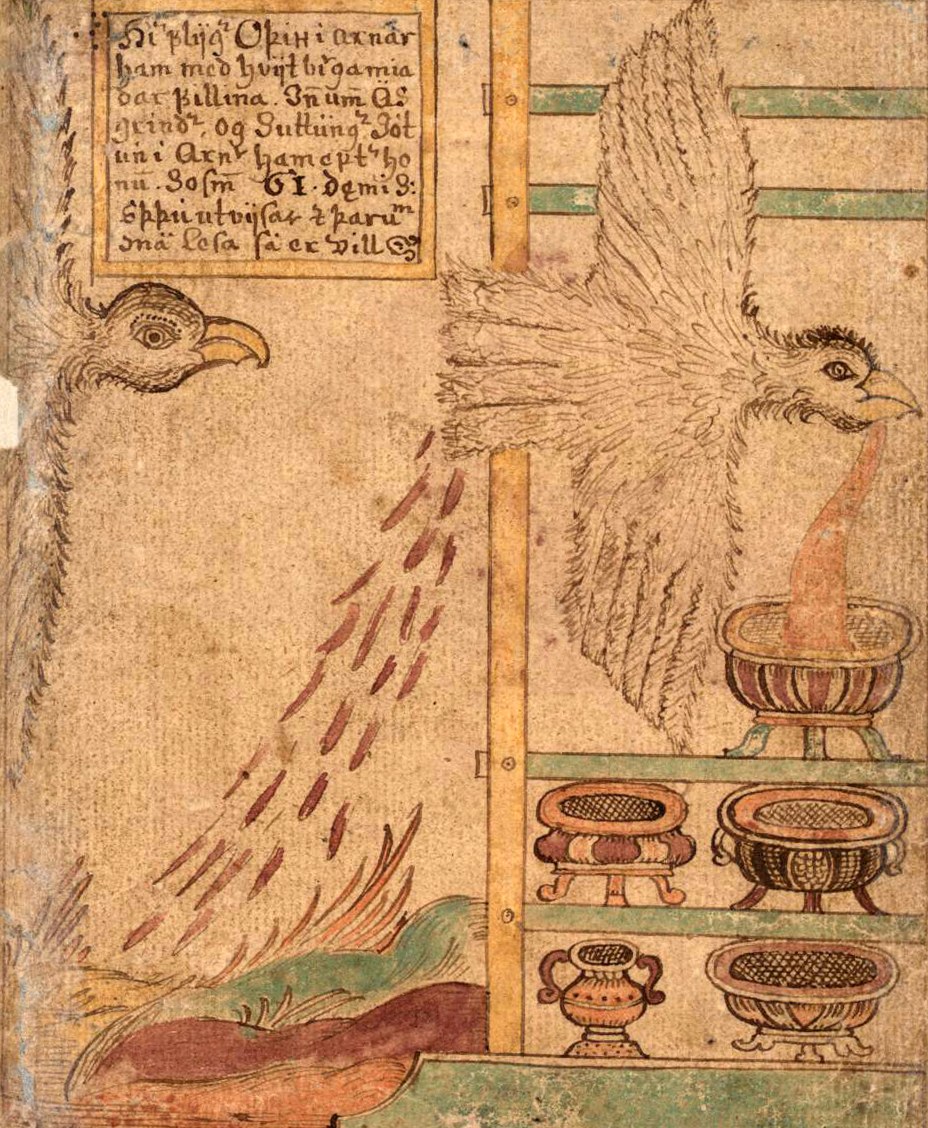
Icelandic Edda-manuscript illustration: Odin, in the shape of a great winged eagle, spews the stolen Mead of Poetry down into three ritual vessels ranged on a wooden frame, while the giant Suttung — also in eagle-shape — pursues at upper left and a stream of the escaped mead falls away below; a handwritten Icelandic caption box sits at top-left.
Norse

The Mead of Poetry

How poetry got into the world: a murdered sage, a mead brewed from his blood, and the god who slept three nights with a giant's daughter to steal it, then left her to grief.
6 minSnorri Sturluson
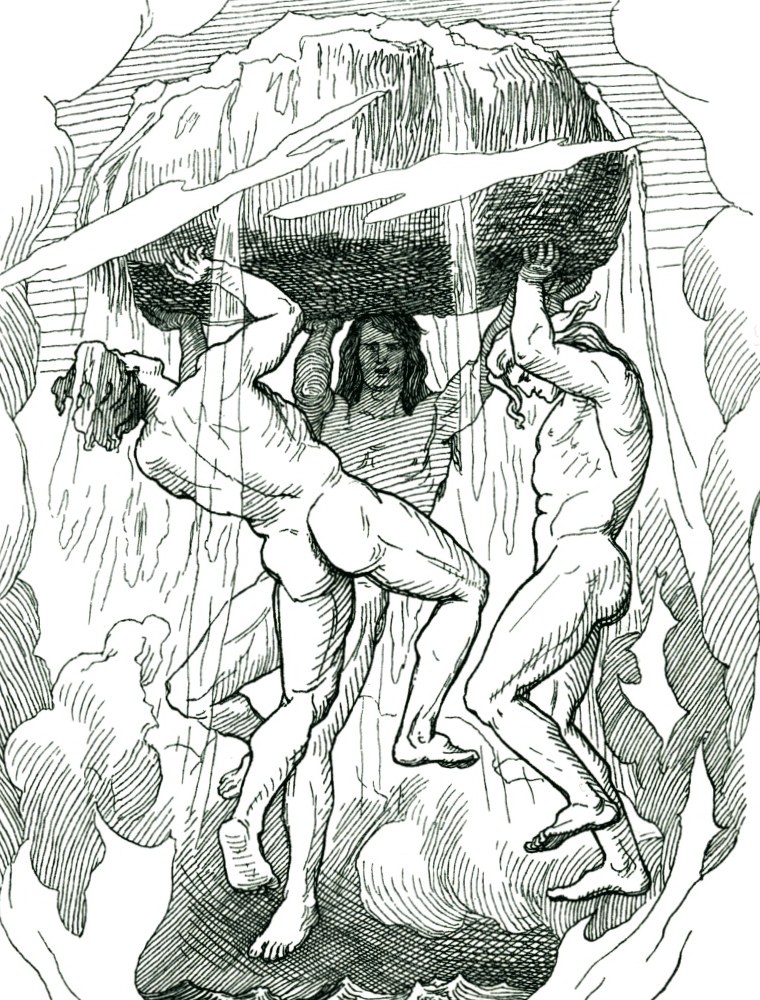
Line engraving of the three nude sons of Bor — Odin, Vili and Ve — straining upward to raise the vaulted mass of the slain giant Ymir's body into the sky-dome above them, standing on rocky ground over waves with mist and flame swirling at either side.
Norse

Creation from Ginnungagap

Before earth or heaven there was a yawning gap, and on either side of it fire and ice: how the first giant quickened between them, and how the world was built from his murdered body.
7 minPoetic Edda
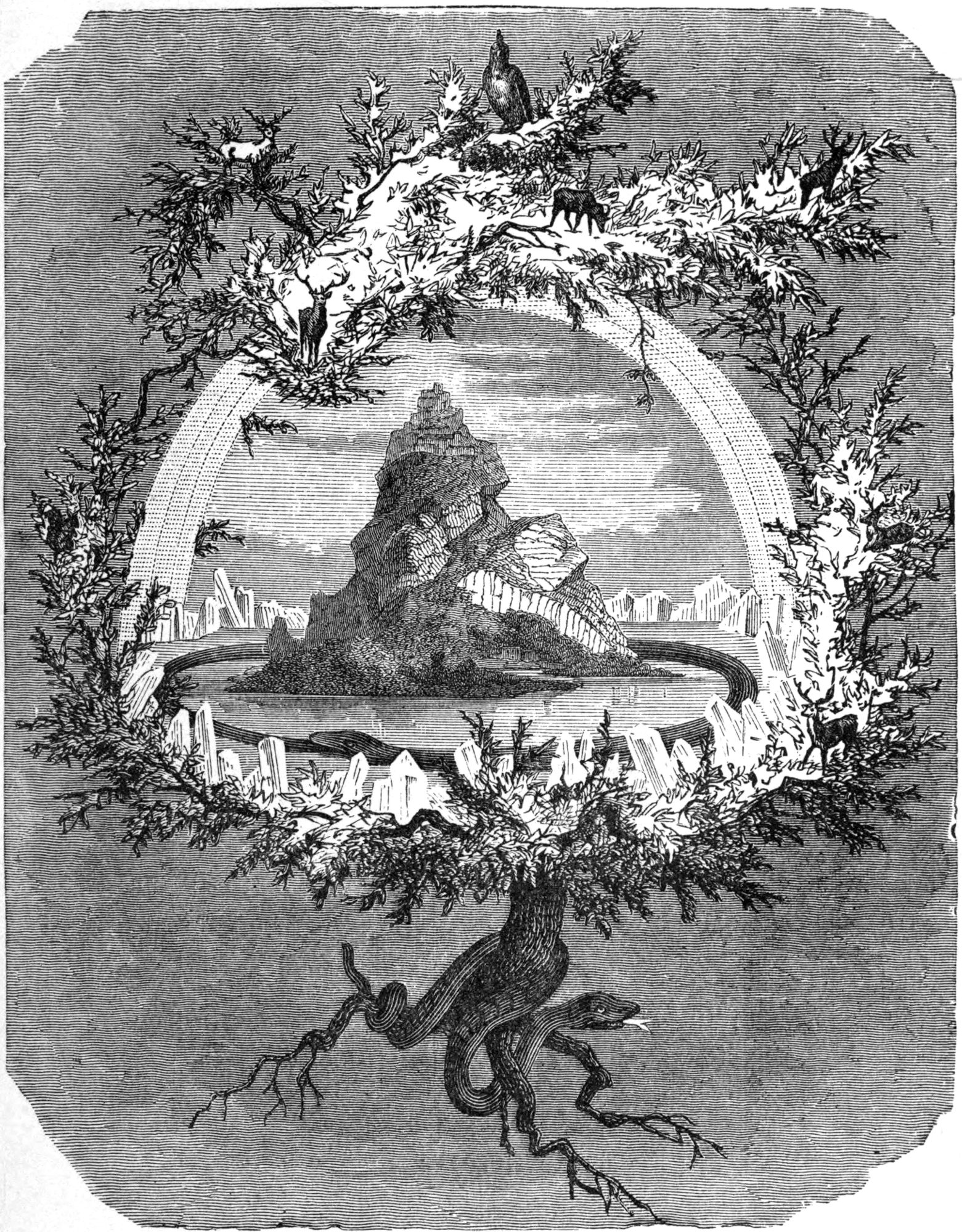
A 19th-century wood-engraving of the world-ash Yggdrasil seen whole: an eagle perched at the crown among the upper branches with four stags browsing the foliage, the central world encircled by the rainbow Bifröst and a ring of water, and the serpent Níðhöggr coiling among the exposed roots at the foot of the tree.
Norse

Yggdrasil, the World Tree

The great ash that binds the worlds is not a serene axis but a creature in perpetual pain: gnawed above, rotting within, torn from below, and still standing green over the well where the Norns pour their clay.
8 minPoetic Edda
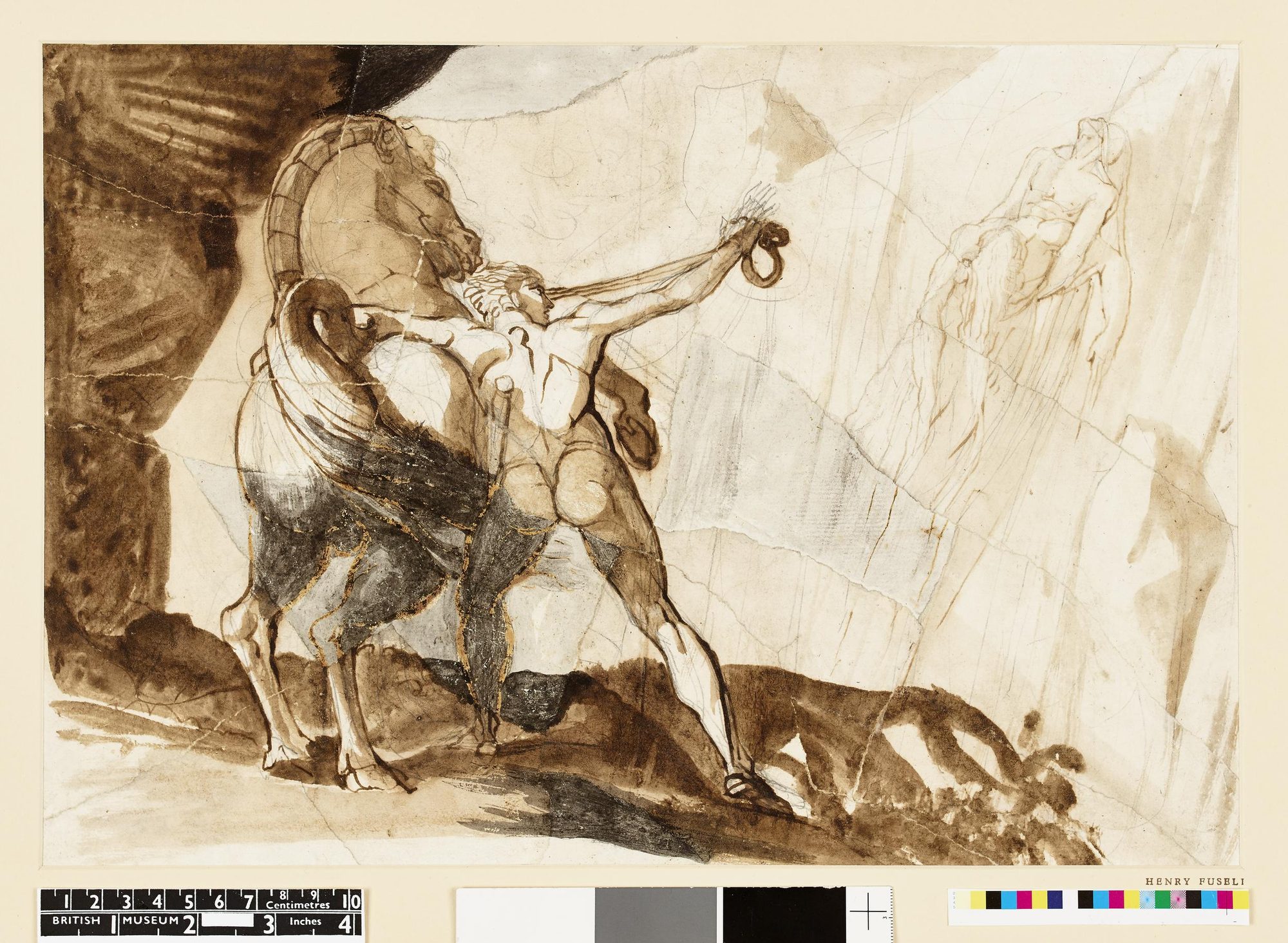
A romantic pen-and-ink drawing of Odin on his night-ride: the god in a wide-brimmed hat and cloak riding down toward the shadowy gate of Hel, his spear lowered.
Norse

Odin, the Allfather

He hanged himself on the world-tree and gave an eye to a well, and in return he took the runes and the deepest draught of wisdom: the god who paid for knowledge in his own flesh.
6 minPoetic Edda
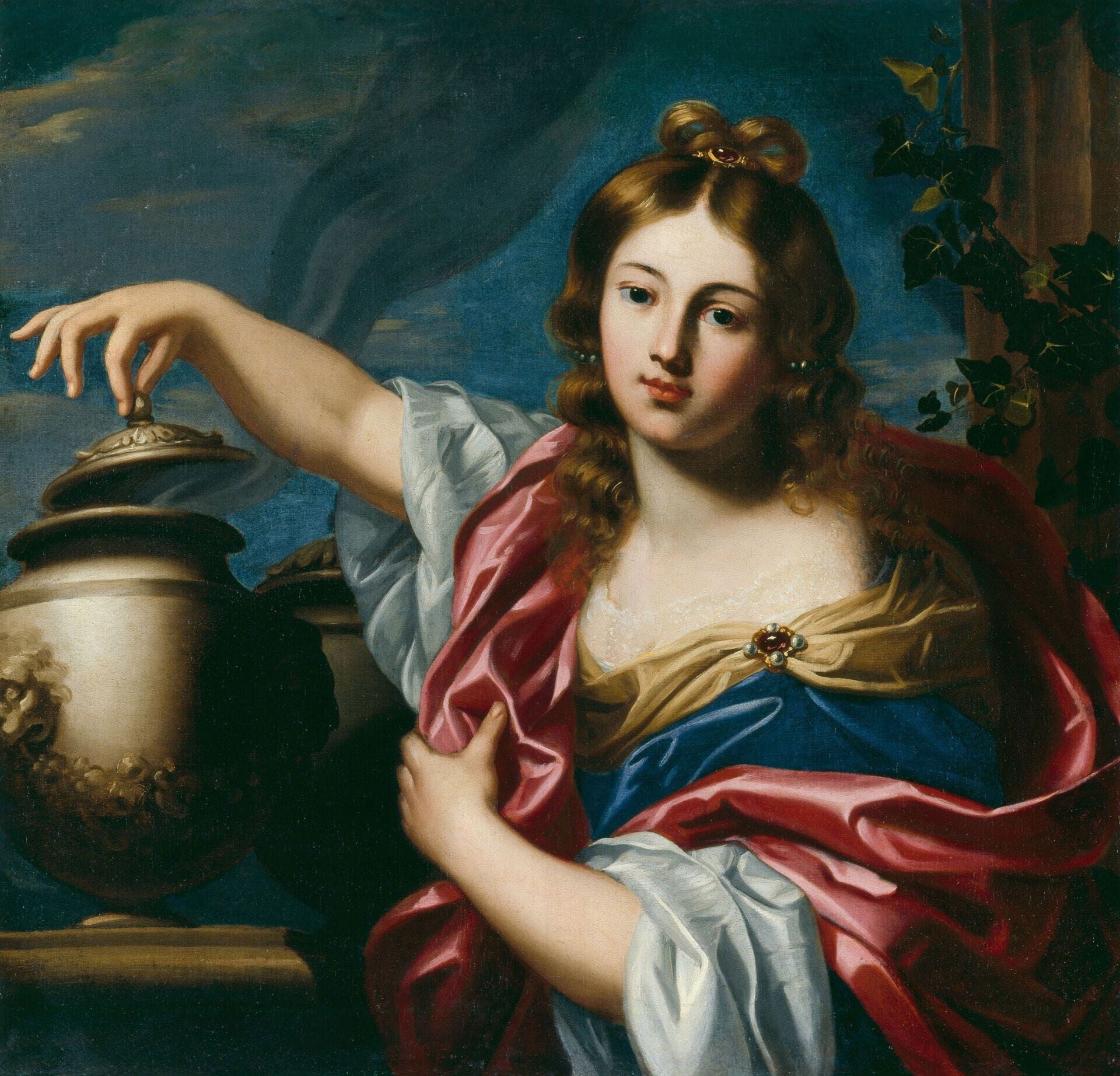
A young woman with loose auburn hair, in a blue gown under a rose-red mantle with a jewelled clasp, rests her right hand on the ornamented lid of a great lidded ceramic jar at the left — a satyr-mask moulded on its swelling belly — as if about to lift it; ivy climbs a broken pillar behind her against a stormy blue sky.
Greek

Pandora, the First Woman

The gods pooled their gifts to build one flawless girl, then handed her to mankind as a punishment; when she lifted the lid of a jar, only Hope stayed behind.
5 minHesiod
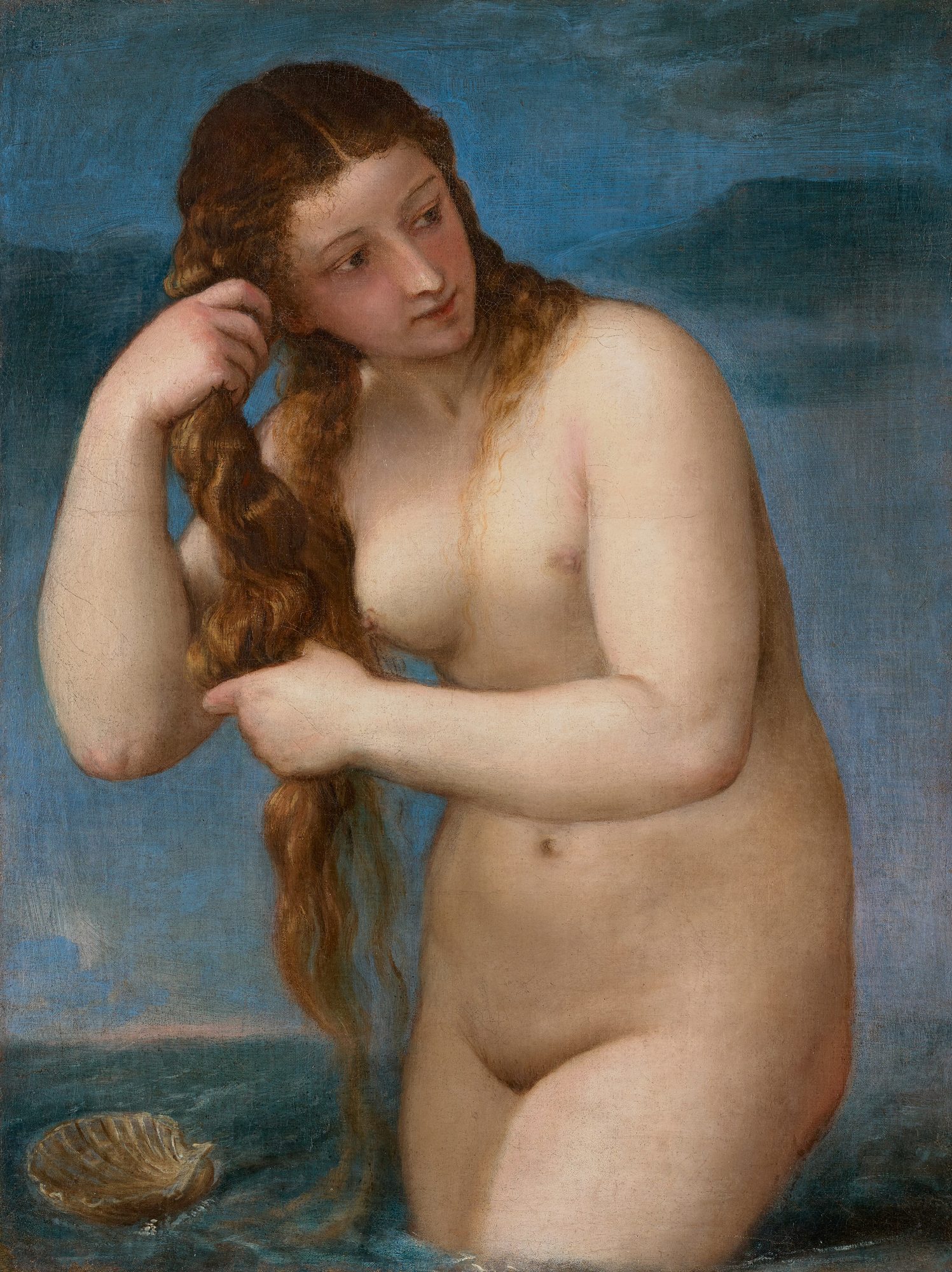
A nude Aphrodite risen waist-deep from a grey-blue sea, wringing the water from the long rope of her hair as she looks aside, a scallop shell adrift on the swell beside her.
Greek

Aphrodite, Goddess of Love

Born from sea-foam and the severed flesh of Heaven, the goddess whose power bent gods and beasts alike, and whom only three could resist.
5 minHesiod
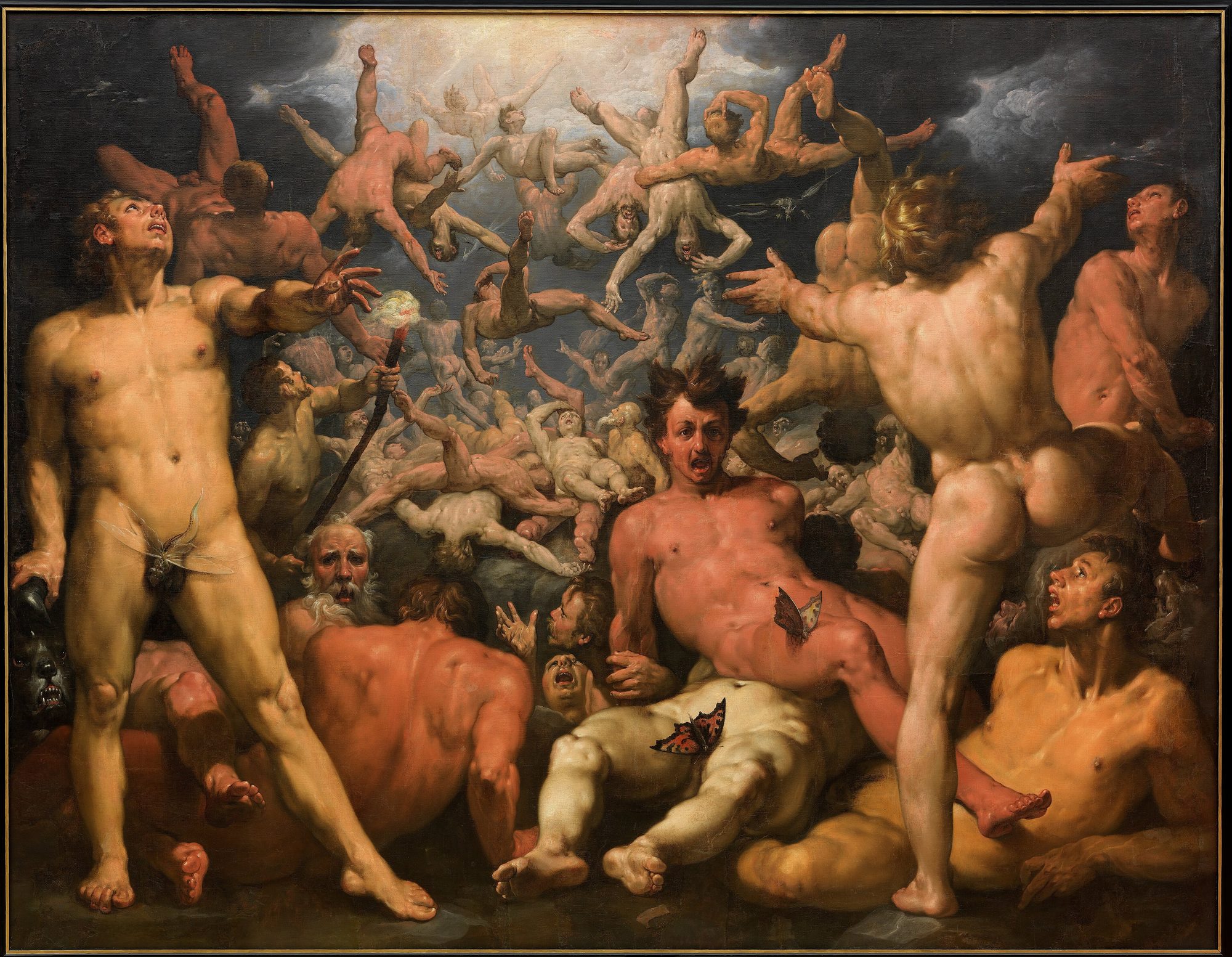
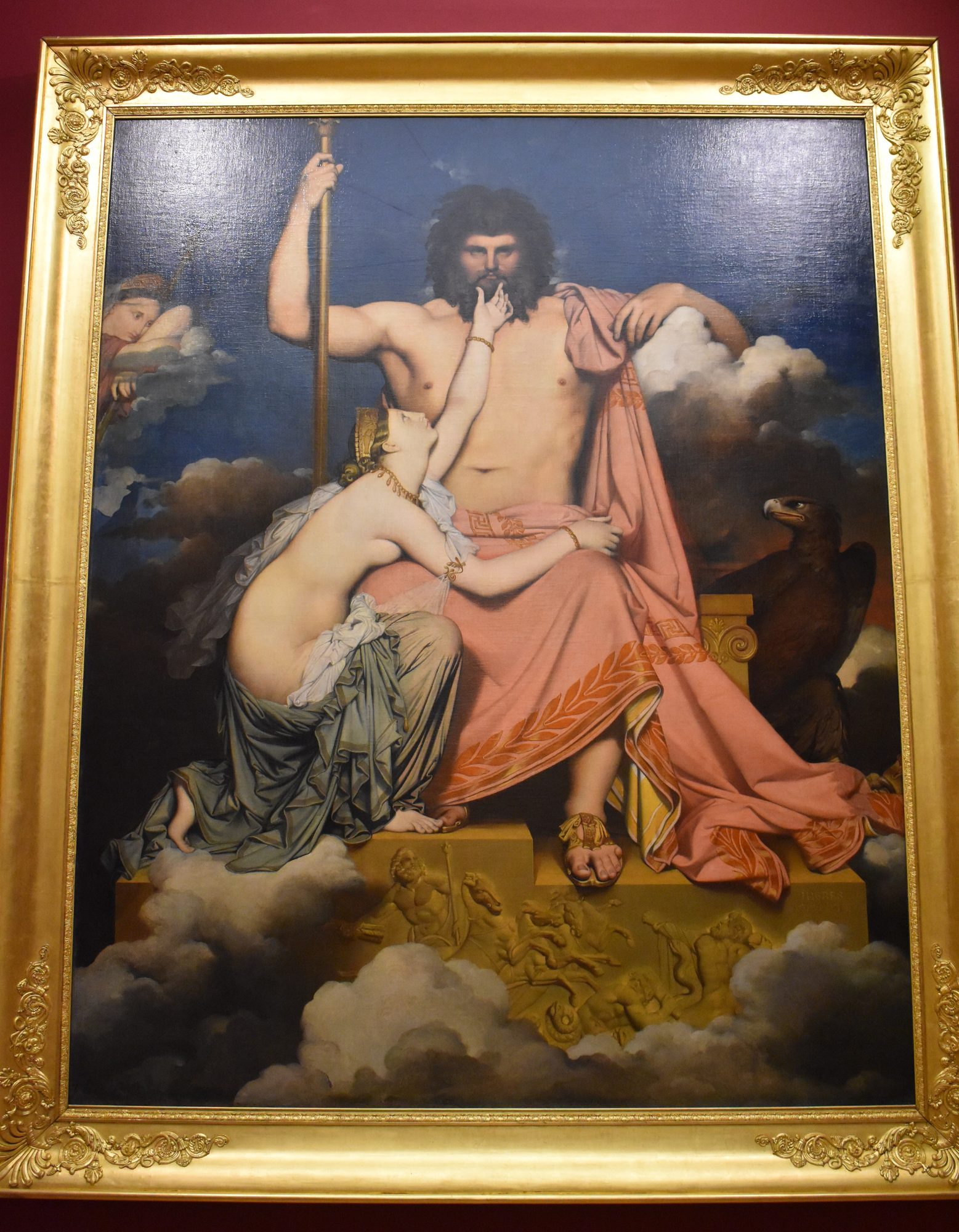
A dark, teeming Mannerist canvas of the defeated Titans hurled from the sky. From a luminous break in the storm-clouds at the top, a mass of muscular nude figures tumbles headlong and foreshortened into the depths, limbs flailing and faces contorted in terror. They pile into a heap of straining bodies across the foreground, ruddy and pale flesh tangled together; one massive figure sprawls face-up at the centre, mouth open in a scream, his hair standing on end. At the lower left a standing youth grips a burning torch while a black hound's fanged head snarls beside him, and a few small butterflies and insects — the painter's emblems of the fleeting — rest on the fallen limbs.
Greek

The Titanomachy

For ten years the sky itself hung in the balance, until Zeus loosed the hundred-armed prisoners of the deep and the world caught fire.
8 minHesiod
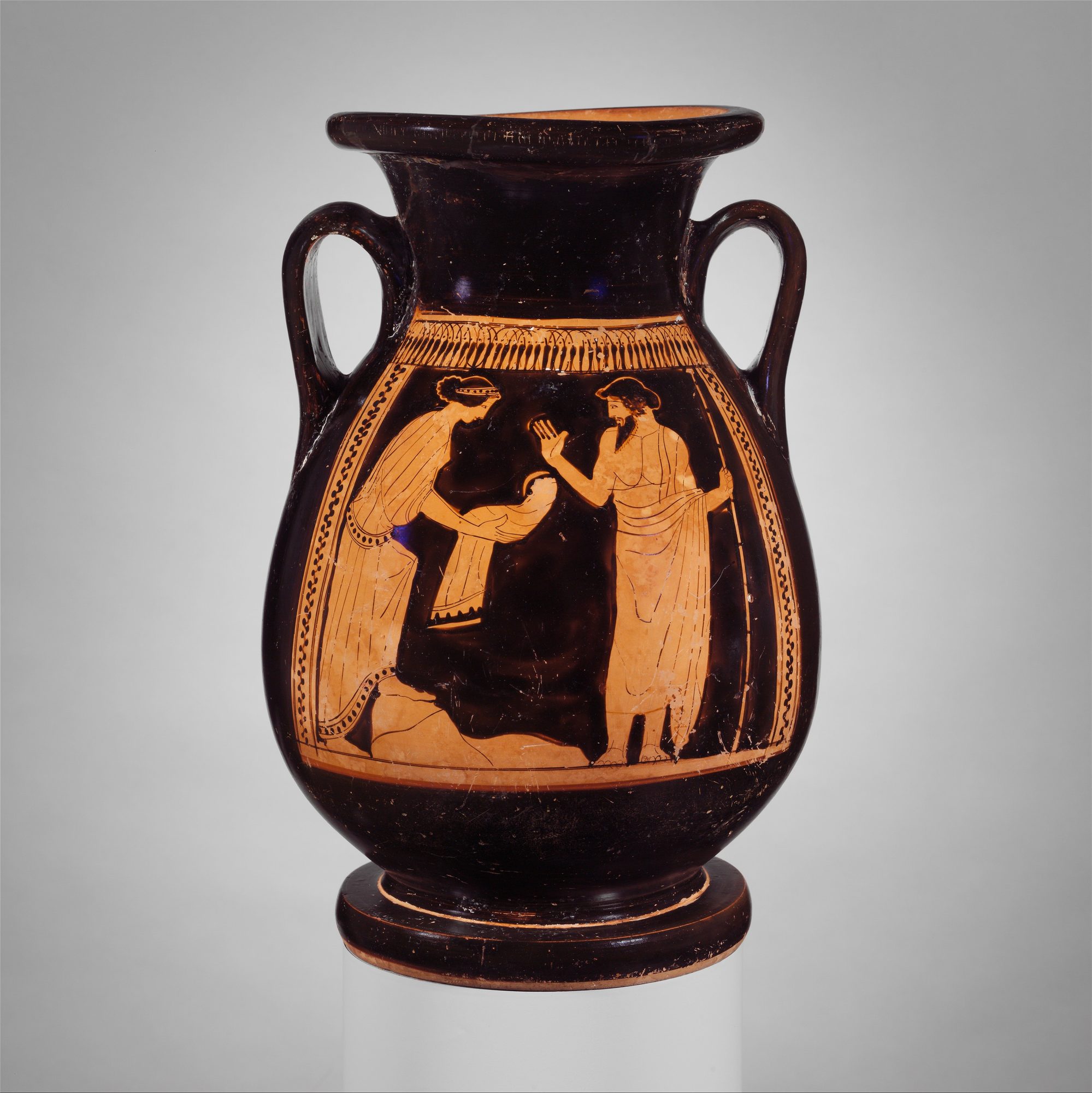
An Attic red-figure pelike, the whole black-glazed vessel standing against a plain grey ground, its belly panel bordered by a band of tongues above and running dot-chains at the sides. In the scene the Titaness Rhea, at left in a long pleated chiton and mantle with her hair bound in a fillet, steps forward and holds out in both hands the stone wrapped in swaddling clothes; facing her at right the bearded Kronos, in a himation that leaves one shoulder bare and a soft cap, grips a long sceptre in his trailing hand and raises his other hand to receive the bundle he believes is his newborn son — the swaddled-stone deception that founds the ruling family.
Greek

The Twelve Olympians: The Ruling Family

There is no ancient list of the Twelve. What the oldest poets give us instead is a household with a throne room, a swallowed generation, and a family quarrel that never quite ends.
7 minHesiod
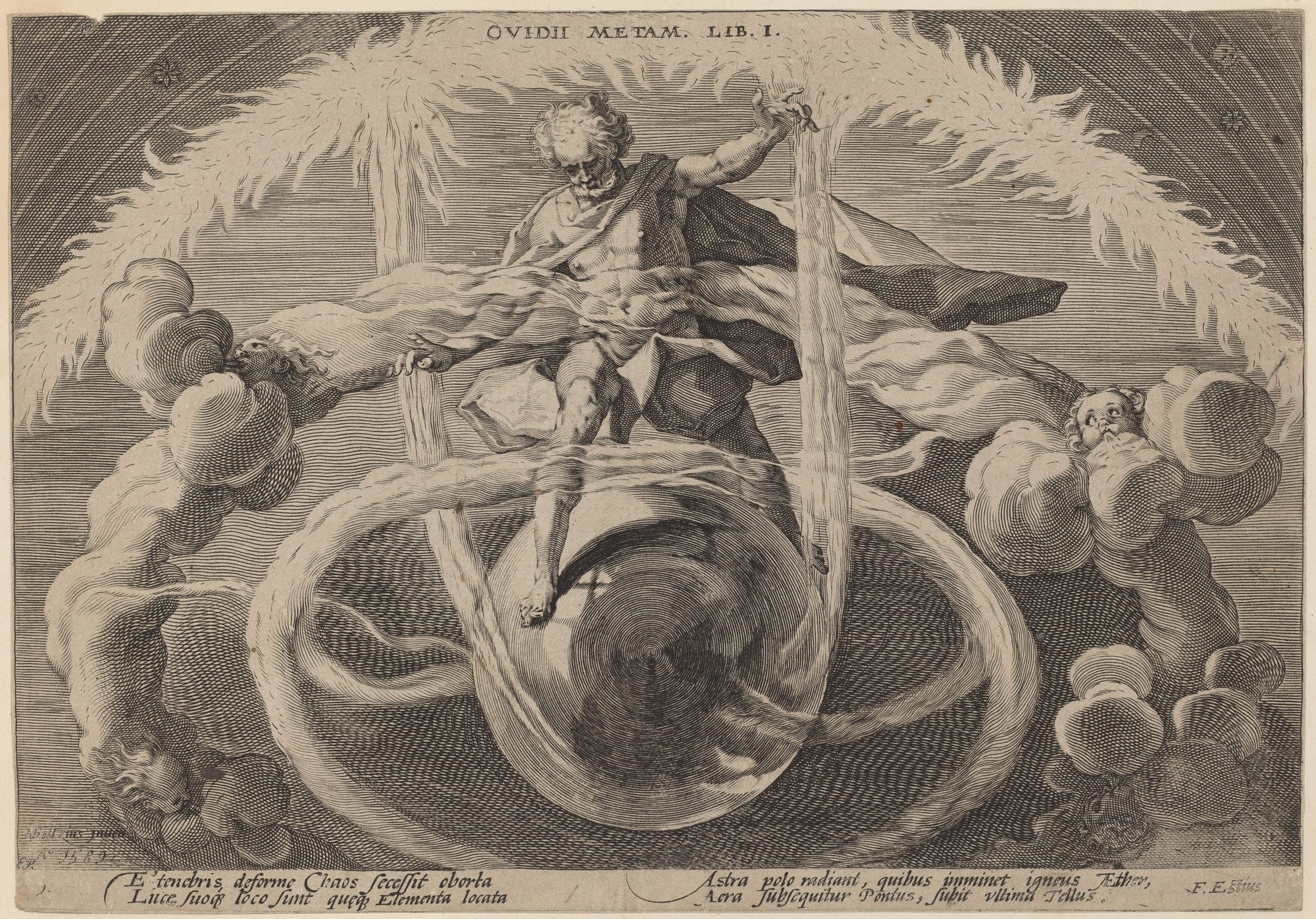
A luminous creator-figure sits enthroned at the centre of the newborn cosmos, arms outspread to draw the concentric spheres of the world out of formless Chaos, while personified winds and elements billow in the four corners — an engraved frontispiece to Ovid's Metamorphoses Book I
Greek

The Birth of the Cosmos

Before there was a world there was only a gap, and out of that yawning dark the first gods came to be.
8 minHesiod