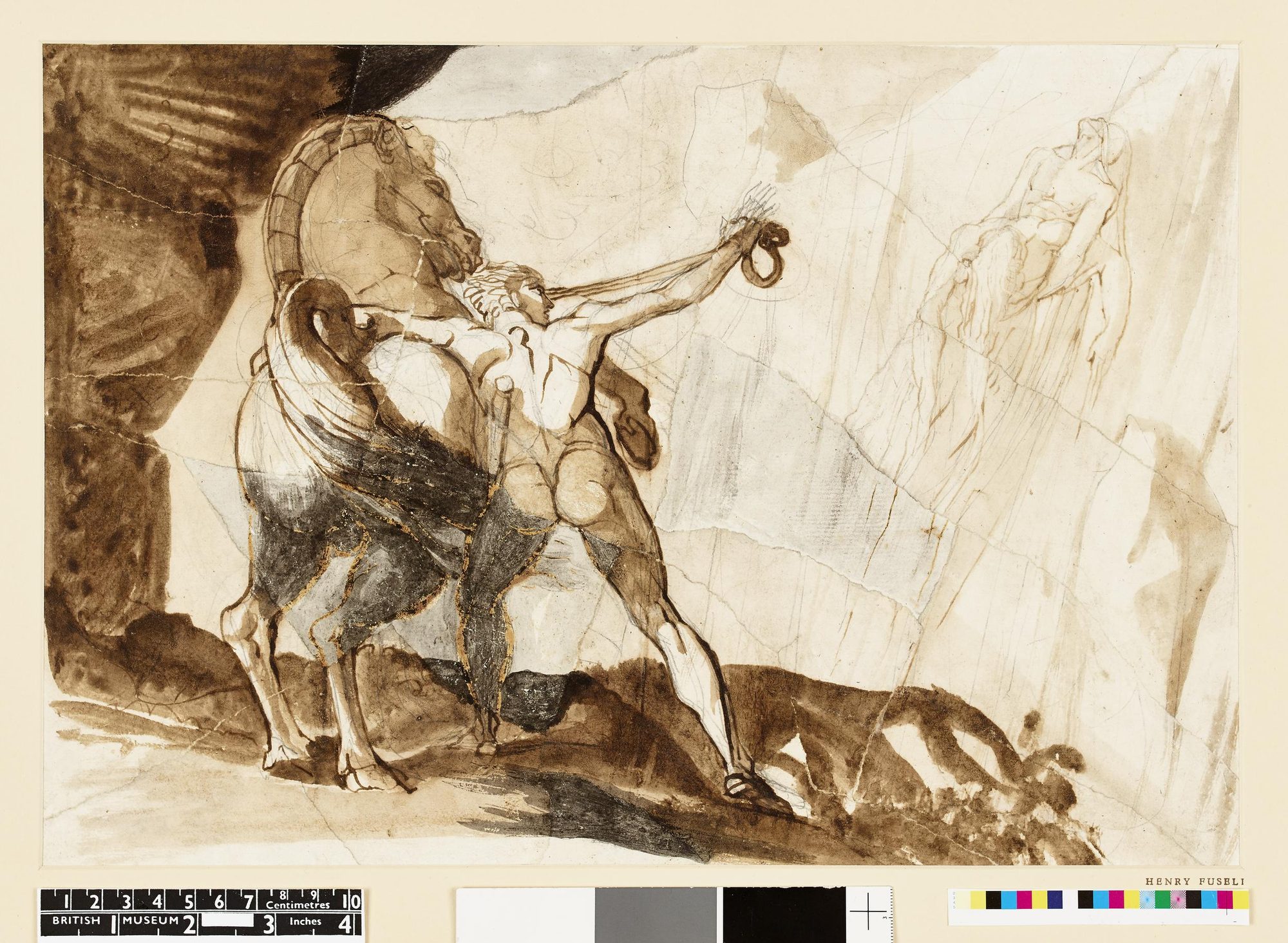
Nine nights he hangs on the tree, and no one comes to help him. A spear has gone into his side. There is no bread lifted to him and no horn of drink, only the wind moving in the branches of an ash whose roots run down into places no one living has ever seen. He is not a captive. He put himself here. He is an offering, and the god to whom he is offered is himself, given over to himself on the windy tree so that he might learn what hangs below. On the ninth night he looks down into the dark, and shrieking, he snatches up the runes, and falls back. This is the Norse god at his strangest and his most characteristic: not thundering from a throne but dangling, wounded, half-dead, buying knowledge with his own agony. His name is Odin, and the Icelandic poems that remember him are almost obsessive on this one point. Whatever else he is, he is the god who pays.
Butchery and carpentry
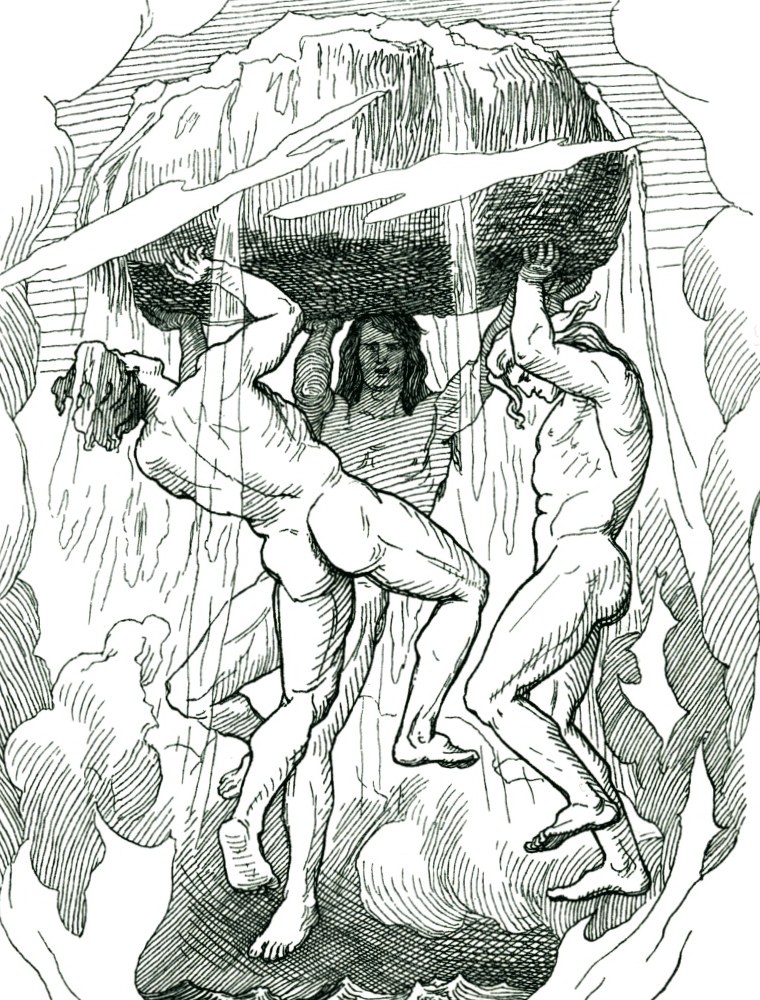
He begins, though, at the beginning of everything. In Snorri Sturluson’s Prose Edda, Odin is the son of Borr and of Bestla, a giant’s daughter, and he has two brothers, Vili and Vé. The three of them do a terrible and necessary thing: they kill the primeval giant Ymir and build the world out of his corpse. His blood becomes the sea, his flesh the land, his bones the crags, his skull the vault of heaven.
Then, walking along the sea-strand, the brothers find two trees and make from them the first man and the first woman, Askr and Embla, giving them spirit and life, wit and feeling, form and speech and hearing and sight. Creation here is not a clean word spoken over the void. It is butchery and carpentry, a world assembled out of a slain body by a god who will spend the rest of the myths taking things apart and putting them to use.
That is why the title fits. Snorri calls him Allfather, Alföðr, because he is father of all the gods and of men.
He is the oldest and foremost of the Aesir, and from a high-seat called Hlidskjálf, set in a silver-thatched hall, he looks out over the whole world and sees every deed done in it. His wife is Frigg. His first son, born of Earth, is Thor.
But the epithet that the poems press hardest is a grimmer one. He is Valfather, Father of the Slain, because all those that fall in battle are the sons of his adoption
; for them he keeps Valhall, and the Valkyries carry the war-dead to his hall. The chief of the gods is also the lord of the killed, and his household is stocked with corpses that were once brave.
An eye laid in pledge
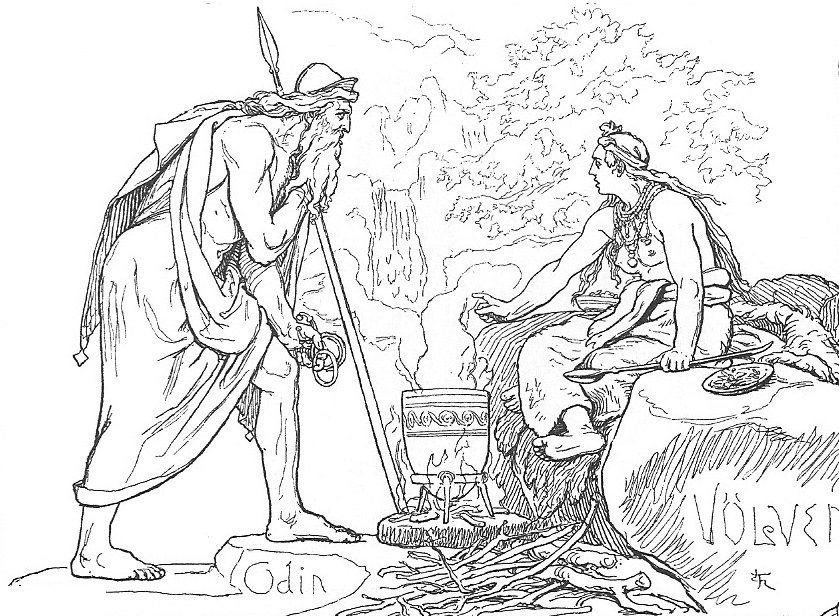
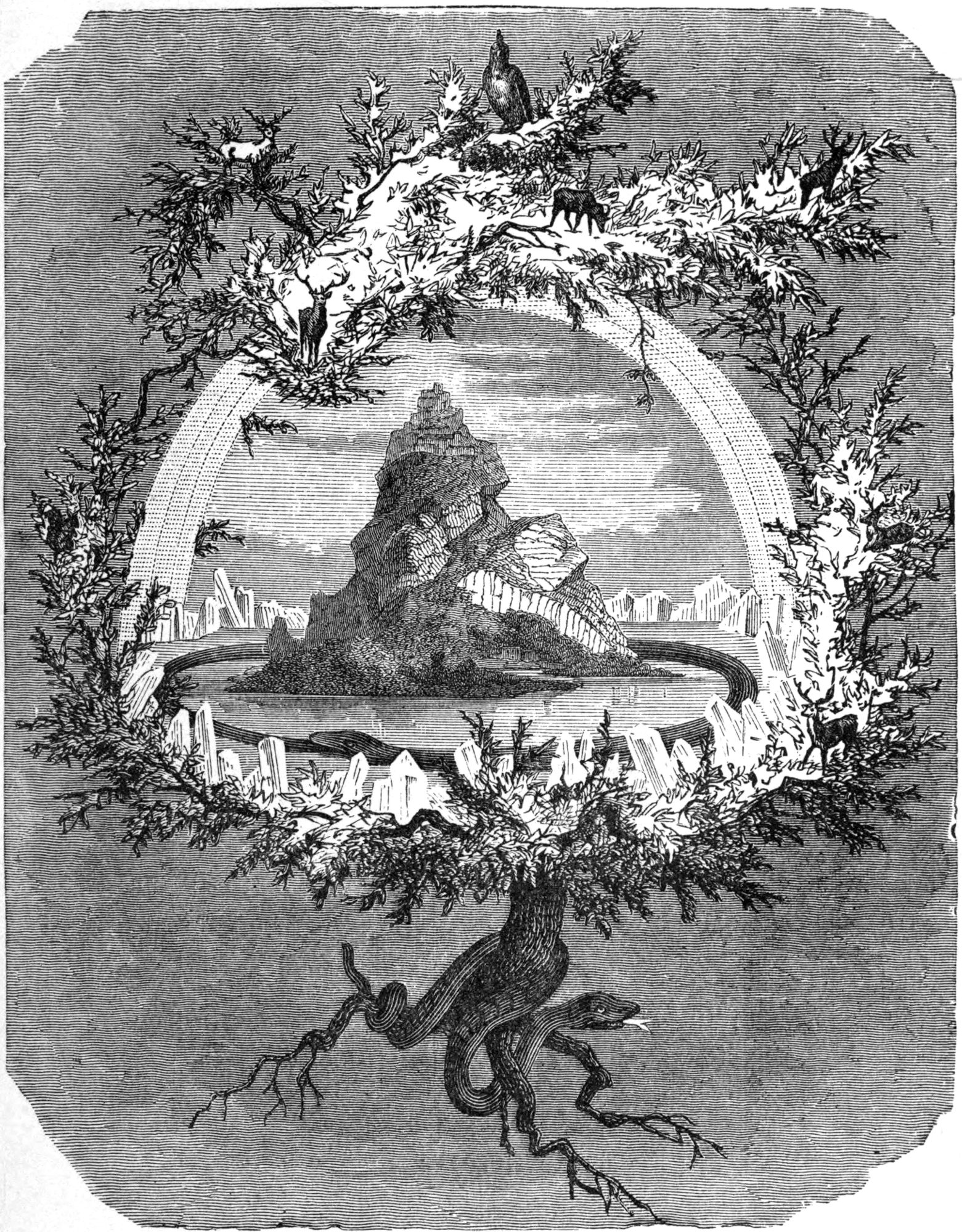
The hunger that drives him is not for battle but for what battle cannot buy. Twice the sources show him trading a piece of himself for wisdom, and the two bargains sit at the centre of everything the tradition remembers about him. The first is the hanging on the tree, that windy ash the poem’s own note names as Yggdrasil, where he wins the runes and learns nine mighty songs from the son of Bölthorn, his mother’s father. The second is quieter and just as costly.
At the well of MimirKeeper of the well of wisdom under the world-tree, in which Odin's pledged eye lies hidden., under the root of the world-tree, wisdom itself is drunk, and Odin comes craving one drink of it. He does not get it for nothing. Thither came Allfather,
Snorri writes, and craved one drink of the well; but he got it not until he had laid his eye in pledge.
The eye is still there. Völuspá knows exactly where: hidden deep in the wide-famed well, and every single morning Mimir lifts mead from Odin’s pledge and drinks. Sovereignty over gods and men, and he has paid for his insight with an eye and a night on the gallows.
Around that hungry, one-eyed centre the poems arrange his familiars, and each says something about the power he keeps. On his shoulders sit two ravens, Huginn and MuninnOdin's two ravens, sent out at dawn to range the whole world and report what they have seen., sent out at dawn to range the whole world and back by mid-morning to murmur into his ear all they have seen: intelligence made feathered and constant. At his feet crouch two wolves, Geri and Freki, and to them he gives every scrap of food set before him, for he himself needs none.
Wine is meat and drink enough for the Allfather. He rides SleipnirOdin's eight-legged grey horse, called the best of all steeds., grey and eight-legged, best of all horses, and wears the ring Draupnir, from which every ninth night eight rings of equal weight drip like water. Even his generosity runs to strange arithmetic: a god who feeds his wolves and starves himself, who owns a ring that breeds more rings, whose wisdom is gathered by birds and paid for in blood.
Bölverk and the auger Rati
He is also, and the poems do not hide it, a schemer and a starter of wars. When he wanted the mead of poetry he did not ask for it. He went in disguise as Bölverk, had the auger Rati gnaw a passage through the mountain, won the giant-maid Gunnloth, who gave him a drink of the marvelous mead while seated on her golden stool, then broke the ring-oath he had sworn and carried the mead off to the world of men.
And in Völuspá it is Odin who throws the first spear in the first war ever fought, hurling it over the host so that in the world did war first come
and the wall that girdled the gods was broken. Wisdom, poetry, and the very invention of warfare all trace to the same restless, calculating hand.
A son left to finish the wolf
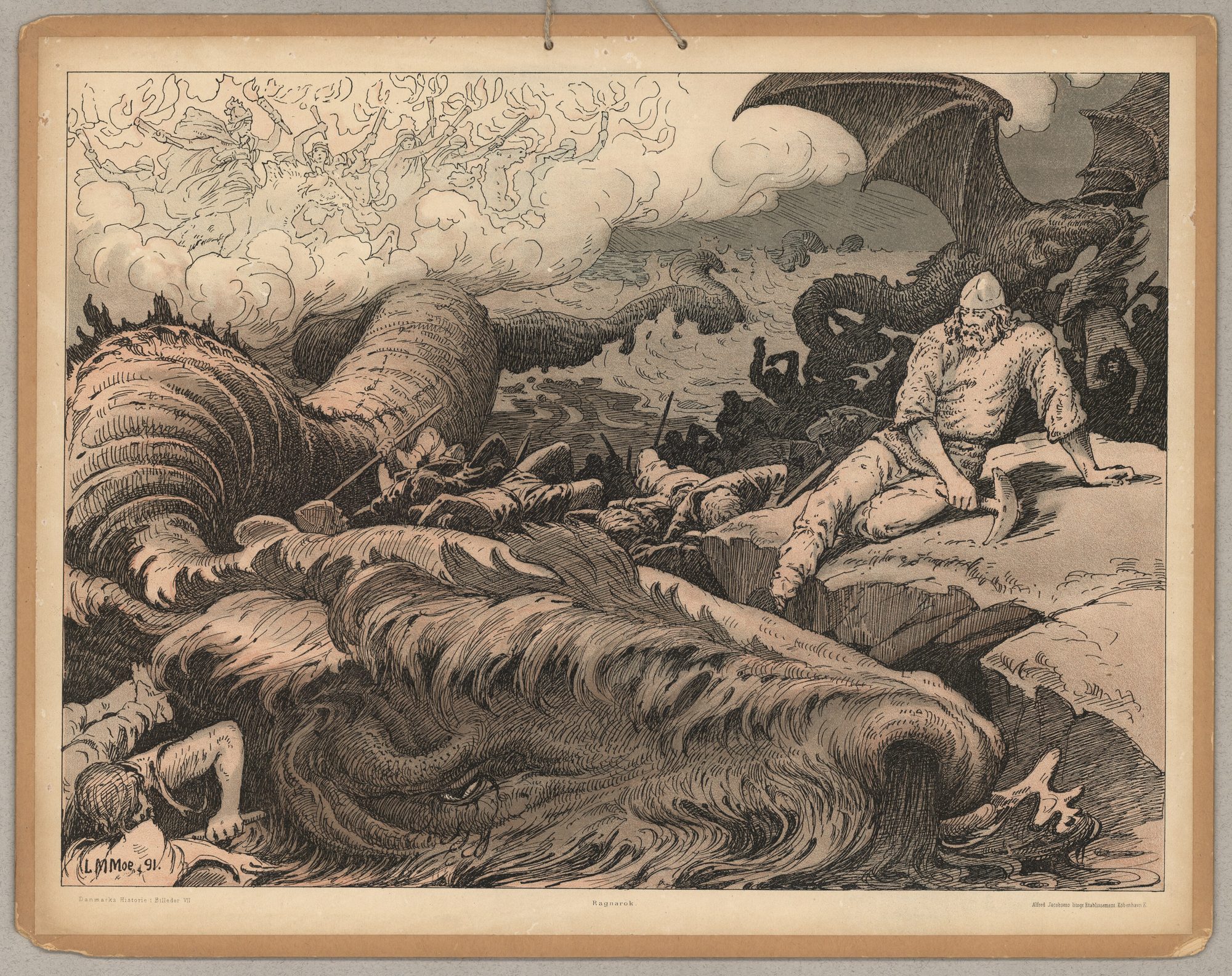
There is a fitting cruelty in how it ends for him. The god who won knowledge of everything, including the future, has always known his own death, and knowing does not save him. At RagnarökThe prophesied doom of the gods at the end of the world, when the old order falls and Odin is swallowed by the wolf., the doom of the powers, Odin rides out first in a gold helmet with his spear Gungnir against the monstrous wolf Fenrir, and the wolf swallows him. That is his ending, plainly told. But it is not quite the last word, because he has a silent son.
Völuspá gives the moment its due: Then comes Sigfather’s mighty son, Vithar, to fight with the foaming wolf; in the giant’s son does he thrust his sword full to the heart: his father is avenged.
The Allfather is not immortal in any comfortable sense. He is a god who knew he would be devoured, who spent his existence buying the wisdom to see it coming, and who could not spend his way out. He could only see clearly to the end, and leave a son behind to finish the wolf.
I ween that I hung on the windy tree, hung there for nights full nine; with the spear I was wounded, and offered I was to Othin, myself to myself, on the tree that none may ever know what root beneath it runs. (Hávamál 139, trans. Bellows)
- Poetic Edda, Hávamál 104–110 and 139–142 (trans. Henry Adams Bellows, 1923; Wikisource, read verbatim)the theft of the mead of poetry, in which Odin as Bölverk has the auger Rati bore through the rock and is given a drink of the marvelous mead by Gunnloth from her golden stool before he breaks his ring-oath and bears the mead Othrörir off to the world of men; and the runic self-sacrifice, nine nights wounded by a spear on the windy tree, offered
to Othin, myself to myself
, the shrieking seizure of the runes, and the nine mighty songs learned from the son of Bölthorn (Bestla’s father). - Poetic Edda, Völuspá 21–29, 47, 53–54 (trans. Henry Adams Bellows, 1923; Wikisource, read verbatim)the burning of Gollveig and the first war in the world, begun when Odin hurls his spear over the host and the wall of the gods is broken; the eye hidden in the well of Mimir and Mimir’s morning draught of mead from
the pledge of Othin
; and Odin’s death fighting the wolf at Ragnarök, avenged by his son Vithar, who thrusts his sword to the wolf’s heart. - Snorri Sturluson, Prose Edda, Gylfaginning III, VI–IX, XV, XVII, XX, XXXVIII, XLII, XLIX, LI (trans. Arthur Gilchrist Brodeur, 1916; Wikisource, read verbatim)Odin’s parentage from Borr and Bestla (daughter of the giant Bölthorn) with his brothers Vili and Vé; the slaying of Ymir and the making of the world and of Askr and Embla; Allfather on the high-seat Hlidskjálf in silver-thatched Valaskjálf; Frigg as his wife and Thor as his son by Earth; the eye pledged for a drink of Mimir’s well; Father-of-the-Slain and Valhall; the ravens Huginn and Muninn and the wolves Geri and Freki (and the wine that is his only food); the eight-legged Sleipnir; the ring Draupnir; and Ragnarök, where Odin rides out with Gungnir, is swallowed by Fenris-Wolf, and is avenged by Vídarr.