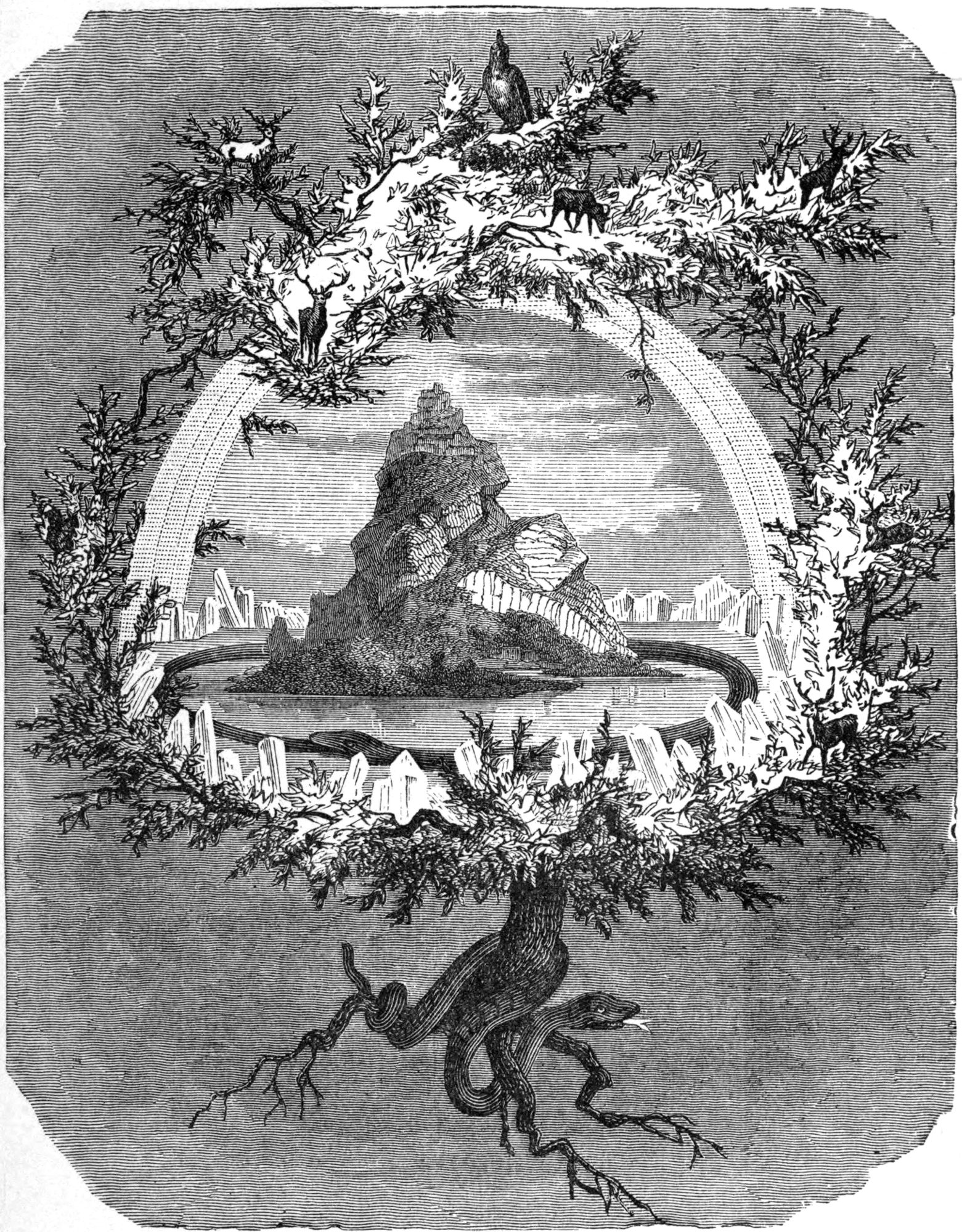
Every day the gods ride out to sit in judgement, and every day they ride to the same place: a tree. Not a hall, not a mountain, not a throne, but an ash so vast that its branches spread over all the world and climb up past the sky. Most of the ÆsirThe gods of Asgard, led by Odin, the principal group among the Norse gods. cross the rainbow bridge to reach it. Thor alone comes on foot, wading river after river, because for him the bridge is all afire and the holy waters boil, so that the strongest of the gods must walk to the council of the gods while the rest of them ride. This is where the North placed the centre of everything. Not a fixed and shining axis, but a living thing that has to be waded to, and that is, even now, quietly dying.
Three roots standing wide apart
The ash is called Yggdrasil, and it is the best and greatest of all trees. Three roots hold it up, and they stand wide apart, reaching down into three different regions of the cosmos. Here the old sources begin to disagree, and it is worth being honest about the disagreement rather than smoothing it over, because the tidy modern diagram that labels the three roots Asgard, JötunheimThe land of the giants in Norse cosmology., Niflheim
and slots one neat world under each is not what the ancient poems say.
The elder verse of Grímnismál sends the roots down to Hel, to the frost-giants, and to mankind. Snorri Sturluson, writing his prose handbook two centuries later, arranges them differently: one root among the Æsir, one among the frost-giants where the yawning gap once was, and one over Niflheim, above the well Hvergelmir where the dragon gnaws. Both agree that a root reaches the frost-giants. On the other two they simply differ, and the clean three-world map most people picture is Snorri’s harmonising hand, not the unanimous voice of the myth.
Mímir drinks from the Gjallarhorn
Under the roots lie wells, and the wells are the reason the tree matters as much as it does. Beneath one root is the well of Mímir, in which wisdom and knowledge lie hidden. Mímir, its keeper, drinks from it each morning out of the Gjallarhorn, and he is full of wisdom because of it.
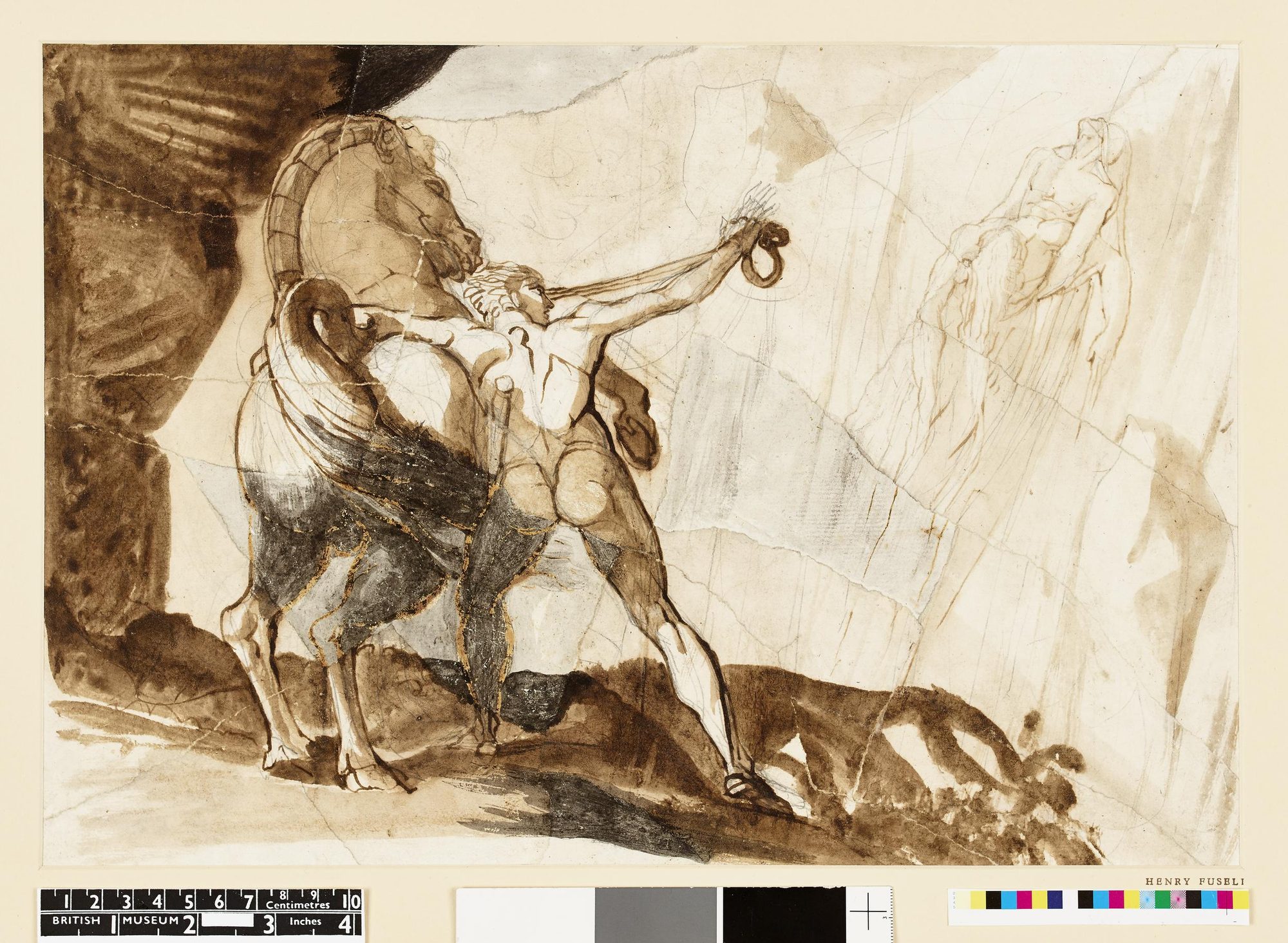
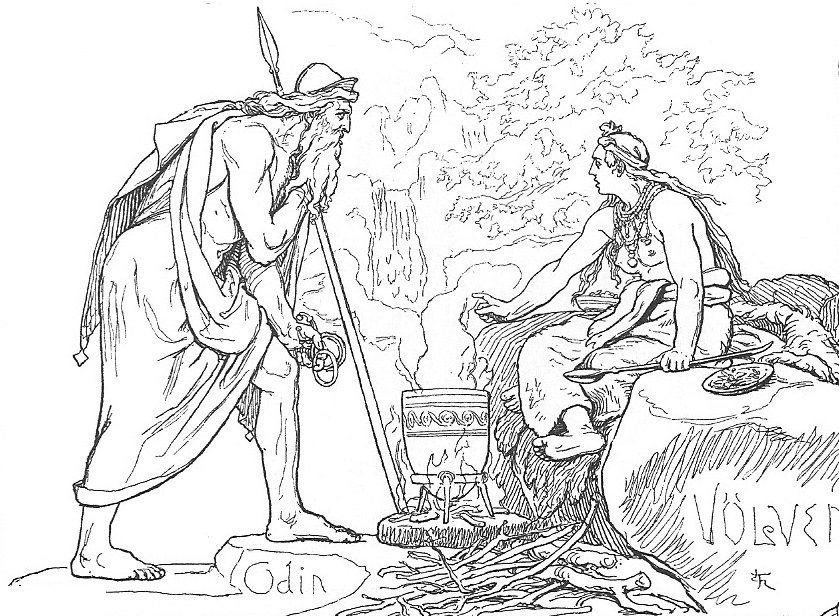
The most famous price ever paid in Norse myth was paid at this water: Odin, the highest of the gods, gave up an eye for a single draught of it. The old prophecy names the debt plainly and tells the god she can see exactly where he has hidden it, in the clear well of Mímir. That is the bargain at the heart of the tree. Sight surrendered for insight, half a face given for the knowledge of what is coming.
Destinies graved onto a tablet
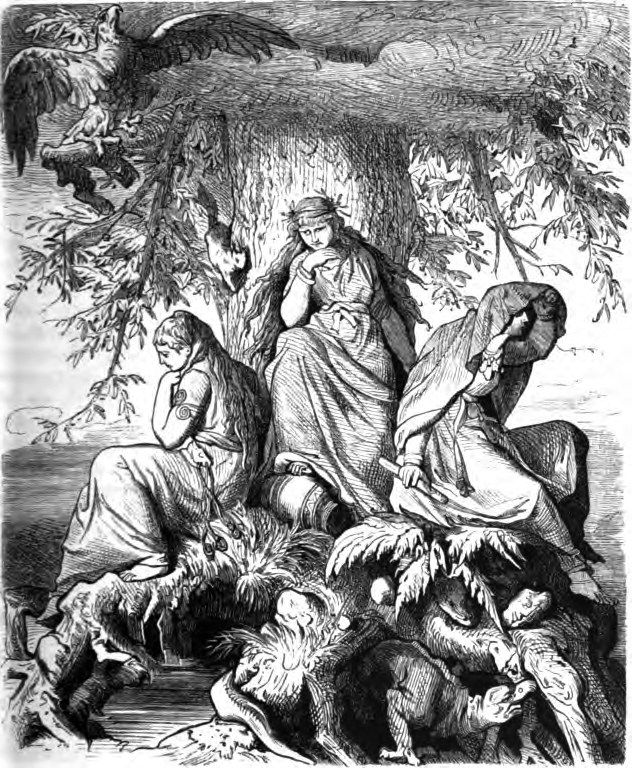
Under another root lies the holy well of Urðr, and here is the tree’s other pole. This is the doomstead, the court where the gods hold their daily judgement, and here dwell the three NornsThe fate-maidens who shape the lives of men, the best known being Urðr, Verðandi and Skuld.: Urðr, Verðandi and Skuld, maidens who come out of a hall beside the water and who shape the lives of men. They grave destinies onto a tablet, and it is they, not the gods, who set the fates of everyone who lives.
Other Norns exist besides these three, of the kindred of the Æsir and the elves and the dwarves; but these are the great ones, and they attend the tree. The ash stands forever green over Urðr’s well, laved with the water they draw, and from it a dew falls down into the valleys. Men call that dew the honey-fall, and it is the food of bees. There is something almost tender in the image: a cosmic tree that weeps sweetness into the fields below, and whose falling dew is what feeds the hives.
The Norns do not only pronounce fate at the well. They tend the tree like gardeners. Every day they take water from Urðr’s fountain, and they take the pale clay that lies around it, and they pour both over the ash so that its branches will not wither or rot.
The water is so holy that anything laid in it comes out white as the film inside an eggshell, that thin membrane against the shell, and two swans swim there who are the parents of every swan that has ever been. Picture it whole: a tree so ancient it should be crumbling, kept alive by three women who each day sluice its roots with white clay and sacred water, while beneath them swim the first swans in the world.
Ratatoskr ferrying spite up the trunk
They have to tend it because the tree is being eaten alive. Yggdrasil suffers more agony than anyone knows. A hart bites it from above. In its trunk it rots. And beneath it the serpent NíðhöggrThe serpent-dragon that gnaws the tree's root from below, tormenting it ceaselessly. tears at the root from below. It is worse even than that single line suggests: four harts, named Dáinn, Dvalinn, Duneyrr and Duraþrór, leap in its branches and strip the young shoots, and a whole nest of serpents, Góinn and Móinn and their brood, lacerate the roots alongside Níðhöggr down in Hvergelmir.
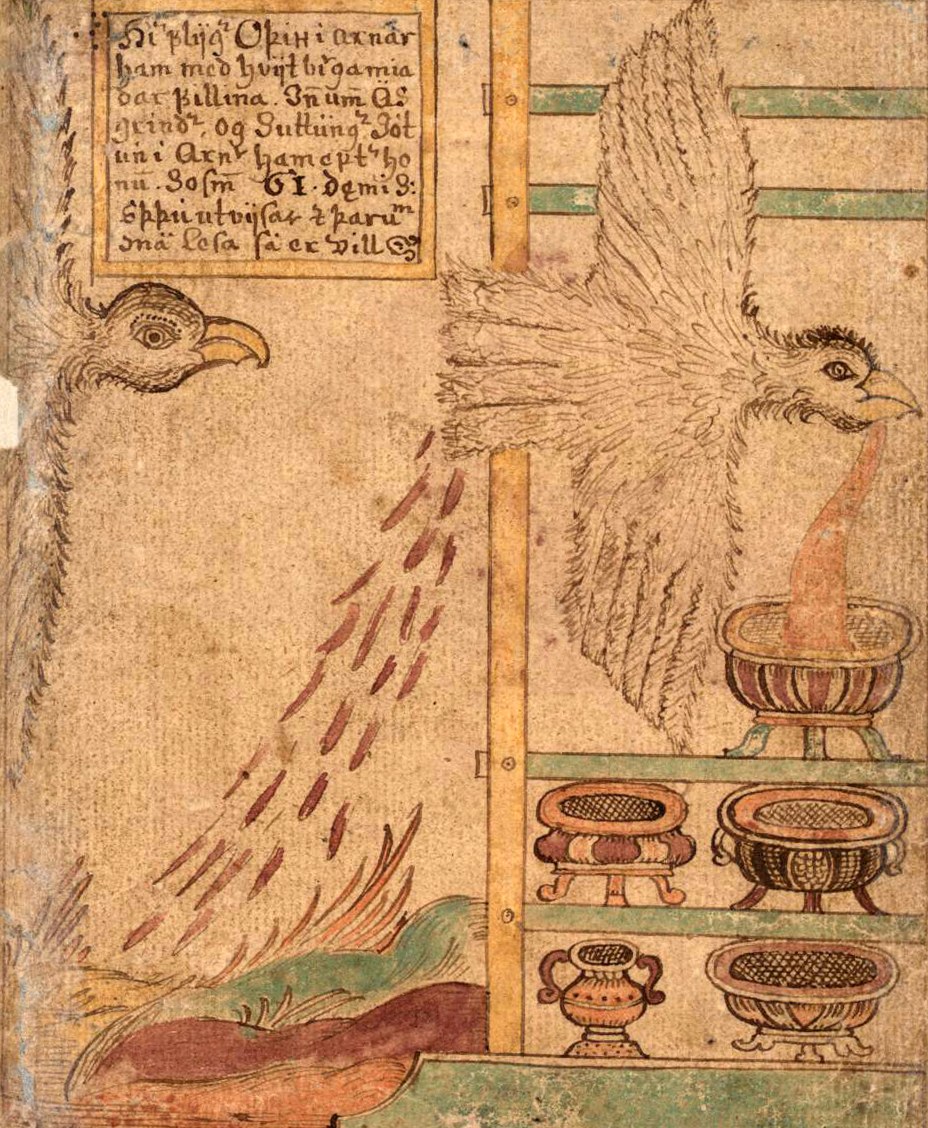
The world-tree is chewed at the crown, decaying in the middle, and gnawed at the foot all at once, a living thing held in perpetual pain. And up and down its length runs a squirrel, Ratatoskr, whose whole task is malice. He carries words of envy from the eagle who sits at the very top, a bird who knows many things and has a hawk called Veðrfölnir perched between its eyes, down the trunk to the dragon at the bottom, and back up again, ferrying spite between the crown and the root so that the two ends of the world stay at war.
The gallows a man rides
The name itself carries the darkest of the tree’s meanings. Yggdrasil is usually read as Ygg’s steed, Ygg being a byname of Odin and a steed being, in the grim idiom of the North, the gallows a man rides when he hangs. This reading is scholarly interpretation and not a line of the Edda; the older translators offer a competing gloss, bearer of Odin
or bearing rain,
and it is fair to say the point is argued rather than settled. But the interpretation has a myth behind it that makes it hard to dismiss.
Odin tells, in his own voice, how he once hung on a wind-rocked tree for nine whole nights, wounded with a spear, given to himself by himself, on a tree of which no one knows from what root it springs. He took no bread and no horn of drink, and at the end of that agony he seized up the runes, shrieking, and fell down from the tree. If the world-ash is Odin’s gallows, then the tree at the centre of the cosmos is also the instrument of the chief god’s self-sacrifice, the frame on which knowledge was bought a second time, with a body instead of an eye.
When Yggdrasil starts to shake
And it will not stand forever. When the end of all things comes, the aged tree, still standing, begins to tremble and to groan, and the loosed giant stirs. Snorri says that when Yggdrasil starts to shake, nothing in heaven or earth is exempt from fear at that terrible hour. And what does the god of the wisdom-well do as the tree shudders toward its fall?
He rides, one last time, to Mímir’s well, to ask the water that cost him an eye what he should do at the ending of the world. The tree that was tormented all its life, weeping honey into the valleys and sluiced with clay by the fate-women, groans at the last like the living creature it always was. The popular diagram gives a still, safe pillar. What the poems give is a suffering ash, gnawed and cherished at once, holding the worlds together for as long as it can bear to.
Yggdrasil’s ash hardship suffers / greater than men know of; / a hart bites it above, and in its side it rots, / Nidhögg beneath tears it. (Grímnismál 35, trans. Thorpe)
- Poetic Edda, Grímnismál (
The Lay of Grimner
) 29–44 (trans. Benjamin Thorpe, in The Elder Eddas of Saemund Sigfusson, Project Gutenberg #14726, read verbatim)the fullest verse catalogue of the tree. The Æsir riding each day to council at Yggdrasil’s ash while Thor goes on foot and wades the rivers Körmt, Ormt and the Kerlaugs because the As-bridge is afire (29); Ratatoskr the squirrel running up and down bearing the eagle’s words to Níðhöggr (32); the four harts Dáinn, Dvalinn, Duneyrr and Duraþrór gnawing the shoots (33); the serpents beneath the tree (34); the ash suffering hardshipgreater than men know of
, bitten above by a hart, rotting in its side, and torn beneath by Níðhöggr (35); and Yggdrasil named best of all trees (44). - Poetic Edda, Völuspá (
The Vala’s Prophecy
) 2, 19, 20, 24, 48 (Thorpe tr., #14726, read verbatim except st. 24)nine worlds and a central tree beneath the earth (2 — the Old Norse of this stanza is a translation crux, so the reliable claim isnine worlds
and an underground central tree, not a precise count of roots or trees); the ashlaved with limpid water
, standingever green over Urd’s fountain
, from which the dews fall into the dales (19); the three Norns Urðr, Verðandi and Skuld whograved on a tablet
the destinies of men (20); Odin’s pledged eye hidden in Mímir’s well (24 — read here only as Snorri quotes it within Gylfaginning 15, not from a standalone Völuspá; the stanza number should be confirmed against an independent edition, as numbering varies); and the aged ash trembling and groaning as the doom begins andthe jötun is loosed
(48). - Poetic Edda, Hávamál 138–139 (Thorpe 140–141, #14726, read verbatim)Odin’s own account of hanging nine whole nights on a wind-rocked tree, wounded with a spear,
myself to myself
offered, on a treeof which no one knows from what root it springs
, taking neither bread nor horn before he seized the runes. The charter-text behind the standard scholarly reading of the name as Odin’s gallows-steed — an interpretation, clearly, and not a statement in the Edda thatYggdrasil means Odin’s horse
. - Snorri Sturluson, Prose Edda, Gylfaginning 15–16 (trans. Rasmus B. Anderson, The Younger Edda, Chicago 1880; Project Gutenberg #18947, read verbatim)the fullest prose synthesis. The ash
the best and greatest of all trees
, its branchesover all the world
andabove heaven
; the gods’ daily council at it; the three roots and Snorri’s own assignment of realms and wells beneath them (one with the Æsir, one with the frost-giantswhere Ginungagap formerly was
, the third over Niflheim’s Hvergelmir where Nidhug gnaws; Mímir’s well of wisdom drunk with the Gjallarhorn under the frost-giant root, Urðr’s well and the doomstead of the Norns under the third) — this neat root-by-root mapping is Snorri’s contribution, not the Poetic Edda’s; the Norns sprinkling the tree with water and clay so its branchesmay not wither or decay
; the water making submerged thingsas white as the film of an egg-shell
, and the two swans that are the parents of all swans; the honey-fall that isthe food of bees
; the eagle atop the tree with the hawk Veðrfölnir between its eyes; Ratatoskr carryingwords of envy
; the four harts; and the named serpents. - Snorri, Gylfaginning (Ragnarök chapter) (Blackwell/Anderson prose text, #14726 and #18947)
The ash Ygdrasil begins to shake, nor is there anything in heaven or earth exempt from fear at that terrible hour
, and Odin riding to Mímir’s well to consult it as the end comes. - Poetic Edda, Fáfnismál 13 (Thorpe tr., #14726)the Norns
of many kinds
, of Æsir, elf and dwarf descent — read here only as Snorri quotes it within Gylfaginning 15, not from a standalone Fáfnismál; the stanza number should be verified before it is cited directly.