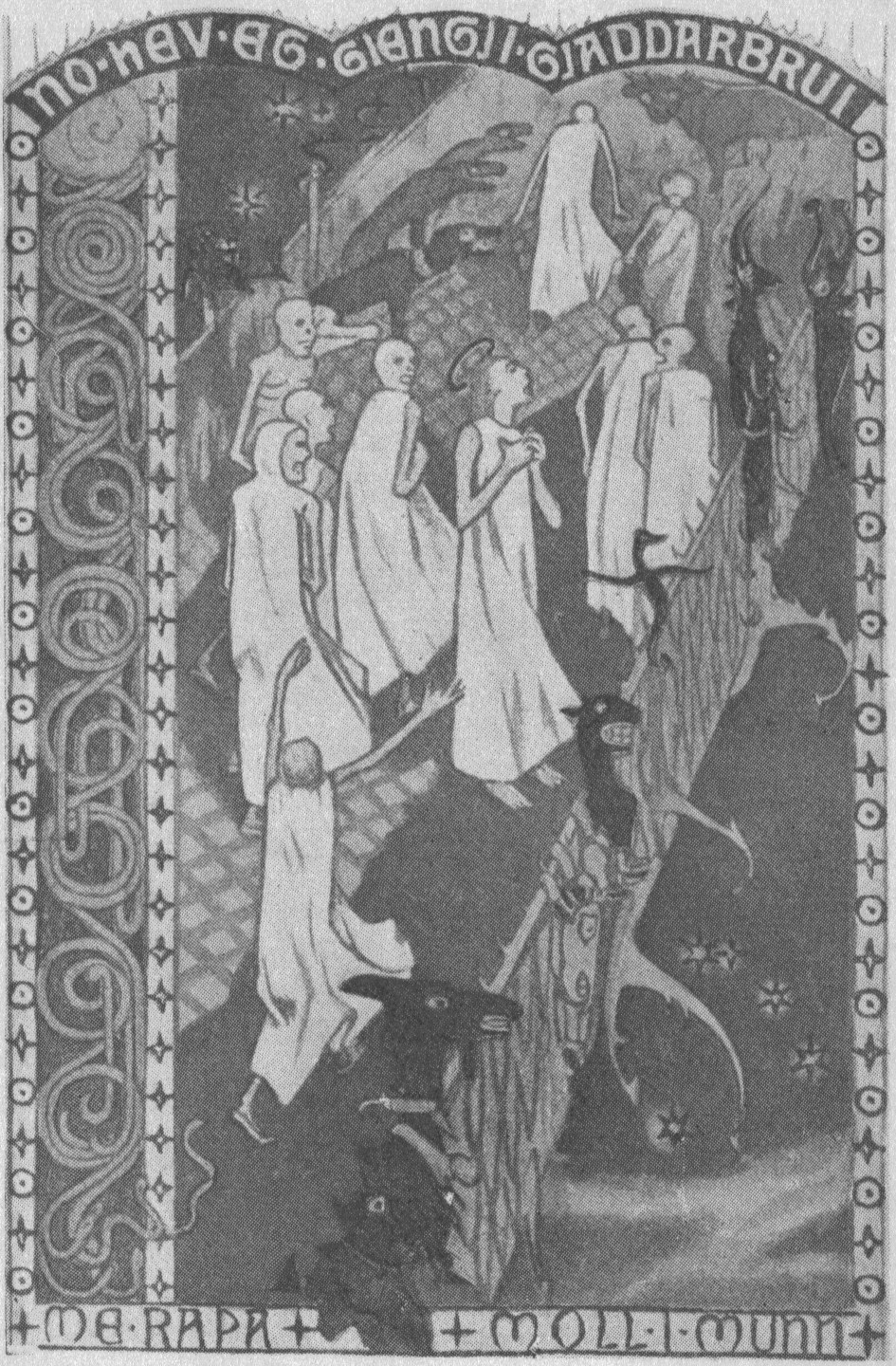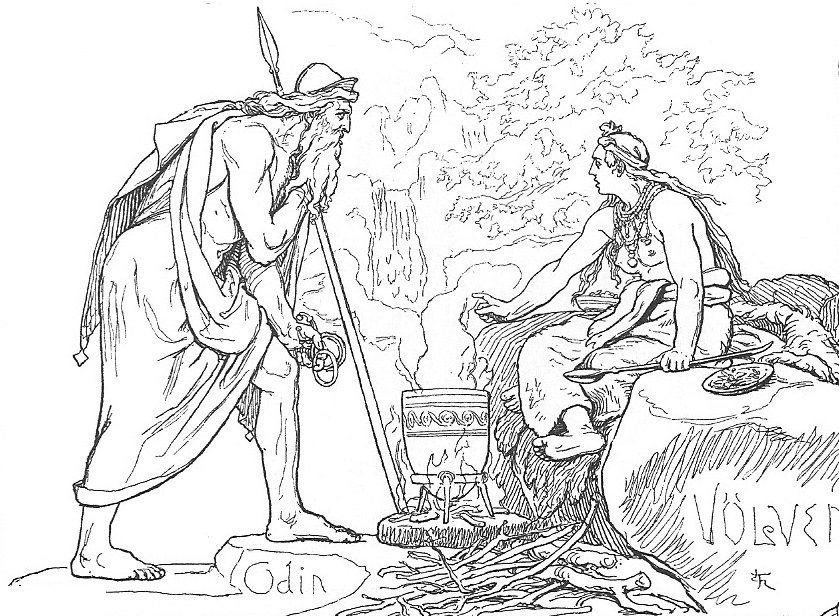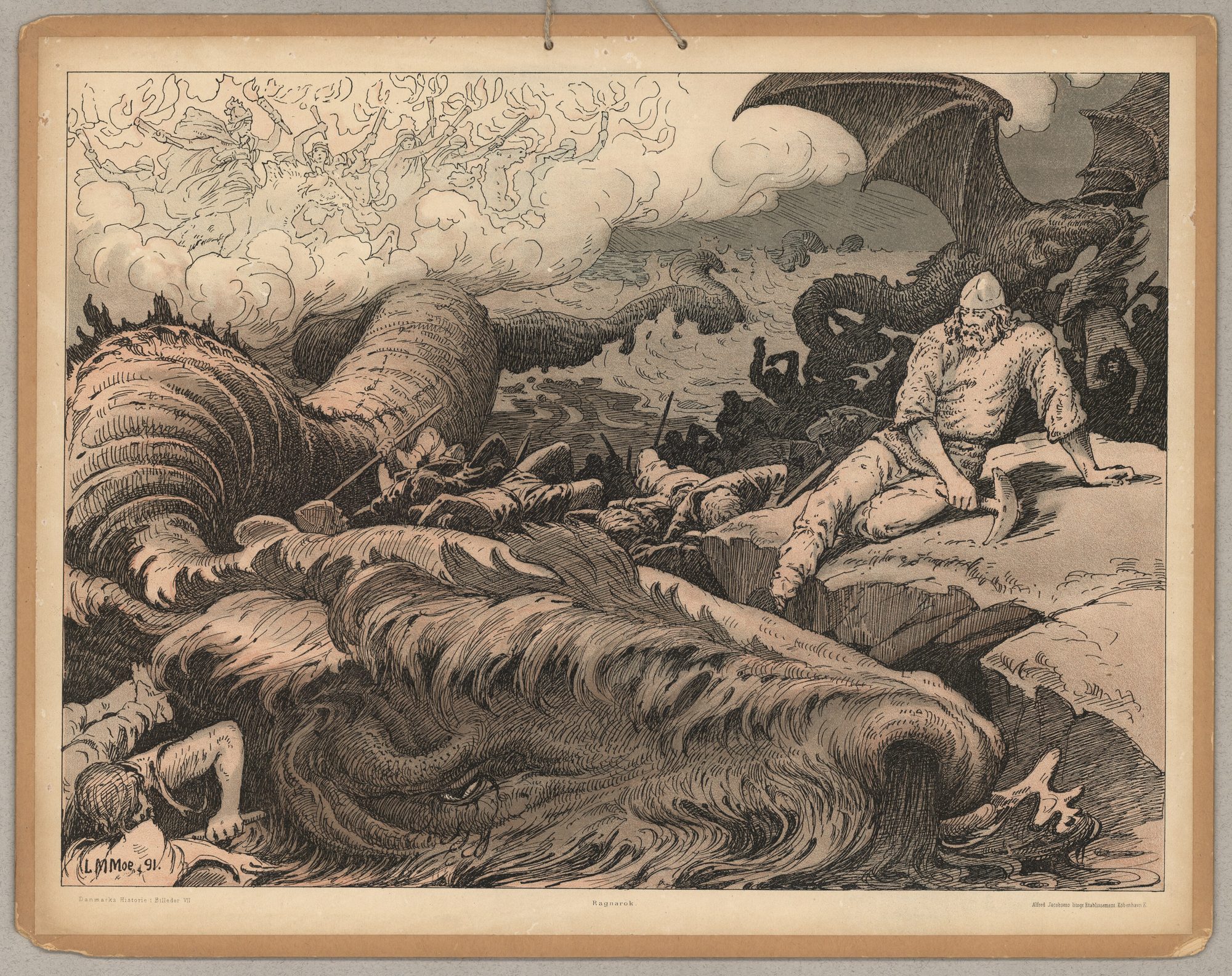
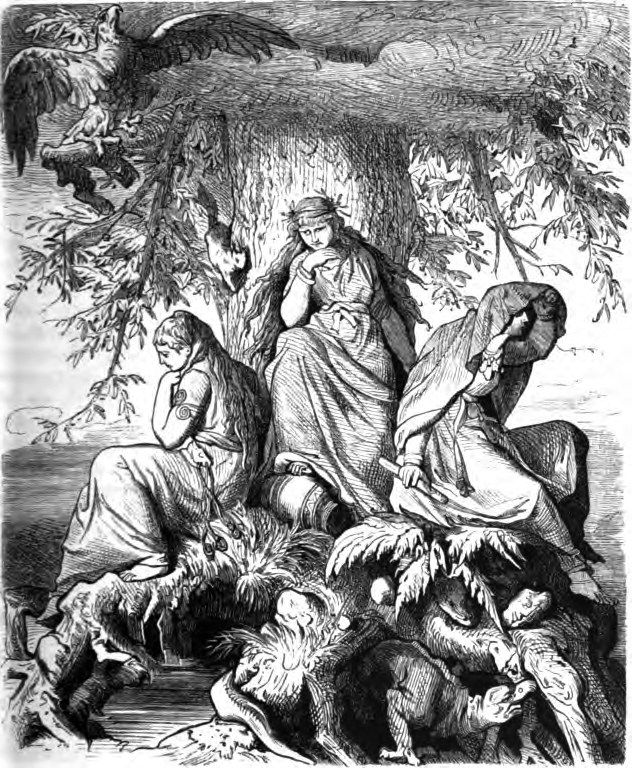
The seeress, dredging up the oldest things she knows, comes to a moment before the world was fully made and finds three women already at work. The great ash still stands green over the white water of Urd’s well, and up from a dwelling beneath the tree come three maidens, mighty in wisdom. They cut marks into wood. They lay down laws. And they allot to the sons of men their lives and set their fates. That is the whole of it in the poem, said almost without pause: three figures rise from under the world-tree and hand out the destinies of every one of the sons of men who will ever live. They are named Urd, Verdande and Skuld.
Three from the dwelling beneath the tree
Snorri, gathering the older verse into order, gives them an address. Yggdrasil has three roots, and the third runs up into heaven; beneath it lies the holiest of all wells, the well of Urd, and it is here the gods hold their court. Every day they ride to it over Bifröst, the trembling rainbow bridge, to give their judgements, and out of a fair hall beside the water come three maids whose names are Urd, Verdande and Skuld.
These maids, Snorri says plainly, shape the lives of men, and we call them norns. So the powers who fix fate do not sit apart in some remote place. They keep house at the exact spot where the gods themselves gather to be judged, which tells you something about who is answerable to whom.
What the names are made to carry
The three names have long been read as a tidy scheme of time. Urd is taken from the past tense of the verb to become,
and stands close to the old word wyrd, that which has come to pass; Verdande is the present participle of the same verb, the becoming that is happening now; Skuld belongs with the word for shall
and for debt, the thing that is still owed and must come. Past, present, and future, in a line.
It is an elegant reading and a very old one, but it is worth being honest that it is a reading. The verse itself only names the three; it does not gloss them. The temporal scheme is drawn out by the translators and editors from the shapes of the words, not stated in the Eddic lines, and it is best carried as an interpretation the names invite rather than a doctrine the poem asserts.
Water and white clay on the ash
Their work is not only decree. The norns who live by Urd’s well are also the gardeners of the world-tree, and the task is daily and physical. Every day they take water from the well, and the white clay that lies around it, and they sprinkle the great ash so that its limbs will not wither and rot. The water is holy past ordinary holiness: everything dipped into it comes out as white as the film inside an eggshell.
Two birds are fed there, the parents of all the swans that swim; the dew that falls from the tree onto the valleys below is called honey-fall, and the bees live on it. The image is worth holding against the popular one. These are not distant spinners drawing a thread; they are keepers of a spring, stooping each morning with water and pale mud to keep a rotting tree alive, and fixing fate as they go.
Of many births, nowise of one race
There is a second answer to the question of how many norns there are, and it does not quite agree with the first. When Sigurth asks the dying dragon Fáfnir who the norns are that come to women in childbed, Fáfnir tells him they are of many births and nowise of one race: some are of the gods, some of the elves, and some are the daughters of Dvalin, of the dwarf-kin. Not three, then, but a countless class of birth-spirits, one crowd of them attending every cradle.
Snorri holds both pictures at once and reasons about the difference: good norns of good descent shape good lives, he says, and when a man is weighed down with misfortune, it is the evil norns that are the cause. It is his own attempt to explain why fate falls so unevenly, and it is a gloss rather than old verse, but it draws its logic straight from Fáfnir’s line: if the norns are of unequal kinds, then the lots they deal will be unequal too.
The doom no fool escapes
Whatever their number, the weight of what they set is the same. Fáfnir warns Sigurth that the fate of the Norns waits for every fool before the headland; row against the wind and you drown, and all danger stands near to death. Their decrees are not advice but the shape of the end, and one name among them reaches past the well.
Snorri lists Skuld, the youngest of the three, a second time in another chapter, and there she rides out with the valkyries to choose who falls in battle, so that the norn who owes the future and the war-maid who collects the dead are, in his telling, one figure wearing two offices. Even the runesThe ancient letters of the Germanic futharks, believed to carry magic power when carved. of power keep her sisters’ mark: when the wise catalogue the strange surfaces the runes of wisdom were shaved and cut into, a bear’s paw, an eagle’s beak, a wolf’s claws, they name among them the nails of the Norns. The marks that bind the world are carved even onto the hands that carve.
Then there came three maidens, mighty in wisdom, / Up from the dwelling below the tree; / Laws they made there, and life allotted / To the sons of men, and set their fates. (Völuspá 20, trans. Bellows)
- Poetic Edda, Völuspá 19–20 (trans. Henry Adams Bellows, 1923; Project Gutenberg #73533, read verbatim)the ash standing ever green over the white water of Urd’s well; three maidens
mighty in wisdom
coming up from the dwelling beneath the tree, named Urth, Verthandi and Skuld; theyscored on the wood,
laid down laws and allotted the lives and fates of the sons of men. (Bellows notes that lines 3–4, the law-giving couplet, may be interpolated, and that the manuscript readssea
where editors printhall
for the maidens’ emergence; the narrative does not over-specify the manner of their coming.) - Poetic Edda, Fáfnismál 11–13 (Bellows, 1923; same ebook, read verbatim)
the fate of the Norns
as an inescapable doom that meets every foolbefore the headland
(11); Sigurth’s question about the Norns who help women in childbirth (12); Fáfnir’s answer that they areof many births
andnowise of one race,
some of the gods, some of the elves, some the daughters of Dvalin the dwarf (13). - Poetic Edda, Sigrdrífumál 17 (Bellows, 1923; same ebook, read verbatim)the catalogue of things on which runes of power were carved, among them
the nails of Norns.
- Snorri Sturluson, Prose Edda, Gylfaginning 15 (trans. Rasmus B. Anderson, The Younger Edda, Chicago 1880; Project Gutenberg #18947, read verbatim)the third root of Yggdrasil in heaven and beneath it the most sacred well of Urd, where the gods hold their doomstead and ride daily over Bifröst; the three maids Urd, Verdande and Skuld, who come from a hall by the well and
shape the lives of men
; the many other norns of god-, elf- and dwarf-kin whocome to every man when he is born, to shape his life
; and Snorri’s rationalising gloss that good norns shape good lives while evil norns bring misfortune. - Snorri Sturluson, Prose Edda, Gylfaginning 16 (Anderson, 1880; same ebook, read verbatim)the norns by Urd’s well taking water and the white clay each day and sprinkling the ash so its limbs
shall not wither nor decay
; the well-water so holy that all things dipped in it turnas white as the film … of an egg-shell
; the two swans fed there, and the honey-fall dew that feeds the bees. - Snorri Sturluson, Prose Edda, Gylfaginning 36 (Anderson, 1880; same ebook, read verbatim)Skuld named as
the youngest norn,
who also rides with the valkyries to choose the slain in battle.