Take the world-ash Yggdrasil and follow it down. Not up, past the branches into the sky where the bright halls stand, but down, along the great root that plunges away from the light and does not stop. It ends in mist. Somewhere in that cold there was a well before there was an earth, Hvergelmir, older than the ground you walk on, and out of it run eleven rivers of venom-cold water, and the last of them runs nearest a gate. Beyond the gate is a country. It has a name that the living learn only when they are past helping: Helheim, the home of Hel, the place that takes almost everyone.
The root that goes into the mist
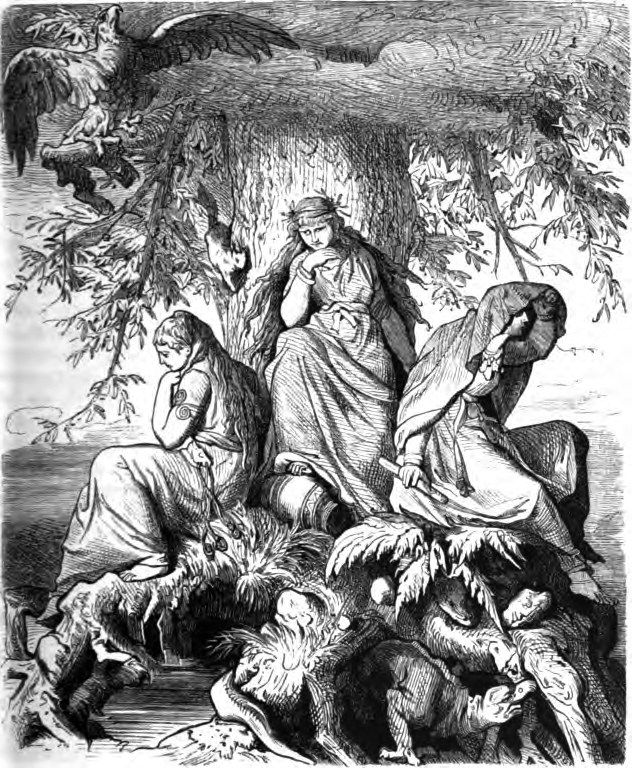
The Norse cosmos is a tree, and like any tree it is held by its roots, and the roots do not all reach into the same soil. Snorri counts three, and the poem of Grímnir counts three, and both send the last of them down into the dark. Under one root, says the poem, Hel abides; under the second, the frost-giants; under the third, mankind. The root that matters here is Hel’s own.
It drives down into Niflheim, the Mist-home, the primordial cold that existed before the world was made, and beneath it lies the ancient well. This is not a pit dug under the earth as an afterthought. It is older than the earth. The death-country is not a basement of creation but one of its foundations, as native to the shape of the cosmos as the ground under the living or the sky over the gods.
There is a guest at that root who never leaves. Beside the spring, at the root itself, coils Níðhöggr, the dark serpent, and it gnaws. It gnaws the root from below, year on year, working at the very timber that holds the death-realm to the tree, and it never finishes and never stops. The image is exact about what this place is: a corner of the world with something eternally eating at its underpinnings, kept and unmade at once.
Eleven rivers and the one that clangs
Before the road there is water. The well Hvergelmir does not sit still. Out of it pour eleven rivers, venom-cold, and Snorri lists them by name until he reaches the last, and of that last one he says the thing worth remembering: Gjöll is the river that runs nearest the gate of Hel. It is the boundary stream, the water you reach when the country of the living is finally behind you, and the older poem knows it too, telling that Gjöll and Leiptr are among the rivers that fall away hence, down to Hel.
The name is a warning in itself. Gjöll belongs to the old verb for resounding, for clanging and booming, and it is a river that makes a noise. A bridge is laid across it, and that bridge answers to the tread of the dead, and it answers loudest, as we will see, to the tread of anyone still alive. To arrive at Gjöll is to arrive at the edge of the audible world, where even the water announces you.
Downward and northward, nine nights in the dark
There is only one way in, and it is long. When a rider once went down to Helheim to ransom a soul back, the road he took is the fullest map the sources give, and every stage of it is cold. He rode nine nights, and through all nine nights the valleys were so deep and so dark that he saw no light at all, down and down, away from the sun.
There is no dawn on this road. The direction is fixed and it is telling: downward, and northward. Not west toward any sunset paradise, but north, into the quarter the Norse mind reserved for cold and mist and the ebbing of the year. Helheim is not a fire waiting below; it is the far cold end of a long descent, and the journey to it is nine sunless nights of falling.
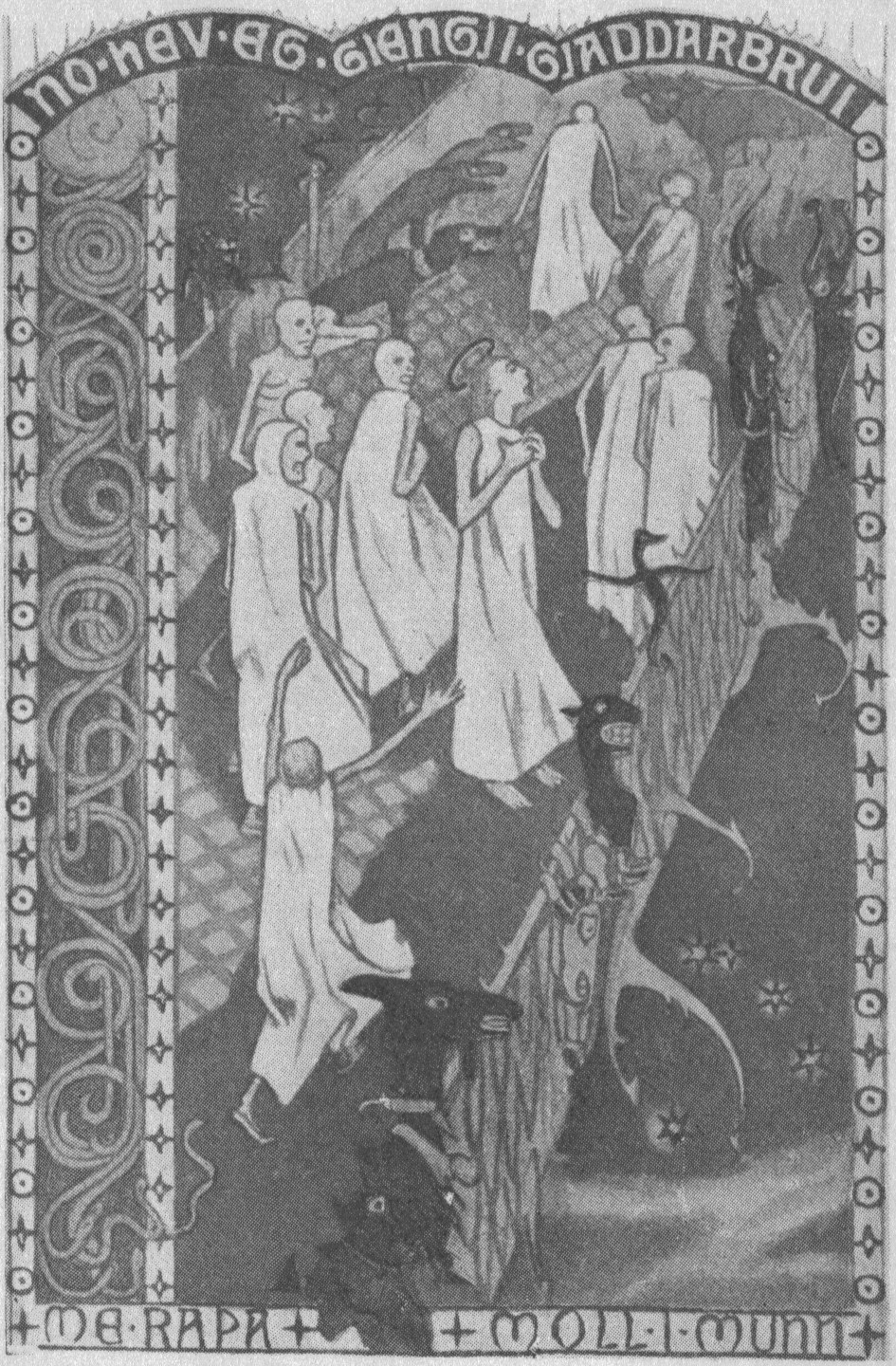
At the bottom the dark breaks on the pale shine of Gjöll, and on the single most vivid thing on the whole road: the Gjallarbrú, the bridge over the resounding river, thatched over the top with shining gold. A roof of bright gold laid across a black underworld stream. It is the one flash of splendour in a country of mist, and it is guarded.
A maiden named Móðguðr keeps the bridge, and when the living rider crossed it she told him something that measures the traffic of this place better than any census. Five whole bands of dead men had ridden over the day before, she said, and yet the bridge boomed no less under him, one living man, than it had under all five bands together. And he did not have the hue of dead men. She could hear the difference, and see it. The dead cross lightly. It is life that makes the golden bridge ring.
A gate too high to knock on
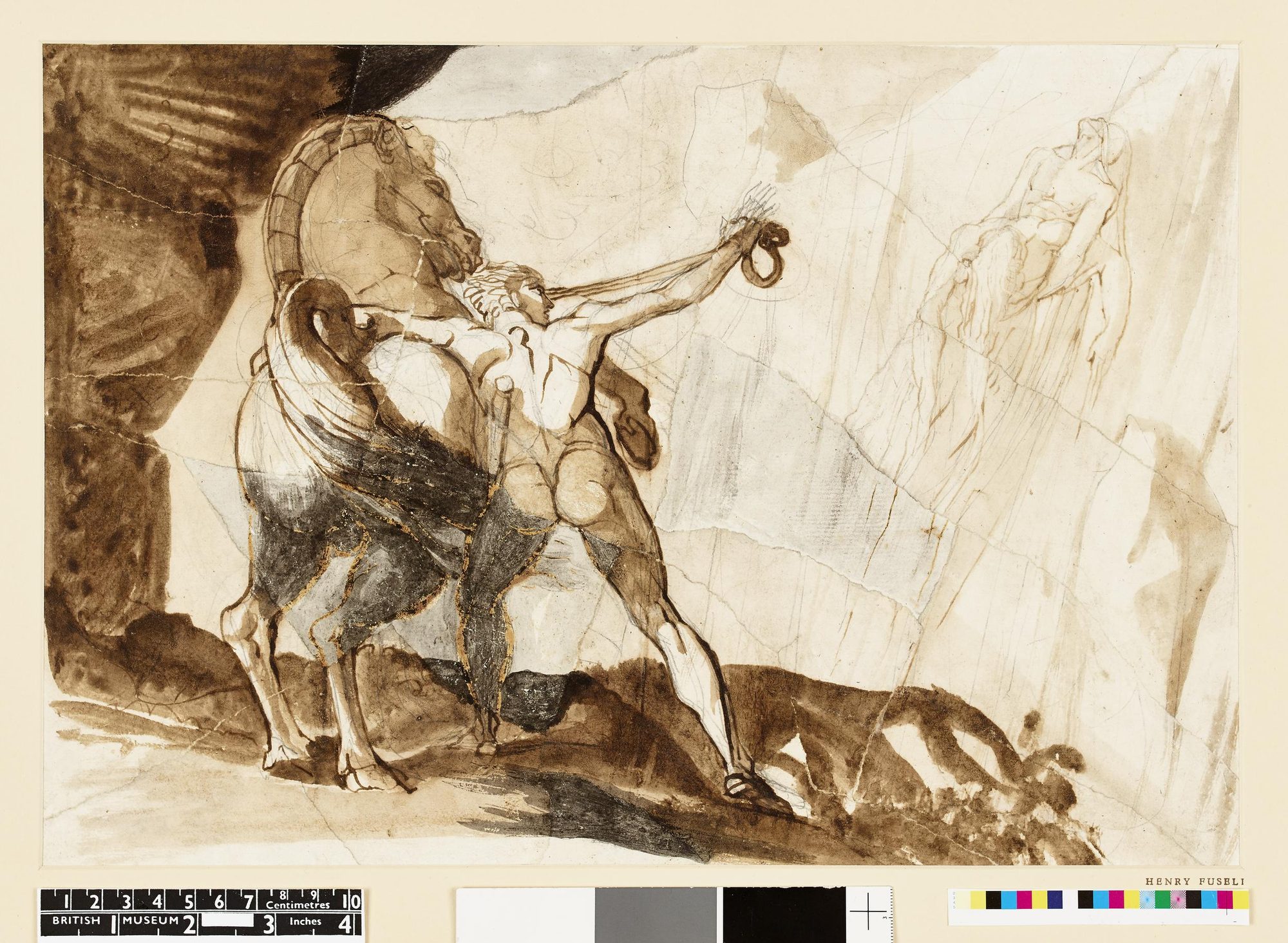
Past the bridge, the wall. Hel’s realm is walled and gated, and Snorri says the walls stand at a strange and forbidding height and the gate is huge. It is not a door you open. When the rider reached it there was simply no way through, and so he did the only thing left: he set his horse at it, drove in the spurs, and the beast gathered itself and leapt the gate of the underworld so cleanly that its hooves never so much as brushed the top.
That detail tells you the scale. The gate of Helheim is built not to be answered but to be impassable, a height that only a god’s own horse could clear in a single bound, and the ordinary dead do not clear it at all. They are let in. They do not get out.
The hall where the furniture has names
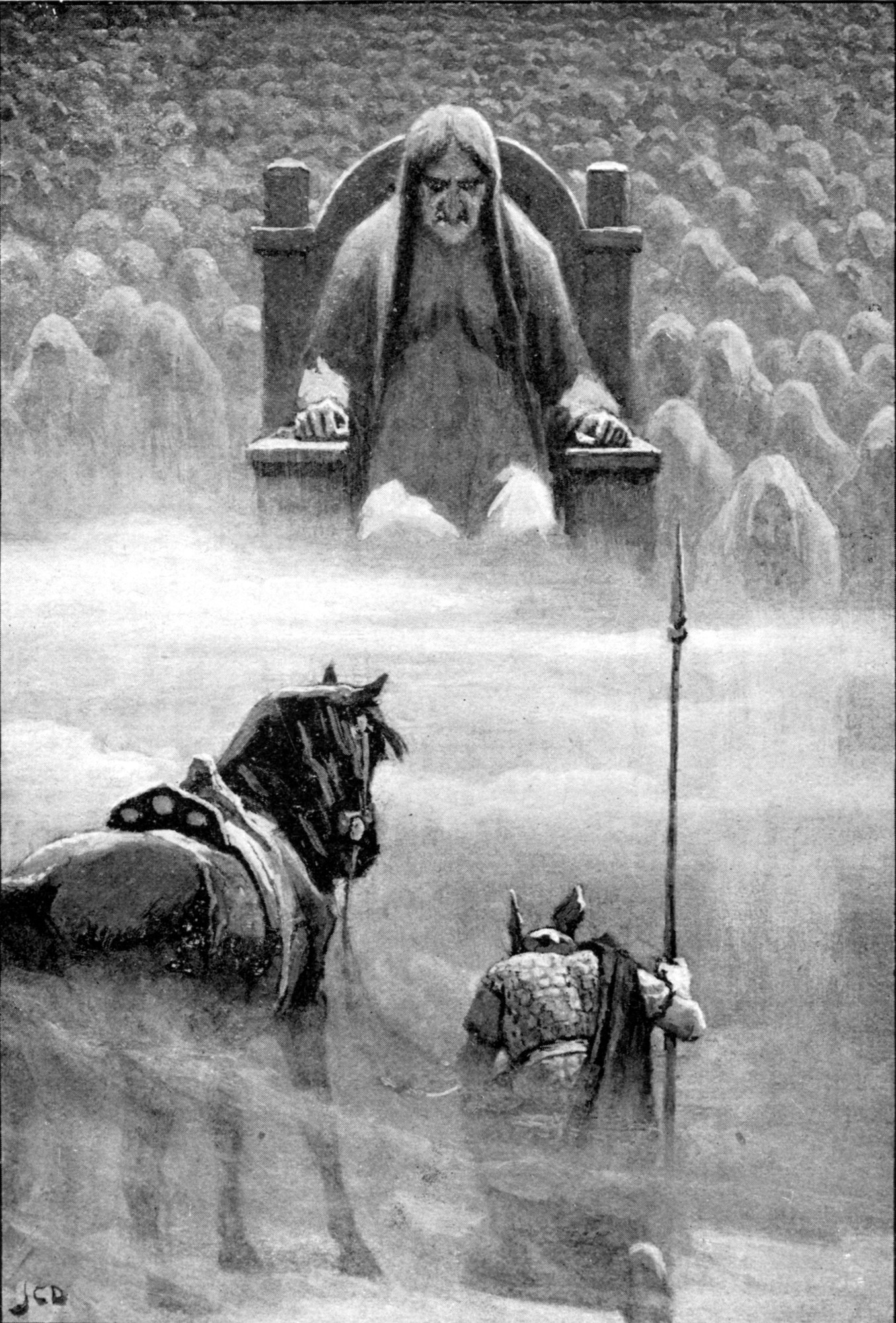
Inside stands the hall, and its name is Eljúðnir. Here the country stops being mere cold geography and becomes something crueller, because everything in the hall is named, and every name is a sentence passed on the guest. The table is Famine. The knife laid on it is Starvation. The threshold you cross to come in is called Stumbling-block, a pit of peril underfoot; the bed you are given is Care, the sick-bed, and the hangings drawn around it are Gleaming-bale, a shimmer of misfortune over the sleeper.
The servants who wait on you are Ganglati and Ganglöt, the slow ones, the tardy ones, whose very names are the dragging pace of the sick-room. This is a house furnished as an argument. To be received into Eljúðnir is to be seated at hunger and cut with starvation and laid down in care, and the furniture will not let you forget which house you have come to.
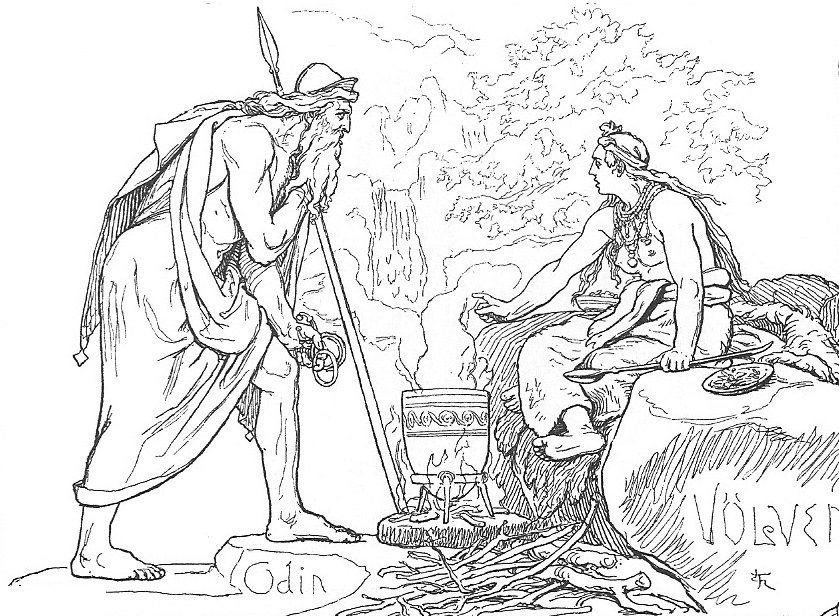
The older poem gives one last glimpse inside, from a time before the hall’s most famous guest had even died. When the benches of Hel stand strewn over with rings and the costly couches are overlaid with gold, and a cup of mead stands ready with a bright shield laid over it, brewed and waiting, the hall is not empty. It is prepared. A grim feast is set for a guest the living have not yet lost, which is the truest thing the sources say about this place. Helheim is not where you are sent as punishment. It is where you are expected. The mead is already brewed.
Here stands mead, / for Baldr brewed, / over the bright potion / a shield is laid. (Baldrs draumar 11–12, trans. Thorpe, 1866)
Who the cold country keeps
One question hangs over the whole realm: who goes there. The load-bearing answer is quiet and it is not about sin. Hel was given power over those who die of sickness or old age, and those are the people her country keeps, which is to say almost everyone who has ever lived. Not the battle-slain, who are chosen for other halls, but the ones who cough their lives out in a bed or wear them down to nothing in old age: the vast, un-sung majority of the dead.
There is a second, harsher line in Snorri, that the wicked go to Hel and the very wicked pass on from her to Niflhel, the ninth world further down, while the virtuous rise to Gimlé and Vingólf. But that reads as a later hand tidying the heathen dead into a moral ledger, a scheme that sits awkwardly beside the older and plainer rule. Helheim is not a hell for sinners. It is the cold north end of the world, under a gnawed root, past a clanging river and a golden bridge and a gate too high to open, and it takes you not for what you did but for how you died.
- Snorri Sturluson, Prose Edda, Gylfaginning 4 (trans. Rasmus B. Anderson, The Younger Edda, Chicago 1880; Project Gutenberg #18947, read verbatim)Niflheim existing before the earth; the well Hvergelmir at its midst; the eleven venom-cold rivers, of which Gjöll is ‘the last’ and runs ‘nearest the gate of Hel’.
- Snorri Sturluson, Prose Edda, Gylfaginning 15 (same edition, read verbatim)the three roots of Yggdrasil; the third reaching into Niflheim over Hvergelmir, where Níðhöggr gnaws the root from below.
- Snorri Sturluson, Prose Edda, Gylfaginning 34 (same edition, read verbatim)Hel cast into Niflheim and given dominion over those ‘who die from sickness or old age’; her great mansion with walls ‘of strange height’ and huge gates; the hall Eljúðnir and its household of grim names (table Famine, knife Starvation, threshold Stumbling-block, bed Care, hangings Gleaming-bale, servants Ganglati and Ganglöt).
- Snorri Sturluson, Prose Edda, Gylfaginning 49 (= Anderson ch. 52; same edition, read verbatim)the road to Hel ‘downward and northward’; the nine nights through deep and dark valleys with no light; the Gjöll-river and the gold-thatched Gjallar-bridge; Móðguðr the bridge-warden and her count of five bands of the dead crossed the day before; the huge high gate leapt untouched; Baldr in the foremost seat.
- Snorri Sturluson, Prose Edda, Gylfaginning 3 (same edition, read verbatim)the virtuous to Gimlé and Vingólf, the wicked ‘to Hel, and from her to Niflhel … the ninth world’ — recorded here as Snorri’s moralising overlay beside, not in place of, the death-by-sickness-or-age rule of ch. 34.
- Poetic Edda, Grímnismál 31 (trans. Benjamin Thorpe, Edda Sæmundar Hinns Fróða / The Elder Eddas, London 1866; Project Gutenberg #14726, read verbatim)‘Three roots … under Yggdrasil’s ash: Hel under one abides, under the second the Hrimthursar, under the third mankind.’ With Grímnismál 27–28 (Gjöll and Leiptr among the rivers that ‘fall hence to Hel’) and 32 (Níðhöggr gnawing below).
- Poetic Edda, Baldrs draumar 6–12 (Thorpe, same edition, read verbatim)Odin’s ride down to Niflhel on Sleipnir; the blood-stained hound met on the road coming ‘from Hel’; ‘Hel’s lofty house’; the benches ‘strewed o’er with rings’, the couches ‘o’erlaid with gold’, and the mead ‘for Baldr brewed’ waiting under a shield.