HomeArchiveThemesAbout

#Fate

Destiny, prophecy, the inescapable, and whether gods are bound by it.

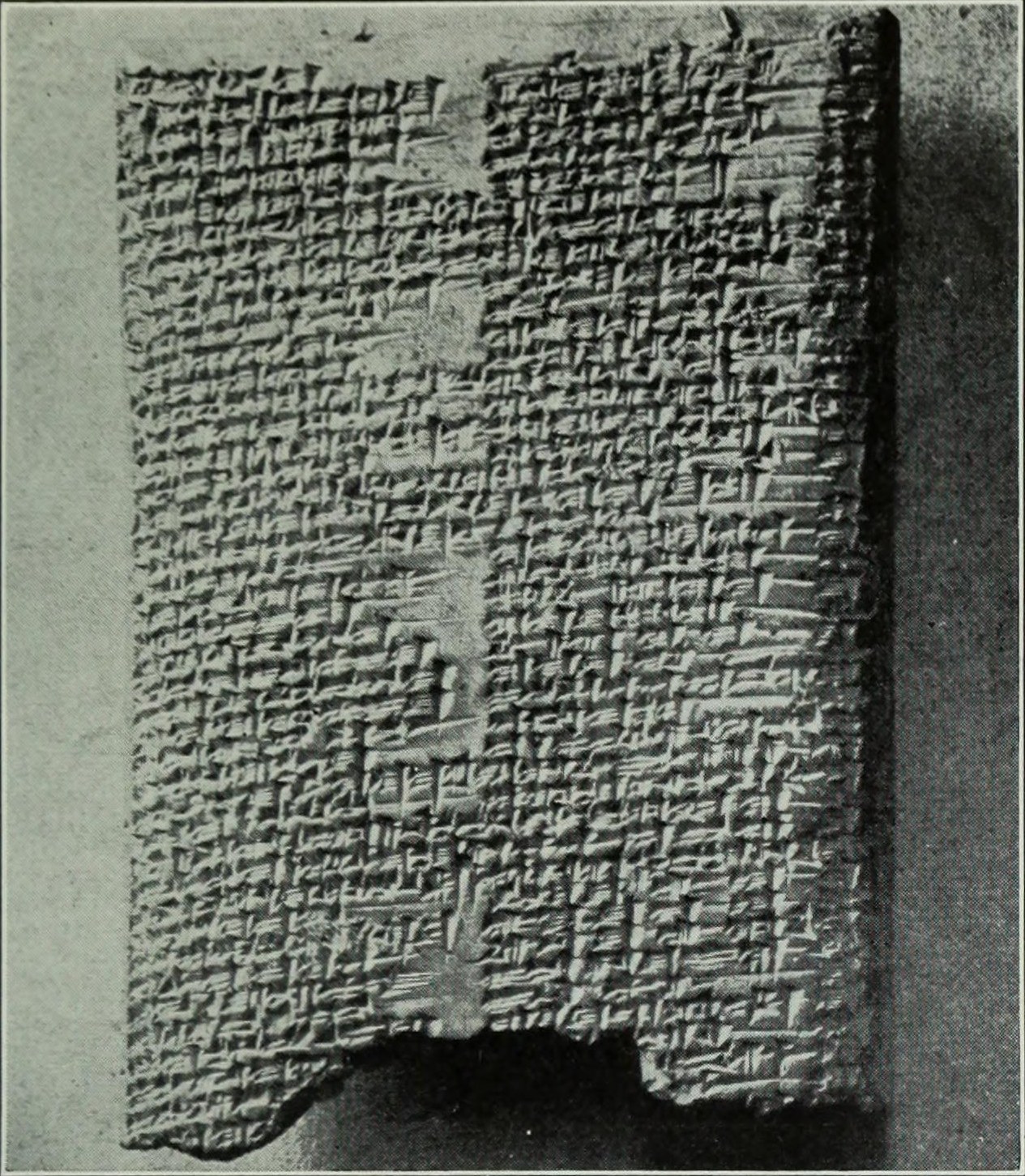
A photograph of the actual ancient clay tablet of the Fourth Tablet of the Babylonian Epic of Creation (Enūma Eliš), British Museum 93016: a broken rectangular fragment densely covered in columns of impressed cuneiform wedges, lit to cast a shadow on a plain ground.
Mesop.

The Tablet of Destinies and the Ordering of Fates

A single clay writ, sealed and laid over the heart, carried the right to decree the fate of the whole created order. Whoever held it ruled the universe, so the history of Mesopotamian kingship is the history of who held it next.
7 min*Enūma Eliš*
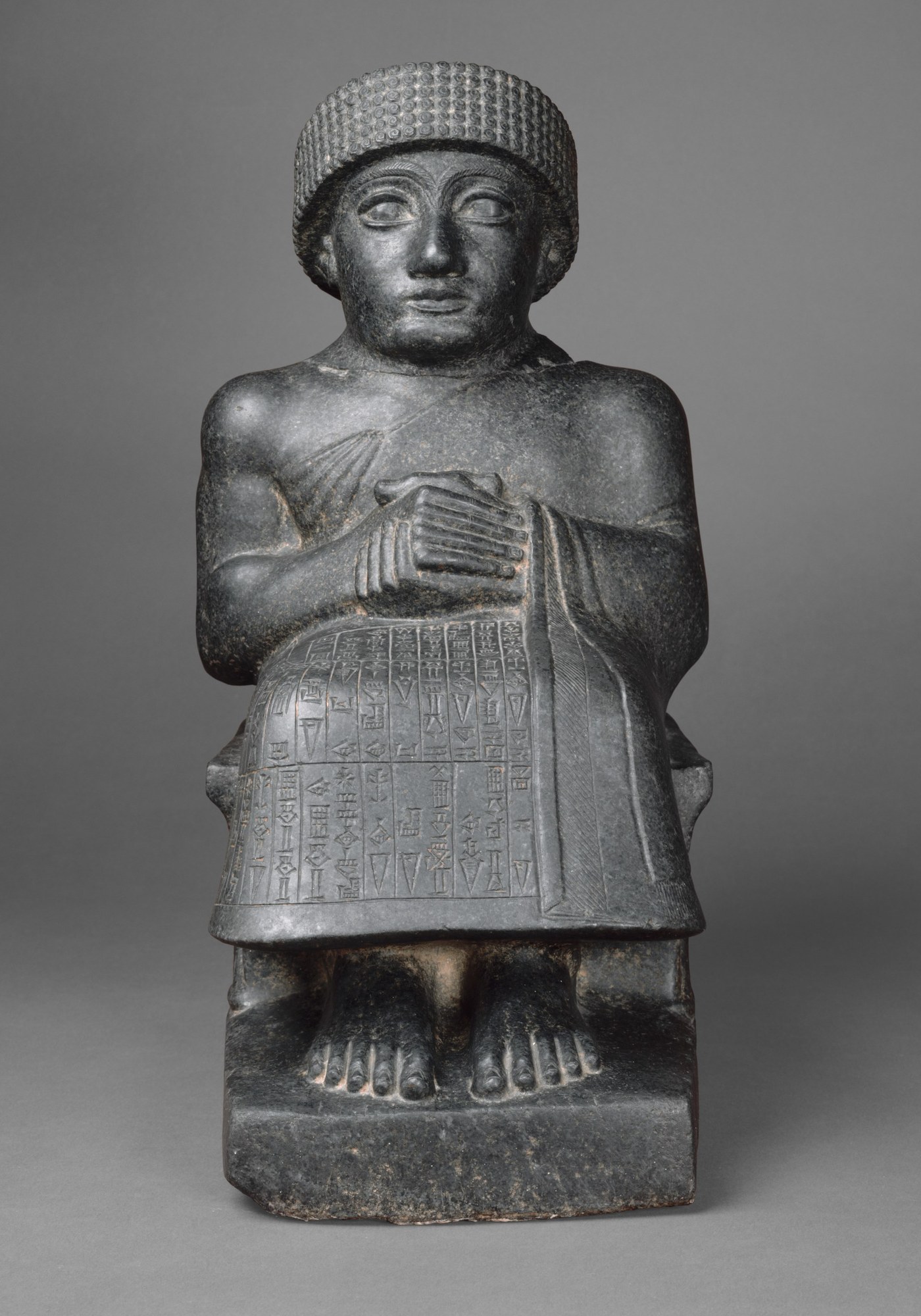
Neo-Sumerian diorite statue of the ruler Gudea of Lagash, seated with hands clasped in prayer at his chest, wearing a brimmed fleece cap and a fringed cloak over one shoulder; his lap and skirt are covered with columns of cuneiform, his bare feet resting on the base.
Mesop.

The Death of Gilgamesh

The strongest king who ever lived is dying in his own bed, and in a dream he must stand before the gods and hear them decide what a man is allowed to keep.

7 minThe Death of Gilgameš
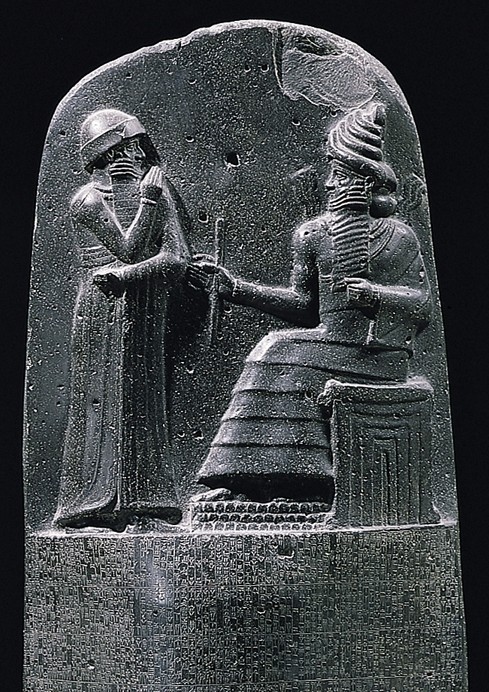
The relief at the top of the law stele of Hammurabi: at right the sun-god Shamash sits enthroned on a tiered temple-façade throne, wearing the many-tiered horned crown of divinity with flames rising from his shoulders, extending the rod-and-ring of just rule; at left the standing king Hammurabi raises one hand to his mouth in reverence to receive it. Carved in dark basalt, the figures set against a plain black ground above the opening lines of the cuneiform law-code.
Mesop.

The Decreeing of Fates at the New Year

Once a year the most powerful man in Babylonia was stripped of his crown, struck on the cheek and made to weep, so that a council of gods could settle his fate and the land's for the twelve months to come.

8 min*Enūma Eliš*
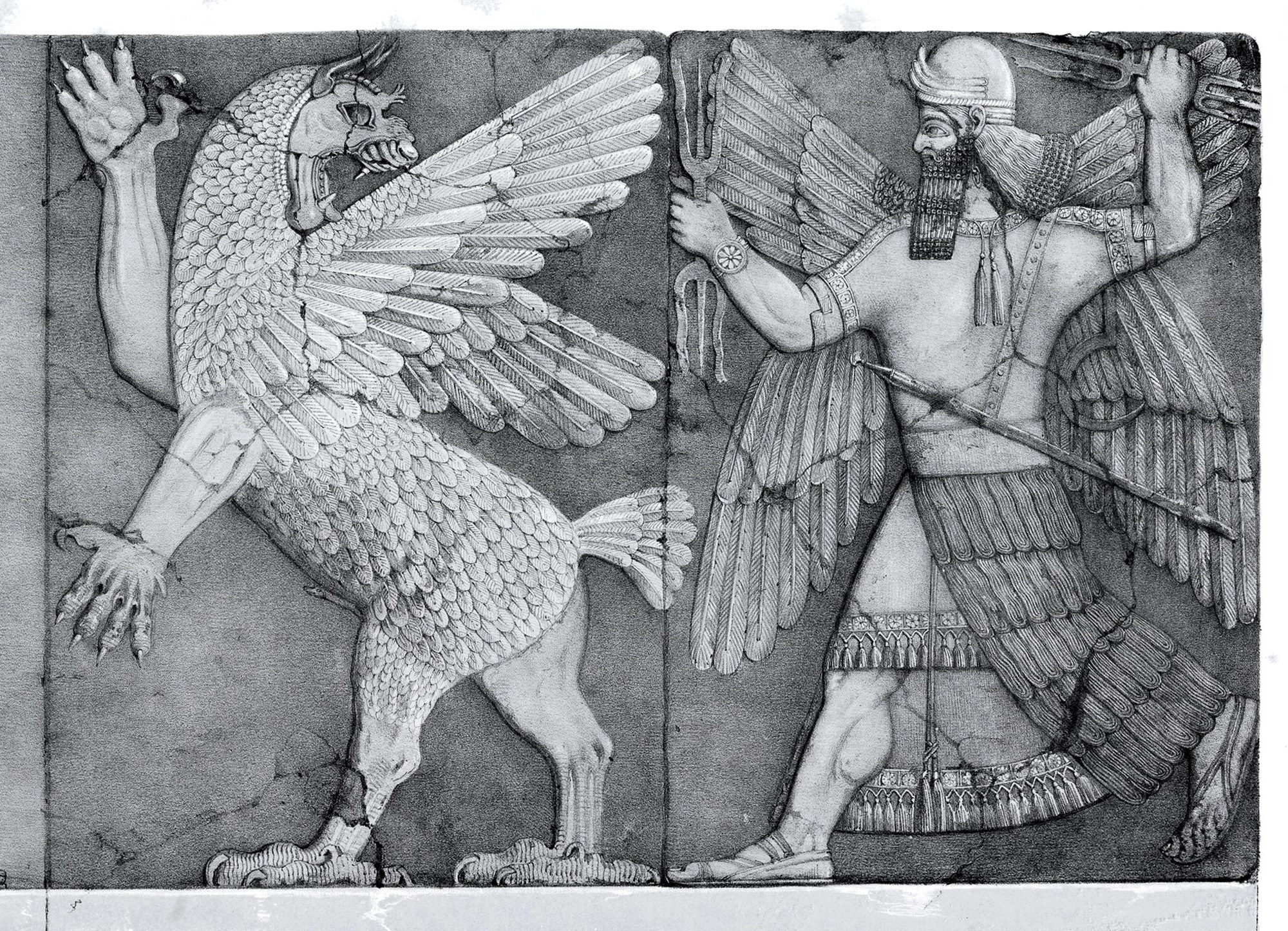
A 19th-century line engraving of a Neo-Assyrian palace relief: at right a bearded, winged warrior-god in a horned helmet strides forward, raising a weapon overhead and holding a bow, pursuing at left a winged, lion-headed and horned monster that flees with clawed hands thrown up.
Mesop.

Anzu's Theft of the Tablet of Destinies

The storm-bird has stolen the writ of fate and made his own word law, and every god the assembly names to fight him refuses. The recovery is a hunt won not by strength but by a trick that turns the thief's own magic dead.

6 minThe Standard Babylonian *Myth of Anzu* / *Epic of Anzû*
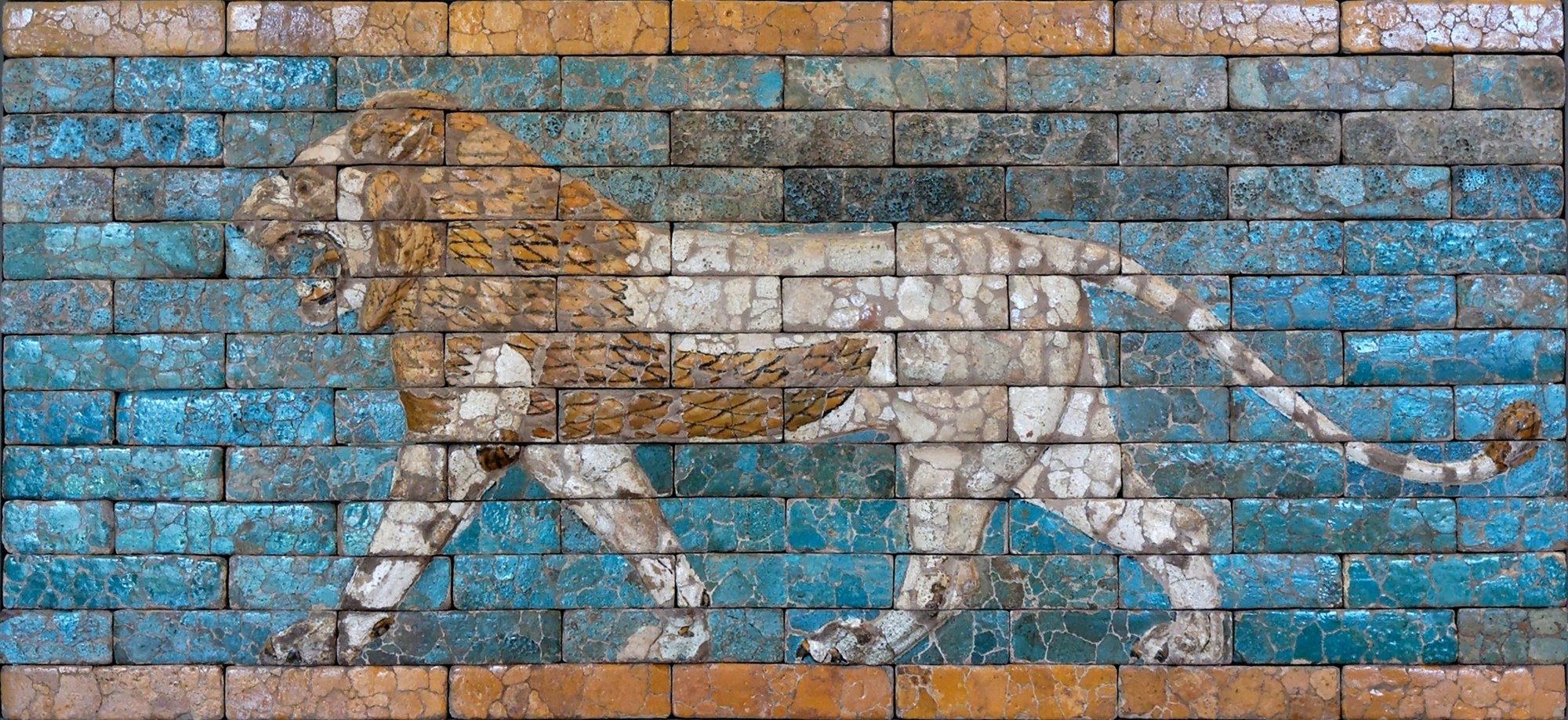
A striding, roaring lion in molded glazed brick — tawny mane, cream body, tail curling up behind — walking left to right across a turquoise-blue field bordered above and below by bands of ochre brick, from the Processional Way of Babylon.
Mesop.

The Akitu: Babylon's New Year Festival

For eleven days each spring the priests of Babylon washed a god, stripped a king of his crown and slapped him until he wept, then carried the whole company of the gods out through the glazed gate to renew the year.

8 minF. Thureau-Dangin
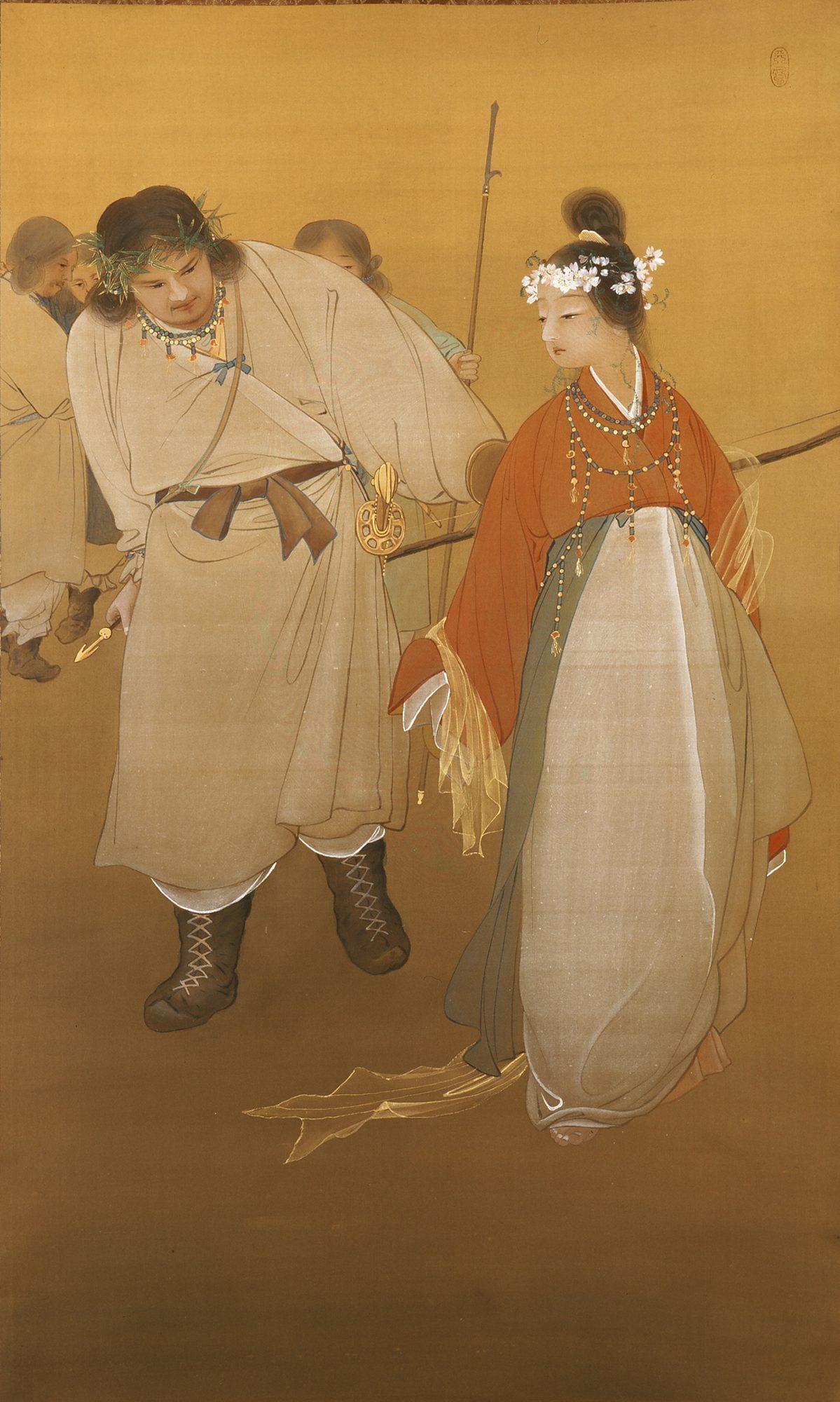
Japanese silk painting of Ninigi-no-Mikoto, the heavenly grandchild, striding in a pale robe with a leafy crown, jewelled necklaces and a gold-fitted sword, beside the blossom-princess Konohana-sakuya-hime, who is crowned with cherry blossom and robed in vermilion over pale green; attendants follow softly behind against a gold ground.
Japanese

The Descent of Ninigi

The sun-goddess hands her newborn grandson a mirror and tells him to reverence it as her own spirit, then sends him down the Floating Bridge of Heaven to rule the earth: how the imperial line came down from the sky, and why its rulers die like flowers.

7 minKojiki
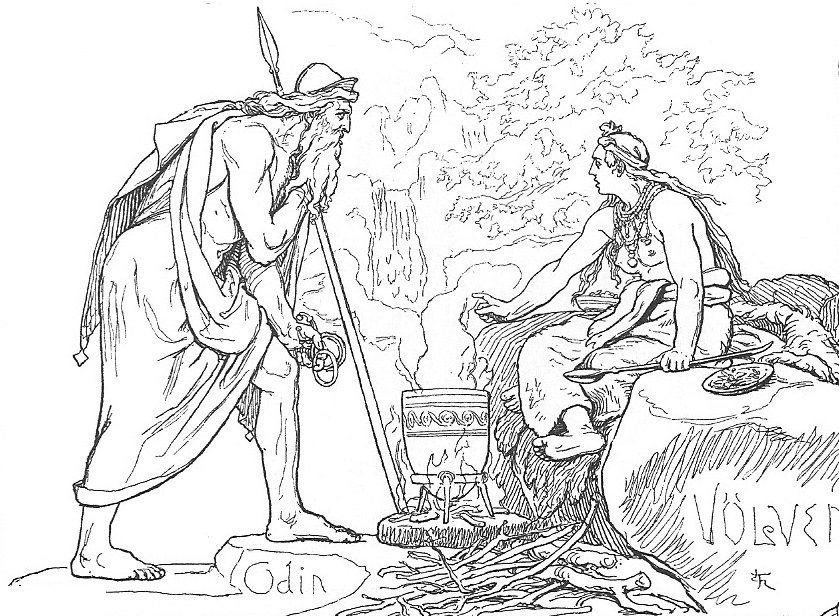
Pen-and-ink line engraving. At left the one-eyed Odin, in a winged cap and a long cloak, leans forward on his upright spear and his sword, his long beard falling; at right the seeress (the völva) sits on a fur-draped rock, one hand raised in speech, a shallow bowl in her lap; a steaming cauldron stands on a low fire between them, a leafy tree behind. The ground bears the incised labels "Odin" and "VÖLVEN".
Norse

The Seeress's Prophecy

Odin raises a dead wise-woman to make her speak, and she gives him the whole arc of the world: its making, his own hidden secrets, and the fire that ends it all.

7 minPoetic Edda
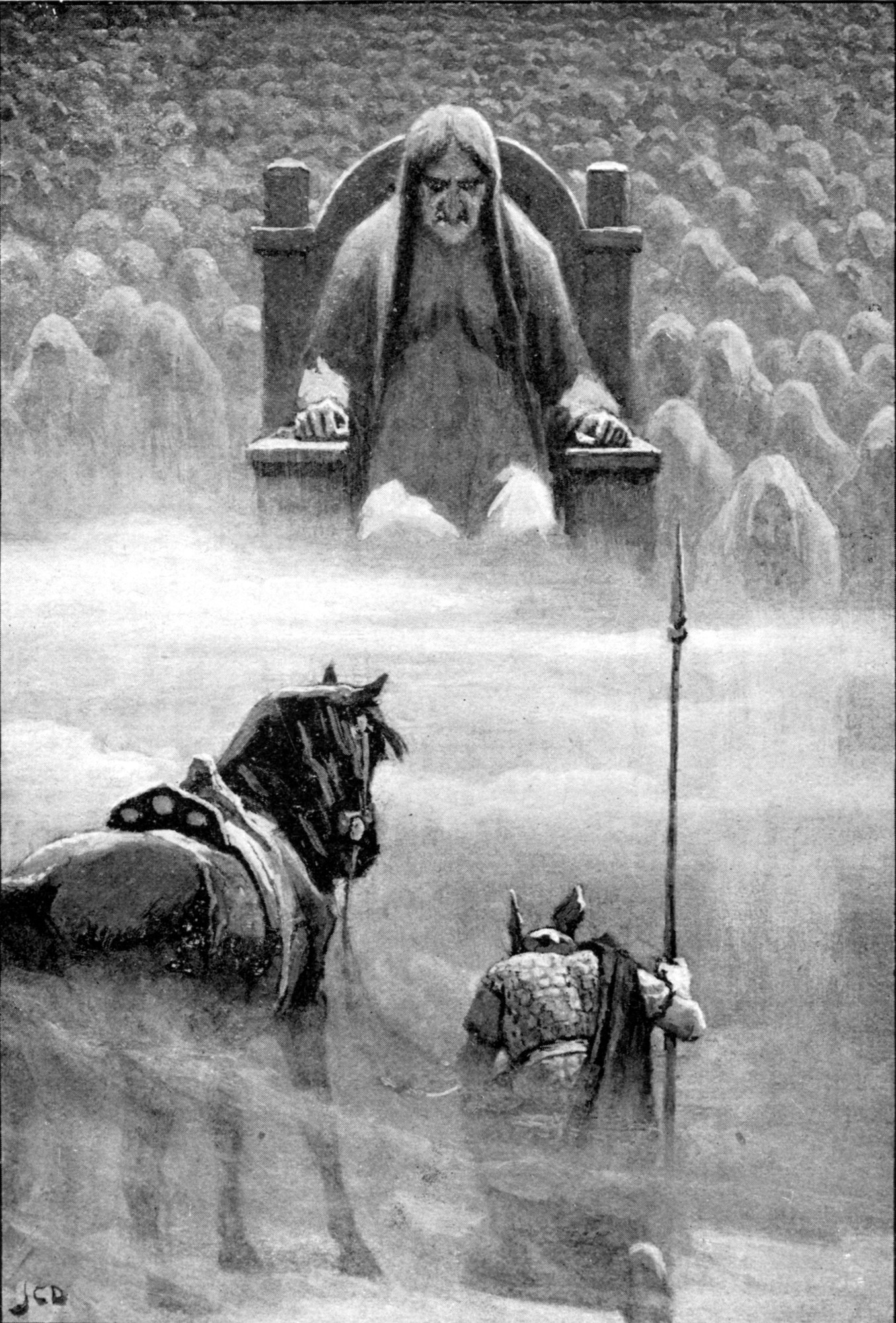
Hel, grim and stern-faced, enthroned on a stone high-seat in the misty dark of her realm, both hands gripping the throne-arms, ranks of the shrouded dead receding behind her; below, Hermóð the Nimble kneels before her with his spear, having dismounted from Odin's dark horse Sleipnir.
Norse

Hel, Queen of the Dead

Half her body the hue of living flesh, half of it corpse-blue, she keeps a hall where the table is called Famine and the bed is called Care: the daughter Odin cast into the mist to rule everyone who dies quietly.

5 minSnorri Sturluson
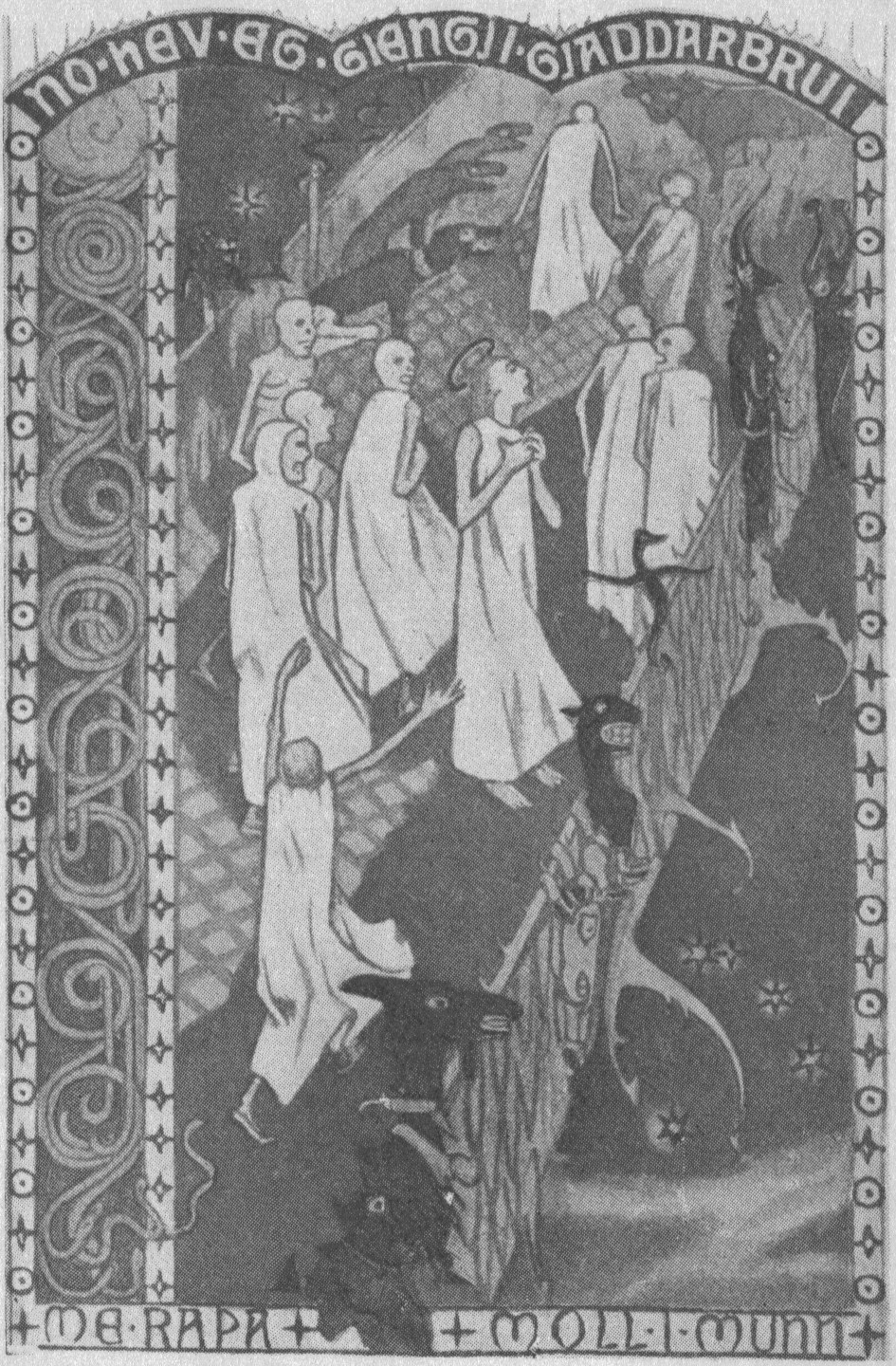
A tall decorative book-plate in the medieval-manuscript manner, worked in grey monochrome and framed by borders of interlaced serpents. A file of pale, shrouded dead climbs a narrow ledge toward a bridge at upper right, led by a haloed figure; dark horned beasts crouch in the shadowed lower reaches. A runic banner across the top reads 'NO HEV EG GJENGJI GJADDARBRUI' ('Now I have crossed the Gjallar-bridge').
Norse

Helheim, the Realm of the Dead Below

Downward and northward, under a root of the world-ash, lies the cold country that takes everyone who dies quietly: nine lightless valleys, a river that clangs, a gold-roofed bridge and a gate so high a god must leap it.

6 minSnorri Sturluson
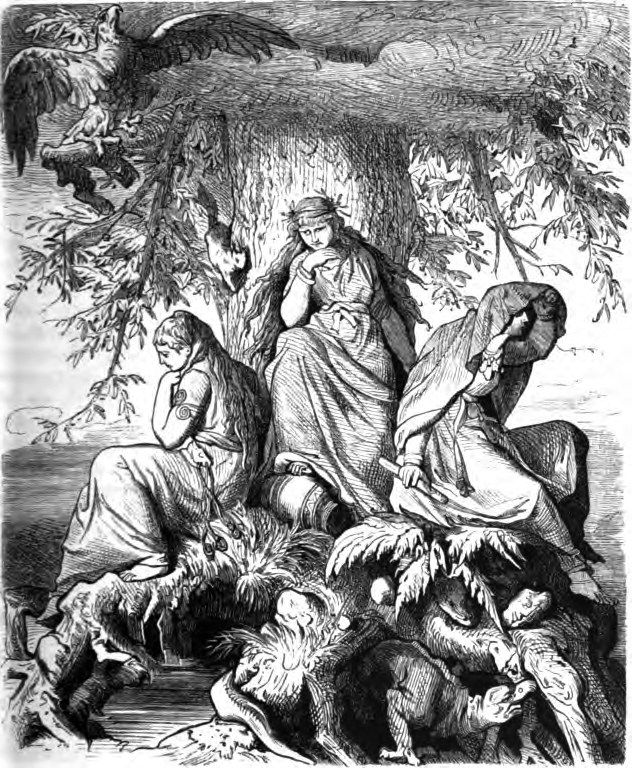
Wood-engraving of the three Norns beneath the world-ash Yggdrasil — three seated maidens in long robes under the great tree, an eagle perched in its crown above and a serpent and gnawing beasts coiling among the exposed roots below.
Norse

The Norns, Shapers of Fate

Three maidens mighty in wisdom come up from a dwelling beneath the world-ash, cut marks into wood, and lay down the lives of the sons of men.

5 minPoetic Edda
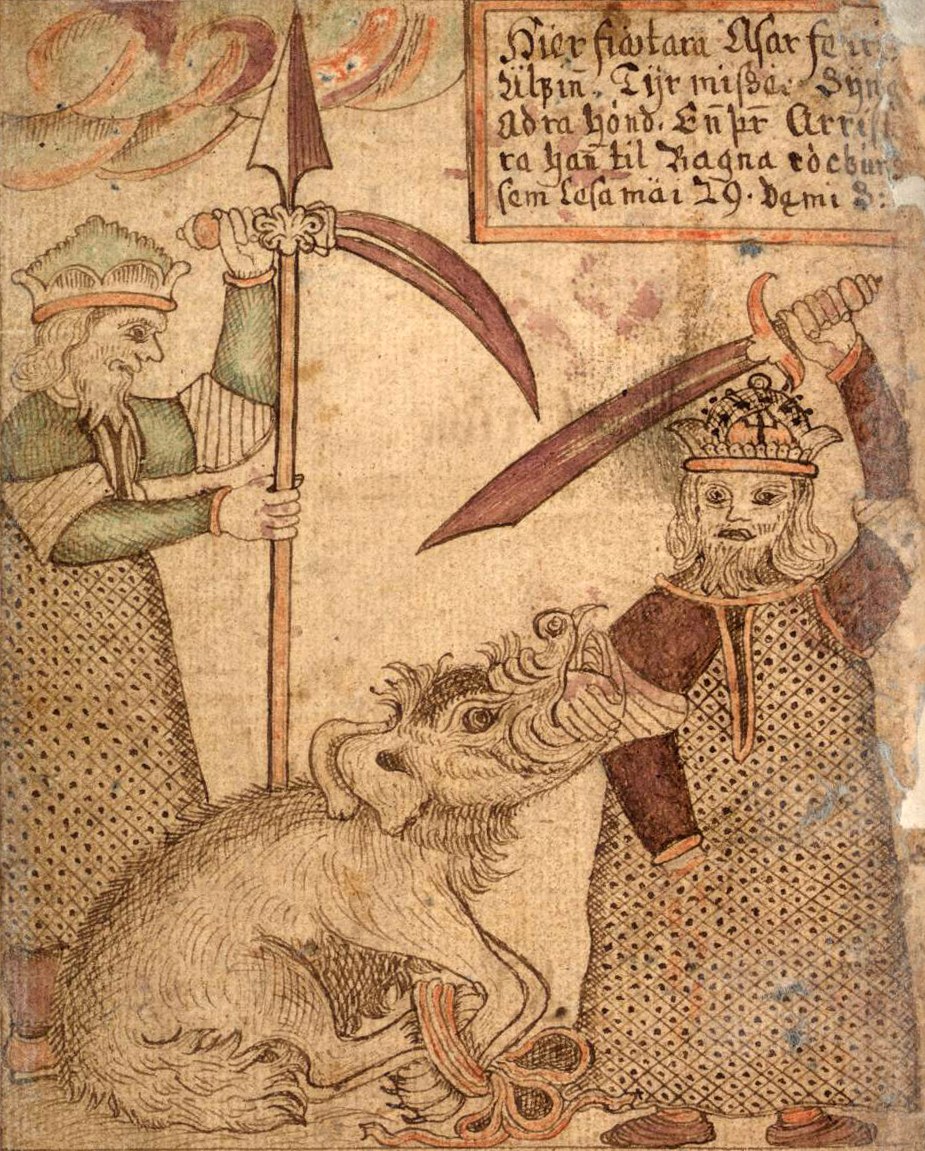
An 18th-century Icelandic manuscript illustration of the binding of Fenrir: at right the crowned god Týr, sword raised in one hand, his other hand thrust into the jaws of the great wolf, which bites down on it; the wolf Fenrir crouches at centre; at left a second crowned god of the Aesir holds a spear and a curved fetter; a handwritten caption box sits at the upper right.
Norse

Tyr, God of the Oath

The boldest of the Aesir laid his sword-hand in a wolf's jaws to bind a doom he could not defeat, and lost it: the god who kept a pledge he knew was false.

5 minSnorri Sturluson
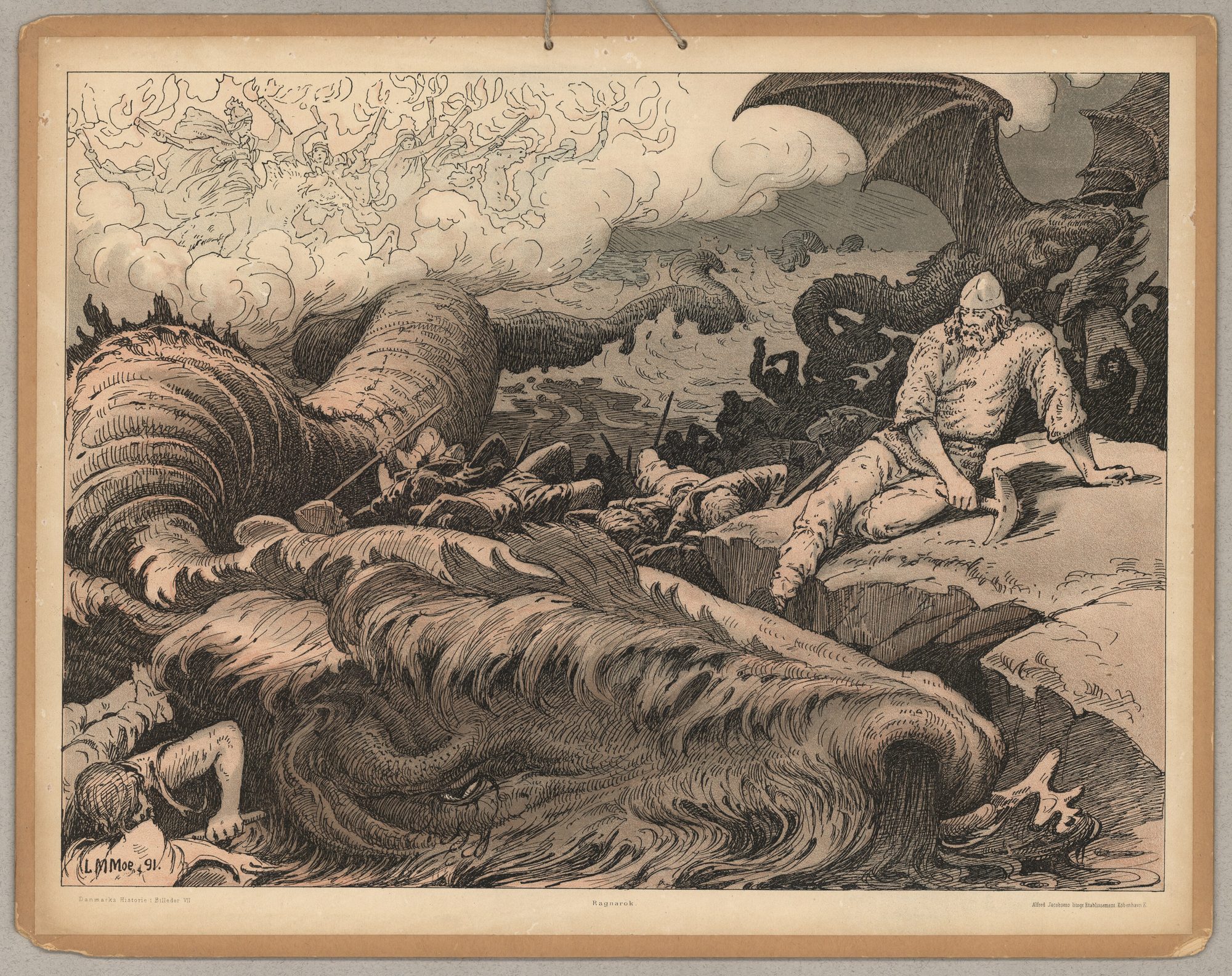
A colour lithograph of Ragnarok: the world consumed in fire and collision, figures and beasts falling amid a blazing sky, in Louis Moe's symbolist register.
Norse

Ragnarök, the Doom of the Gods

Not a twilight but a doom: the wolf runs free, the serpent floods the land, a ship of dead men's nails breaks loose, and the gods ride knowingly to a battle the prophecy says they cannot win, on a field a hundred miles square.

8 minPoetic Edda
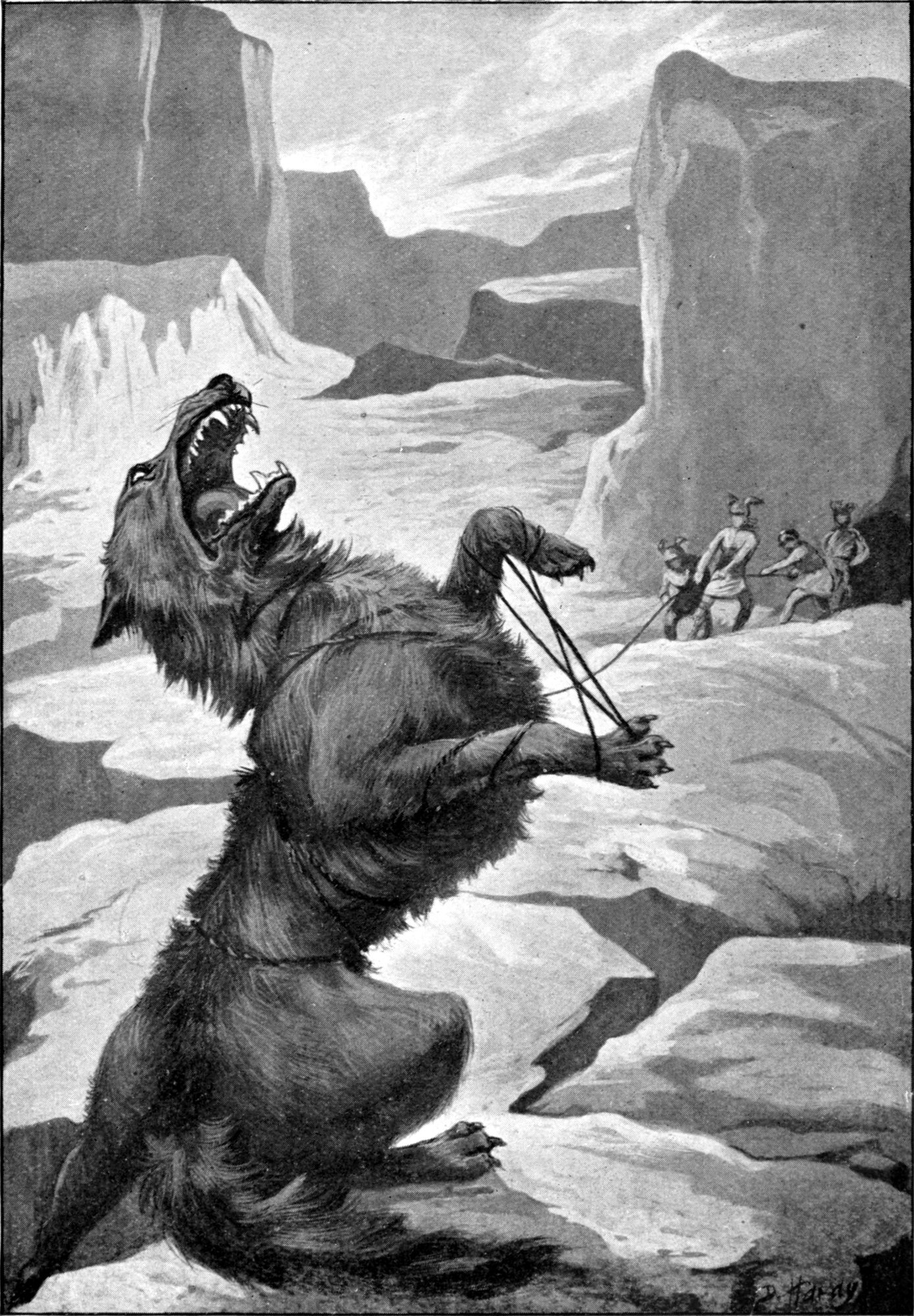
A monochrome wash drawing of the binding of Fenrir: the great wolf's jaws gaping wide around the god Týr's outstretched hand as the unbreakable fetter holds.
Norse

The Binding of Fenrir

A wolf the gods reared at home, two iron chains he snapped like kindling, and a ribbon of six impossible things: how the Aesir caught the beast fated to kill Odin, and what it cost the one god brave enough to feed him.

6 minSnorri Sturluson
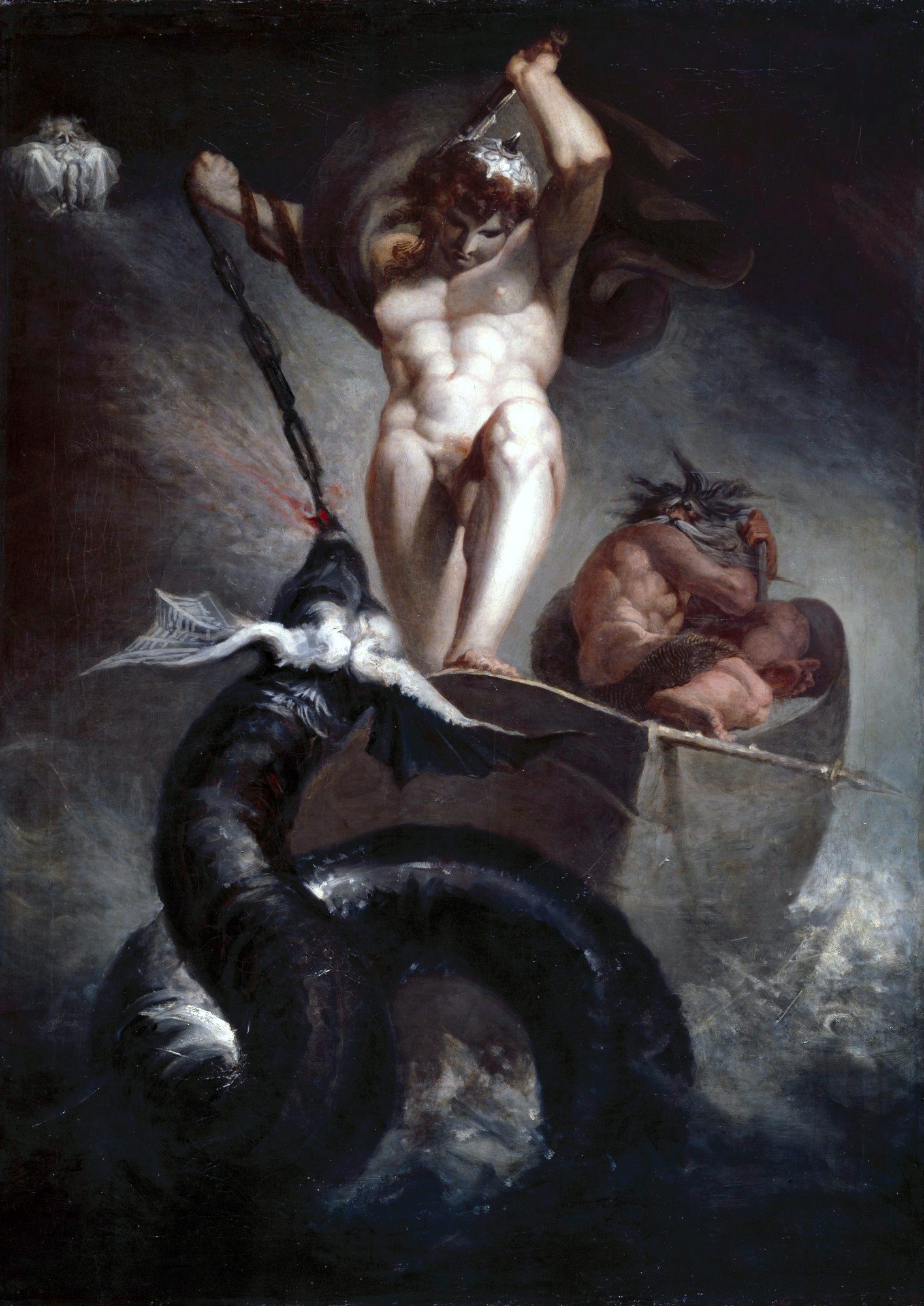
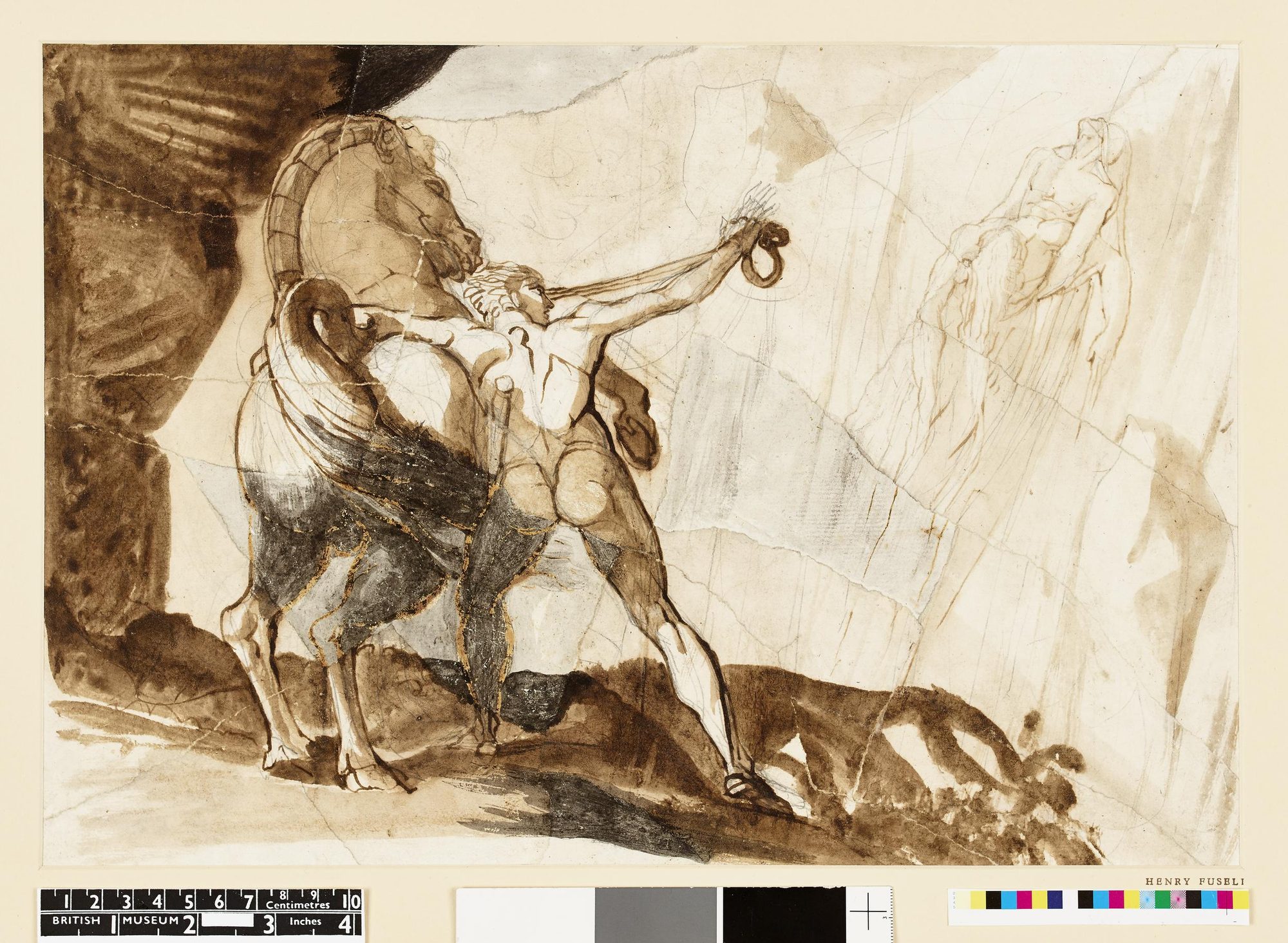
Fuseli's dark oil painting of the muscular nude Thor standing braced on the gunwale of Hymir's boat, his hammer raised high overhead, hauling up the fishing line at whose end the great Midgard-serpent Jörmungandr rears its scaled coils from the black sea below; the red-faced giant Hymir cowers in the stern.
Norse

Jörmungandr, the World Serpent

Odin flung a newborn snake into the sea to be rid of a prophecy, and it grew until it ringed the whole earth and bit its own tail: the boundary of the world, and the one foe fated to kill Thor even as Thor kills it.

5 minSnorri Sturluson
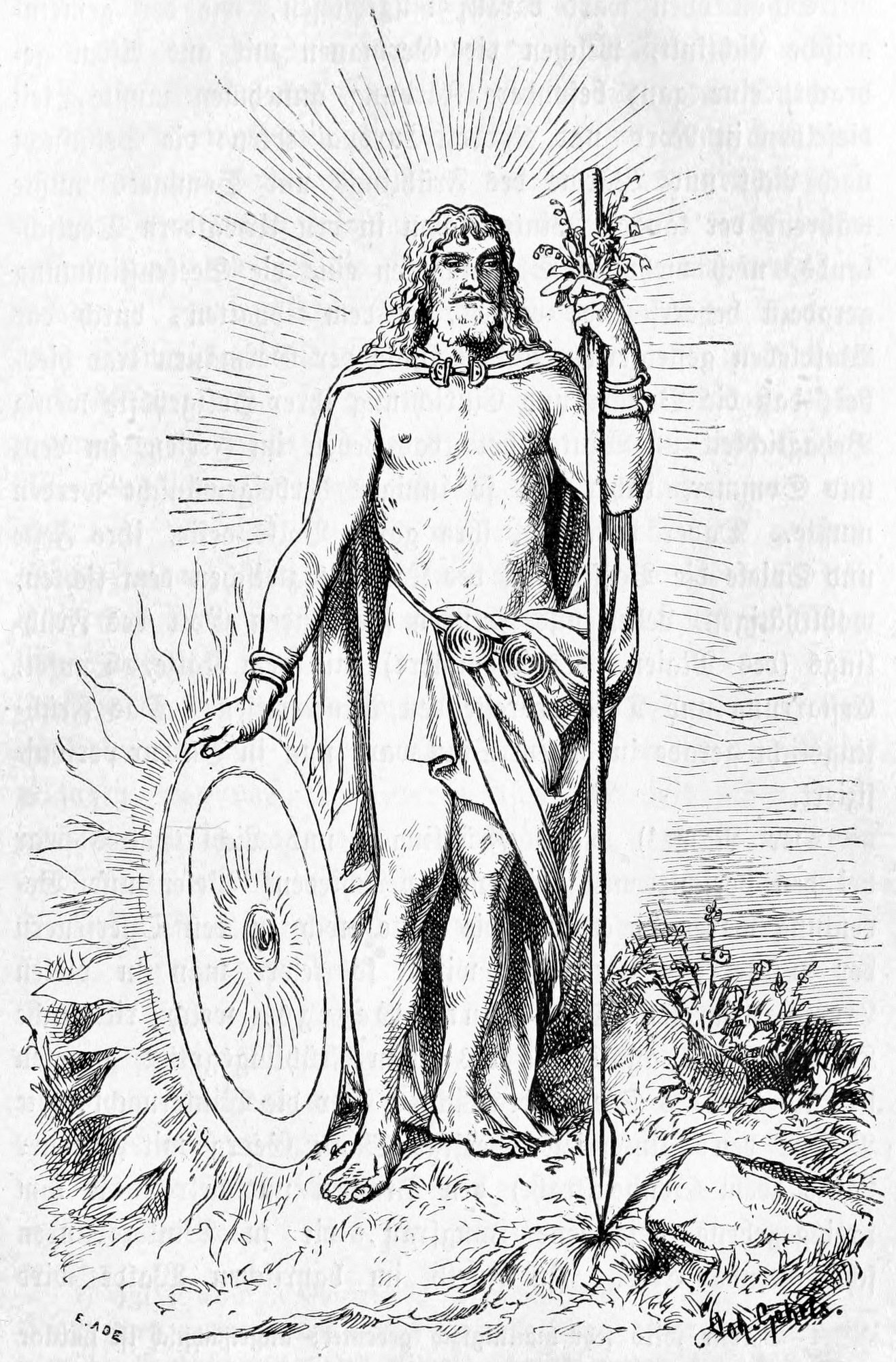
An 1888 illustration of the shining god Baldr, fair-haired and armed, standing in the hall of Walhall.
Norse

Baldr the Shining

The best of the gods, so fair that light streamed from him, at home in a hall nothing unclean could enter: the portrait of a god the myth was built to take away.

4 minSnorri Sturluson
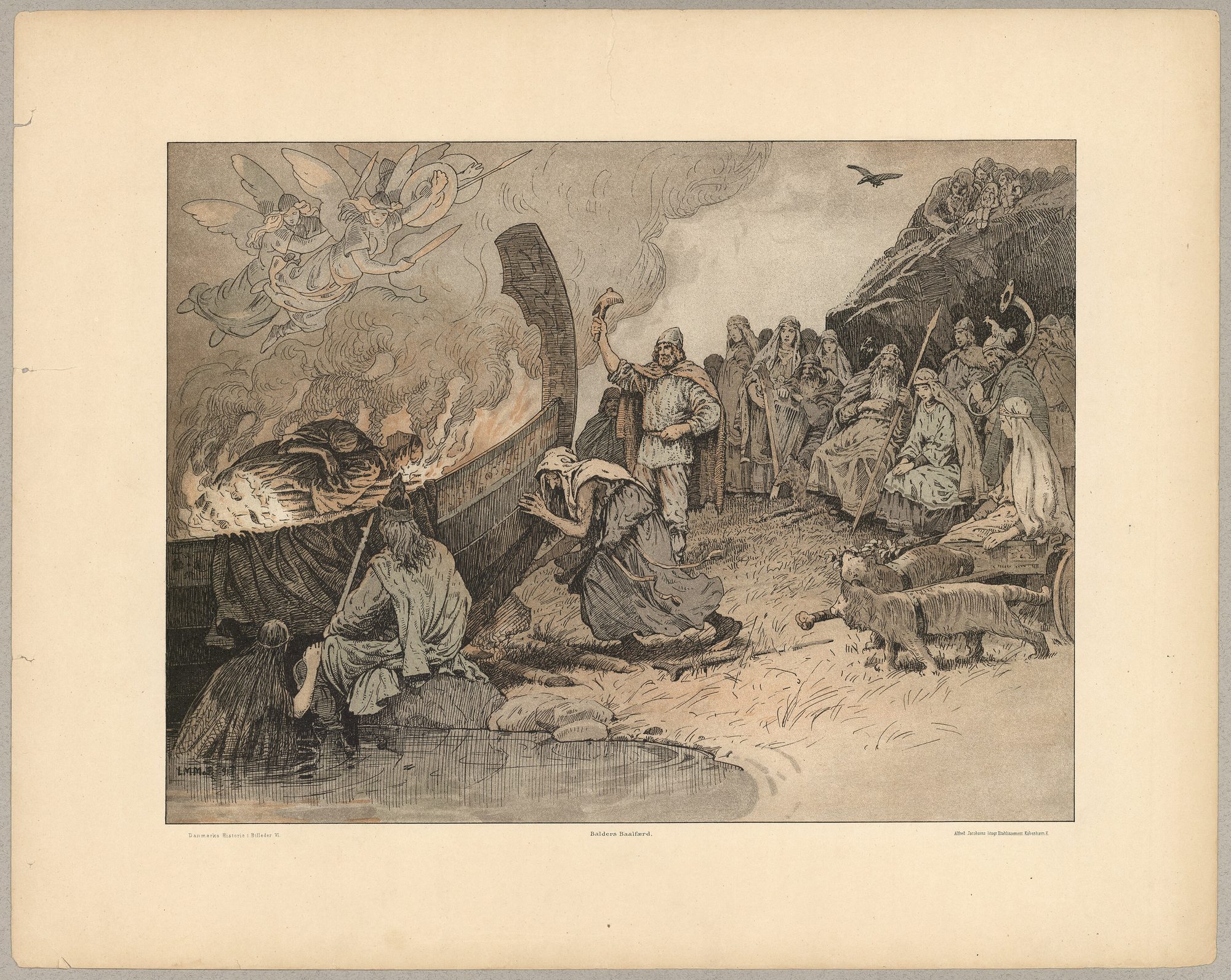
A colour lithograph of Baldr's ship-pyre funeral: the dead god laid on his burning ship, mourners gathered on the shore as flames and smoke rise.
Norse

The Death of Baldr

A god the whole world had sworn never to harm, a sprig of mistletoe no one thought to ask, and a blind brother's hand: how the north's best-loved god was murdered into Hel and the doom of the gods began.

7 minSnorri Sturluson
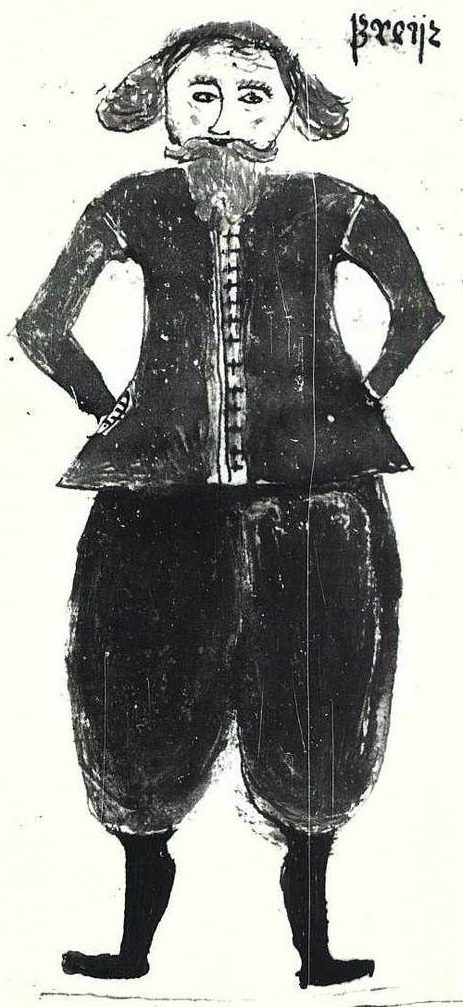
A naïve 17th-century Icelandic manuscript drawing of the Norse god Freyr as a bearded, long-haired man standing frontally with his hands on his hips, wearing a buttoned dark tunic, wide breeches and boots, his name "Freir" inscribed in the upper-right corner.
Norse

Freyr, Lord of Plenty

He climbed into a seat that was not his, looked out over all the worlds, and fell so hard for a giant's daughter that he gave away the one sword that could have saved him: the Vanir god of the fruitful season, lord of the elves, and the most renowned of the gods you called on for peace.

6 minPoetic Edda
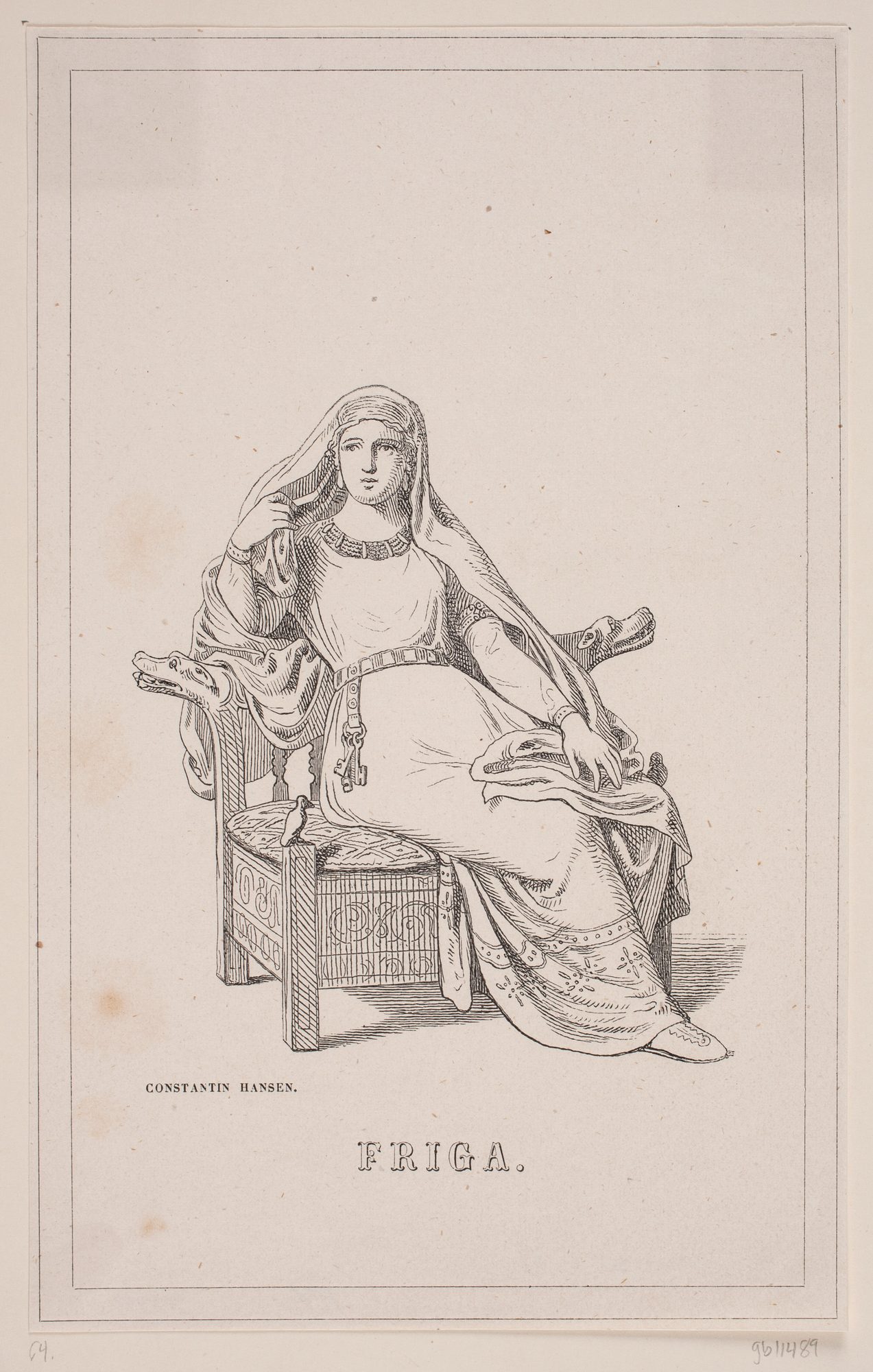
A 19th-century print of the goddess Frigg as a crowned queen, standing full-length in flowing robes, a distaff in one hand.
Norse

Frigg, Queen of the Aesir

She knows the fate of every living thing and never speaks it, and when the one doom she tried to bar comes for her son, all she can do is weep: the foremost of the goddesses, undone by a single overlooked shrub.

5 minSnorri Sturluson
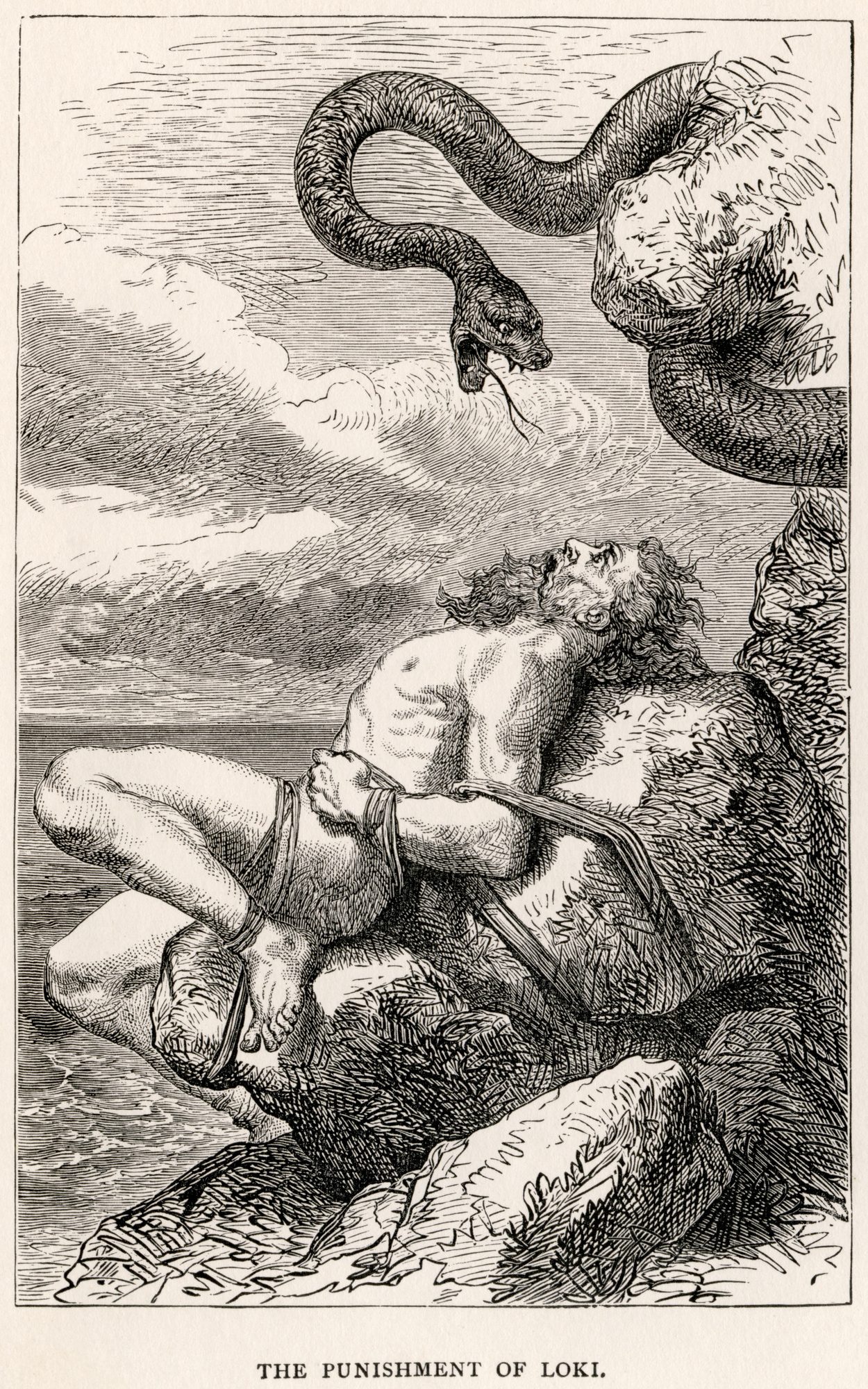
An illustration of Loki's punishment: the bound trickster lying beneath a serpent that drips venom on his face, his wife Sigyn beside him holding the catching bowl.
Norse

Loki, the Trickster

The handsome, fickle mischief-monger of the Aesir who drags the gods into ruin and then, more often than not, is the only one clever enough to haul them back out again.

6 minSnorri Sturluson
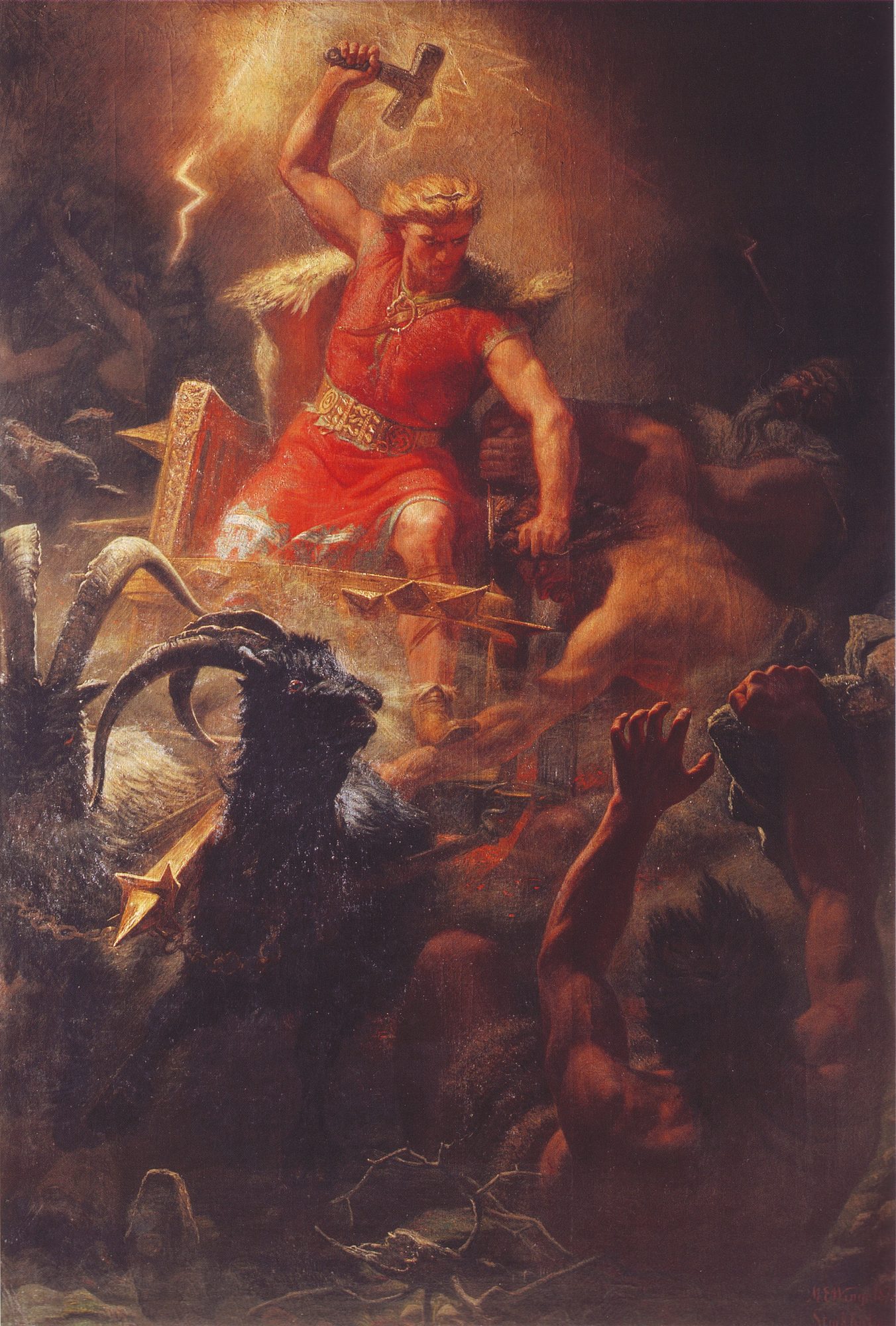
An oil painting of Thor in his goat-drawn chariot, red-bearded and mail-shirted, swinging his hammer Mjöllnir against a mass of charging giants under a storm sky.
Norse

Thor, God of Thunder

The strongest of the gods wakes to find his hammer gone, and the only way to get it back is to put on a bridal veil: a portrait of the Aesir's giant-killer at his most terrifying and his most absurd.

6 minPoetic Edda
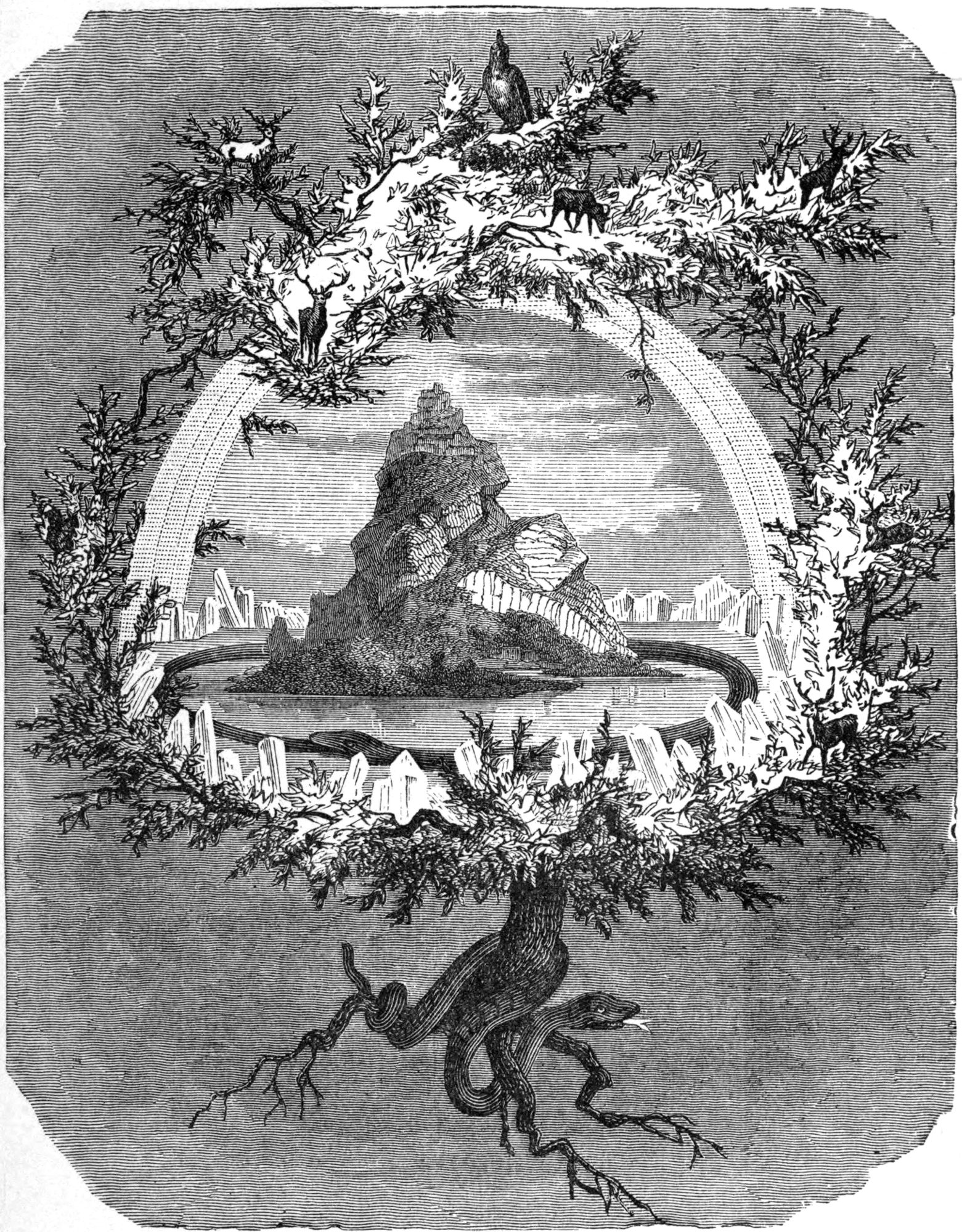
A 19th-century wood-engraving of the world-ash Yggdrasil seen whole: an eagle perched at the crown among the upper branches with four stags browsing the foliage, the central world encircled by the rainbow Bifröst and a ring of water, and the serpent Níðhöggr coiling among the exposed roots at the foot of the tree.
Norse

Yggdrasil, the World Tree

The great ash that binds the worlds is not a serene axis but a creature in perpetual pain: gnawed above, rotting within, torn from below, and still standing green over the well where the Norns pour their clay.

8 minPoetic Edda
A romantic pen-and-ink drawing of Odin on his night-ride: the god in a wide-brimmed hat and cloak riding down toward the shadowy gate of Hel, his spear lowered.
Norse

Odin, the Allfather

He hanged himself on the world-tree and gave an eye to a well, and in return he took the runes and the deepest draught of wisdom: the god who paid for knowledge in his own flesh.

6 minPoetic Edda
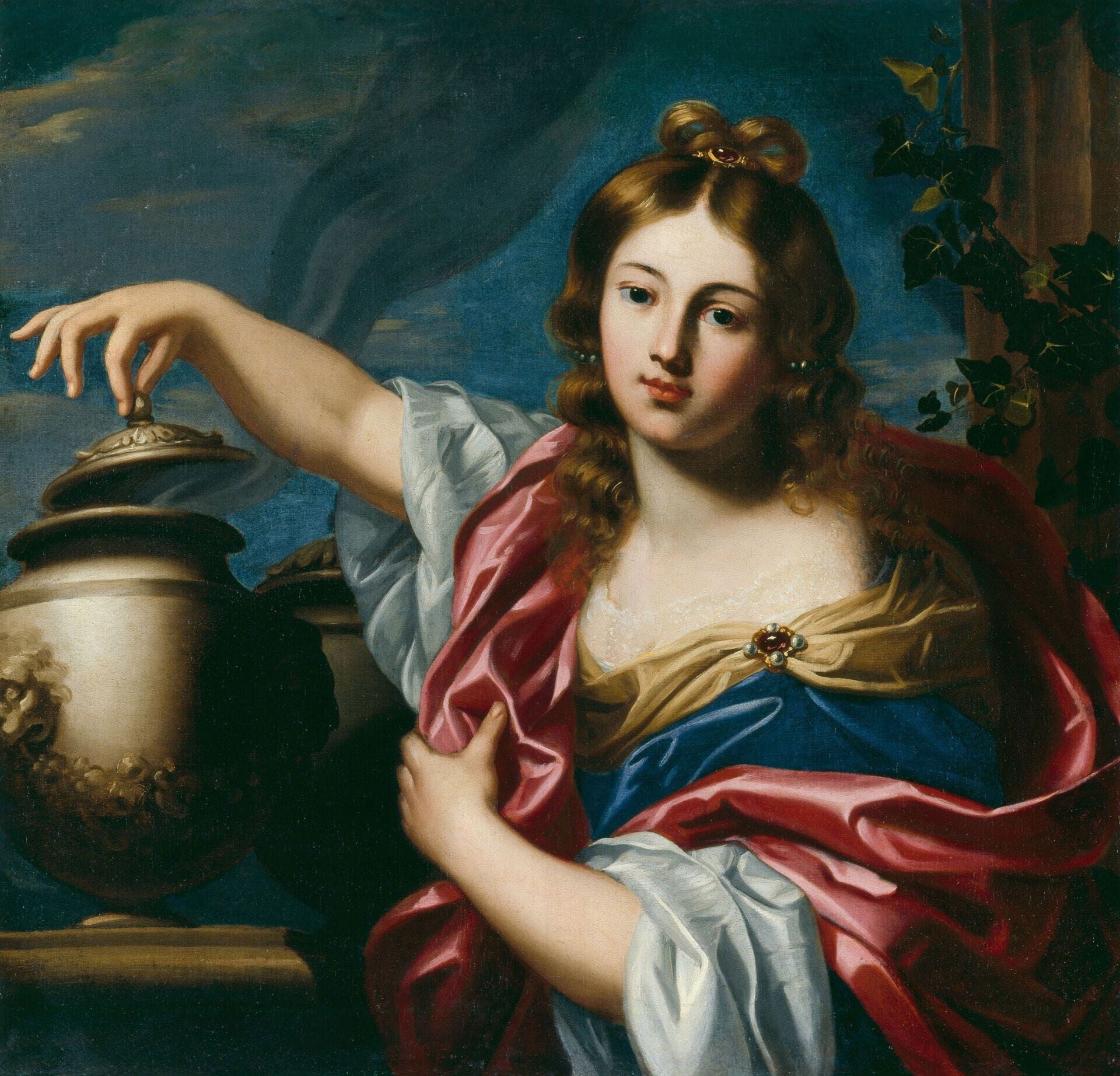
A young woman with loose auburn hair, in a blue gown under a rose-red mantle with a jewelled clasp, rests her right hand on the ornamented lid of a great lidded ceramic jar at the left — a satyr-mask moulded on its swelling belly — as if about to lift it; ivy climbs a broken pillar behind her against a stormy blue sky.
Greek

Pandora, the First Woman

The gods pooled their gifts to build one flawless girl, then handed her to mankind as a punishment; when she lifted the lid of a jar, only Hope stayed behind.

5 minHesiod
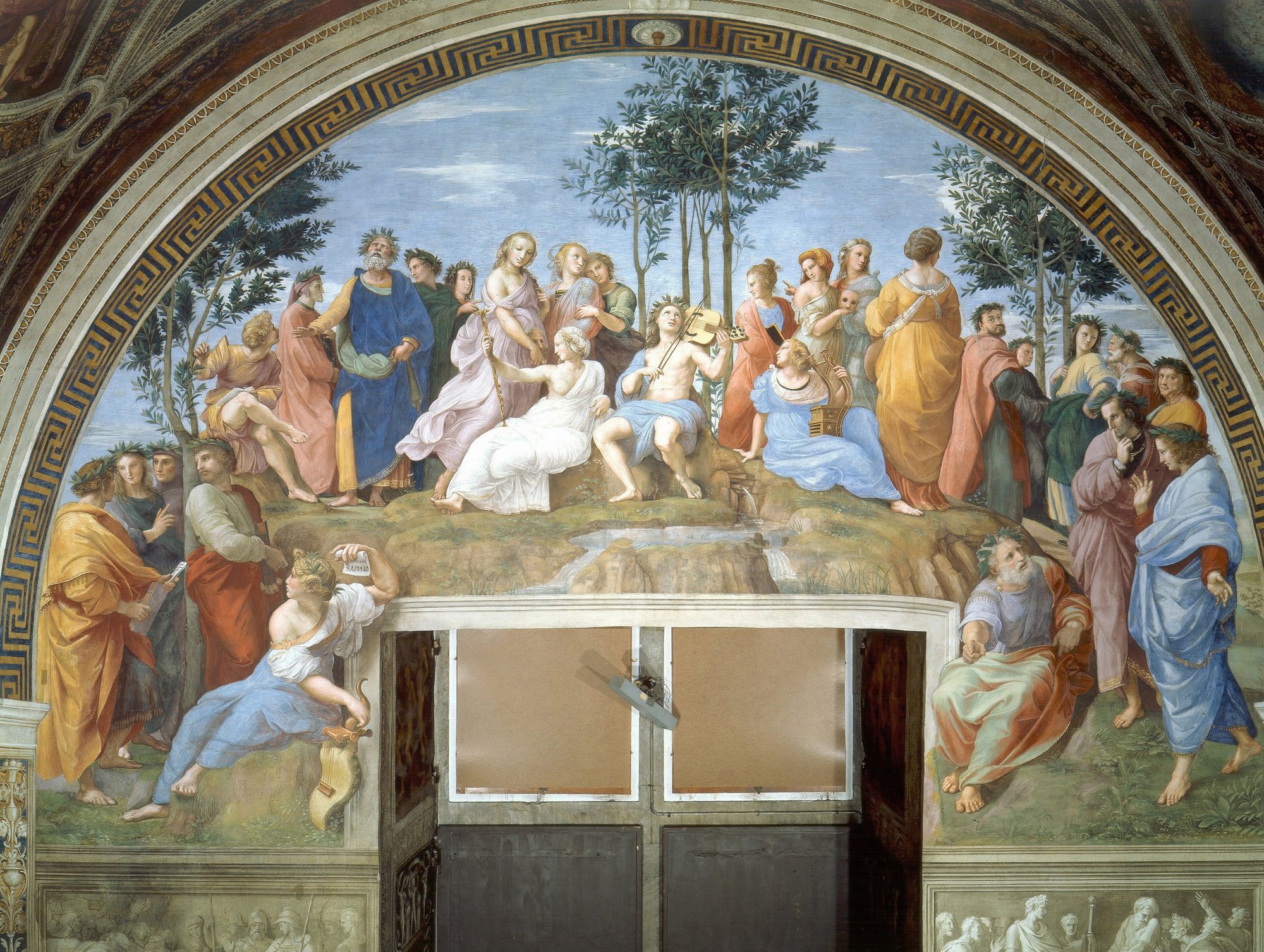
Raphael's fresco The Parnassus: Apollo seated at centre on Parnassus playing a stringed lyre, surrounded by the nine Muses and the great poets of antiquity, beneath a vaulted sky.
Greek

Apollo, God of Light and Prophecy

The newborn who burst his swaddling bands to claim the lyre, the bow and the truth of Zeus, then killed a dragon to found the oracle that spoke for him.

5 minHomeric Hymn 3
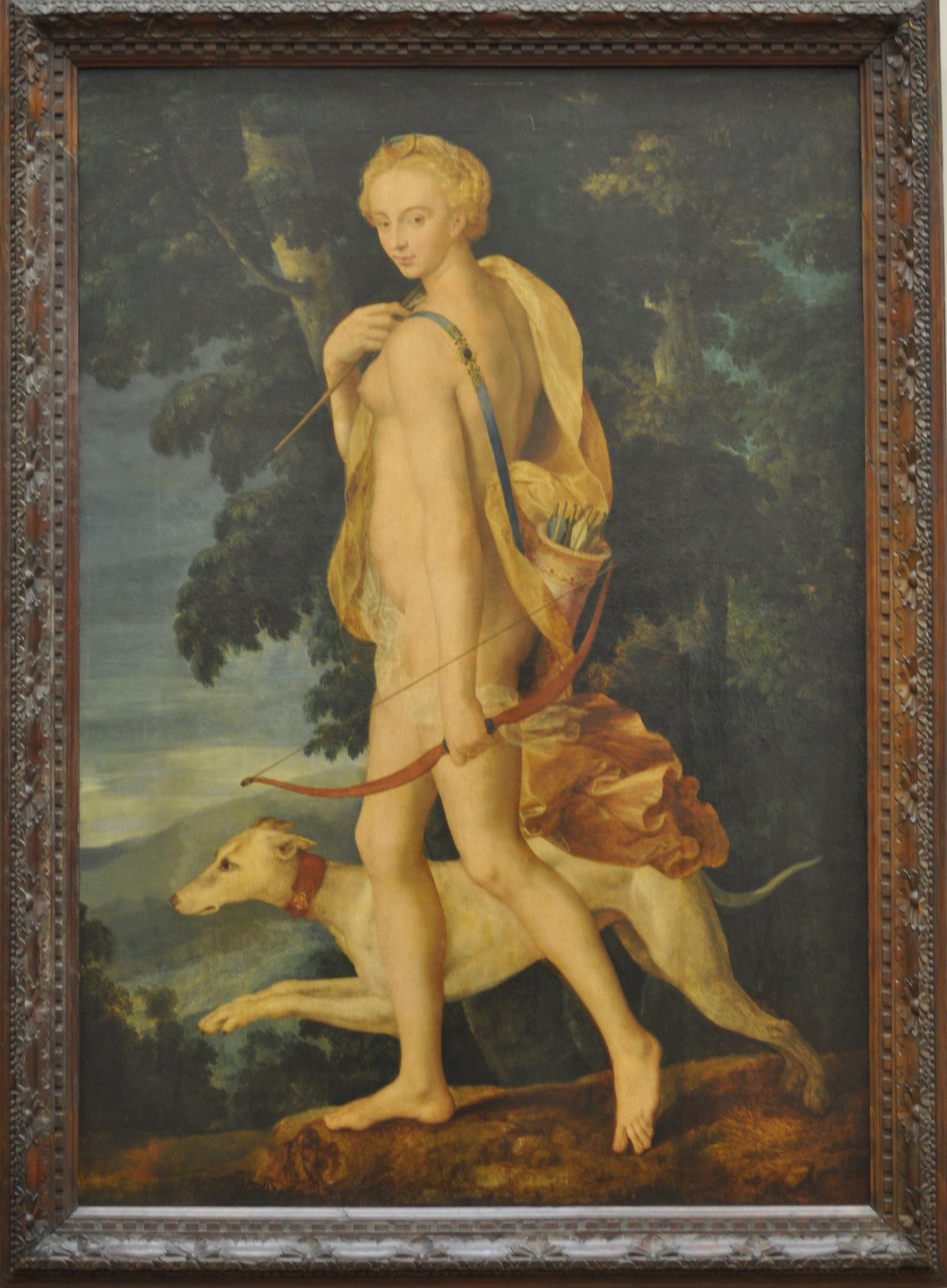
Diana the huntress striding through a dark wood, a gold mantle slipping from her shoulders, reaching back to draw a white-fletched arrow from the quiver at her side while a red recurve bow hangs in her lowered hand. A lean white hound courses at her feet, and a lake glimmers through the trees behind her.
Greek

Artemis, the Huntress

The small child who climbed onto her father's knee and asked for a bow, eternal maidenhood and all the mountains in the world, then took them.

5 minHomeric Hymn 27
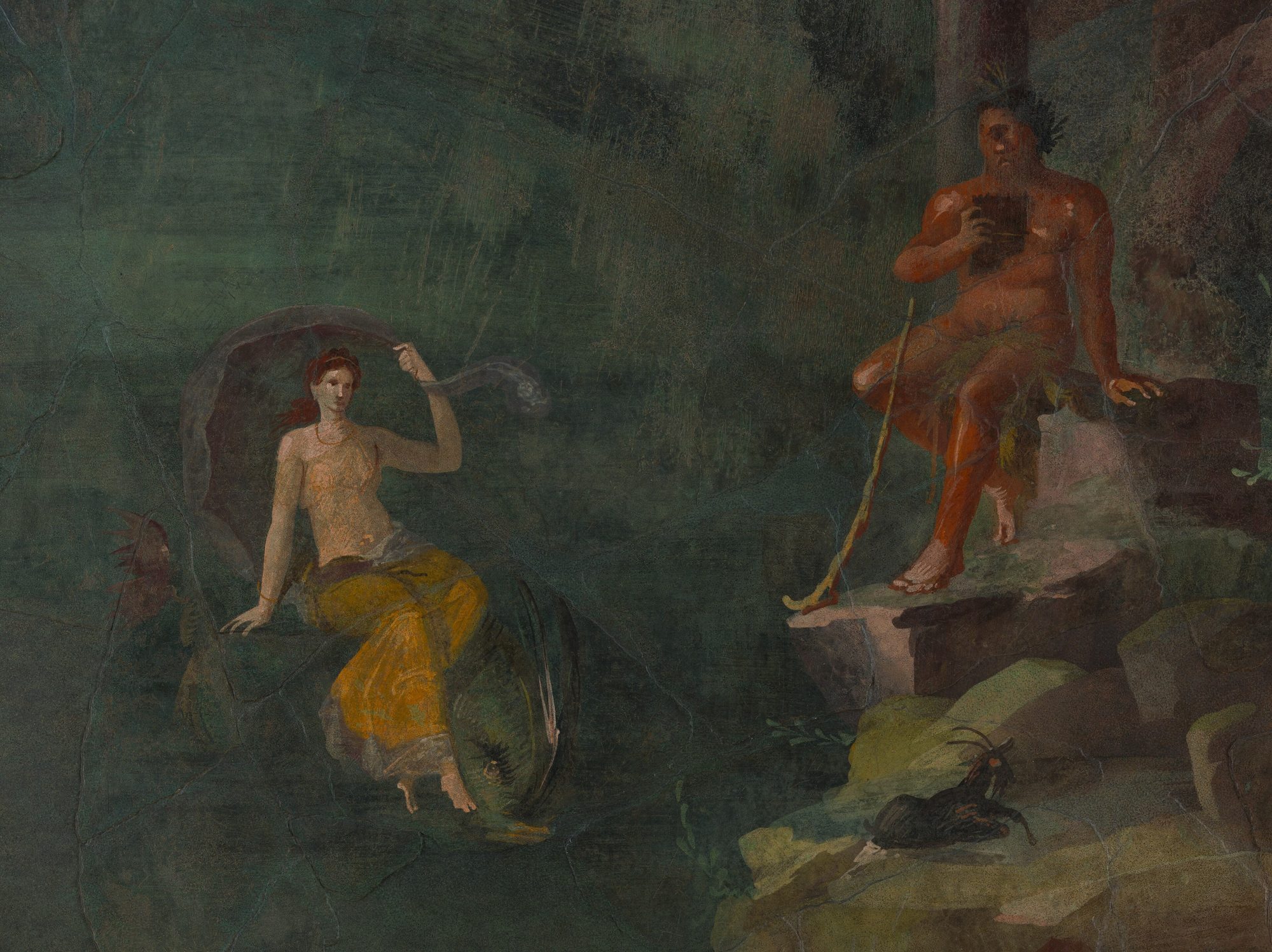
A Roman fresco in the Third Style: the Cyclops Polyphemus, a giant seated in a landscape, receives the cup of wine as the sea-nymph Galatea rides a dolphin across the sea at the panel's edge, under a violet-blue sky.
Greek

Odysseus and the Cyclops

He beat a giant with a lie and a sharpened stake, then threw it all away for the pleasure of hearing the monster learn his name.

7 minHomer
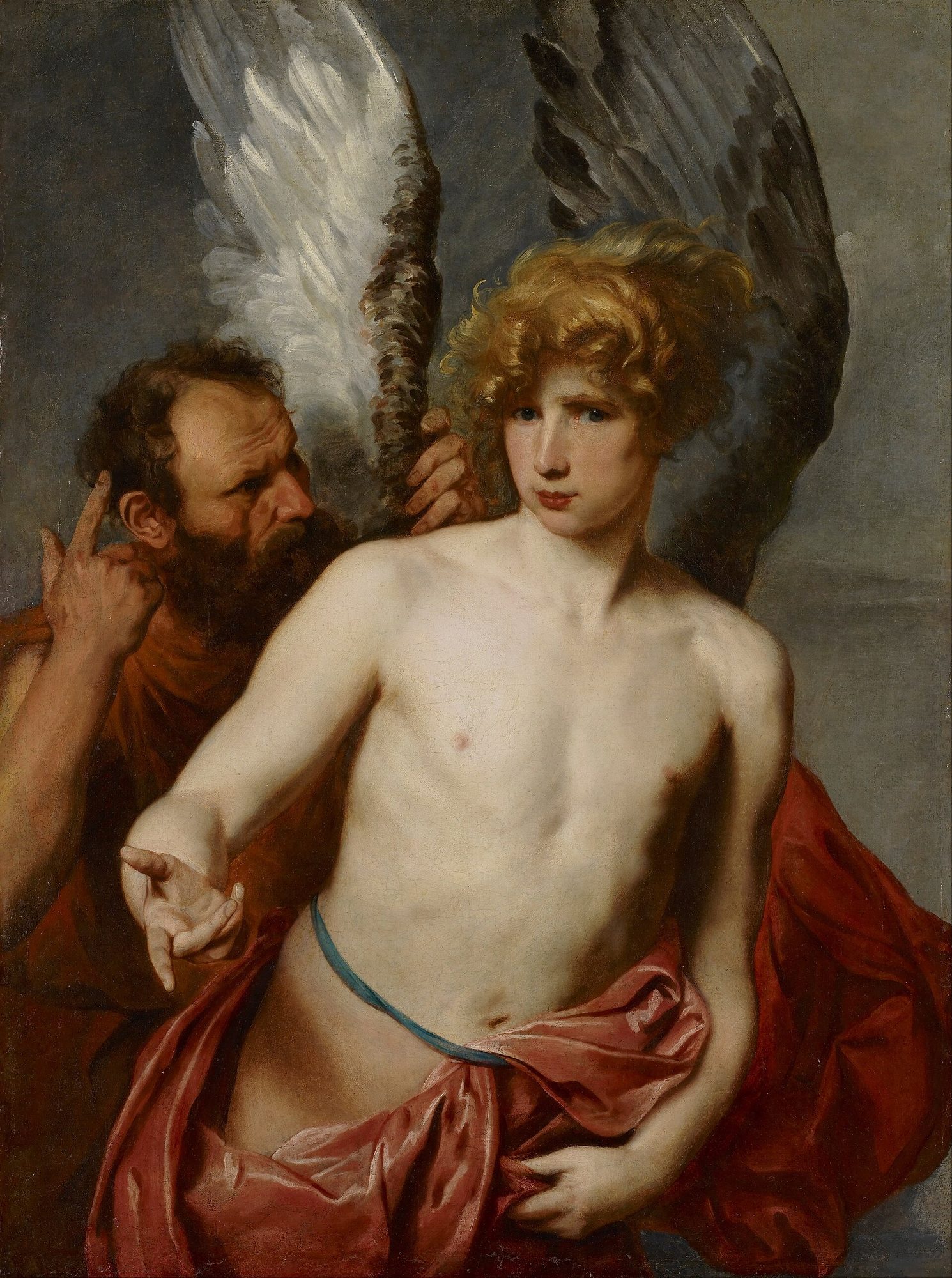
A Baroque painting of Daedalus and Icarus. The aged, balding, grey-bearded Daedalus stands behind his son in a russet-orange robe, one hand steadying a great feathered wing (one pinion pale, one dark) at the boy's shoulder while the other hand rises with a raised, admonishing finger, as though giving a warning. In front of him the youthful, bare-torsoed Icarus, with tousled golden hair and a red drape falling from his hips, gazes out past the viewer, one arm extended. The background is a plain, shadowed studio wall.
Greek

Daedalus and Icarus

A caged inventor reasons that if the sea and the land are watched, the sky at least lies open. He builds his son a pair of wings, and gives him one rule to keep him alive.

6 minOvid
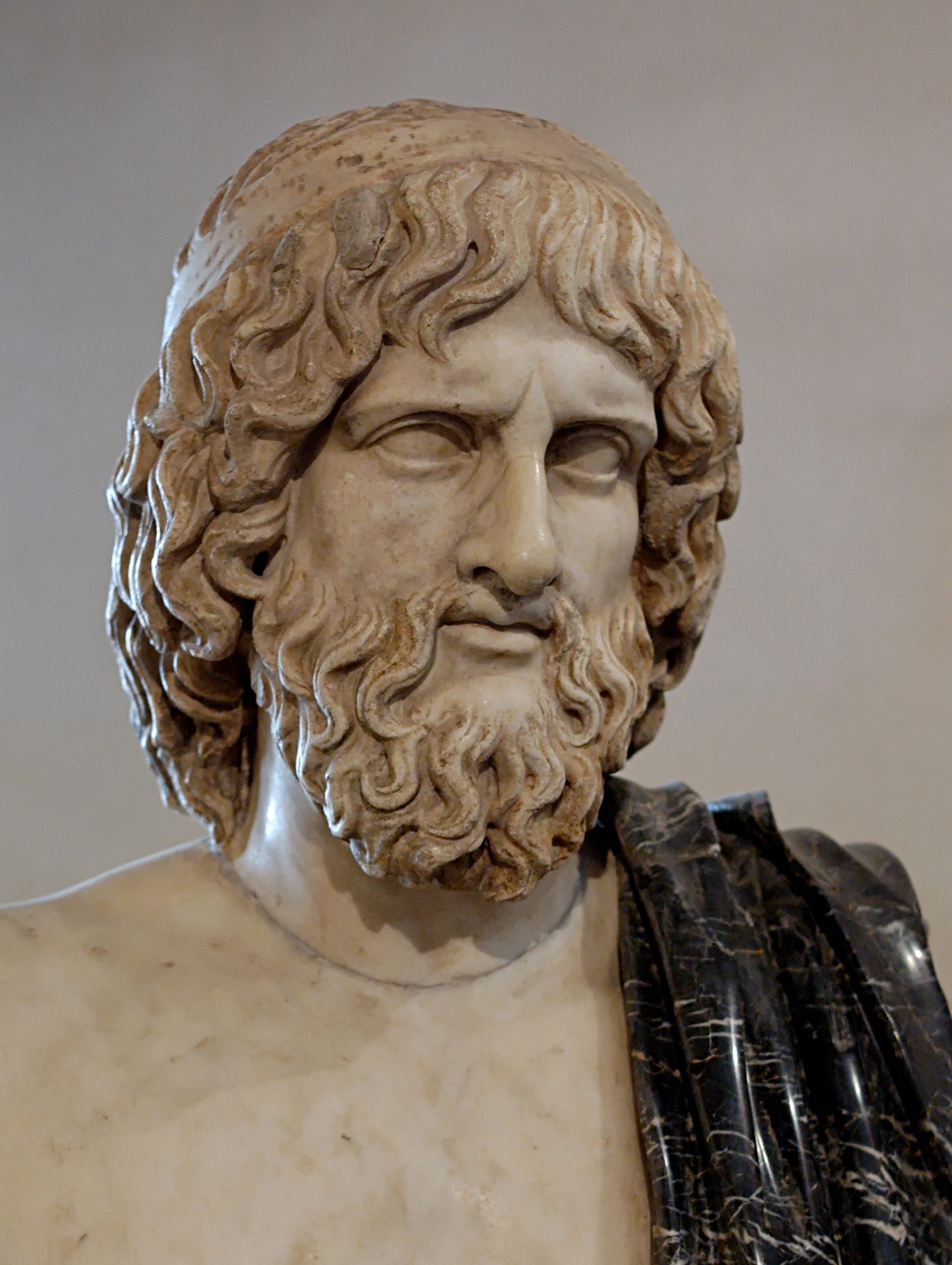
A marble bust of Hades — a mature, heavy-bearded god with thick wavy hair falling to the shoulders, deep-set blank eyes and a furrowed, stern brow, gazing off to the side. A dark near-black marble mantle (a modern restoration) is draped over his right shoulder, set against a plain grey ground.
Greek

Hades, Lord of the Dead

He drew the darkness by lot, not by choice, and the Greeks feared his name so much they called him the Rich One instead.

5 minHesiod
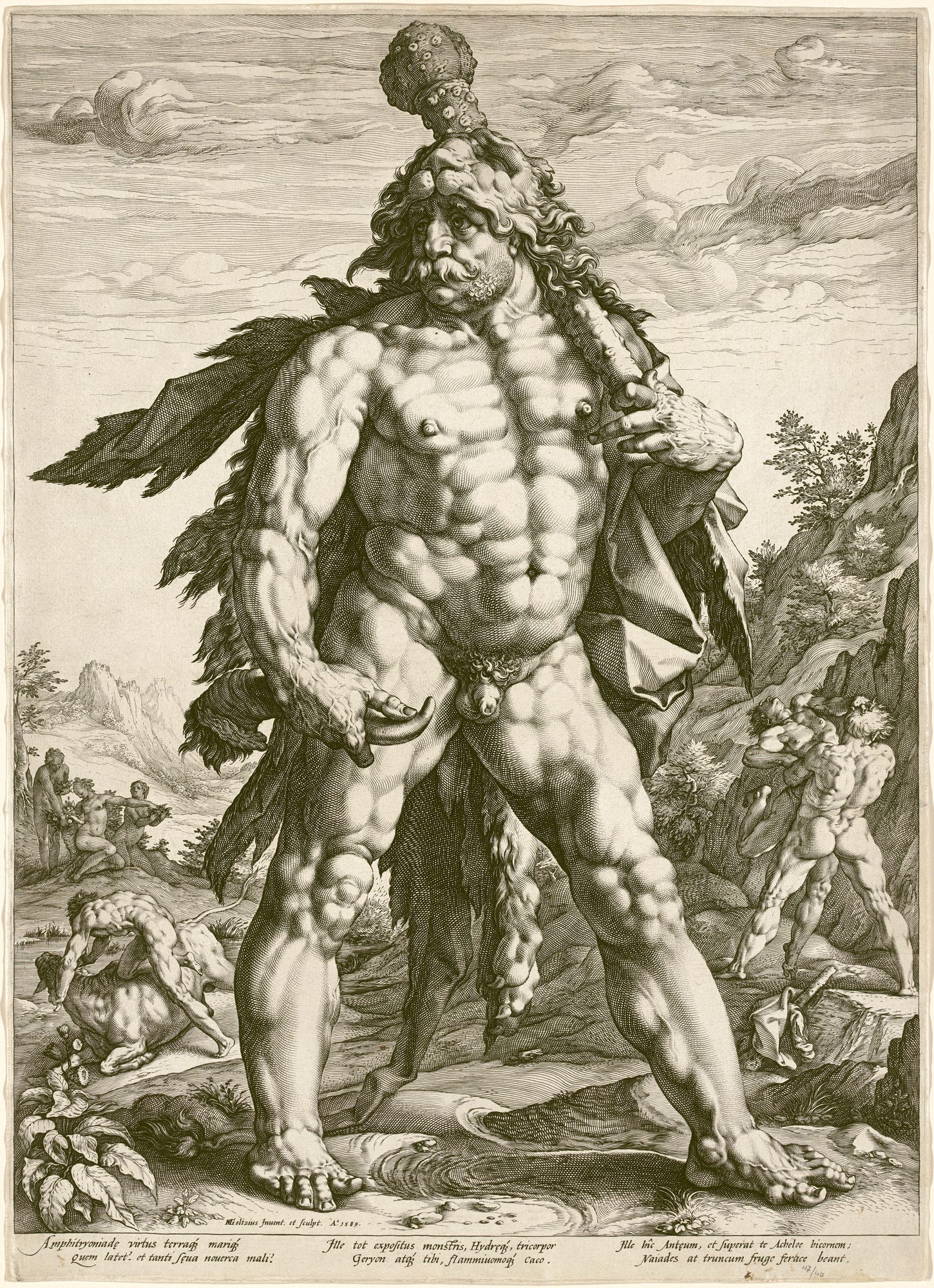
An engraving of a colossal, heavily muscled Hercules standing frontally, the Nemean lion-skin worn as a hood over his head and draped down his left side, the knotted olive-wood club resting over his right shoulder; small background vignettes show his combats with Antaeus, Cacus and Achelous in a classical landscape.
Greek

Heracles, the Greatest Hero

The strongman son of Zeus strangled serpents in his cradle and cleaned the world of monsters, but the labour that made him a god began in the ruin of his own house.

6 minPseudo-Apollodorus
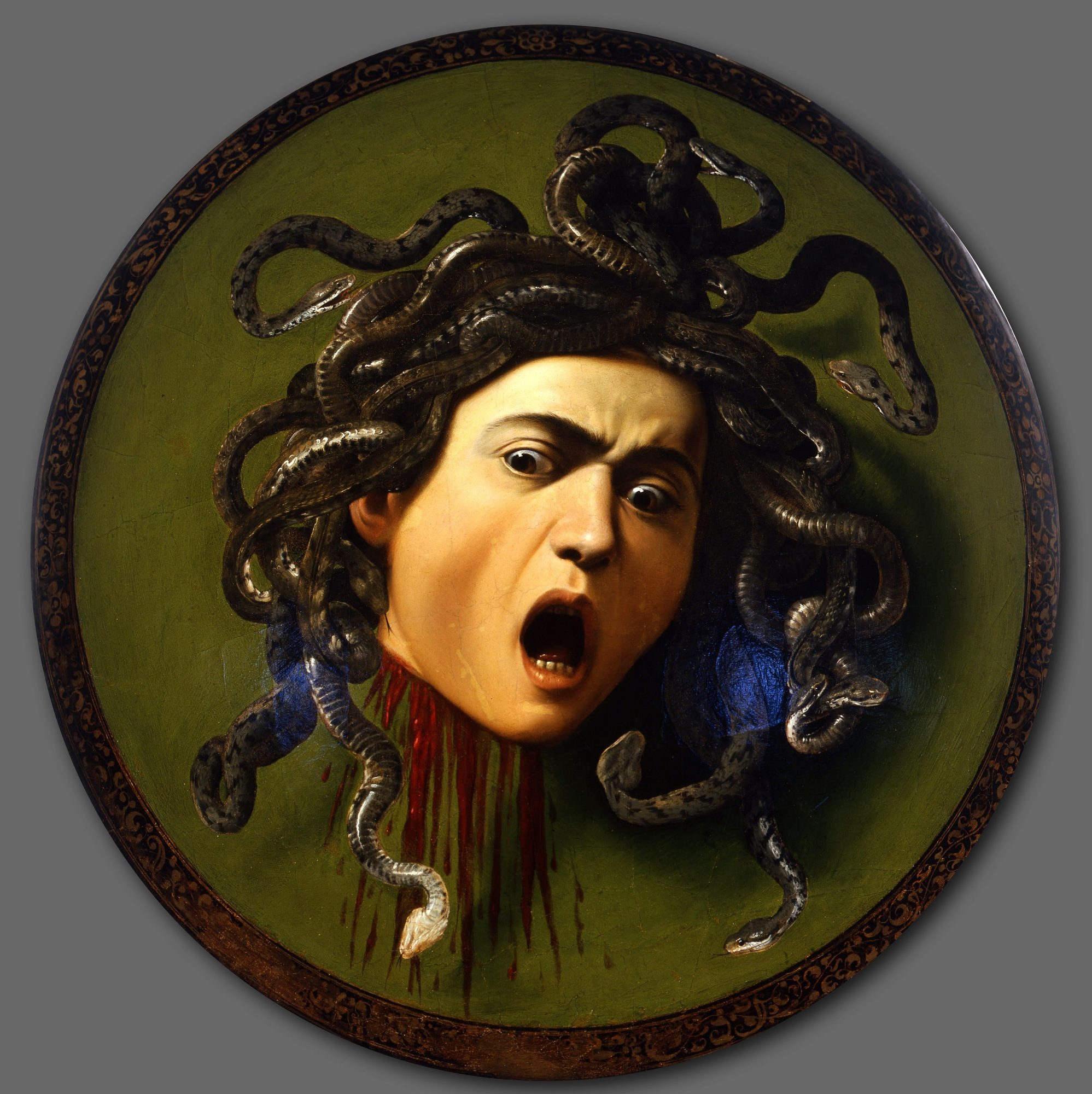
A severed, snake-haired head with wide staring eyes and mouth open in a scream, blood streaming from the neck, dark serpents writhing outward from the scalp against a green convex ground ringed by a gilt border — Caravaggio's Medusa, painted on a ceremonial parade shield, showing the Gorgon's face in the instant after decapitation.
Greek

Medusa and the Gorgons

A face no one could look at and live, and a hero who beat it by refusing to look. The only mortal monster in a family of immortal ones, killed in her sleep.

5 minHesiod
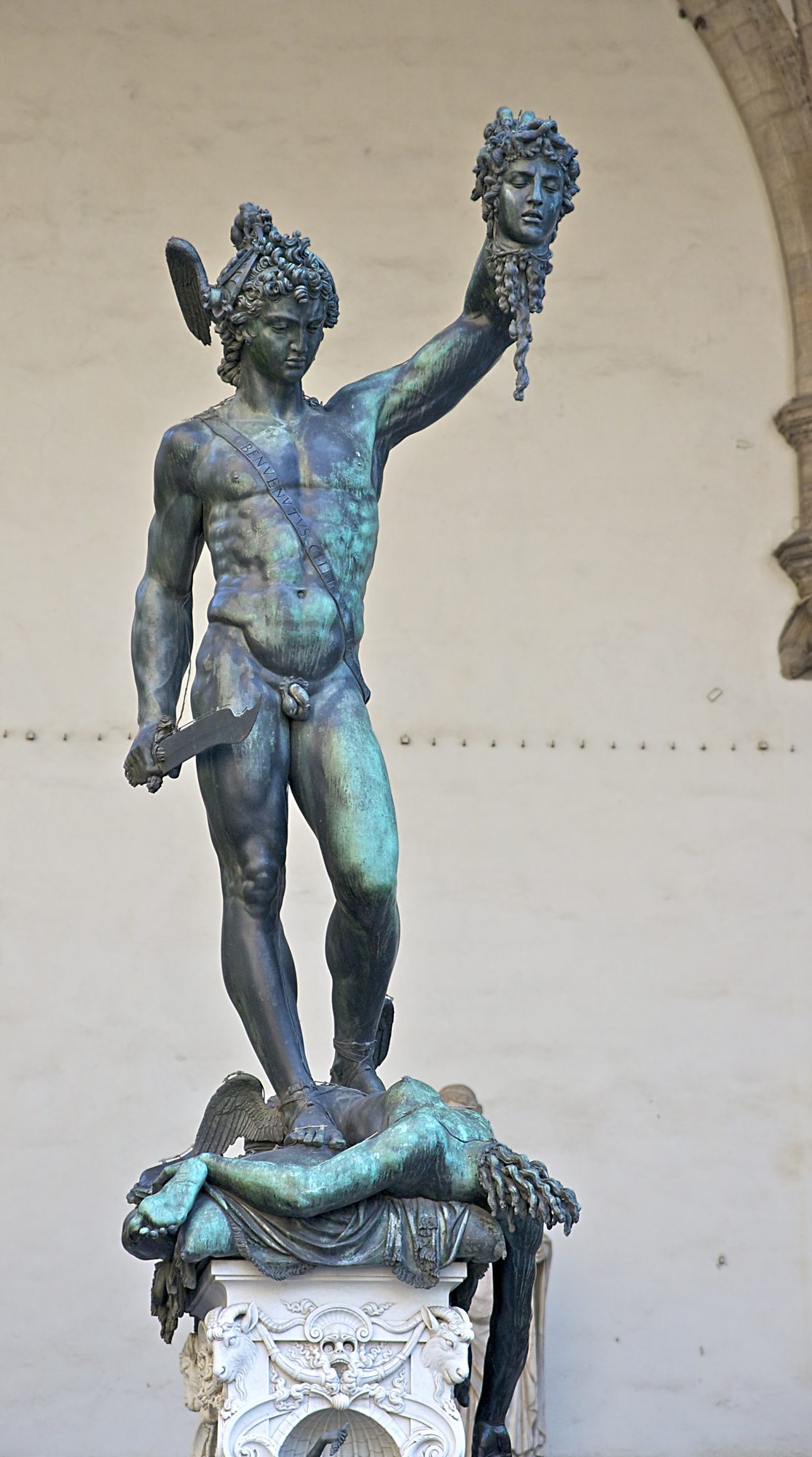
A nude young hero in a winged cap holds aloft the severed, snake-haired head of Medusa in his raised left hand and a curved sickle in his lowered right, his own gaze cast down and away from the trophy; the Gorgon's decapitated body slumps beneath his feet on an ornate pedestal against a plain pale wall — Benvenuto Cellini's bronze Perseus with the Head of Medusa in the Loggia dei Lanzi, Florence.
Greek

Perseus, Slayer of Medusa

Locked in a bronze cell, cast to sea in a chest, sent for a head no man could look at and live. The hero who won by never looking, and killed his grandfather by accident.

6 minPseudo-Apollodorus
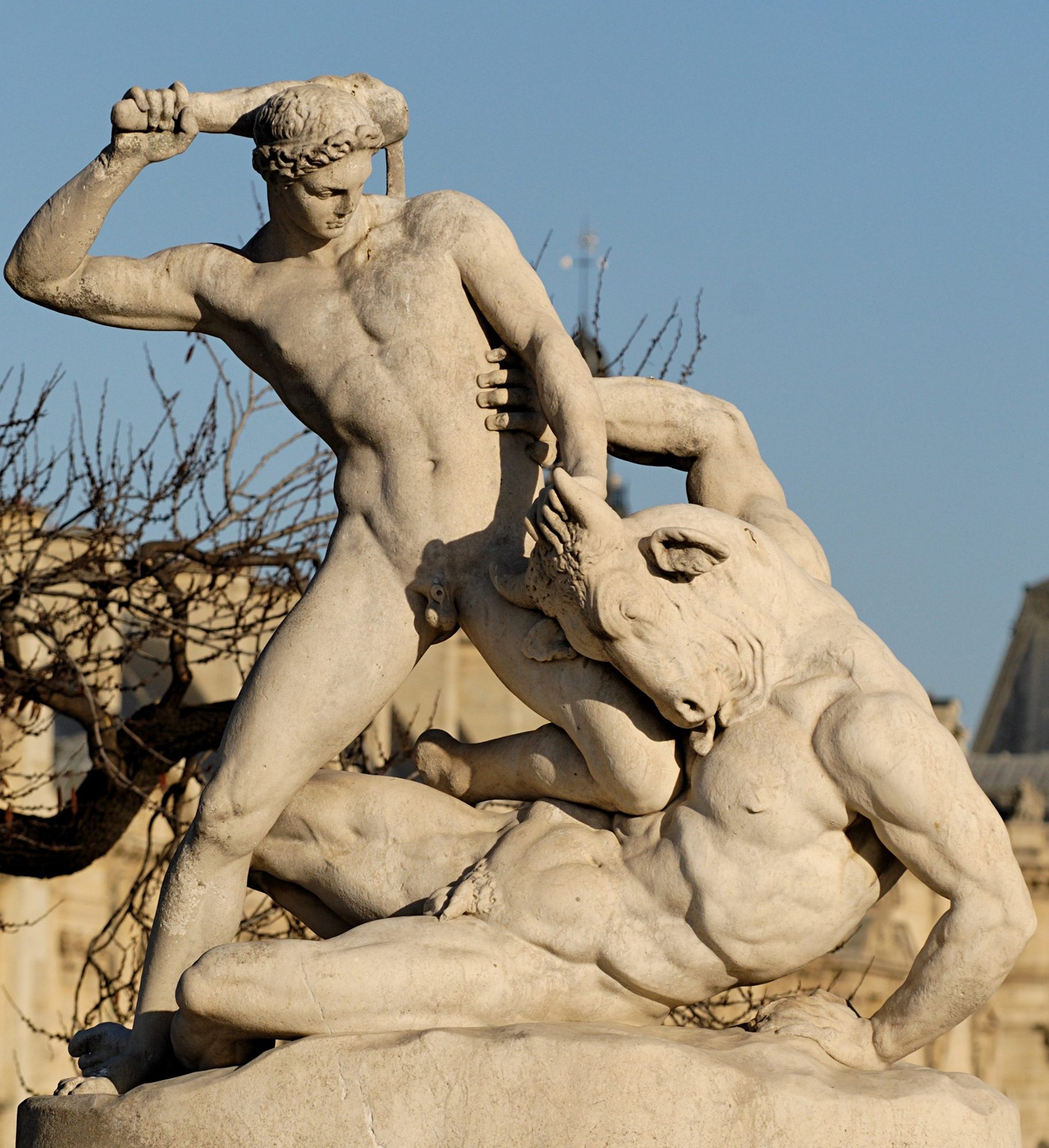
A white marble statue of a nude, laurel-crowned Theseus lunging forward with a club raised overhead in one hand, gripping the horned head of the bull-headed Minotaur with the other as the beast collapses beneath him over a fallen youth, set against a soft-focus ground of bare trees and pale stonework.
Greek

Theseus, Hero of Athens

A prince who chose the killers' road, unwound a thread through the dark to end a monster, and forgot a single sail. The founder Athens made in its own image, remembered for what he built and what he abandoned.

6 minPlutarch
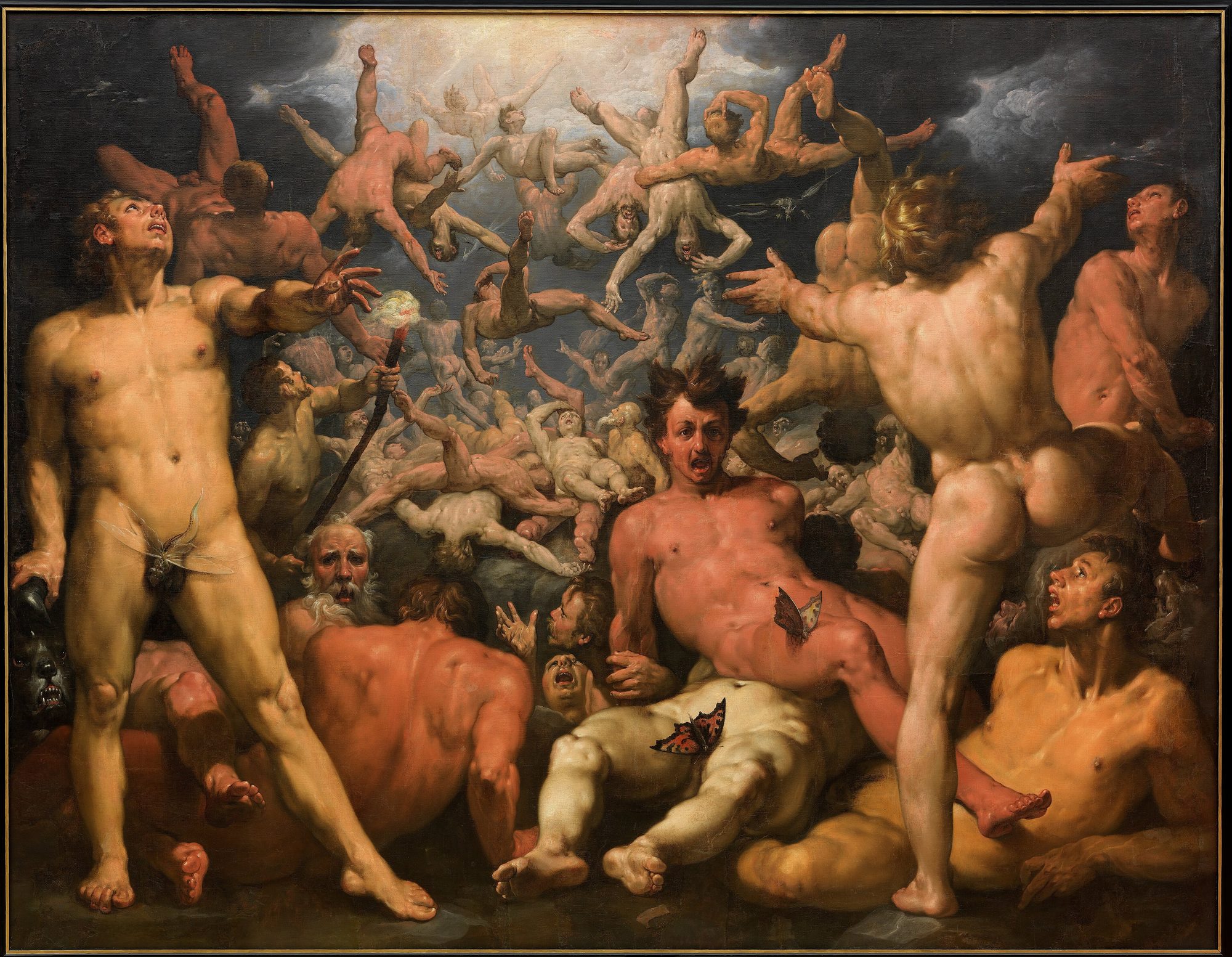
A dark, teeming Mannerist canvas of the defeated Titans hurled from the sky. From a luminous break in the storm-clouds at the top, a mass of muscular nude figures tumbles headlong and foreshortened into the depths, limbs flailing and faces contorted in terror. They pile into a heap of straining bodies across the foreground, ruddy and pale flesh tangled together; one massive figure sprawls face-up at the centre, mouth open in a scream, his hair standing on end. At the lower left a standing youth grips a burning torch while a black hound's fanged head snarls beside him, and a few small butterflies and insects — the painter's emblems of the fleeting — rest on the fallen limbs.
Greek

The Titanomachy

For ten years the sky itself hung in the balance, until Zeus loosed the hundred-armed prisoners of the deep and the world caught fire.

8 minHesiod
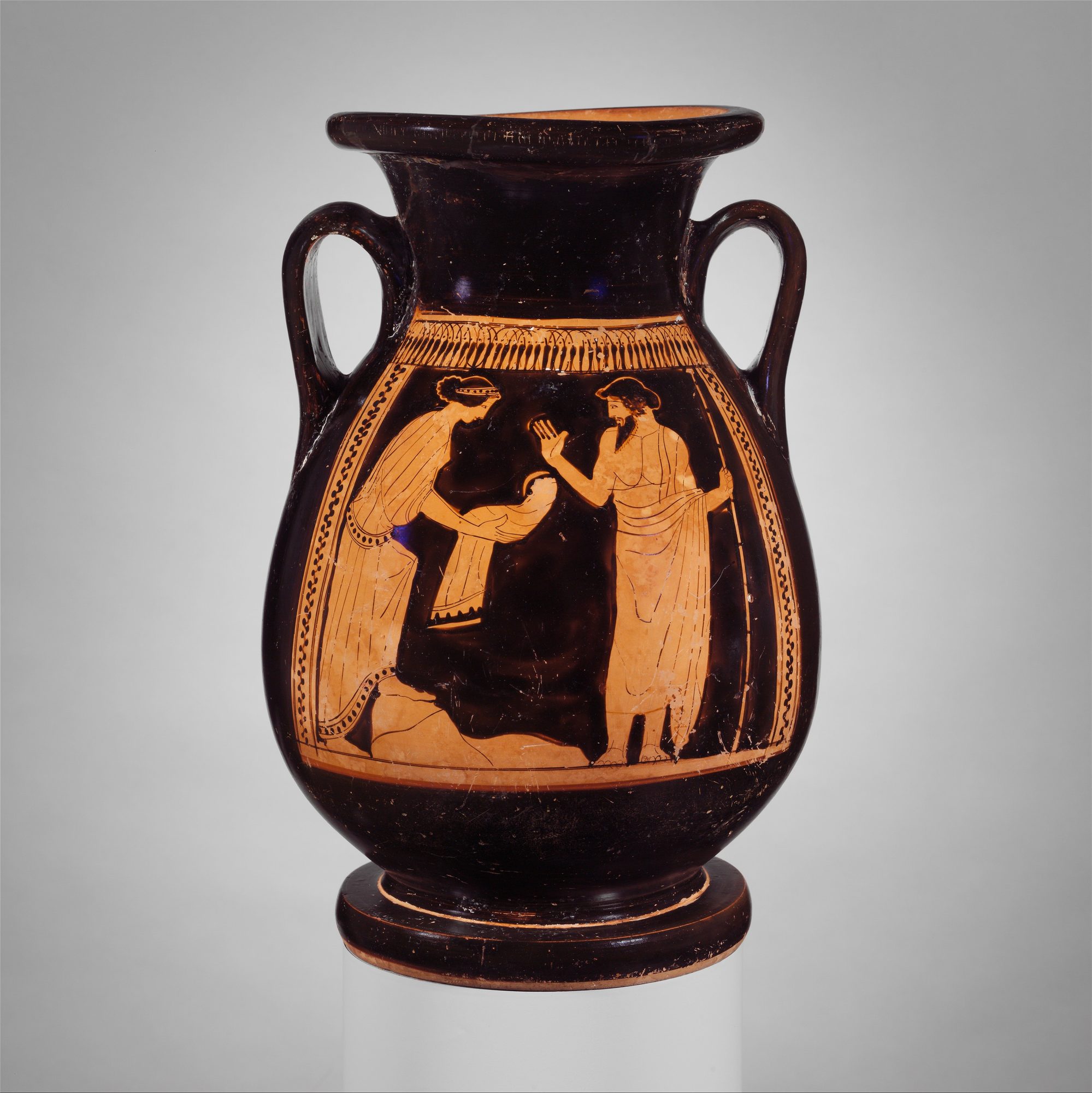
An Attic red-figure pelike, the whole black-glazed vessel standing against a plain grey ground, its belly panel bordered by a band of tongues above and running dot-chains at the sides. In the scene the Titaness Rhea, at left in a long pleated chiton and mantle with her hair bound in a fillet, steps forward and holds out in both hands the stone wrapped in swaddling clothes; facing her at right the bearded Kronos, in a himation that leaves one shoulder bare and a soft cap, grips a long sceptre in his trailing hand and raises his other hand to receive the bundle he believes is his newborn son — the swaddled-stone deception that founds the ruling family.
Greek

The Twelve Olympians: The Ruling Family

There is no ancient list of the Twelve. What the oldest poets give us instead is a household with a throne room, a swallowed generation, and a family quarrel that never quite ends.

7 minHesiod