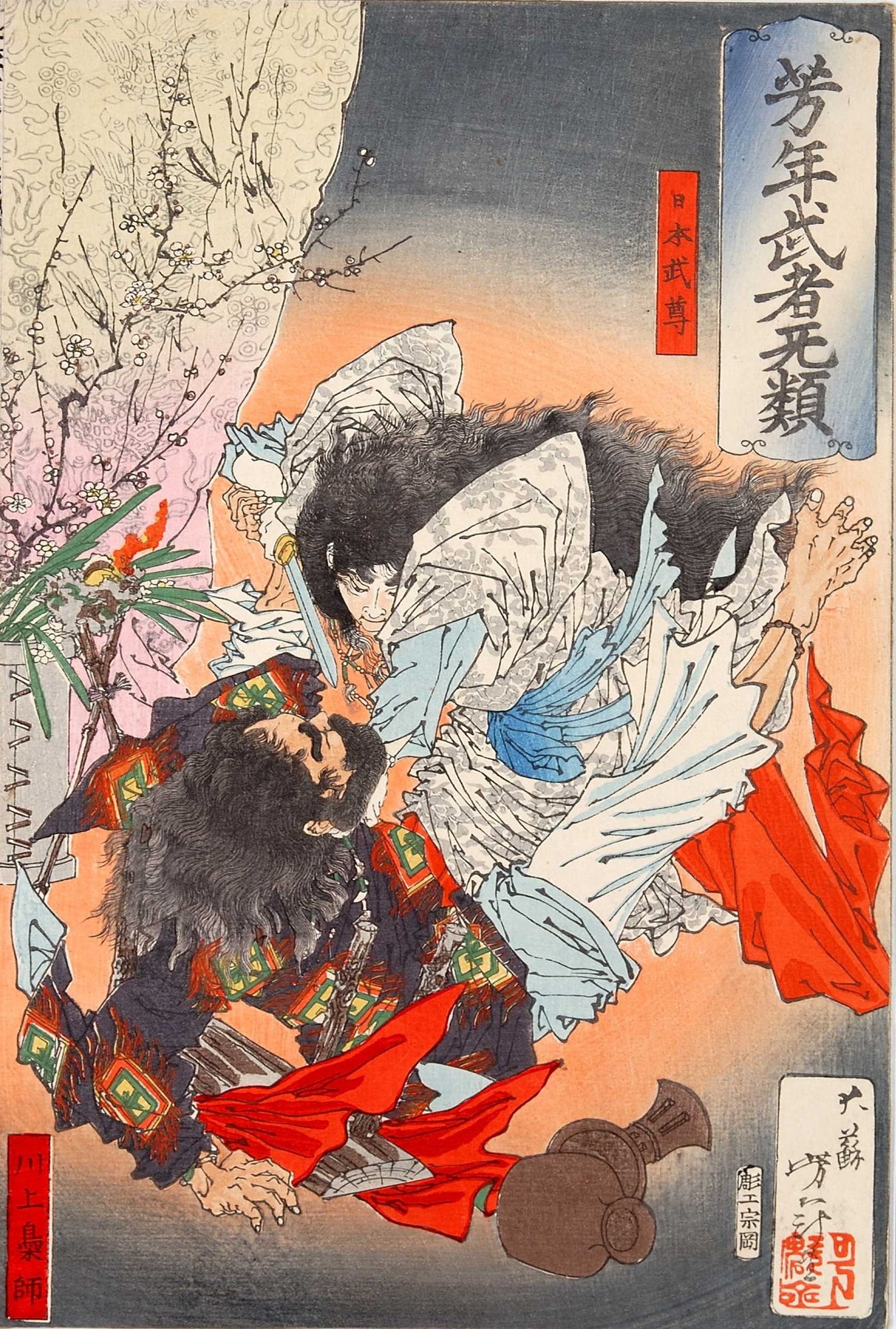
A boy came home from killing for his father, and before the dust of the western road was off him he was sent to kill again in the east. Both of Japan’s oldest chronicles record the errands. They cannot agree on what the errands meant. In one, the son weeps to his aunt that his father must wish him dead; in the other, the father, hearing that the son has died, cannot sleep, cannot taste his food, and beats his breast crying out for the child he sent away.
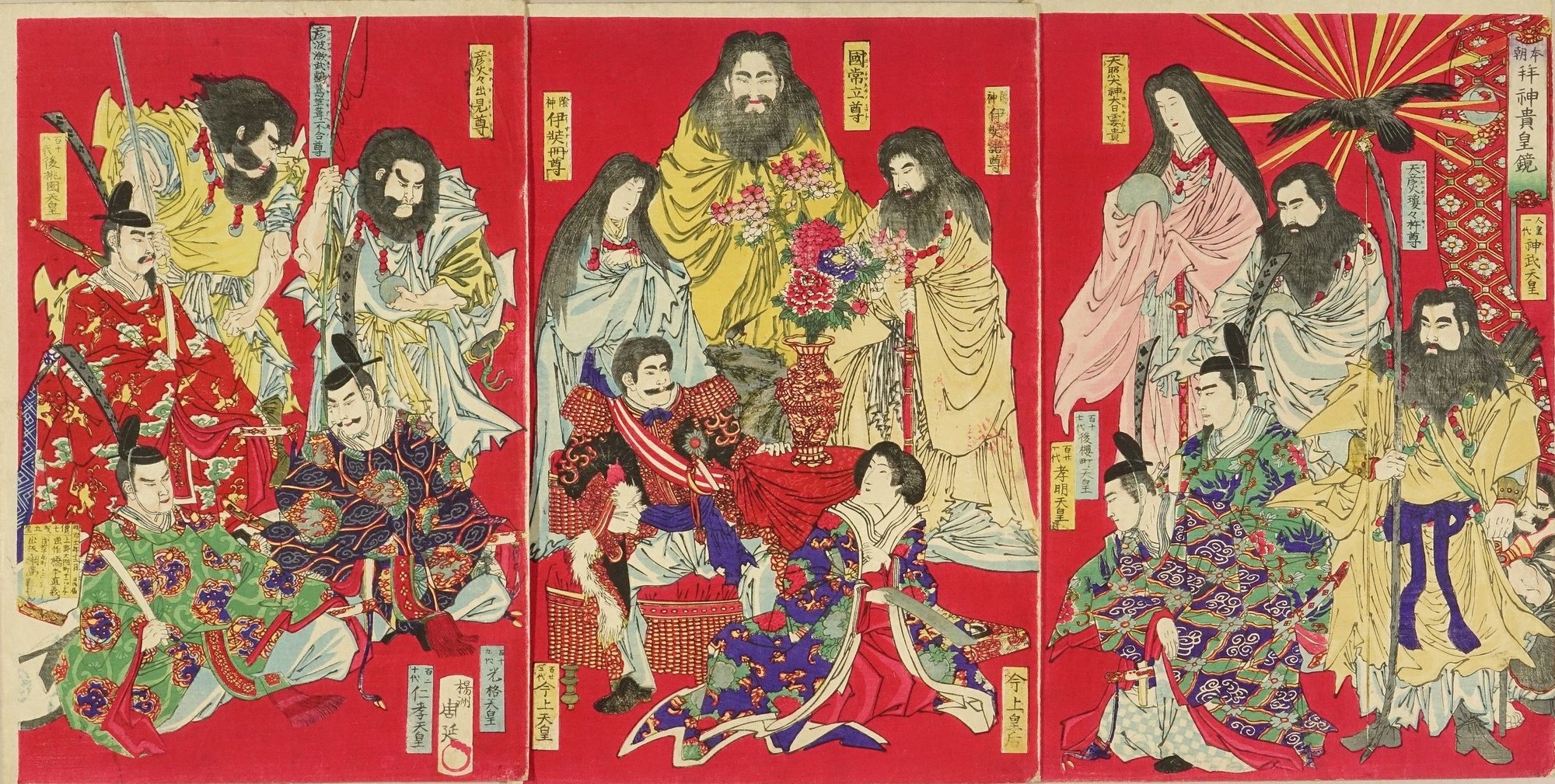
The prince was called Wo-usu, and the emperor his father was Ō-tarashi-hiko-oshiro-wake, whom later ages named Keiko, twelfth in the traditional line of sovereigns. He dwelt in the palace of Hishiro at Makimuku. The story of what passed between the two men survives in two witnesses set down only about eight years apart, the KojikiThe older of Japan's two court chronicles, presented in 712 CE; it tells this bond as pure narrative, with no year-dates, and centres the son's grievance. in 712 and the Nihon ShokiThe second court chronicle, completed 720 CE, eight years after the Kojiki; it dates the reign to a legendary calendar and centres the father's grief. in 720, both court projects of the same Nara-period generation. The reign they describe they place some six centuries earlier, in a legendary calendar the chroniclers reconstructed rather than remembered.
The later of the two even prints regnal year-dates in the margin, the KumasoA people of southern Kyushu who refused tribute to the Yamato court; the western enemy the prince is sent to kill on his first errand. subdued in what it reckons as A.D. 98, the eastern campaign in 110, the death in 113. These are the chronicle’s own count, not history; Aston, its translator, warned that the emperor’s grand speeches read as a cento of Chinese literature and cannot be received as a document of Japanese history.
A sword hidden in a girl’s dress
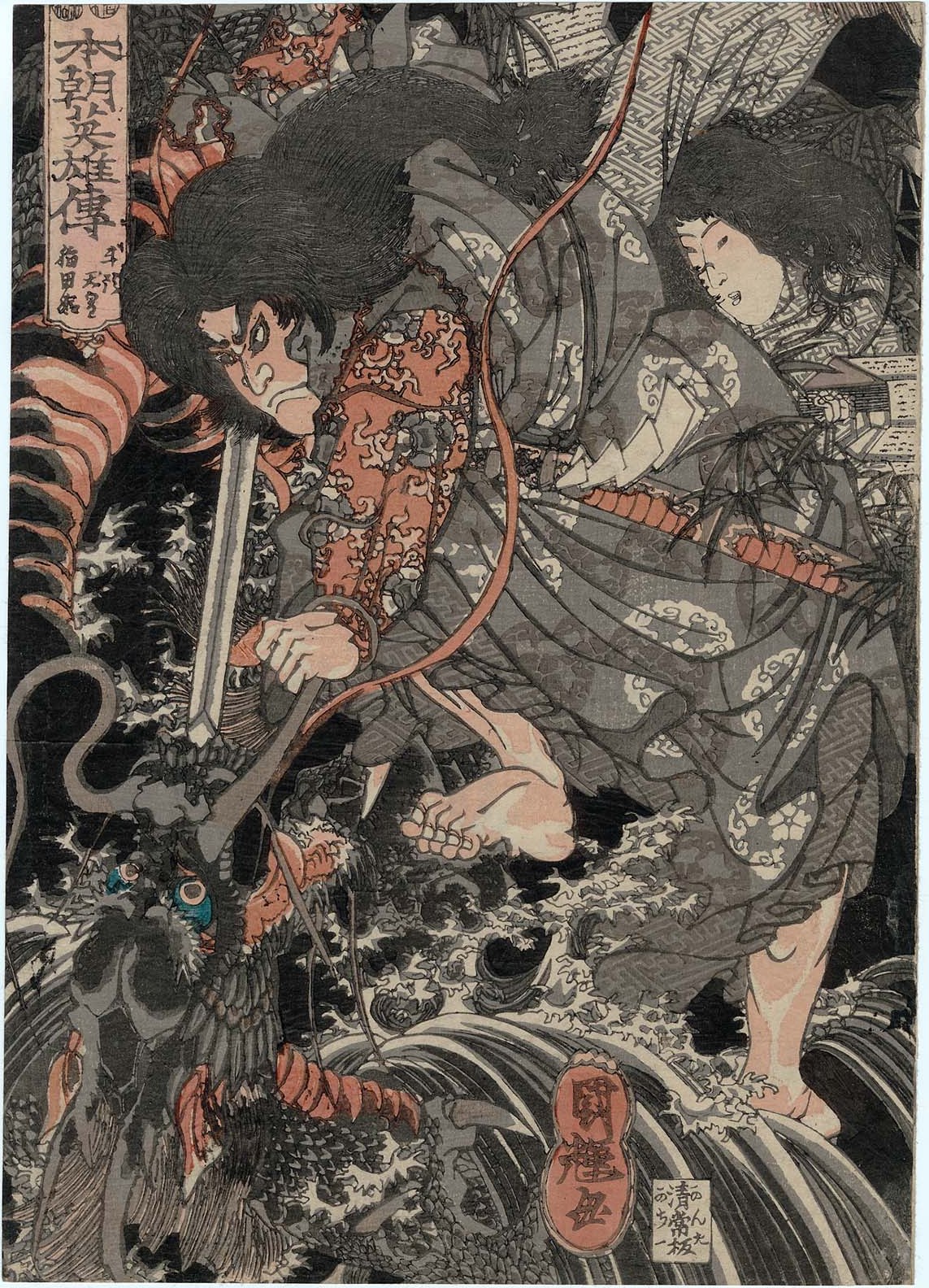
The killing that made the prince begins the same way in both books. Wo-usu is young, and he goes west against the Kumaso in the guise of a girl. He combs down his bound-up hair after the manner of girls, borrows his aunt’s upper garment and skirt until he looks quite like a young woman, and hides a sabre in his bosom. Set among the feasting bravoes in their cave, he draws the blade and strikes.
Here the two accounts begin to part. The Kojiki gives him two victims, elder and younger brothers, and a savage close: catching the fleeing younger man at the foot of the cave steps, he thrusts the sabre through his buttock, and finished it, in the chronicle’s own words, by ripping the man up like a ripe melon. The Nihon Shoki gives one leader, Torishi-kaya, also called the Brave of Kahakami, and stops at the clean thrust through the breast. In both, the dying man gives the boy the name that would outlast him. Until now, the brave says, no one has been braver than we; from this time you shall be called Yamato-take, the Champion of Yamato.
But the reason the boy was sent at all is already different. The Nihon Shoki treats the Kumaso war as an ordinary imperial order, a campaign like any other. The Kojiki gives it a colder root. There the Heavenly Sovereign is alarmed at the valour and ferocity of his own son’s disposition, and it is that alarm, the fear of the thing he has fathered, that sends the boy west. From its first page the older chronicle is already telling a story about a father who finds his son frightening.
No sooner home than sent away again
What happens between the campaigns is where the Kojiki turns the knife. On the road home the prince alone subdues the mountain-Deities, the river-Deities, and the Deities of Anado, then goes up to the capital. He is at once made to kill the Idzumo bravo too, by a trick with a false blade: he girds a harmless wooden sword of oak, proposes a friendly exchange of weapons, and challenges the man to draw, so that the bravo dies clutching a sword that will not leave its sheath. The prince makes his report and goes up again.
Then, immediately, the sovereign lays a fresh command on him: subdue the twelve roads of the East. He is given a holly-wood spear eight fathoms long, and no army. He has barely set down the burden of the west before the east is loaded onto him, alone.
What the prince said at Ise
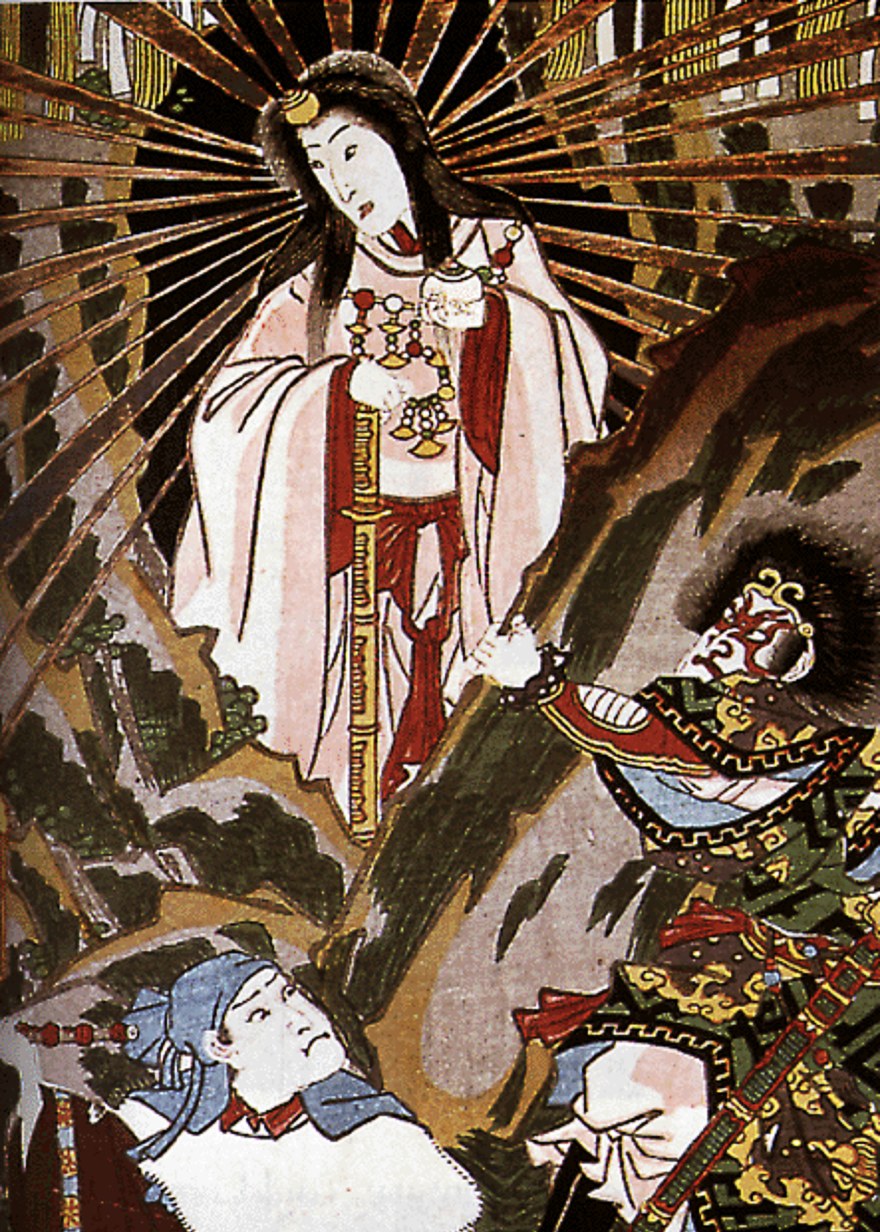
On his way east the prince goes to the shrine of the sun goddess to see his aunt Yamato-himeThe prince's aunt, priestess of the sun goddess at Ise, who arms him with the sword Kusa-nagi and hears his fear that his father wants him dead., and to her he says the thing the whole subject turns on. The sovereign, he tells her, must think he will die soon. Why else send him to smite the wicked people of the West, and then, no sooner is he come up again, send him off afresh to pacify the wicked people of the twelve circuits of the East, and this time without so much as an army at his back? He can read only one meaning in it. And he departed, the Kojiki says, with lamentations and tears.
The chronicler leaves a little room in the words, and Chamberlain, translating in 1882, marked it. Where the prince says his father thinks
he will die soon, the translator noted that the verb may as well be understood to mean wishes.
That single footnote is the strongest warrant anyone has for the darkest reading of this family. The prince is not merely fearing an accident on a hard road. He may be saying, in a phrase the original leaves deliberately open, that his father wants him dead and has found a way to arrange it that never has to be spoken aloud.
The father who tried another son first
Set the Nihon Shoki beside that scene and the same dispatch turns almost tender. Before Yamato-take is sent east at all, the emperor first orders a different son, Prince Oho-usu, to go. Oho-usu is afraid and runs to conceal himself among the grass. The emperor does not force him; he chides the coward and grants him the province of Mino as a fief, and only then does Yamato-take step forward of his own accord to take the eastern war his brother would not.
And the father who sends this braver son is made to grieve at the sending. Whereas in outward form thou art Our child, he tells the prince at parting, in reality thou art a God, and though the speech is exactly the sort of Chinese-flavoured rhetoric Aston flagged as unhistorical, its feeling is plain enough: this is a man handing his best son to danger and blessing him on the way. The later verdict is explicit. In spite of Our affection for him, the emperor says, We sent him into the country of the enemy. There is no alarm here, no wish to be rid of a frightening child. There is duty, and behind it fondness.
The waste moor and the choked voice
The eastern campaign is where the two chronicles run closest, and where the son finally falls. Yamato-hime arms him at Ise with the Herb-Quelling-Sabre, Kusa-nagi, and in the Kojiki alone with a sealed bag to open in an emergency; the Nihon Shoki gives him the sword and the warning to be cautious and yet not remiss, but no bag. On the moor a local ruler lies about a violent deity to lure him onto the grass, then sets the grass alight, and he escapes by mowing a firebreak with the sword and striking a counter-blaze. After a serpent-god on Mount Ibuki strikes him with sickness, his strength runs out on the moor of Nobo.
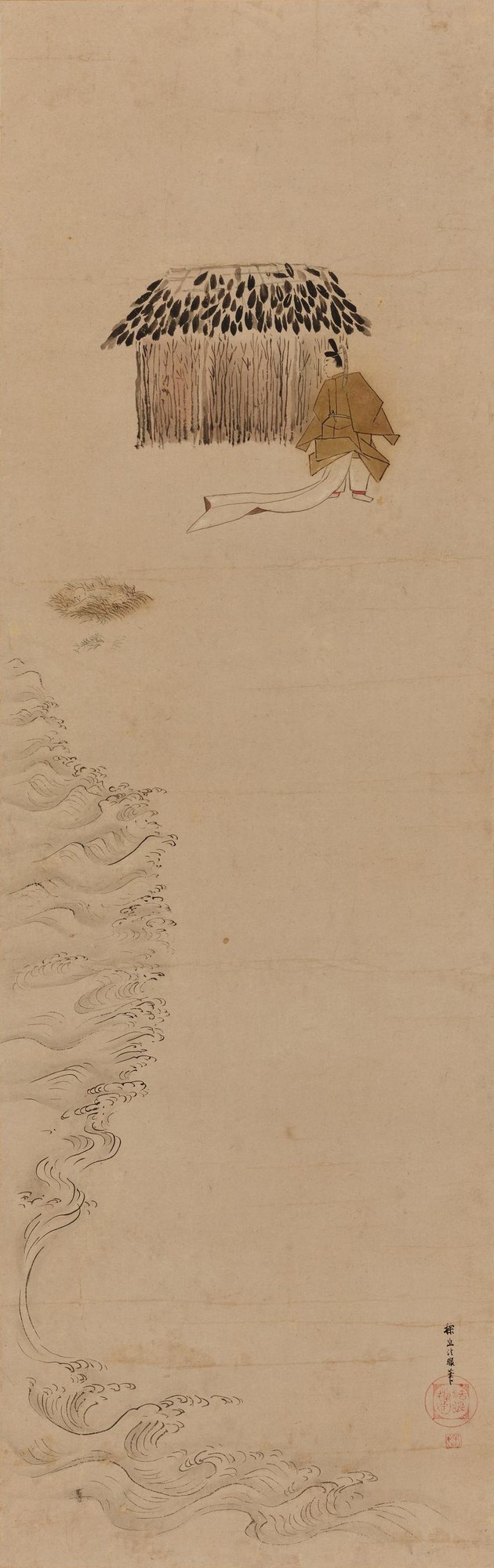
He dies there alone, in the Nihon Shoki, with a message sent home ahead of him. Alone I lay me down on the waste moor, he says, with none to say a word to me. He does not grieve for the body he is losing. My only grief, he ends, is that I cannot meet thee. He was thirty years old.
And now the chronicle that never gave the father a cold thought gives him his whole heart at once. When word reached him the emperor could not sleep peacefully on his couch, nor was the taste of food sweet to him; night and day his voice was choked with grief, and with tears and lamentations he beat his breast.
Oh! Our son, Prince Wo-usu!… so in spite of Our affection for him, We sent him into the country of the enemy. No day passed that we did not think of him… Oh! what a calamity! Oh! what a crime! While We least expected it, we suddenly lost Our child. (Nihongi, trans. Aston, Book VII)
That is the second chronicle’s last word on the bond, and it is the opposite of the first’s. The Kojiki closes the sending on a son leaving in tears, convinced his father wants him gone. The Nihon Shoki closes the same reign on a father who beats his breast and calls the sending a crime. Neither is simply right. They are two courts of the same decade, drawing on one store of legend and choosing which grief to keep, and between them they leave a father and son who can be read, with equal warrant from the page, as a murderer of his own child or a mourner of him.
- Kojiki (Records of Ancient Matters, 712 CE), Sections LXXX–LXXXIII (80–83), reign of Emperor Kei-kō, trans. Basil Hall Chamberlain (1882)the read-verbatim source for the son’s story. The sovereign,
alarmed at the valour and ferocity of his august child’s disposition,
sends Wo-usu to take the two Kumaso bravoes; the girl-disguise in the feasting cave, the dying brave’s gift of the name Yamato-take, and the killingripped him up like a ripe melon
; the pacifying of the mountain- and river-Deities on the road home and the slaying of the Idzumo bravo by the false wooden sword; the immediate re-dispatch east witha holly-wood spear eight fathoms
long and no army; the prince’s words to Yamato-hime at Ise that the sovereigncertainly thinks I shall die quickly,
and Chamberlain’s own footnote thatthinks
heremay be understood to mean ‘wishes’
; his departurewith lamentations and tears
; the Kusa-nagi sword and the emergency bag; the Sagamu moor-fire, the fire-striker, and the place named Yakidzu. Read at en.wikisource.org, Kojiki (Chamberlain, 1882), Sections 80–83. - Nihon Shoki (Nihongi, Chronicles of Japan, 720 CE), Book VII, reign of Emperor Ō-tarashi-hiko-oshiro-wake (Keiko), trans. W. G. Aston (1896)the read-verbatim source for the father’s story. The Kumaso campaign as an ordinary imperial order (marg. A.D. 98) and the killing of Torishi-kaya,
the Brave of Kahakami,
who names the prince Yamato-dake; the eastern dispatch (marg. A.D. 110) in which the emperor first orders Prince Oho-usu, whoran to conceal himself among the grass
and is granted Mino instead, before Yamato-take volunteers; the parting praise,whereas in outward form thou art Our child, in reality thou art a God,
which Aston footnotes as literary Chinese import thatcannot be received as a document of Japanese history
; the Kusa-nagi and Yamato-hime’sBe cautious, and yet not remiss
; the Suruga moor-fire; the illness after Mount Ibuki and the lone death on the moor of Nobo (marg. A.D. 113) at age thirty,My only grief is that I cannot meet thee
; and the emperor’s lament,Oh! Our son, Prince Wo-usu!… in spite of Our affection for him, We sent him into the country of the enemy.
Read via archive.org, identifiernihongi1asto.