HomeArchiveThemesAbout

#Grief And Mourning

Loss, lament, and its consequences.

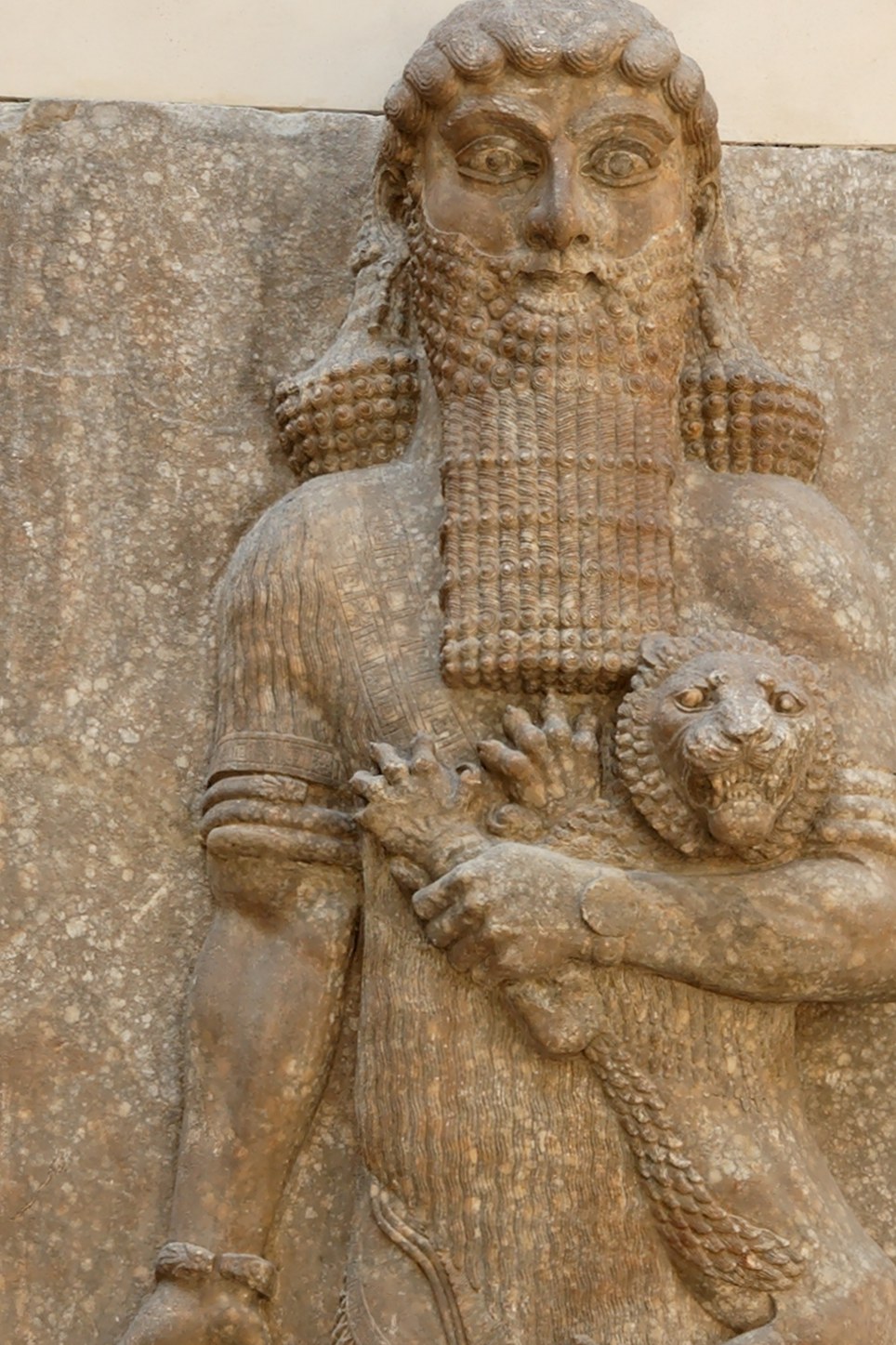
Neo-Assyrian stone relief: a colossal bearded male figure with elaborately curled hair and a long tiered beard stands frontally, cradling a small lion against his chest with his left arm while a coiled object (read as a serpent) hangs from his lowered right hand; carved gypsum-alabaster from a palace façade.
Mesop.

Gilgamesh and Enkidu

A king who let no bride reach her wedding bed, and the wild man the gods made out of clay to break him: how the two who first tried to kill each other became the one bond in the oldest story we have.
6 min*The Epic of Gilgamesh*
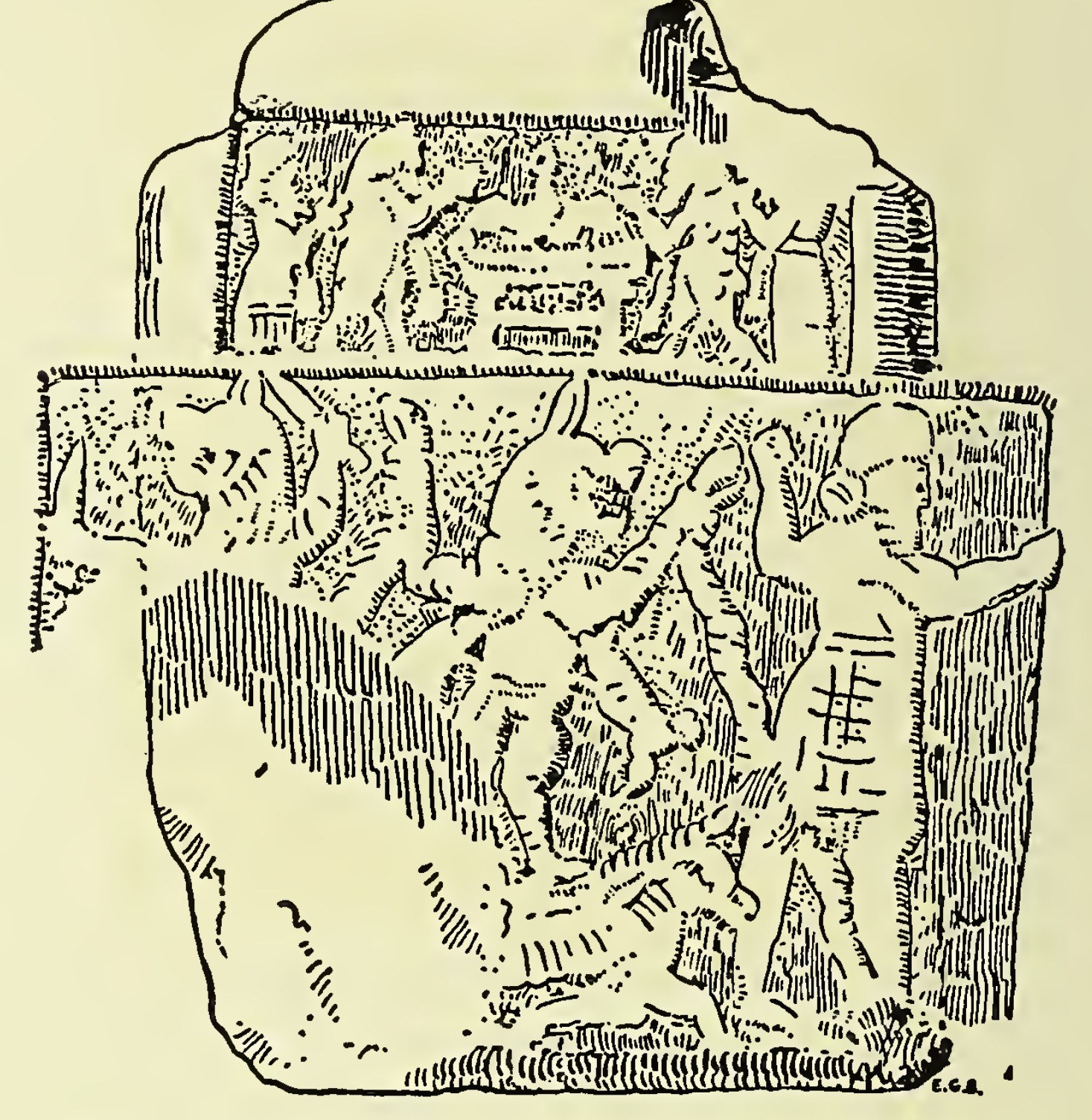
Line engraving of a Babylonian bronze exorcism amulet shown from the back: a tall arched plaque whose upper edge is overhung by the horned, dog-headed face of a demon peering down; below, stacked horizontal registers of ritual figures and vessels, and at the base the underworld, where the demoness Lamashtu with lifted arms is driven off across the water toward the land of the dead.
Mesop.

Kur, the Land of No Return

Dust for bread, mud for meat, and feathers for clothes: the great below of the Sumerians and Babylonians, a house with a bolt on the door and a queen who lets no one out.
8 min*Inana's Descent to the Nether World*
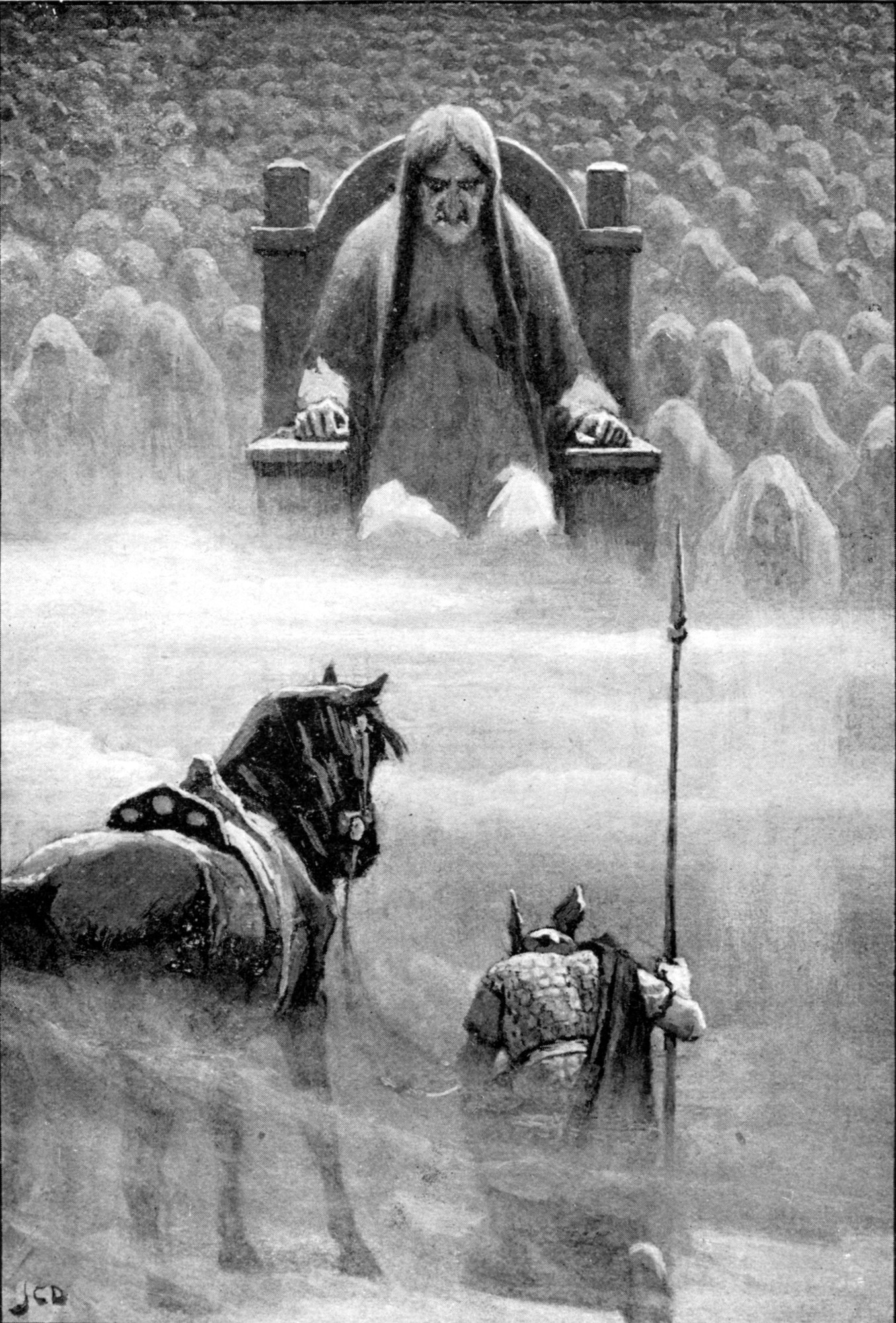
Hel, grim and stern-faced, enthroned on a stone high-seat in the misty dark of her realm, both hands gripping the throne-arms, ranks of the shrouded dead receding behind her; below, Hermóð the Nimble kneels before her with his spear, having dismounted from Odin's dark horse Sleipnir.
Norse

Hel, Queen of the Dead

Half her body the hue of living flesh, half of it corpse-blue, she keeps a hall where the table is called Famine and the bed is called Care: the daughter Odin cast into the mist to rule everyone who dies quietly.
5 minSnorri Sturluson
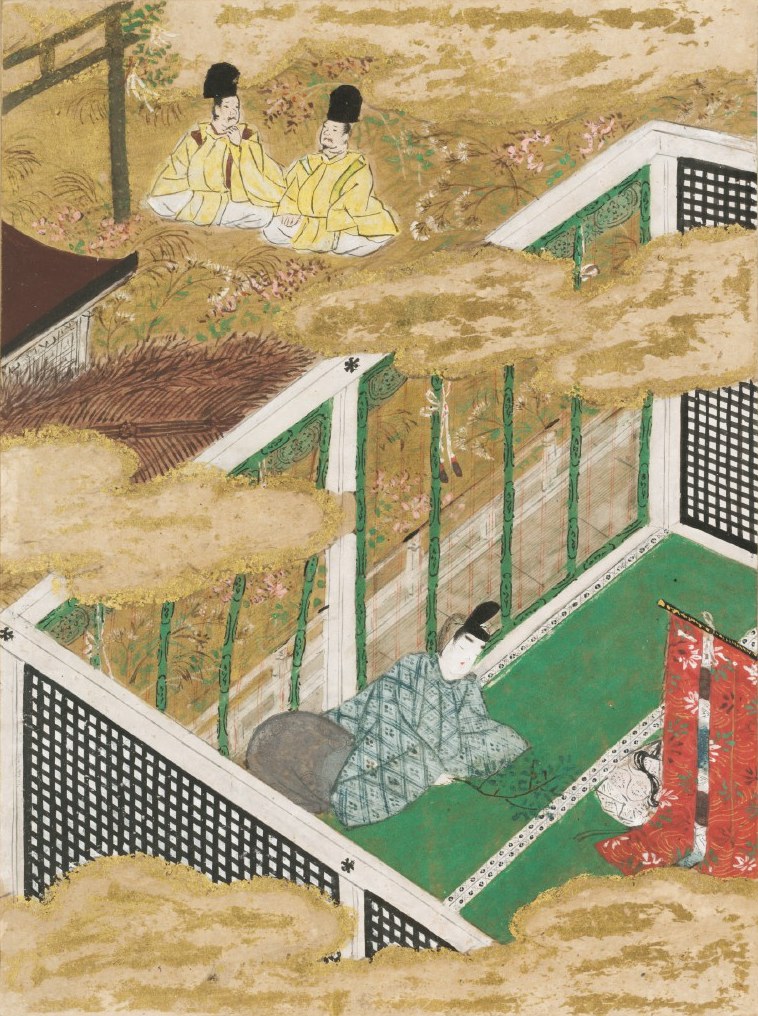
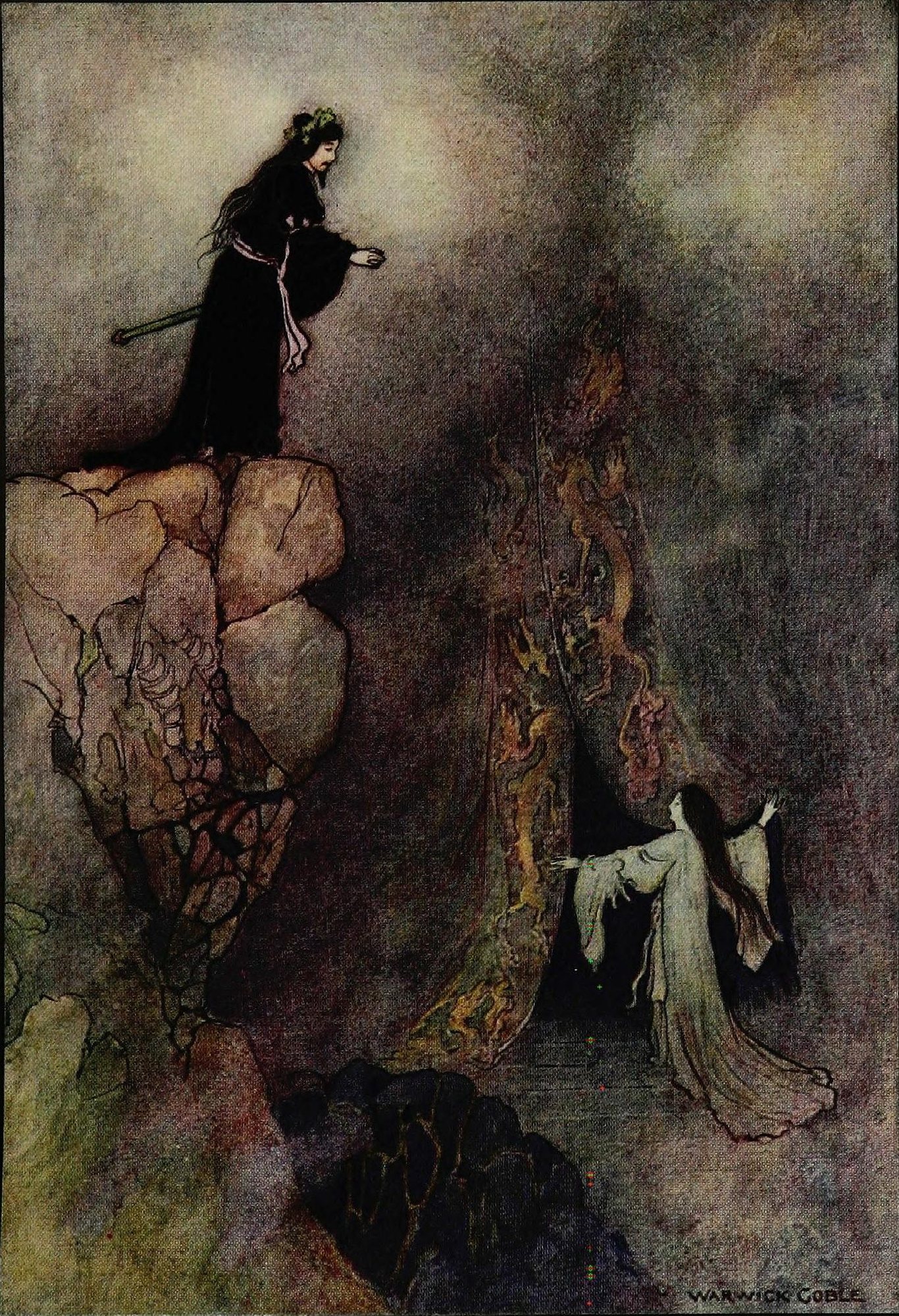
A dark, misty underworld chasm. At the top of a rocky crag on the left, Izanagi stands in a long black robe with a sword at his hip, looking down; at the lower right a pale, white-robed woman with long streaming hair, Izanami, rises from the fiery dark of Yomi with her arms flung up toward him, spectral shapes and flame climbing the rocks between them.
Japanese

Izanagi's Descent to Yomi

He followed his dead wife into the land of the dead to bring her home, lit a single forbidden light to look at her, and fled a rotting queen: the myth that gave Japan its death, its cleansing rite, and its three brightest gods.
6 minKojiki
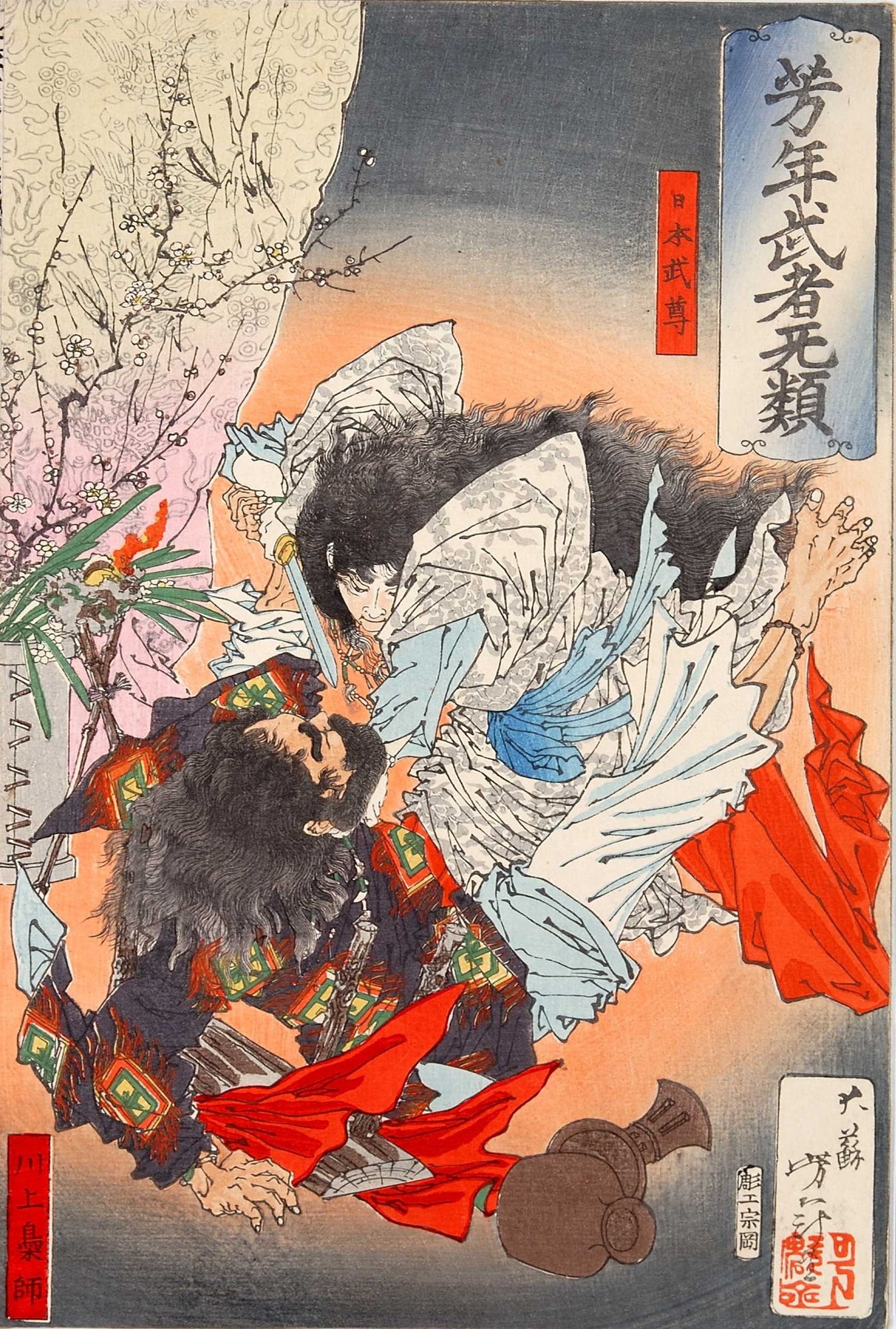
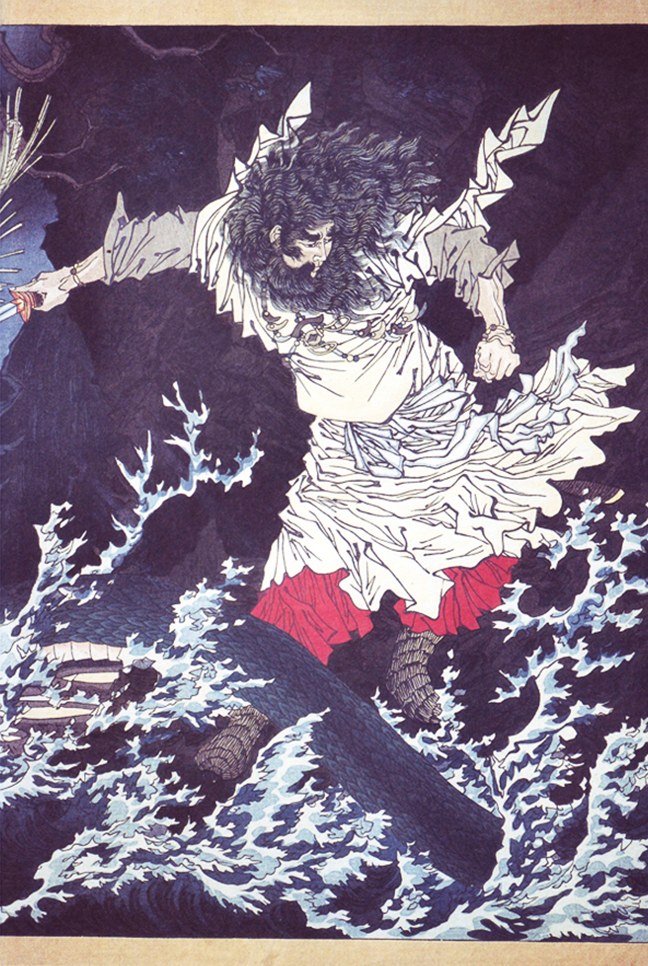
Japanese woodblock print of the storm-god Susanoo, wild-haired and bearded in a white robe over a red under-robe, striding through foaming waves with his arms flung wide and a sword gripped in his lowered left hand, in the moment of slaying the eight-headed serpent Yamata-no-Orochi at the River Hi in Izumo.
Japanese

Susanoo, the Storm God

Born from a washed nose, he wept the green mountains bare and was cast out of two worlds before he ever drew a sword on the eight-headed serpent: the most turbulent of the Japanese gods, expelled troublemaker turned culture-hero of Izumo.
6 minKojiki
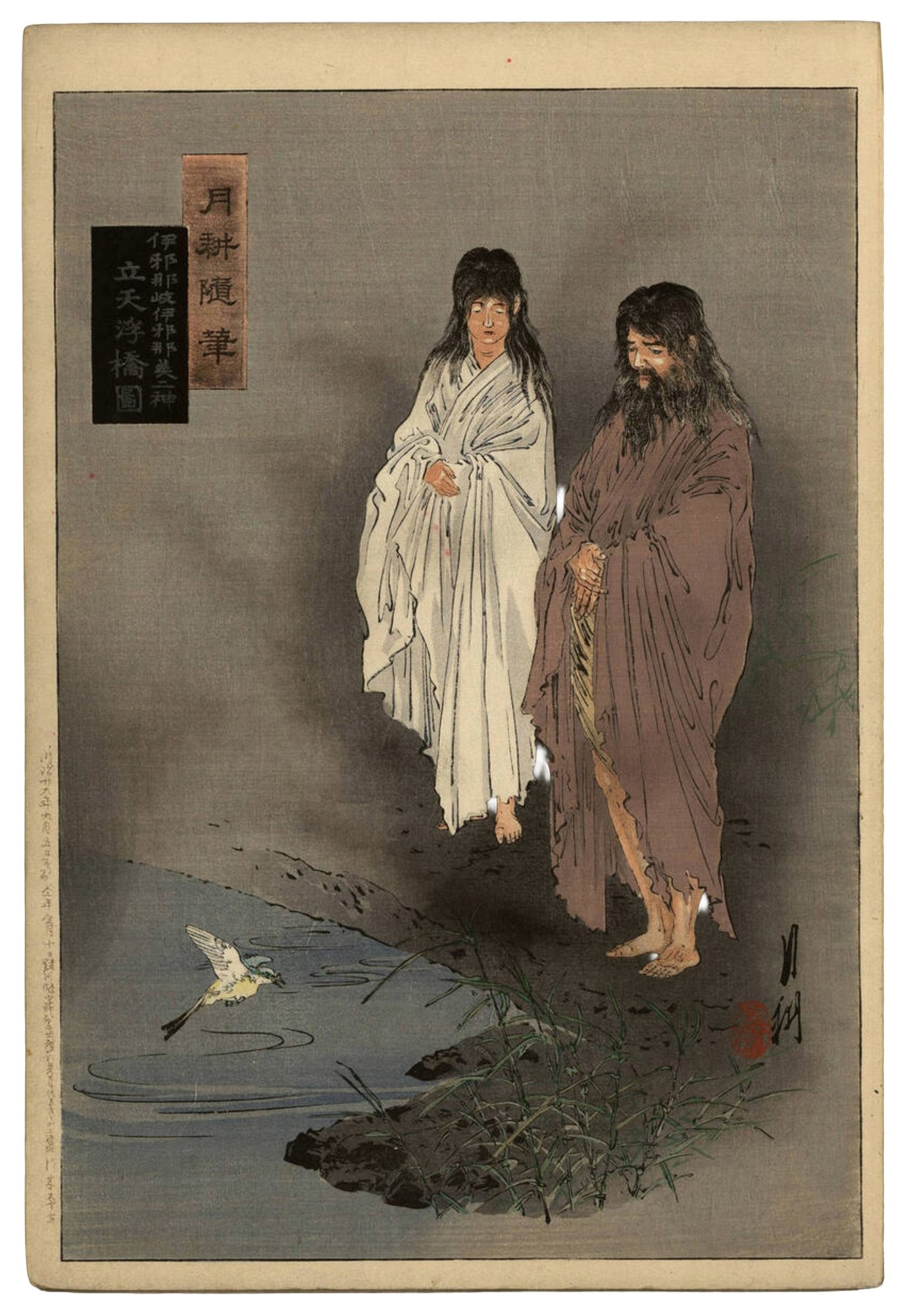
Japanese woodblock print of the two creator deities on the Floating Bridge of Heaven. Izanami in a loose white robe with long black hair and lowered eyes stands beside the wild-haired, bearded Izanagi in a brown robe, who holds the heavenly jewel-spear upright in his clasped hands; a kingfisher skims the water at the reed-fringed brink below them.
Japanese

Izanagi, the Male Who Invites

He stirred the sea to a curd and raised the first island from a spear-tip, then lost his wife to the underworld and came back to wash the pollution off: from the water of his cleansing were born the sun, the moon and the storm.
5 minKojiki
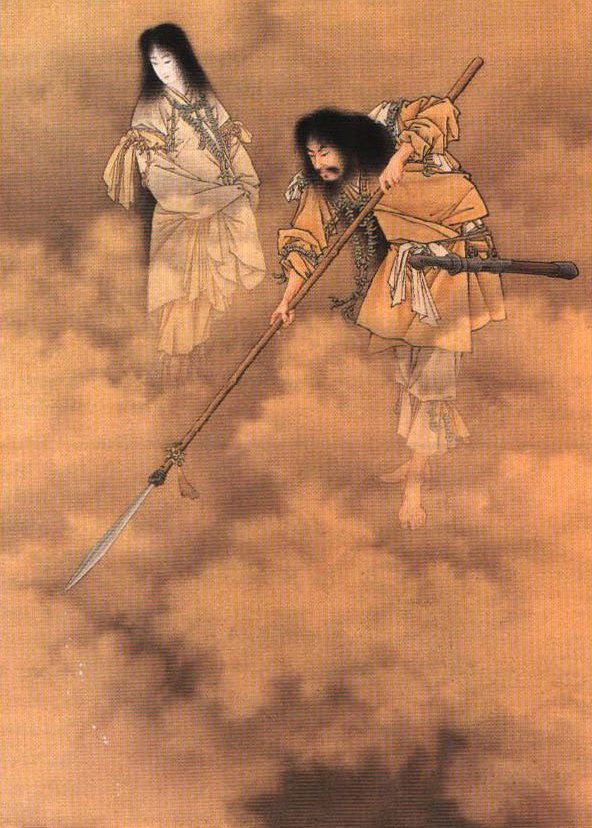
Japanese hanging-scroll painting of the two creator deities standing on cloud above a lone sea-wave. Izanami, at left in a pale robe with long black hair and lowered eyes, stands beside the wild-haired, bearded Izanagi, who leans out and lowers the long jewel-spear so its blade dips toward the water below.
Japanese

Izanami, the Female Who Invites

She spoke first at the pillar and bore the world a crooked child, then bore it right: the islands of Japan and the gods of sea and wind and fire, until the last birth killed her and made her queen of the dead.
5 minKojiki
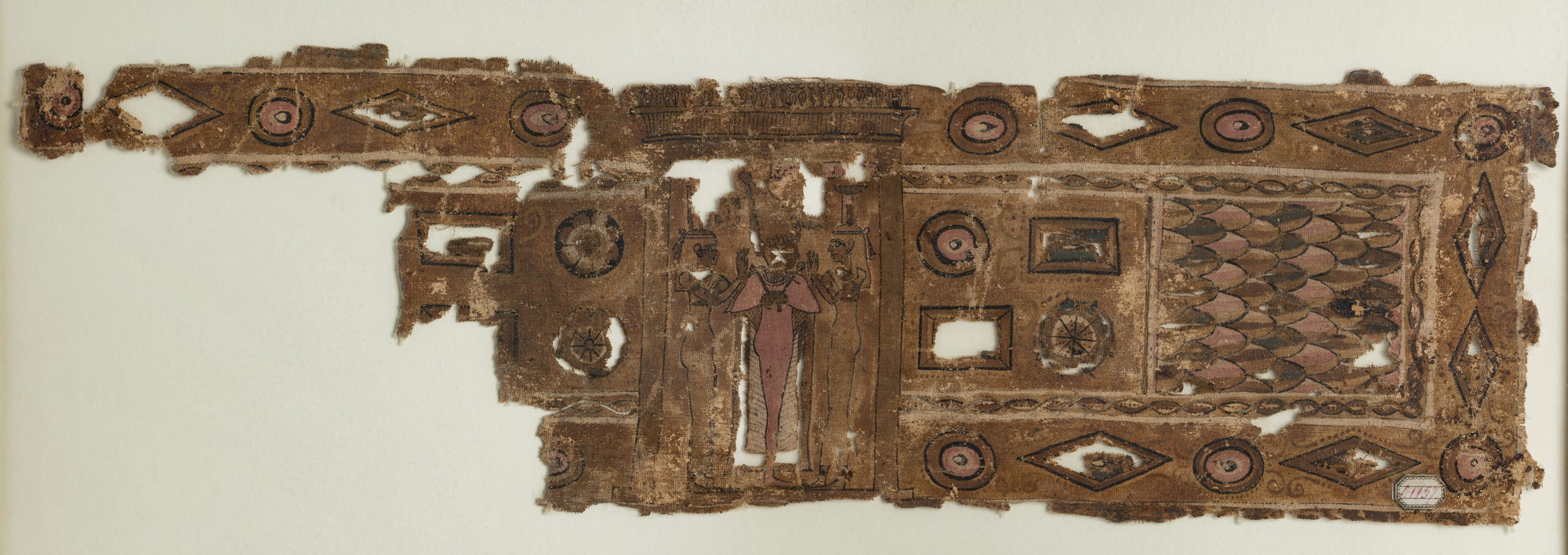
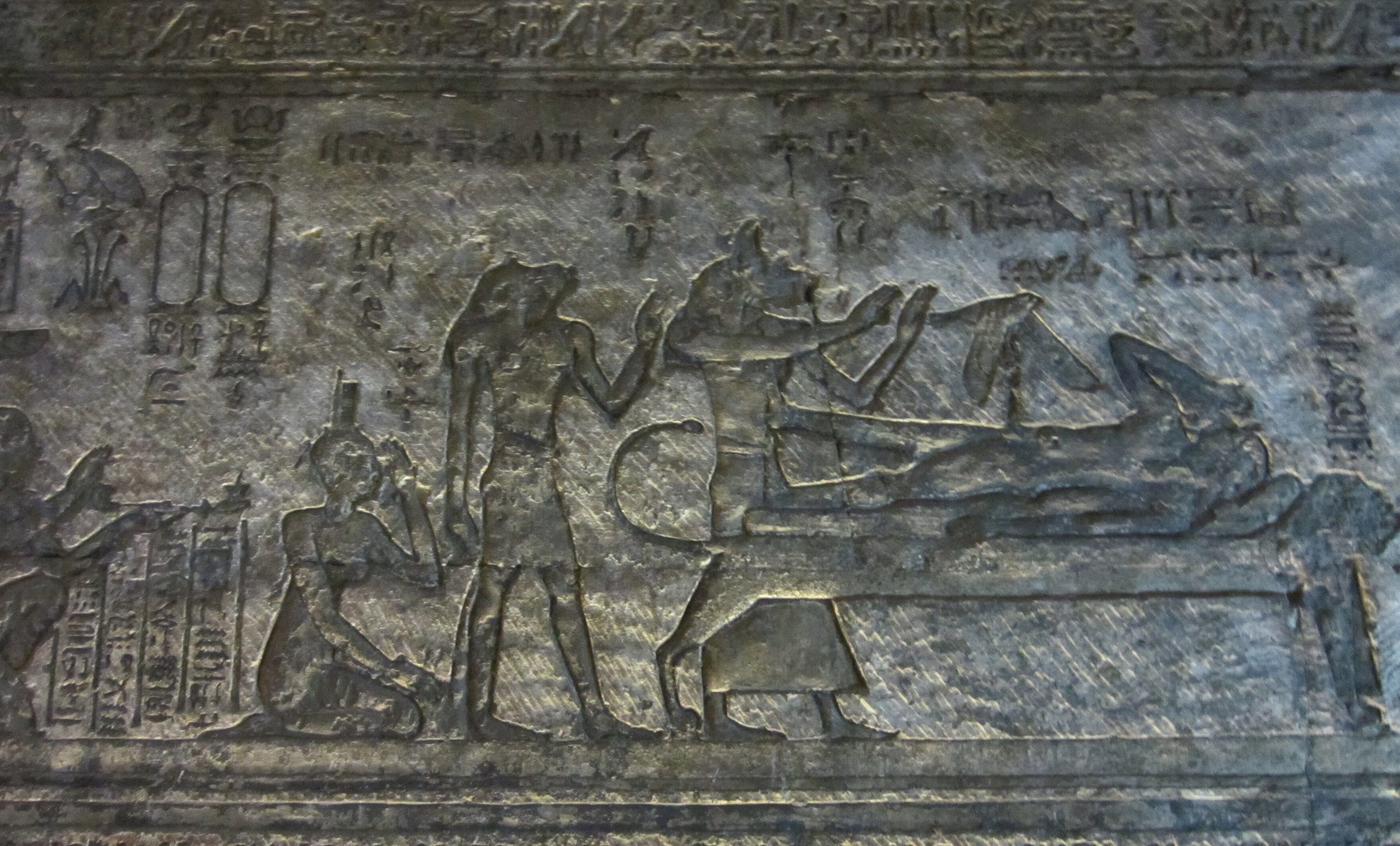
Roman-period Egyptian funerary shroud in painted linen: the mummiform god Osiris lies at the centre on a bier, green-skinned, arms crossed over his chest; the goddesses Isis and Nephthys stand or kneel at head and foot with hands raised in mourning; winged deities and columns of hieroglyphs fill the surrounding bands.
Egyptian

Isis Gathers the Scattered Osiris

A widow cuts a lock of her hair, puts on mourning, and walks out into the marshes to find a husband her brother has thrown to the water: the long search for the body of Osiris, and why no single ancient text tells it whole.
7 minPlutarch
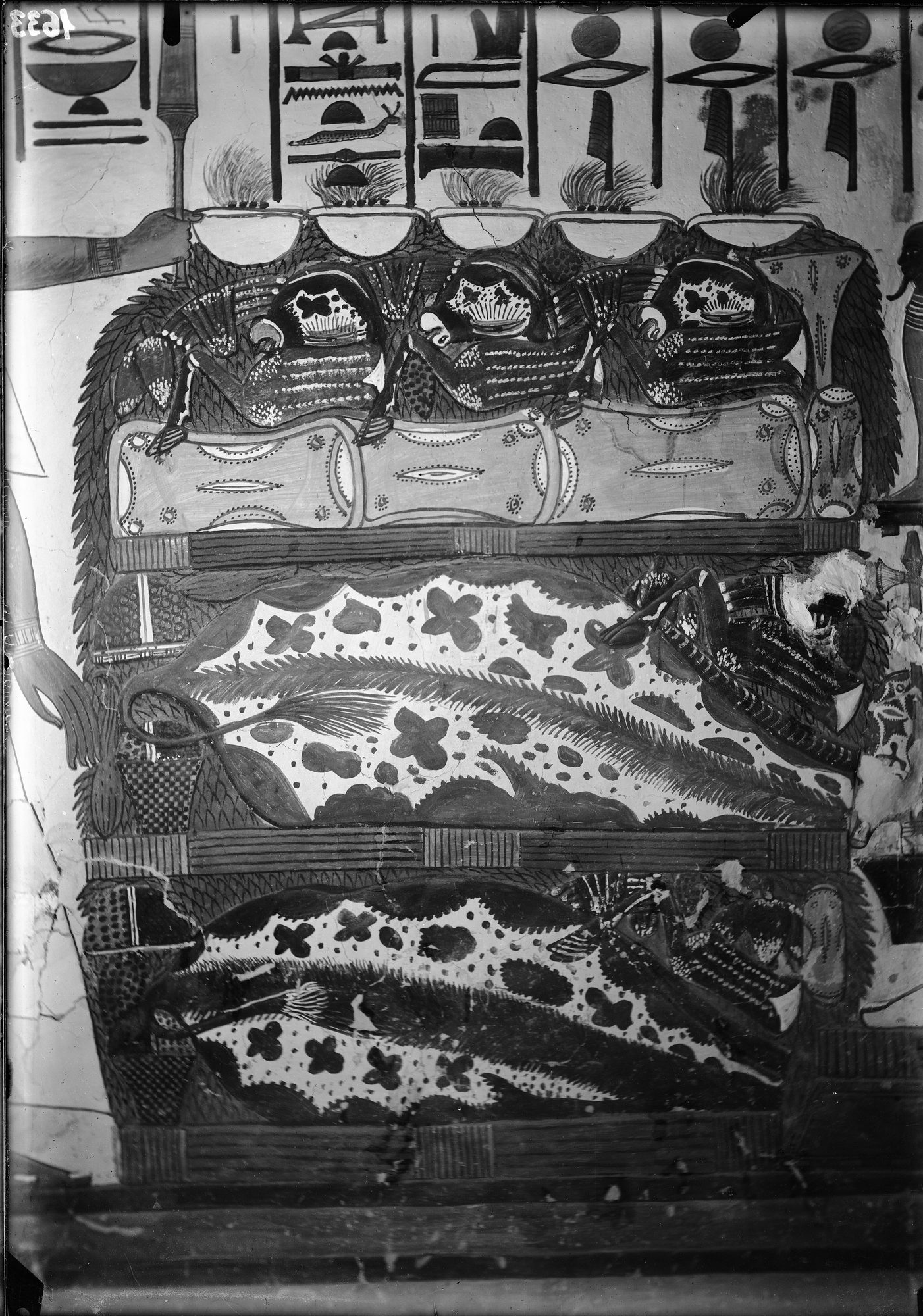
An ancient Egyptian tomb painting from the tomb of Nefertari: a great pile of offerings heaped before the seated god Osiris, Nefertari's invocation recorded in the hieroglyphs above.
Egyptian

The Death and Return of Osiris

A brother's fitted coffin, a body torn into pieces and scattered, and the magic of a wife who gathered them back: how the murdered king was made whole and got an heir from beyond death.
6 minPlutarch
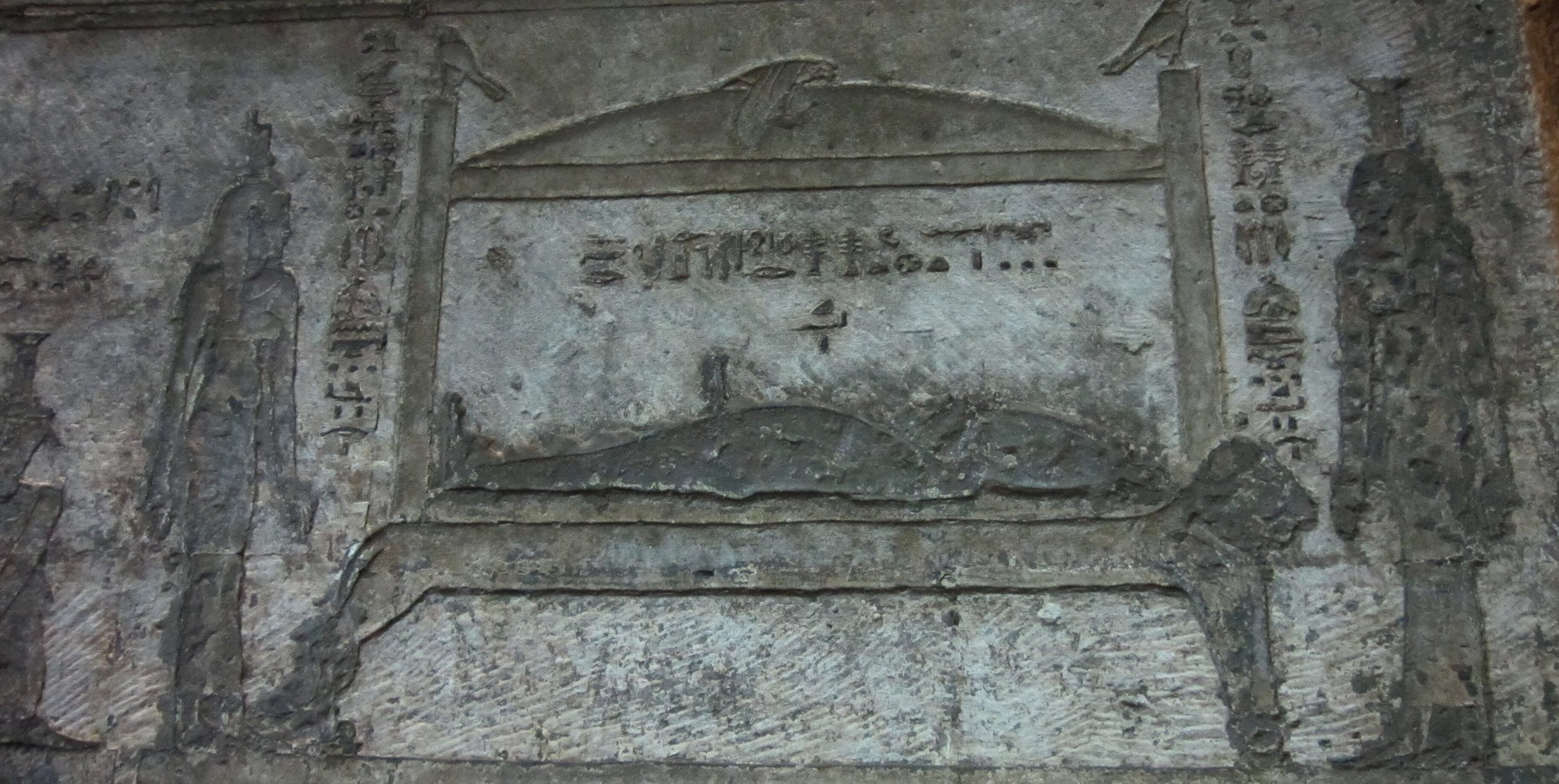
An ancient Egyptian sunk-relief scene carved in stone: the dead god Osiris lies wrapped as a mummy on a low funerary bier beneath an arched shrine-canopy, a bird (the soul as a hawk) hovering with outspread wings over the canopy's ridge; a tall crowned goddess stands mourning at the left and another at the right, each with columns of hieroglyphs above, the whole panel worn grey temple limestone.
Egyptian

The Mysteries of Osiris at Abydos

Once a year the god was carried out to die, hunted to his grave on the desert flats, and brought home again: what a royal treasurer, a Greek philosopher and a temple archive each saw of the drama, across seventeen centuries.
8 minIkhernofret Stela
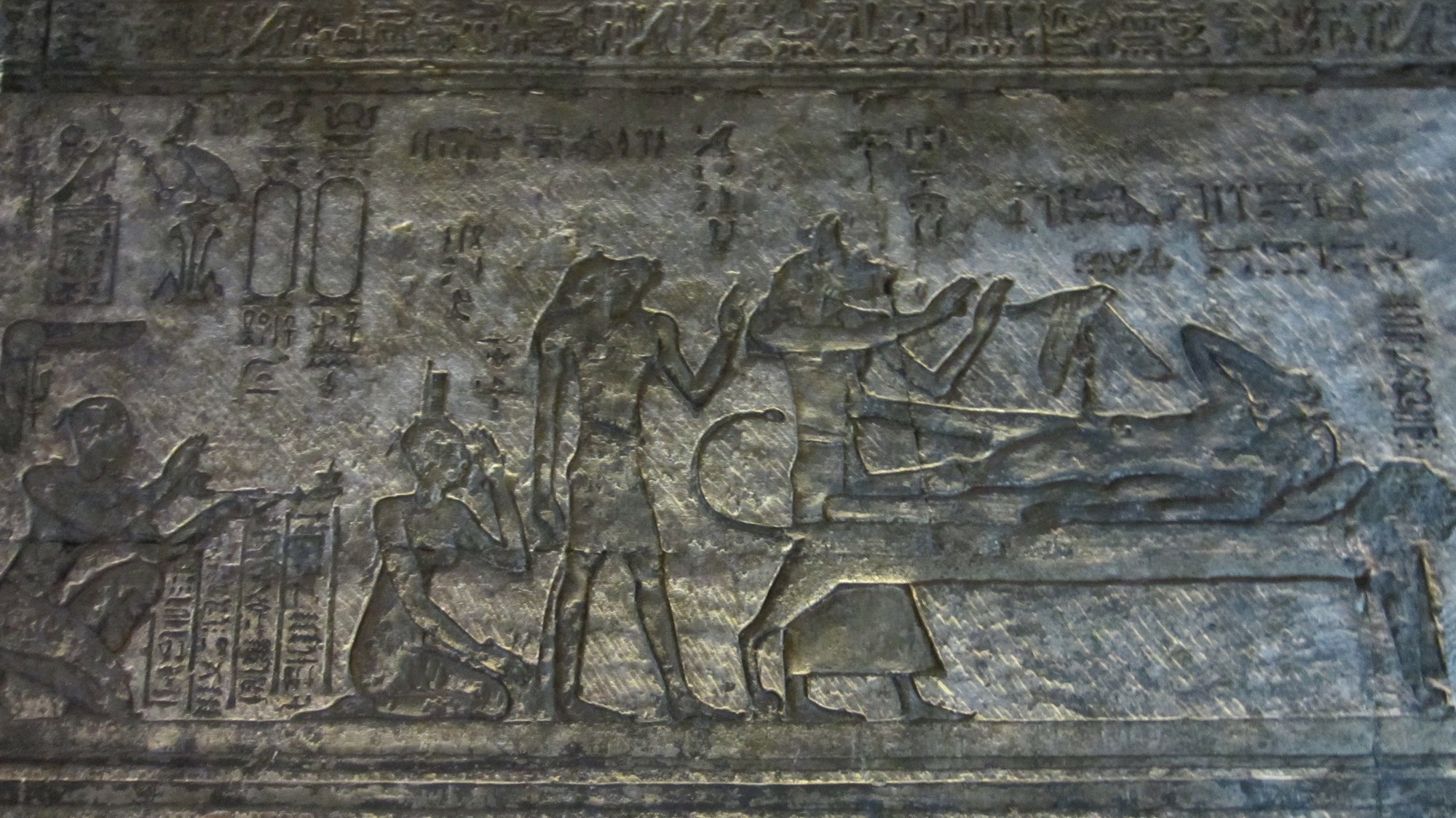
Ancient Egyptian temple relief carved in sunk relief on a chapel wall. At right the god Osiris lies recumbent and ithyphallic on a low bier; above his body the goddess Isis, in the form of a kite with outstretched wings, settles to conceive the heir. The jackal-headed god Anubis attends at the couch, and to the left a standing goddess and a kneeling goddess mourn, with a seated figure at the far edge. Columns of hieroglyphs and royal cartouches fill the field, framed by hieroglyphic border bands above and below.
Egyptian

Isis Conceives Horus over the Slain Osiris

A carrion bird settles over a murdered god at Nedit, beats life back into him with her wings, and draws from the dead body a son sharp as a star: the strangest conception in Egyptian myth, and the making of an avenger.
6 minPyramid Texts §632
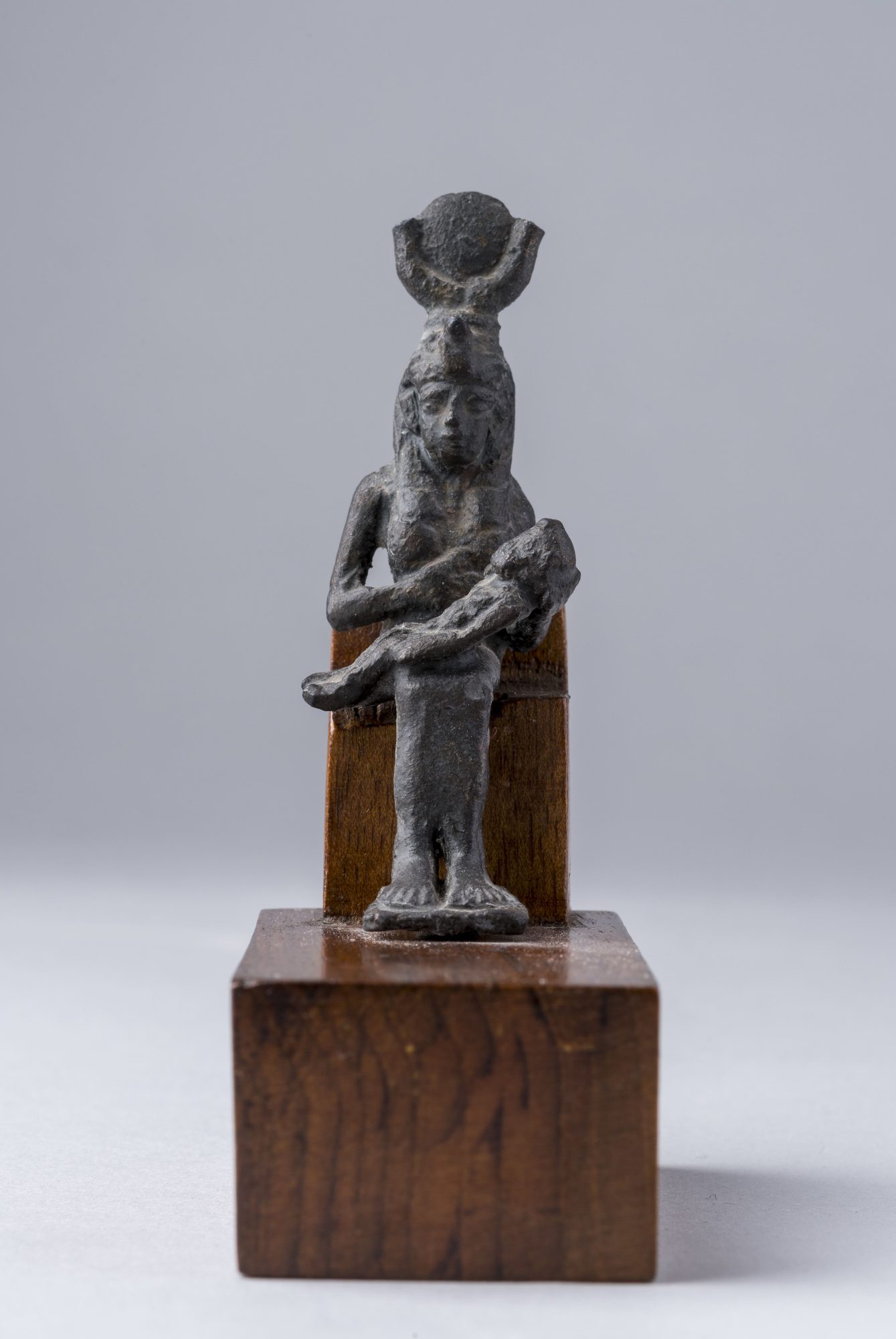
An ancient Egyptian bronze statuette of the enthroned goddess Isis nursing the infant Horus on her lap.
Egyptian

Isis, the Great of Magic

Weret-hekau, Great of Magic: the goddess who reassembled a murdered god, hid her son in a marsh, and wrung the secret name of the sun-god out of his own poisoned body.
6 minThe Legend of Ra and Isis
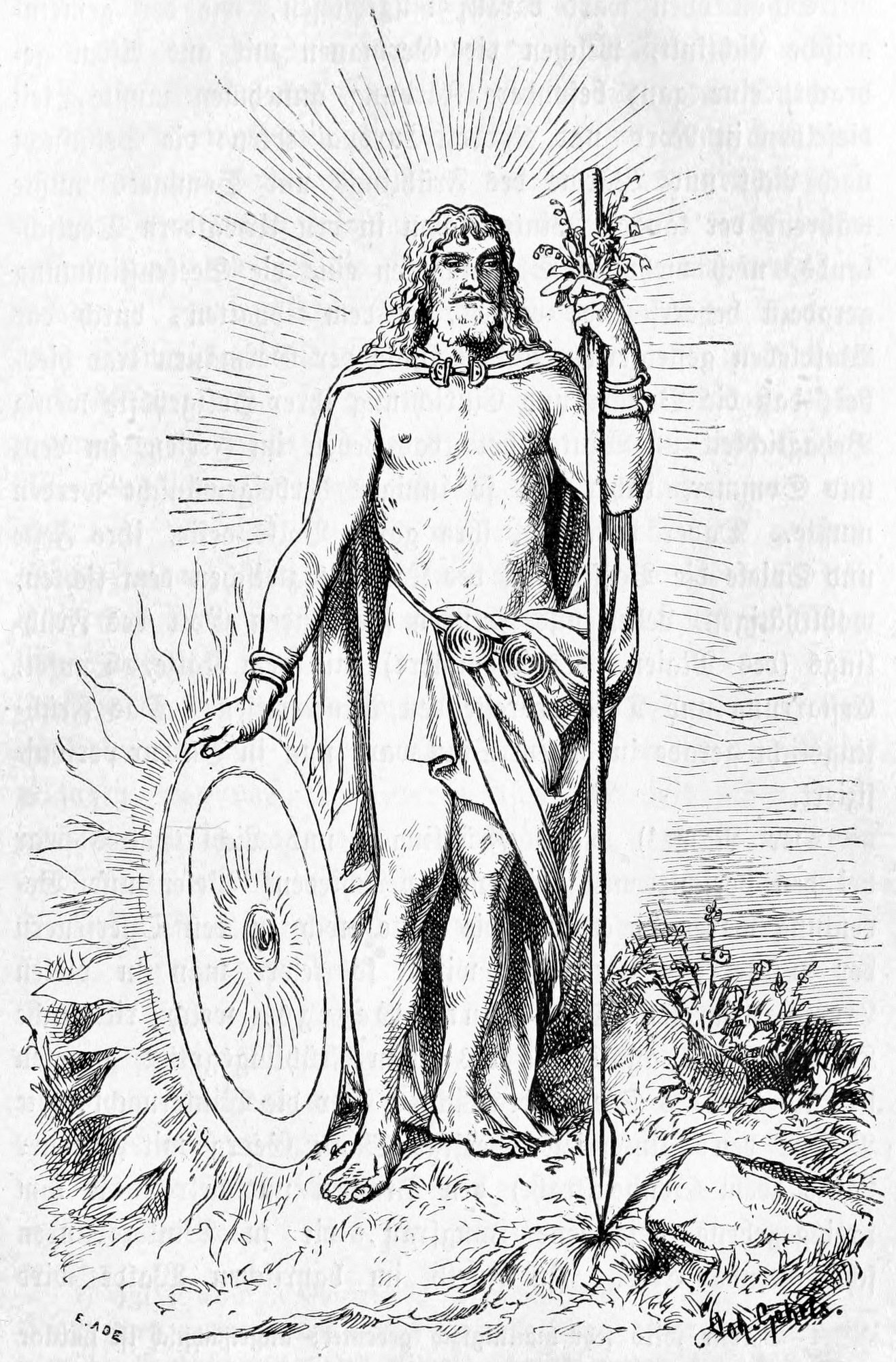
An 1888 illustration of the shining god Baldr, fair-haired and armed, standing in the hall of Walhall.
Norse

Baldr the Shining

The best of the gods, so fair that light streamed from him, at home in a hall nothing unclean could enter: the portrait of a god the myth was built to take away.
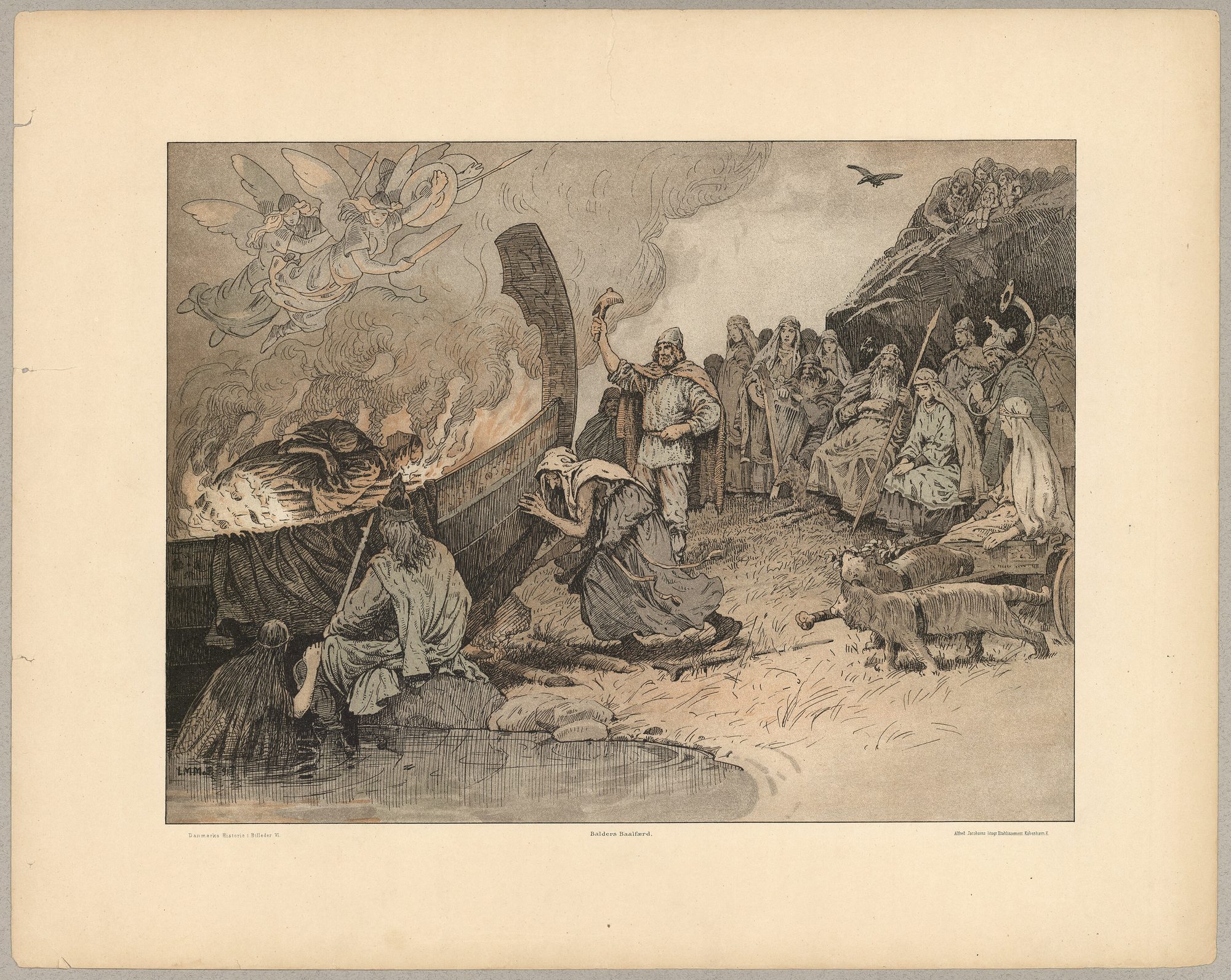
4 minSnorri Sturluson
A colour lithograph of Baldr's ship-pyre funeral: the dead god laid on his burning ship, mourners gathered on the shore as flames and smoke rise.
Norse

The Death of Baldr

A god the whole world had sworn never to harm, a sprig of mistletoe no one thought to ask, and a blind brother's hand: how the north's best-loved god was murdered into Hel and the doom of the gods began.
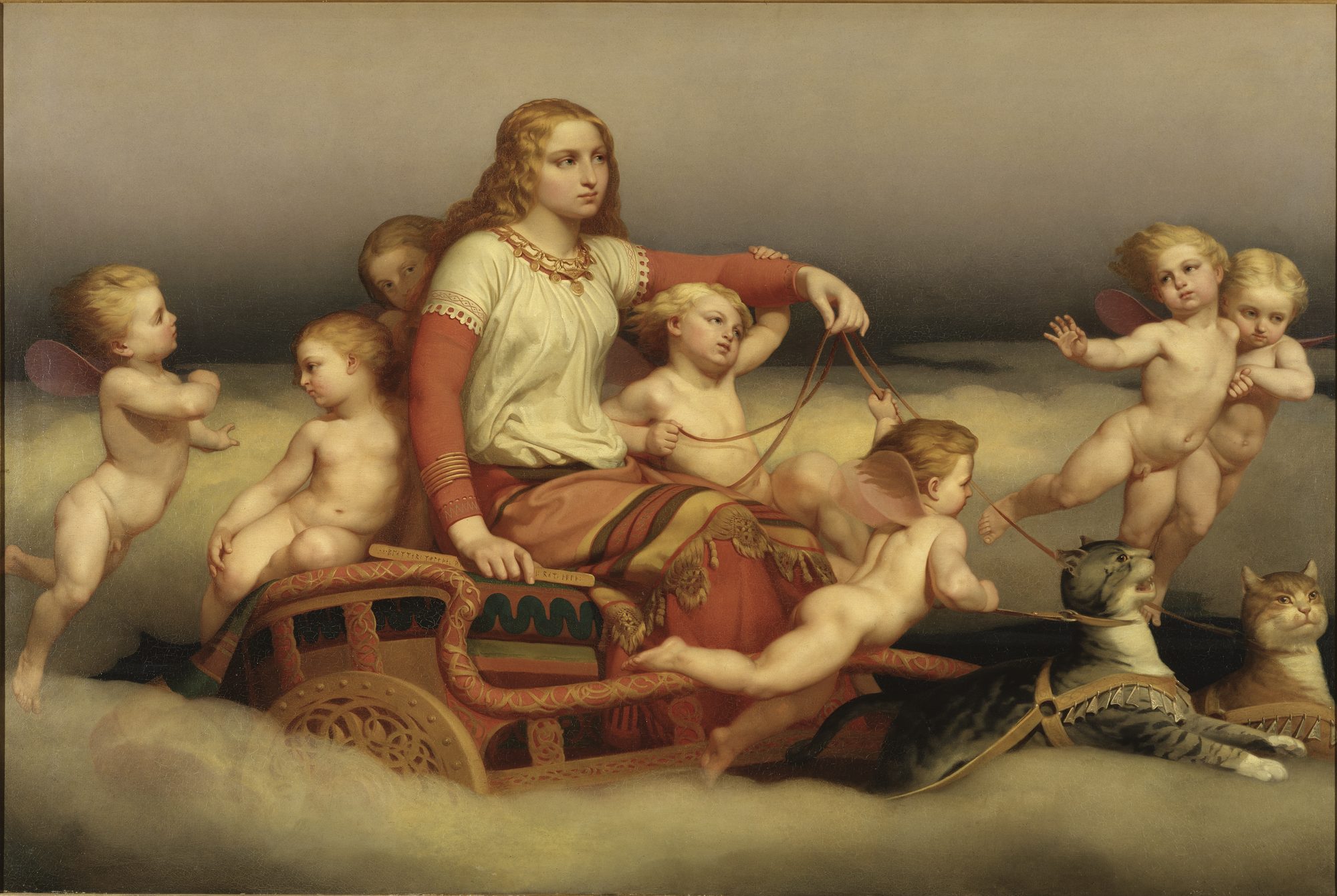
7 minSnorri Sturluson
An oil painting of the goddess Freyja walking through a twilight landscape, helmeted and cloaked, her golden necklace at her throat, searching for her vanished husband.
Norse

Freyja of the Vanir

She rides to the battlefield in a chariot drawn by cats and carries home half the slain, weeps red gold for a husband who wandered off, and is the goddess men pray to when they are in love: the strangest and most renowned of the Norse goddesses.
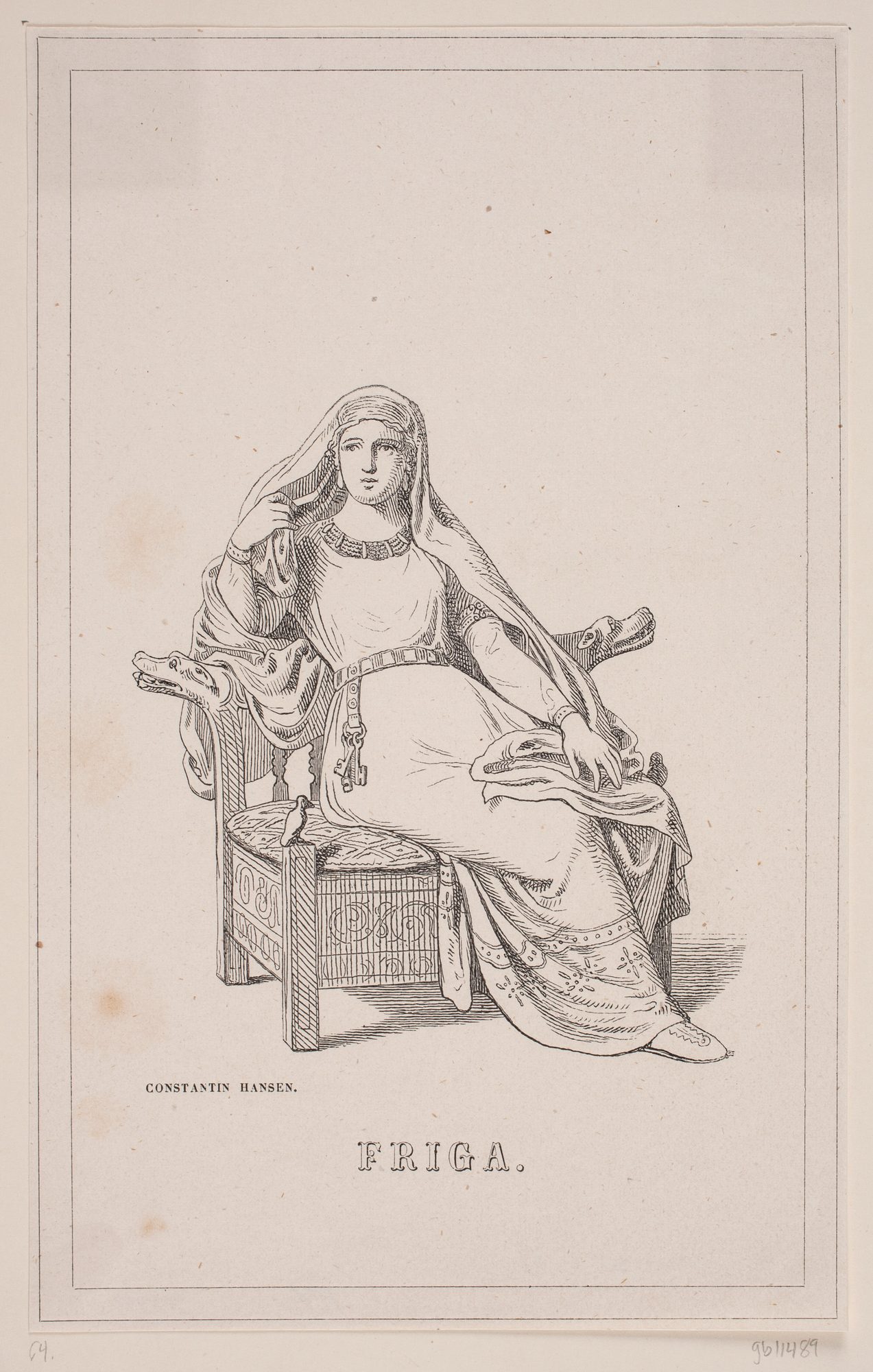
6 minSnorri Sturluson
A 19th-century print of the goddess Frigg as a crowned queen, standing full-length in flowing robes, a distaff in one hand.
Norse

Frigg, Queen of the Aesir

She knows the fate of every living thing and never speaks it, and when the one doom she tried to bar comes for her son, all she can do is weep: the foremost of the goddesses, undone by a single overlooked shrub.
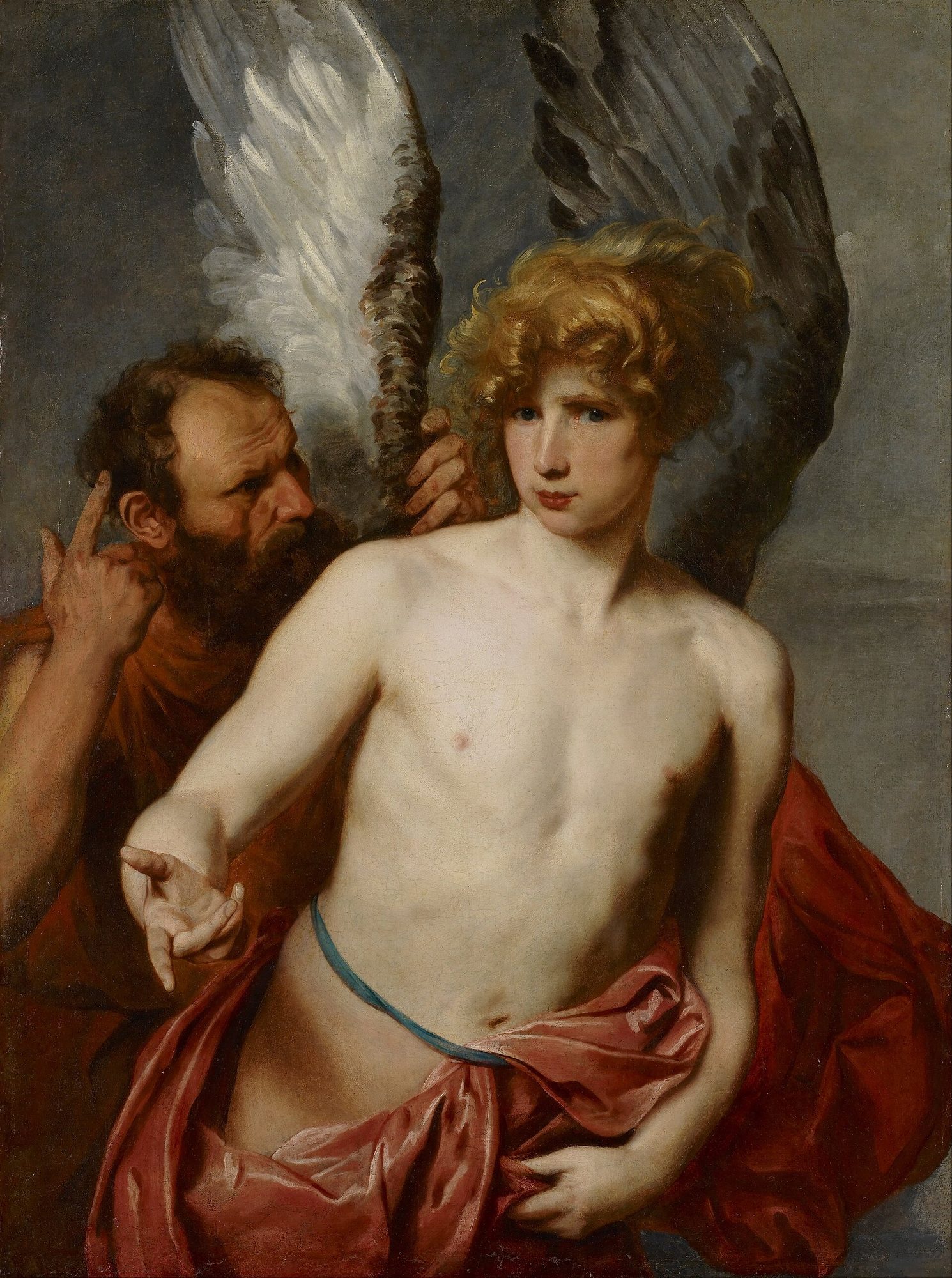
5 minSnorri Sturluson
A Baroque painting of Daedalus and Icarus. The aged, balding, grey-bearded Daedalus stands behind his son in a russet-orange robe, one hand steadying a great feathered wing (one pinion pale, one dark) at the boy's shoulder while the other hand rises with a raised, admonishing finger, as though giving a warning. In front of him the youthful, bare-torsoed Icarus, with tousled golden hair and a red drape falling from his hips, gazes out past the viewer, one arm extended. The background is a plain, shadowed studio wall.
Greek

Daedalus and Icarus

A caged inventor reasons that if the sea and the land are watched, the sky at least lies open. He builds his son a pair of wings, and gives him one rule to keep him alive.
6 minOvid
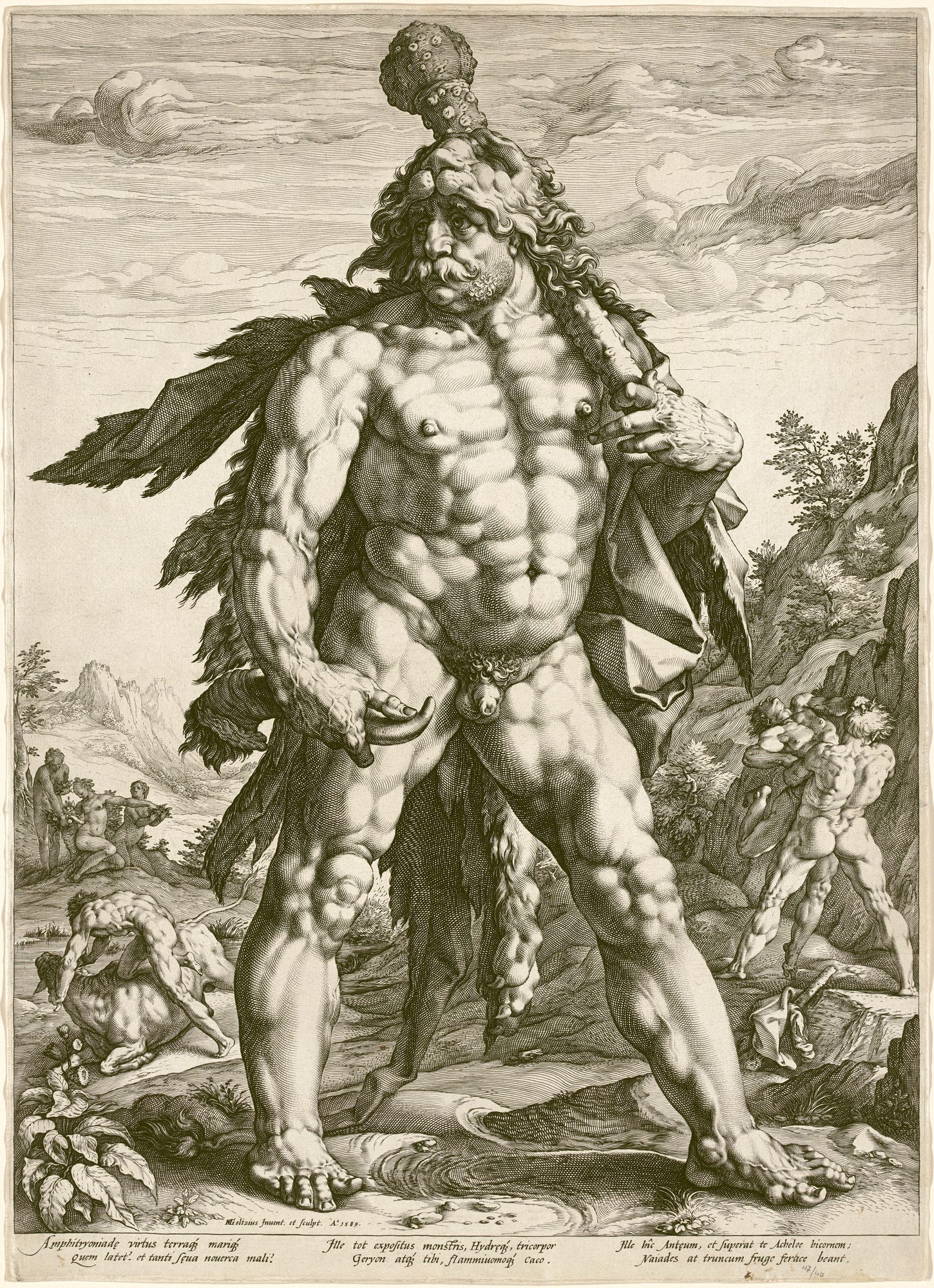
An engraving of a colossal, heavily muscled Hercules standing frontally, the Nemean lion-skin worn as a hood over his head and draped down his left side, the knotted olive-wood club resting over his right shoulder; small background vignettes show his combats with Antaeus, Cacus and Achelous in a classical landscape.
Greek

Heracles, the Greatest Hero

The strongman son of Zeus strangled serpents in his cradle and cleaned the world of monsters, but the labour that made him a god began in the ruin of his own house.
6 minPseudo-Apollodorus
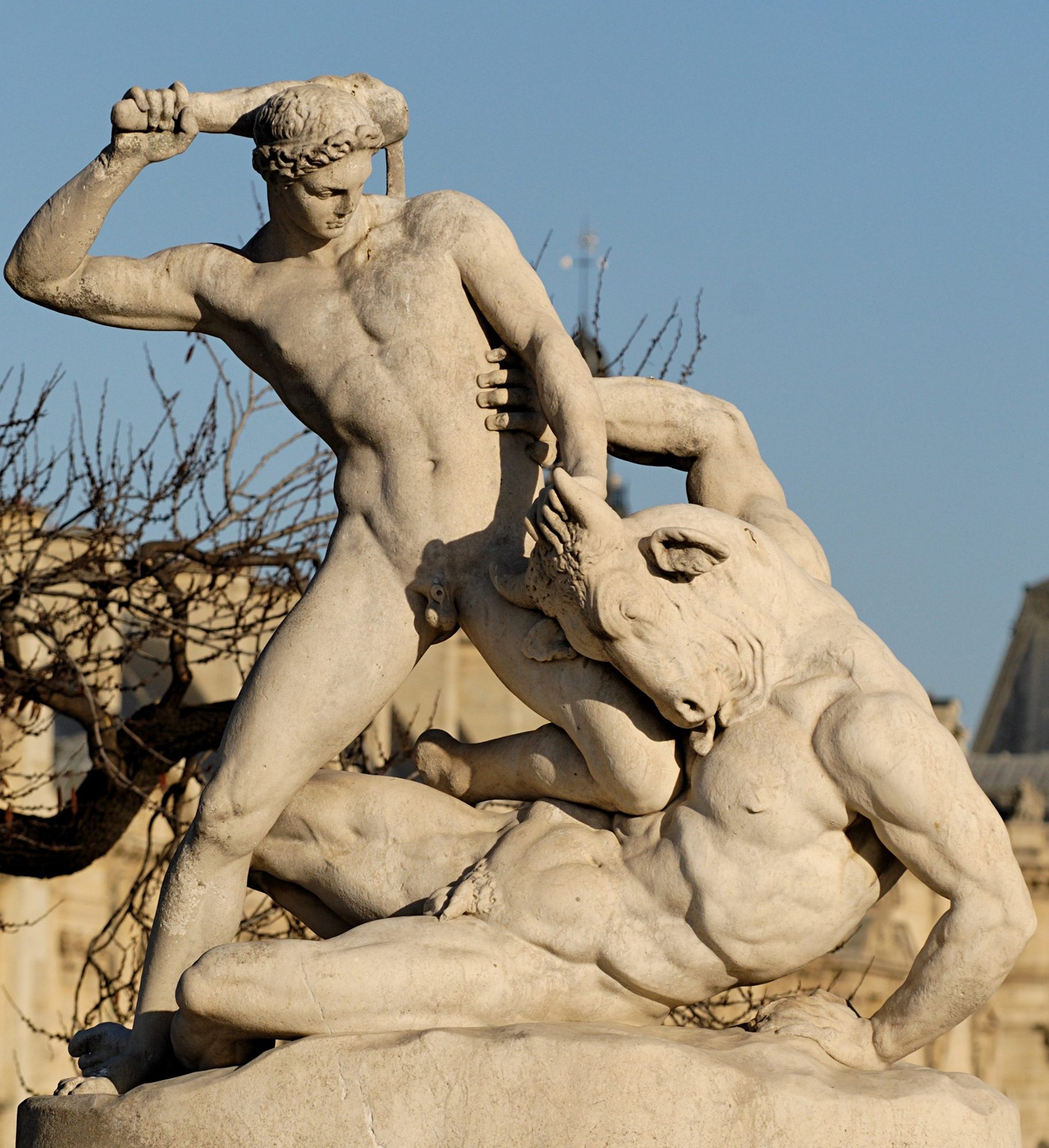
A white marble statue of a nude, laurel-crowned Theseus lunging forward with a club raised overhead in one hand, gripping the horned head of the bull-headed Minotaur with the other as the beast collapses beneath him over a fallen youth, set against a soft-focus ground of bare trees and pale stonework.
Greek

Theseus, Hero of Athens

A prince who chose the killers' road, unwound a thread through the dark to end a monster, and forgot a single sail. The founder Athens made in its own image, remembered for what he built and what he abandoned.

6 minPlutarch