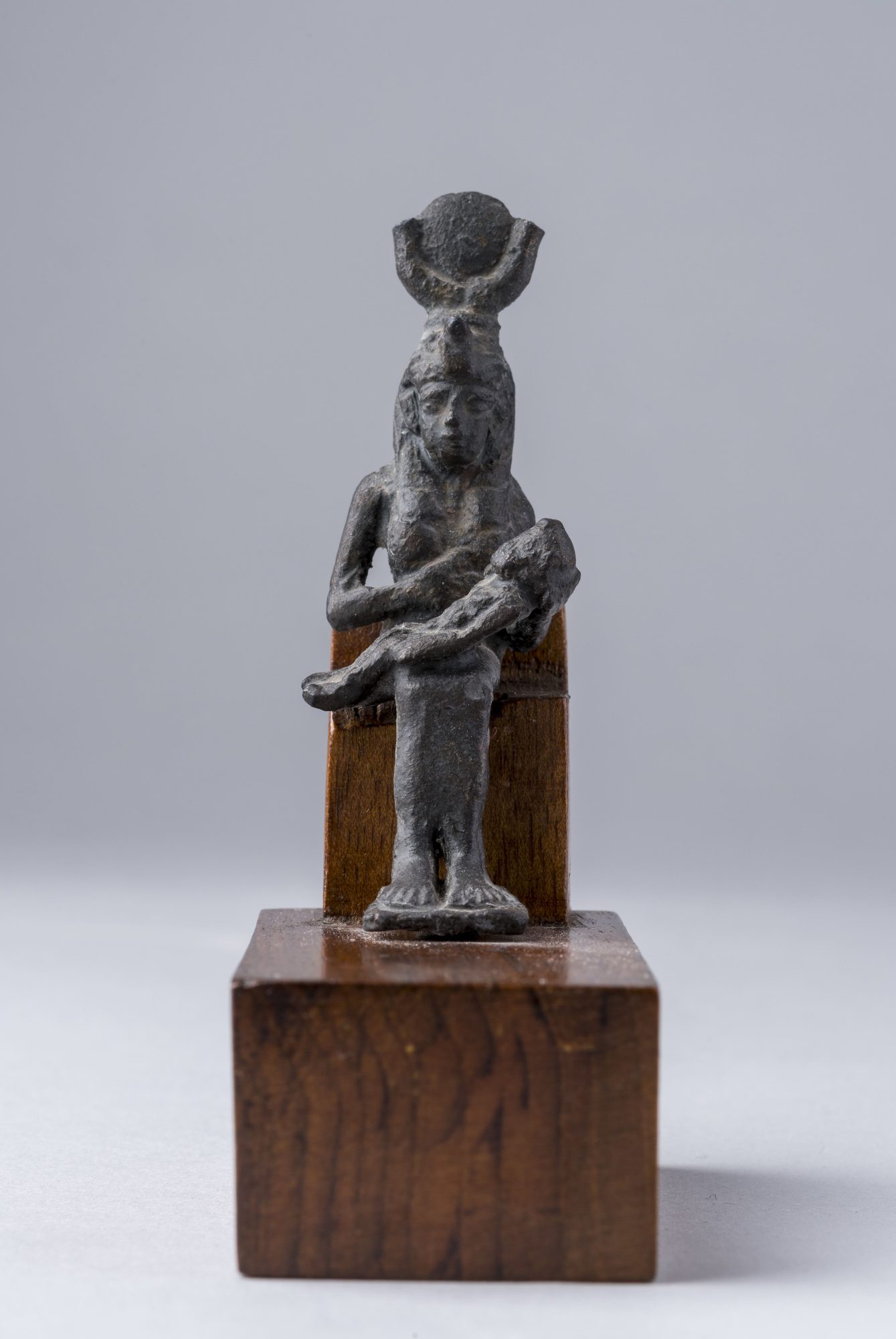
The old sun-god was dribbling. Ra had grown ancient, and as gods will when they age in the Egyptian imagination, his mouth had begun to run, the saliva falling to the ground as he passed on his daily circuit of the sky. Isis gathered it. She kneaded the spittle with earth into the shape of a serpent, breathed a spell over it so that it lived, and laid the thing across the road the sun-god walked every day. She did not lift a hand against him. She let him walk into it.
When the serpent struck, the poison went through the lord of creation like nothing his own magic could touch, hotter than fire and colder than water, until his jaws chattered, his lips trembled, and the god who had made the world could not speak. This is the essential thing to hold about Isis: her power is a spoken and a made thing, spell and true name and breath, never a blow. She is weret-hekau, Great of Magic, and every story about her is a demonstration of it.
Out of his body and into hers
She had done this to a purpose. When Ra cried out in his agony, Isis came, all concern, and offered to heal him, on one condition. He must tell her his name. Divine Father, tell me thy name,
she said, for he who uttereth his own name shall live.
The sun-god twisted. He recited his titles instead: Khepera in the morning, Ra at noon, Temu in the evening. Isis was not deceived, because those were only the names the world was allowed to know, and the poison she had made went on burning.
At last, undone by it, he surrendered the thing itself: his secret name would pass, he said, out of his body and into hers. She took it, spoke the cure, Flow, poison, come out of Ra,
and the god was healed. But she now held the one true name behind the sun, and with it a power over even the highest of the gods. The whole tale is, in the end, a snakebite spell copied out to cure the stung; and that is exactly why it puts her mastery of the word at the centre, where the Egyptians kept it.
Keeping the dead god whole
Long before that scheme, the same power had done gentler and more desperate work. When her husband and brother Osiris, the good king of Egypt, was murdered by their brother Set and his body lost, it was Isis who recovered and restored it. The oldest text that names her, carved inside the pyramid of King Unas more than four thousand years ago, does not tell the murder at all; it simply shows her keeping the dead god whole and alive, Osiris, whom you have preserved alive, he lives. She does not work alone.
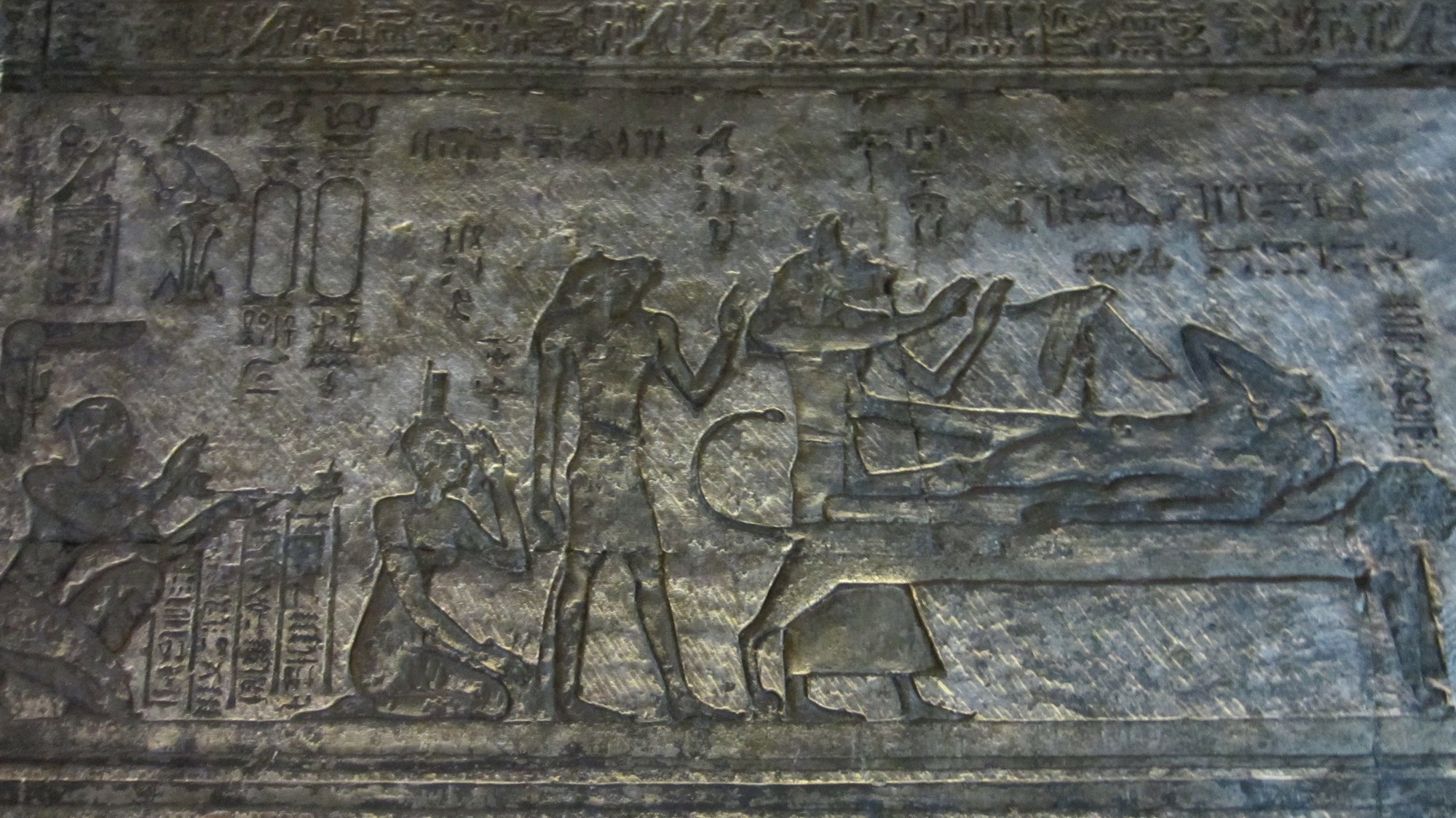
Beside her stands her sister Nephthys, the two of them paired as the mourner-goddesses who tend the corpse of the god: Isis takes care of him, Nephthys suckles him. In their grief the sisters were likened to kites, the far-ranging birds of prey whose thin cry the Egyptians heard as lament. In one tradition Isis, still in that bird’s form, beats her wings over her dead husband to fan breath and life back into him, and conceives from him a son. The Coffin Texts preserve a stranger variant, in which she is quickened instead by a flash of lightning. The tradition does not settle the how; it insists only on the outcome, that from a dead god a living heir was got.
Hidden in the papyrus marshes
That heir was Horus, and the second great labour of Isis was to keep him alive. Pregnant and hunted by Set, she hid in the papyrus marshes of the Delta, the reed-thicket the Egyptians called Akh-bity, the nest of Horus,
and there she bore and raised the child in secret. The image of the goddess seated with the infant at her breast, Isis giving suck to the small Horus, became one of the most reproduced figures in all of Egyptian art. But the marsh was not safe.
On the Metternich Stela, a Late Period healing-stone covered in spells against venom, the child is stung by a scorpion while his mother is away, and she returns to find him lifeless. She puts her nose to his mouth and finds no breath. Her lament is one of the rawest things in Egyptian literature, each line falling like a blow, Horus is bitten, he for whom I cared and suffered when he was being fashioned in my womb, is bitten, and she throws herself about, the text says, like fish laid on red-hot coals. Then she does what she always does. She cries out, and the sky answers. The Boat of Ra halts in its course, and Thoth comes down.
It matters that it is Thoth who comes. On that stela the decisive spell over the dying child is spoken not by Isis but by Thoth, who descends to heal the child for his mother
and brings with him the fluid of life from Ra. Isis summons the help and stops the sun in its tracks; the culminating word is another god’s. Other magical texts do give her the cure outright, or show her coercing Ra or Geb into it, and the sources genuinely differ.
The flattened modern Isis, the solitary miracle-worker who resurrects the dead by her power alone, is a simplification the ancient texts do not support, and she is the greater figure without it. Her helpers are always there, Nephthys, Anubis, above all Thoth. Her genius is not that she needs no one; it is that she can move the whole machinery of heaven, halt the barque of the sun, and bend the god of words himself to her purpose, on behalf of the dead husband and the threatened child she will not give up.
A Greek gloss on her name
Even the Greeks, coming late to her, reached for the word. Plutarch glosses her name to mean knowledge, and passes on the reports that made her the daughter of Hermes, and others that made her the daughter of Prometheus. These are Greek overlays on a goddess whose native parents were the earth and the sky, and they should be held as such. But the instinct behind them was sound. Whatever they got wrong about her parentage, they had grasped the one thing that never changed across three thousand years of her worship: that her power was the power of the word, and that she was, first and last, Great of Magic.
“Divine Father, tell me thy name, for he who uttereth his own name shall live.” (The Legend of Ra and Isis, trans. Budge)
- The Legend of Ra and Isis (New Kingdom magical tradition, preserved in the Turin magical papyrus), read verbatim in **E. A. Wallis Budge, *Legends of the GodsThe Egyptian Texts* (1912)**, Project Gutenberg ebook 9411: Isis
mighty in words
gathering the aged Ra’s saliva, moulding and animating a serpent, and laying it on his path; the bite, and the poisonhotter than fire and colder than water
; Ra’s evasive self-naming (Khepera in the morning, Ra at noon, and Temu in the evening
); his surrender of the secret name (my name shall pass from my body into hers
); and Isis’s healing spell,Flow, poison, come out of Ra.
A genuinely ancient text whose purpose is a snakebite cure, which is why it foregrounds Isis’s magic (ḥeka). - The Metternich Stela (Late Period, 30th Dynasty, c. 360 BCE; a cippus of Horus), read verbatim in **E. A. Wallis Budge, *Legends of the GodsThe Egyptian Texts* (1912)**: Isis’s passage through the Reed Swamps escorted by seven scorpion-goddesses; the rich woman who shut her door and the poor woman rewarded; the innocent child stung and healed by Isis’s compassion; the later sting of her own son Horus; the
Horus is bitten
lament and Isis leapinglike fish when they are laid on red-hot coals
; the nose put to the child’s mouth to test for breath; the halting of the Boat of Ra; and Thoth’s descent to speak the decisive cure and transferthe fluid of life of Ra.
- Pyramid Texts of Unas (Old Kingdom, c. 2350 BCE), Utterance 219 and §371, read via pyramidtextsonline.com (a modernised version of Alexandre Piankoff, The Pyramid of Unas, Bollingen/Princeton, 1968)the earliest attestation of Isis in the Osiris myth — Isis as the one who preserves Osiris alive (
Osiris, whom you have preserved alive, he lives
), and Isis with Nephthys as the paired mourner-goddesses tending the dead god (Isis takes care of him, Nephthys suckles him
). - Plutarch, De Iside et Osiride (Of Isis and Osiris), Moralia §§2, 3, 12 and 14, trans. William Watson Goodwin (1878), ToposText work/274 (CTS URN urn:cts:greekLit:tlg0007.tlg089)the Greek etymology of her name toward
knowledge
; the report thatmany have reported her the daughter of Hermes, and many of Prometheus
; her birth on the epagomenal days; and the lock of hair cut in mourning at Koptos. A Greek synthesis composed more than two millennia after the earliest Egyptian sources, and a Hellenistic overlay on her native genealogy (daughter of Geb and Nut), not pan-Egyptian canon. - (Secondary, for framing and variant-flagging, not primary)G. Pinch, Egyptian Mythology (2004); G. Hart, The Routledge Dictionary of Egyptian Gods and Goddesses (2005): the kite-form conception of Horus and the
fans breath into Osiris
image; the papyrus refuge Akh-bity (nest of Horus,
Greek Khemmis/Chemmis near Buto); the Coffin-Textflash of lightning
conception variant (Faulkner 1973); and the consistent presence of Isis’s helpers rather than a solo resurrector.