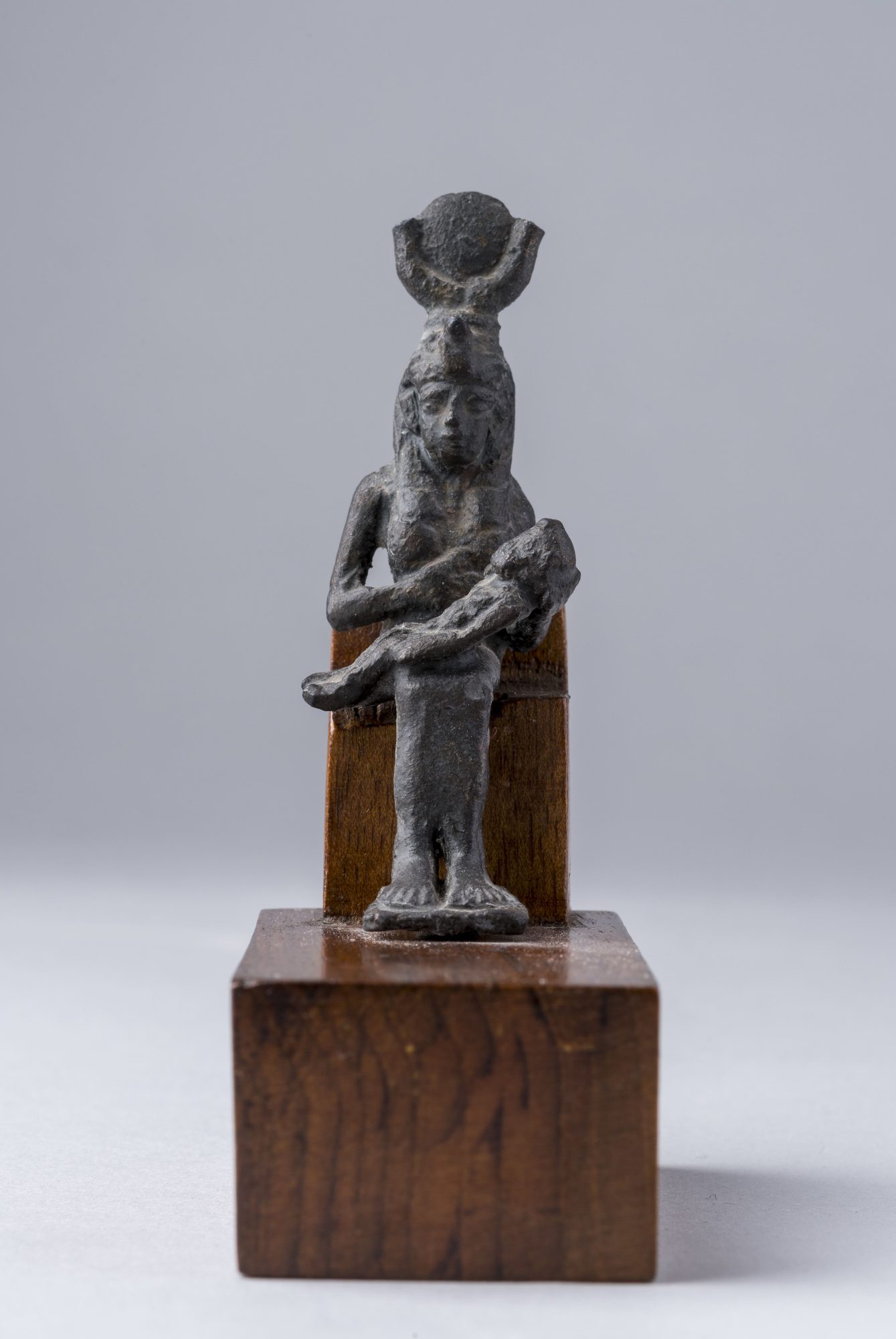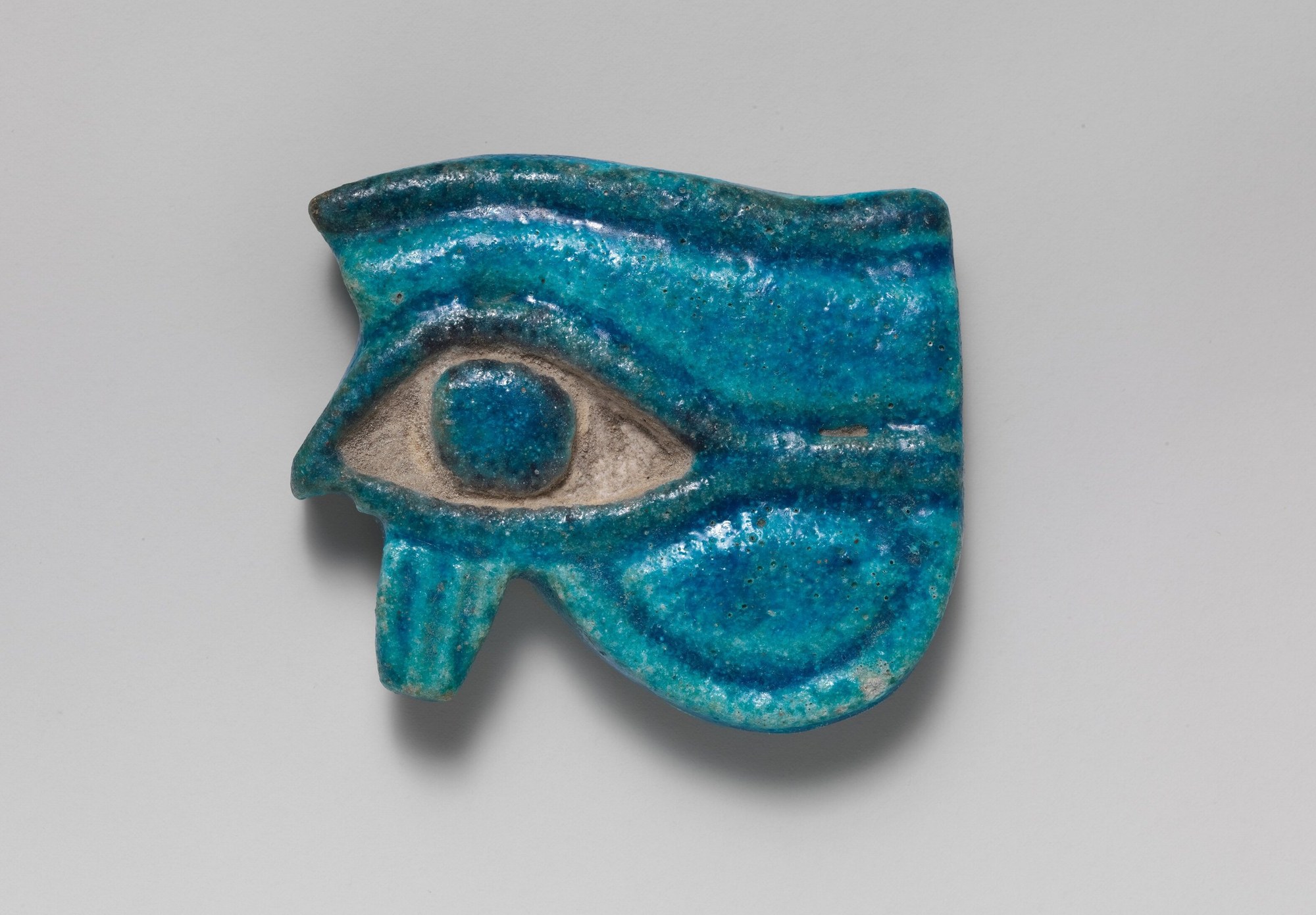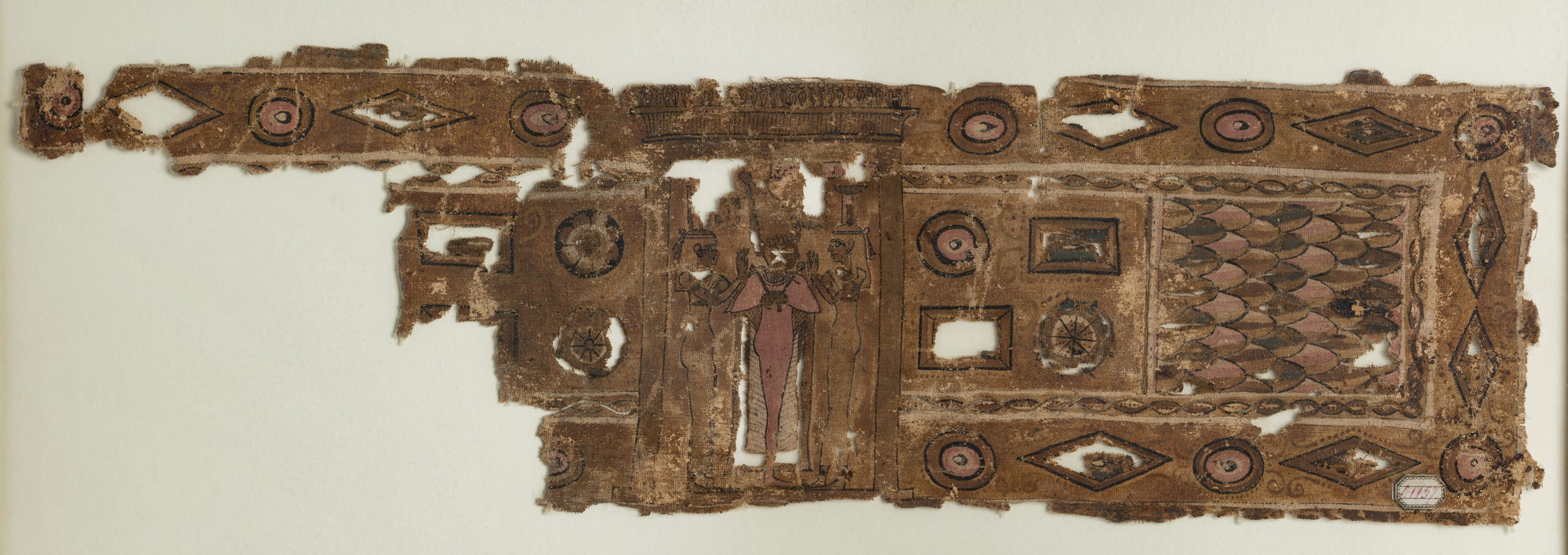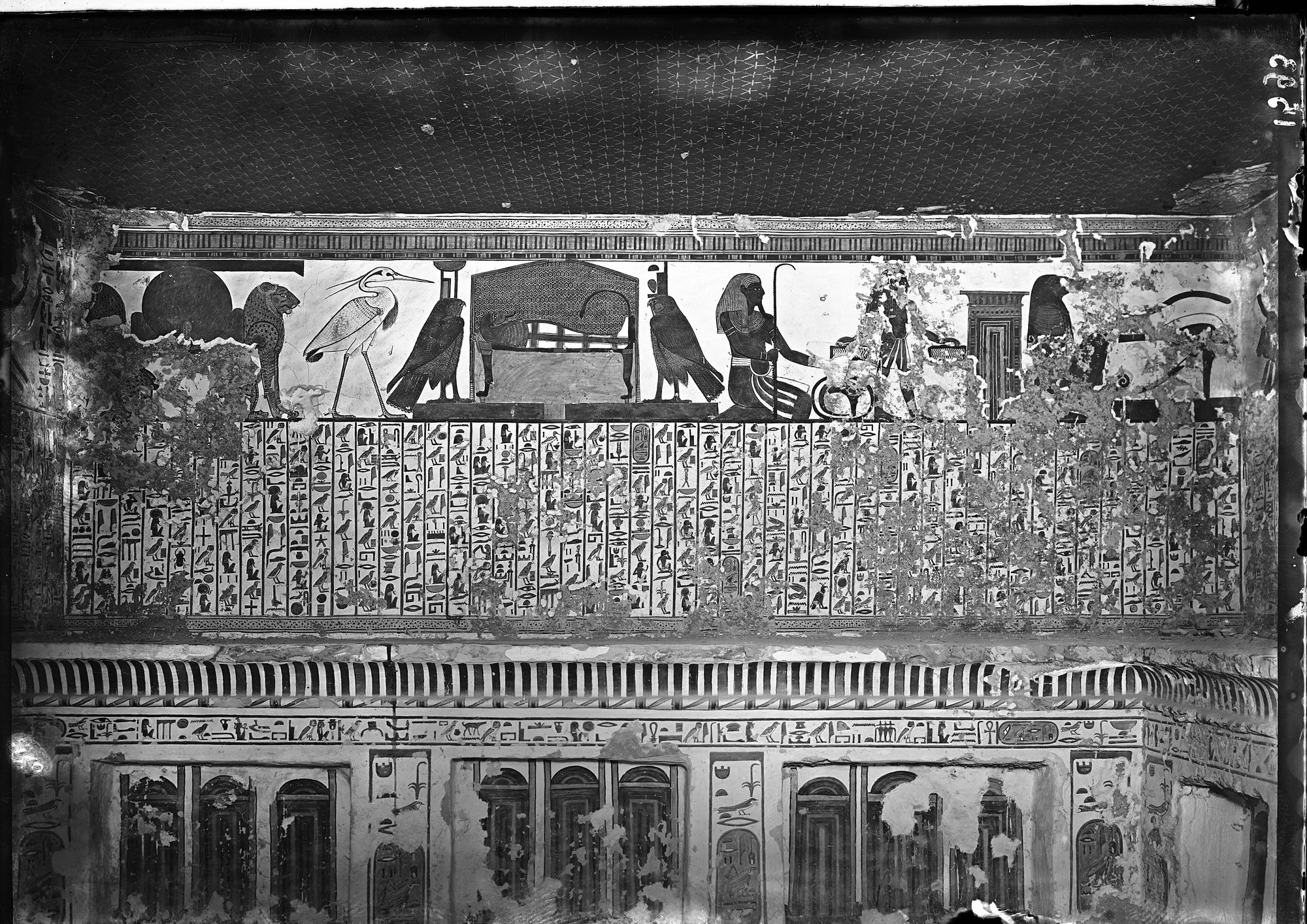
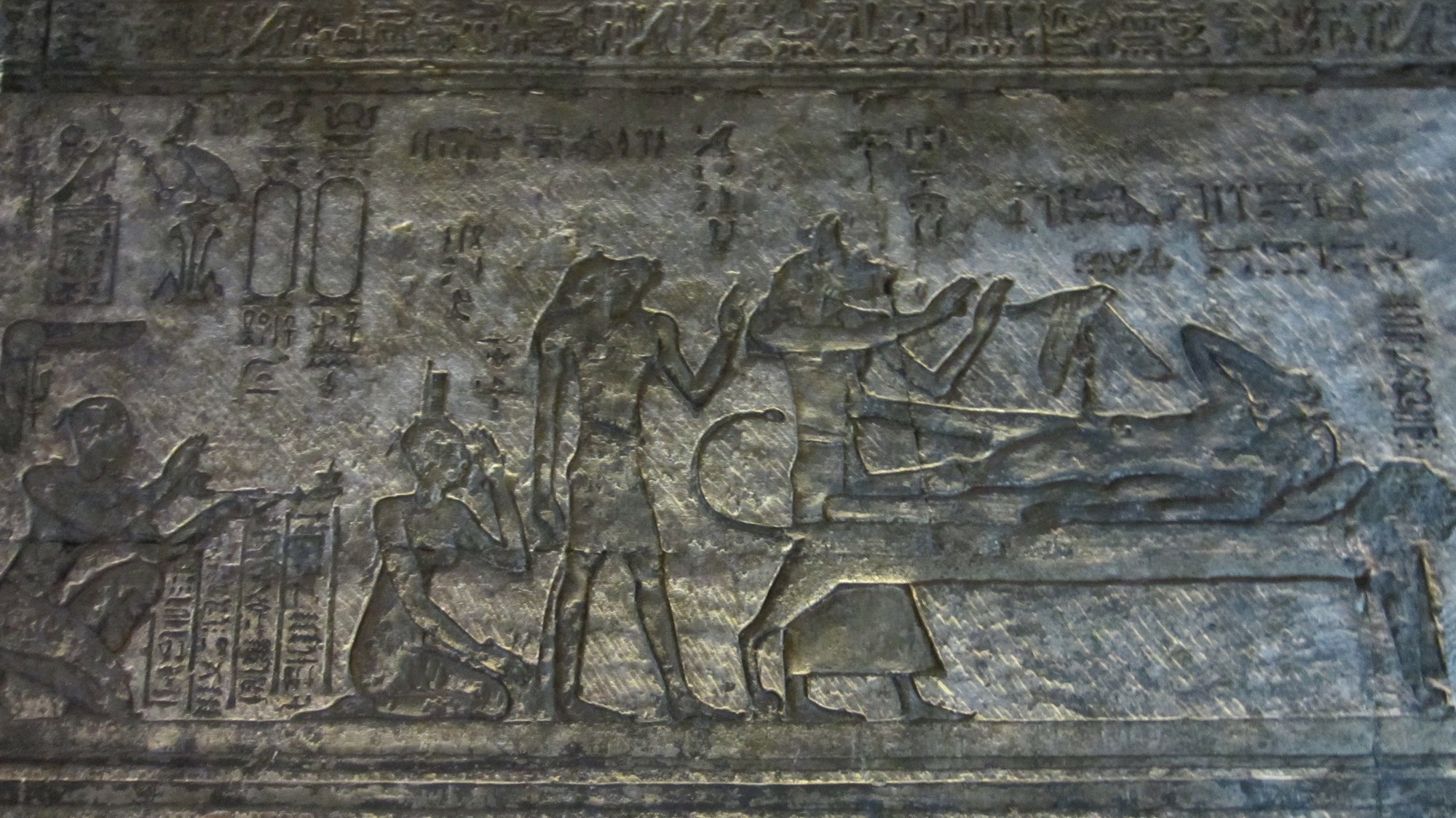
The body lay in the open at a place called Nedit, where the brother had felled him to the earth. It was not buried, not yet washed, not yet wept over. It simply lay there, the murdered king, while above the reeds two birds turned in the air, quartering the ground with the wide unhurried circles that carrion birds make when they have caught the scent of the dead. They were kites, and their cry was the thin high wail that Egyptians heard as the keening of women. They were his sisters, Isis and Nephthys, and they had been searching, and now they had found him. What happens next is the strangest thing any pantheon asks a mourner to do. Isis does not only grieve over the corpse. She conceives a child on it.
Two birds quartering the ground at Nedit
The oldest witness to this scene is not a story at all. It is carved into the burial chambers of Old Kingdom pyramids, chanted over dead pharaohs to make them live, and it names the birds precisely. The hj.t-bird comes, the kite comes,
the spell says, they are Isis and Nephthys, and they are come in search of their brother Osiris.
Elsewhere the two arrive at the bier and take up their stations, one on the right and one on the left, one as the hj.t-bird and one, Nephthys, as the kite. They find him where Set threw him down, felled to the earth in Nedit. There is no drift to a foreign coast here, no chest, no fourteen scattered pieces. There is only a killing-ground, a body on it, and two sisters who came as birds of prey because a bird of prey is what finds the dead first.
The choice of the kite is not decoration. The Egyptian word is Drt, the black kite, a scavenger that circles and stoops on the fallen, and the ancient ear caught two things in it at once: the shrill carrying call that sounded like a woman’s lament, and the bird’s own business, which is to go unerringly to the dead. A goddess searching the land for her murdered brother and a kite searching it for carrion are, in this reading, doing the same thing with the same body. The metaphor is grim and exact, and the Egyptians reached for it long before any Greek came to tidy the tale.
Wings that beat the breath back in
Before there can be a conception there has to be a body capable of one, and the reanimation is itself the work of wings. In the Great Hymn to Osiris, carved on a New Kingdom stela, the winged Isis settles over her dead husband and does two things with her feathers. She afforded him shade with her feathers,
the hymn says, and with her wings created air.
The beating of the wings is not a mourner’s flutter.
It is a bellows. She fans breath and life into the inert god, who carries the standing Egyptian name for the helpless dead, the Weary One, and she revived the faintness of the Weary One.
The kite that came to the corpse as a scavenger becomes the kite that starts its heart. The same image the Egyptians used for finding the dead, the circling bird, they turn without a seam into the image for raising him.
This is where the native Egyptian scene and the famous Greek one quietly refuse to be the same story, and it is worth stopping to say so rather than welding them together. In the Egyptian texts the body is whole. The reassembly, where it is mentioned, restores the god intact, and the seed is drawn straight from him.
The seed drawn from the dead god
Then the hymn says the thing that the mortuary spells say in blunter words. Isis, it tells us, took in his seed and provided an heir.
The Pyramid Texts, older by many centuries and never meant for a general reader, put the mechanism without any veil. Isis comes to thee rejoicing for love of thee,
one runs; thy semen goes into her.
Another has the god’s own act in it: Thou hast placed her on thy phallus, that thy seed may go into her.
The conception is drawn directly out of the reanimated body, an act of will and magic performed by the living goddess upon the barely-living god. She is at once the mourner over him and the mother of what he will father. In the native telling there is no missing member, no substitute, no workaround. The dead king’s own body gives up the heir.
And the heir is described by a single startling image, repeated across the spells: he is pointed, and he is pointed like Sothis.
Sothis is the star the Egyptians called Sopdet, the brilliant heliacal rising of Sirius whose return from below the horizon each year heralded the flood of the Nile. The seed goes into her pointed like Sothis,
and out of the dead god Horus the pointed has come forth,
named in the same breath Horus who was in Sothis.
The child conceived over a corpse is figured as a star climbing back into the sky, sharp, luminous, and returning like the flood-star that promises the land will live again. It is one of the most compressed images in all of Egyptian myth: a resurrection, a conception, and the turning of the agricultural year folded into a single pointed thing.
What the star-child was for
The child has a purpose, and the oldest spells state it as flatly as they state everything else. Out of the conception comes not merely a son but a debt to be collected. The fullest passage names it in the very act of the seed passing: Horus the pointed has come forth from thee,
it tells the dead Osiris, and then, in the god’s own titulary, Horus has avenged thee, in his name of ‘Horus, the son, who avenges his father.’
The avenging is written into the name at the moment of conception. Isis does not draw an ordinary heir from the body. She draws the one who will come back for the murderer, and the Egyptian texts leave no gap between the making of the child and his charge.
The Great Hymn shows the far end of that arc. The hidden child, suckled in solitude, the place where he was being unknown,
is reared in secret until he can be brought before the assembled gods, and when he comes the Ennead breaks into acclamation: Welcome, Horus, son of Osiris! Stalwart hearted, justified! Son of Isis, heir of Osiris!
The son conceived over the corpse at Nedit stands in the hall of the gods and is given his father’s office. The whole Egyptian theology of kingship runs through this one improbable conception: every living pharaoh was Horus, every dead one Osiris, and the throne passed from the dead to the living by way of a widow who would not let her murdered husband stay barren.
The Greek priest tells it otherwise
None of this is how the story reaches most modern readers, because most modern readers meet it through Plutarch, a Greek priest writing around 100 CE, and Plutarch’s version is a different machine. In his telling Set does not merely kill Osiris but dismembers him into fourteen parts and scatters them, and the one part Isis never recovers is the phallus, thrown into the river and eaten by three kinds of fish.
She makes a replica of the lost member and consecrates it. And here his account quietly breaks its own logic: he still reports that Osiris consorted with Isis after his death,
but the child of that union is not the avenger at all. It is Harpocrates, Horus the Child, untimely born and weak in his lower limbs.
In Plutarch’s scheme the avenging Horus was already conceived and born before Osiris ever died; the posthumous union produces only a frail afterthought.
The two traditions cannot be merged without contradiction, and the tidy popular scene, the god cut in fourteen, the missing member replaced by a golden phallus, the kite drawing living seed from the reassembled body, is exactly that illegitimate merger. It takes Plutarch’s dismemberment and lost member and welds them onto the Egyptian image of the hovering bird drawing seed from an intact corpse.
In the native sources the member is present and the seed is real; in Plutarch it is destroyed and only a replica honoured. The conception of the avenger over the body belongs to the Egyptian texts, the Pyramid Texts and the Great Hymn, and it is there that Isis settles as a kite over her dead husband and draws from him the son sharp as a star.
Isis comes to thee rejoicing for love of thee; thy semen goes into her, while it is pointed like Sothis. Horus the pointed has come forth from thee, in his name of “Horus who was in Sothis.” (Pyramid Texts §§1635–1636, Utterance 593, tr. Mercer)
- Pyramid Texts §632 (Utterance 366), trans. Samuel A. B. Mercer, The Pyramid Texts (Longmans, Green & Co., 1952); public-domain scan, archive.org id
THEPYRAMIDTEXTSTRANSLATIONthe earlier conception passage,Thou hast placed her on thy phallus, that thy seed may go into her… Horus the pointed has come forth from thee as Horus who was in Sothis.
The conception line falls within Utterance 366; cited by paragraph in the canonical manner (Mercer prints the dead king asN.
). Note: the paragraph literally numbered §366 in Mercer is a different, unrelated ascension text and is not cited here. - Pyramid Texts §§1634–1637 (Utterance 593), trans. Mercer 1952the fullest conception passage,
Isis comes to thee rejoicing for love of thee; thy semen goes into her, while it is pointed like Sothis. Horus the pointed has come forth from thee… Horus has avenged thee, in his name of ‘Horus, the son, who avenges his father.’
Source for the posthumously conceived child named outright as the avenger. - Pyramid Texts §§1255–1256 (Utterance 532) and §1280 (Utterance 535), trans. Mercer 1952the two mourning birds who find the slain god,
one of them as a hj.t-bird, one of them (Nephthys) as a kite
, whofound Osiris, after his brother Set had felled him to the earth in Ndi.t (Nedit)
; andthe kite comes; they are Isis and Nephthys… come in search of their brother Osiris.
Source for Nedit as the killing-ground and for the kite-form search. - Pyramid Texts §741 (Utterance 417), trans. Mercer 1952the mother-bird who bears the dead god aloft
in her name of ‘Kite’
, the source for the Drt (kite) epithet attached to Isis. - Great Hymn to Osiris, Stela of Amenmose (Louvre C286), New Kingdom (18th Dynasty), trans. Aylward M. Blackman in Adolf Erman, The Literature of the Ancient Egyptians (Methuen, 1927), pp. 140–144; public-domain scan, archive.org id
in.ernet.dli.2015.532519the winged Isis whoafforded him shade with her feathers, and with her wings created air
, whorevived the faintness of the Weary One, that took in his seed and provided an heir, that suckled the child in solitude, the place where he was being unknown
, and the Ennead’s acclamation,Welcome, Horus, son of Osiris! Stalwart hearted, justified! Son of Isis, heir of Osiris!
Quoted here in Blackman’s public-domain 1927 wording; theC286
designation and the nameStela of Amenmose
are the standard Egyptological identification (Lichtheim, AEL I, 1976, pp. 81–86, in copyright, not quoted here), Erman’s footnote knowing the object only as an 18th-Dynasty tombstone in Paris. - Plutarch, De Iside et Osiride (Of Isis and Osiris) 18–19 (Moralia 358A–E), trans. Frank Cole Babbitt, Loeb Classical Library vol. V (1936), via LacusCurtiusthe Hellenized divergence, source for the fourteen scattered parts, the phallus lost to the fishes and replaced by a consecrated replica, and the posthumous union producing not the avenger but the weak-limbed Harpocrates,
untimely born and weak in his lower limbs
. A 1st–2nd century CE Greek philosophical retelling using Greek god-names (Typhon for Set), late and interpretive, not an Egyptian primary text.