Every evening the same god died at the western edge of the sky. The Egyptians watched the sun swell red and heavy and go down behind the desert, and they had a name for it in that hour: not Khepri the scarab, the young sun climbing into being at dawn, but Atum, the finished disk, the sun completed and about to be gone. The two are a deliberate pair, the becoming and the completed, and between them they bracket the whole day. It is the completed one who is the more unsettling, because his name carries two meanings at once. Egyptian tm means to finish
, to complete
; it also means not
, to not-be
. The god of the setting sun is at once the Complete One and the Un-maker, the being in whom the world is finished and the being who can return it to nothing. He stands at both ends of time, holding together what the creation stories, forever looking at the beginning, cannot hold together.
His famous act belongs to that beginning and to another post. Alone in the first waters, Atum drew the first divine pair, Shu and Tefnut, out of his own body, and the generations of the gods began; that self-generation is told next door, in the story of how he brought forth the twins. Here the concern is everything else true of him: his city, his names, the way he was drawn, the end of the world he presides over, and the two thousand years across which the picture of him changed.
The city the Greeks called the sun
His home was Iunu, a place the Hebrew Bible calls On and the Greeks renamed Heliopolis, City of the Sun
, after they matched its god to their own Helios. It stood in what is now the north-eastern edge of Cairo, and almost nothing of it survives above ground; the last upright stone of the precinct is a red-granite obelisk raised by Senusret I around 1950 BCE, still standing at Matariya. Here Atum’s priests held the oldest claim in Egyptian religion, that their god was the first being, self-risen from the primeval waters before anything else existed.
The sacred stone of the first mound, the benben, stood in its own shrine within the precinct, the hillock of first land the creation cosmologies narrate in full. His living animal was kept here too: the Mnevis bull, a black bull marked with a solar disk and a rearing cobra at its brow, treated as the earthly body of the fused sun-god Atum-Ra and second in rank only to the Apis of Memphis. When Akhenaten later swept the old gods away, the Mnevis cult was one of the very few he spared, presumably because the sun in it was hard to deny.
Lord to the limit
The names given to Atum are compact theology, each a claim about what he is. Neb-er-djer, Lord to the Limit
, makes him the god whose dominion runs to the outermost edge of what exists: everything, out to its bound, is his. The Complete One
, straight from the root of his name, is its positive face, the finished and self-sufficient god who holds the whole unmade world inside himself.
Kheper-djesef, he who came into being of himself
, is the self-created god who needed no maker. And Bull of the Ennead
belongs to the same family of claims, making him the potent head and sire of the nine gods descended from him; in the Pyramid Texts the epithet is spoken over the dead king, who takes it on as Atum’s heir. He is the outer bound, the finished whole, the uncaused cause and the potent father, a god defined by having nothing before him and nothing beyond.
A creator dressed as a pharaoh
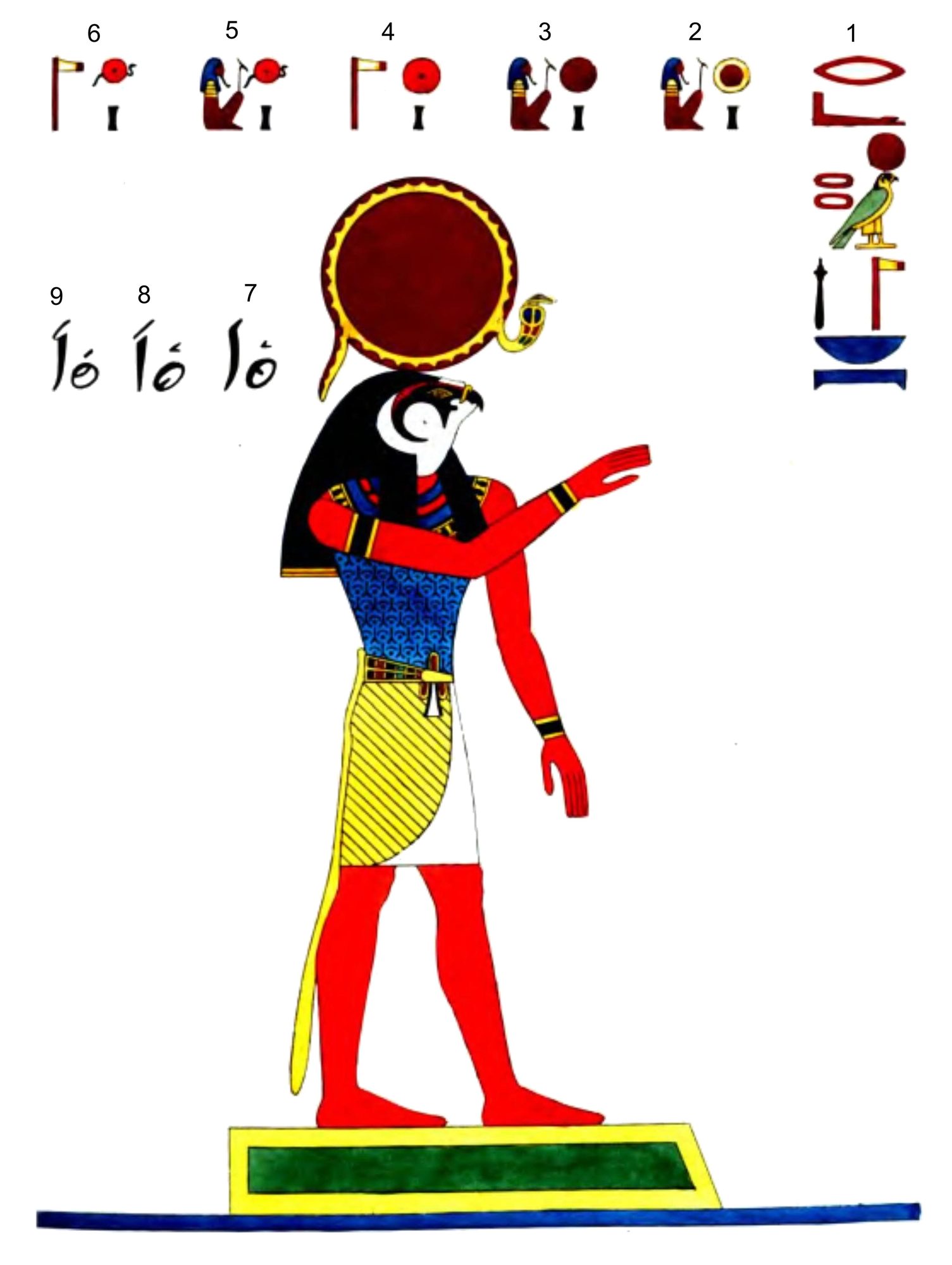
Look at how he is drawn, and the theology becomes a picture. Of all the primeval creators, Atum is figured not as an animal or an abstraction but as a man, and specifically as a man wearing the pschent, the Double Crown, the tall white cone of Upper Egypt fitted inside the red basket-crown of Lower Egypt that a living pharaoh wore to rule the two lands. This is not decoration. The god from whom kingship descends is himself dressed as a king; Heliopolitan royal theology made its creator a pharaoh and its pharaoh a child of the creator, and the two mirror each other in one image.
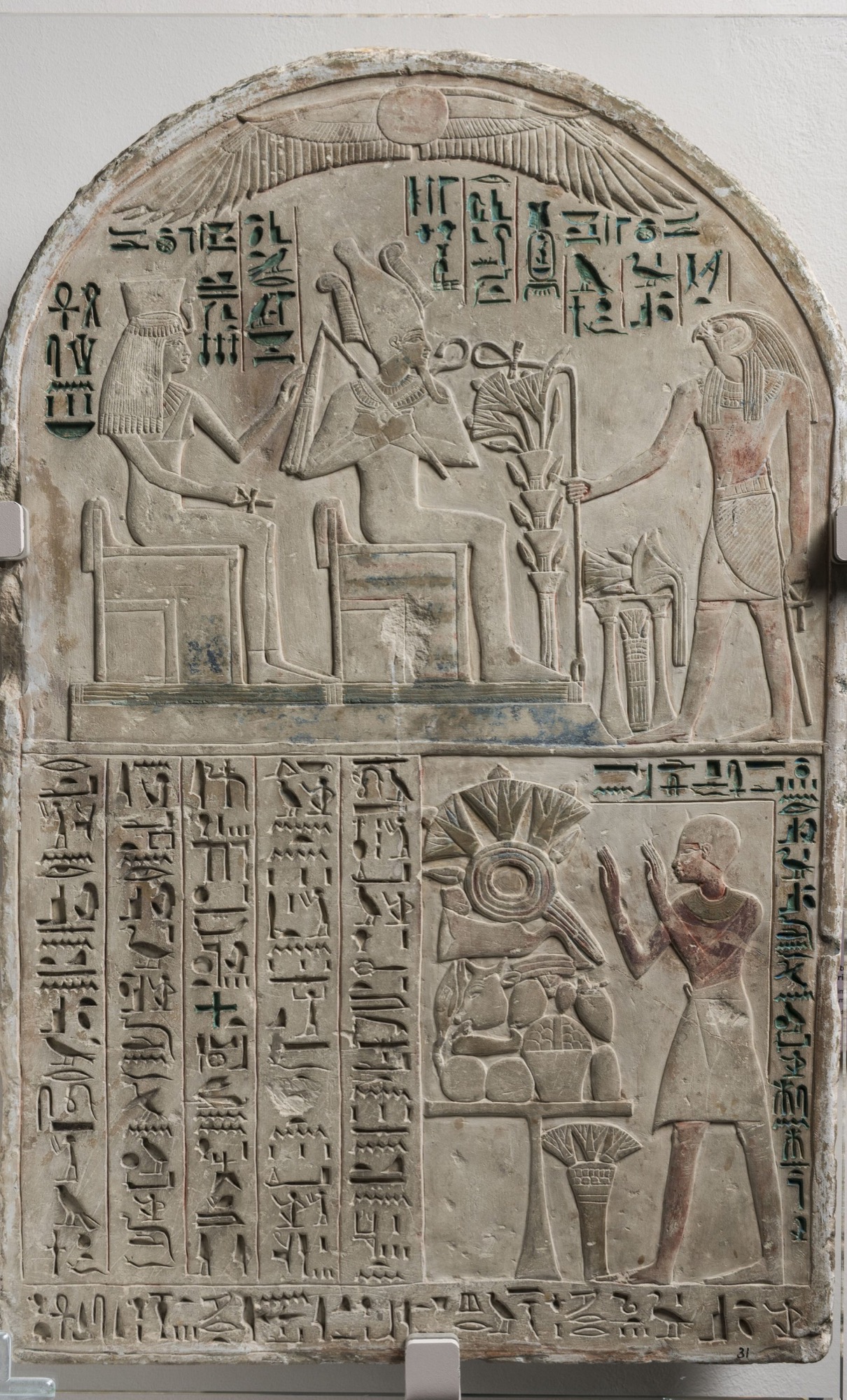
The relief shown here, Atum in the Double Crown faced by Queen Hatshepsut’s offering hands, is that claim carved in limestone. He has other forms too: an old man leaning on a staff, the aging evening sun; a serpent, the shape he keeps at the end of the cycle and of the animal that renews itself; a mongoose, a lion, a bull, a lizard, an ape; and, in his fusion with the morning sun, the scarab of Khepri. But the crowned man comes first, because it is the one that says what he is for.
When the world goes back to the water
The negative sense hidden in his name is not a play on words. Egyptian theology made it literal, in a chapter of the Book of the Dead that the creation stories never reach. In Chapter 175, the chapter of not dying a second time
, the dead man, speaking as Osiris, has come into a place he can barely describe: It hath not water, it hath not air; it is depth unfathomable, it is black as the blackest night, and men wander helplessly therein.
Atum answers him. He decrees that Horus shall rule and the dead shall live for millions of years, then tells Osiris what waits at the far end of time: “I am doing away with all the wrong which I did… I am Fate (or Time) and Osiris, and I have made my transformations into the likeness of divers serpents.
Man knoweth not, and the gods cannot behold” the beauty he has made. Read with the scholarly gloss on the passage and its older Coffin Texts ancestor, the meaning is stark: the ordered world will dissolve back into the flood it rose from, and only Atum and Osiris will survive, Atum as a serpent that men do not know and the gods cannot see. The god who spat out the first pair is the god who will draw the whole of creation back into the water. He holds both ends of time in one body.
Hand on the dead king’s arm
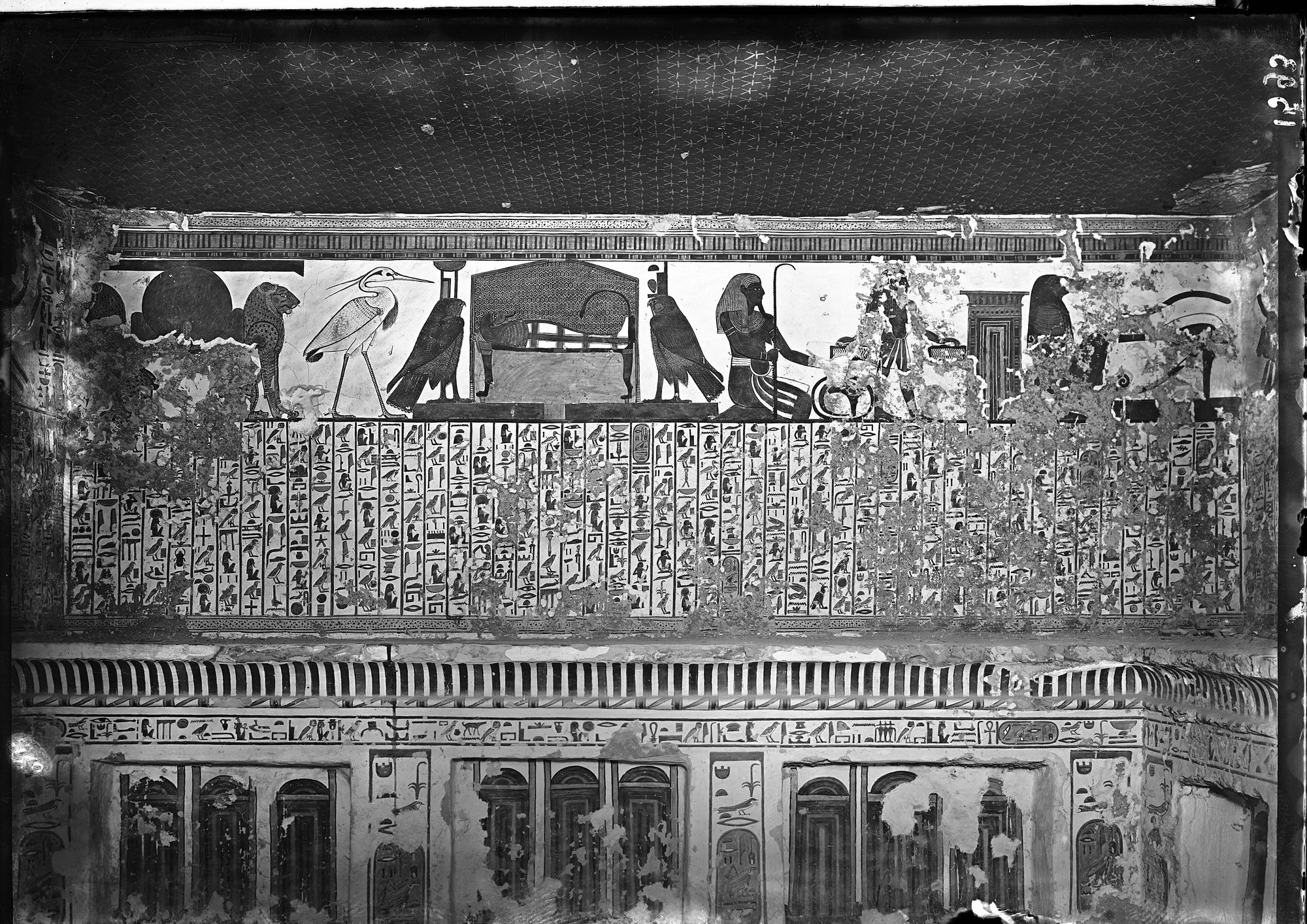
Between those two ends, his chief business with the living was the king. In the Pyramid Texts, carved into the burial chambers of the Old Kingdom pharaohs, it is Atum who receives the dead king and lifts him to the sky. The father of N., Atum, lays hold of the arm of N.; he assigns N. to those gods, who are the nimble, the wise, the imperishable
, one utterance runs, N.
standing for the dead king’s name; another calls to the god directly, Atum, let N. ascend to thee, enfold him in thine embrace.
The king does not merely go to the god; he goes as kin, for the royal dead are the children of Atum
, of the creator’s own line. This closes the loop with the crown: the god drawn as a pharaoh takes the dead pharaoh by the arm, and the pharaoh he lifts joins his family. Kingship and the creator hold each other up, on earth and in the sky alike.
Two thousand years of a fading sun
None of this stood still. In the Old Kingdom, when the Pyramid Texts were carved between roughly 2350 and 2150 BCE, Atum was among the most prominent gods in Egypt, creator and father of the king at once. Then the sun-god Ra rose, and from the Fifth Dynasty on Atum was folded into him as Ra-Atum, keeping the evening as his share of the solar day while Ra and Khepri took the morning and the noon.
In the New Kingdom, as Amun-Ra of Thebes became the supreme state god, he receded further, surviving in the great royal funerary books as the evening-sun stage of the sun’s nightly journey. He never quite went out: in the Late Period his name resurfaced in the eastern Delta at Per-Atum, the House of Atum
, the town the Hebrew Bible calls Pithom, where a temple carried his cult down into the last Egyptian centuries.
The span matters, and the previous account of this god buried it. The Pyramid Texts quoted above are a near-contemporary Old Kingdom witness, around 2350 BCE. The Bremner-Rhind papyrus, the great late source for his self-generation, is hieratic ink on a Ptolemaic roll dated to about 310 BCE, the twelfth year of Alexander IV, roughly two thousand years younger. That is a wider gap than the one between Homer and the travel-writer Pausanias, and it sits between two native Egyptian texts, which makes it easy to miss; when they agree, a reader can only weigh the agreement by knowing whether they stand centuries or millennia apart.
These stand millennia apart. The same caution belongs to the translations. Mercer’s 1952 Pyramid Texts and Budge’s 1898 Book of the Dead, both quoted here, are dated renderings; the modern standard for the Pyramid Texts, Faulkner’s 1969 translation, remains in copyright and cannot be quoted in a project like this. What the reader gets is the honest public-domain wording, with its age on the label.
I am doing away with all the wrong which I did, from the time when this earth came into being from Hu, when it sprang from the watery abyss even as it was in the days of old. I am Fate (or Time) and Osiris, and I have made my transformations into the likeness of divers serpents. (Book of the Dead, Chapter CLXXV, tr. Budge; “Tem” = Atum)
- Pyramid Texts, Utterance 373, §380a — Samuel A. B. Mercer tr., The Pyramid Texts (Longmans, Green & Co., 1952); public-domain scan, archive.org id
THEPYRAMIDTEXTSTRANSLATION. Read verbatim for Atum raising the dead king to the skyThe father of N., Atum, lays hold of the arm of N.; he assigns N. to those gods, who are the nimble, the wise, the imperishable.
Mercer’sN.
is a placeholder for the dead king’s name. - Pyramid Texts, Utterance 409, §717a — Mercer 1952, same scan. Read verbatim for the epithet
N. is the bull of the Ennead.
- Pyramid Texts, §213a — Mercer 1952, same scan. Read verbatim for
Atum, let N. ascend to thee, enfold him in thine embrace.
- Pyramid Texts, Utterance 600, §1655c — Mercer 1952, same scan. Read verbatim for the royal dead as the
children of Atum
(used here only for the descent of kingship; the nine-name Ennead roll-call this line closes belongs to the genealogy hub and is not reproduced here). Mercer 1952 is a dated translation, of comparable vintage and reputation to Budge; the modern standard is R. O. Faulkner’s 1969 rendering, which is in copyright and therefore unusable in a public-domain project. - Book of the Dead, Chapter CLXXV (175) — E. A. Wallis Budge tr., *The Book of the DeadAn English Translation … of the Theban Recension* (1898); public-domain scan, archive.org id
in.ernet.dli.2015.219449(Vol. III). Read verbatim for the Atum–Osiris end-of-the-world dialogue: the lightless land (It hath not water, it hath not air; it is depth unfathomable, it is black as the blackest night, and men wander helplessly therein
) and the un-making of the world (I am doing away with all the wrong which I did … I am Fate (or Time) and Osiris, and I have made my transformations into the likeness of divers serpents. Man knoweth not, and the gods cannot behold, the two-fold beauty which I have made for Osiris, who is greater than all the gods
). The Papyrus of Ani copy is c. 1250 BCE; the composition descends from a Coffin Texts spell of c. 2000 BCE. Budge (1898) is a dated translator, andTem
is his spelling of Atum; his English is not the ancient text. - Bremner-Rhind Papyrus (BM EA 10188),
The Book of Knowing the Creations of Re
— R. O. Faulkner, Journal of Egyptian Archaeology 23 (1937) & 24 (1938). Hieratic ink on papyrus, Ptolemaic, c. 310 BCE (dated to year 12 of Alexander IV), roughly two thousand years later than the Old-Kingdom Pyramid Texts. Named here for the epithet Neb-er-djer,Lord of All
; its self-generation monologue is the property of the story sibling and is not reproduced here. - R. H. Wilkinson, The Complete Gods and Goddesses of Ancient Egypt (Thames & Hudson, 2003), pp. 17–18, 99–101, 174–175, 205 (secondary, authoritative; cited, not read verbatim) — the tm name-gloss (
complete
/finish
), the Iunu cult, the Double-Crown iconography and animal forms, the Mnevis bull, and the evening-sun/Khepri contrast. - van der Toorn, Becking & van der Horst (eds), Dictionary of Deities and Demons in the Bible (Brill, 1999), pp. 121, 123 (secondary; cited, not read verbatim) — the serpentine evening Atum paired against the scarab morning Khepri, and the snake that renews itself.