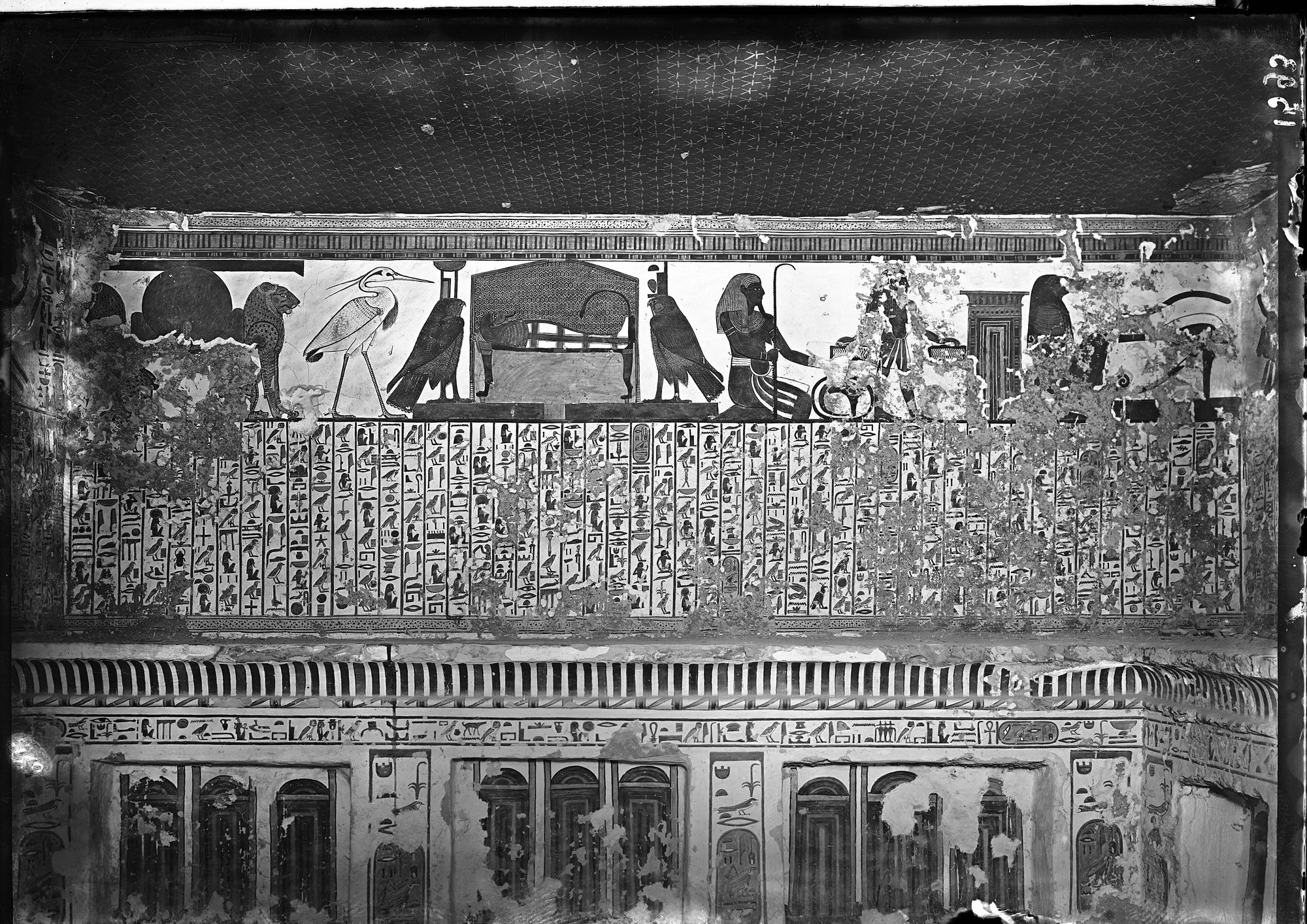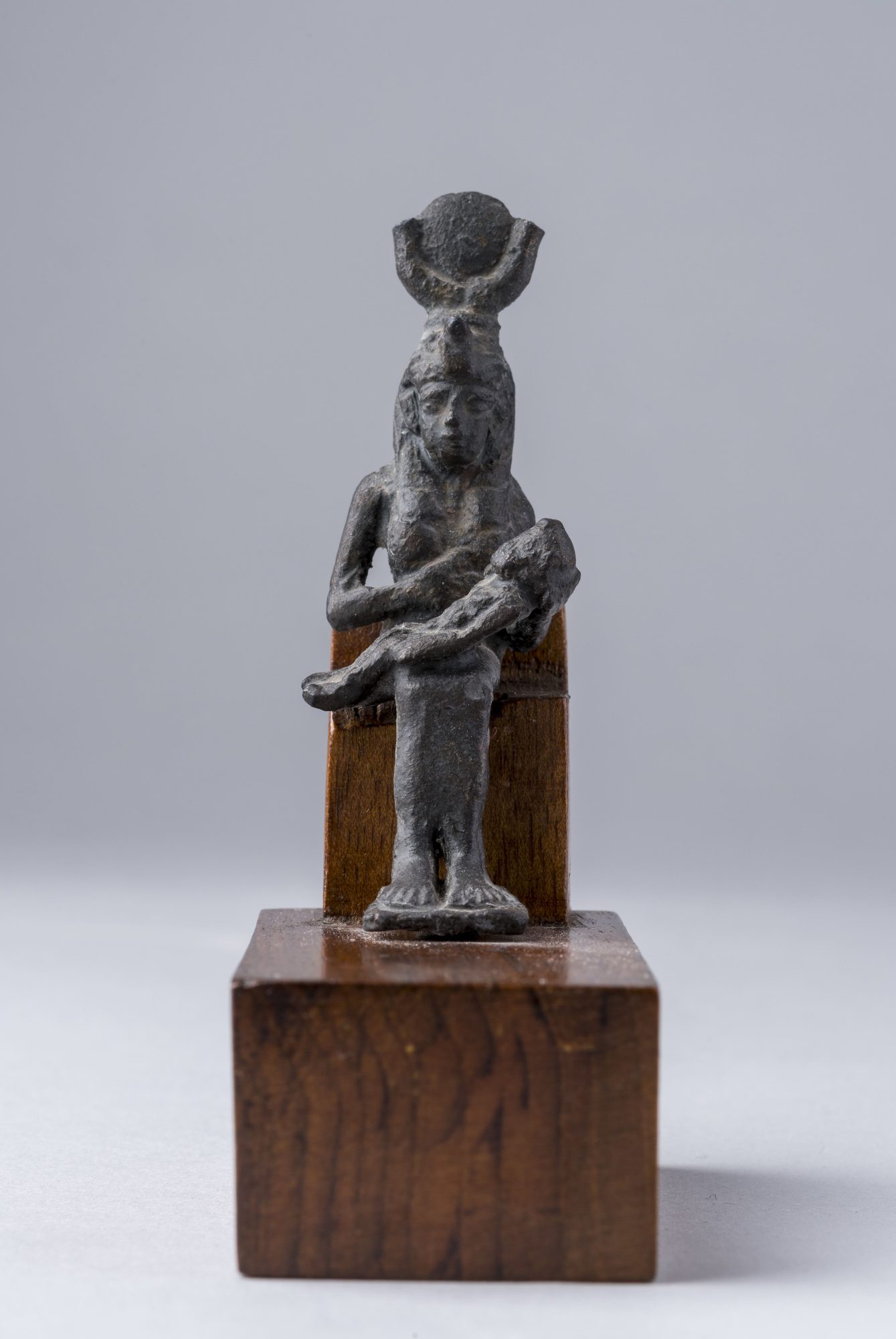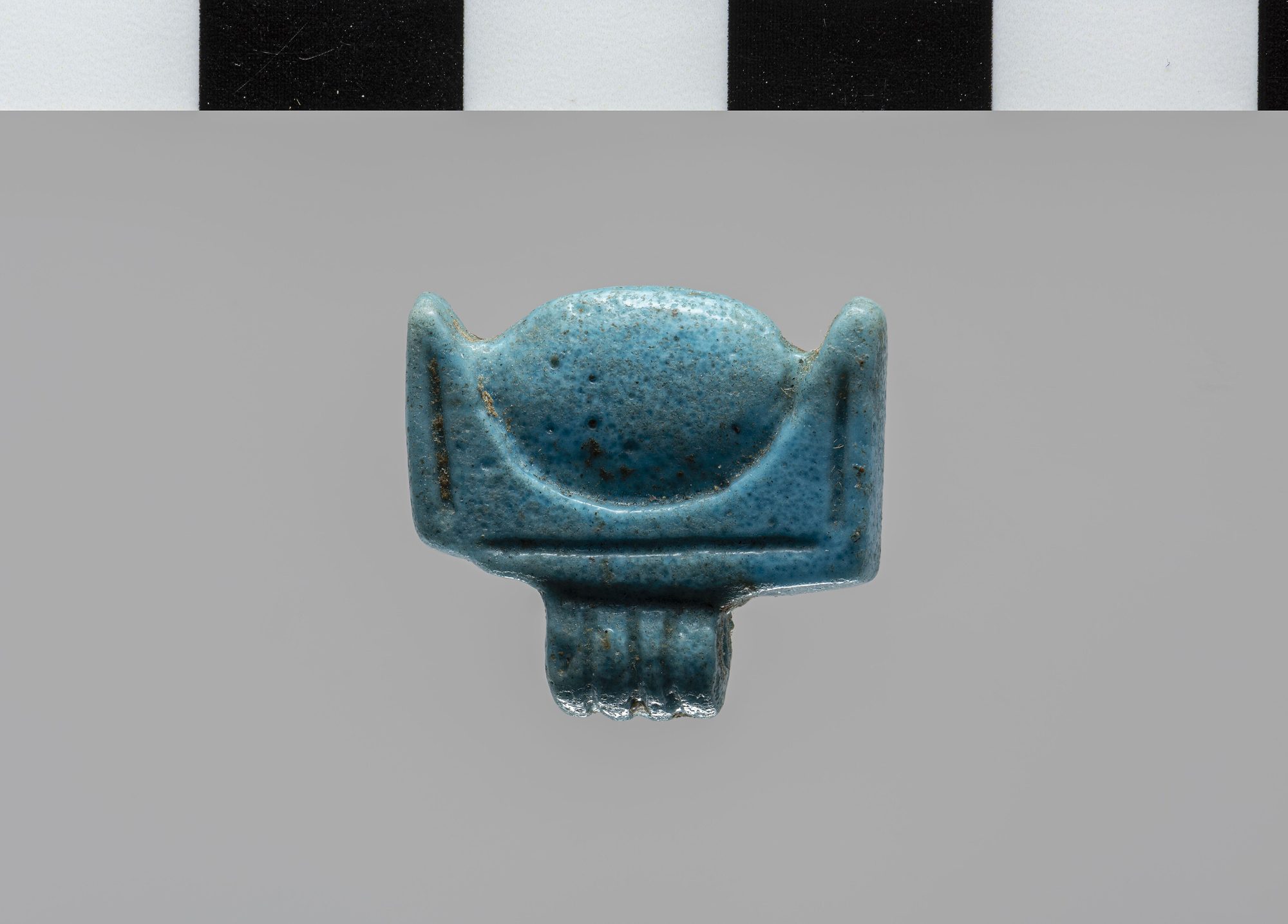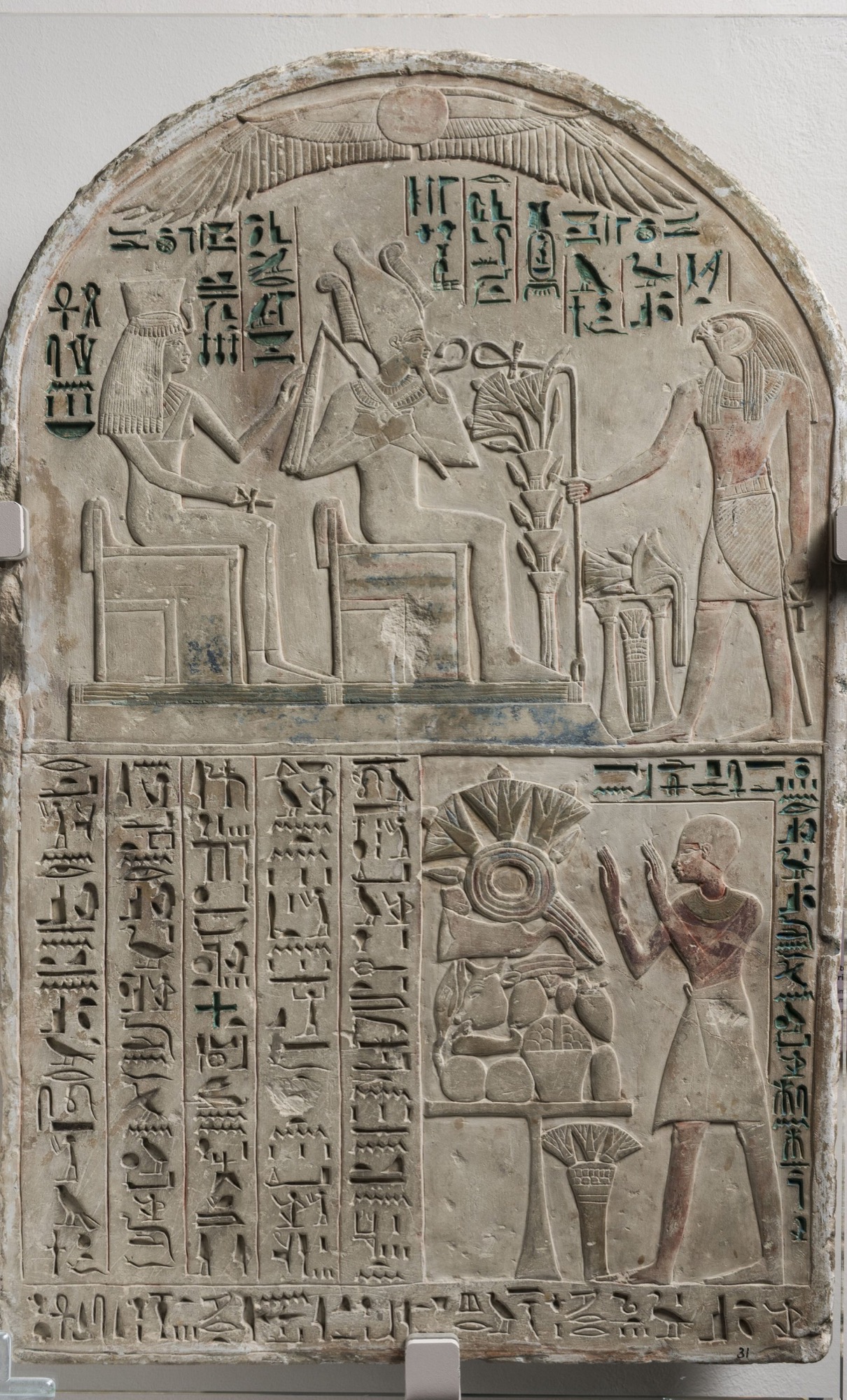
At evening the sun-god is an old man tottering down the western sky, and his own body has begun to betray him. His bones have turned to silver, his limbs to gold, his hair to lapis-lazuli, and mankind, seeing him grown ancient, has begun to plot against him. That is how one of the oldest Egyptian legends imagines the world’s most powerful being: not as a fixed blaze of glory but as a god who ages across a single day, who was young at dawn and is failing by dusk, and who will have to be carried up out of the world he made because he can no longer bear to rule it. To the Egyptians the sun was never one thing. It was a life, watched from its birth in the east to its death in the west, and lived over again every morning.
The beetle who shoulders the disk up
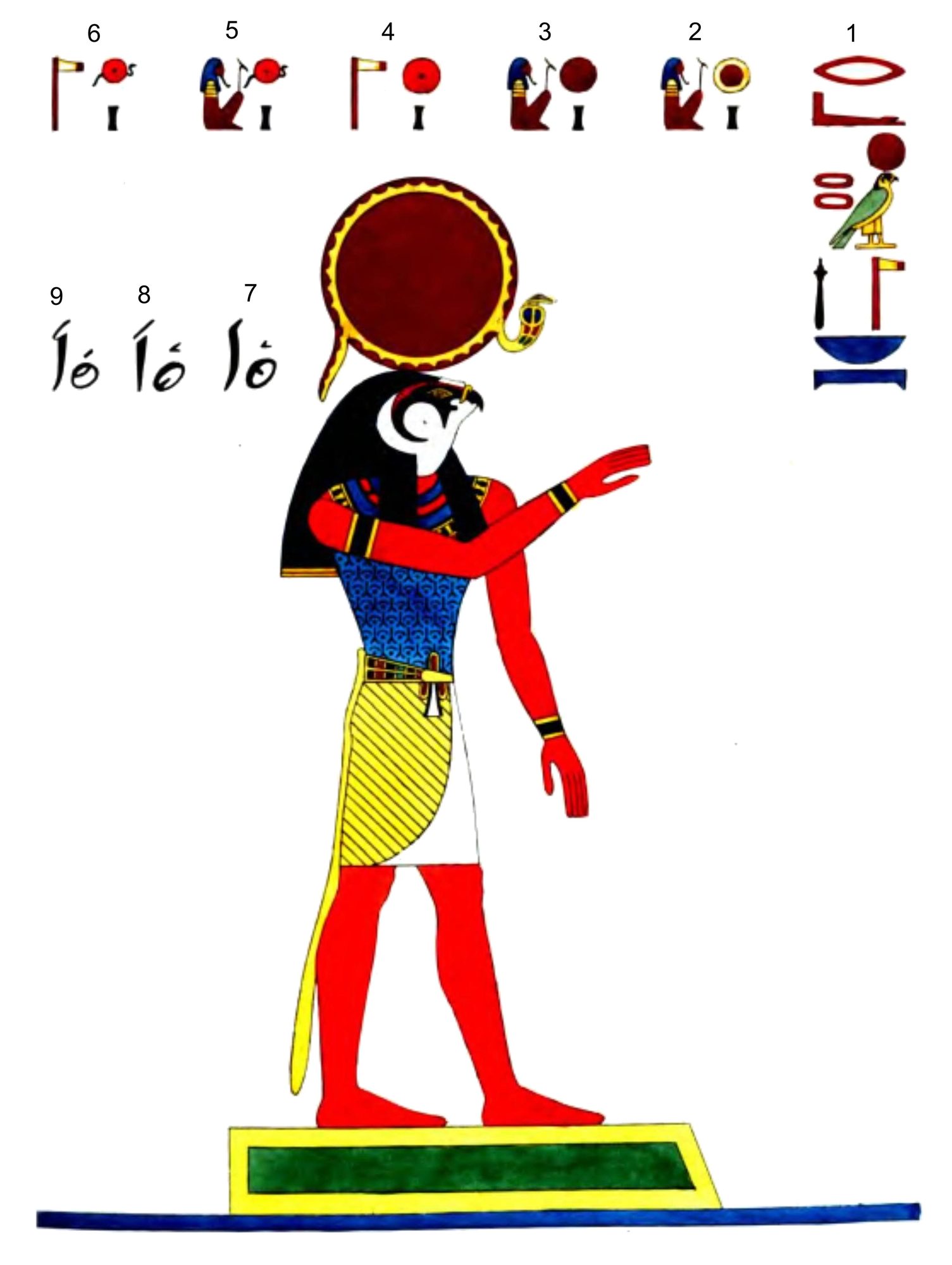
They saw him, the earliest texts insist, in more than one form. At dawn he is Khepri, the scarab-beetle who shoulders the disk up over the eastern horizon, who himself became
, a name built on the verb kheper, to come into being, so that the god’s very title announces that he made himself. At his noon height he is simply Re, the material sun at full strength. By evening he is Atum, that aged man tottering down the west.
These were not, at first, three names for one god. The Pyramid-Age Egyptians honoured older, separate powers, the beetle of the dawn, the disk, the aged sun of Heliopolis, the horizon-falcon, and only later did they coalesce into the compound sun-god we call Ra. The plurality is not confusion. It is memory, preserved in the texts, of a time when the sun had many masters.
Four beginnings, none cancelling the others
How he first came to be, the sources will not settle. At Heliopolis, the god’s great cult-city a few miles from modern Cairo, Atum arose self-developed in the primeval ocean called Nu and begat the first gods from himself.
But the same tradition also says that Ptah had shaped an egg from which the sun issued; and that a lotus grew from the water with the youthful sun-god hidden inside it; and that at Heliopolis the god first appeared as a phoenix alighting on the ancient pyramid-stone in the Phoenix-hall. Four beginnings, none cancelling the others. The Egyptians were content to let the sun be born four ways, because a god who renews himself each morning is, in a sense, always being born.
From the self-made one came the family of the world. The sun-god begat Shu, the god of air, and Tefnut his wife; of these came Geb the earth and Nut the sky; and their children were Osiris and Set, Isis and Nephthys. This is the Heliopolitan Ennead, the nine, and it hangs entire from the single figure of the creator who stood alone in the water and spoke the rest into being.
Thoth at the prow
The daily labour of that creator is a voyage. Ra crosses the heavens in two barques, one for the morning and one for the evening, and the passage of a day is the passage of a ship: he passes the night in the evening-barque and wakes in the morning-barque. The translators quarrel over the boats’ names, Renouf writes them Mââtit and Sektit, Budge gives Matet and Semktet, and modern Egyptology has normalised them as the day-bark Mandjet and the night-bark Mesektet, but the two-boat rhythm is old and constant.
At sunrise he is greeted as Horus of the Two Horizons, the horizon-falcon whose rising floods the two lands with light. The bark is crewed like a warship. The text places Thoth at the prow to destroy the god’s adversaries; at the look-out is Horus, with Thoth and Maat at his sides; the Ant and Abtu fish swim ahead of the hull as it takes the water. The speed of the crossing is dizzying: Leagues by millions, and hundreds of thousands, in a small moment thou hast travelled them, and thou goest to rest.
Apophis coiled in the dark
For the sun does not merely shine; it fights. The night voyage is a running battle, because the dark is not empty. Coiled in it waits Apophis, the serpent of chaos, called Âpepi in the old hymns, and every night he must be met and put down, slaughtered
and annihilated
, felled by blows upon his backbone. When Ra turnest thy face to the West
, his mother Nut enfolds him, and he goes to rest in Manu, the mountain of evening, and there in the deep of the world he undergoes his strangest change.
In the Tuat, the underworld, Ra and Osiris become one: Ra setteth as Osiris… He is the One divine form, the hidden one of the Tuat.
The living sun and the dead king merge in the dark and rise, at dawn, renewed. This is the funerary tradition’s own vision, the solar-Osirian fusion, sitting alongside and distinct from Heliopolis’s daylight theology; both were true at once to those who kept them.
Saved by a trick and by beer
The most human of his stories is also the most terrible. Grown old, his silver bones aching, Ra learns that mankind is conspiring against him, and on the counsel of Nu he sends out his Eye. The Eye of Ra is a power in its own right, feminine, active, ferocious, and it goes forth as the goddess Hathor to slaughter the rebels. She does the work too well. Become Sekhmet, the lioness, she waded about in the night season in their blood
, beginning at Herakleopolis, and will not stop; humanity faces extinction not from the sun’s enemies but from its own defender.
So Ra resorts to cunning. He has seven thousand vessels of beer brewed and stained red with mandrakes and human blood until it looks like a flood of gore, and has it poured out over the fields in the night. The goddess comes upon the red lake at dawn, mistakes it for the blood she craves, drinks until she is drunk, and gives no further thought to men and women. The world is saved by a trick, and by beer.
But the sun-god has had enough of us. Weary of humankind, Ra withdraws from the earth. Nut takes the form of the great celestial cow and bears him up on her back into the sky, and the earth was in darkness
as he ascends; Shu is set beneath her to hold her aloft, and the supports of heaven come into being. It is a retreat and a coronation at once. The creator leaves the world he made, climbs beyond it, and from that height keeps to the eternal circuit of the two boats, dying into the west each dusk and hauling himself up each dawn, the oldest and the newest god at the same instant.
Adoration to thee, O Râ; Adoration to thee, O Tmu, at thy coming in thy beauty, in thy manifestation, in thy mastery. (Book of the Dead XV, trans. Renouf)
- Pyramid Texts (Old Kingdom, c. 24th–22nd c. BCE), cited via J. H. Breasted, Development of Religion and Thought in Ancient Egypt (1912), pp. 9–13 (utterances including §§1208–9 and §1587)the three sun-forms Khepri, Re and Atum; the morning- and evening-barques; the self-creation of Khepri/Atum in the beetle-name wordplay; and the Ennead born from Atum. Substance (three forms, two barques, self-creation, the Ennead) is secure; the verbatim wording and utterance numbers, read here in Breasted’s quotation rather than in a Pyramid-Texts edition, await confirmation against Faulkner (1969) or Allen (2005).
- The Book of the Heavenly Cow (the Legend of the Destruction of Mankind), read verbatim in **E. A. Wallis Budge, *Legends of the GodsThe Egyptian Texts* (1912), Ch. II**: Ra as the god
self-begotten and self-created
; his bones of silver, members of gold and hair of lapis-lazuli; the Eye sent forth as Hathor and become Sekhmet, wading in blood at Suten-henen (Herakleopolis); the seven thousand vessels of mandrake-reddened beer and human blood; the goddess made drunk; and Ra borne aloft on Nut as the celestial cow, with Shu set beneath her and the supports (Heh) of heaven coming into being. - Book of the Dead, Chapter XV (the Hymns to Ra at rising and setting), read verbatim in P. Le Page Renouf, The Egyptian Book of the Dead (1904)Ra-Harmakhis, Horus of the Two Horizons,
who art Chepera Self-originating
; the Mââtit (morning) and Sektit (evening) boats; Thoth at the prow to destroy the adversaries, and Horus at the look-out with Thoth and Maat; the slaughter of the Sebau and the annihilation of Âpepi (Apophis); the Ant and Abtu fish before the bark;Leagues by millions…
; Nut enfolding Ra at dusk; and his rest in Manu, the western mountain. (Renouf’s own note: the later Ch. XV is a XIXth-dynasty composite of a rising-hymn, a litany, and setting-hymns.) - Book of the Dead, Chapter CLXXX (180), read verbatim in E. A. Wallis Budge, The Book of the Dead (Medici Society ed.)
Ra setteth as Osiris… He is the One divine form, the hidden one of the Tuat
, the solar-Osirian fusion of the funerary tradition. - Hymn to Amen-Ra (Papyrus of Ani, New Kingdom), read verbatim in E. A. Wallis Budge, The Papyrus of Ani (1913)the Theban syncretism of Ra with Amun,
the chief who made the world as he made himself
. Noted here as later New-Kingdom fusion, distinct from the older Heliopolitan Ra.