HomeArchiveThemesAbout

#War And Conflict

Divine and heroic warfare, strife, vengeance.

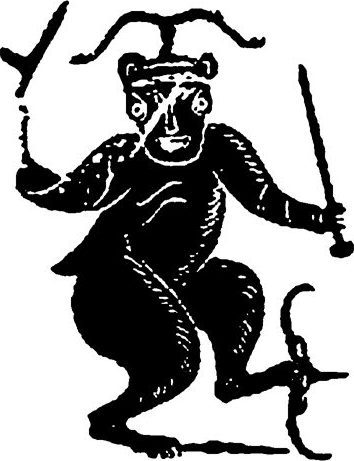
Black line image of the war-monster Chiyou as a horned, shaggy hybrid figure standing frontally, a blade brandished in each raised hand and a third weapon planted point-down at his side, with a long tail and clawed hoof-like feet, on a plain white ground; a rendering of a Han-dynasty stone-relief motif.
Chinese

Chiyou, the War Monster

Dig in the fields of the old north country and you may turn up a skull hard as bronze, or a tooth two inches long that no hammer will break: the bones, people said, of the horned god of war the Yellow Emperor could kill but never quite be rid of.
6 minClassic of Mountains and Seas
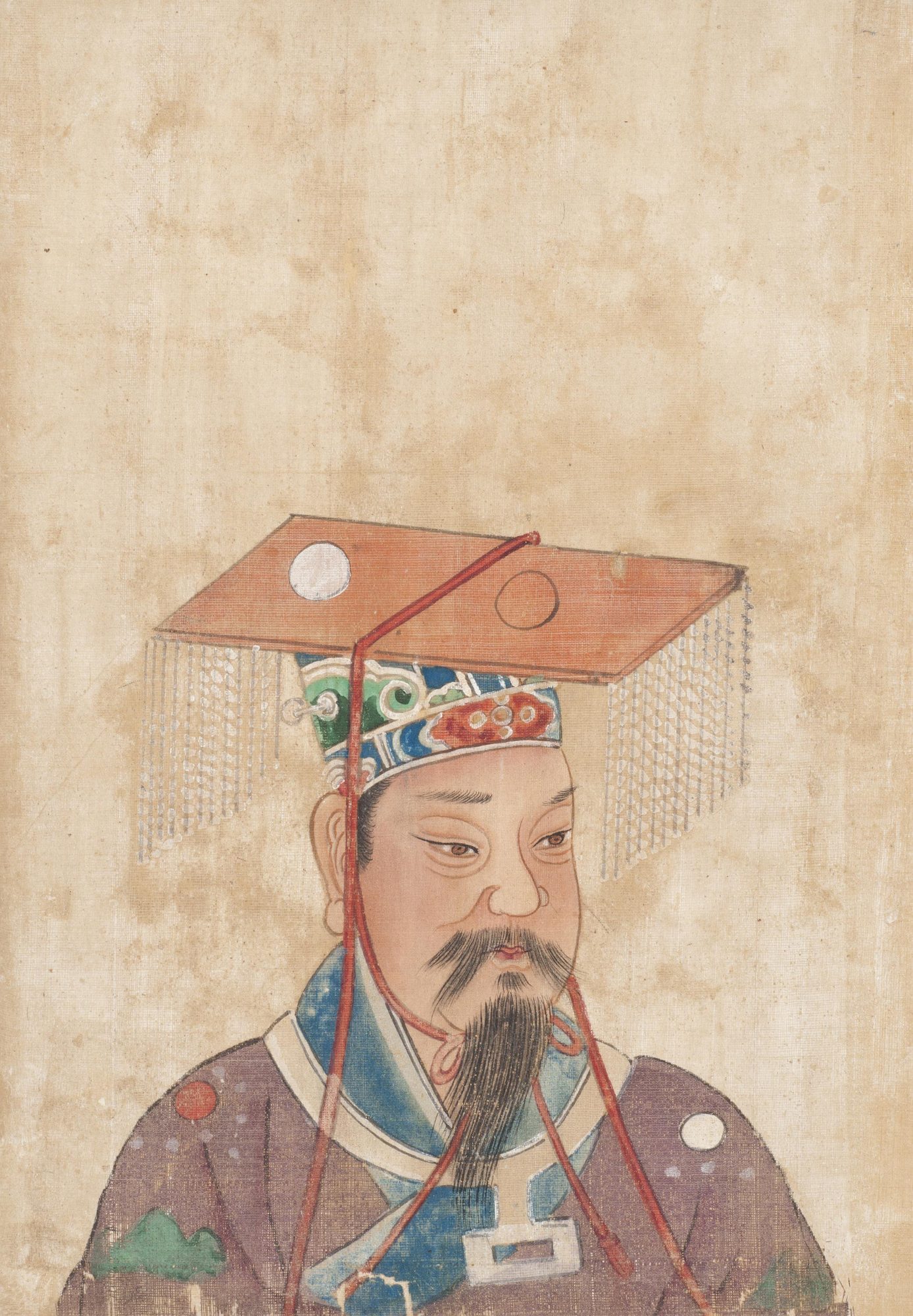
Ink-and-colour album-leaf portrait of the Yellow Emperor as Son of Heaven, shown in bust length wearing the flat-boarded mianguan crown with beaded tassel strings and a dragon-robe over a blue collar, against a plain aged-silk ground.
Chinese

The Yellow Emperor

When the old order collapsed and the fiercest of the warlords could not be subdued, a man who could speak from the cradle trained in shield and dagger-axe, broke the rebel Chiyou on the wilderness of Zhuolu, and was raised up as the first Son of Heaven of a civilised world.

7 minSima Qian
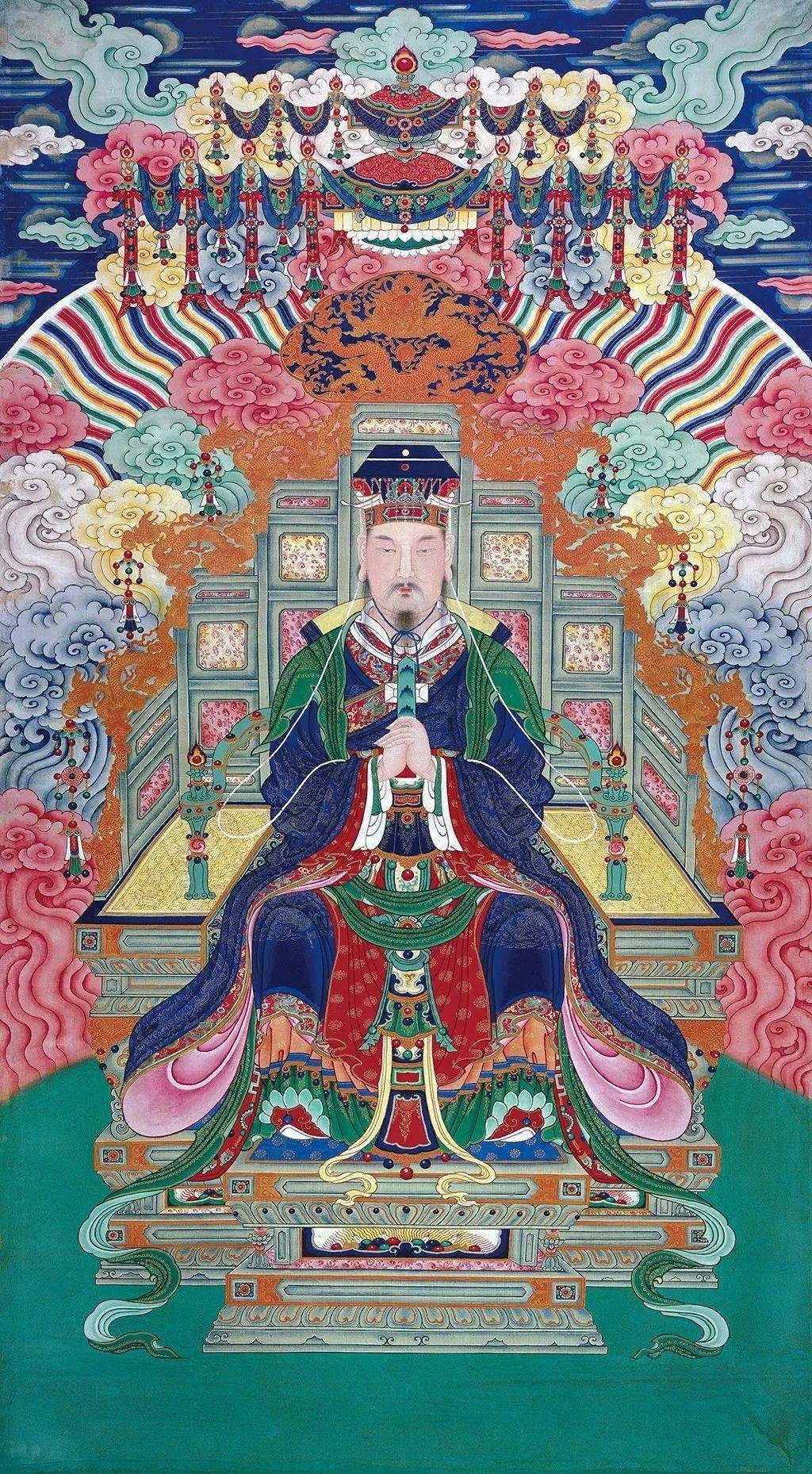
Ming-dynasty Daoist temple painting of the Jade Emperor enthroned in imperial court robes, wearing the flat mortarboard crown (mianguan) with hanging bead-strings and holding a ceremonial gui tablet in both hands, seated beneath a dragon canopy on a stepped throne amid coloured clouds.
Chinese

The Jade Emperor

Supreme sovereign of Heaven and head of a celestial civil service, whose whole war machine could not subdue one stone monkey, and who had to send west for the Buddha to save his own throne.

6 minWu Cheng'en
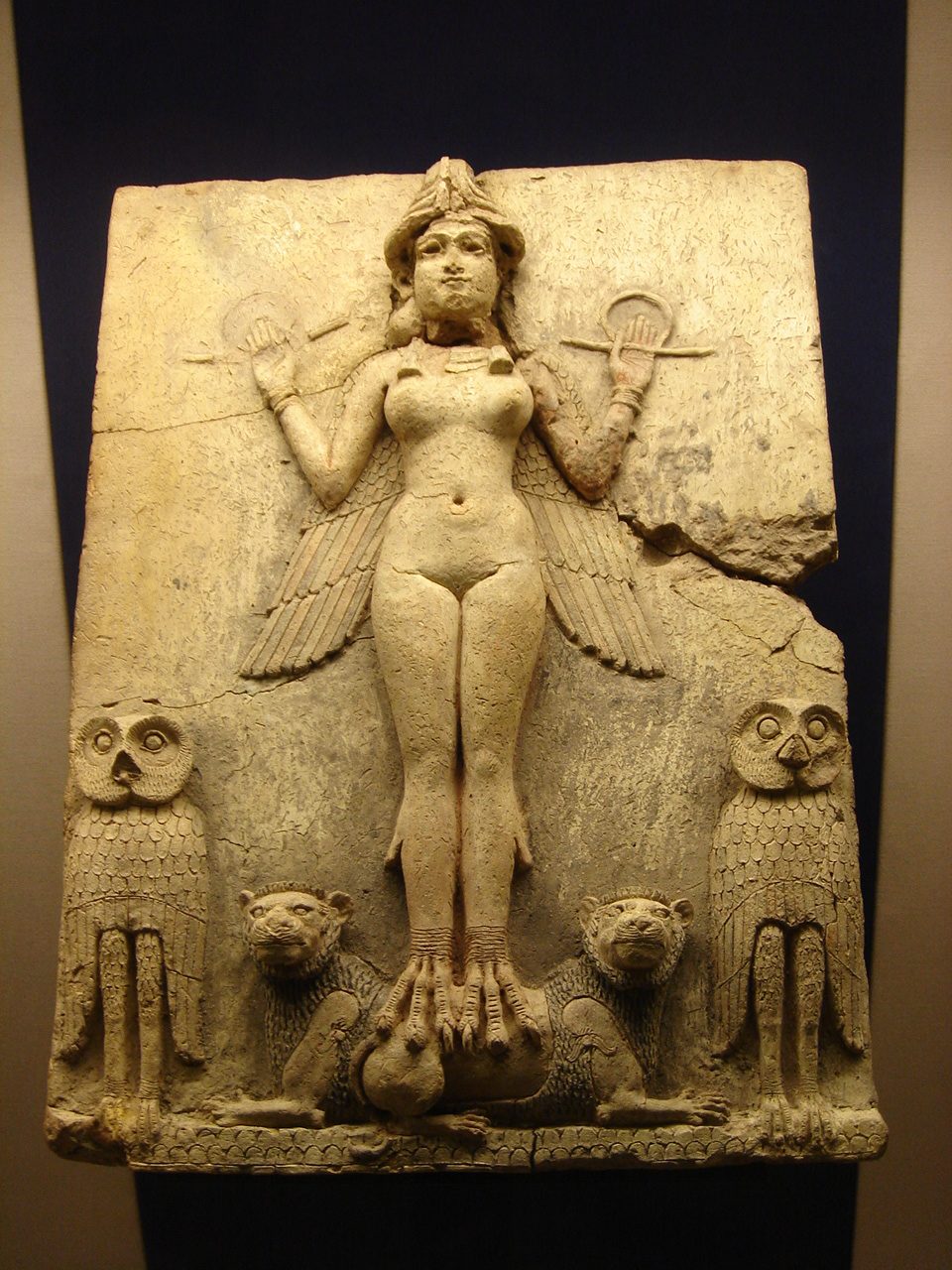
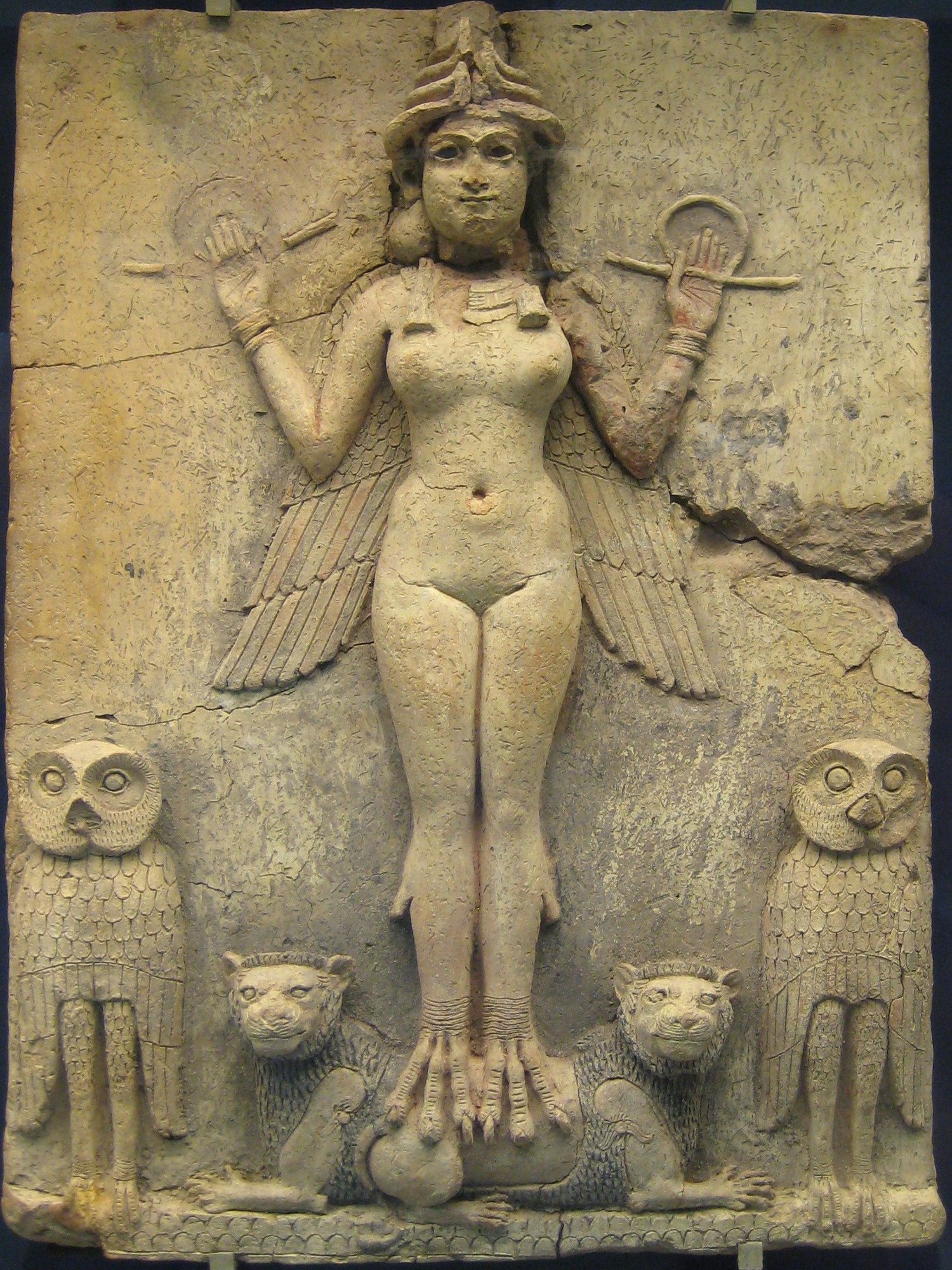
Old Babylonian terracotta relief plaque: a frontal nude winged goddess with a horned crown and bird talons for feet, holding a rod-and-ring measuring emblem in each raised hand, standing on the backs of two recumbent lions and flanked by a pair of upright owls, over a scale-patterned mountain register.
Mesop.

Inanna-Ishtar, Queen of Heaven

Goddess of desire and of war in a single body, the morning star who walked down alive into the land of no return: boldest of the great gods, and the most dangerous to love.

7 min*Inana's Descent to the Nether World*
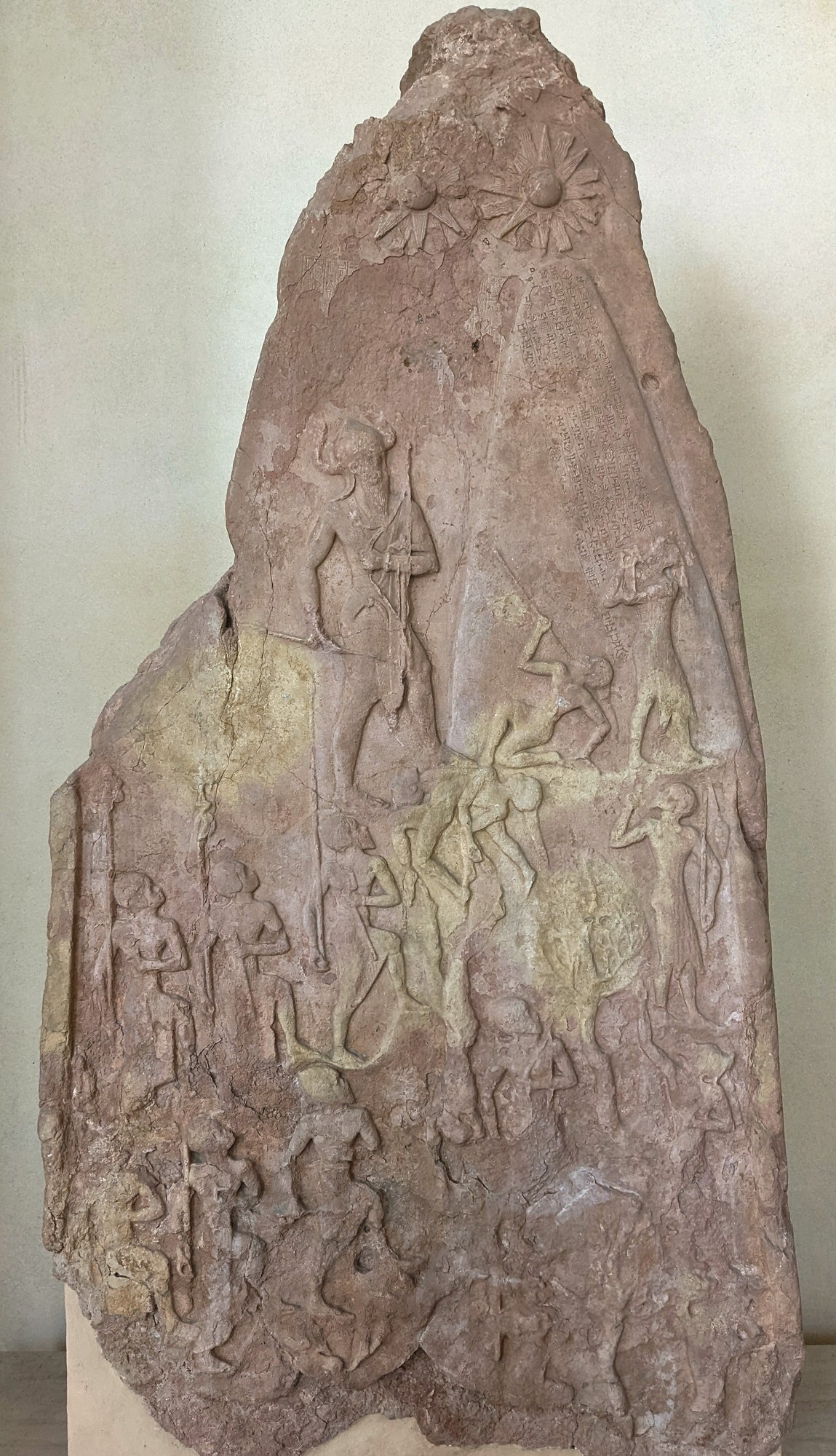
The Victory Stele of Naram-Sin: a tall pink-sandstone monument carved in relief. The Akkadian king Naram-Suen, wearing a horned helmet of divinity and carrying a bow and spear, climbs a wooded mountain above his soldiers, who advance in file; his defeated enemies fall, flee and beg beneath him, and sun-and-star glyphs of the gods shine over the peak.
Mesop.

The Curse of Agade

A king took axes to the god's own house, packed the temple's gold into leather bags, and loaded it onto ships. So the poets, four centuries after the city fell, explained why Agade vanished from the earth.

6 min'The cursing of Agade'
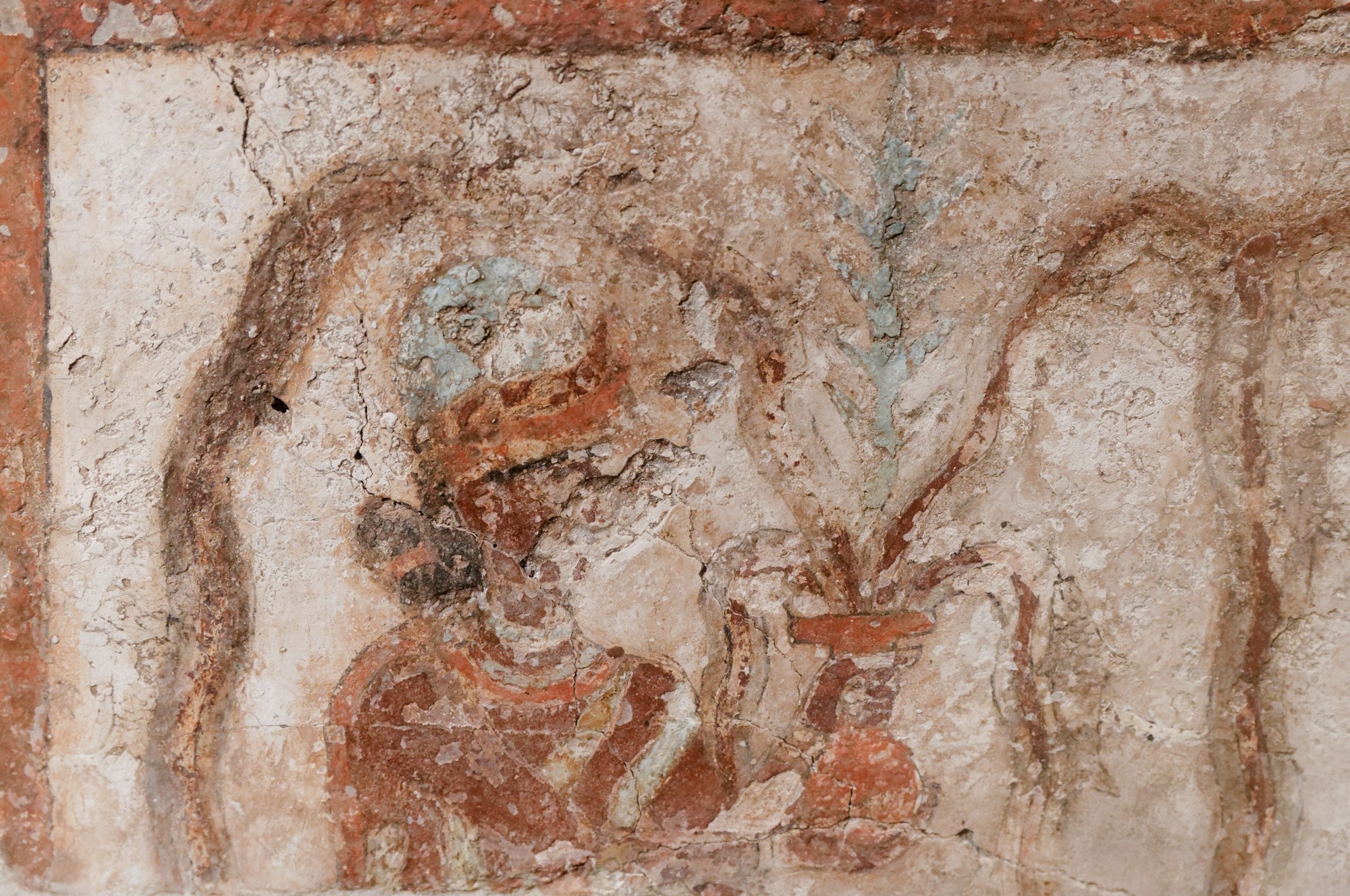
Detail of the Mari palace wall painting known as the Investiture of Zimri-Lim: a goddess in a blue-crowned headdress and a red-and-blue flounced robe stands within a painted red frame, holding a globular vessel from which a leafy plant and streams of water rise — the flowing-vase goddess who embodies the life-giving sweet waters, the abundance of the water-god Ea. The surface is a cracked, fragmentary tempera-on-plaster ground in ochre, red and turquoise.
Mesop.

Atrahasis: The Making of Humankind

Forty years the lesser gods dug the rivers by hand. Then they burned their tools and surrounded their master's house in the dark, and the only way to end the strike was to build a creature that could take the work off them.

7 min*Atra-hasis*
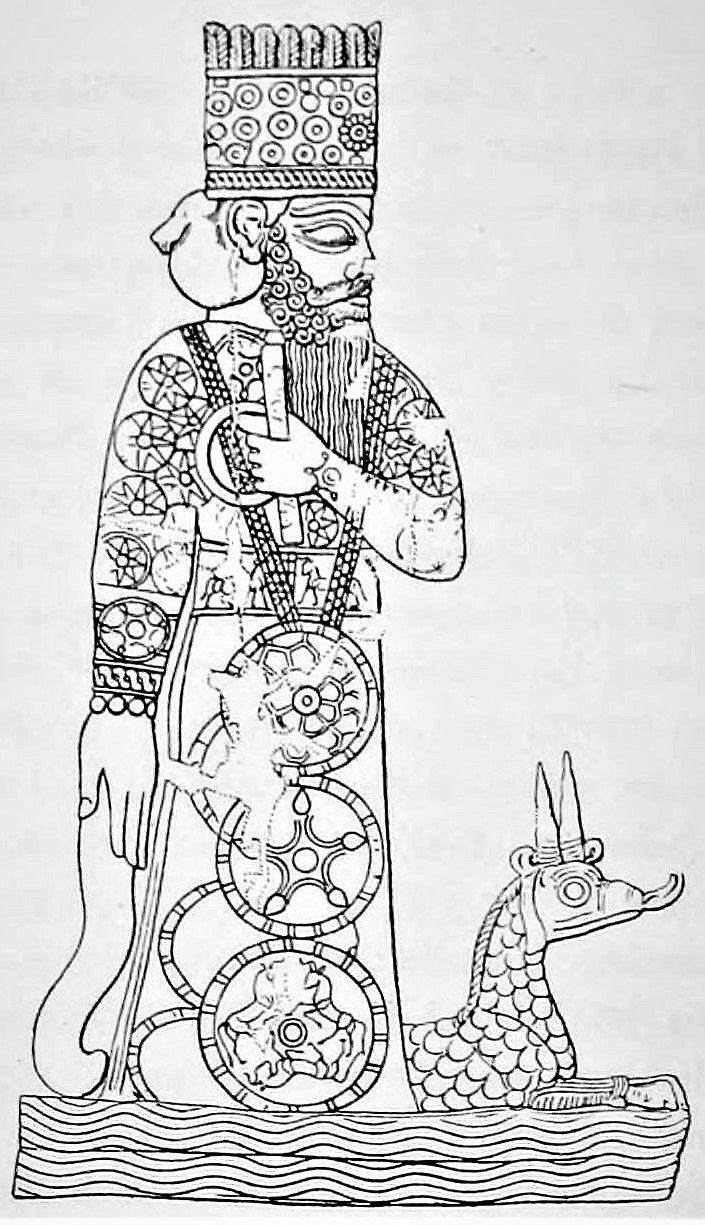
Line drawing of the Statue of Marduk: a bearded god in a tall crenellated horned crown and a long fringed robe covered in rosette-discs stands frontally, holding the ring-and-rod of kingship at his chest, while his scaled, horned snake-dragon (the mušḫuššu) crouches at his feet; both stand on a plinth of wavy lines — the split waters of the vanquished Tiamat.
Mesop.

Marduk, Champion of Babylon

The young storm-god who alone dared face the salt-water chaos, drove the winds down her throat and split her body into the sky, and traded a single victory for the kingship of all the gods.

6 min*Enūma Eliš*
The Old Babylonian "Queen of the Night" terracotta relief: a winged nude goddess in a horned headdress, holding a rod-and-ring symbol in each raised hand, standing on the backs of two lions and flanked by two owls, with a scale-pattern mountain base below. The figure has been variously identified as Ishtar, Lilith, or Ereshkigal.
Mesop.

Ereshkigal: The Queen the Sources Kept Rewriting

A goddess so fearsome she was barely worshipped, married off to a different god in every century that told her tale, and finally borrowed by Greek sorcerers who never knew what her name once meant.

4 min*Nergal and Ereshkigal*
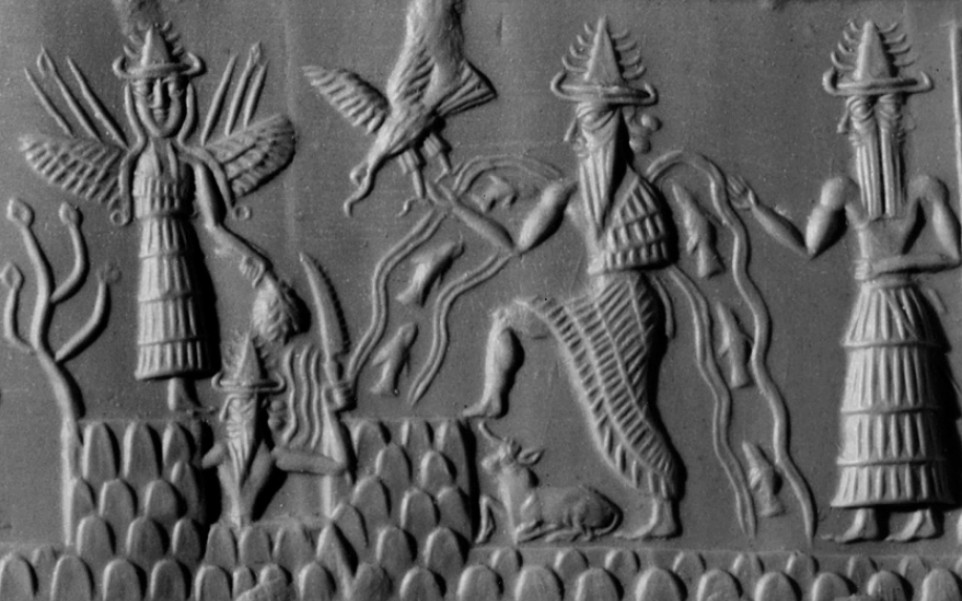
Rolled-out impression of an Akkadian cylinder seal: a file of standing deities identified by their many-horned crowns — the winged goddess Ishtar at left, the sun-god Shamash rising through the mountains at centre, and at right the god Ea (Enki), lord of the sweet-water deep, with streams of water and fish flowing from his shoulders, his two-faced vizier Usimu beside him.
Mesop.

Apsu and Tiamat: The Sweet Water and the Salt Sea

Before heaven had a name there were two waters, and they mingled. Everything that followed, the gods, the quarrel, the war that split a body into a sky, began in that first commingling of the fresh and the salt.

6 minEnūma Eliš
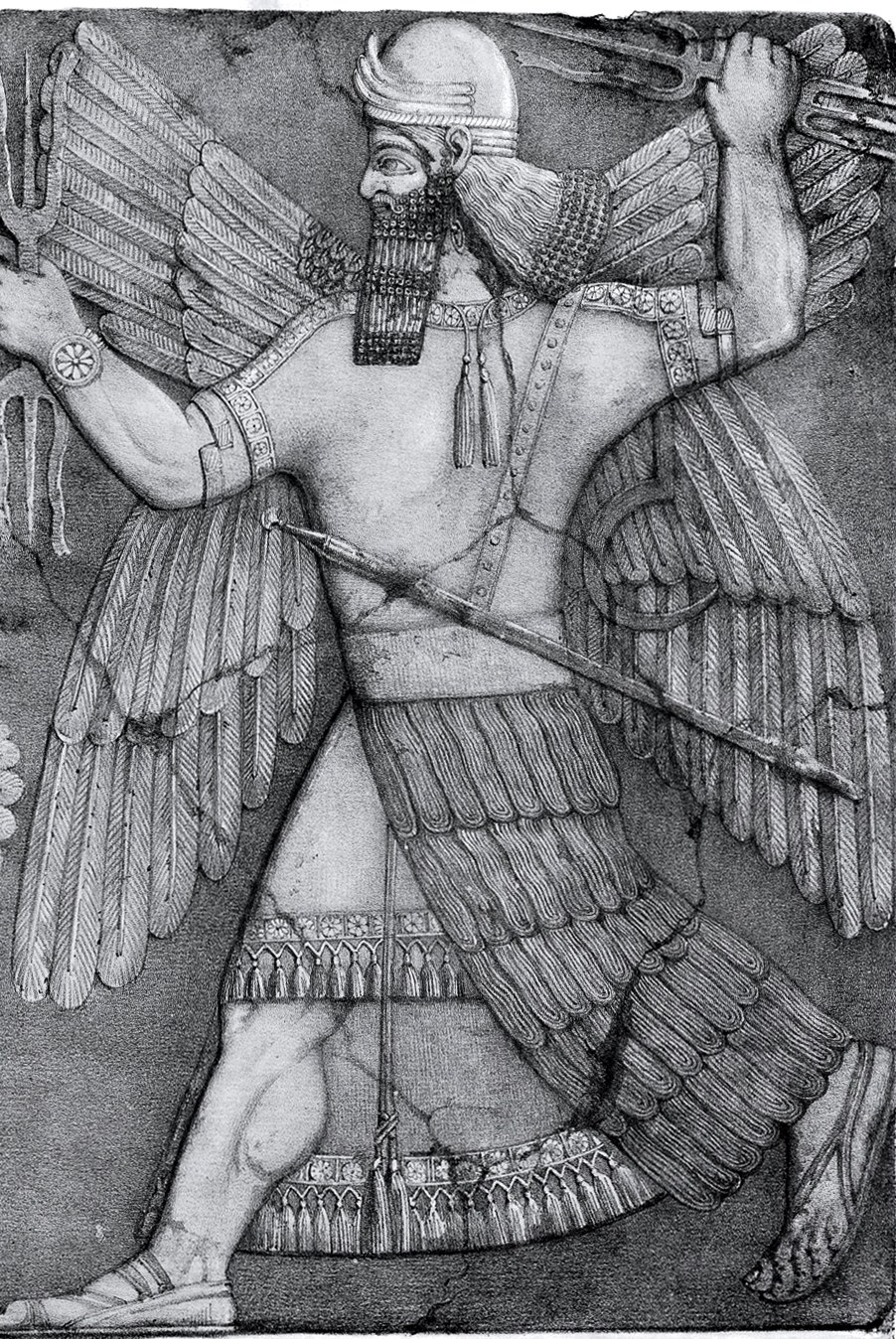
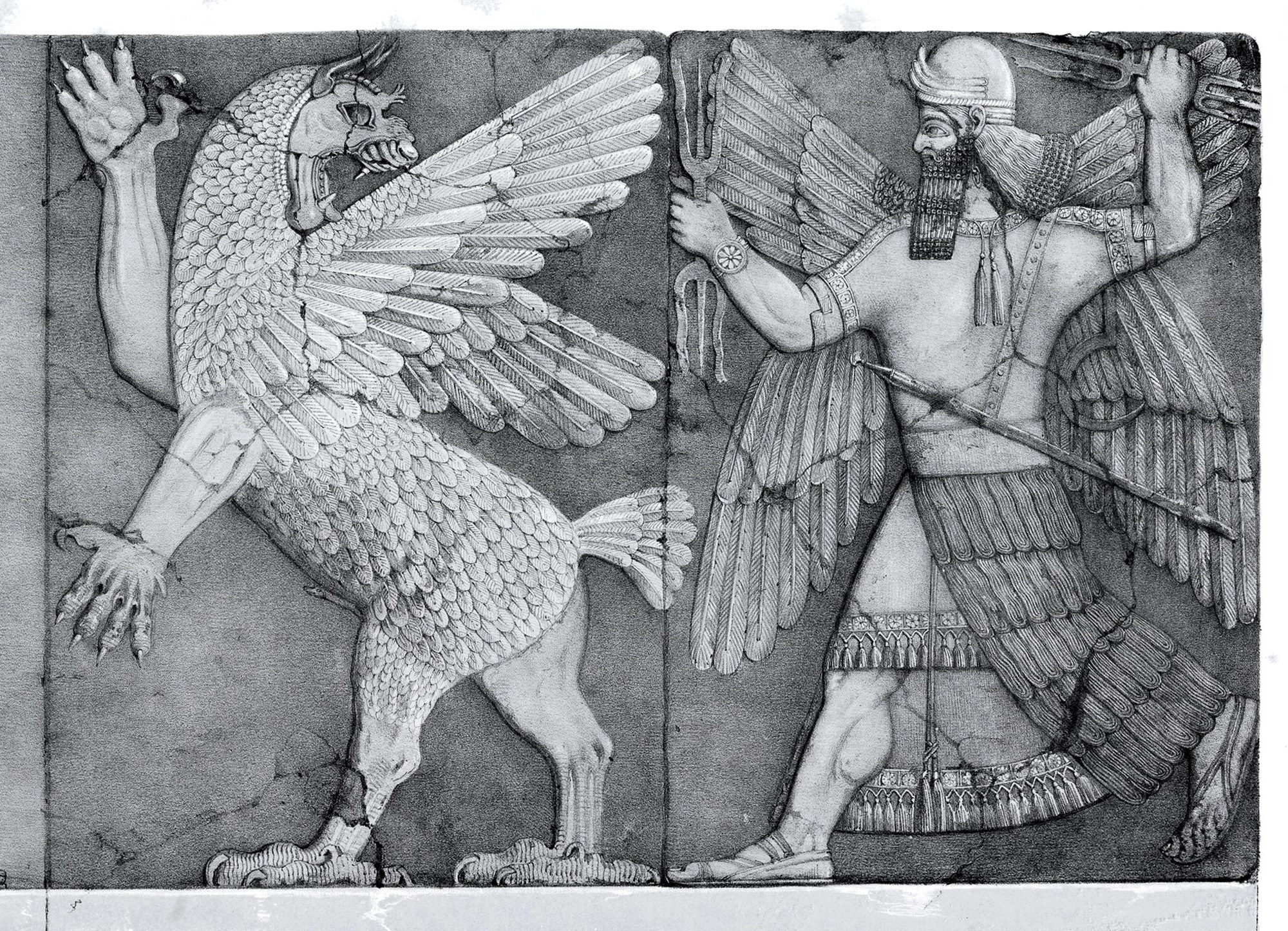
Neo-Assyrian carved stone relief: a four-winged, helmeted and bearded storm-god strides forward brandishing thunderbolts, the deity who in the tradition slays the chaos-monster Tiamat.
Mesop.

Tiamat, the Primeval Sea

She was the salt ocean before the ocean had a shore, the mother of every god, and the body a younger god would one day split open to roof the sky. This is Tiamat as a being: her names, her monstrous brood, and how her carcass became the world.

8 min*Enūma Eliš*
A 19th-century line engraving of a Neo-Assyrian palace relief: at right a bearded, winged warrior-god in a horned helmet strides forward, raising a weapon overhead and holding a bow, pursuing at left a winged, lion-headed and horned monster that flees with clawed hands thrown up.
Mesop.

Anzu's Theft of the Tablet of Destinies

The storm-bird has stolen the writ of fate and made his own word law, and every god the assembly names to fight him refuses. The recovery is a hunt won not by strength but by a trick that turns the thief's own magic dead.

6 minThe Standard Babylonian *Myth of Anzu* / *Epic of Anzû*
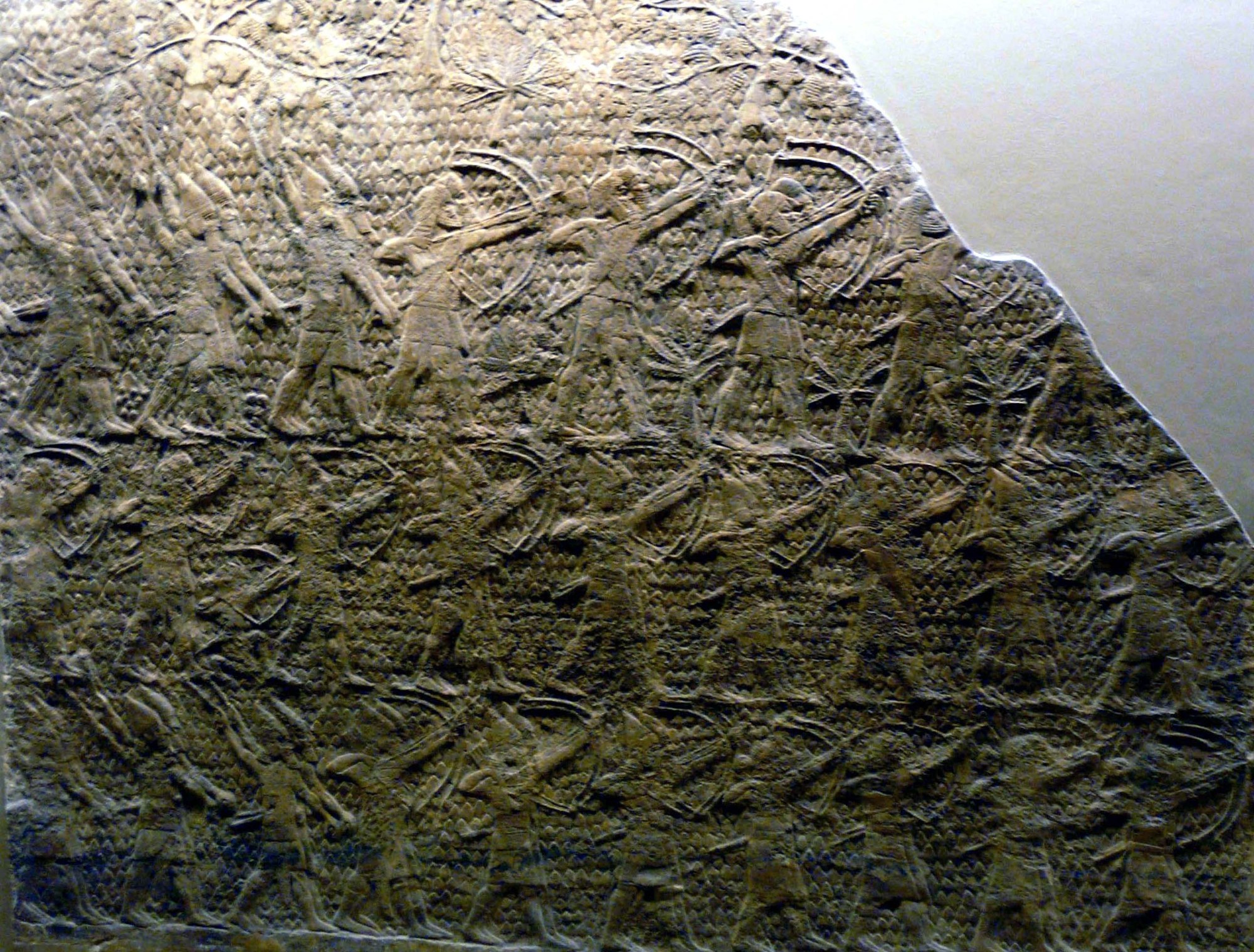
Carved Neo-Assyrian stone relief crowded with soldiers advancing uphill: archers drawing their bows and slingers whirling stones, packed in dense registers across a weathered tan gypsum panel with its broken top edge.
Mesop.

Erra and Ishum: The Wrath of the Plague God

The war-god lies too tired to rise, until his own heart and seven restless weapons talk him into a slaughter no god can call off. Only his own minister can end it, and only by making war on a mountain instead of on men.

6 minThe Poem of Erra and Ishum
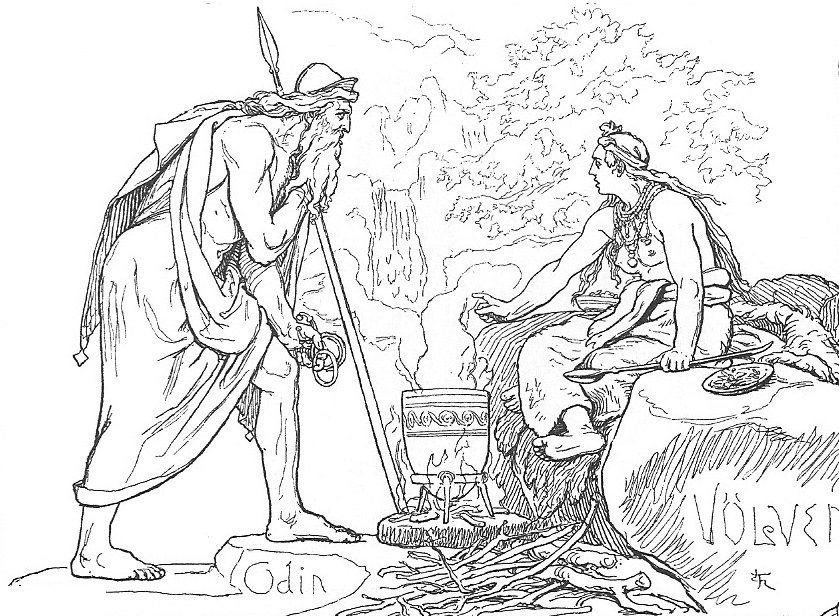
Pen-and-ink line engraving. At left the one-eyed Odin, in a winged cap and a long cloak, leans forward on his upright spear and his sword, his long beard falling; at right the seeress (the völva) sits on a fur-draped rock, one hand raised in speech, a shallow bowl in her lap; a steaming cauldron stands on a low fire between them, a leafy tree behind. The ground bears the incised labels "Odin" and "VÖLVEN".
Norse

The Seeress's Prophecy

Odin raises a dead wise-woman to make her speak, and she gives him the whole arc of the world: its making, his own hidden secrets, and the fire that ends it all.

7 minPoetic Edda
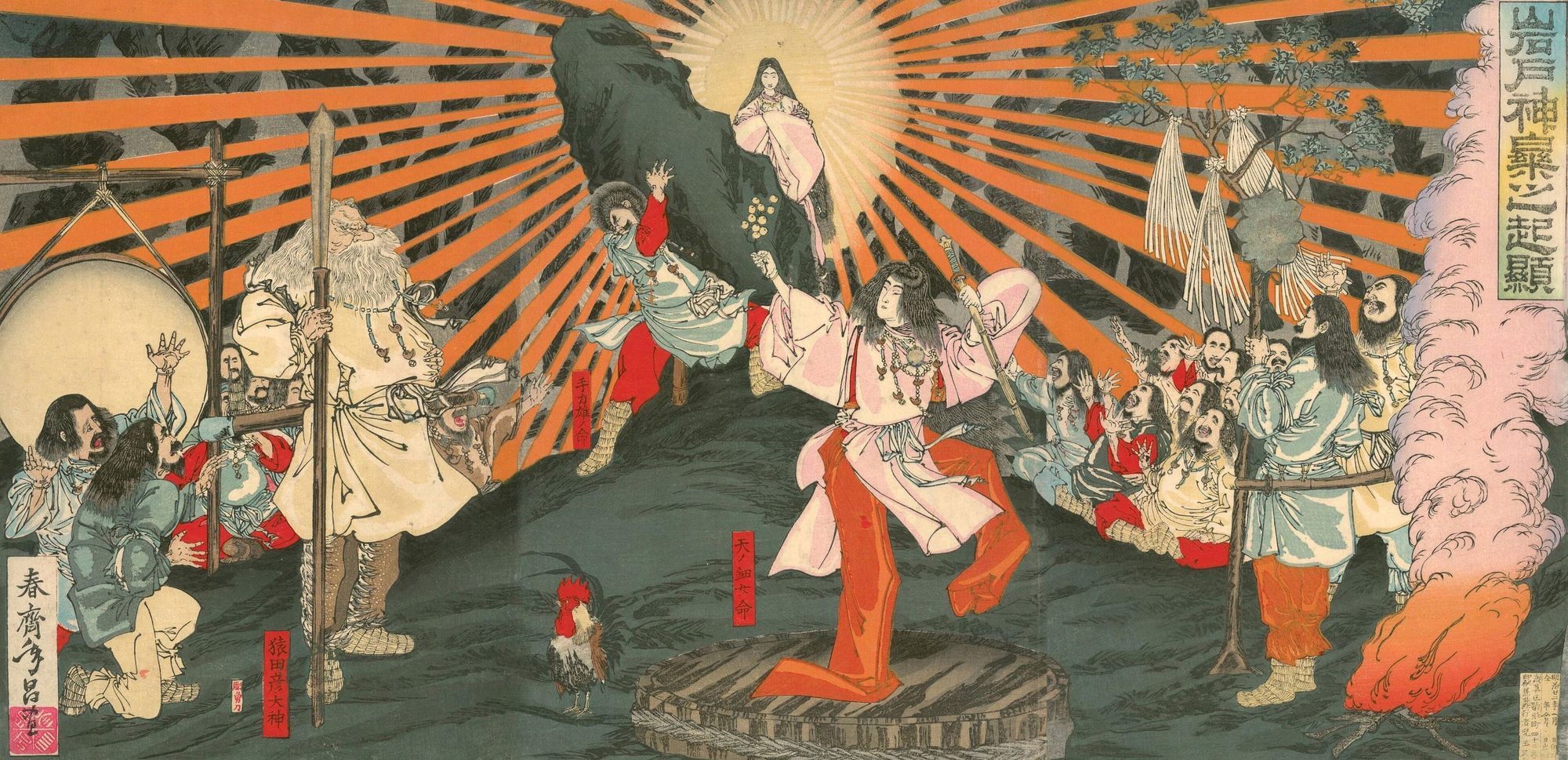
Meiji woodblock print of the sun-goddess Amaterasu emerging from the Heavenly Rock-cave, a radiant white-and-pink-robed figure haloed in a golden sunburst against the dark cliff, while below her the Dread Female Ame-no-Uzume dances wildly on an overturned tub, a red-combed cock crows at her feet, and the strong-god Tajikarao reaches up toward the cave; orange sun-rays stream across the whole scene.
Japanese

Amaterasu and the Rock Cave

The sun-goddess bolts herself inside a stone door and the world goes black; it takes a forged mirror, a ribald dance and eight hundred myriad gods laughing in the dark to trick the light back out.

6 minKojiki
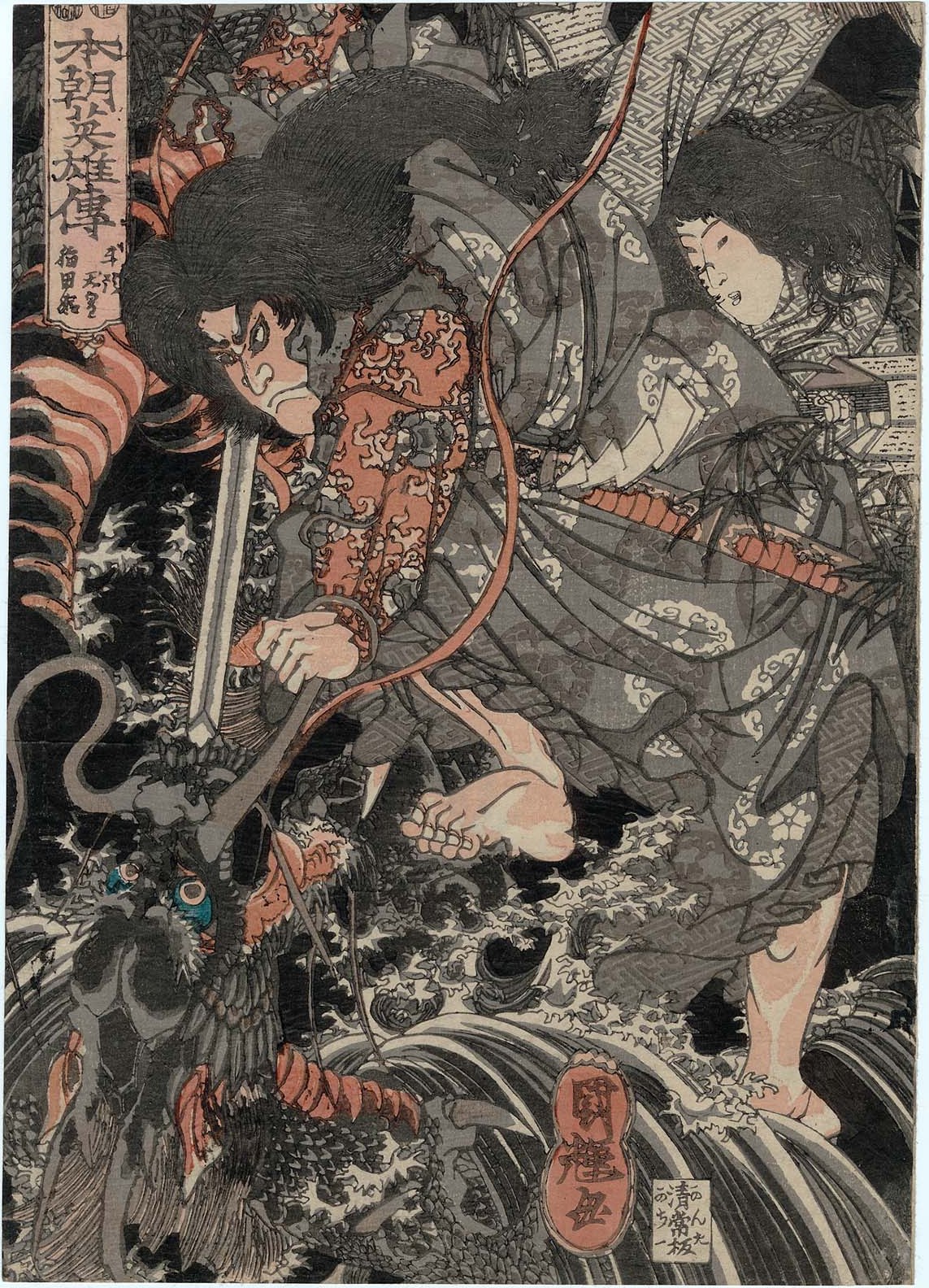
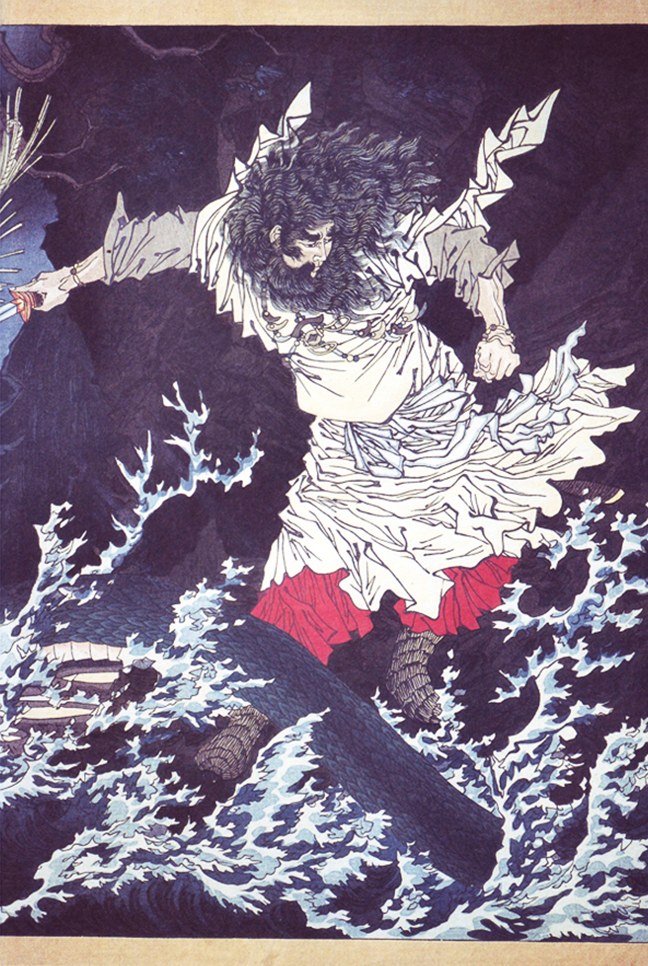
Japanese woodblock print of the storm-god Susanoo, wild-haired and bearded in a white robe over a red under-robe, striding through foaming waves with his arms flung wide and a sword gripped in his lowered left hand, in the moment of slaying the eight-headed serpent Yamata-no-Orochi at the River Hi in Izumo.
Japanese

Susanoo, the Storm God

Born from a washed nose, he wept the green mountains bare and was cast out of two worlds before he ever drew a sword on the eight-headed serpent: the most turbulent of the Japanese gods, expelled troublemaker turned culture-hero of Izumo.

6 minKojiki
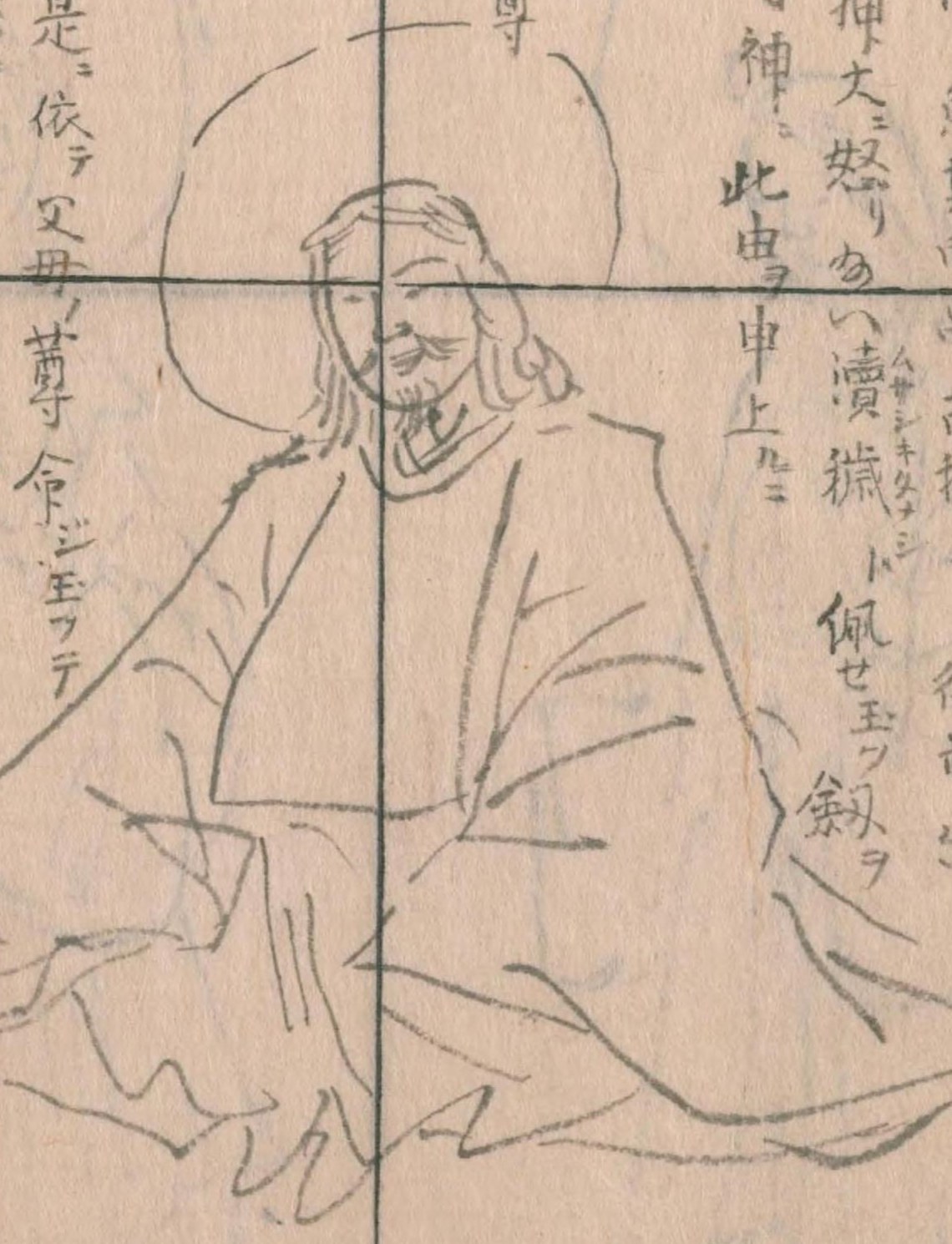
Edo-period Japanese woodblock book-illustration of the moon-god Tsukuyomi, a bearded deity in flowing court robes seated frontally with a full moon-disc halo behind his head, one hand raised to his brow, surrounded by columns of classical Japanese text.
Japanese

Tsukuyomi, the Moon God

Born from the right eye of a god washing himself clean of the dead, the moon drew his sword on a goddess who fed him from her mouth, and for that the sun turned her face away: the quiet god whose one act set the sun and moon apart.

5 minNihon Shoki
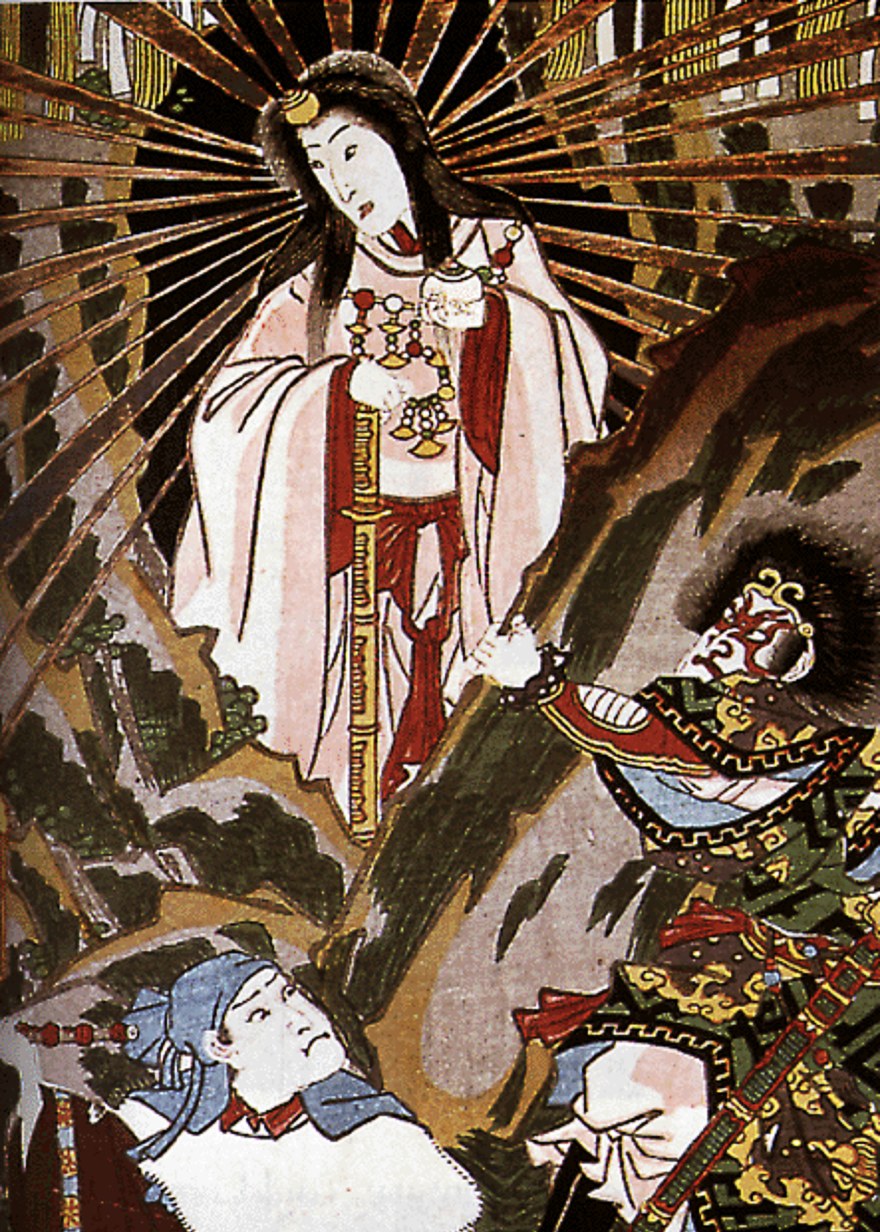
Japanese woodblock print of the sun-goddess Amaterasu, white-robed with loose black hair and gold rays streaming from her head, emerging from the mouth of the Heavenly Rock-cave; the fierce-faced strong-god Ta-jikara-wo grasps her hand to draw her out while another deity kneels gazing up at the returning light.
Japanese

Amaterasu, the Sun Goddess

The radiance that shone through all six quarters at birth, the goddess who armed herself like a warrior against her own brother and then shut the door on the world: ancestress of the emperors and light of the High Plain of Heaven.

6 minNihon Shoki
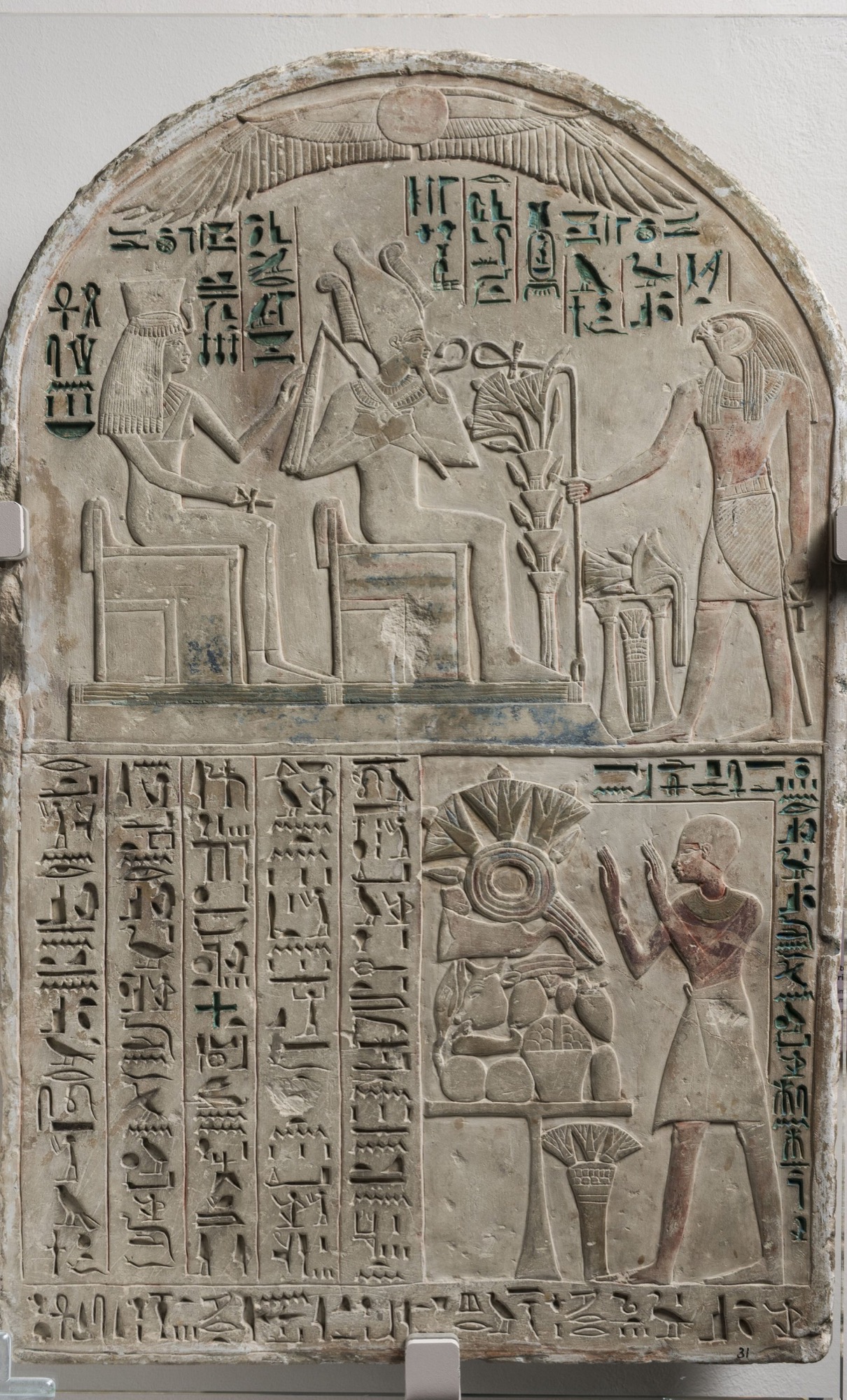
Ancient Egyptian limestone stela with an arched, painted lunette. Under a winged sun-disk, the upper register shows the god Osiris enthroned in the tall White Crown holding the crook, the goddess Isis seated behind him on a second throne, and the falcon-headed god Horus standing before them presenting lotus flowers over a laden offering-stand; columns of green-filled hieroglyphs fill the field, with a royal cartouche between Osiris and Horus. In the lower register a shaven-headed worshipper raises both hands in adoration before a heaped offering-table, beside several columns of a hieroglyphic hymn.
Egyptian

Horus Avenges His Father

Reared in the marshes until his arm was strong, the falcon-son came for the throne his uncle stole: three ancient traditions, a slaughter, a tribunal and a war, and not one clean duel among them.

6 minPyramid Texts
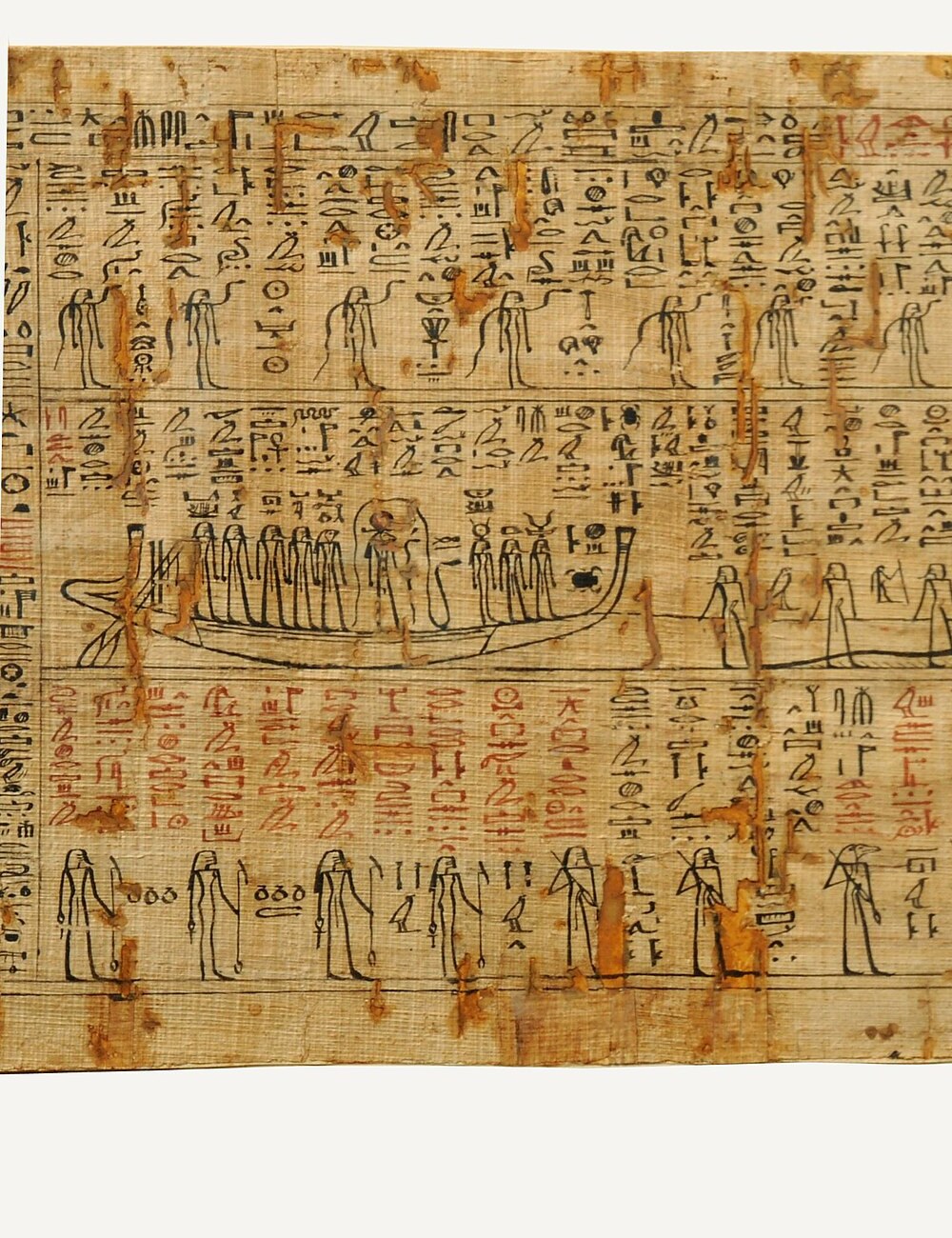
An ancient Egyptian funerary papyrus of the Book of the Amduat, its central register showing the sun-god's night-bark crewed by a file of standing gods, with columns of black-and-red hieroglyphs and rows of processional deities above and below.
Egyptian

The Duat and the Night Journey

A ram-headed sun hauled by ropes through a valley of the dead, a serpent staked with knives, a rebirth out of a monster's tail: the Egyptian underworld the sun and the dead must cross before dawn.

8 minThe Book of the Dead
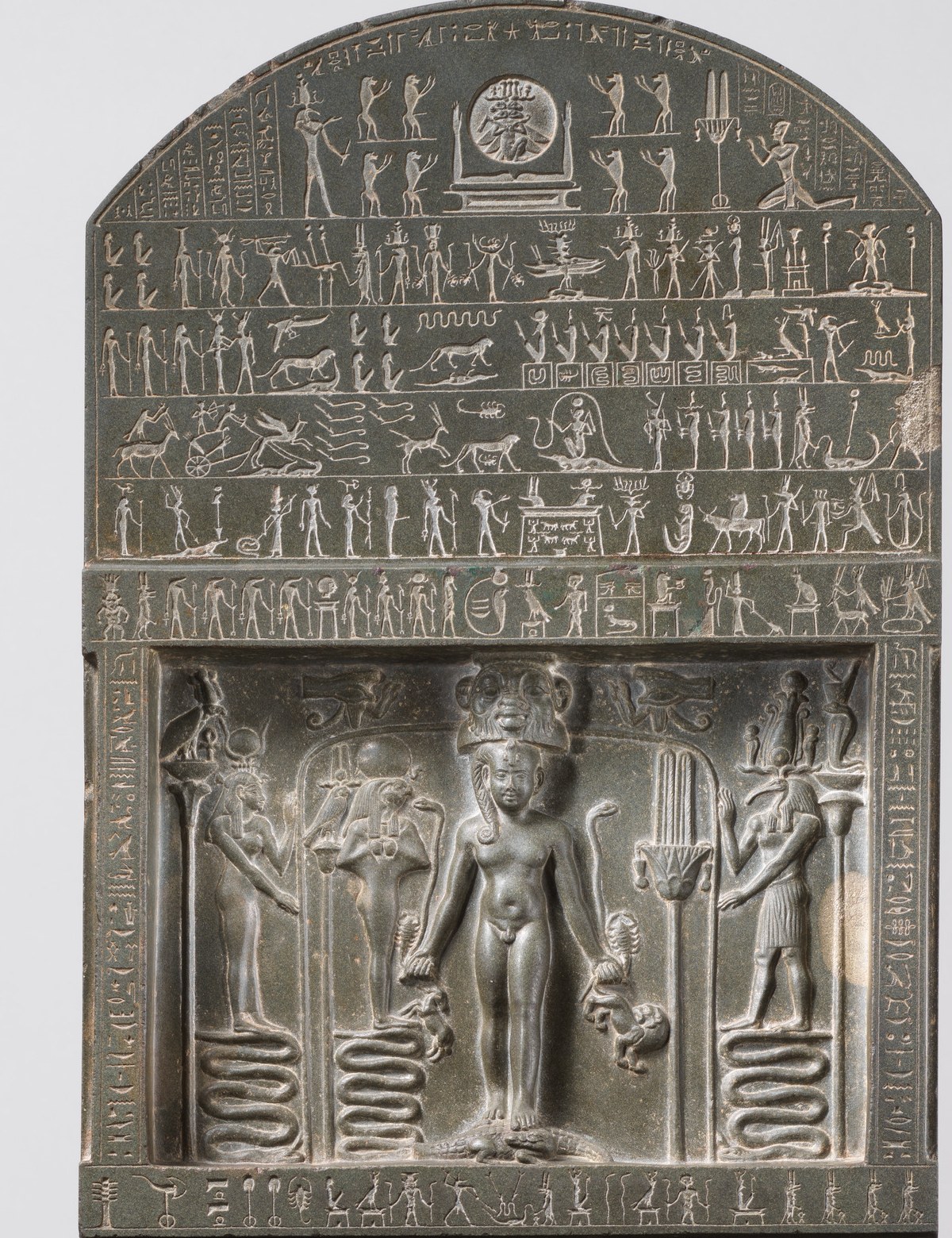
Ancient Egyptian dark-stone magical stela (cippus): in a recessed panel the nude child-god Horus stands frontally on two crocodiles, grasping serpents, a scorpion, a lion and a gazelle in his fists, crowned by the mask of the god Bes and flanked by two deities standing on coiled serpents; above, an arched lunette with registers of gods and dense hieroglyphs.
Egyptian

The Contendings of Horus and Set

Eighty years of lawsuits and duels for a dead king's throne: an uncle and a nephew, a bench of gods that cannot make up its mind, and a mother who will not let her son lose.

6 min"The Contendings of Horus and Seth
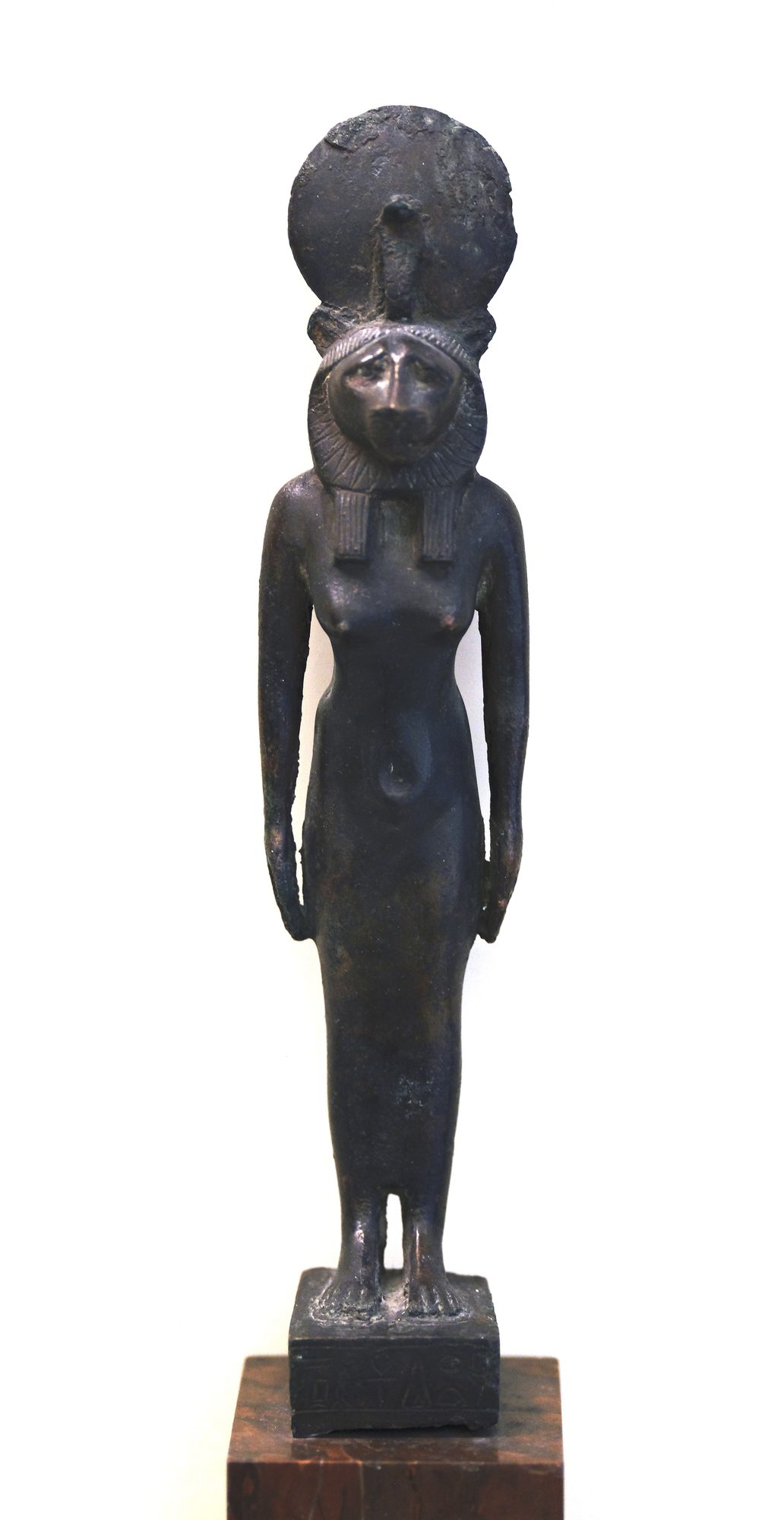
An ancient Egyptian granodiorite statue of the lioness-headed goddess Sekhmet, a slender figure with a sun disk and uraeus at her brow, holding a papyrus sceptre.
Egyptian

Sekhmet: The Powerful

A goddess carved in statues enough to face every day of the year, whose breath was plague and whose priests were physicians: the lioness the Egyptians both feared and begged.

7 minPyramid Texts
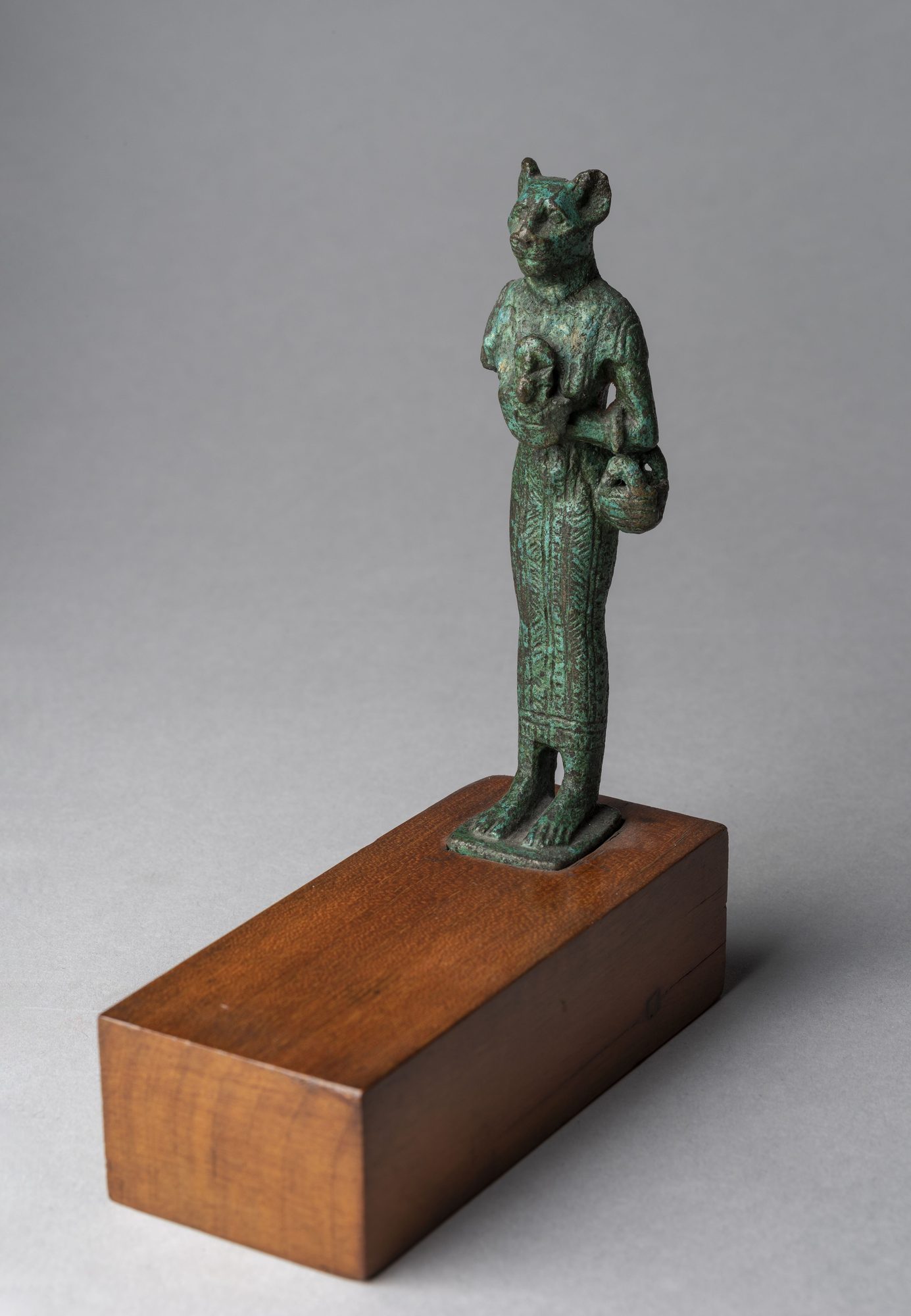
An ancient Egyptian bronze statuette of the goddess Bastet in cat-headed form, a lithe female figure with a lioness-domestic cat head and a broad collar.
Egyptian

Bastet: The Cat of Bubastis

Before she was the gentle cat with kittens at her feet, she was a lioness of the sun a dead king dared not offend. Egypt drank more wine at her festival than in all the rest of the year.

6 minPyramid Texts
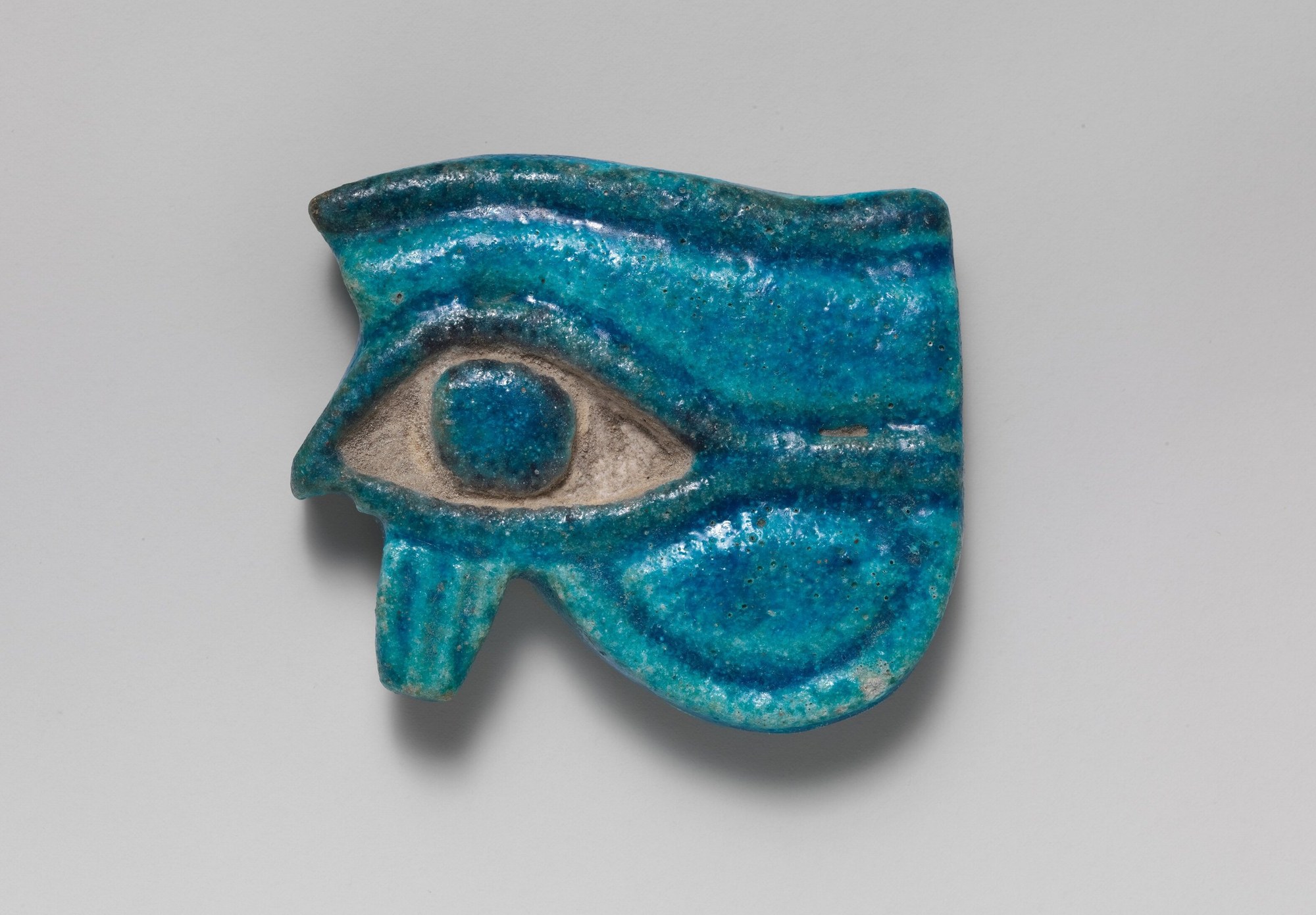
An ancient Egyptian wedjat (Eye of Horus) amulet in brilliant turquoise-blue glazed faience, photographed on a plain neutral ground. The stylised falcon-eye shows the arched brow and dark upper cosmetic-line, the almond eye with a raised round pupil, a vertical striated teardrop marking dropping straight down below the eye, and a curling spiral cheek-marking sweeping out to the right. The glaze is worn to pale matte around the eye socket; the whole amulet is intact.
Egyptian

The Eye of Horus, Torn and Made Whole

A black pig, a mighty storm, an eye put out: how the Egyptians told the wounding of Horus two ways at once, and why the healed eye became the very word for wholeness.

6 minPyramid Texts
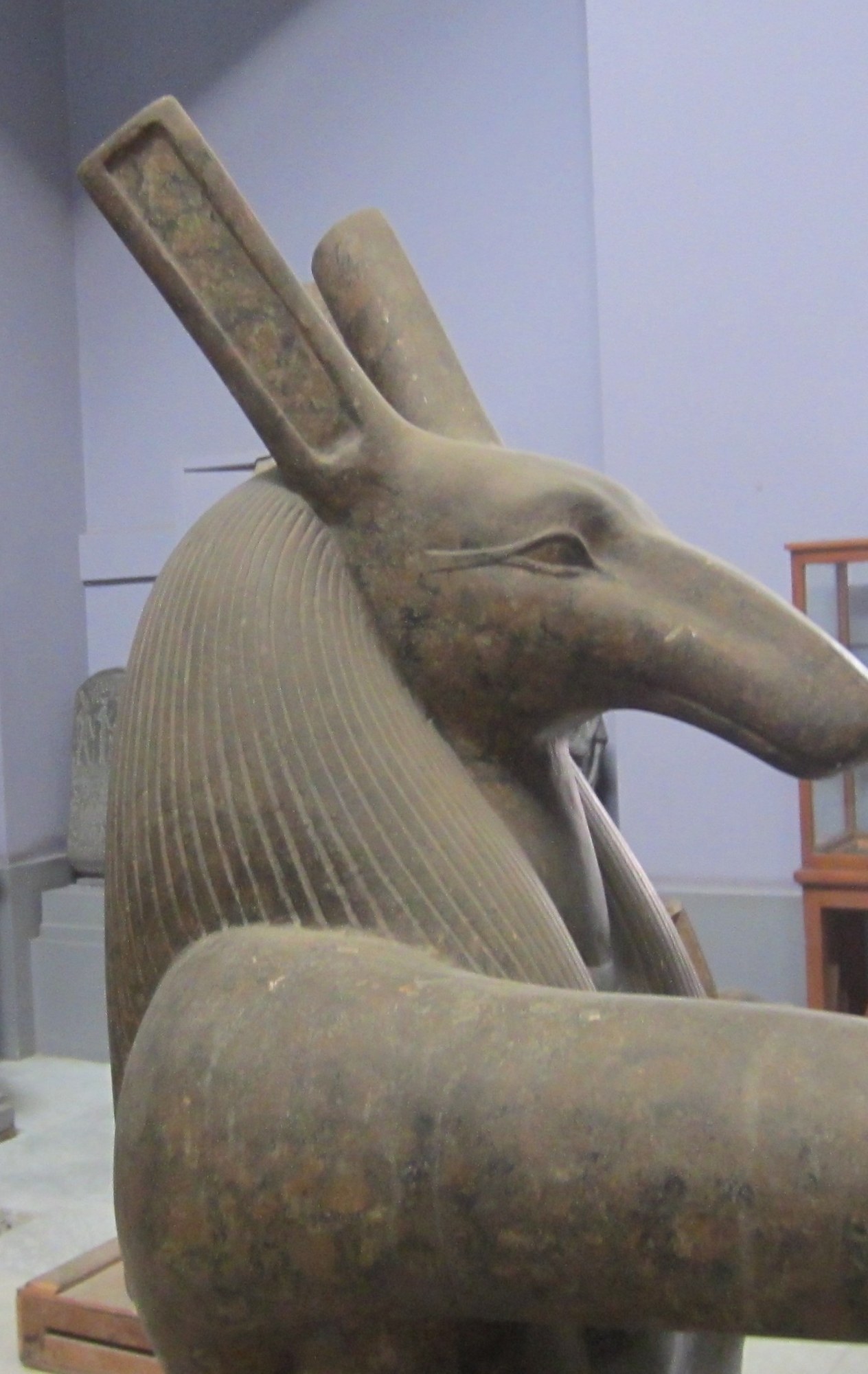
Detail of an ancient Egyptian granite statue showing the head of the god Set in profile: the composite "Set-animal" head with its long down-curved snout, tall squared upstanding ears and almond eye rimmed by a cosmetic line, backed by a striated tripartite wig, with the god's neck and one arm below, against a plain grey museum wall.
Egyptian

Set, God of Chaos

Storm-god, desert-lord and fratricide: the red god the Egyptians both needed and feared, murderer of Osiris and rival of Horus, who was never only a villain.

6 minPyramid Texts
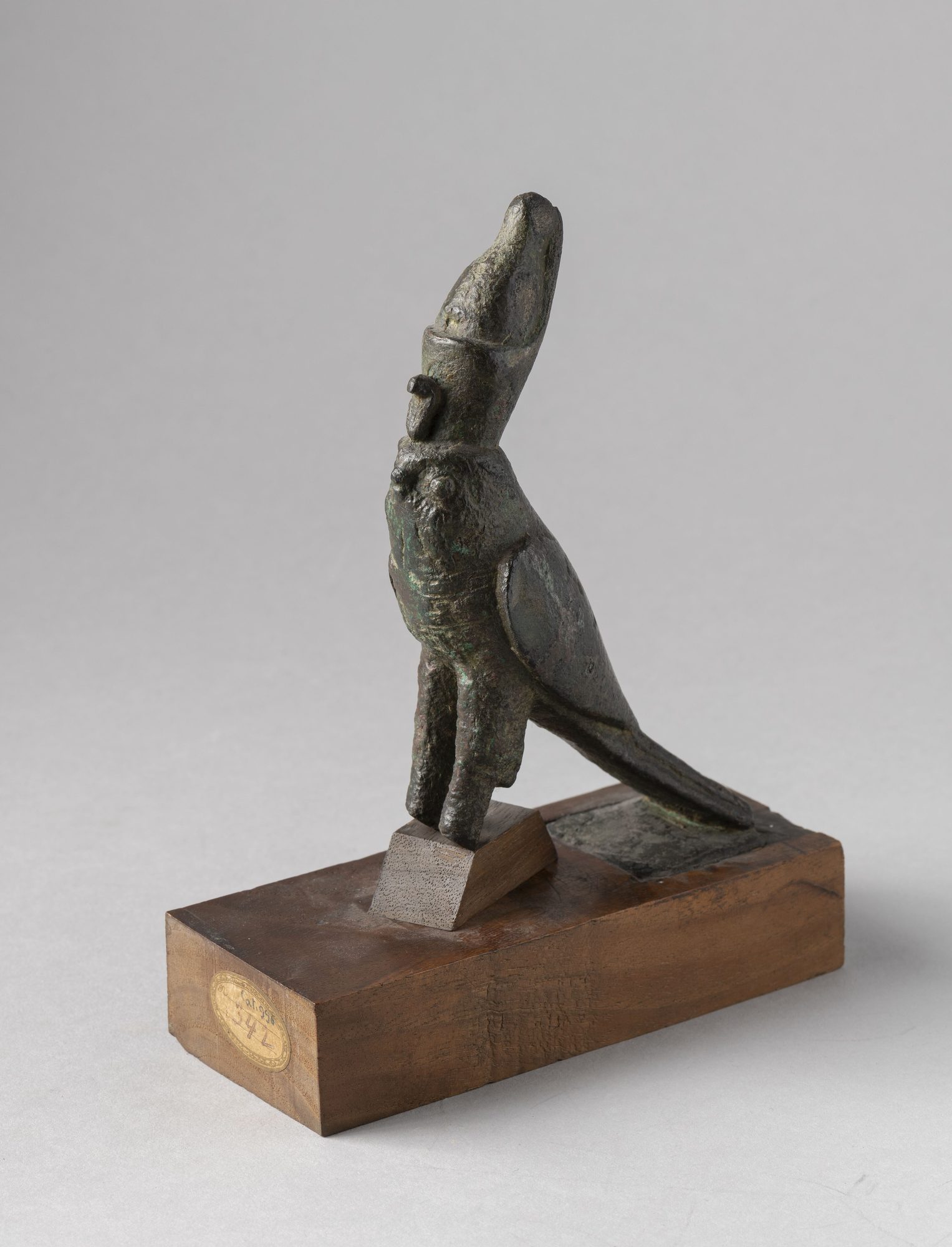
An ancient Egyptian bronze statuette of Horus as a falcon wearing the double crown of Upper and Lower Egypt.
Egyptian

Horus, the Falcon King

The falcon-headed heir who takes back a stolen throne: son of a murdered god, raised in a marsh, and vindicated before the assembled gods as the rightful king of Egypt.

6 minPyramid Texts
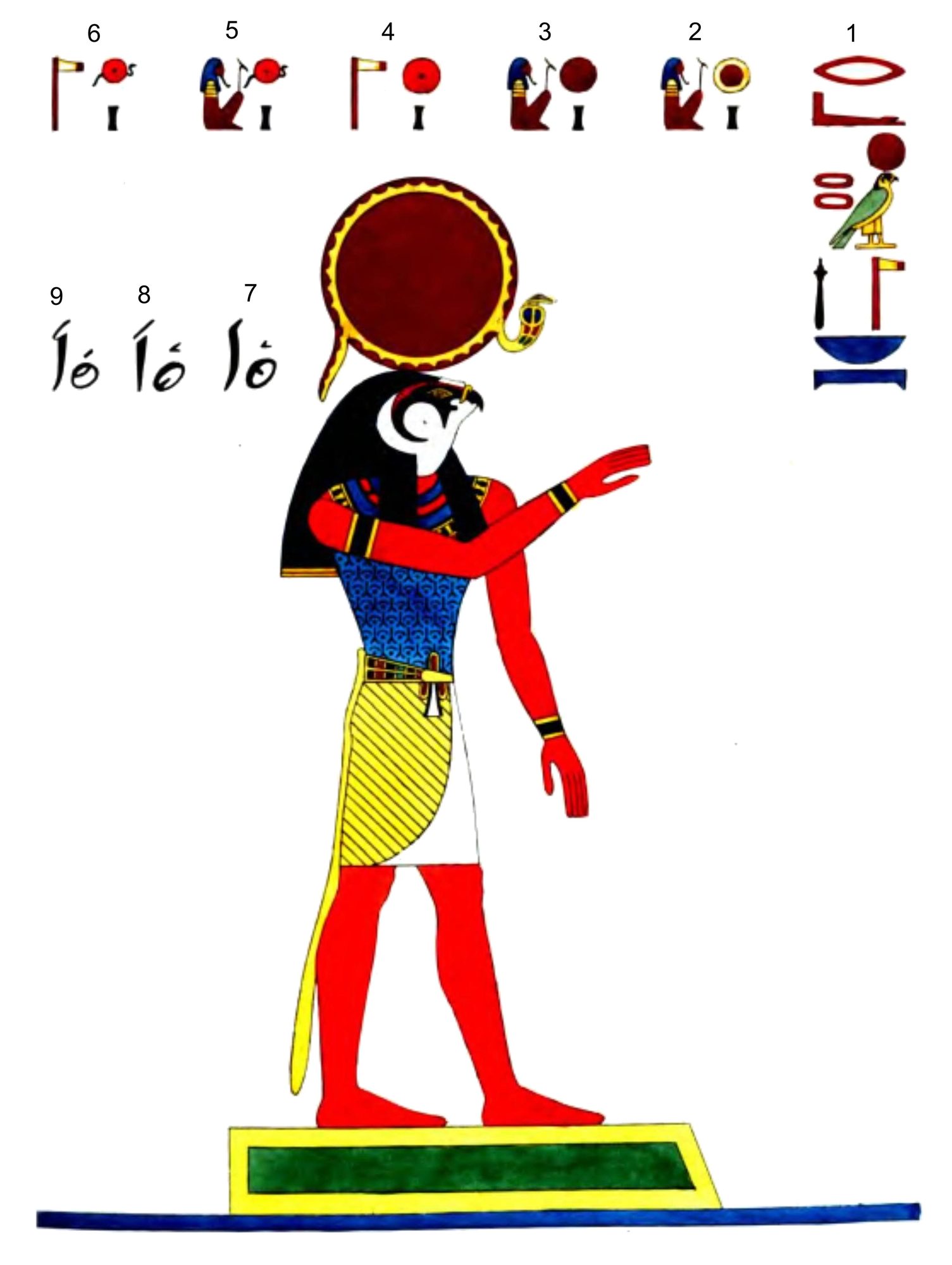
A hand-coloured lithograph plate of the sun-god Re: falcon-headed, crowned with the solar disk, striding in profile, from Champollion's Panthéon égyptien.
Egyptian

Ra, the Sun God

Beetle at dawn, blazing disk at noon, a tottering old man sinking into the west: the creator sun-god of Heliopolis who sails the sky by day and fights his way through the underworld by night.

6 minPyramid Texts
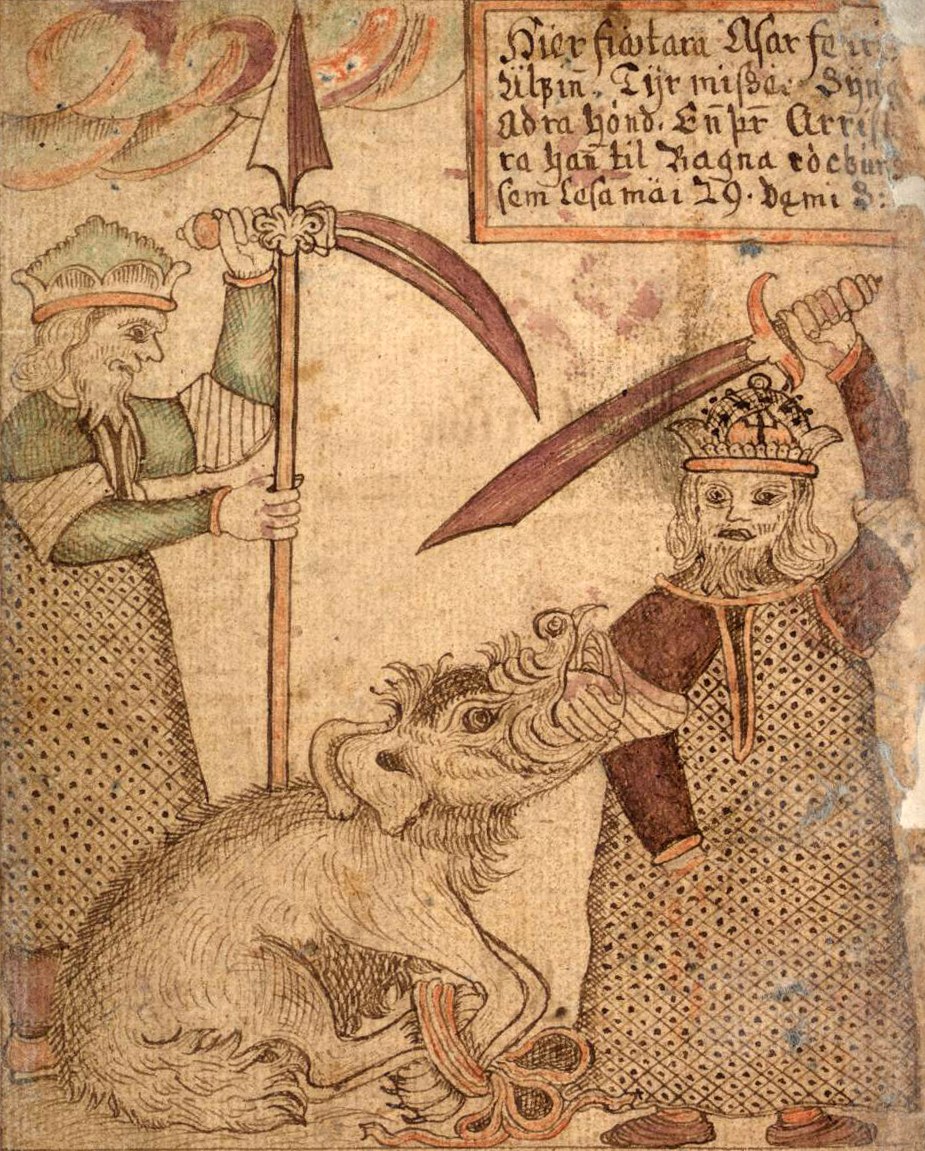
An 18th-century Icelandic manuscript illustration of the binding of Fenrir: at right the crowned god Týr, sword raised in one hand, his other hand thrust into the jaws of the great wolf, which bites down on it; the wolf Fenrir crouches at centre; at left a second crowned god of the Aesir holds a spear and a curved fetter; a handwritten caption box sits at the upper right.
Norse

Tyr, God of the Oath

The boldest of the Aesir laid his sword-hand in a wolf's jaws to bind a doom he could not defeat, and lost it: the god who kept a pledge he knew was false.

5 minSnorri Sturluson
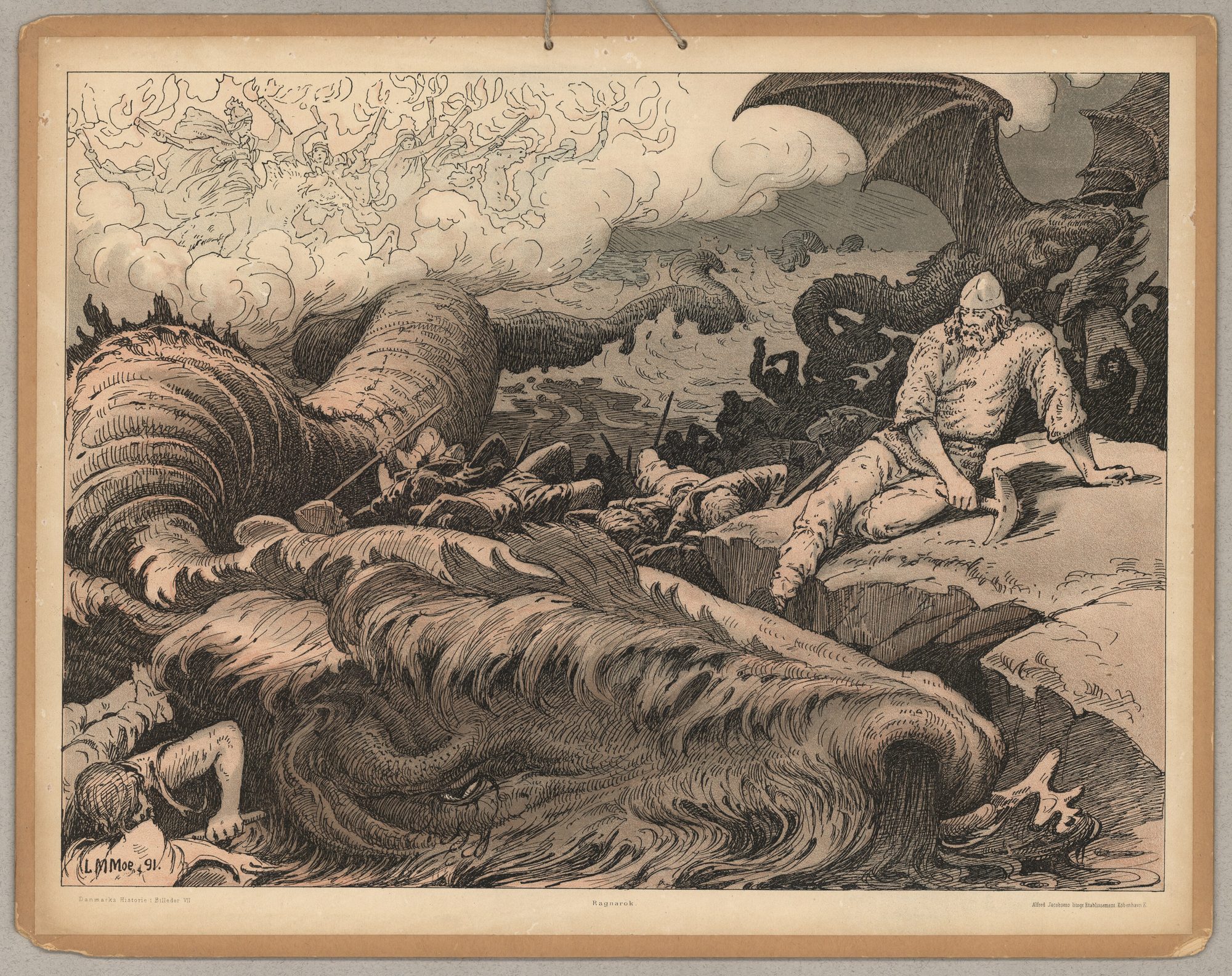
A colour lithograph of Ragnarok: the world consumed in fire and collision, figures and beasts falling amid a blazing sky, in Louis Moe's symbolist register.
Norse

Ragnarök, the Doom of the Gods

Not a twilight but a doom: the wolf runs free, the serpent floods the land, a ship of dead men's nails breaks loose, and the gods ride knowingly to a battle the prophecy says they cannot win, on a field a hundred miles square.

8 minPoetic Edda
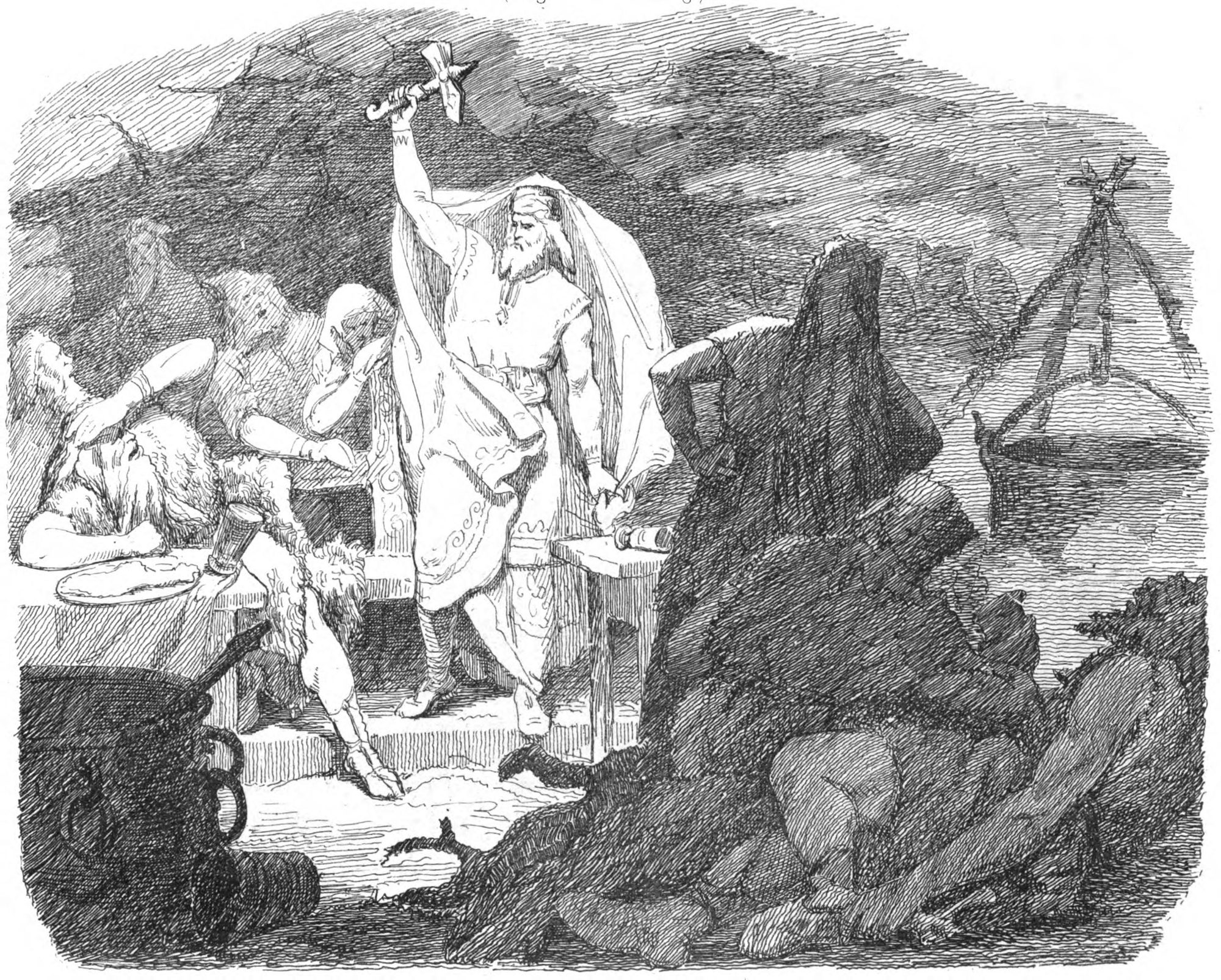
A lithograph of Thor regaining his hammer: at the forced wedding the god seizes Mjöllnir from the giant Thrym, the bride's veil still about him, Loki at his side.
Norse

The Theft of Mjöllnir

A giant buries the thunder-god's hammer eight leagues down and names his ransom: the goddess Freyja for his bride. So the strongest of the gods is bound into a bridal veil and sent to a wedding he means to end with a killing.

6 minPoetic Edda
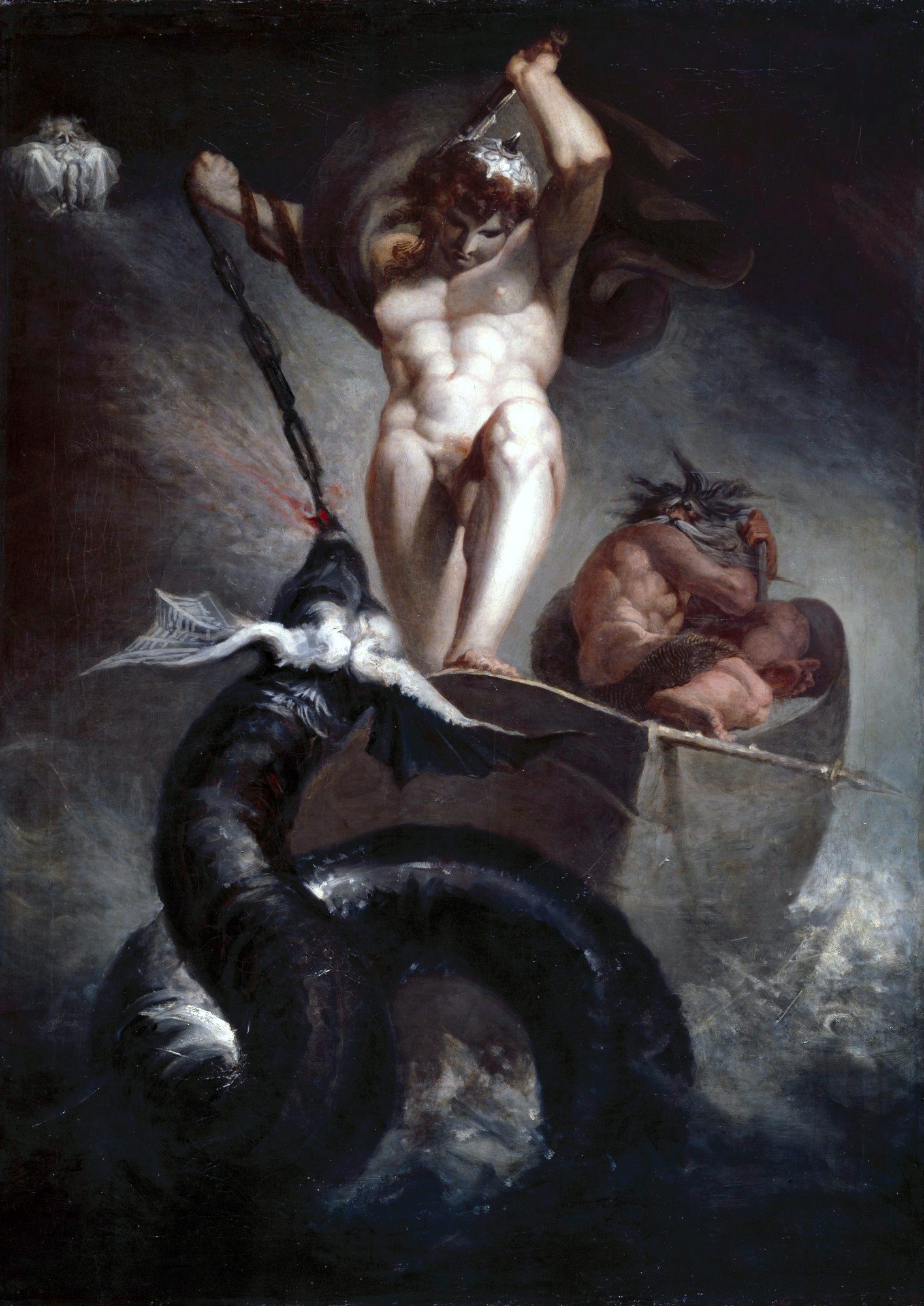
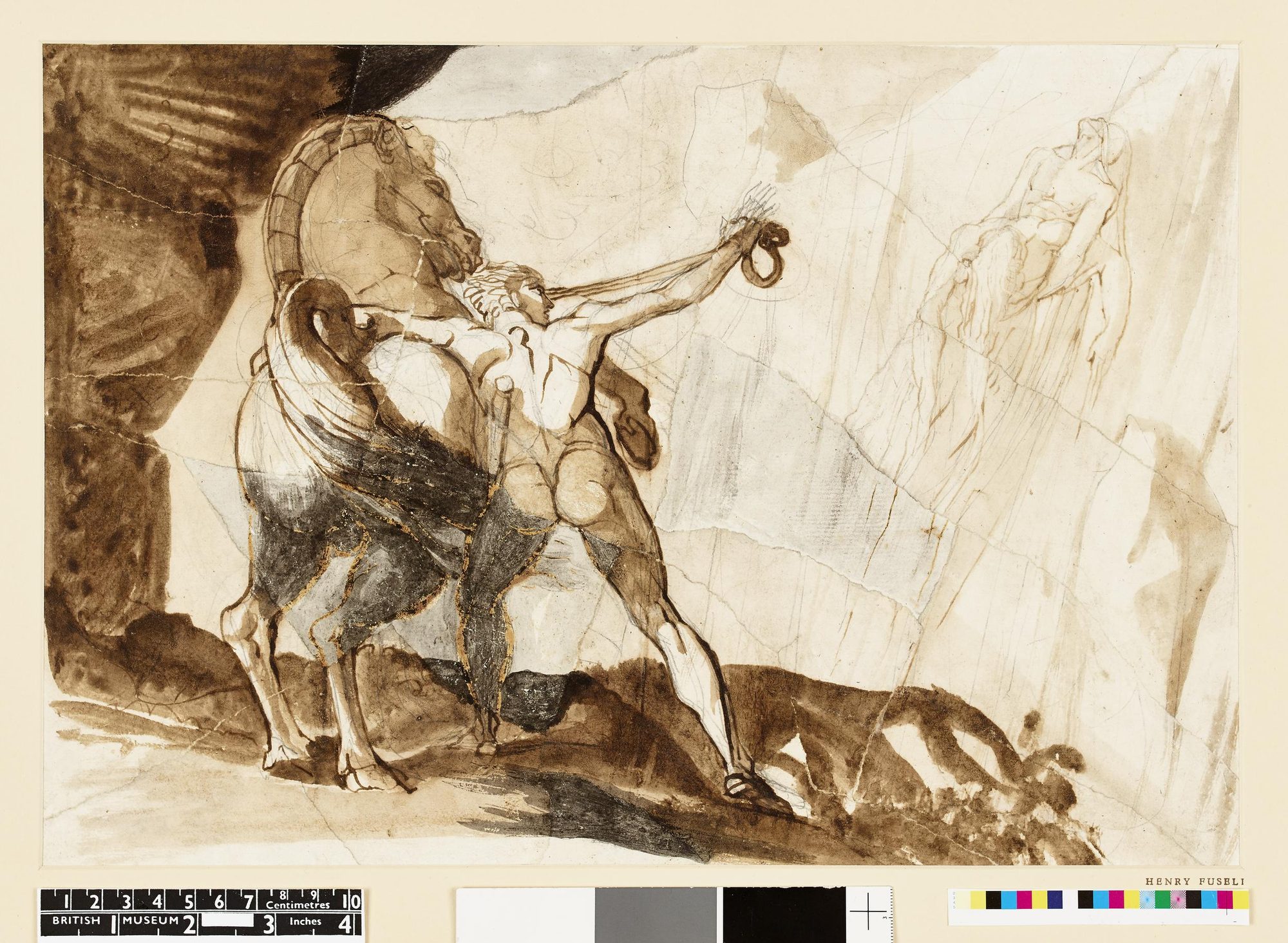
Fuseli's dark oil painting of the muscular nude Thor standing braced on the gunwale of Hymir's boat, his hammer raised high overhead, hauling up the fishing line at whose end the great Midgard-serpent Jörmungandr rears its scaled coils from the black sea below; the red-faced giant Hymir cowers in the stern.
Norse

Jörmungandr, the World Serpent

Odin flung a newborn snake into the sea to be rid of a prophecy, and it grew until it ringed the whole earth and bit its own tail: the boundary of the world, and the one foe fated to kill Thor even as Thor kills it.

5 minSnorri Sturluson
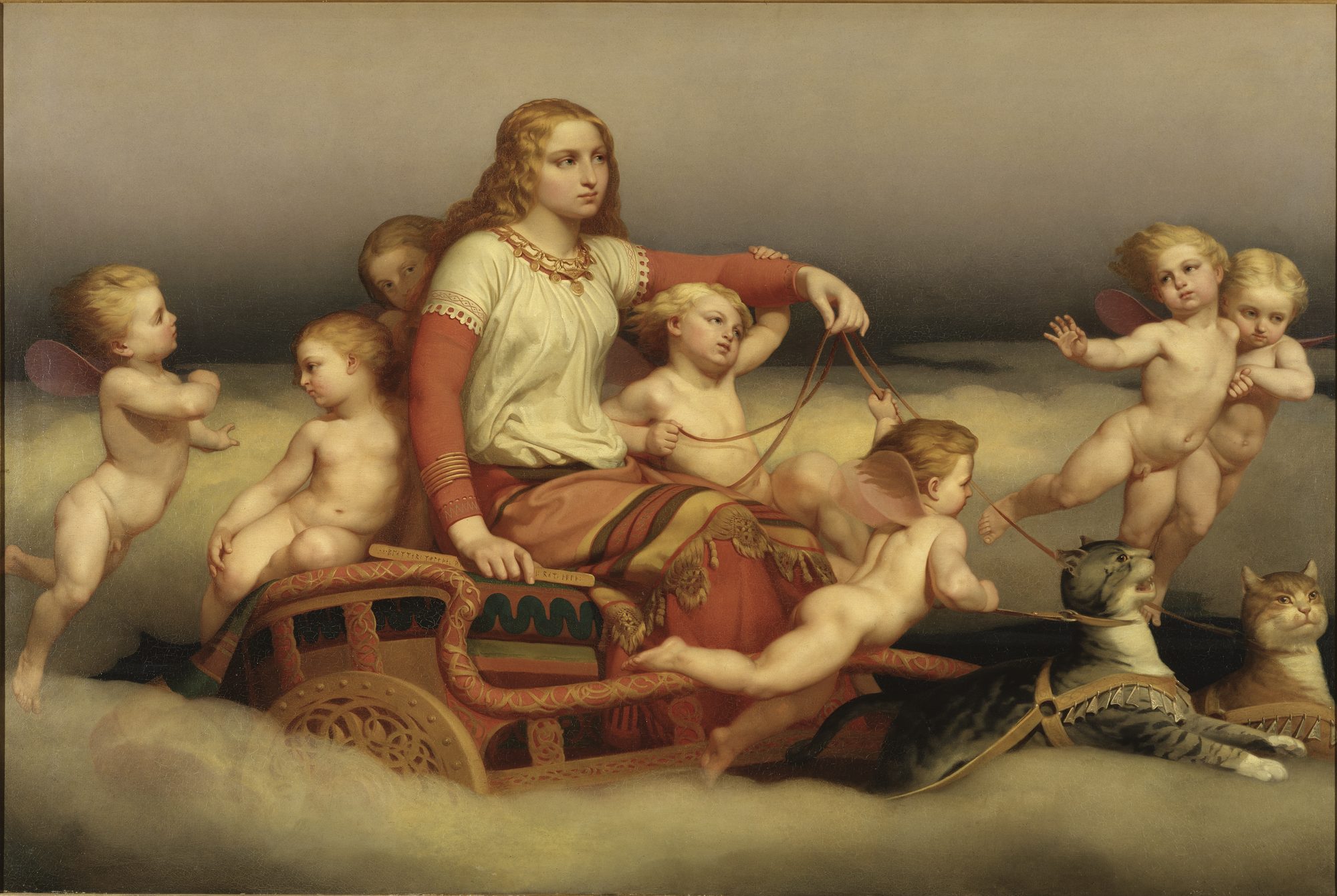
An oil painting of the goddess Freyja walking through a twilight landscape, helmeted and cloaked, her golden necklace at her throat, searching for her vanished husband.
Norse

Freyja of the Vanir

She rides to the battlefield in a chariot drawn by cats and carries home half the slain, weeps red gold for a husband who wandered off, and is the goddess men pray to when they are in love: the strangest and most renowned of the Norse goddesses.

6 minSnorri Sturluson
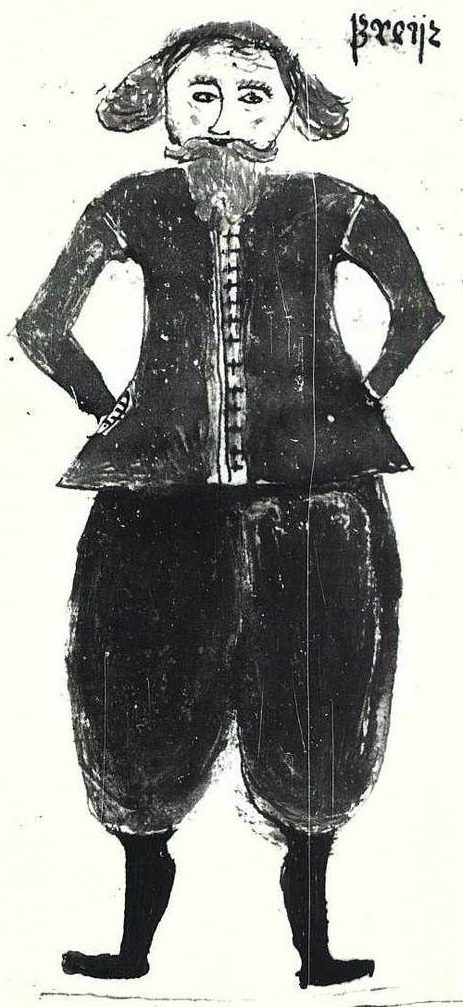
A naïve 17th-century Icelandic manuscript drawing of the Norse god Freyr as a bearded, long-haired man standing frontally with his hands on his hips, wearing a buttoned dark tunic, wide breeches and boots, his name "Freir" inscribed in the upper-right corner.
Norse

Freyr, Lord of Plenty

He climbed into a seat that was not his, looked out over all the worlds, and fell so hard for a giant's daughter that he gave away the one sword that could have saved him: the Vanir god of the fruitful season, lord of the elves, and the most renowned of the gods you called on for peace.

6 minPoetic Edda
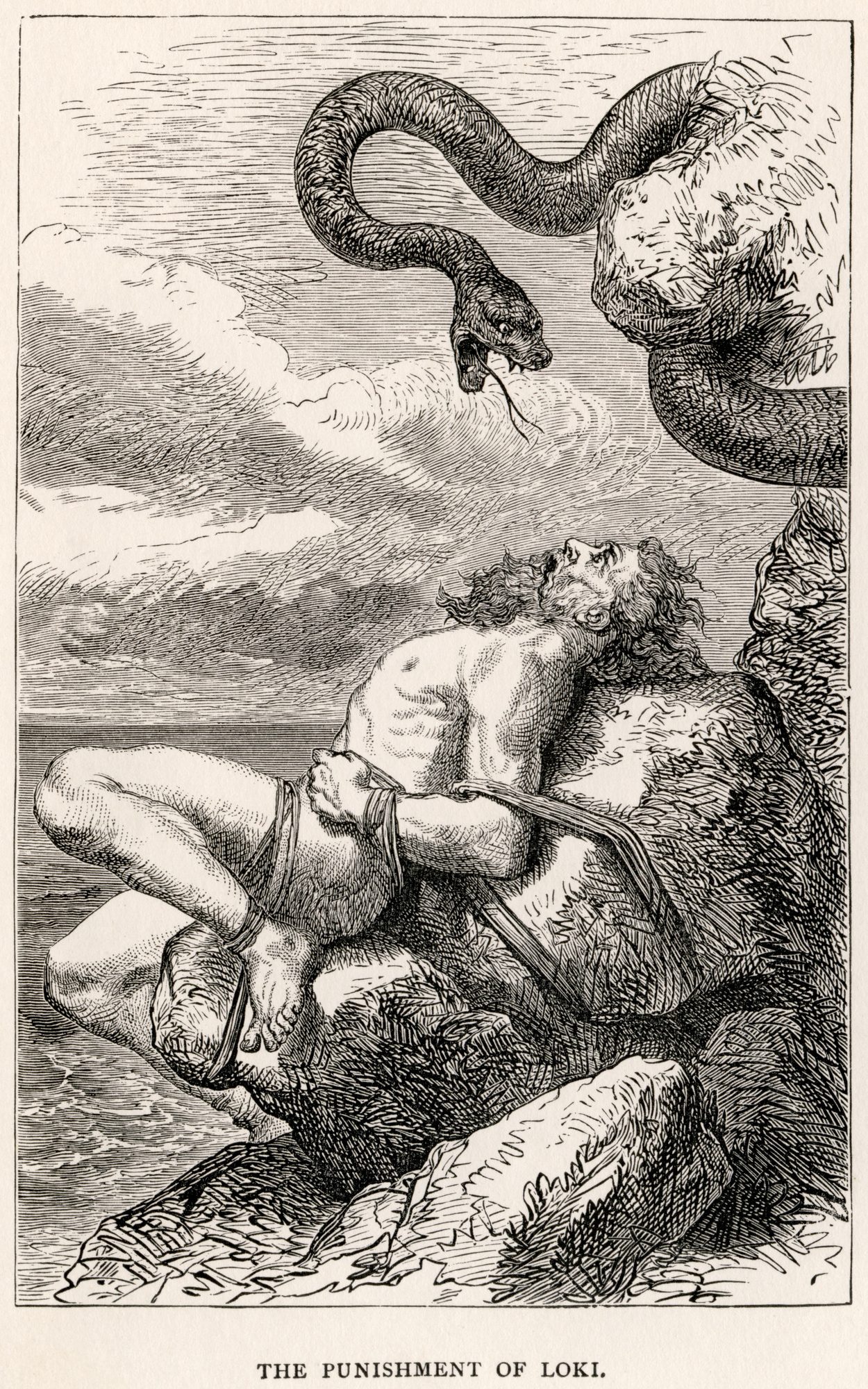
An illustration of Loki's punishment: the bound trickster lying beneath a serpent that drips venom on his face, his wife Sigyn beside him holding the catching bowl.
Norse

Loki, the Trickster

The handsome, fickle mischief-monger of the Aesir who drags the gods into ruin and then, more often than not, is the only one clever enough to haul them back out again.

6 minSnorri Sturluson
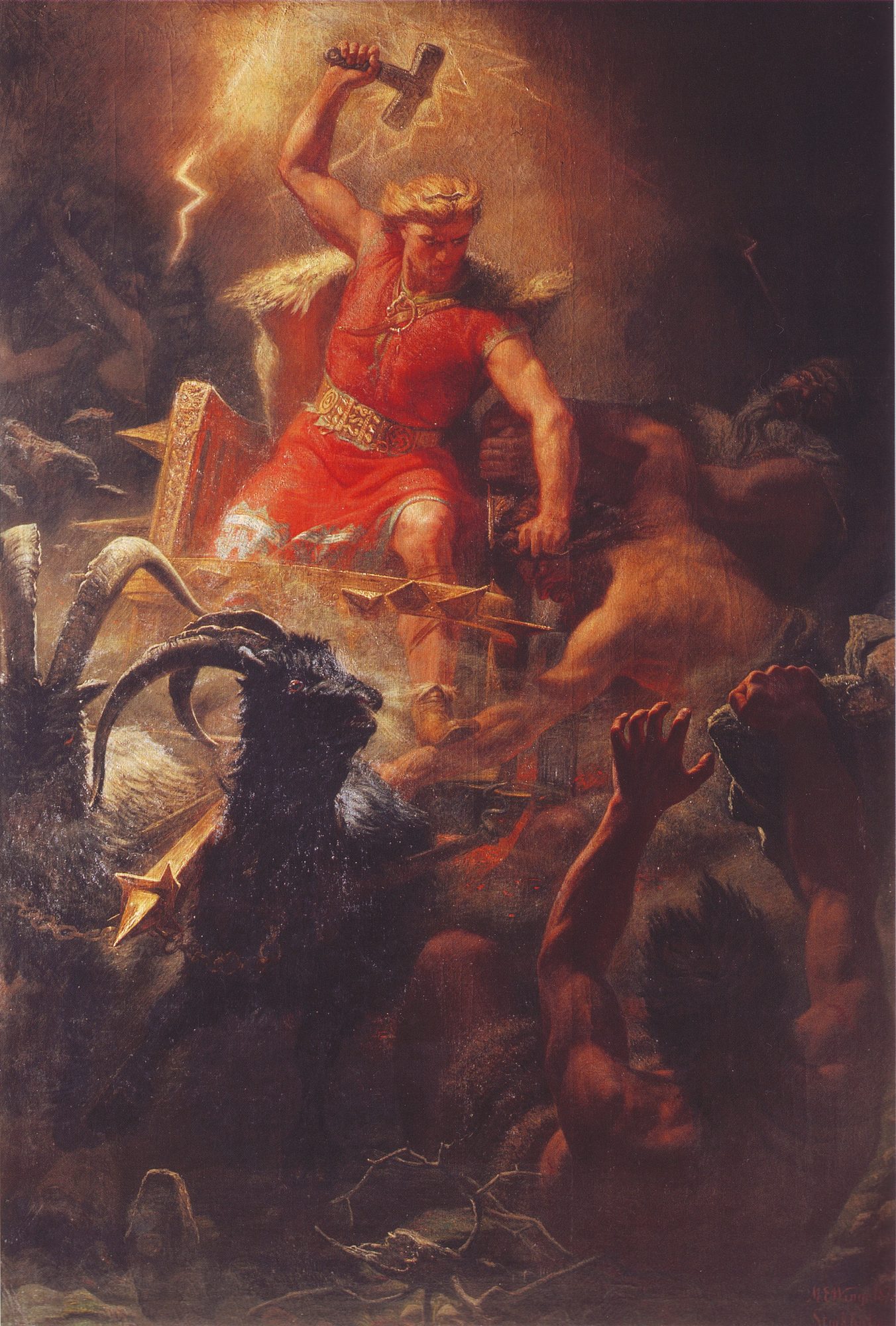
An oil painting of Thor in his goat-drawn chariot, red-bearded and mail-shirted, swinging his hammer Mjöllnir against a mass of charging giants under a storm sky.
Norse

Thor, God of Thunder

The strongest of the gods wakes to find his hammer gone, and the only way to get it back is to put on a bridal veil: a portrait of the Aesir's giant-killer at his most terrifying and his most absurd.

6 minPoetic Edda
A romantic pen-and-ink drawing of Odin on his night-ride: the god in a wide-brimmed hat and cloak riding down toward the shadowy gate of Hel, his spear lowered.
Norse

Odin, the Allfather

He hanged himself on the world-tree and gave an eye to a well, and in return he took the runes and the deepest draught of wisdom: the god who paid for knowledge in his own flesh.

6 minPoetic Edda
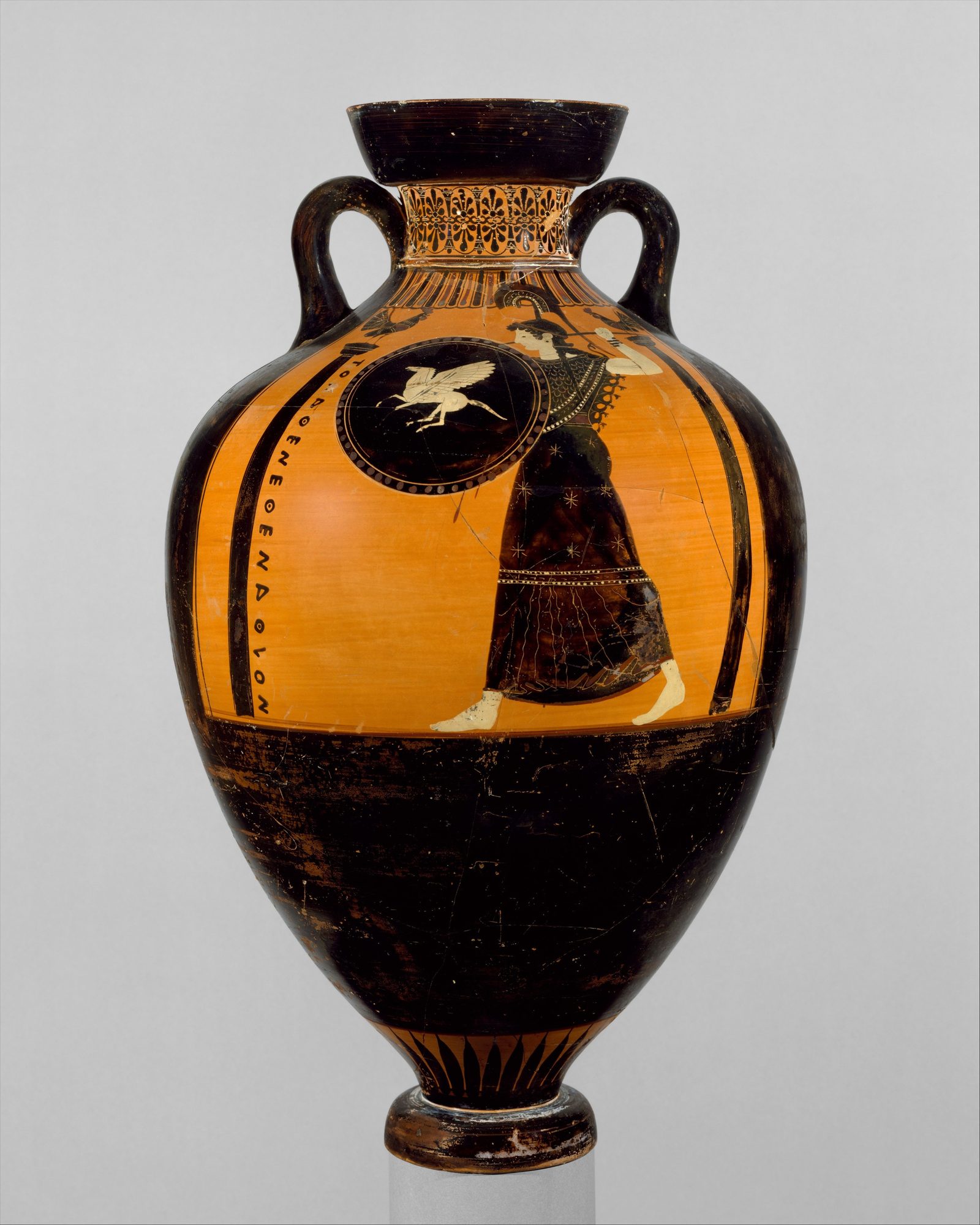
A black-figure Panathenaic prize amphora: the goddess Athena Promachos strides to the left between two columns, helmeted, brandishing a spear and holding a round shield, her aegis across her chest.
Greek

Athena, Goddess of Wisdom and War

She was born from her father's skull in full armour, spear already levelled, and the whole of Olympus reeled at the sight of a daughter equal to Zeus.

5 minHesiod
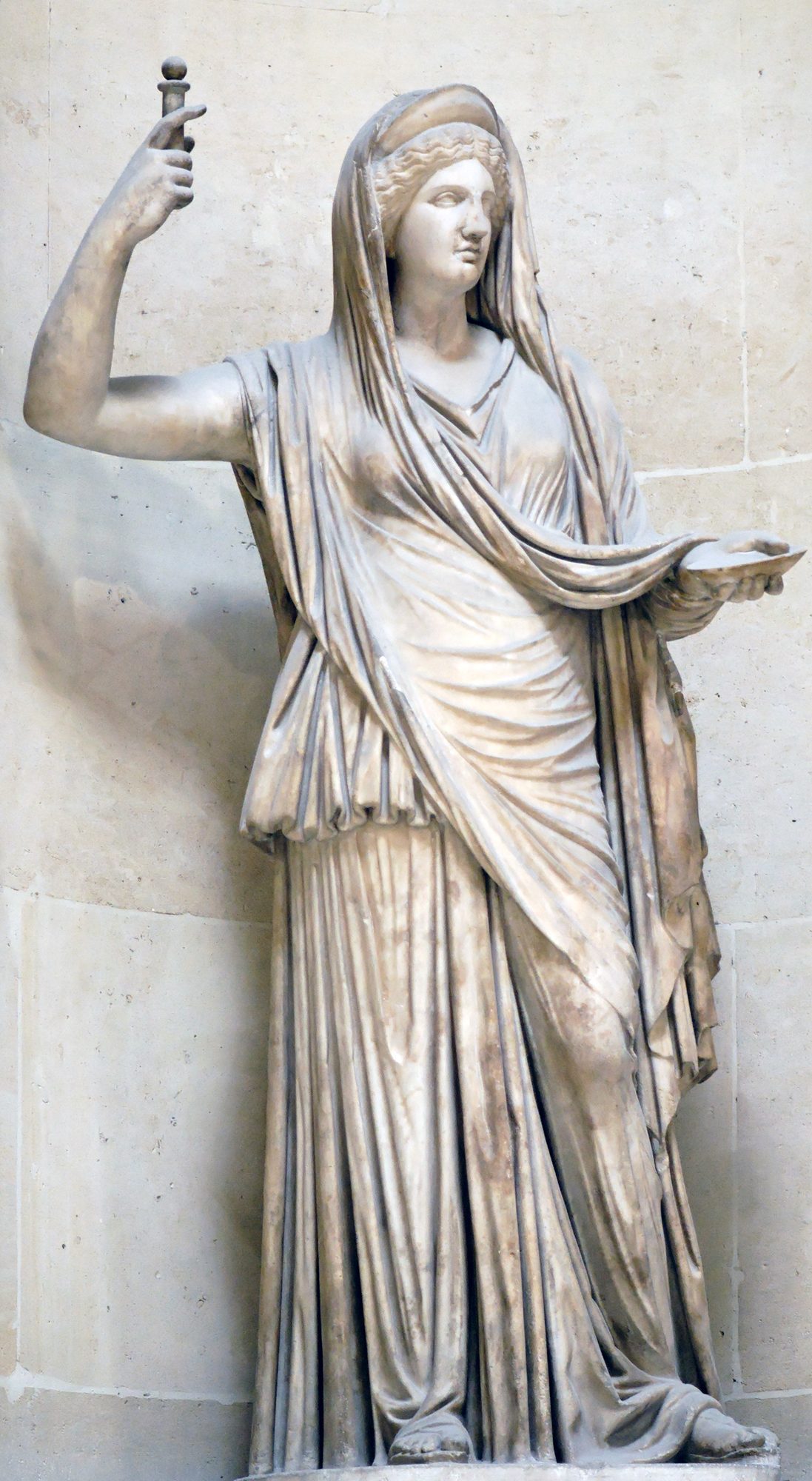
Marble statue of Hera as queen, standing veiled in a long chiton and himation with a diadem band across her brow, her raised right hand holding a sceptre and her extended left hand bearing a shallow offering dish.
Greek

Hera, Queen of Olympus

The goddess of marriage who ruled beside Zeus and warred against him in the same breath, dressing for seduction as a strategy of state.

6 minHomer
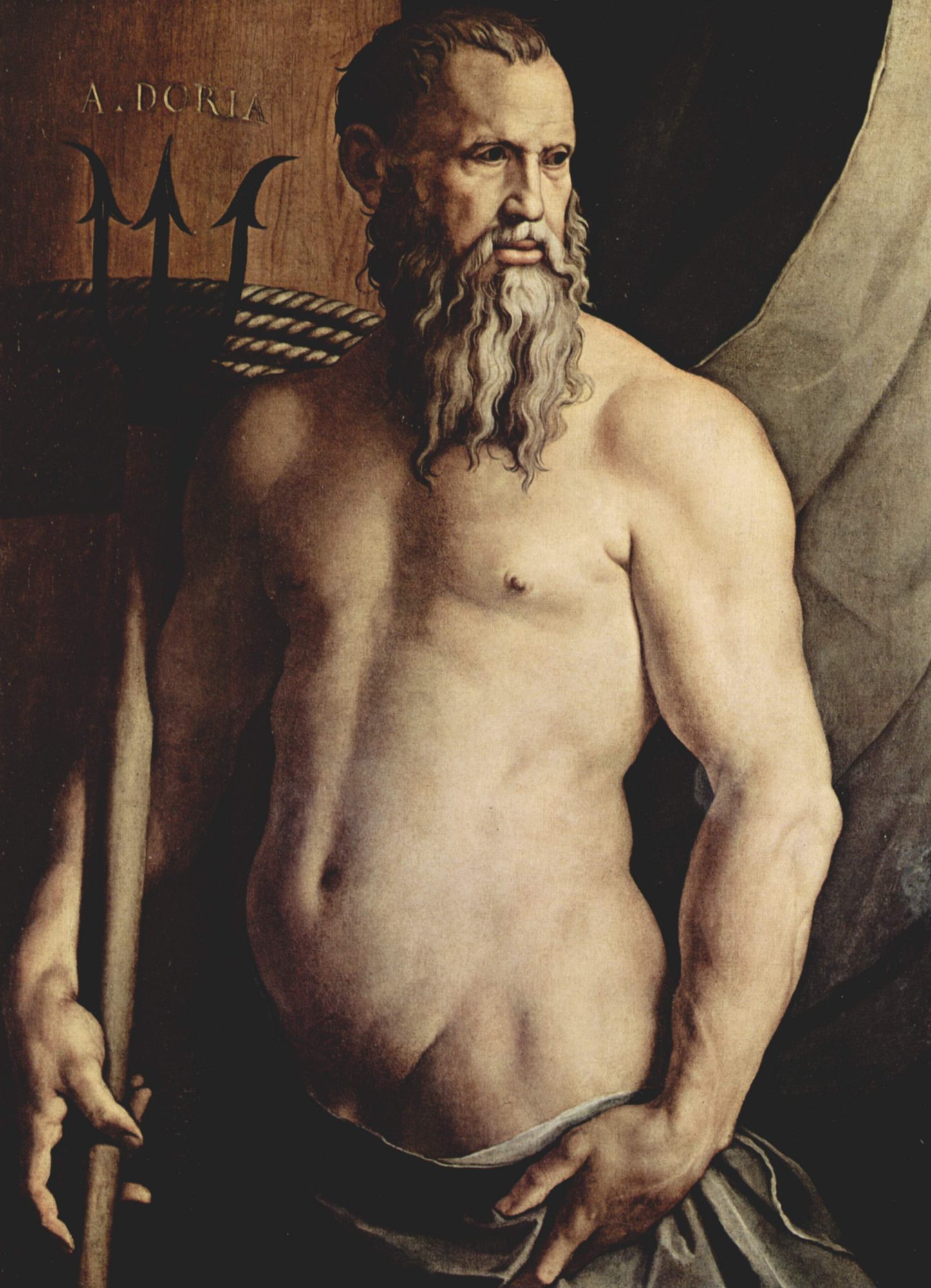
A grey-bearded, muscular sea-god shown half-length and nude to the waist, a grey-green drape at his hips, gripping a three-pronged trident in his right hand. Behind his shoulder a ship's spar wound with rope and a carved trident emblem sit against a dark wooden ground, with the incised inscription "A·DORIA" at upper left.
Greek

Poseidon, Lord of the Sea

He drew the grey sea by lot and never forgave a slight, splitting rock with his trident to raise storms, drown heroes and shake the earth itself.

5 minHesiod
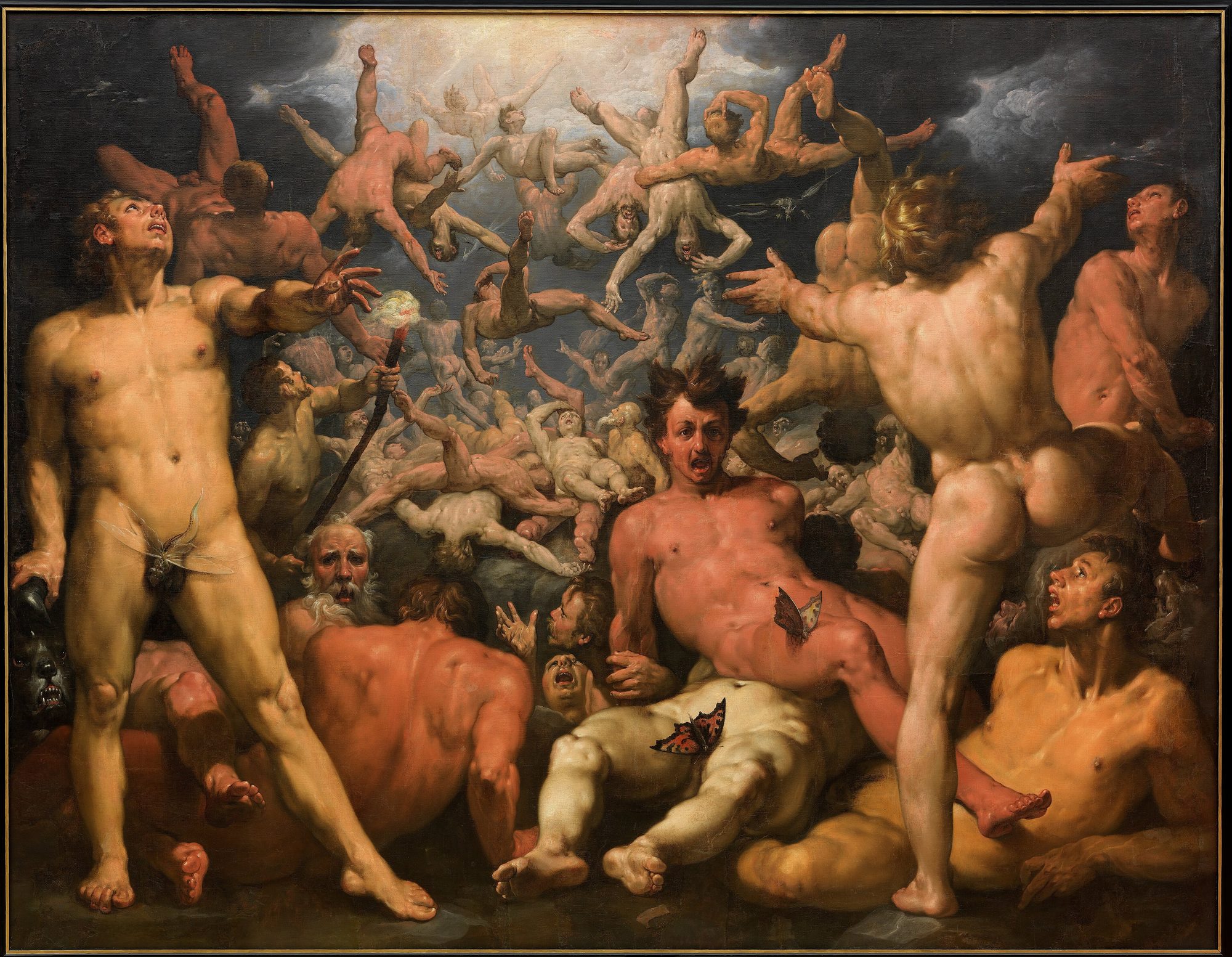
A dark, teeming Mannerist canvas of the defeated Titans hurled from the sky. From a luminous break in the storm-clouds at the top, a mass of muscular nude figures tumbles headlong and foreshortened into the depths, limbs flailing and faces contorted in terror. They pile into a heap of straining bodies across the foreground, ruddy and pale flesh tangled together; one massive figure sprawls face-up at the centre, mouth open in a scream, his hair standing on end. At the lower left a standing youth grips a burning torch while a black hound's fanged head snarls beside him, and a few small butterflies and insects — the painter's emblems of the fleeting — rest on the fallen limbs.
Greek

The Titanomachy

For ten years the sky itself hung in the balance, until Zeus loosed the hundred-armed prisoners of the deep and the world caught fire.

8 minHesiod