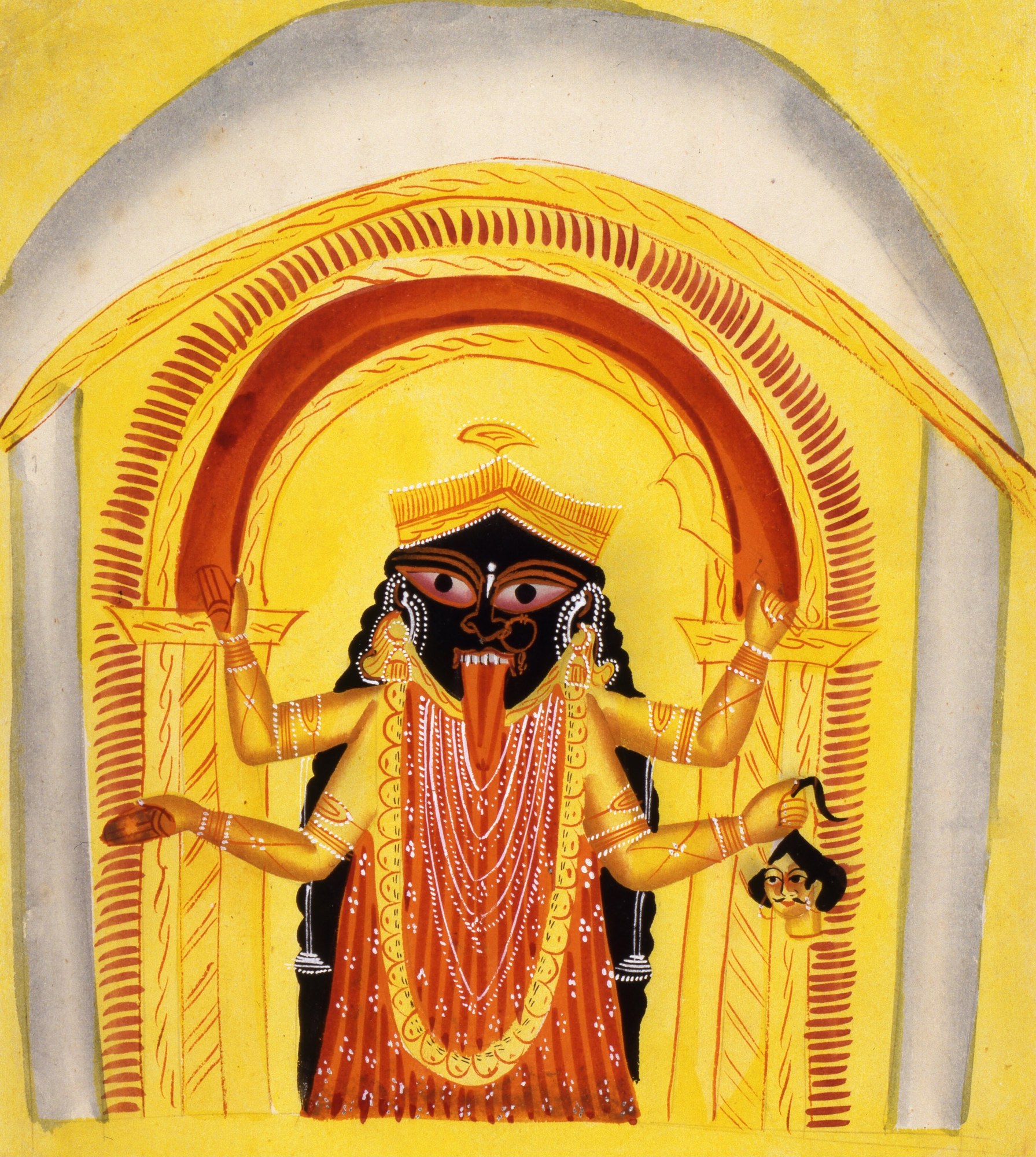
The name promises more than the oldest text delivers. To a modern devotee Kali is the eater of time itself, the black mother who outlasts the destruction of the world and stands on the corpse of her own husband with her tongue thrust out. To the scripture that first names her, around the fifth or sixth century, she is none of that. She is simply the black one, and she is black for a plain reason given on the page: the goddess Ambika grew so angry that her face went dark as ink, and out of that darkened brow a darker goddess sprang. The word the text reaches for is a colour. The rest was added later, over a thousand years, until the colour word had swallowed a whole theology.
Black, not time
The trap is in the title. Sanskrit keeps two near-identical words the ear cannot tell apart: kala, black, and kala, time. As a feminine of the first, Kali is the dark woman.
As a feminine of the second, she is she who is time,
a short step from the devourer of the hours. But the two words are distinct in origin, and scholars are clear they were welded together by popular etymology, an after-the-fact hearing of one word inside the other. The Devi Mahatmya, the founding ShaktaOf the tradition that worships the Goddess as the supreme power, for whom the Devi Mahatmya is the founding scripture. scripture, offers no such play. It never derives her name from time at all. When it does pause to explain a name, the name it explains is a different one.
A title earned on the field
That earned name is ChamundaThe name the Devi Mahatmya gives Kali for bringing back the heads of the demons Chanda and Munda; a title earned in the battle, not a birth-name.. In the battle where she first appears, the demon generals Chanda and Munda are sent against the Goddess, and Kali cuts them down and carries their two severed heads back to her maker, laughing. For the deed the Goddess renames her on the spot: because she has brought Chanda and Munda, she shall be famed in the world as Chamunda. This name, at least, the text explains: not by cosmology, but by a killing. The tradition would later hand Kali the grandest possible etymology, mistress of time and death. Her own first scripture gave her a battlefield nickname built from two demons’ names.
What she looked like at the start
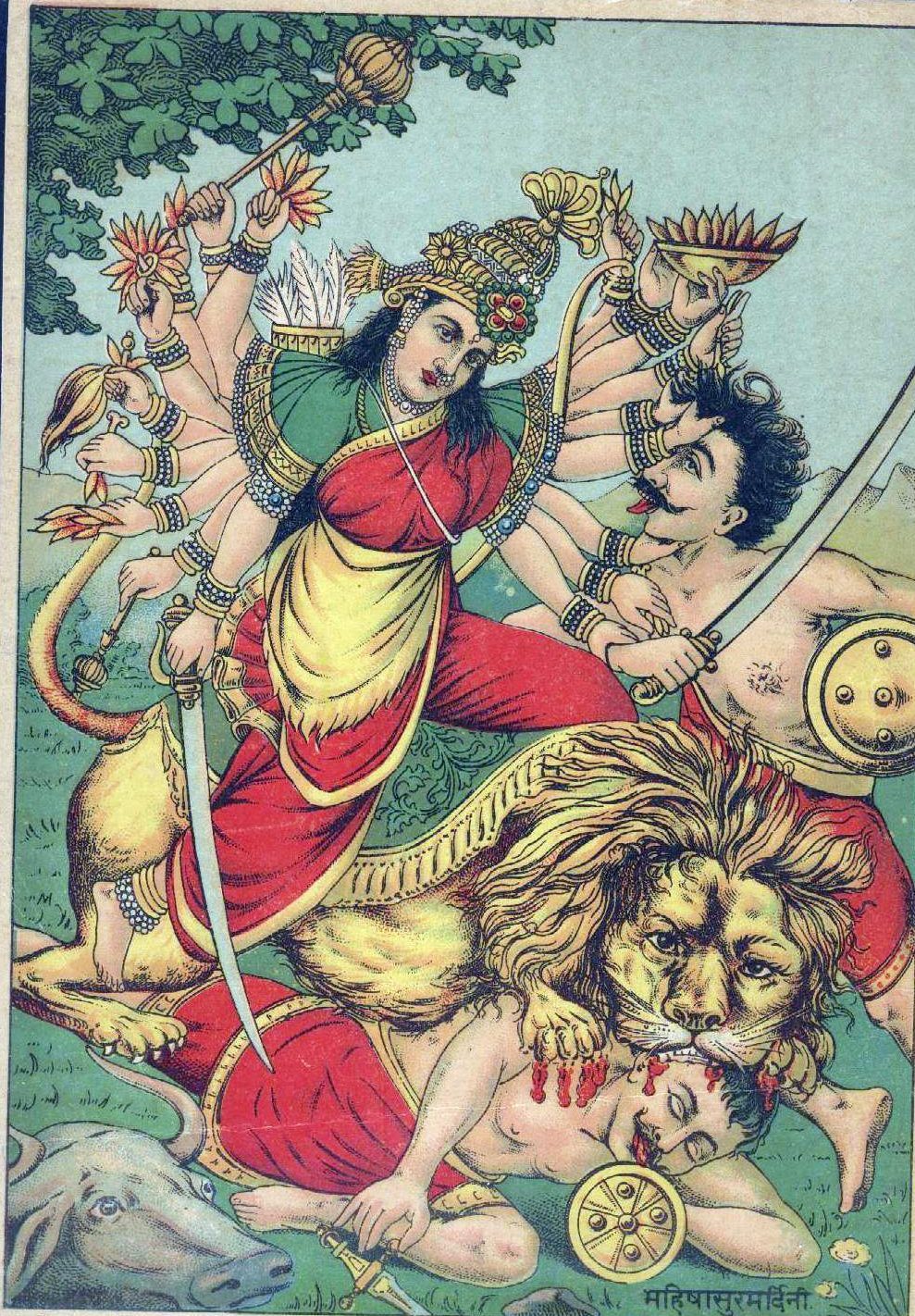
The Kali of that scripture is a specific and terrible figure, and worth seeing before the later centuries redraw her. She comes armed with a sword and a noose. She carries a khatvangaA staff topped with a skull, carried by Kali as she springs from the goddess's brow; a mark of the cremation ground and its ascetics., the skull-topped staff of the cremation ground. A garland of skulls hangs at her throat, a tiger’s skin is her only clothing, her flesh is wasted to the bone, her mouth is impossibly wide, her eyes are sunk and red, and her tongue lolls as she fills the sky with her roaring.
The birth from Ambika’s frowning forehead, and the devouring of the demon army that follows, are narrated in full in the companion piece on the one Goddess in all her forms (see devi-great-goddess); there is no need to retell the battle here. What matters here is that this first Kali is pure ferocity in the service of another goddess. There is no husband under her feet. There is no calm behind the rage. The famous stillness comes later.
The gentler Kali of the Tantras
Four to six hundred years after the Devi Mahatmya, a Tantric scripture of the northeast, the Kalika Purana, draws a startlingly different Kali. She is still dark, but her darkness is called soothing; she is beautiful, firm and youthful, four-armed, riding a lion, holding a sword in one hand and a blue lotus in another.
That is a narrower span than the one separating Homer, around the eighth century before the common era, from the travel-writer Pausanias who catalogued Greek shrines in the second century after it, close to nine hundred years apart; yet even across the shorter Indian gap the change is not cosmetic. The emaciated horror of the battlefield has become an object of worship in her own right, gentled into someone a devotee might approach. The reader should hold the two portraits apart rather than blending them into one timeless Kali: they are two moments in a long life, centuries of cult lying between them.
The image that came last
Last of all comes the picture the world now keeps of her. Kali dancing on the prostrate body of Shiva, right foot forward, a garland of severed heads and a skirt of severed arms, her tongue out. That image, and the reading of her as the power that devours even time, belong to medieval Tantra and to the Shakta devotion of Bengal that flowered from roughly the sixteenth century onward. None of it is in the Devi Mahatmya, which knows no Shiva-corpse and no Kali-as-consort at all.
To set that image on the fifth-century battlefield would be to hang a later painting in an older room. The devourer of time is a true and living Kali; she is simply not the first one, and the title that opens this piece describes the end of her story read backward onto its beginning. The black goddess who leapt from an angry brow to behead two demons was made mistress of the ages only long after her makers had themselves passed into the ages she is said to eat.
Out from the surface of her forehead, which was rugged with frowns, issued suddenly Kali of the terrible countenance, armed with a sword and noose. (Devi Mahatmya / Markandeya Purana, Canto LXXXVII, tr. F. E. Pargiter)
- Devi Mahatmya, = Markandeya Purana, Cantos LXXXVII–LXXXVIII (its own chapters 7–8), trans. F. E. Pargiter, The Markandeya Purana, Bibliotheca Indica, Asiatic Society of Bengal (Calcutta, 1904); text c. 5th–6th c. CE, the oldest major appearance of Kali in Sanskrit. The source of everything asserted here about the first Kaliher birth from the wrath-darkened brow of Ambika (whose face
grew dark as ink in her wrath
), her sword, noose, khatvanga, garland of skulls and tiger-skin, the devouring of the demon army, the beheading of Chanda and Munda, and her naming as Chamunda for that deed. The full birth-and-battle narrative is told in the companion postdevi-great-goddess; this figure piece draws from the same reading for the name and the iconography. The block-quoted description of her emergence is Canto LXXXVII. Read verbatim. - Kalika Purana (Tantric/Shakta Purana of Kamarupa, c. 10th–11th c. CE)the later, gentler Kali
of a soothing dark complexion,
beautiful, four-armed, lion-riding, holding a sword and a blue lotus, roughly four to six centuries after the Devi Mahatmya. Not read verbatim here; reported through Sanjukta Gupta,The Worship of Kali according to the Todala Tantra,
in D. G. White (ed.), Tantra in Practice (Princeton, 2000), p. 466. Treated as second-hand, not as a verbatim Kalika Purana quotation. - Secondary scholarship (interpretation, clearly not primary text)Thomas B. Coburn, Devi-Mahatmya: Crystallization of the Goddess Tradition (Motilal Banarsidass, 1984), pp. 111–112, for the kala (black) / kala (time) homonym and the popular etymology that fused them; David Kinsley, Hindu Goddesses (Univ. California Press, 1988), pp. 86–90, for the medieval Shiva-corpse iconography, the tongue, and the Bengali Dakshina-Kali tradition. These date the
devourer of time
reading and the standing-on-Shiva image as later developments, absent from the Devi Mahatmya.