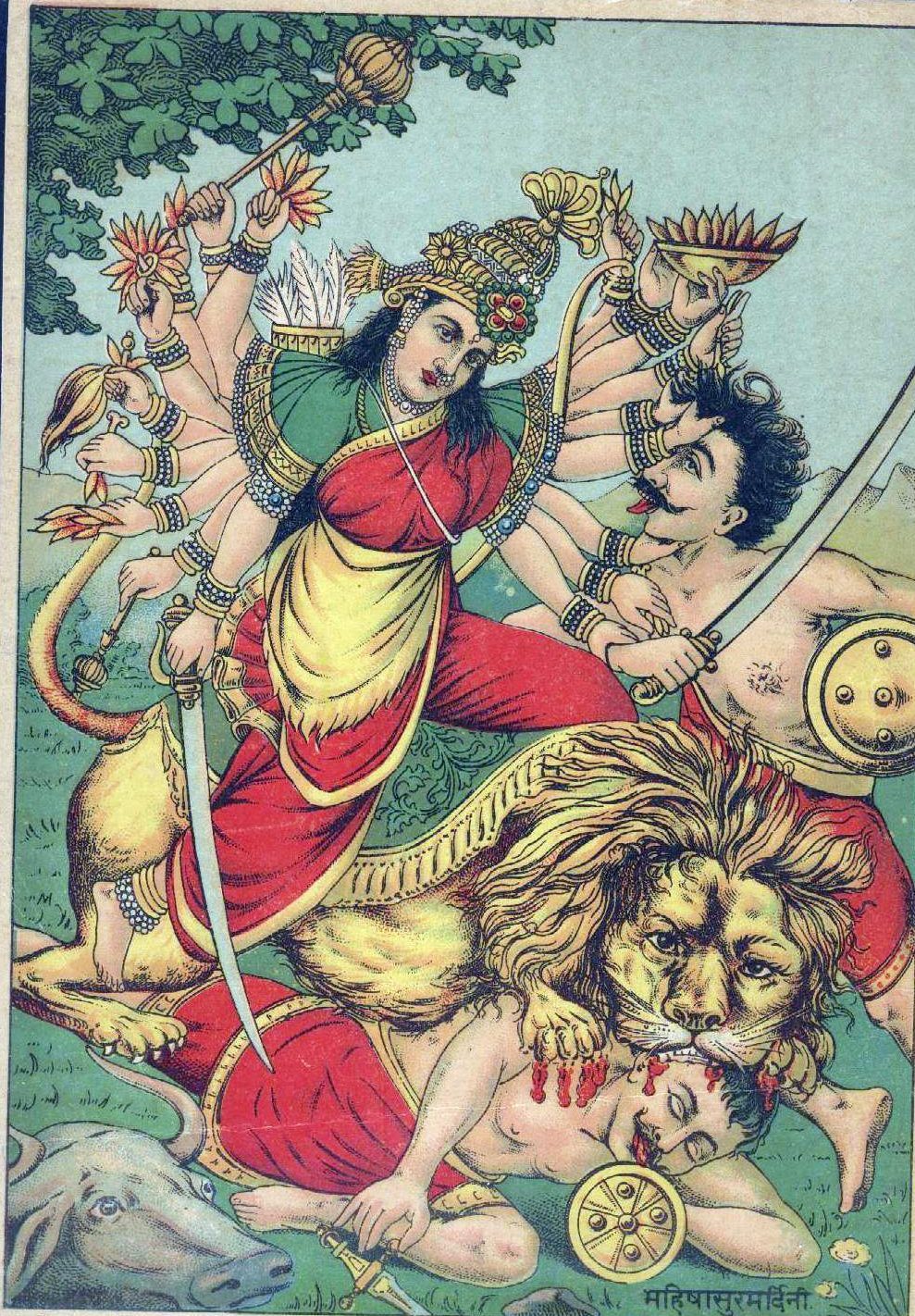
The buffalo-demon had won. After a hundred years of war Mahisha had beaten Indra and the gods out of heaven and seized their offices one by one, so that he himself was Sun and Moon, wind and fire and death, and the dispossessed gods wandered the earth with nowhere to stand. When they gathered at last before Vishnu and Shiva to tell it, something happened that none of them had planned. Out of the faces of the angry gods a great light began to stream, tejas pouring from Shiva and Vishnu and Brahma and all the rest, and the separate lights ran together into one blaze like a burning mountain, filling the whole sky.
Then the blaze drew itself in and took shape, and the shape was a woman. Her face was formed of Shiva’s fire, her hair of Yama’s, her arms of Vishnu’s, her three eyes of the fire of Agni; the Moon made her breasts, Indra her waist, the Earth her hips, Brahma her feet. She was assembled, limb by limb, out of everything the gods had in them, and when she was whole she was greater than the sum of them all.
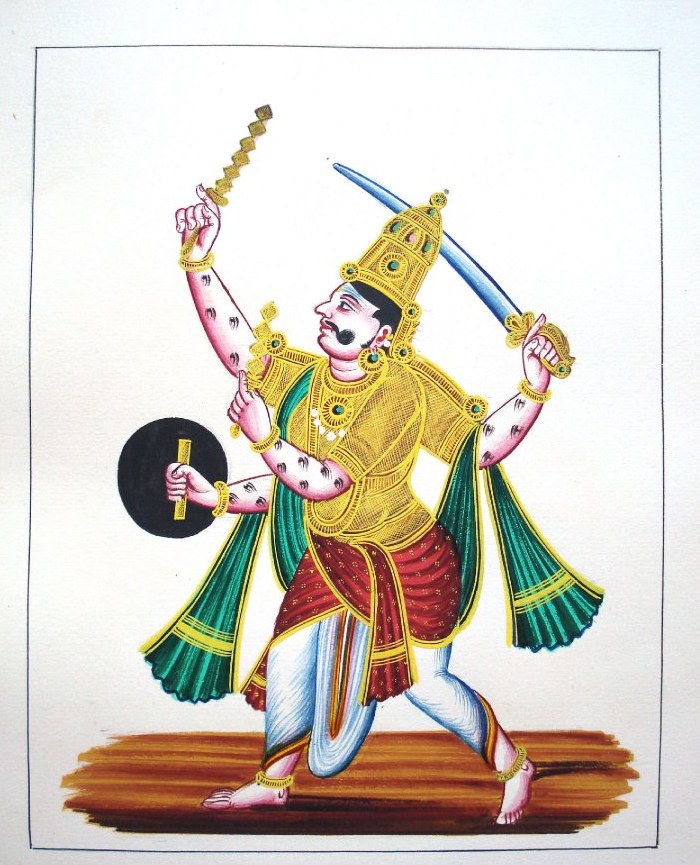
Each god armed her from his own store. Shiva drew a trident out of his trident and gave it to her; Vishnu a discus out of his discus; Varuna a conch, Agni a spear, Vayu a bow with a full quiver, Indra a thunderbolt and a bell from the great elephant Airavata, Yama the rod of Fate. The ocean of milk hung a necklace of pearls on her and clothed her in undecaying garments; the mountain Himavat led up a lion for her to ride.
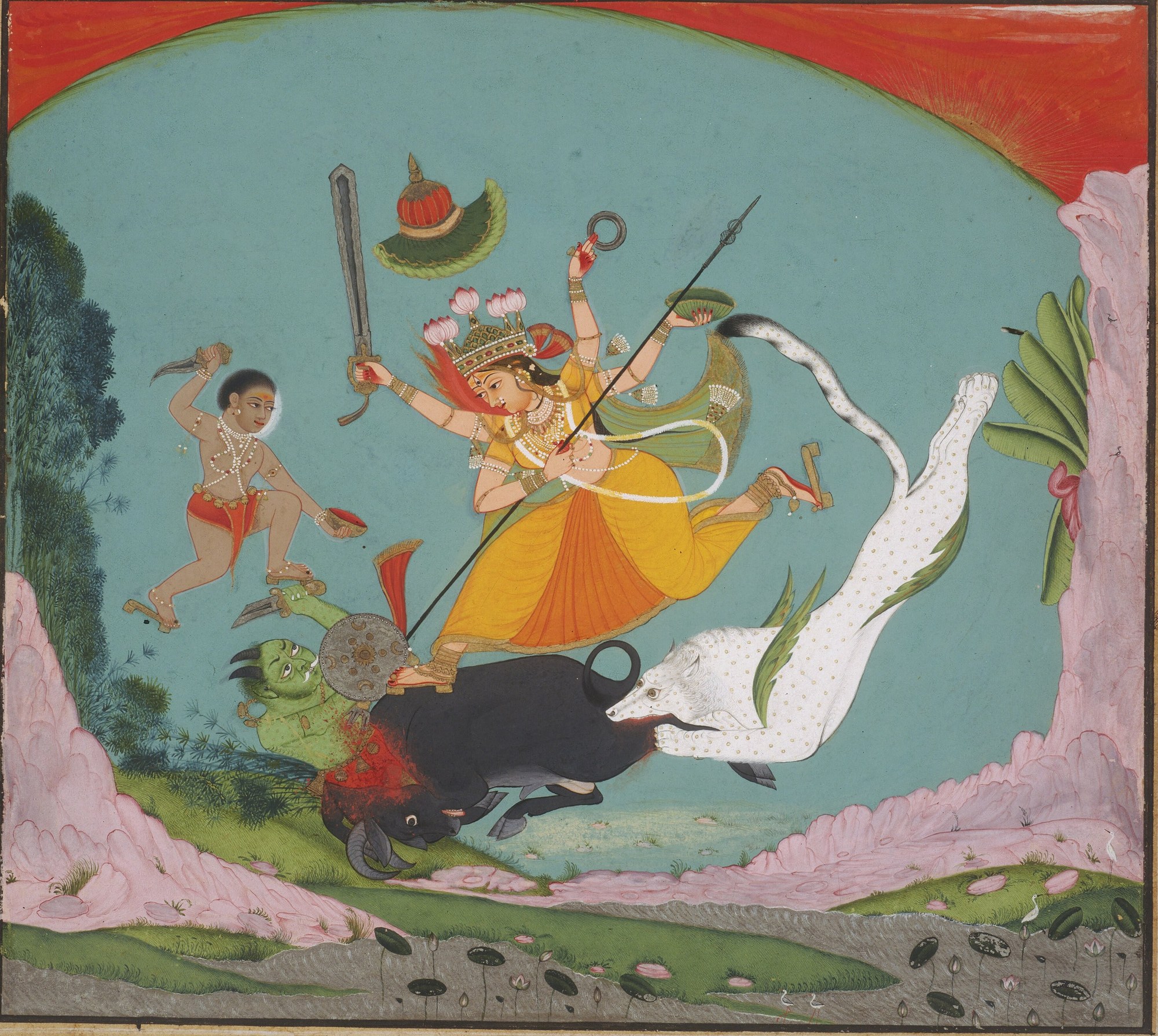
When she was armed she threw back her head and roared, a roar mixed with a peal of laughter that rocked the whole world, and the mountains shook on their roots. This is the shape most people picture when they hear her name: the many-armed warrior on the lion, bristling with the weapons of every god at once. The text calls her Chandika, and Ambika, and the crusher of the buffalo-demon.
He would not stay one thing
Mahisha’s death is one of the great set-pieces of the tradition. She broke his armies and his generals, and then the buffalo himself came on, laying men low with a blow of his muzzle, stamping them under his hooves, lashing them with his tail and ripping them with his horns. When she flung her noose over him he would not stay one thing.
He was a buffalo, then a lion, then a man with a drawn sword, then a great elephant whose trunk she cut away, then a buffalo again. At last she drank down a divine mead, and as her eyes went red she laughed, sprang onto his back, set one foot on his neck, drove her spear into him, and as he strained half out of the buffalo’s mouth in his own true form she struck off his head with her sword.
Rope that binds, knife that frees
But this Goddess is older and larger than any one battle, and the text is careful to say so from its very first page. The whole account is told by a sage named Medhas to two ruined men, a king driven from his throne by treacherous ministers and a merchant thrown out by his own greedy wife and sons. What torments them is not the loss but that they still love the people who wronged them; they cannot understand why the mind clings so. That clinging, Medhas tells them, is the work of the Goddess herself, whom he calls Maha-Maya, the Great Illusion, she who forcibly draws the minds even of the wise into delusion, by whom this whole universe is created.
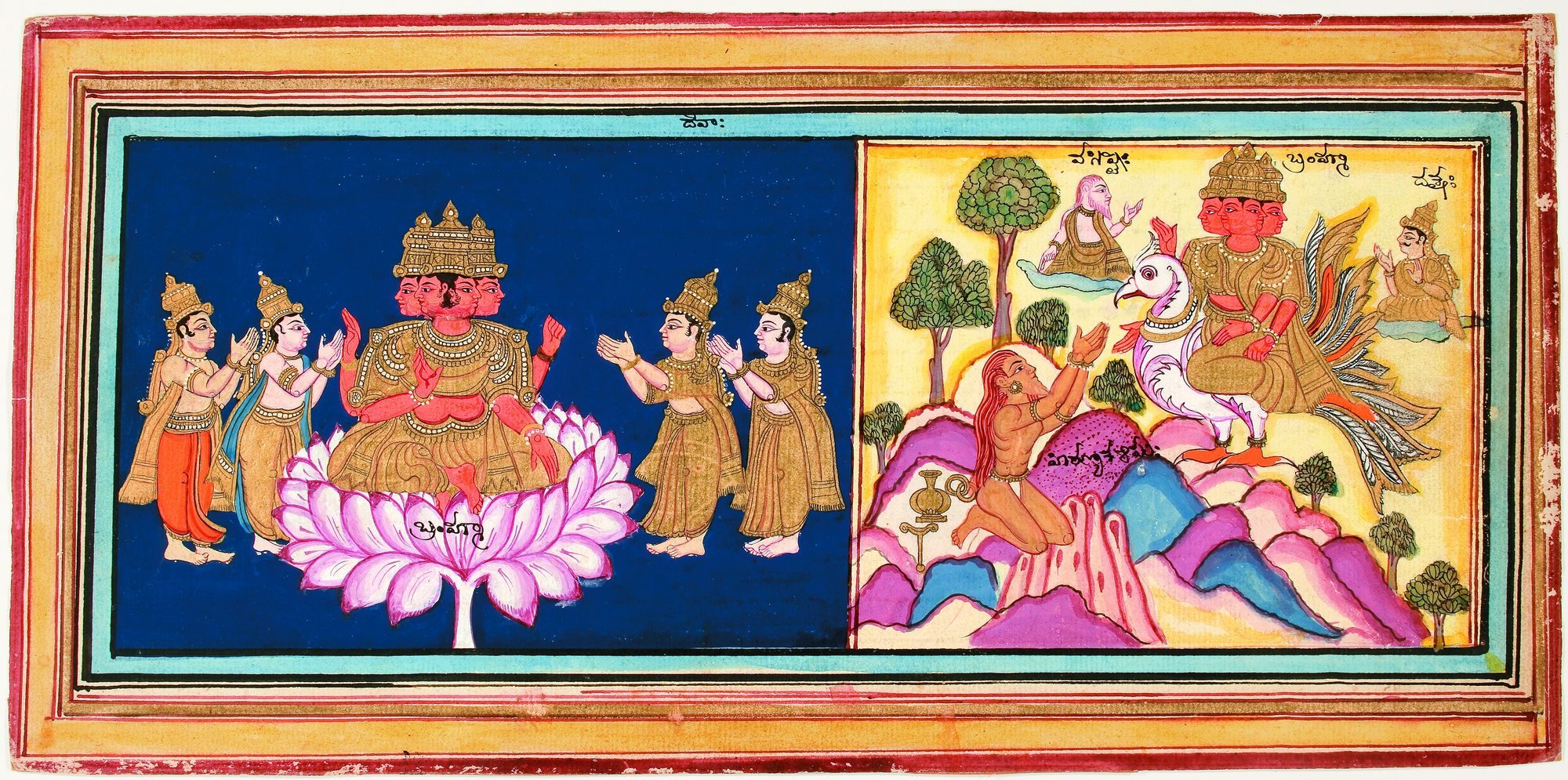
She is the rope that binds beings to the world and the knife that cuts them free: the cause of bondage and the cause of final release, and, in the phrase the text keeps returning to, the queen over all lords. She is even Vishnu’s own sleep. At the end of a cosmic age, when two demons sprang from the dirt of the sleeping Vishnu’s ear and moved to kill Brahma, it was she, Vishnu’s slumber personified, whom Brahma had to praise and coax to loosen her hold so the god could wake and fight.
Stepping out of the sheath of Parvati
Her fiercest face has its own story of coming into being. When the demon brothers Shumbha and Nishumbha had taken the three worlds, the gods sang to her on the Himalaya, and a radiant goddess stepped out of the sheath of Parvati’s body, so that Parvati, emptied of her, turned black and was thereafter called Kalika, the dark one.
The bright goddess, Kaushiki, so dazzled the demons’ spies that Shumbha resolved to have her, and she answered with a vow: she would wed only the one who beat her in battle. When his captains Chanda and Munda came to take her by force, her face went dark as ink with rage, and out of the surface of her frowning forehead sprang Kali.
Two heads carried back to Chandika
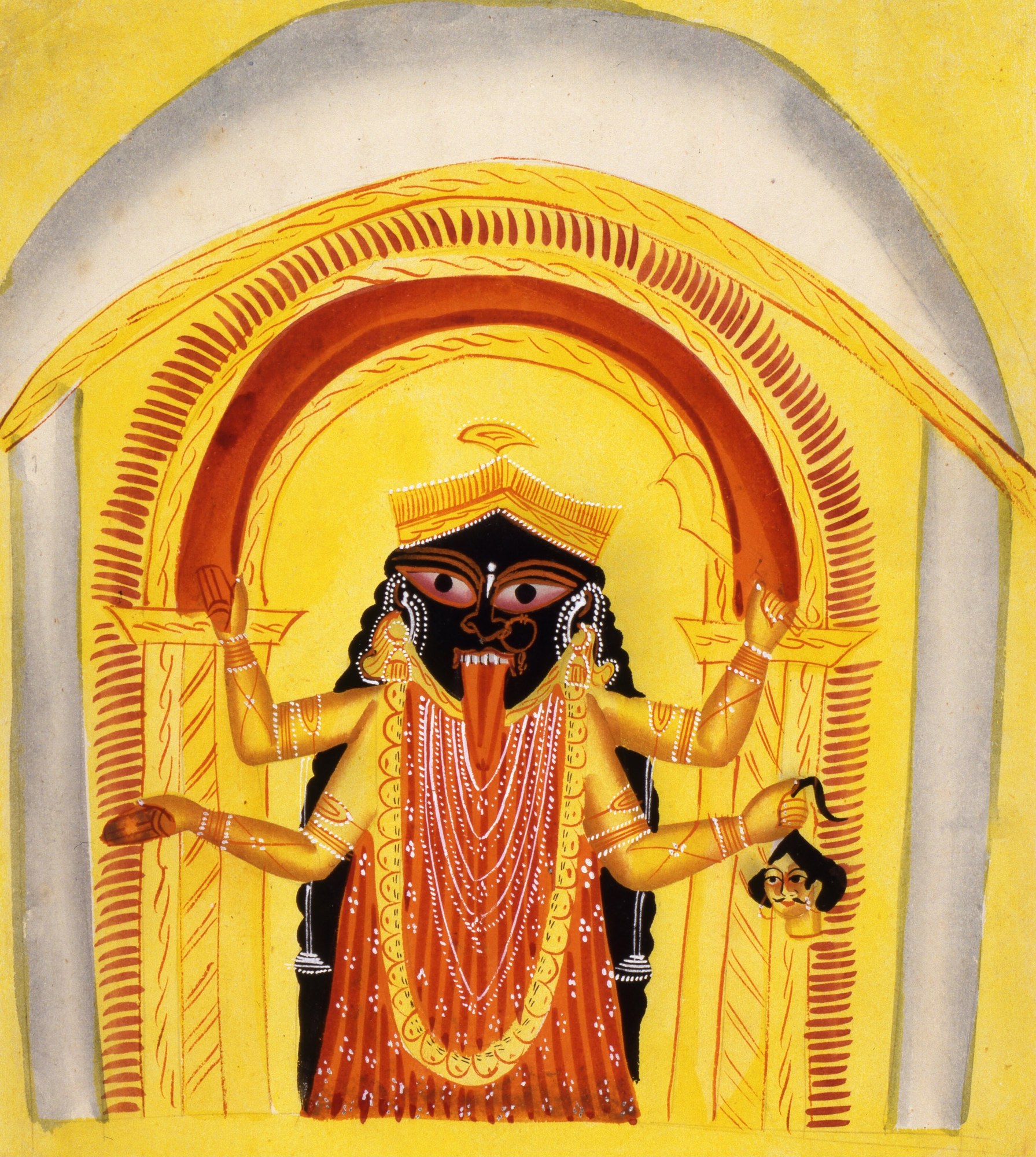
She came armed with a sword and a noose, carrying a skull-topped staff, garlanded with skulls and clad in a tiger’s skin, gaunt and huge-mouthed, her red eyes sunk deep and her tongue lolling, and she filled the sky with her roaring. She flung whole war-elephants, riders and drivers and bells and all, into her mouth and ground them with her teeth. She beheaded Chanda and Munda and carried their two heads back to Chandika, who laughed and gave her a new name for the deed: because she had seized Chanda and Munda, she would be famous in the world as Chamunda.
When Shumbha’s whole host poured down, the powers of the gods came to her aid in the shape of goddesses, the Mothers, each one the energy of a god made flesh; and against the demon Raktabija, from every drop of whose spilt blood a new demon equal to him leapt up out of the ground, it was Kali who solved the riddle of him, stretching her mouth wide to catch the blood before it could fall and swallowing his clones as fast as they were born, until, drained dry, he died.
Mothers drawn back into her body
Then comes the line that is the whole point. Nishumbha fell, and Shumbha, watching the Mothers fight beside her, sneered that she won only by leaning on the strength of other goddesses. Her answer is the doctrinal heart of the entire book. Alone verily am I in the world here,
she said. What other goddess is there besides me? See, vile one, that these goddesses, who have their divine power from me, are entering into me indeed.
And as she spoke the Mothers were drawn back one by one into her body, until she stood alone, and alone she killed him.
That is the paradox the text holds without flinching and never resolves, because to resolve it would be to miss it. In one episode she is assembled out of the gods, a thing they make from their pooled light; in another the gods and all their goddesses are powers she lends out and takes back at will, and she was there before any of them.
Durga and Kali, Chandika and Chamunda and Kaushiki, the warrior on the lion and the gaunt devourer with the lolling tongue, are not rivals or even quite separate persons. They are the faces of one Goddess, put on and drawn back like the Mothers into her breast. Whether you meet her as the delusion that binds you to the world or the knowledge that frees you, the text says, you are meeting the same queen over all lords, and there is no second.
An earthen image on the sand-bank
The two ruined men who heard the tale went down to a river’s sand-bank, made an earthen image of her, and worshipped it for three years, offering at the last their own blood drawn from their own limbs. She came to them and gave each what he was made for. The king asked for his kingdom and more, and was promised rebirth as a Manu, a father of a coming age of the world. The merchant, wiser in his ruin, asked only for the knowledge that would loosen the rope, and was given it. The Goddess who is the illusion is also the way out of it, and she grants both to whoever will ask.
Alone verily am I in the world here; what other goddess is there besides me? See, vile one, that these goddesses, who have their divine power from me, are entering into me indeed. (Devi Mahatmya / Markandeya Purana, Canto 90, tr. F. E. Pargiter, The Markandeya Purana)
- Devi Mahatmya (also called Durga Saptashati, Chandi Path, Saptasati), = Markandeya Purana, cantos 81–93 (its own internal chapters 1–13), trans. F. E. Pargiter, The Markandeya Purana, Asiatic Society of Bengal (Bibliotheca Indica), Calcutta 1904the single foundational Sanskrit text in which the many goddesses are affirmed as manifestations of one supreme Goddess (Devi / Mahadevi). Narrated by the sage Medhas to the exiled King Suratha and the outcast vaishya Samadhi. Pargiter’s is the standard public-domain scholarly English translation; his preface discusses the Devi Mahatmya as an interpolation into the Purana and notes it is
a text-book of the worshippers of Kali throughout Northern India.
- Canto 81 (= DM ch. 1)the frame story of the two wronged men who still love those who betrayed them; Medhas’s teaching of Maha-Maya,
the Great Illusion,
whoforcibly drawing the minds even of those who know, presents them to delusion,
by whomis created this whole universe,
at oncethe cause of the bondage of worldly existence
andthe eternal cause of final emancipation,
the queen over all lords
; and the first episode, Madhu and Kaitabha, sprung from the dirt of the sleeping Vishnu’s ear, whom Vishnu (once his own sleep, praised by Brahma, withdraws) cleaves on his thighs by the trick of their own boon. - Cantos 82–83 (= DM ch. 2–4)Mahisha the buffalo-demon’s hundred-year conquest of heaven; the goddess Chandika / Ambika amalgamated from the gods’ combined tejas into
a burning mountain,
each body-part formed from a named god’s energy; the arming (Shiva’s trident, Vishnu’s discus, Varuna’s conch, Agni’s spear, Vayu’s bow, Indra’s thunderbolt and Airavata’s bell, Yama’s rod, the ocean’s pearls, Himavat’s lion); her world-shaking roarblended with a horse-laugh
; and the shape-shifting death (buffalo → lion → man → elephant → buffalo) ending with the foot on the neck, the spear, and the decapitation: the Mahishasuramardini kill. - Cantos 85–90 (= DM ch. 5–10)Shumbha and Nishumbha; Kaushiki issuing from the sheath of Parvati’s body, so that Parvati turns black and is called Kalika; the vow to wed only her conqueror; Kali springing from Ambika’s frowning forehead (sword, noose, skull-staff, skull-garland, tiger-skin, lolling tongue, sunken red eyes) and devouring the army; the beheading of Chanda and Munda and the naming of Chamunda; the Mothers / Shaktis of the gods taking bodily form; Raktabija, from each fallen blood-drop of whom a new demon springs, undone by Kali drinking his blood; and Devi’s non-dual declaration,
Alone verily am I in the world here… these goddesses, who have their divine power from me, are entering into me indeed,
before she kills Shumbha alone. - Canto 93 (= DM ch. 13)the resolution. Suratha and Samadhi worship an earthen image of the Goddess on a river sand-bank for three years, offering
the bali offering also sprinkled with blood drawn from their own limbs
; she grants Suratha his kingdom and rebirth as the eighth Manu, Savarni,son of the Sun,
and grants the vaishya liberating knowledge. The whole tale is set inside the Markandeya Purana’s account of that coming Manu. - The Mahakali / Mahalakshmi / Mahasaraswati three-form scheme (the Pradhanika, Vaikritika and Murti Rahasya appendices recited with the Durga Saptashati)a widespread traditional reading assigning episode 1 (Madhu-Kaitabha) to Mahakali, episode 2 (Mahisha) to Mahalakshmi, and episode 3 (Shumbha-Nishumbha) to Mahasaraswati. These labels are a later ritual/commentarial layer and are not applied in Pargiter’s core cantos; recorded here as tradition, not as core-verse fact.
- The
Durga = slayer of the demon Durgama
etymology and the expanded Devi theology of the later Devi Bhagavata Puranaa separate, later text. The Devi Mahatmya’s own hymn does call the Goddess onewho is a further shore difficult to be reached,
but the Durgama-slaying narrative belongs to the later Purana, not to this text.