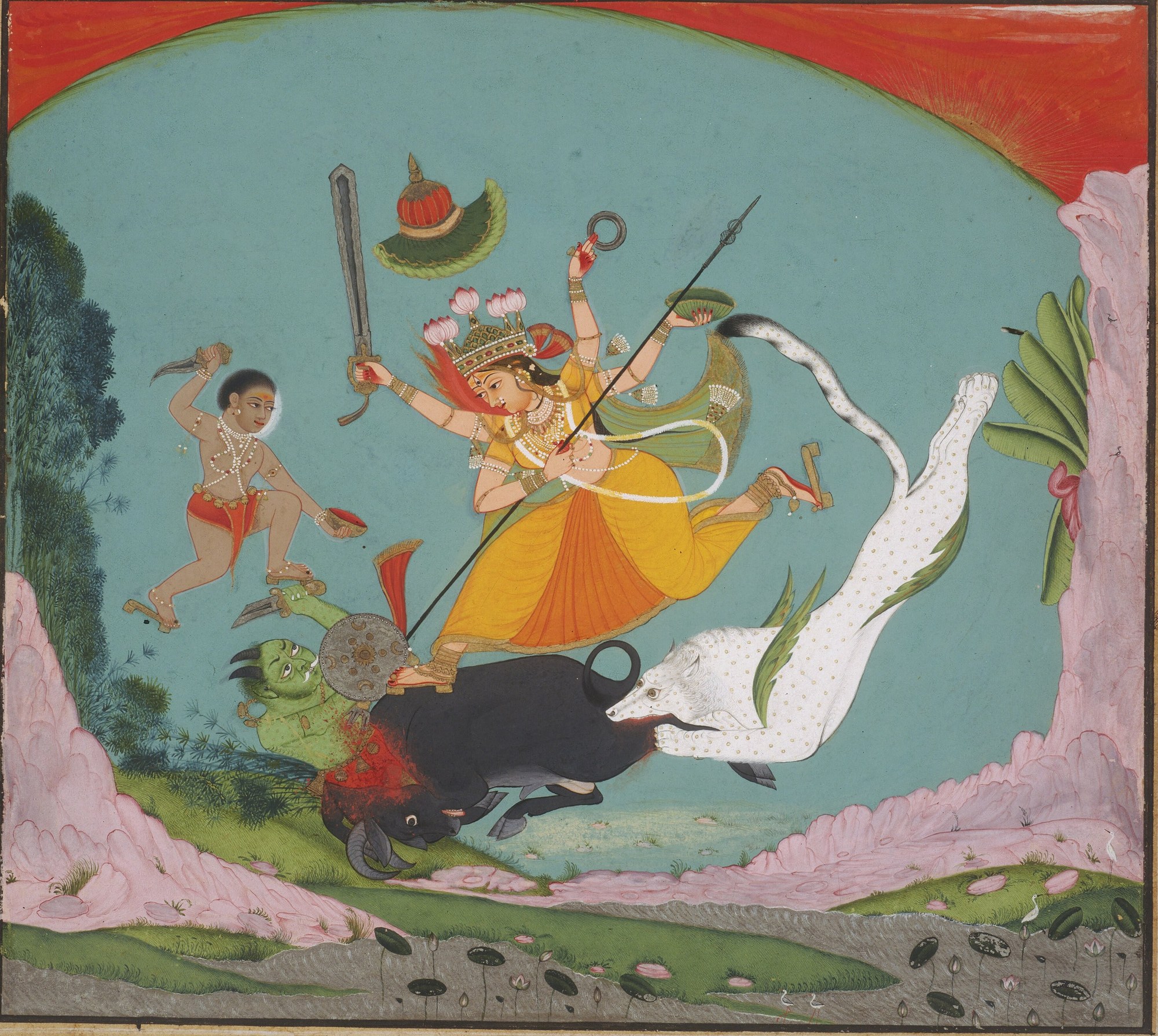
The most famous name in the story is not in the story. Through the whole battle of the Devi Mahatmya, the Sanskrit scripture of around 550 CE that first tells how a goddess was assembled to kill the buffalo demon, the fighter on the lion is never once called Durga. She is ChandikaThe name the Devi Mahatmya uses for the goddess through the battle, before the closing hymn calls her Durga.. She is Ambika. She is Bhadrakali, the mother of the world. The name the world reaches for first, the name on every autumn festival and every temple lintel, is fastened to her only at the very end, in the hymn the rescued gods sing over the corpse, and it is not a name at all. It is a description of what she is good for.
The name that came last
The making and the killing are told in full in the companion piece to this one, on the one Goddess in all her forms (see devi-great-goddess). In brief: the buffalo demon Mahisha had beaten the gods out of heaven and seized their offices one by one, and in answer the gods poured out their tejasThe fiery inner energy or radiance of a god; the pooled tejas of all the gods is what streams out and hardens into the goddess., the fiery inner energy of a god, which ran together like a burning mountain and hardened into a woman.
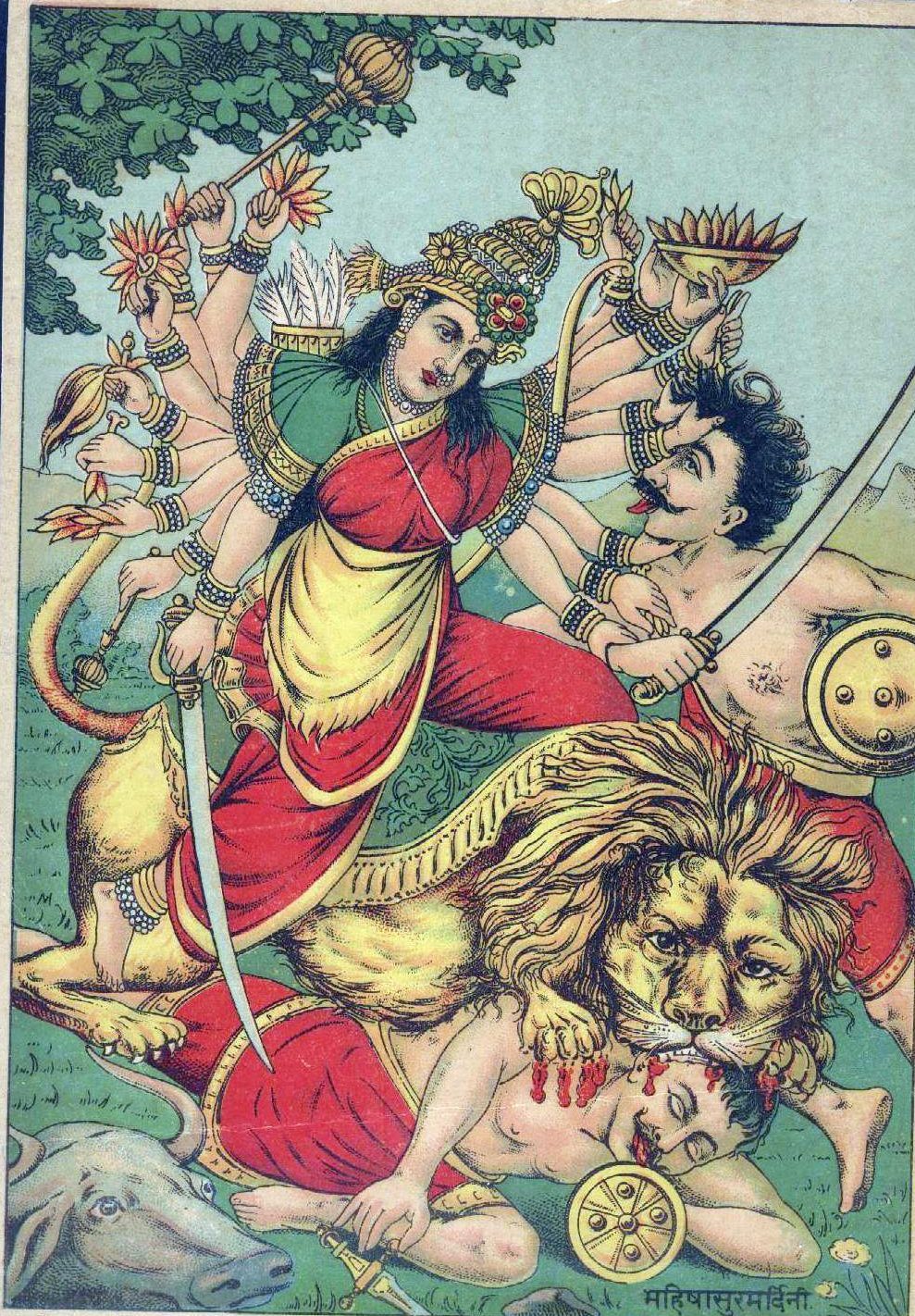
They armed her with a duplicate of every weapon in heaven, set her on a lion, and she broke the demon’s armies and then the demon himself, in a running duel through his shifting shapes, and struck off his head. That is the scene every later image freezes. It is not, however, what makes her Durga.
The gods sing her many things in the closing hymn. They hail her as the mother of the world, as the illusion that binds and the knowledge that frees, and among these they call her Durga, the boat to cross the difficult ocean of existence.
That is the sense of the word: not the warrior, not the buffalo-slayer, but the vessel that carries the faithful across. It is an epithet, one honour in a stack of honours, spoken after the killing is over. In the oldest telling of her most famous deed, the slayer’s headline name is the last word said about her.
From closing hymn to household word
What happened next is the real subject of a Durga article, because it happened outside the text. A word the Devi Mahatmya used once, in passing, at the end, became the name under which an entire tradition of worship gathered. The battle-names receded. Chandika survives now mostly as a title of the scripture itself, the Chandi Path. Ambika and Bhadrakali drifted toward the fierce and the local.
But Durga rose to stand for the whole warrior-goddess, and then for more than the warrior: the autumn festival that fills eastern India, the Durga Puja, takes its name from her, and the clay images built each year for it show precisely the Mahishasuramardini pose, the many-armed goddess with her foot on the buffalo and her spear in its neck. The compound title Mahishasuramardini, crusher of the buffalo demon,
which the earliest text does not use of her as a name either, became the standard label of that iconography.
There is a quiet lesson in the drift. The tradition did not remember her best line or her cleverest stratagem. It remembered the shape of the kill, froze it into an image, and then reached past all her battle-names for the one word that promised the worshipper something: passage. The goddess the scholarship calls a war-engine made of borrowed rage is worshipped as the boat across.
The Devi Mahatmya against the Devi Bhagavata
The other thing that belongs to a figure of Durga, rather than to the story of the killing, is how differently two scriptures draw her, and how far apart in time they stand. The Devi Mahatmya is the older witness, around 550 CE. The Devi Bhagavata Purana, which retells the same episode at far greater length, is dated by most scholars to somewhere in the ninth to fourteenth centuries, three to six hundred years later.
That is a wider gap than the one between Homer and the travel-writer Pausanias who described his shrines. The two are not two registers of one story. They are two texts, and where the later one adds a detail the older one lacks, the detail is a later growth, not the buried original.
Three of those growths are worth naming, because the modern picture of Durga is built partly out of them. The famous boon, that no god, demon or man of the male sex could ever kill Mahisha, so that he laughed at the idea of dying by a woman, is not in the Devi Mahatmya at all. It is the Devi Bhagavata’s invention, its neat explanation for why the answer to the demon had to be a goddess.
The older text never explains his invulnerability and never needs to; it simply pours the gods out and re-forges them female. The she-buffalo mother that gives Mahisha his animal body, and the Sarabha, a beast said to be worse than a lion, that the later text slips into the chain of his transformations, are the same kind of thing: sharp, memorable, and three centuries too young to be the source.
Why the answer had to be a goddess
Read in its own right, the earliest telling makes a stranger claim than the boon-story that grew up to explain it. No single god could unseat the buffalo, because the buffalo had taken each god’s own office and turned it against him. The answer was not a stronger god. It was every god at once, poured out and re-forged into one body that belonged to none of them, a female body armed with the whole armoury of heaven and mounted on a lion.
The gods did not send a champion. They emptied themselves and made a goddess, and only she could do what not one of them could do alone. The later tradition would explain her with a boon and crown her with a name that means safe passage. The oldest text needed neither. It simply showed the thing the gods could only be together, and let her fight.
Roar, roar on thy brief moment, O fool, the while I quaff this mead! The gods shall soon roar, when I shall slay thee even here. (Devi Mahatmya / Markandeya Purana Canto LXXXIII, tr. F. E. Pargiter)
- Devi Mahatmya, = Markandeya Purana Cantos LXXXII–LXXXIV (Pargiter trans., The Markandeya Purana, Bibliotheca Indica)the primary and oldest source, c. 550 CE. The full narrative of the goddess’s assembly from the gods’ pooled tejas, the arming, the lion from Himavat and the shape-shifting kill is narrated in the companion post
devi-great-goddess; this piece draws from the same reading for the naming and epithet history — the goddess called Chandika, Ambika and Bhadrakali through the battle, and hailed as Durga,the boat to cross the difficult ocean of existence,
only in the closing hymn (Canto LXXXIV). The block-quoted taunt is Canto LXXXIII. - Devi Bhagavata Purana, Book 5 (Vijnanananda trans., 1921)the later retelling, dated by most scholars to the 9th–14th c. CE — roughly three to six centuries after the Devi Mahatmya, so its additions are later accretions rather than the original story. It alone supplies Mahisha’s Danava parentage (a son of Rambha, conceived on a she-buffalo); the boon of Brahma that no male being could kill him,
let woman be the cause of my death
; Vishnu’s proposal to create the goddessout of the collective energy
; and the Sarabha form inserted into the shape-shift chain. These are noted here as this text’s own, not the Devi Mahatmya’s.