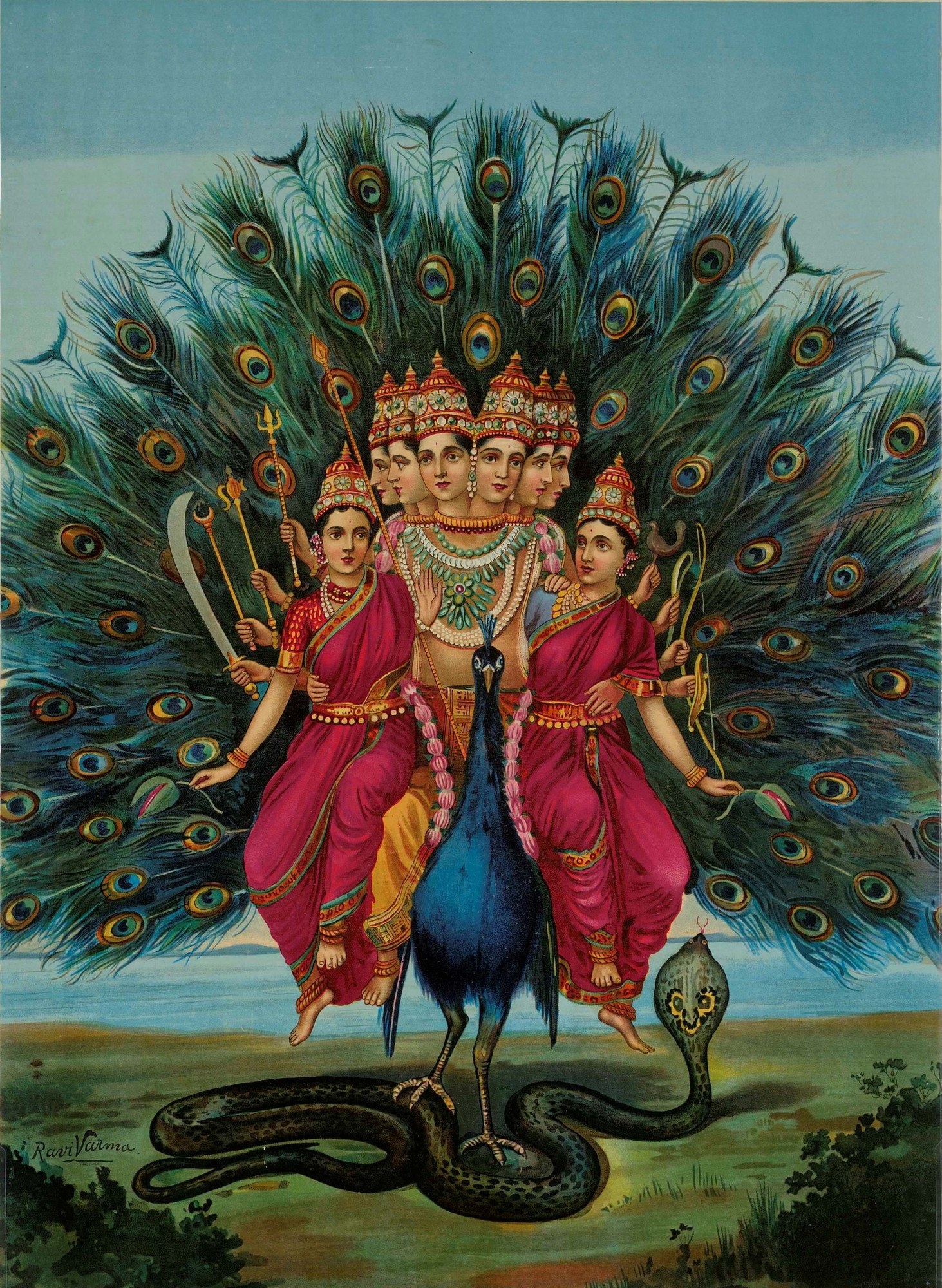
Ask the oldest texts who fathered the god of war and they will not agree with one another. One says the fire-god Agni begot him on Svāhā, the daughter of Dakṣa. Another says he sprang from the seed of Śiva, too hot for any womb to hold. A third makes him the child of Agni and the six star-mothers. The great epic that tells his birth at the greatest length does not settle the question so much as raise it: its narrator asks how the boy came to be known as the son of Agni, and how he was begotten by Rudra of Gaṅgā and Kṛttikā,
all in one breath, as if the tangle were the point. This is a god whose parentage is itself a contested tradition, and the honest way to meet him is to stand where the versions cross rather than pick one and call it the truth.
Three fathers and a hymn that keeps them all
The two fullest accounts sit a long way apart in time. The Mahābhārata’s telling, in the Vana Parva, belongs to a text whose received form spans roughly the fourth century BCE to the fourth century CE. The rival account, in the Śiva Purāṇa, comes from a work dated somewhere between the seventh and the twelfth century of the common era, five hundred to a thousand years younger.
That gap is wider than the one between Homer and Pausanias, and both texts are Sanskrit, both are Hindu, both call the child by the same names. Yet they disagree on his father, on the demon he was born to kill, and on why he has six faces. They are not two versions of one story. They are two strata of a tradition that never stopped rebuilding him.
The epic does something remarkable with the disagreement: it refuses to resolve it. In the great hymn of his fifty-one names, the gods praise the war-god by conceding every parentage at once. According to thine own inclinations,
they tell him, thou hast appeared as the son of Gaṅgā, Svāhā, Mahī, or Kṛttikā.
Four mothers, offered not as error to be corrected but as the god’s own range. The tradition did not lose track of who bore him. It decided he belonged to all of them, and wrote that into his praise.
Cast off, and named for it
The names themselves carry the fracture. In the Mahābhārata, Svāhā takes the forms of the sages’ wives to win the fire-god she loves, catches his seed, and in the shape of a bird casts it six times into a golden lake on the White Mountain. From that seed a boy is born, and because the sages regarded him as a thing cast off, he is called Skanda, a name the epic reads as the cast-off, the spilled or discharged. He comes into the world already six-faced, with twelve ears, twelve eyes, twelve hands and feet, one neck and one belly, and he grows to his full form in the first days of the waxing moon.
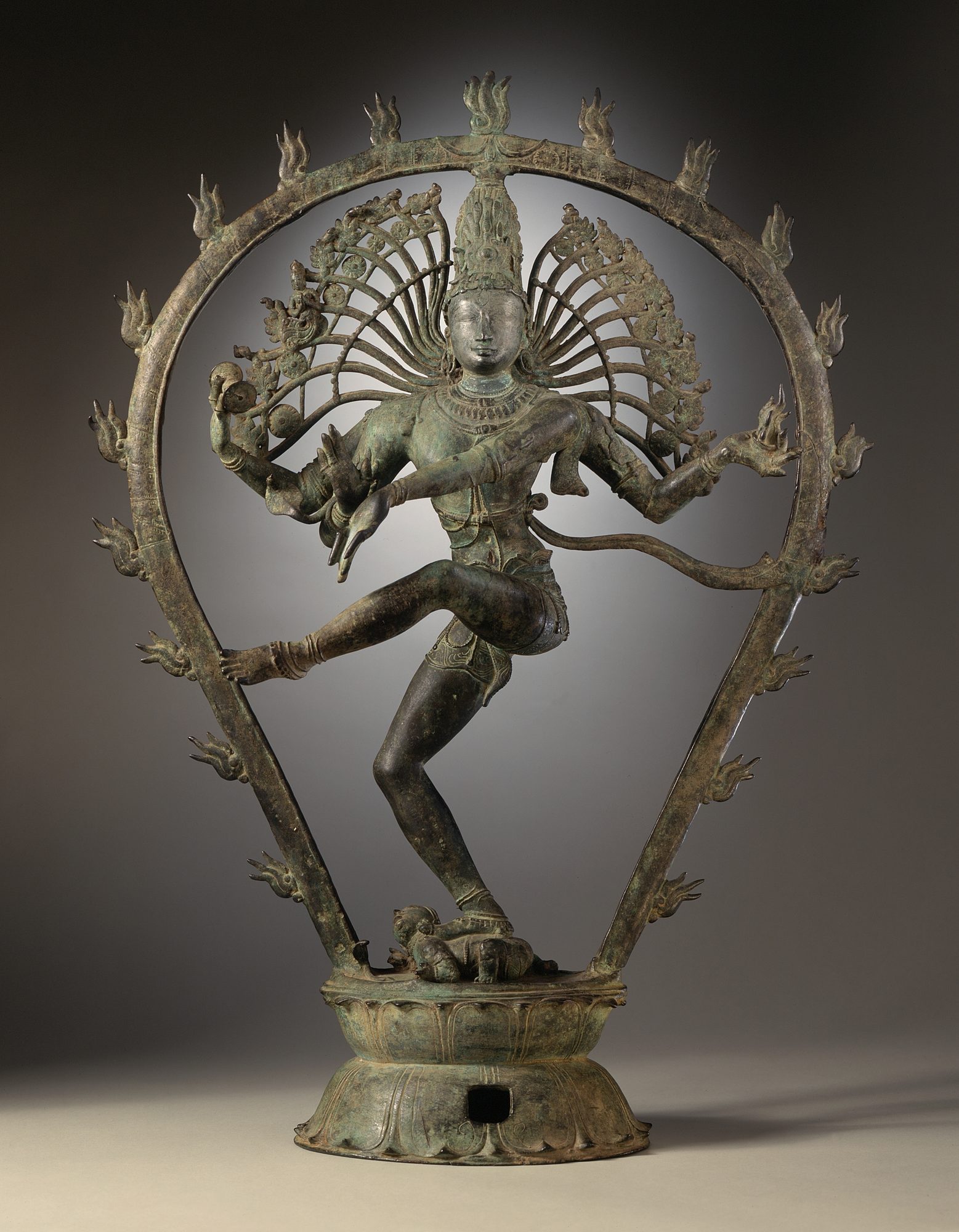
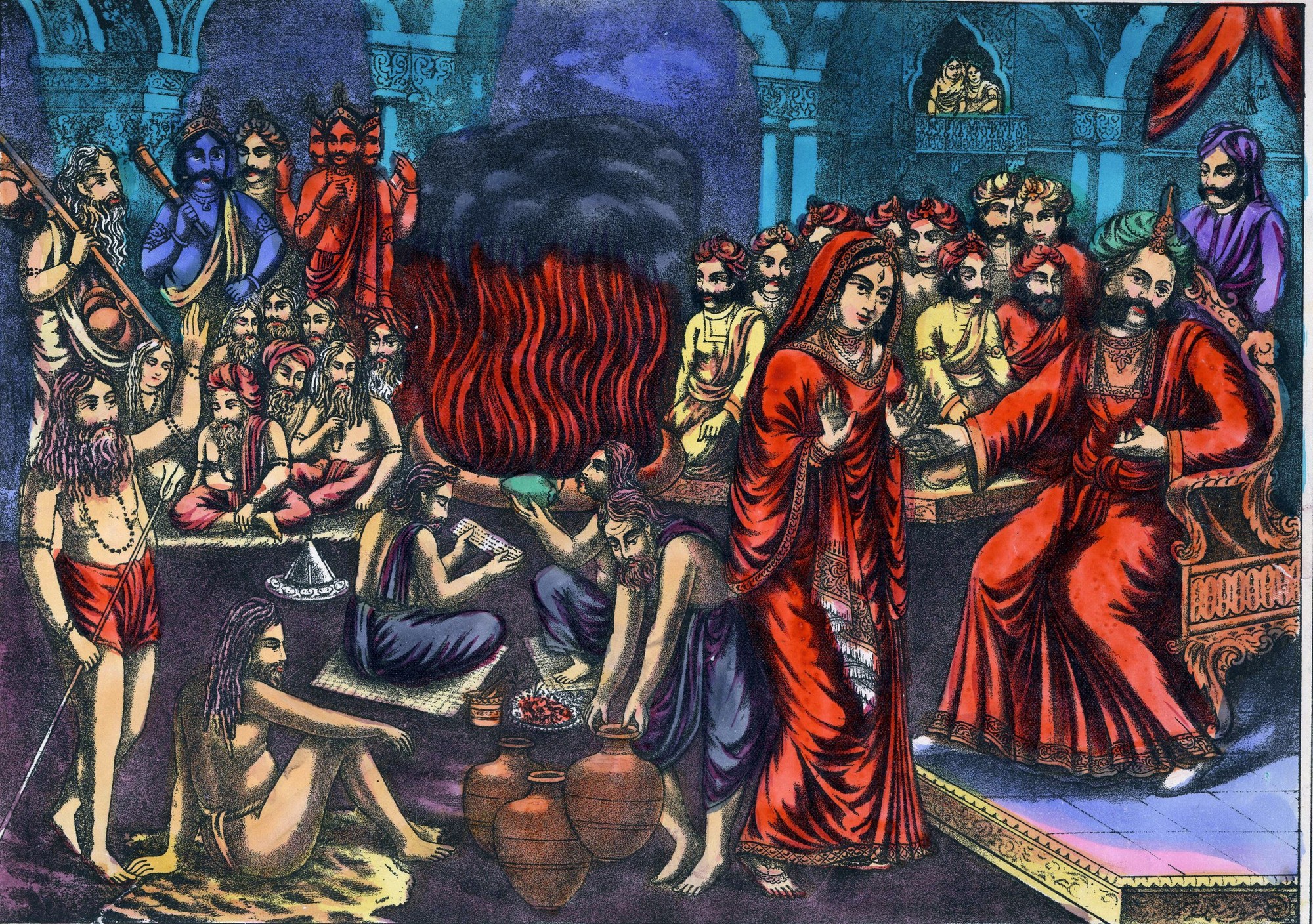
The Śiva Purāṇa reaches the same boy by a different road and lands him in the reeds. Śiva’s seed is swallowed by Agni in the form of a dove, vomited up as gold, deposited in the six wives of the sages as they bathe in the cold month, cast onto the mountain Himavat, hurled into the Gaṅgā, and rolled at last by the waves into a forest of śara-grass, where the child is born.
Then come the KṛttikāsThe six star-mothers (the Pleiades), wives of six of the seven great sages, who suckle the newborn god and give him the name Kārttikeya, "of the Kṛttikās.", the six star-mothers, each demanding to nurse him, and to end their quarrel he sprouts six mouths and drinks from all six breasts at once. From them he takes the name the tradition remembers him by, Kārttikeya, son of the Kṛttikās. Here the six faces are not innate at all. They are the answer to six mothers, grown so no one goes unhonoured.
That is a genuine divergence, and it is worth holding still. In the epic the six faces are given from the first instant; in the Purāṇa they are acquired at the breast. The same feature, the very thing that makes him unmistakable in every image, has two incompatible origin stories preserved side by side across a thousand years. A later synthesis would try to smooth it, telling of six sparks from Śiva fused by Pārvatī into one six-headed child, but that neat fusion is the youngest layer of all and should not be read back onto either of the older two.
The boy the gods could not kill
Both accounts agree on one scene, and it is the one that makes him a war-god rather than a marvel. The newborn is so terrible that the frightened gods urge Indra to destroy him. Indra hurls the thunderbolt, and it strikes the child’s right side. No wound follows. Instead the blow births a second armed youth out of him, Viśākha, club in hand, and Indra, seeing what he has made, abandons the attack and asks the boy for protection.
The Śiva Purāṇa multiplies the moment: the bolt raises not one companion but three, Śākha, Viśākha and Naigama, who rout the king of the gods together. Either way the lesson is the same. The weapon that unmakes demons cannot unmake this child; it only arms him further.
So Indra does the one thing left to a defeated king. He consecrates the boy commander of the celestial host and gives him a bride. The office and the marriage are the same gift twice over, because the bride’s name is Devasenā, Army of the Gods,
and the title senāpatiThe commander-in-chief of an army; the office Indra confers on the war-god, making him generalissimo of the host of the gods. puns straight through her: he is at once the husband of Devasenā and the commander of the deva-sena, the host of heaven. The pun is the theology in miniature, the war-god wedded to war itself.
Whose demon, whose head
Then the tradition splits again, on the largest question a war-god faces: whom did he kill? The Śiva Purāṇa, and the Purāṇic and Tamil texts that follow it, make his great enemy Tārakāsura, a demon whom a boon of Brahmā had rendered unkillable by anyone but a son of Śiva.
That boon is the whole engine of the Śaiva birth: it is why Śiva, an ascetic after the death of Satī, must be brought to marry Pārvatī at all, so that the one being who can end Tāraka can be born. When the commander finally meets the demon, they fight spear to spear, a celestial voice declares that Śiva himself stands present in the form of his son, and the war-god strikes Tāraka between the nipples so that he falls with all his limbs shattered.
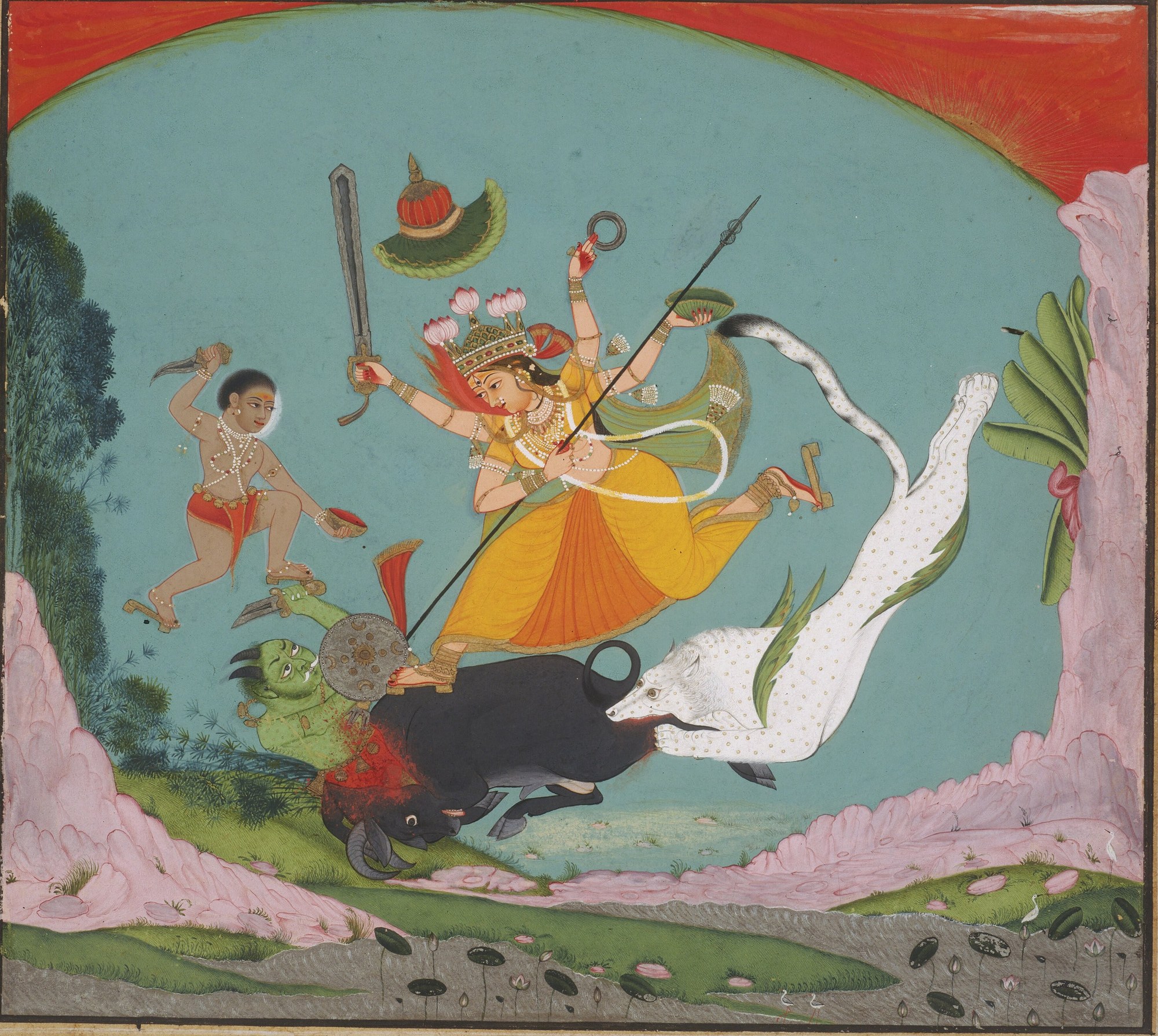
The Mahābhārata names a different foe. In the epic the demon who seizes the war and drives the gods before him is Mahiṣa, the buffalo, and it is Skanda who advances clad in blazing red
in a gold chariot drawn by chestnut horses and takes off his head with a hurled Śakti. Readers of this pantheon will know Mahiṣa as the demon of the goddess Durga, cut down by her spear in the Devi Mahatmya (see durga-slayer-of-mahishasura); that is by far the better-known killing, and it belongs to the goddess tradition. The epic’s assignment of the same buffalo to Skanda is not a mistake to be corrected against the goddess. It is an older, independent line, preserved in a text centuries before the crystallised Goddess scripture, and it deserves to be flagged rather than quietly overwritten. Two traditions claimed the same head. Both kept their claim.
The red one on the peacock
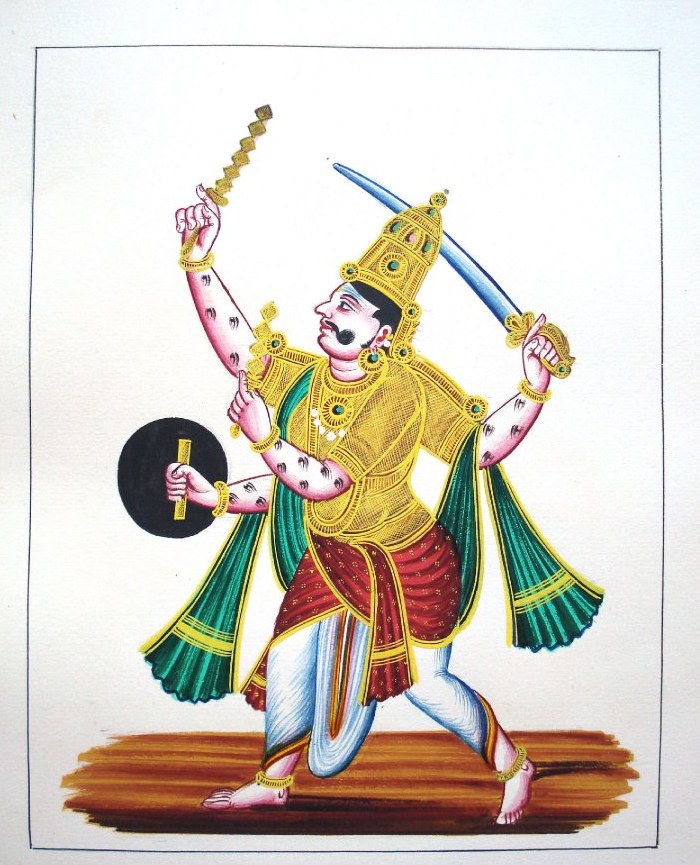
Underneath all the divergence there is a figure the images agree on, and he is remarkably consistent for a god so contested in words. He rides a peacock. He carries the velThe spear that is the war-god's signature weapon, given him at birth; in the epic a hurled Śakti-dart, in the Tamil tradition the vetrivel, "the spear of victory.", the spear given him at birth. His banner bears a red cock, the rooster the newborn Skanda already grips in the epic before he shatters a mountain with an arrow. He is Ṣaṇmukha, the six-faced, and Kumāra, the eternal youth, and Guha, the secret one, and Mahāsena, the great general.
In the Bhagavad Gītā, when Kṛṣṇa names the highest thing in each class of beings to show where the divine is most concentrated, he says of soldiers, among warrior-chiefs I am Skanda.
That single line, dropped into the most widely read Hindu scripture there is, fixes his rank past any dispute over his parents. Whatever else the texts cannot settle, they agree he is the best of commanders.
The Tamil country knows him by another name and a wider life. There he is Murukaṉ, the youth,
Ceyyōṉ, the red one,
god of the hill country, praised in the Tolkāppiyam and across the Sangam poems from centuries before the common era. The Tamil tradition gives him a second consort beside Devasenā, the hunter-girl Vaḷḷi, and in its late scripture, the seventeenth-century Kanda Purāṇam, expands his single enemy into three demon brothers.
But that text is a Tamil retelling composed roughly a millennium after the Sanskrit epic core, and its three-demon war and its love for Vaḷḷi should not be projected back onto the ancient figure as though they were always there. They are the newest room in a very old house.
That house has been under construction for two thousand years, which is why no single wall holds it up. A god with three fathers, two demons and two accounts of his own face is not a god the tradition failed to describe. He is a god it kept describing, in text after text, each one certain, none of them cancelling the last, until the war-god became the sum of everything said about him.
According to thine own inclinations, thou hast appeared as the son of Gaṅgā, Svāhā, Mahī, or Kṛttikā. (Mahābhārata, Vana Parva, Section CCXXXI, tr. Kisari Mohan Ganguli)
- Mahābhārata, Vana Parva, Sections CCXVII, CCXXIV–CCXXXI (Ganguli trans., P. C. Roy ed.)the fullest epic account, read verbatim. Skanda as son of Agni and Svāhā; the six-fold casting of the seed into the golden lake on the White Mountain; the
cast off
etymology of the name Skanda; the innate six faces, twelve ears, twelve eyes, twelve hands and feet; the newborn gripping a red cock and shattering Mount Krauñca; Viśvāmitra as first priest; Indra’s thunderbolt birthing the single youth Viśākha; the consecration as senāpati and the gift of Devasenā, with the deva-sena-pati pun; the slaying of the buffalo-demon Mahiṣa with the hurled Śakti; and the fifty-one names with the concessionthe son of Gaṅgā, Svāhā, Mahī, or Kṛttikā
(Section CCXXXI). Received text c. 4th c. BCE – 4th c. CE. - Bhagavad Gītā 10.24 (Mahābhārata, Bhīṣma Parva; Mukundananda, holy-bhagavad-gita.org)Kṛṣṇa’s vibhūti self-identification, senānīnām ahaṁ skandaḥ,
among warrior-chiefs I am Skanda.
- Śiva Purāṇa, Rudra-saṃhitā, Kumāra-khaṇḍa, Chapters 2, 3, 10 (J. L. Shastri trans., 1950)the Śaiva birth, read verbatim, and dated some 500–1000 years after the epic core (c. 7th–12th c. CE). Śiva’s seed swallowed by Agni as a dove; Pārvatī’s curse of barrenness on the gods’ wives; the deposit in the six sages’ wives who bathe in Māgha; the Himavat→Gaṅgā→śara-reed birth; the six faces assumed to suckle the six Kṛttikās at once, giving the name Kārttikeya; the spear-gift; the thunderbolt birthing Śākha, Viśākha and Naigama; and the spear-duel death of Tāraka, struck
between the nipples
and fallingwith all his limbs shattered
(Chapter 10). - Kālidāsa, Kumārasambhava, c. 5th c. CE (digest this pass, not quoted)the kāvya of the burning of Kāma, Pārvatī’s penance and the Śiva–Pārvatī union leading to the birth. The authentic poem is Cantos I–VIII (Mallinātha); Cantos IX–XVII, containing the war and Tāraka’s death, are widely held a later interpolation, so the genuine poem does not itself narrate the killing.
- Purāṇic and Tamil cross-references (Cologne Purāṇa Index, wisdomlib and Wikipedia digests; not read verbatim, cited as pointers)Brahmāṇḍa II.10.81 and Vāyu 27.53 (son of Śiva and Svāhā); Bhāgavata VI.6.14 and Viṣṇu Purāṇa I.8.11 (son of Agni and the Kṛttikās); Skanda Purāṇa (Devasenā as daughter of Indra and Śacī; the day-by-day formation of the body); Tolkāppiyam (c. 2nd c. BCE) and the Sangam corpus (Murukaṉ / Ceyyōṉ, the Tamil war-god of the hills); Kanda Purāṇam (Tamil, 17th c. CE) for the three-demon scheme and the Vaḷḷi romance, a retelling roughly a millennium after the Sanskrit epic core.