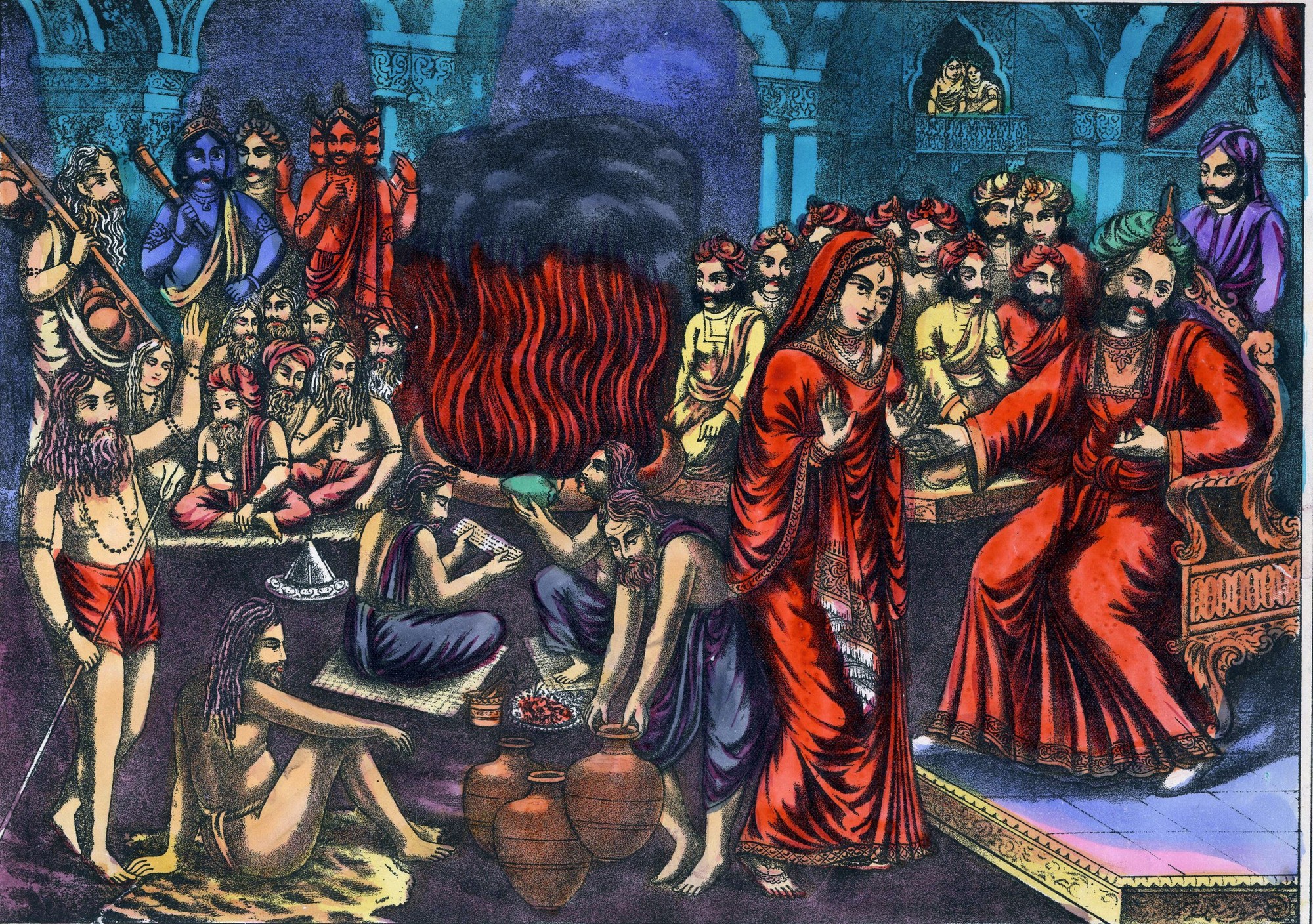
Her name means the good wife, the true one, and it is the cruellest thing about her that English took it for something else. When the colonial administration wanted a word for the burning of a widow on her husband’s pyre, they reached for hers and wrote it down as suttee. But Satī was no widow, and there was no pyre. Her husband was very much alive when she died, and she died over an insult to him, not in mourning for him. The rite that carries her name inverts her story at every point. She is the wife who would not outlive her father’s contempt for the god she had married, and who left the body that father gave her by a fire she raised inside herself.
The daughter who chose her father
Before she is anyone’s victim she is a decision. In the Śiva Purāṇa she is the Great Goddess, Śakti herself, who consented to be born into a mortal-facing lineage, and she tells Dakṣa so to his face: I had been propitiated formerly for becoming your daughter.
Dakṣa is a PrajāpatiA 'lord of creatures': one of the primal progenitor-gods born of Brahmā, of whom Dakṣa is chief; the class from which many lineages of gods and sages descend., a lord of creatures and a son of Brahmā, who had performed long penance for exactly this boon, that the Goddess would come to him as a child. She came because he asked. That is the hinge the whole tragedy turns on: the father who wins a goddess for a daughter by devotion is the same father who will drive her out of her body by scorn.
Even her place among his children is unsettled, and the text is honest about not knowing. Dakṣa fathered sixty daughters, and where Satī stands among them the Śiva Purāṇa cannot say: Some say that Śivā was the eldest of his daughters, some say that she was the middle and some say she was the youngest. All the three opinions are correct in different Kalpas.
A scripture that will fight to the death over her husband’s honour shrugs at her birth-order. She is defined not by her rank in the house but by whom she married out of it.
Two reasons a father comes to hate a god
Why Dakṣa turned on Śiva is a question the traditions answer in two incompatible ways, and the split runs along sectarian lines. The reader should know the texts that carry them are neither contemporaries nor neutral: the Śaiva Śiva Purāṇa in its surviving form is a work of perhaps the tenth or eleventh century, and the Śākta Devī Bhāgavata is later still, most often placed in the eleventh or twelfth, a century or two apart and each pressing its own god’s case.
In the Śaiva telling the cause is wounded pride, and it is almost petty. At an earlier great sacrifice at PrayāgaThe confluence of the Gangā and Yamunā, a great gathering-ground for sacrifice; in the Śaiva account the site of the quarrel that later kills Satī., where the two rivers meet, Śiva did not rise or bow when Dakṣa entered the assembly. The affront festered. Dakṣa cursed him for it, calling him a shameless haunter of cremation grounds surrounded by spirits and ghosts, and declared him cut off from any share of the offerings; Śiva’s attendant Nandin cursed Dakṣa and his brahmins back. The whole later catastrophe grows from a god who would not stand up.
The Śākta telling has no patience for a quarrel over etiquette and supplies a stranger, more physical cause. The sage Durvāsā, having received from the Goddess a garland still trailing bees and heavy with jasmine, passes it to Dakṣa, who lays it on his marital bed; its fragrance rouses him to an animal action
that curdles, in the Devī Bhāgavata’s account, into bitter enmity toward Śiva and Satī both. It is a myth built to make the Goddess the unmoved centre of even her enemy’s hatred. Neither cause appears in the other’s book, and the earliest account, the Vaiṣṇava Bhāgavata, gives no origin at all: it simply finds the two already estranged.
Royal insignia at a door that is closed
However the hatred began, it hardens into a public exclusion. Dakṣa stages a sacrifice and invites Viṣṇu, Brahmā and the whole assembly of gods, and pointedly withholds an invitation from Śiva, allotting him no portion of the offering. Against her husband’s advice, Satī insists on going anyway, uninvited, to her father’s rite.
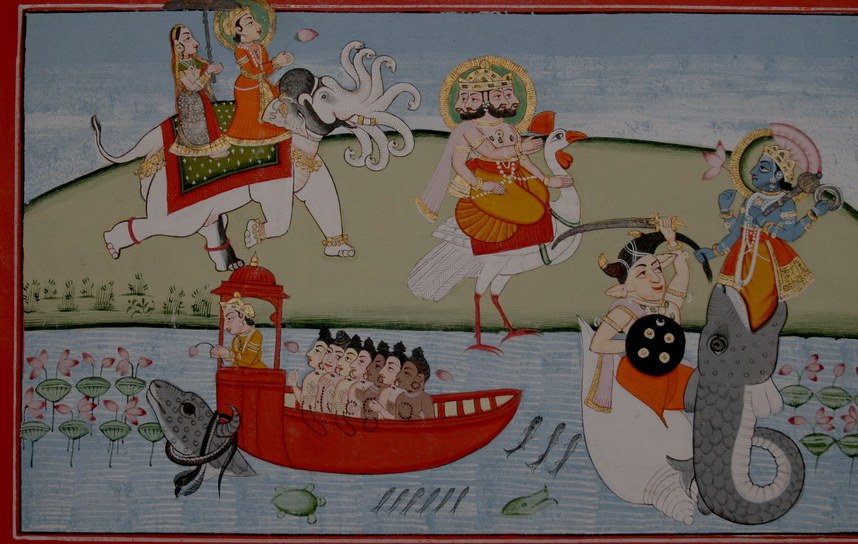
The Bhāgavata dresses her arrival in a queen’s full state, which is exactly what makes it unbearable. She rides Śiva’s bull, escorted under a white umbrella with fly-whisks and garlands and mirrors, singing Sārikā birds, kettle-drums and conches and flutes: every royal honour, carried to a house where she is not welcome. The sacrificial ground roars with Vedic hymns from competing brahmins; the vessels stand ranged along the sides, made of clay, wood, iron, gold, darbha grass and hides.
Into that noise she walks, and no one greets her. Only her mother and sisters dare embrace her, with their throats choked with tears,
while her father and everyone else withhold welcome out of fear of Dakṣa. There is a small, precise wound in the Bhāgavata here: Śiva used to call her Dākṣāyaṇī, daughter of Dakṣa, as an endearment, and now that the man behind the name has turned enemy the very word makes her immediately lose all joyfulness and smiles.
What is a sacrifice without the lord of sacrifice
Then she speaks, and the good wife shows her edge. Seeing no share set apart for her husband, Satī does not plead; she denounces. She turns on her father and on the assembled gods who let the exclusion stand, demanding what such a rite can even be: What is that sacrifice without Śiva who is sacrifice Himself?
Dakṣa answers with open contempt, and the Śiva Purāṇa lets him have the full slur: Your husband Śiva is known to the wise as inauspicious. He is not of a noble lineage. He is the king of goblins, ghosts and spirits. He is excluded from Vedic rites.
That is the sentence she will not live under. To hear her husband reviled, and worse, to have been born of the mouth that reviles him, is a defilement she means to burn off. He who reproaches Śiva and he who hears such reproaches, both of them go to hell,
she says. Hence I shall cast off my body and enter the fire. O father, of what avail is this life unto me?
The reasoning is exact: the body itself is the problem, because the body came from Dakṣa. To keep it is to keep a piece of the man who slandered her god.
Your husband Śiva is known to the wise as inauspicious. He is not of a noble lineage. He is the king of goblins, ghosts and spirits. He is excluded from Vedic rites. (Śiva Purāṇa, Rudrasaṃhitā, Satīkhaṇḍa 29.31–33, tr. J. L. Shastri)
A fire raised, not a fire leapt into
Here the retellings almost all go wrong, and it is worth being careful, because the correction is the same in every early source that narrates the death. Satī does not fling herself into the sacrificial flames. She generates the fire herself. She sits facing north, sips water, closes her eyes, and enters a yogic trance; she raises the vital breath through the body, balancing it at the navel and driving it up through heart and throat to the point between the brows, fixes her mind on her husband’s feet, and kindles by that concentration a heat that reduces her to ashes.
The Bhāgavata titles the chapter plainly, Satī’s Self-immolation by Yoga,
and reports that her body was soon ablaze with fire produced by her samadhi.
The Śiva Purāṇa has her fall in the yogic fire
and be reduced to ashes in accordance with her own wish.
The Devī Bhāgavata says she burnt Her body by the fire arising out of Yoga.
The confusion is understandable, because her own words use the language of fire: I shall cast off my body and enter the fire.
But the fire she enters is the one she makes. That these three books agree on the manner of her death is not a small thing, since they agree on little else and were written centuries apart in rival camps: a Vaiṣṇava text, a Śaiva text and a Śākta text, each with its own god to exalt, all describing the same inner combustion. It is the pyre-leap of popular retelling, not the yogic fire of the scriptures, that is the late arrival.
Her death does not stay quiet. At the gate her attendants had waited in their thousands, sixty thousand of them by the Śiva Purāṇa’s count, and when word reaches them roughly twenty thousand cut themselves down and courted death along with Satī.
What Śiva did with his grief, the fierce being he tore from himself to wreck the sacrifice and behead the father who caused it, belongs to another figure and another article; here it is enough to say that the rite Dakṣa held to shut Śiva out was destroyed by Śiva’s grief at what it cost him.
The body that became a map
There is one aftermath that belongs to Satī alone, and to no other telling of a god’s death in this tradition. The Śākta scriptures could not let her body simply be ash. In the Devī Bhāgavata the maddened Śiva takes up her burnt corpse and carries it across the world, and to make him let go Viṣṇu cuts the body apart; wherever a piece falls, that ground becomes a Śakti-pīṭhaA seat of the Goddess: a pilgrimage site marking where a piece of Satī's body is said to have fallen, the texts disagreeing on how many there are, from seven to a hundred and eight., a seat of the Goddess, and is worshipped forever after. Her death, in this reading, is not an ending but a scattering that plants the Goddess into the earth of the subcontinent at fixed points of pilgrimage.
How many such seats there are, no two texts agree. The Devī Bhāgavata lists a hundred and eight. The Kālikā Purāṇa, the Assam text that centres the shrine at Kāmākhyā, names seven. Later reckonings give fifty-one, fifty-two, sixty-four; the historian D. C. Sircar traced the stubborn fifty-two
to a copying confusion in Bengal. The instrument varies too: the Devī Bhāgavata I read says Viṣṇu used arrows, while the familiar modern synthesis has him loose his discus and cut her into a tidy fifty-one. What every version keeps is the shape of the idea, that a woman who refused to carry her father’s body one moment longer became, in dying, a body large enough to hold a hundred holy places.
This is where her story hands off. The Goddess who cast off the body Dakṣa gave her chose the terms of her return, resolving to be born again to the wife of the mountain and to win Śiva a second time: that is the story of Pārvatī, and it is told elsewhere. Satī’s own story ends at the fire she raised, over an insult, with her name still ringing wrongly through a language that would one day borrow it for the opposite of what she was.
- Bhāgavata Purāṇa 4.3–4.5 (Tagare trans., Motilal Banarsidass, via wisdomlib; read verbatim, 4.4)the earliest datable account, core c. 500–1000 CE, redaction commonly 9th–early 10th c. Supplies the royal escort on Nandin and the vessels list, the mother-and-sisters greeting, the
Dākṣāyaṇī
wound, and the yogic death sequence (chapter titledSatī’s Self-immolation by Yoga
). Being Vaiṣṇava, it gives no origin for Dakṣa’s enmity and none of the pīṭha machinery. - Śiva Purāṇa, Rudrasaṃhitā, Satīkhaṇḍa, chs. 1, 14, 26, 29–31 (J. L. Shastri trans., 1950, via wisdomlib; read verbatim)the fullest Śaiva narrative. Ch. 14, Satī’s birth to Dakṣa and Vīriṇī/Asiknī, the
propitiated formerly
line and the disputed birth-order; ch. 26, the Prayāga snub and the mutual curses; ch. 29, her rebuke and Dakṣa’sking of goblins
slur (block-quoted above); ch. 30, the yogic fire and the sixty-thousand attendants. Surviving chapters date c. 10th–11th c. CE, two to three centuries later than the Bhāgavata core. - Devī Bhāgavata Purāṇa 7.29–7.31 (Vijñānananda trans., 1921–22, via wisdomlib; read verbatim, 7.30)the Śākta rewrite, most placed 11th–12th c. CE. Unique for the Durvāsā-garland cause of Dakṣa’s enmity, for the yogic-fire death phrased as
fire arising out of Yoga,
and for founding the Śakti-pīṭhas from the body Viṣṇu cuts apart (108 seats). The pīṭha network is a later Śākta overlay, absent from the Bhāgavata’s own account. - Kālikā Purāṇa (B. N. Shastri trans., Nag Publishers; not read verbatim, via secondary report)the Assam Śākta text also called the Satī Purāṇa, c. 10th–11th c. CE, centring Kāmākhyā and giving a shorter list of seven pīṭhas. Cited for the pīṭha-count variance only.
- D. C. Sircar, The Śākta Pīṭhas (1973)the standard modern study of the pīṭha lists, noting the fifty-one-versus-fifty-two confusion arising in Bengali transmission. Scholarship, not primary; cited via the apparatus, not independently read.