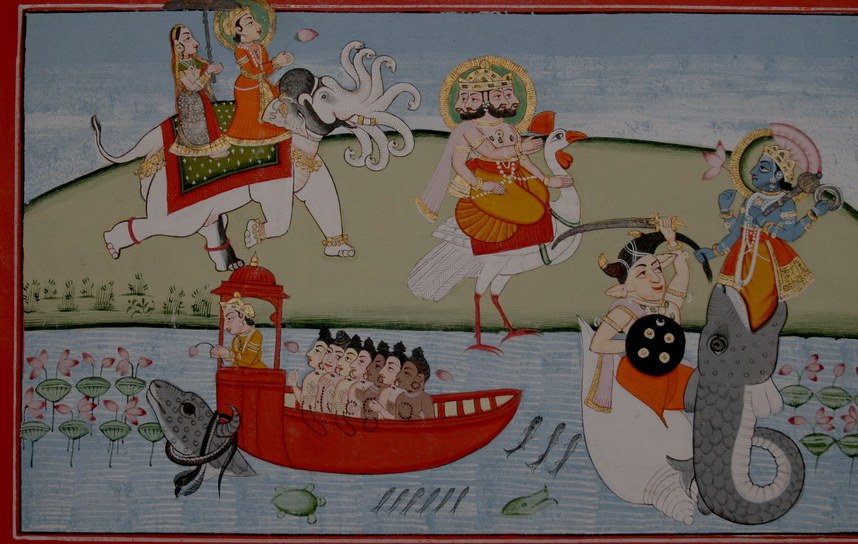
His name is the oldest thing about him, older than any story told of him. In Sanskrit manu- is kin to the English word man, and in the most ancient hymns he is already there as the first of all people, the father of the human line, the one who lit the first sacrificial fire. He does nothing dramatic in those early verses; he simply is, the ancestor at the head of the family tree. Everything else the tradition would come to say about Manu, that he outlived a world-drowning flood, that he alone begot the surviving race, that he handed down the code of law, was fitted onto that quiet ancestral figure over the following seventeen centuries, and by different authors who did not always agree on what they were describing.
The man the name outran
Read forward from the beginning and Manu grows more crowded with every text. The Ṛgveda, roughly a thousand years before the common era, names him and stops there: father Manu, first sacrificer, no flood, no lawbook. The flood is not original to him. It is an accretion, and a datable one. The earliest surviving telling of a Manu who survives a deluge comes from the Śatapatha Brāhmaṇa, a work of priestly commentary from around the eighth century before the common era, some centuries after the hymns. From there the figure keeps gathering roles until, by the epic and Purāṇic period, three separate Manus in three separate offices have been braided into a single name.
This is the first thing to hold steady about him: Manu
is not one person doing several things. The texts describe more than one Manu. The lawgiver of the code and the survivor of the flood are, strictly, different figures of different world-ages who were later collapsed together.
Two Manus, one code of ages
The Manusmṛti, the Laws of Manu, works out the machinery that makes the collapse possible. Its opening chapter sets time itself as a series of enormous ages, and it assigns each age its own Manu. There are seven of them, the text says, these seven very glorious Manus,
the first being Svāyambhuva, the Self-existent’s descendant produced through the being called Virāj, and the seventh being the son of Vivasvat,
the Sun. Each Manu produces and protects the whole creation during the world-age, the manvantaraOne of the vast world-ages of Hindu time, each presided over by its own Manu; the sources count seven such Manus and ages down to the present., that is his to keep.
That scheme quietly performs the join. The lawgiver-frame belongs to the first Manu, Svāyambhuva, in whose mouth the code is placed. The flood belongs to the seventh, VaivasvataThe seventh and present Manu, "son of Vivasvat" the Sun; the flood-hero of the epic and Purāṇic tellings and ancestor of the current humankind., the Sun’s son. But because the present world-age is Vaivasvata’s, and because the office of law-giving attaches to the very idea of a Manu, the tradition treats them as one continuous figure without ever quite saying they are the same man. The bridge is real; it is also a piece of scaffolding, and it is worth seeing the seam.
What the flood gained on its way down the centuries
The flood story is where the assembly shows most plainly, because the tale is told three times by witnesses so far apart that they cannot be treated as one voice. The Śatapatha’s version and the Matsya Purāṇa’s version are separated by roughly thirteen hundred years, a longer span than divides us from the Norman Conquest, and across that gulf the saving fish changes identity twice.
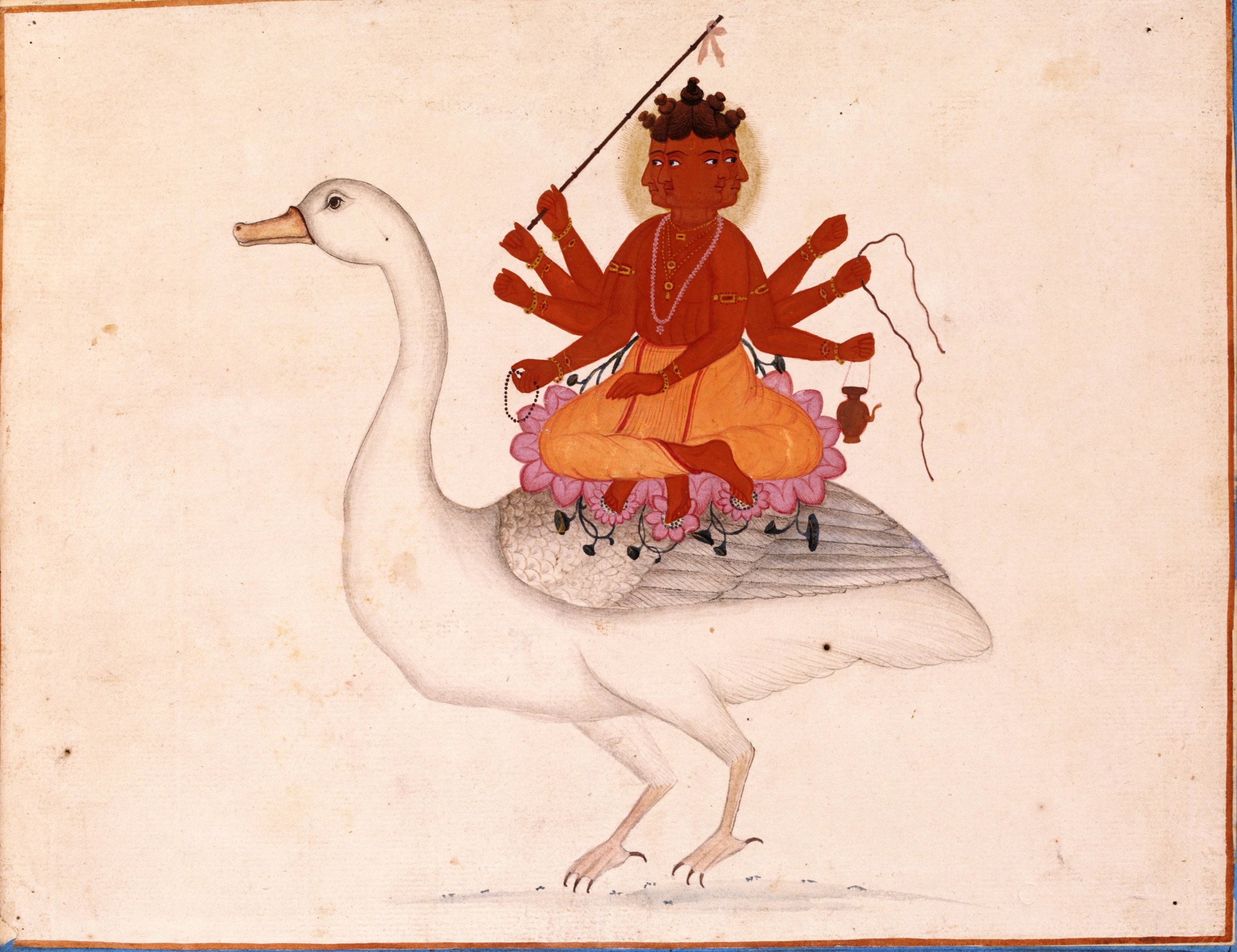
In the oldest telling the fish is nobody in particular. It is simply a fish that comes into Manu’s cupped hands as he washes and asks to be reared, promising to save him from a coming flood. By the later, interpolated stratum of the Mahābhārata the fish has become a god: at the end it announces, I am Brahma, the Lord of all creatures.
By the Matsya Purāṇa, several centuries later again, the fish is Viṣṇu, whom Manu hails as Keśava and Janārdana, and the whole episode has been rebuilt as the first descent, the first avatāra, of that god.
In that latest telling the rescue even begins with a rite: Manu is pouring a tarpanaA water-libation poured in offering to one''s ancestors; in the Purāṇic flood it is while pouring this that Manu first cups the saving fish in his hands., a water-libation to his ancestors, when a tiny carp falls into his cupped hands. Nobody, then Brahmā, then Viṣṇu: the fish’s rising divinity tracks the rise of Vaiṣṇavism across the same interval. To call the ancient Śatapatha fish Viṣṇu
is to import a deity thirteen centuries too early.
What the flood saves changes with it. The oldest account is starkly lonely. The flood then swept away all these creatures, and Manu alone remained here.
No ark-crew, no sages, no rescued scriptures. Manu wants offspring and makes a sacrifice into the waters, offering butter, sour milk, whey and curds, and after a year a woman rises from it, his daughter Iḻā, born solid with clarified butter gathered in her footprint; through her, the text says, he generates this race of Manu.
The later versions crowd the deck. Now Manu embarks with the seven sages and the seeds of all creatures, and in the Purāṇa the Vedas themselves are carried aboard to be re-taught at the world’s remaking. The mountain that receives the ark is named for the event in both traditions, a piece of landscape that remembers the rescue: in the Śatapatha its slope is Manu’s descent
; in the epic it is Naubandhana, the tying of the ship.
The lawgiver’s own beginning
The Manusmṛti keeps the flood at arm’s length. It never retells the deluge; its business is the beginning, not the ending, of a world. Its cosmogony has its own strange grandeur. The universe lies in darkness until the Self-existent appears and casts his seed into the waters he has made, and the seed becomes a golden egg, in brilliancy equal to the sun,
in which the creator is himself born.
Because the waters, the nārāḥ, were his first resting-place, the ayana, he takes from them the name Nārāyaṇa. After a year he splits the egg by thought alone into heaven and earth, divides his own body into male and female, and through that division and the being Virāj brings forth Manu, the speaker of the law. Whether one reads the flood-survivor or the lawgiver, the same principle holds: a single figure stands at the join between an unmade world and a peopled one.
He has drawn a modern nickname for the flood, the Indian Noah, and it is a useful signpost for a reader meeting him for the first time. But it belongs to comparative mythology, not to any Sanskrit text, and the same caution applies as to the fish’s changing name. It is an observation made from outside, laid over a figure the Indian tradition built for its own reasons, out of an ancestor whose name was already ancient when the first flood-water rose.
The flood then swept away all these creatures, and Manu alone remained here. (Śatapatha Brāhmaṇa I.8.1.6, Eggeling trans.)
- Śatapatha Brāhmaṇa I.8.1.1–11 (Julius Eggeling tr., The Śatapatha-Brāhmaṇa, Part I, Sacred Books of the East vol. 12, Oxford 1882, pp. 216–220)the earliest datable Indian flood narrative. The unnamed, un-deified fish that comes into Manu’s hands and asks to be reared; its growth from jar to pit to sea; the ship tied to its horn and towed to
yonder northern mountain,
whose slope is thereafter calledManu’s descent
; the desolatethe flood then swept away all these creatures, and Manu alone remained here
; and the birth of the daughter Iḻā from the offered butter, sour milk, whey and curds, through whom Manu generatesthis race of Manu.
Tradition conventionally placed c. 800 BCE. - The Laws of Manu (Manusmṛti), Chapter I.1–63 (Georg Bühler tr., Sacred Books of the East vol. 25, Oxford 1886, pp. 2–20)the cosmogony (the darkness dispelled by the Self-existent, the golden egg
in brilliancy equal to the sun,
the nārāḥ/Nārāyaṇa etymology, the division of the Lord’s body and the production of Manu through Virāj), the doctrine of the seven Manus and their manvantaras (Svāyambhuva first,the son of Vivasvat
seventh), and the identification of the present Manu as Vaivasvata. The text does not narrate the flood. Verse core c. 200 BCE – 200 CE. - Mahābhārata, Vana (Āraṇyaka) Parva,
Matsya
episode, in the Mārkaṇḍeya section (Kisari Mohan Ganguli tr., P. C. Roy ed.; archive.org DjVumahabharataofkri02royp)Vaivasvata Manu’s ten-thousand-year penance; the little fish reared through the vessel-to-ocean growth; the ark boarded with the seven Ṛṣis and all seeds; the tow to the highest peak of the Himavat,still called by the name of Naubandhana
; and the fish’s self-revelation,I am Brahma, the Lord of all creatures.
A later stratum of the epic relative to its war-narrative core; composed c. 400 BCE – 400 CE. The exact adhyāya number varies by edition and is not fixed here. - Matsya Purāṇa, Chapters I–II (
A Taluqdar of Oudh
tr., B. D. Basu ed., The Matsya Puranam, Sacred Books of the Hindus vol. 17, Allahabad 1916, pp. 3–7)the fullest, mostcanonical
retelling. Brahmā’s boon; the tiny carp falling into Manu’s hands as he pours a water-libation to his ancestors; the six-stage growth (jar, pitcher, well, tank, Ganges, ocean); Manu’s recognition of the fish as Viṣṇu (Keśava, Hṛṣīkeśa, Janārdana); the Vedas and the seeds of creation stowed aboard; and Śeṣa the serpent-king serving as the tow-rope. Here the fish (Matsya) is Viṣṇu’s first avatāra. Core c. 250–500 CE. - Ṛgveda (c. 1500–1200 BCE)cited as negative evidence. Manu appears as the primal ancestor and first sacrificer,
father Manu,
but the hymns contain no flood; the deluge is a post-Vedic accretion onto an already-ancient figure. Not read line-by-line for this piece; the point rests on Eggeling’s and Bühler’s notes and on standard scholarly consensus, and no specific verse is attributed here.