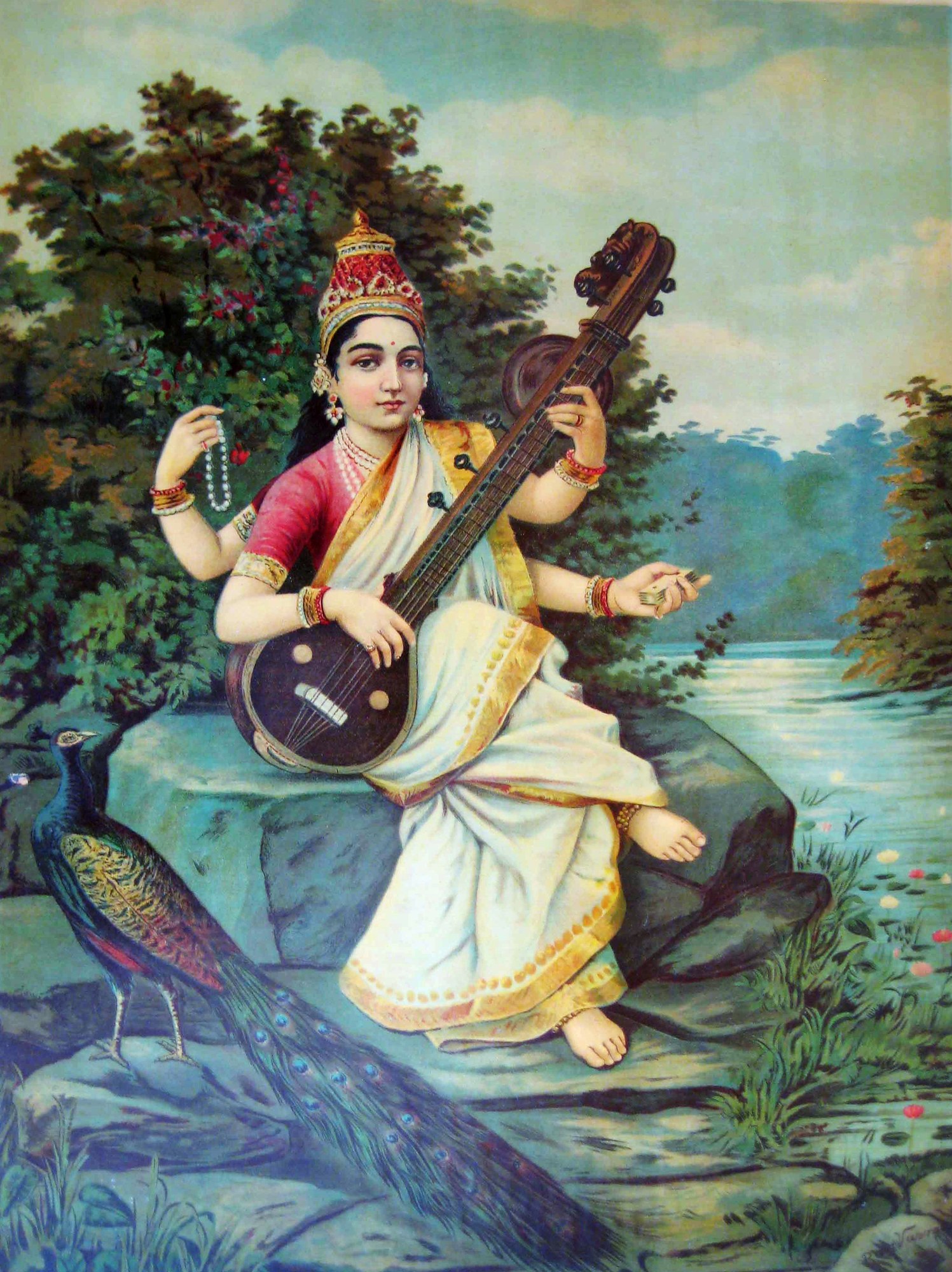
She arrives in the oldest Sanskrit anyone can read not as a woman with a lute but as a wall of water. The hymn-singers of the Ṛgveda knew Sarasvatī first of all as a river, and the river they praised was violent: surpassing in majesty and might all other waters,
a flood that hath burst with her strong waves the ridges of the hills.
She is asked to cut down enemies, to discover rivers for the tribes of men,
to come onward with tempestuous roar.
The white-robed patroness of learning who sits so calmly in later shrines, a book in one hand and a stringed instrument across her lap, would not be recognisable here. The distance between the two pictures is not a matter of mood. It is a matter of some two and a half thousand years.
The flood that burst the hills
The Rigveda is the earliest layer of the whole tradition, its older hymns composed perhaps between 1500 and 1000 BCE, and in it Sarasvatī is overwhelmingly a physical thing: the greatest of rivers, running pure in her course from mountains to the ocean, alone of streams.
She is seven-sistered, sprung from threefold source, the Five Tribes’ prosperer,
a power who hath filled the realms of earth, and that wide tract, the firmament.
She is terrible as well as generous, terrible with her golden path,
her limitless unbroken flood, swift-moving with a rapid rush.
The singers who invoked her wanted her waters and her strength against their foes, and they got a goddess who was indistinguishable from the flood she rode.
Even so, a second nuance is already present in these early verses. She must be extolled by every sage,
and the poets beg her not to refuse us thy milk.
A river that inspires the wise is only a step from a goddess of the wise. But it is a step the Ṛgveda has not yet taken. The lute, the books, the whiteness, the patronage of grammarians: none of that is here. To read it back into these hymns is to collapse two and a half millennia into a single portrait.
The queen who makes a man a sage
The bridge to the later goddess is laid by a different Ṛgvedic hymn, and it is worth being exact about what it does and does not say. In the very last stratum of the Ṛgveda stands the Devī SūktaA hymn of the Ṛgveda (10.125) spoken in the first person by the goddess Vāc, declaring her power to make a man a sage; the textual root of Sarasvatī as goddess of speech., a hymn spoken in the first person by VācSpeech itself, deified as a goddess in the Ṛgveda; in later tradition her identity is merged with Sarasvatī, who thus becomes the goddess of sacred speech., Speech
herself made divine. She is not named Sarasvatī in it. She is Speech, and she boasts of a cosmic reach: I am the Queen, the gatherer-up of treasures, most thoughtful, first of those who merit worship.
Above all she claims the power to lift a human mind: I make the man I love exceeding mighty, make him a sage, a Ṛṣi, and a Brahman.
That single line is the seed of everything Sarasvatī later becomes. Yet the equation of the two goddesses is not Vedic. The Devī Sūkta says Vāc; the merger of Vāc with Sarasvatī is the work of later, post-Ṛgvedic tradition, which folds the goddess of speech into the river-goddess until they are one. What is honest to say is only this: the Ṛgvedic goddess of Speech is afterward identified with Sarasvatī, and by that identification the river inherits the mind.
White as ten million moons
By the time the Devī Bhāgavata Purāṇa is composed, around the eleventh or twelfth century of the common era, the transformation is complete. The gap from those Vedic hymns is enormous: roughly 2,500 years, longer than the span from Homer to the present day. This late Sarasvatī is a goddess of learning first and a river only in memory, and she now cradles a vīṇāA long-necked Indian stringed instrument; the lute Sarasvatī cradles in her Purāṇic iconography, the emblem of her patronage of music., the long-necked lute that becomes her emblem.
The Purāṇa fixes her image with a precision the Veda never attempted. She is of a white colour, of a smiling countenance and exceedingly beautiful, the lustre of whose body overpowers that of the ten millions of Moons, whose garment is purified by fire, in whose hands there are Vīṇā and books.
The lute has arrived at last, and with it the books.
Everything about her worship turns white. Devotees bring her white flowers of good scent, white sandalpaste, new white clothes, nice conchshell, nice garlands of white flowers, nice white necklaces.
She is worshipped, the text says, on the day before the fifth of the bright fortnight of the month of Māgh, the day of commencement of education,
the spring festival at which a child is first set to study.
She is now Vāgdevī and Vāgvādinī, the goddess of speech, under whose influence the hearts of illiterate stupid persons become illumined with knowledge.
Her protective hymn, her Kavaca, reads as a roll-call of the men who shaped Sanskrit learning: it is by her grace, the Purāṇa claims, that Vālmīki became eloquent, that Vyāsa classified the Vedas and composed the eighteen Purāṇas, that Pāṇini and Kātyāyana and Yājñavalkya became great authors. The river that burst the hills has become the patron saint of grammar.
How the river married the creator
The same Purāṇa also tells, in its own sectarian way, how this goddess came to be the wife of Brahmā the creator, which is where the mainstream tradition places her. It is a domestic disaster. Sarasvatī, in this telling, is one of three wives of Viṣṇu, alongside Lakṣmī the goddess of fortune and Gaṅgā the river. Trouble begins when Gaṅgā and Viṣṇu exchange smiling glances.
Sarasvatī’s face became red out of anger; she began to tremble,
her lips quivered, and she rose up to catch hold of Gaṅgā by Her hairs violently
before Lakṣmī stepped between them. Curses fly in every direction. Viṣṇu ends the quarrel by simply dividing his household: O Gange! Go to Śiva. O Sarasvatī! Go to Brahmā. Let the good-natured Kamalā remain with Me.
The Purāṇa is careful to keep all her identities alive at once. In its resolution she goes in her one part to have the form of a river,
in her one half part to Brahmā,
and in her full parts remains in the highest heaven. It is a neat device: the same goddess can be the water in the plain, the wife at the creator’s side, and the supreme power above both, without any of the three cancelling the others. This is one tradition’s answer, a Śākta and Vaiṣṇava one, and not the only story of how she came to Brahmā. But it captures something true about her whole career. She was never made to be one thing.
I make the man I love exceeding mighty, make him a sage, a Ṛṣi, and a Brahman. (Ṛgveda 10.125.5, tr. Ralph T. H. Griffith)
- Ṛgveda 6.61 (to Sarasvatī) (Ralph T. H. Griffith, trans., The Hymns of the Rigveda, 1889–96; of the older core of the Ṛgveda, c. 1500–1000 BCE)read verbatim for the river-goddess as flood and foe-slayer who
hath burst with her strong waves the ridges of the hills,
is invoked todiscover rivers for the tribes of men,
and isseven-sistered, sprung from threefold source,
extolled by every sage. - Ṛgveda 7.95 (to Sarasvatī) (Griffith, trans., as above; same stratum)read verbatim for the clearest river depiction,
pure in her course from mountains to the ocean, alone of streams Sarasvatī hath listened.
- Ṛgveda 10.125 (the Devī Sūkta, hymn of Vāc) (Griffith, trans., as above; of Book 10, the latest stratum of the Ṛgveda, c. 1200–1000 BCE, some centuries younger than the family-book hymns above)read verbatim for the first-person self-declaration of Speech deified,
I am the Queen, the gatherer-up of treasures,
andI make the man I love… a sage, a Ṛṣi, and a Brahman.
The hymn names its speaker Vāc, not Sarasvatī; the identification of the two is a later, post-Ṛgvedic development. - Devī Bhāgavata Purāṇa, Book 9 (Prakṛti Khaṇḍa), chapters 4, 6 and 7 (Swami Vijñānananda, trans., The Śrīmad Devī Bhāgavatam, 1921–22; of a Śākta Mahāpurāṇa generally dated c. 11th–12th c. CE, roughly 2,500 years after the Ṛgvedic hymns)read verbatim for the white iconography and the vīṇā,
in whose hands there are Vīṇā and books
; the white-offering list and the Māgh / Vasanta Pañcamī festivalday of commencement of education
; her titles Vāgdevī and Vāgvādinī; the Kavaca’s roll-call of authors (Vālmīki, Vyāsa, Pāṇini, Kātyāyana, Yājñavalkya); and the three-wives quarrel of chapters 6–7 in which Viṣṇu parcels his wives out, sending Gaṅgā to Śiva and Sarasvatī to Brahmā, and her being is divided into river, consort, and supreme goddess at once. The originfrom the end of the lips of Rādhā
is specific to this Purāṇa’s Kṛṣṇaite frame; the more familiarborn from Brahmā
motif belongs to other texts and is not asserted here. The swan mount, standard in later art, is not in the passages read and is omitted.