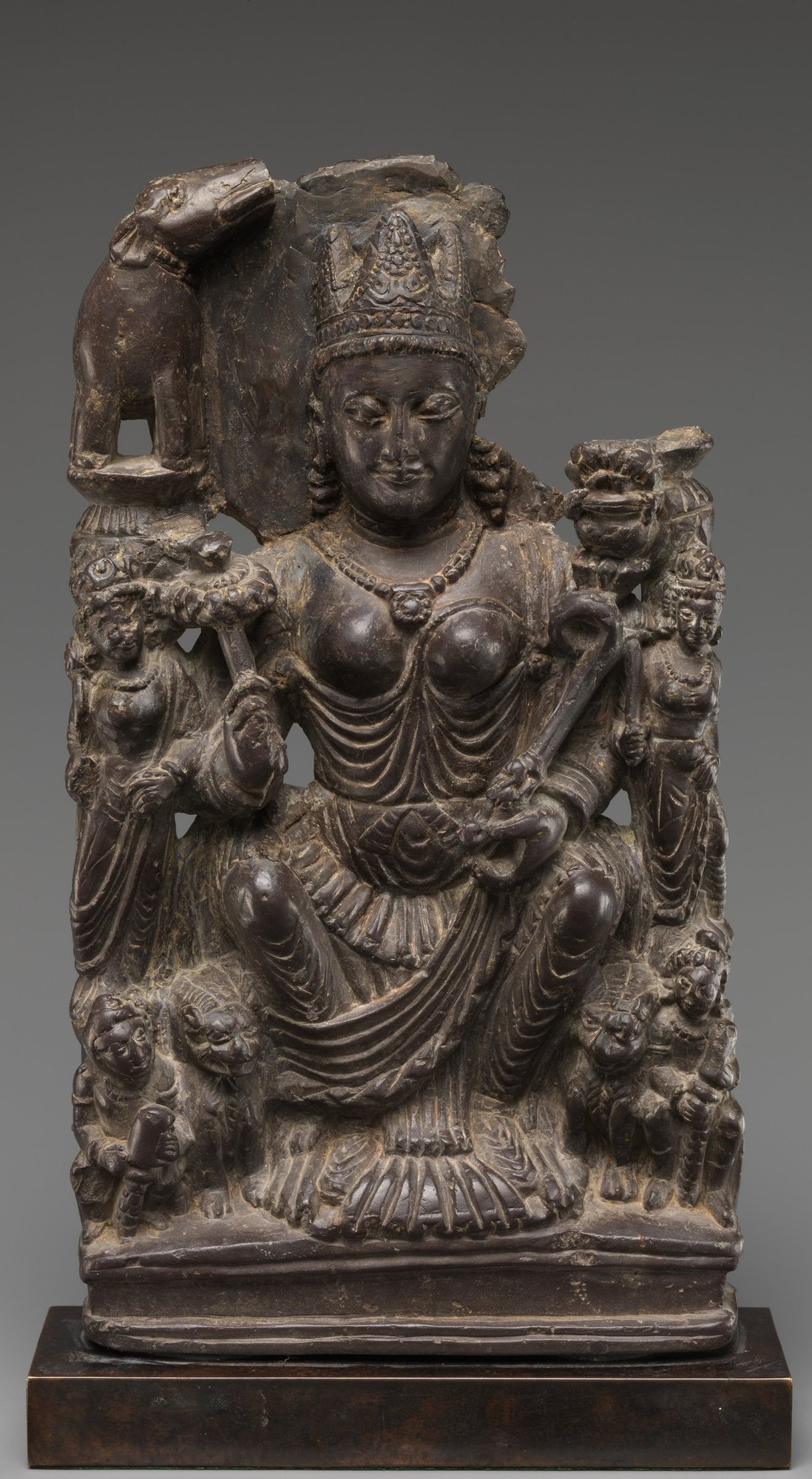
Bring her to me, the oldest hymn begins, and it does not ask the goddess directly. It asks the fire. The worshipper who wants Lakshmi kindles AgniThe Vedic fire-god and sacrificial flame (also called Jātavedas); in the Sri Sukta it is Agni who is asked to fetch Lakshmi to the worshipper., the sacrificial flame, and pleads with the flame to fetch her: golden of hue, tawny, garlanded in gold and silver, moon-bright, made of gold. This is the earliest substantial portrait of the goddess Hindus would come to call the giver of every good thing, and it is worth pausing on how narrow and how physical it is.
She is wealth made visible. The petitioner wants gold and cattle and horses and servants, and wants her opposite, AlakshmiLakshmi's opposite: misfortune, poverty, hunger, thirst and dirt, whom the Sri Sukta asks the goddess to drive from the house., who is hunger and thirst and dirt and ruin, driven out of the house. There is no husband here, no ocean, no birth-story at all. There is only a radiance summoned through fire into a home that needs her.
Golden, and drenched from no sea we are told of
The Sri Sukta, the hymn that opens this way, is a late addition to the Rigveda, one of its appendix hymns, a khilaAn appendix hymn attached to the Rigveda outside its core family books; the Sri Sukta is one such, later than the oldest Vedic verses., and though it is old it is not among the most ancient Vedic verses. Scholars place it broadly in the late-Vedic centuries, somewhere in the long stretch between roughly 1000 and 500 before the common era.
Its Lakshmi is already fully a goddess of fortune, but she is a goddess of a particular and limited kind: a fertility-and-wealth power invoked at the hearth-fire, fragrant, ever-nourishing, rich in cattle-dung and grain, called the sovereign of all beings and asked, plainly, for money. The hymn calls her moist, ārdrā, drenched, an image later readers loved to read as her rising, wet, from the sea. But the hymn itself tells no such story. The sea-birth, and the marriage that the whole of later Hinduism builds around her, belong to a different and much later stratum of the tradition, and the honest reader keeps the two apart.
Mother of the world, born twice
That later stratum speaks in the Puranas, and its portrait is vast where the hymn was narrow. The Vishnu Purana, composed in Sanskrit perhaps a thousand years or more after the Sri Sukta, in the middle of the first millennium of the common era, no longer treats Lakshmi as a wealth-power summoned into a house. It makes her the eternal, imperishable bride of Vishnu and the mother of the whole world, co-eternal with the god and stretched out as wide as he is. As he pervades everything, the text says, so does she; where he is meaning, she is speech. She is no longer fetched by fire. She is half of the structure of reality.
And the same text does something braver than most mythologies attempt. It admits that it does not know where she comes from, and refuses to choose. The pupil Maitreya raises the difficulty out loud: everyone says the goddess Sri was born from the sea of milk when it was churned for the nectar of the deathless, so how can you now tell me she was the daughter of the sage Bhrigu by his wife Khyati?
The teacher does not suppress one story in favour of the other. He reconciles them in time. Her first birth, he says, was indeed as Bhrigu’s daughter; it was only at a subsequent period that she was produced from the sea. Two origins, both kept, ordered rather than erased. A goddess this old has been born more than once, and the tradition would rather carry both memories than tidy one away.
Rising to choose
Of that second birth, the ocean-birth, only her own moment concerns us here, for the long labour of the churning belongs to its own telling. When the sea at last gives her up she comes not as one more treasure hauled from the deep but as its culmination, and the Vishnu Purana lingers on her as it lingers on nothing else that rose that day. Seated on a full-blown lotus, a water-lily in her hand, radiant with beauty, the goddess Sri rose from the waves.
The holy rivers came to attend her bathing; the elephants of the sky took up pure waters in vases of gold and poured them over her; the sea itself gave her a wreath of flowers that would never fade, and the divine artificer decked her in heavenly ornaments. Then, before all the assembled gods and demons who had churned for her, she made her choice plain in a single gesture. She cast herself upon the breast of Vishnu. The demons who had laboured beside the gods watched fortune turn her face away from them in the same instant, and knew they had lost.
The god’s shadow, in every life he lives
What the churning fixed, once and for all, is the thing that most defines her afterwards: she is never apart from Vishnu again. Whatever form he takes when he descends into the world, she takes the matching one and stands beside him. When he is the dwarf who measures the three worlds, she is the lotus at his side; when he comes as the axe-bearing Parashurama, she is the earth he fights for; when he is Rama, she is Sita, following him into exile; when he is Krishna, she is Rukmini, his queen.
His every life has her in it. This is the deep logic of a goddess of fortune wedded to the god who preserves the world: prosperity is what abides where order is kept, and so wherever the preserver goes to mend a broken age, abundance walks in at his side wearing whatever face the age requires.
She left the world only once, in the frame the Puranas give the churning, and the memory of that abandonment shapes her final promise. When she had risen and chosen and the gods were restored, the king of the gods sang her praises, and she granted him two boons: that she would never again forsake the three worlds, and that she would never desert anyone who repeated his hymn to her morning and evening. It is a small, human bargain at the end of a cosmic story. The goddess who was once summoned through fire into a single house now promises the whole world she will not leave it, on the one condition that it remember to ask.
What the two texts do not say
Almost everything a modern devotee pictures when they picture Lakshmi is younger still than the Purana. The goddess flanked by two elephants that pour water over her, the Gaja-Lakshmi of temple lintels and festival posters, has a genuine root in these texts, for the sky-elephants do bathe her at the churning and the Sri Sukta already knows the sound of elephants about her.
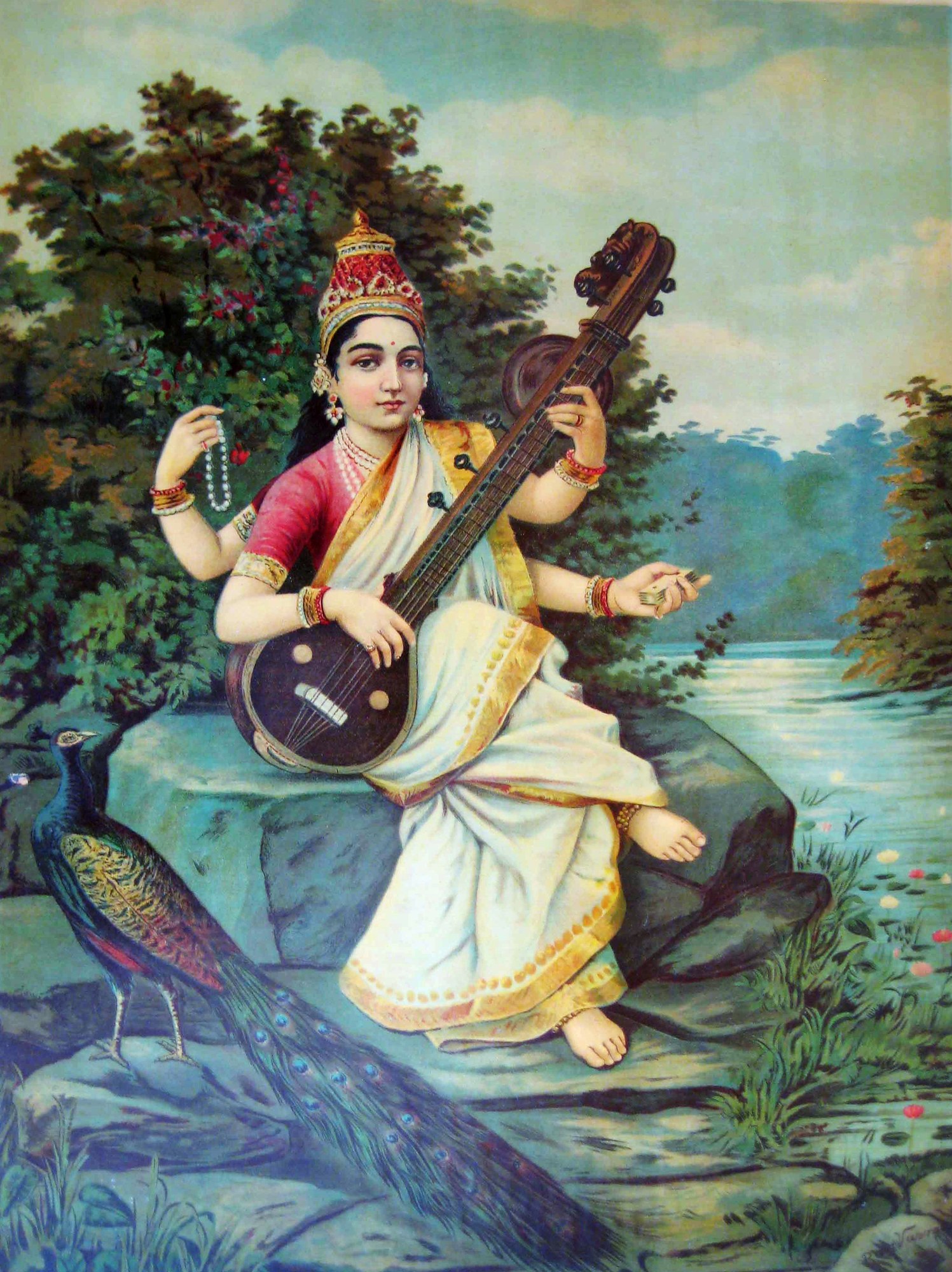
But her four arms, the coins showering endlessly from her open palm, the owl she rides, and above all her firm attachment to Diwali, the festival of lights at which Indian households still throw their doors open to invite her in, are later growths of iconography and worship, not a narrative the Sri Sukta or the Vishnu Purana tells. The image is ancient at its root and modern in its flower, which is fitting for the goddess of abundance: she keeps arriving, in every age, wearing what that age can recognise as good fortune.
Then, seated on a full-blown lotus, and holding a water-lily in her hand, the goddess Sri, radiant with beauty, rose from the waves. (Vishnu Purana 1.9, tr. H. H. Wilson)
- Sri Sukta (Śrī Sūkta), a khila (appendix) hymn attached to the Rigveda, 15 ṛcs plus a phalashruti (incipit hiraṇyavarṇāṃ hariṇīṃ suvarṇarajatasrajām,
of golden hue, tawny, garlanded in gold and silver
)the earliest hymnic portrait of Śrī-Lakshmi — golden, moon-bright, lotus-seated,moist
(ārdrā), invoked through Agni (Jātavedas, the sacrificial fire) for gold, cattle, horses and servants, and to banish Alakshmi (poverty, hunger, thirst, dirt). No churning-birth and no marriage to Vishnu appear in this text. Sanskrit read verbatim (Sanskrit Wikisource); English imagery via Ranganatha Muni’s bhashya (tr. A. Srinivasa Raghavan, 1937), a working rendering, so the imagery is paraphrased rather than quoted. Late-Vedic, commonly dated c. 1000–500 BCE. - Vishnu Purana, Book I, Chapter 8 (H. H. Wilson trans., 1840)Sri as the eternal, all-pervading consort of Vishnu and mother of the world (
in like manner as he is all-pervading, so also is she… omnipresent
); the Sri/Vishnu identity litany (he meaning, she speech); and her first birth as the daughter of the sage Bhrigu by his wife Khyati, together with Maitreya’s objection that she was said instead to be born from the sea. Sanskrit text c. 4th–6th c. CE. - Vishnu Purana, Book I, Chapter 9 (Wilson trans., 1840)the reconciliation of her two births (
her first birth was as the daughter of Bhrigu by Khyati: it was at a subsequent period that she was produced from the sea
); her lotus epiphany (seated on a full-blown lotus… radiant with beauty, rose from the waves
); the sky-elephants pouring pure waters over herfrom vases of gold
; the sea’s wreath of never-fading flowers; her casting herselfupon the breast of Hari
; her accompanying Vishnu in every descent (Padma with the dwarf Vāmana, Dharani with Parashurama, Sita with Rama, Rukmini with Krishna); and the two boons granted after Indra’s hymn of praise. - Vishnu Purana, Book I, Chapter 9, Wilson’s footnote 8the editorial finding that the Durvasa-curse frame for the churning is
an embellishment added to the original,
absent from the Matsya Purana and the Hari Vamsa and from the oldest epic versions (the Ramayana and Mahabharata), which ascribe the churning simply to the gods’ and demons’ desire for immortality — the ground on which this piece treats the curse-frame as later, not original.