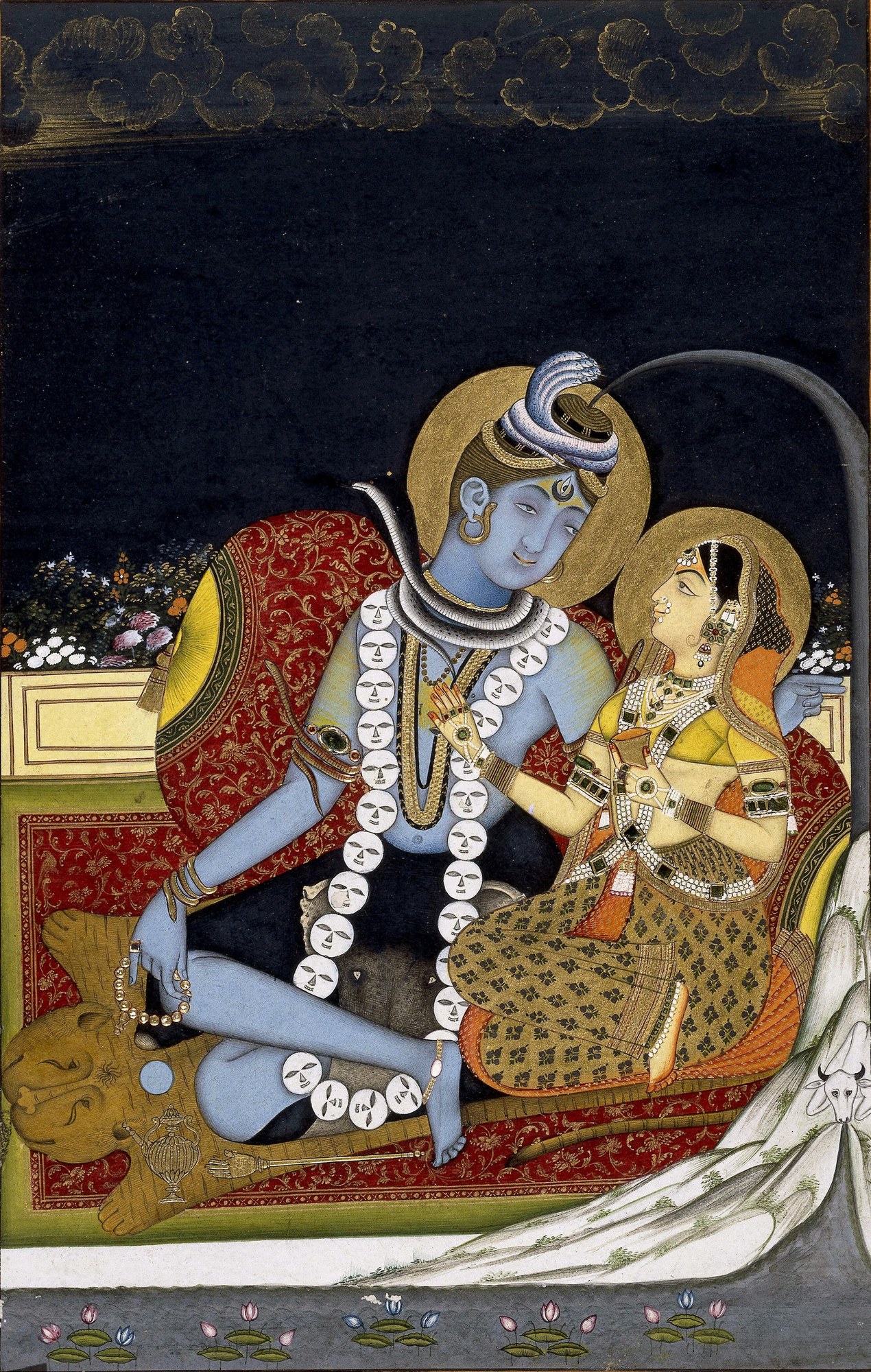
She had been a wife before, and had walked out of that body on purpose. In the older grief of the story, before there is any daughter of the mountain, there is Satī: Śiva’s first wife, whose father Dakṣa had insulted the god she loved past bearing. She did not fling herself onto a fire. She sat, drew the vital breath up through her own body from the navel to the brow, and let an inner heat reduce her to ash in accordance with her own wish. Dying, she made a choice about what came next. She would be born again to Menā, the wife of the mountain-king, because Menā had once loved her like a daughter. The goddess the tradition calls benevolent begins with a woman deciding, on the way out of one life, exactly how to walk into the next.
Born at midnight in spring
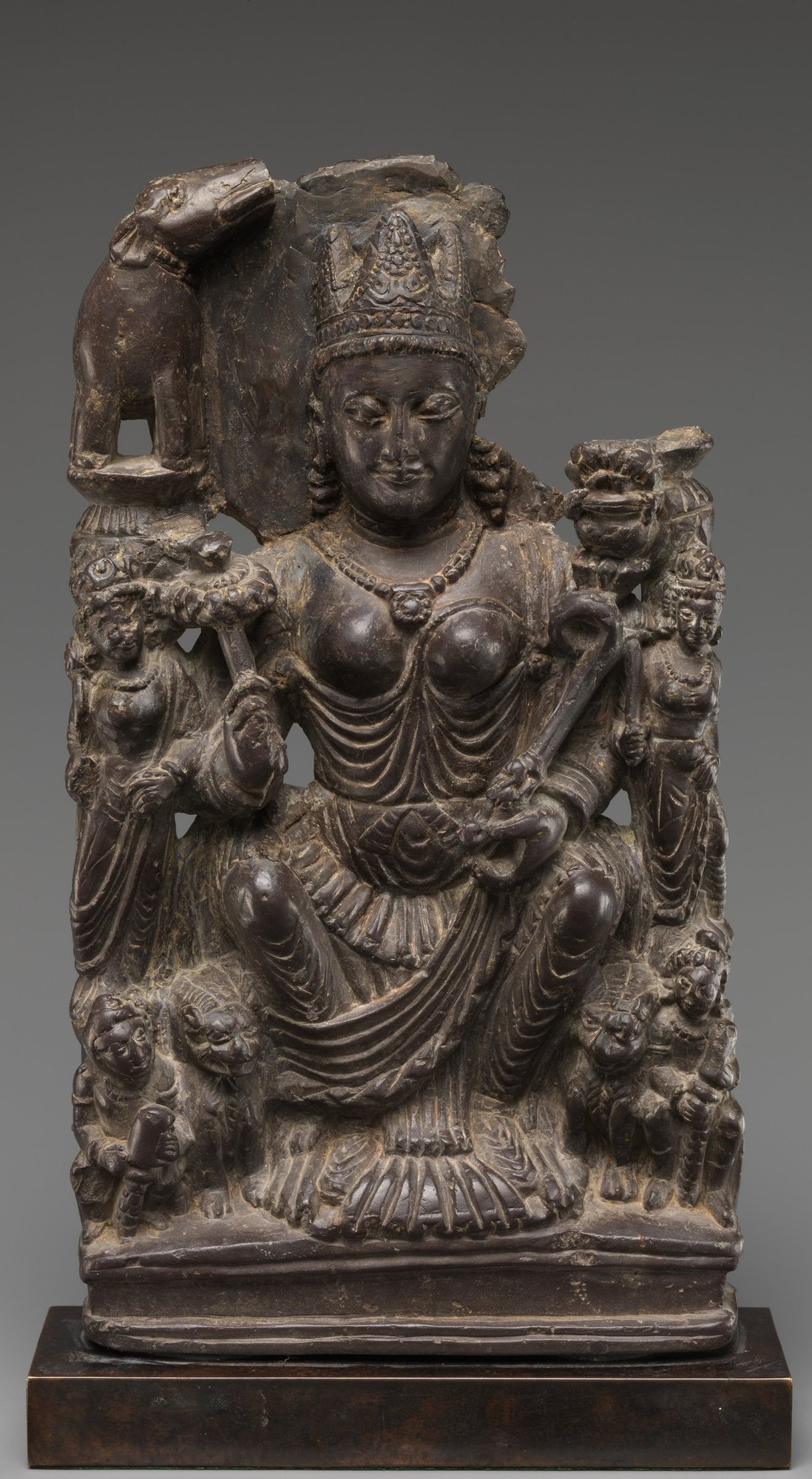
She kept the promise. To the mountain-king Himavat, whom the poets give both a human shape and the range of snow itself, and to his wife Menā, a daughter came at length, born at midnight in spring under the constellation Mṛgaśiras, with flowers falling from the sky and the divine musicians singing. They called her Pārvatī, and the name is a plain fact of her parentage: it means Daughter of the Mountain, the child of Himavat’s line. Kālidāsa, writing his court poem around the fourth or fifth century, says that as an infant she had no other name but Child of the Mountain.
The name that stuck to her came from her mother’s fear. When the girl grew and turned to fierce austerity, Menā cried out to stop her, the syllables u mā, O, do not.
The word became a name, and Umā she was called from then on. It is worth noting how old this is against how young the fuller story is: the figure of Umā the Daughter of the Mountain surfaces in the Kena Upaniṣad, perhaps the sixth to fourth century before the common era, where she reveals the highest truth to the gods. That is roughly a thousand years before the elaborate biography of rebirth and penance was written down.
Why beauty was no use
Here is the thing the retellings most often get backwards. Parvati did not win Śiva with her beauty. Her beauty is precisely what failed. The gods needed her married to the ascetic god for a reason larger than love: only a son begotten by Śiva could kill the demon Tāraka, whom no other power could touch, and so they engineered the match.
But Śiva was sunk in meditation and wanted no wife, and when the love-god Kāma crept up to loose an arrow of desire at him and turn his mind toward the girl, Śiva opened his third eye and burnt Kāma to ash where he stood. Desire itself, sent against him, was incinerated. The lovely daughter of the mountain, presented to him fresh and adorned, moved him not at all.
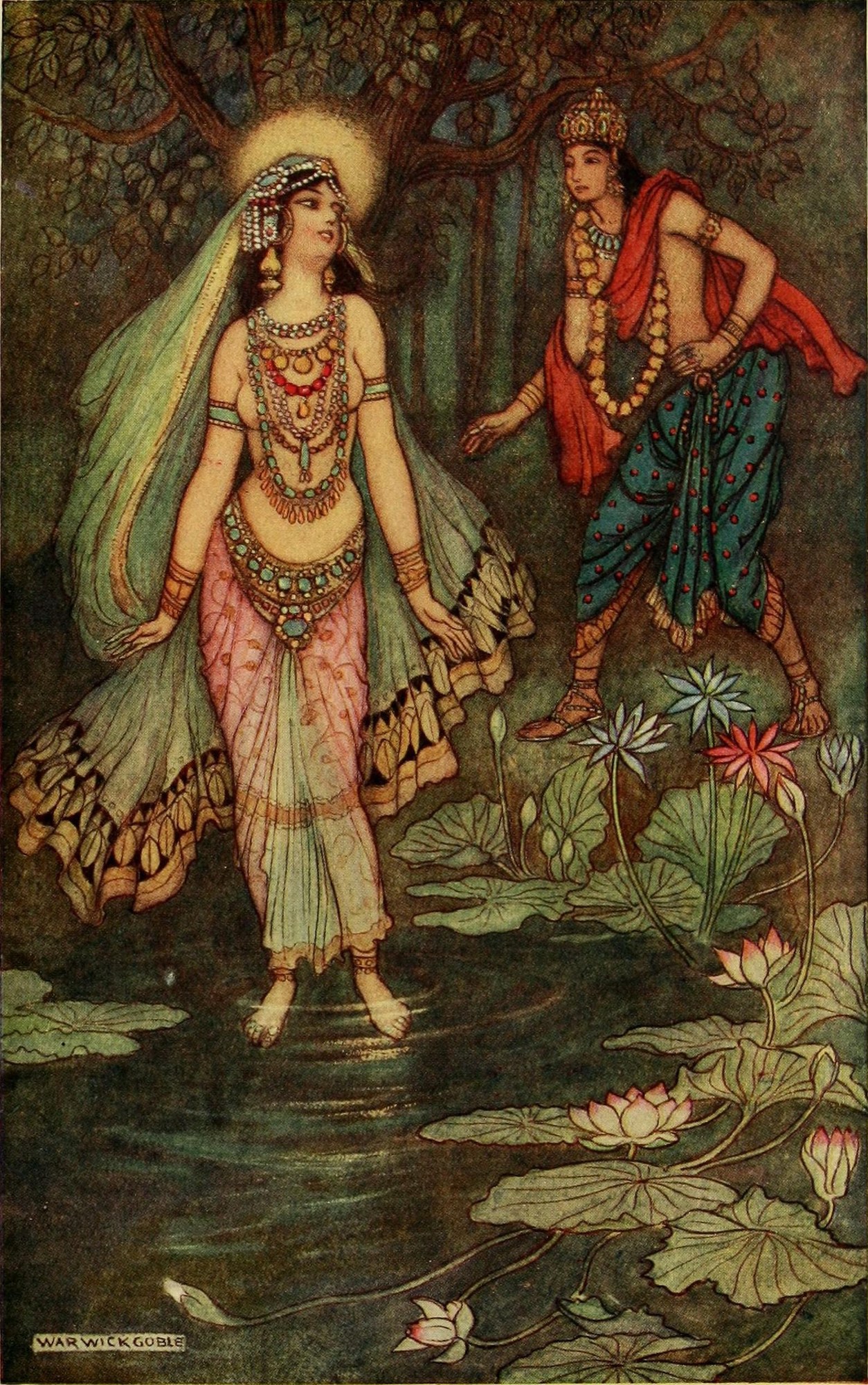
So she took the only road left, and it was the hard one. She put off her jewels for a bark hermit-coat and a girdle of grass, rough against limbs that had known better, let her hair mat, and went into the forest to raise tapasThe heat of ascetic penance: the self-generated inner fire a Hindu ascetic raises through fasting and endurance, and the power it confers., the heat of ascetic penance, until the god could not ignore what she had made of herself.
Standing between the fires
Kālidāsa lingers on what that cost her, because he is a poet of the body and he knows the reader must feel it. She sat through the summer full in the centre of four blazing piles of fire, the sun a fifth furnace overhead, and did not flinch. She lived on the nectar of moonbeams and on stream-water. When the monsoon came she let the rain slide down her unsheltered body; when winter came she lay on the bare, frozen ground. She watered the young trees of the forest daily like their nursing mother and gentled the wild fawns until they fed from her hand.
Then she gave up her food. The last and highest stage of the fast, the poets say, is to live on the leaves that fall of themselves from the trees, taking nothing that must be plucked. Even that Parvati refused. She ate nothing at all, and for it the gods gave her the title AparṇāThe title Parvati earns by giving up even fallen leaves in her fast; from a-parṇā, "leafless," the maiden of the unbroken fast., the leafless one, the maiden of the unbroken fast. The name is a monument to a refusal: it records not what she took but what she would not.
The stranger who slandered the god
When the god came to her at last, he came in disguise, to see whether the penance was real or merely spectacular. In Kālidāsa’s telling a young brahmin hermit appears, praises her devotion, and then turns and reviles the very god she is starving herself to win. He calls Śiva a beggar of unknown ancestry, snake-wreathed and smeared with the ash of the dead, clothed in a bloody hide, riding a bull, crowned with a sliver of moon, carrying a broken skull.
Parvati hears the slander and answers in fury, turning each ugliness into a glory: the funeral ash on him, she says, touched by that body, takes the lustre of eternal fire. She has heard enough, and she turns to leave rather than stand and listen. And the hermit puts off his disguise: it is Śiva himself, telling her that from this hour he is her slave, won not by her face but by her penance.
The Śiva Purāṇa, a compilation that reached its present form perhaps five to eight hundred years after Kālidāsa, tells the same test in two moves rather than one. First the god sends the Seven Sages to probe her resolve with cutting, deceitful remarks; she holds firm. Only then does Śiva come himself, disguised as a matted-haired old ascetic, to insult himself to her face and be driven off before he is revealed.
Read the two together and one caution is worth keeping: this is not two witnesses agreeing across the room. The motif of the disguised, self-slandering suitor is genuinely old, fixed by Kālidāsa’s poem; the doubled test and the elaborate causal machinery around it belong to the later scripture. They are half a millennium apart, and the story only looks seamless because both were folded into one tradition long after the fact.
The bridegroom with no lineage
The wedding nearly broke on a technicality, and the snag is the most revealing thing in it. As Himavat prepares to give his daughter away, he asks the bridegroom, as any father must, to recite his gotraAn ancestral clan-line traced to a founding sage, which a groom must recite at a Hindu wedding; the rite stalls when the groom is Śiva, who has none., the ancestral lineage a groom names at a Hindu wedding, along with his family and his Veda. Śiva turns his face away. He has no gotra.
The god who is to father the saviour of the worlds cannot answer the ordinary question a village marriage would put to any man, because he stands outside the whole system of lineage and name. The sage Nārada breaks the deadlock by declaring what Śiva is: identical with Nāda, primordial sound itself, so that he both has no lineage and is the source all lineages come from. The mountain’s daughter, who chose her own second birth and won her husband by burning away everything soft in herself, marries a god who cannot say where he is from because he is where everything is from.
Their son would be the war-god the whole plan was for, born to kill the demon Tāraka. But that is his story, not hers. Parvati’s own story is the one that ends here, at the altar, with the ascetic she wanted kneeling as her slave and her father’s reasonable question left hanging in the air, unanswerable and answered at once.
The words the god speaks when he sheds the disguise are the whole story in four lines. It was never the face that moved him:
O gentle maiden, wise and true of soul, Lo, now I bend beneath thy sweet control. Won by thy penance, and thy holy vows, Thy willing slave ŚIVA before thee bows. (Kumārasambhava V.86, tr. Ralph T. H. Griffith)
- Kālidāsa, Kumārasambhava, Cantos I and V (Griffith verse translation, The Birth of the War-God, 1879, Project Gutenberg #31968)the earliest sustained literary telling, c. 4th–5th c. CE, read verbatim. Canto I supplies Himavat and Menā, the spring birth, the
u mā
naming that yields Umā, and the title Aparṇā; Canto V supplies the four-fire penance, the moonbeam-and-water diet, the bark coat and grass girdle, and the full disguised-brahmin test with Śiva’s self-revelation (block-quoted here). Griffith rendered only the genuine Kālidāsa core (Cantos I–VIII); the later continuation is not used. - Śiva Purāṇa, Rudra-saṃhitā (2), Satī-khaṇḍa ch. 30 (J. L. Shastri trans., 1950, via wisdomlib)Satī’s death by inner yogic fire, an act of her own will, read verbatim. The extant Purāṇa dates c. 10th–13th c. CE, some five to eight centuries later than Kālidāsa; the elaboration around the shared motifs is this later layer, not a second ancient witness.
- Śiva Purāṇa, Rudra-saṃhitā (3), Pārvatī-khaṇḍa (Shastri, read verbatim)Satī’s resolve to be reborn to Menā and the marriage of Himavat and Menā (ch. 1); the spring birth (ch. 6); Śiva’s consent, the demon Tāraka and the burnt love-god as the reason the wooing must be won by penance (ch. 24); the two-stage test, the Seven Sages then Śiva-as-Jaṭila (chs. 25–28); and the marriage with the gotra-into-Nāda resolution (ch. 48).
- Kena Upaniṣad §3 (the Umā Haimavatī episode), c. 6th–4th c. BCEthe earliest textual trace of the goddess-figure, roughly a millennium before the Purāṇic biography. Cited as the earliest attestation; not read verbatim this session.
- David Kinsley, Hindu Goddesses (1988), pp. 36–41, with E. W. Hopkinsthe dating of the Satī–Pārvatī complex, the non-Aryan mountain-goddess hypothesis, and the late Haṃsa Upaniṣad as the first use of the actual name
Pārvatī.