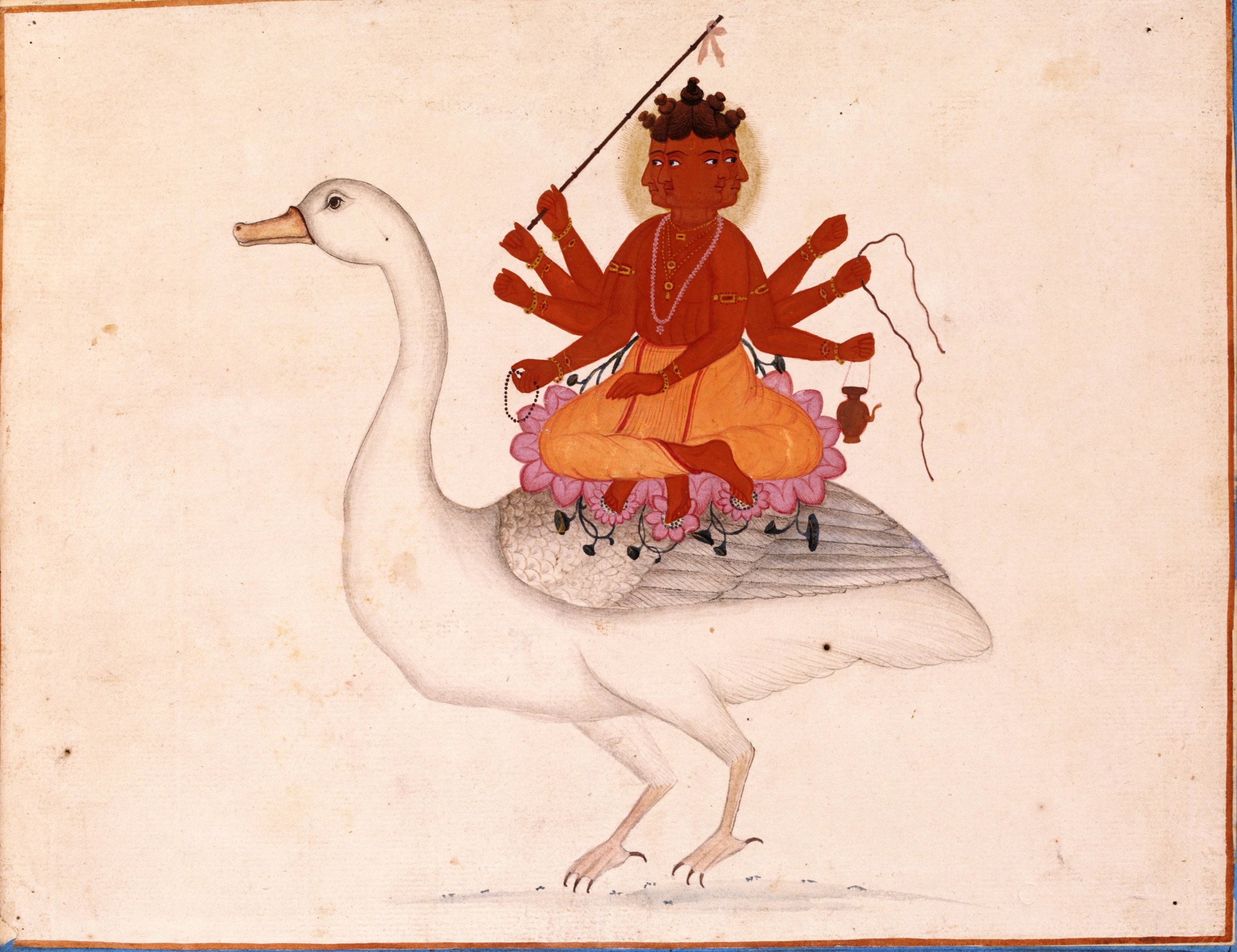
Nothing has a shape yet, and there is water everywhere. On that shoreless flood lies a single golden thing, round and shut, and inside it the whole world is folded up unmade: the continents and the seas, the mountains, the planets and the stars, the gods and the demons and every human being that will ever live, all of it packed into a sphere resting on the surface of the deep. This is the Brahmāṇḍa, the egg of Brahmā, and it is not a mountain a traveller could reach or a heaven a soul could climb to. It is the universe itself, seen from outside for the one moment before there is any inside to stand in.
The word says what it is. Brahmāṇḍa breaks into Brahmā and aṇḍa, egg,
so the whole cosmos is named as a single egg belonging to the creator, the shell in which he is enclosed and from which he issues. The Purāṇas that describe it are not interested only in what happened. They are interested in the shape of the container, and the shape is the strangest and most exact thing they give us.
Expanded like a bubble of water
Before the egg is a shell it is a swelling. The Viṣṇu Purāṇa sets out an order of unfolding that the Sāṅkhya thinkers had worked out long before: primordial matter stirs, and out of it come intellect, then the sense of self, then the subtle rudiments of the senses, and last the five gross elements, earth and water and fire and air and ether.
Each stage is a tattvaA 'principle' or evolved reality in Sāṅkhya cosmology: the ordered stages, from intellect and ego down to the gross elements, out of which the material world unfolds., a principle laid down in sequence like sediment. When the gross elements are finally present, they gather, and from the direction of spirit they combine and close into a form. The text reaches for the plainest possible image for what that closing looks like. The elements, it says, formed an egg, which gradually expanded like a bubble of water.
The cosmos does not begin as a fixed sphere dropped into the sea. It begins as a bubble, thin-walled and swelling on the surface of the flood, a process caught at the instant it becomes a thing.
A womb as vast as Meru
And it is enormous past any use of the word. The Viṣṇu Purāṇa measures the interior against the largest object its own cosmography knows. The egg’s womb, it says, was vast as the mountain Meru, and it was built out of the mountains themselves; the mighty oceans were the waters that filled its cavity. The scale inverts: the great world-mountain, taller than any distance a body could walk, is here merely the size of the shell’s inner chamber, and all the oceans of the world are just the fluid standing in the bottom of it.
Inside, the egg holds the entire cosmos, and the Purāṇas list its contents with a kind of relish. In that egg, the Viṣṇu Purāṇa says, were the continents and the seas and the mountains, the planets and the divisions of the universe, the gods, the demons, and mankind.
The Brahmāṇḍa Purāṇa, from which the object takes its name, fills the same interior out further: the seven worlds are established within the egg, and with them the whole earth and its seven continents, the seven oceans, the great mountains and the thousands of rivers, the moon and the sun with the stars and the planets, and out at the edge of the light the ring-mountain Lokāloka that divides the lit world from the dark. Everything that is anywhere is in here. There is no outside to any of it except the shell.
Each skin ten times the last
Then comes the image that makes the Brahmāṇḍa unlike any other cosmic egg, the heart of the whole conception. The shell is not one shell. The egg is wrapped in seven concentric skins, one inside the next, and each skin is ten times the extent of the one it encloses.
The Viṣṇu Purāṇa names them moving outward from the surface of the egg: water, then air, then fire, then ether, then Ahaṅkāra, the sense of self out of which the elements arose, then Mahat, intellect, and finally, sheathing the whole, the indiscrete Principle, unmanifest matter itself. Each envelope is tenfold the one within it, so that the sizes climb by powers of ten from the innermost watery skin to the vast dark rind at the rim.
The Brahmāṇḍa Purāṇa gives the same seven and the same tenfold rule as a clean outward sequence, water to fire to wind to ether to the ego-principle to intellect to PradhānaPrimordial unmanifest matter, the beginningless source of every inner principle and, as the egg''s outermost skin, the rim of the whole created world., and calls them the seven Āvaraṇas, the seven coverings that belong to primordial nature. The two texts differ a little on the order of the middle skins, fire and wind changing places between them, and one of the Brahmāṇḍa Purāṇa’s lines survives only in a damaged state and had to be restored by its editor from a parallel passage; the honest statement is not a single fixed roster but the scheme itself, seven elemental sheaths, each ten times the one within, from water at the core to unmanifest matter at the rim.
For the whole layered picture the Viṣṇu Purāṇa reaches, beautifully, for a fruit. The seven-sheathed egg, it says, resembles the cocoa-nut, filled interiorly with pulp and exteriorly covered by husk and rind. It is a domestic image for the largest object imaginable: crack the universe like a coconut and you would find the worlds inside it as the white meat, wrapped first in the close husk and then in the coarse outer shell, layer under layer under layer.
The Bhāgavata Purāṇa, compressing the same doctrine into a line, calls the egg Viśeṣa and says only that it is surrounded by elements, water and the rest, each ten times bigger than the last, and covered on the outside by Pradhāna. The multiplier and the outermost skin stay constant wherever the doctrine is told.
The egg that is a body
There is one more turn, and it changes what the egg is. The shell is not merely a container the god happens to sit in. In the Viṣṇu Purāṇa the egg is the natural abode of Viṣṇu in the form of Brahmā, the maker enclosed in the thing he will unfold. The Bhāgavata Purāṇa goes further and identifies the two outright: from the egg arises the Virāṭ-puruṣaThe cosmic Person, the universe imagined as a single colossal body, born from the egg and animated when the Soul enters it., the cosmos imagined as one gigantic Person, and the text says plainly that this extensive world is the body of Lord Hari.
The universe is not a room the god stands in. It is the god’s own frame, and the Bhāgavata narrates the deities taking up residence in it organ by organ, fire entering the mouth, the wind the nostrils, the sun the eyes, so that every force in the world is a faculty of a single sleeping body. The egg is only inert, the text is careful to add, until the Soul enters it; then the Person wakes and rises from the water.
Around and beneath the whole image lies the flood, the EkārṇavaThe single boundless flood, the one undivided ocean on which the creator lies asleep before the world takes shape., the one boundless ocean the Brahmāṇḍa Purāṇa describes before anything is made, with the thousand-headed, golden-hued creator lying alone upon it. The egg floats on that flood; the worlds float in the egg; and the god is at once the sleeper on the water, the shell around the worlds, and the body the worlds compose.
The coconut and the older seed
It is tempting to read the layered egg back to the beginning of the tradition, as though this were how India had always pictured the cosmos. It was not. The image of a golden egg on the first waters is genuinely ancient: the oldest Veda already sings of Hiraṇyagarbha, the golden germ, who arose in the beginning as the one lord of all created beings and held up the earth and the heaven.
But that Vedic hymn belongs to roughly a thousand years before the common era, while the elaborate machinery of the seven tenfold sheaths, the tattvas laid down in Sāṅkhya order, the egg equated with the cosmic body, is the work of the Purāṇas around the middle of the first millennium of the common era. The gap between the Ṛgvedic golden germ and the Purāṇic layered Brahmāṇḍa is on the order of fifteen centuries. The seed is Vedic; the coconut, with all its skins, is a much later growth on it, and the reader reaching back for origins should not credit the Vedas with a scheme their heirs invented.
The three Purāṇas that do carry the scheme, on the other hand, are near neighbours in time, all of them recensions within the same few centuries, so their agreement is not the meeting of far-separated witnesses but the shared inheritance of one closely related family of texts. That is why they can differ on the order of a middle skin and still hold the same count of seven and the same rule of ten.
The later comparison of the Brahmāṇḍa to the world-eggs of other peoples, the Orphic egg of the Greeks and the cosmic eggs of Egypt and Persia, belongs to something later still: the footnotes of a nineteenth-century British Sanskritist, drawing his own lines across cultures three thousand years after the Vedic hymn. It is a real and suggestive parallel, but it is his observation, not a claim the Purāṇas make about themselves.
What the Purāṇas themselves offer is stranger and more precise than any parallel: a universe you could hold, in principle, the way you hold a coconut, wrapped in seven skins that climb by tens, floating shut on a shoreless sea, with the worlds and the gods and every one of us folded into the pulp, and the whole thing at once the house of the creator and his living body.
Its womb, vast as the mountain Meru, was composed of the mountains; and the mighty oceans were the waters that filled its cavity… And this egg was externally invested by seven natural envelopes… each tenfold the extent of that which it invested… resembling thus the cocoa-nut, filled interiorly with pulp, and exteriorly covered by husk and rind. (Viṣṇu Purāṇa I.2, tr. H. H. Wilson)
- Viṣṇu Purāṇa I.2 (
Prayer of Parāśara to Viṣṇu
; the cosmogony, the egg and the seven envelopes), trans. H. H. Wilson (1840), public domainthe tattva-evolution from primordial matter through intellect, ego, the subtle rudiments and the five gross elements; the elements thatformed an egg, which gradually expanded like a bubble of water
; the eggresting on the waters,
the excellent natural abode of Viṣṇu in the form of Brahmā
; its wombvast as the mountain Meru… composed of the mountains
with the oceans filling its cavity; the contentsthe continents and seas and mountains, the planets and divisions of the universe, the gods, the demons, and mankind
; the seven envelopesof water, air, fire, ether, and Ahaṅkāra the origin of the elements… next came the principle of Intelligence; and, finally, the whole was surrounded by the indiscrete Principle: each tenfold the extent of that which it invested
; and the closing simileresembling thus the cocoa-nut, filled interiorly with pulp, and exteriorly covered by husk and rind.
The single fullest verbatim statement of the layered egg. Text core generally dated c. 4th–5th century CE; Wilson’s the standard 19th-century English. - Bhāgavata Purāṇa 3.26.51–53, 63–70 (Kapila’s Sāṅkhya cosmology), trans. G. V. Tagare (Motilal Banarsidass, 1976)the egg called Viśeṣa, born of the synthesised principles; the Virāṭ-puruṣa arising from it; the elemental wraps
each ten times bigger than the previous one,
covered on the outside by Pradhāna; the declaration thatthis extensive world is the body of Lord Hari
; the golden egg lying on the water and rising only when the Soul enters; and the deities entering the organs of the cosmic body one by one (fire to the mouth, wind to the nostrils, sun to the eyes, and the rest). Usually dated c. 9th–10th century CE, some centuries later than the Viṣṇu Purāṇa’s core. Tagare’s English is in copyright and is cited here for verse location and content, not reproduced. - Brahmāṇḍa Purāṇa I.1.3.29–34 and I.1.5.1–3 (
Description of the Evolution of the Universe
; the Ekārṇava cosmic ocean), trans. G. V. Tagare (Motilal Banarsidass, 1958)the seven worlds established within the egg, together with the seven continents, seven oceans, the great mountains and thousands of rivers, the sun, moon, stars and planets, and the ring-mountain Lokāloka; the seven Prākṛtic Āvaraṇas sheathing the egg in outward order, water → fire → wind → ether → Bhūtādi (the ego-principle) → Mahat → Pradhāna,each tenfold
the last; and the boundless flood (Ekārṇava) on which the thousand-headed, golden Brahmā-Nārāyaṇa lies alone before creation. The Brahmāṇḍa Purāṇa is reckoned among the oldest Purāṇas (core c. 4th–6th century CE), its text layered. Cited for location, structure and content, not reproduced (Tagare’s English in copyright). Note: verse I.1.3.32 is a defective text whose innermost-shell line is an editorial restoration from Vāyu Purāṇa 4.84a; the count of seven and the tenfold rule are secure across the Viṣṇu, Brahmāṇḍa and Vāyu Purāṇas, but the exact wording of that one restored line is reconstructed, not attested. - Ṛgveda 10.121 (Hiraṇyagarbha Sūkta), trans. R. T. H. Griffith, The Hymns of the Rigvedathe
golden germ
Hiraṇyagarbha whoin the beginning
rose asborn Only lord of all created beings
andfixed and holdeth up this earth and heaven.
From Maṇḍala X, the latest layer of the Ṛgveda, commonly dated c. 1200–1000 BCE. Cited here only to mark the Vedic root of the golden-egg motif, roughly fifteen hundred years older than the layered Purāṇic Brahmāṇḍa, and NOT as a witness to the seven-sheath scheme, which is a later Sāṅkhya-flavoured Purāṇic elaboration.