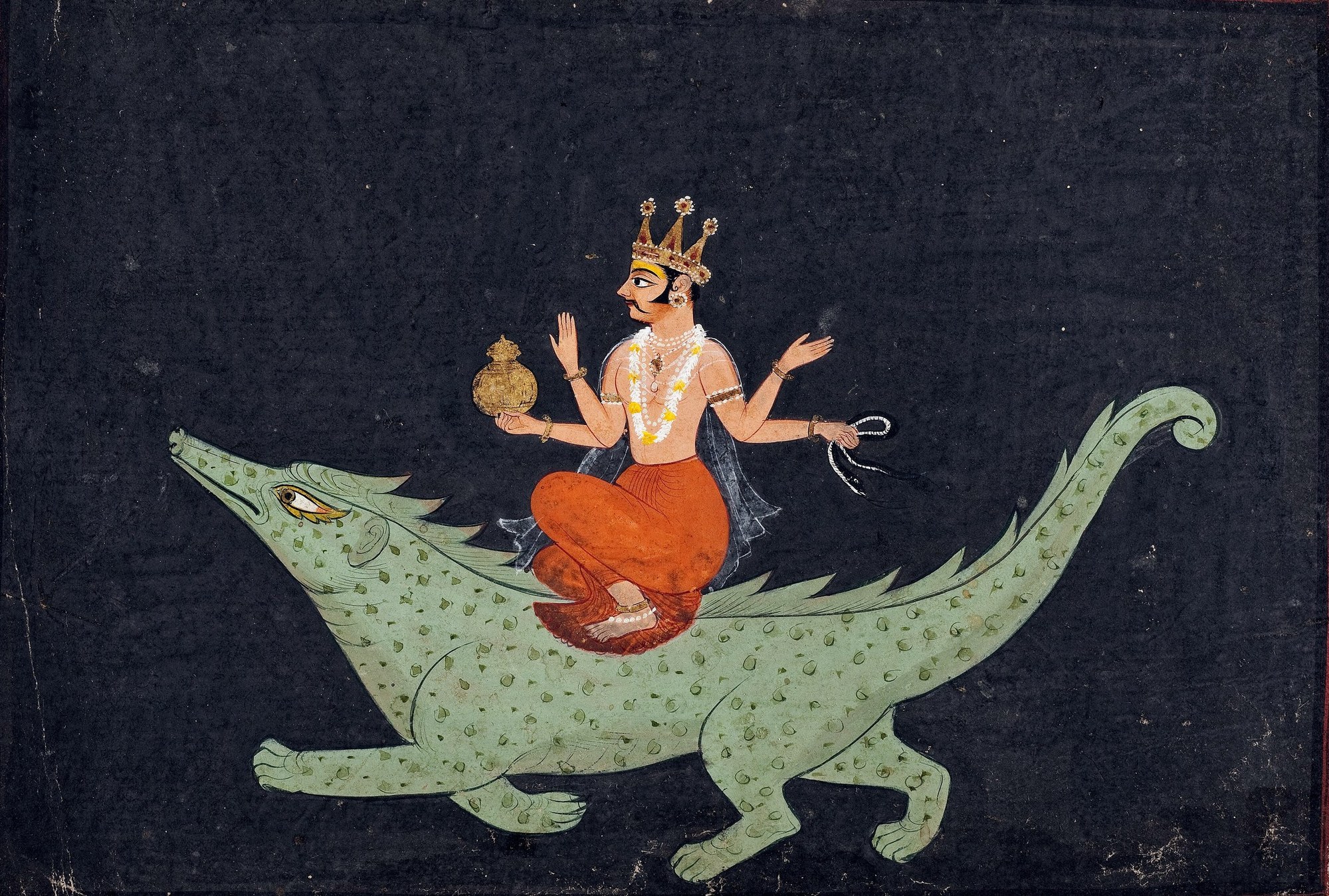
Two people sit down together and lower their voices, and a third is already listening. Not from behind a curtain or across the room, but from the sky, and from close by at the same time, because distance is nothing to him. Whatever the two of them think they are concealing, the oldest hymns say, the gods already know, and one god above the rest keeps the account. He is the great superintendent, and he sees as if he stood at your shoulder. He is the sovereign who props heaven and earth apart and who cut the pathway for the Sun, and he is also the one who counts, patiently and without end, how many times each human being has blinked.
This is Varuna as the earliest layer of Indian scripture draws him, and it is worth saying at once which layer that is, because Varuna does not stay this large. The hymns quoted here belong to the Ṛgveda and the Atharvaveda, the two oldest strata of the Veda, composed by oral poets somewhere between roughly 1500 and 900 BCE and written down only far later.
In that early world Varuna stands among the first rank of the gods. A thousand years and more after these hymns, in the epics and the Purāṇas, he shrinks to a lesser power, a god of the western ocean and the waters and little else. The noose stays in his hand, but the sky is no longer his. What follows is the sovereign of the older poems, not the sea-god he became.
The god who props the sky apart
Before he is a watcher he is a maker of order, and the order is physical before it is moral. Varuna is the one who holds heaven and earth asunder and keeps the space between them open; the one who urged the high sky to its motion and spread the earth beneath it.
He cut a channel for the Sun to travel and set the rivers running toward the sea, and the days follow the great course he made for them. When the poet wants to praise the regularity of the visible world, that night gives way to day and the moon and stars keep their stations, he says that Varuna’s holy laws remain unweakened, and through the night the moon moves on in splendour.
That phrase, holy laws, is the translator’s. The Sanskrit concept underneath it is rita, the order that is at once how the cosmos runs and how a life ought to be conducted, truth and lawfulness and the fitness of things all in one word. The Victorian scholar Griffith, whose renderings are quoted throughout here and who was writing some three thousand years after the poets, almost never uses the Sanskrit term; he gives it as holy law,
Law,
order,
hallowed might.
So the reader should hold the word rita in mind as the thing Varuna guards, while remembering that the stately English of these quotations is Griffith’s coat thrown over it, not the naked Vedic word.
Thousand-eyed, seated round about
The physical order and the moral order are the same order, and this is why the god who steadies the sky is also the god who watches conduct. The fullest statement of the watching comes from the Atharvaveda, the later of the two collections, whose surveillance imagery is more developed than anything in the Ṛgveda proper and postdates those hymns by something like two to four centuries. The gap is small as these things go, close kin rather than one voice, but it is real, and the elaborated all-seeing Varuna is most at home in the younger book.
There the vision is total and strangely intimate. His spies go forth from the sky and, thousand-eyed, look out over the whole earth. What two people say sitting together, the hymn insists, King Varuna knows as the third among them. He has numbered the very blinks of humankind, and the image the poet reaches for is a gambler at the board: as a gambler fixes the dice, so Varuna fixes these things.
Even the shape of the world is his body, for the two oceans, the poet says, are Varuna’s two paunches, and he lies hidden even in a little puddle of water. The Ṛgveda gives the same all-seer a throne, where he sits among his people to govern all and beholds what has been and what will yet be done, knowing the path of the birds through the air, the ships upon the sea, and the thirteenth intercalary moon. Nothing hidden is hidden from him.
Seven by seven, a hundred fetters
The watching would be idle without a consequence, and Varuna’s consequence is a cord. His signature instrument is the pāśaThe noose or fetter Varuna casts over the guilty; the translations here say 'fetters' and 'bonds', 'noose' being the standard word for the concept., the noose or fetter he throws over the guilty, and the poets multiply it with relish. In one hymn the fetters stand seven by seven, triply relaxed and shining, and the prayer is that they bind whoever speaks untruth and let the truth-speaker go free. In another the count leaps to a hundred: with a hundred fetters bridle the liar, the poet asks, let not the speaker of untruth escape you, watcher of men. The exact number is never the point; the point is that the order has a grip, and the grip closes on falsehood.
The punishment that follows is grimly specific. The bound liar is left with his belly falling apart, in the poet’s words, like a hoopless vessel, a barrel whose bands have burst. Whitney, who translated the Atharvaveda hymn, notes plainly what this is: the disease is dropsy, the swelling of the body with water, and it is Varuna’s punishment for sin. The Ṛgveda dramatises the sufferer from the inside.
Let me not yet enter the house of clay, he begs, the house of clay being the grave; I move along tremulous like a wind-blown skin. And the cruellest detail, the paradox that names the disease without naming it: thirst found your worshipper though he stood in the very midst of the water-floods. A man drowning in his own body, parched in the middle of water, is the exact face Varuna’s justice wears.
As from the cord a calf
And yet the hand that ties can also loose, and the whole religious weight of Varuna sits in that reversal. The same cord that binds the liar is untied for the penitent, and the great hymns of confession are among the most personal things in the Ṛgveda. Loosen the bonds that hold me, one poet prays, the bonds above, between, and under, so that, made sinless, I may belong to AditiThe Vedic mother-goddess whose sons are the Ādityas, Varuna among them; to 'belong to Aditi' is to be restored to freedom and sinlessness.. Aditi is the mother-goddess whose sons are the Ādityas, Varuna among them, and to belong to her again is simply to be free and clean of guilt.
Varuna forgives the father’s sin as well as the son’s: free us from the sins our fathers committed, the poet asks, and from those in which we have ourselves offended, and then, in an image a herdsman would understand at once, loose us as from the cord a calf.
The most searching of these hymns belongs to the seer Vasishtha, and what makes it remarkable is that the sinner does not know what he has done. Fain to know this my sin, he says, I question others and seek the wise, and they answer only that Varuna is angry with him. Then comes the line that gives Vedic religion an early and generous theology of human weakness: it was not our own will that betrayed us, the poet says, but Seduction, thoughtlessness, wine, dice, or anger, and even sleep does not put away all wrongdoing.
Sin here is not simply chosen. It is stumbled into, and the god who sees every stumble is also asked to understand it. Vasishtha even claims to have known Varuna closer than any accusation, remembering how the two of them once embarked together and how it was the god who made him a seer; and so his cry, what has become of those our ancient friendships, when without enmity we walked together, lands the harder. The all-seeing judge and the frightened friend are the same god, and the hymn does not choose between them.
Loosen the bonds, O Varuna, that hold me, loosen the bonds above, between, and under. So in thy holy law may we made sinless belong to Aditi, O thou Aditya. (Ṛgveda 1.24.15, tr. Griffith)
One further title needs a word of warning, because a modern reader will read it backwards. The hymns call Varuna an AsuraIn this early Vedic sense a lofty, incorporeal spiritual being, cognate with the Avestan Ahura, and the opposite of the later meaning of asura as 'demon'., and in the later tradition an asura is a demon, an anti-god, the enemy of heaven. In this old Vedic sense it means the reverse: a lofty, incorporeal spiritual being, a word cognate with the Avestan Ahura of Zoroastrian Persia.
To call Varuna an Asura in the Ṛgveda is to call him exalted, not fallen. It is a small reminder that the majestic overseer of these early poems, the sovereign who counts the blinks of the world and holds its order in a cord, is standing at the very beginning of a long tradition that would, over the following thousand years, quietly take almost all of it away from him.
- Ṛgveda 1.24 (Sunahsepa cluster; trans. Ralph T. H. Griffith, The Hymns of the Rigveda, 2nd ed., Vol. I, BenaresLazarus, 1896): Varuna cuts the pathway for the Sun and holds his laws unweakened over moon and stars; the
hundred balms
of healing; the confession’s plea toloosen the bonds above, between, and under
and sobelong to Aditi
; and the bound youth Sunahsepa’s supplication for release. The hymn is traditionally ascribed to Sunahsepa and is addressed to several gods, not to Varuna alone. Composed c. 1500–1200 BCE; this translation is Victorian, roughly three millennia later. - Ṛgveda 1.25 (Griffith, Vol. I)the enthroned all-seer who
sits among his people
and beholdswhat hath been, and what hereafter will be done
; who knows the ships on the sea, the path of the birds, the twelve months and the intercalary moon; robed, withhis spies seated round about.
(The exact wording of v.13’s second half-line was garbled in the source scan and is given here only for its secure sense.) - Ṛgveda 7.86 (trans. Griffith, The Hymns of the Rigveda, 2nd ed., Vol. II, BenaresLazarus, 1897): Vasishtha’s penitential hymn, in which the sinner does not know his offence and questions the wise; sin is laid to
wine, dice, or anger,
toSeduction
andthoughtlessness
rather than to the will alone; and the god is asked to forgive a father’s sin as well as one’s own, and toset free Vasishtha.
- Ṛgveda 7.87–7.89 (Griffith, Vol. II)the remainder of Vasishtha’s Varuna cluster, including the shared boat and the broken friendship (7.88), and the
house of clay,
the tremulous sufferer, and the thirst amid the flood (7.89), which Griffith’s own note cross-references to the Atharvaveda dropsy hymn. - Atharvaveda 4.16 (trans. William Dwight Whitney, Atharva-Veda Saṁhitā, Harvard Oriental Series Vol. 7, Cambridge, MA, 1905)the definitive all-seeing hymn. The
great superintendent
who seesas it were, from close by,
third to every private talk; histhousand-eyed
spies over the earth; thewinkings of people
numberedas a gambler the dice
; the two oceans asVaruna’s paunches
; the fettersseven by seven
and thehundred fetters
; and the liar leftlike a hoopless vessel,
which Whitney’s note glosses as dropsy,Varuna’s punishment for sin.
Composed c. 1200–900 BCE, some two to four centuries later than the Ṛgveda hymns above, and the surveillance theology is most fully developed here in the younger book.