HomeArchiveThemesAbout

#Kingship And Power

Sovereignty among gods, succession, rule and its legitimacy.

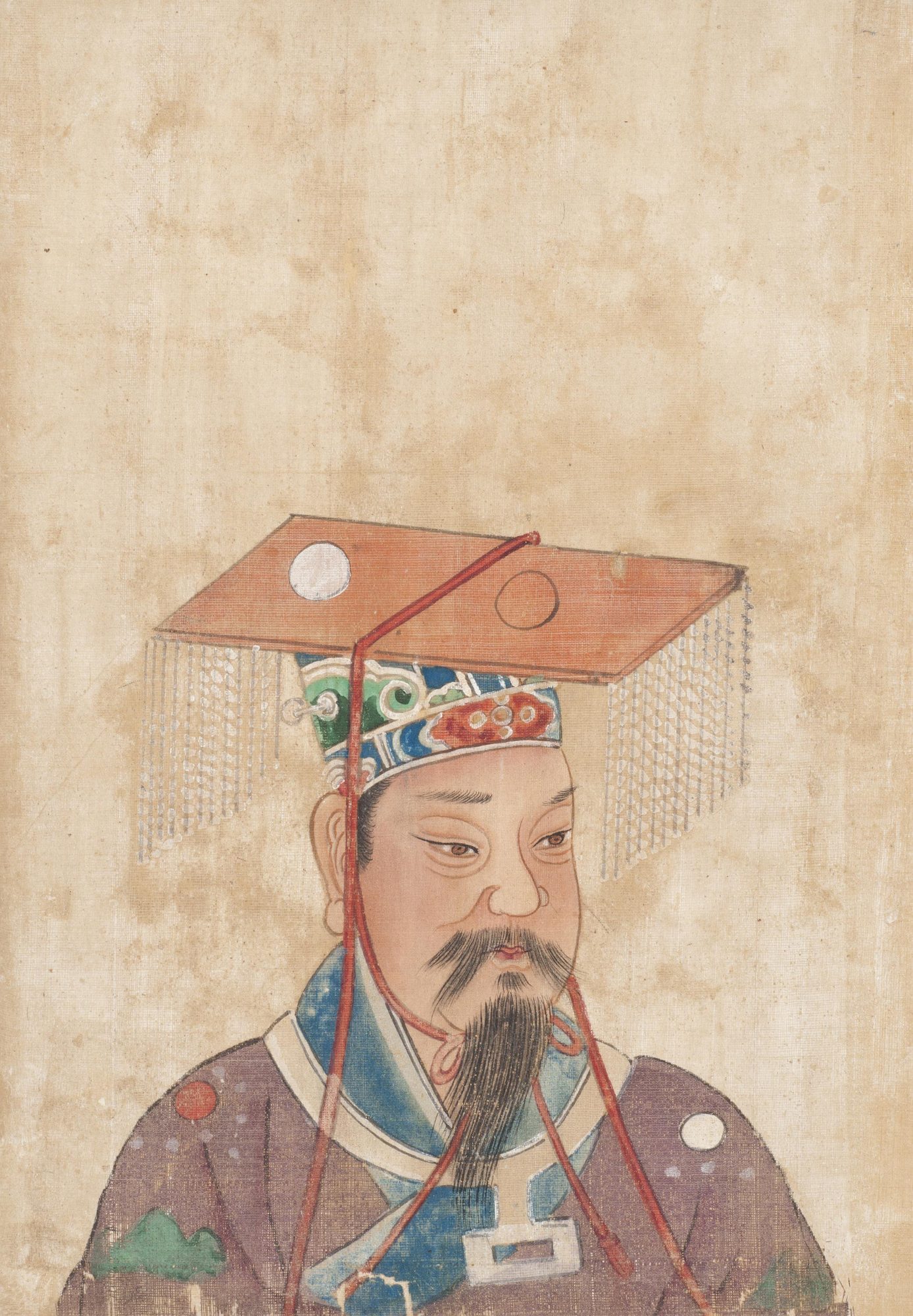
Ink-and-colour album-leaf portrait of the Yellow Emperor as Son of Heaven, shown in bust length wearing the flat-boarded mianguan crown with beaded tassel strings and a dragon-robe over a blue collar, against a plain aged-silk ground.
Chinese

The Yellow Emperor

When the old order collapsed and the fiercest of the warlords could not be subdued, a man who could speak from the cradle trained in shield and dagger-axe, broke the rebel Chiyou on the wilderness of Zhuolu, and was raised up as the first Son of Heaven of a civilised world.
7 minSima Qian
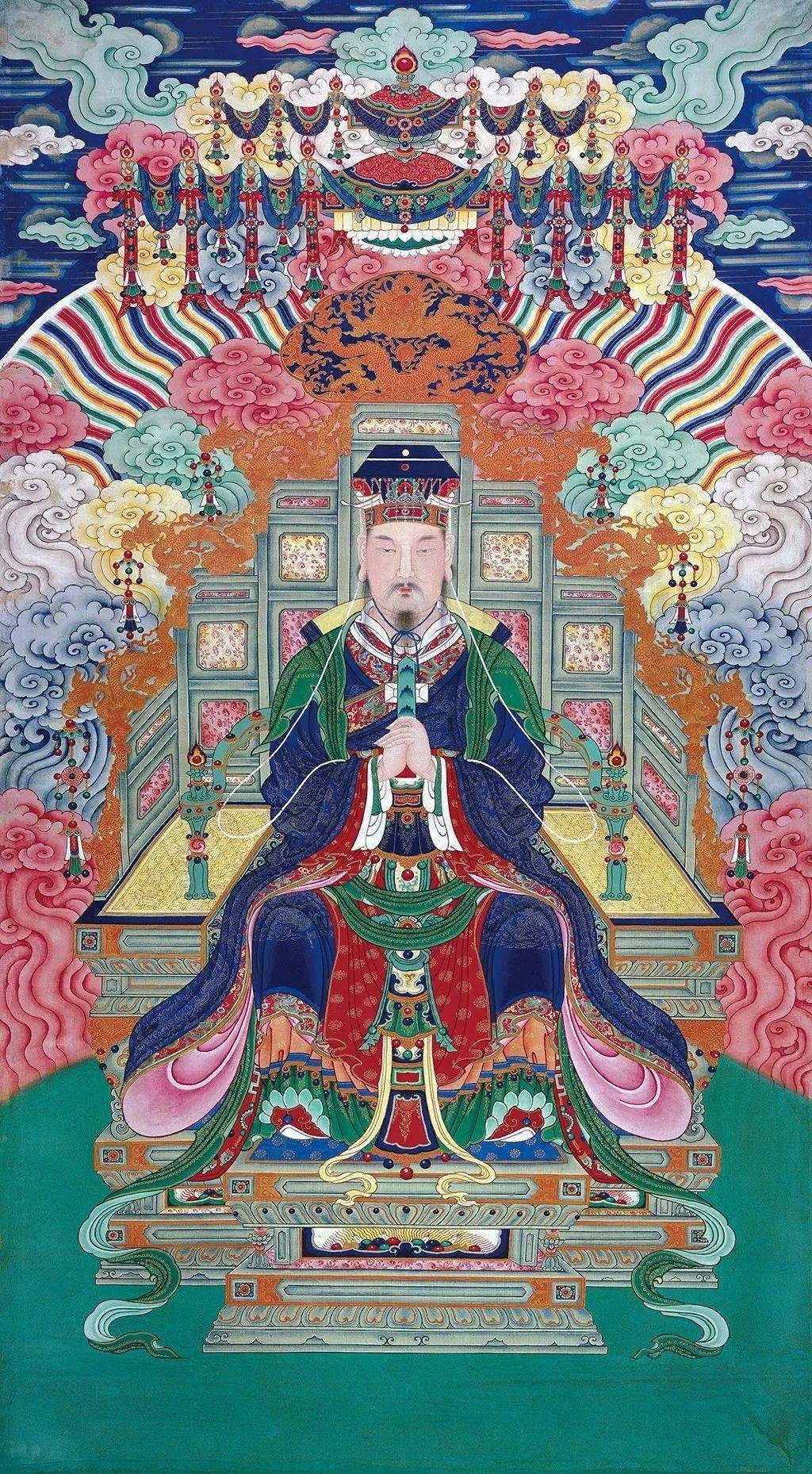
Ming-dynasty Daoist temple painting of the Jade Emperor enthroned in imperial court robes, wearing the flat mortarboard crown (mianguan) with hanging bead-strings and holding a ceremonial gui tablet in both hands, seated beneath a dragon canopy on a stepped throne amid coloured clouds.
Chinese

The Jade Emperor

Supreme sovereign of Heaven and head of a celestial civil service, whose whole war machine could not subdue one stone monkey, and who had to send west for the Buddha to save his own throne.

6 minWu Cheng'en
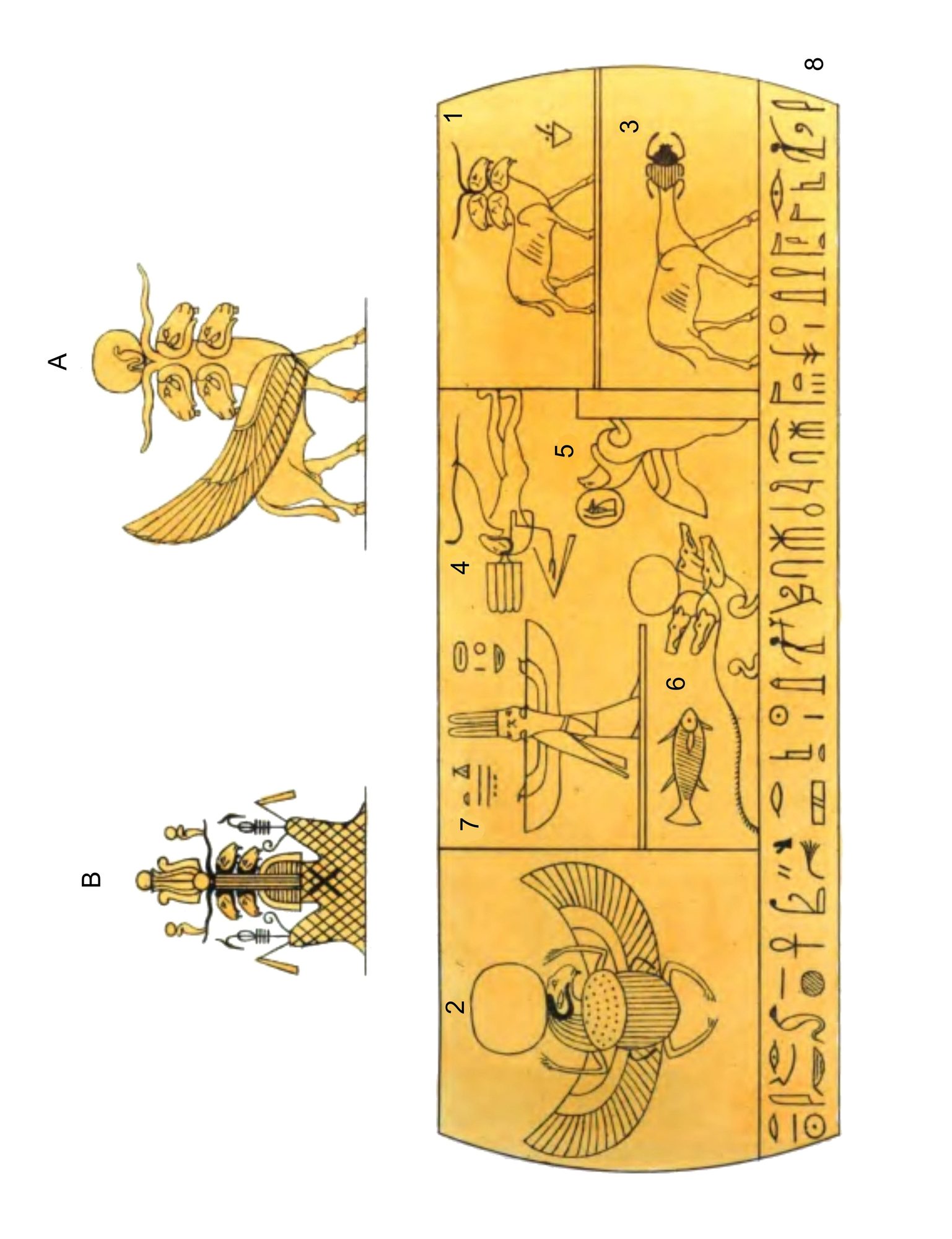
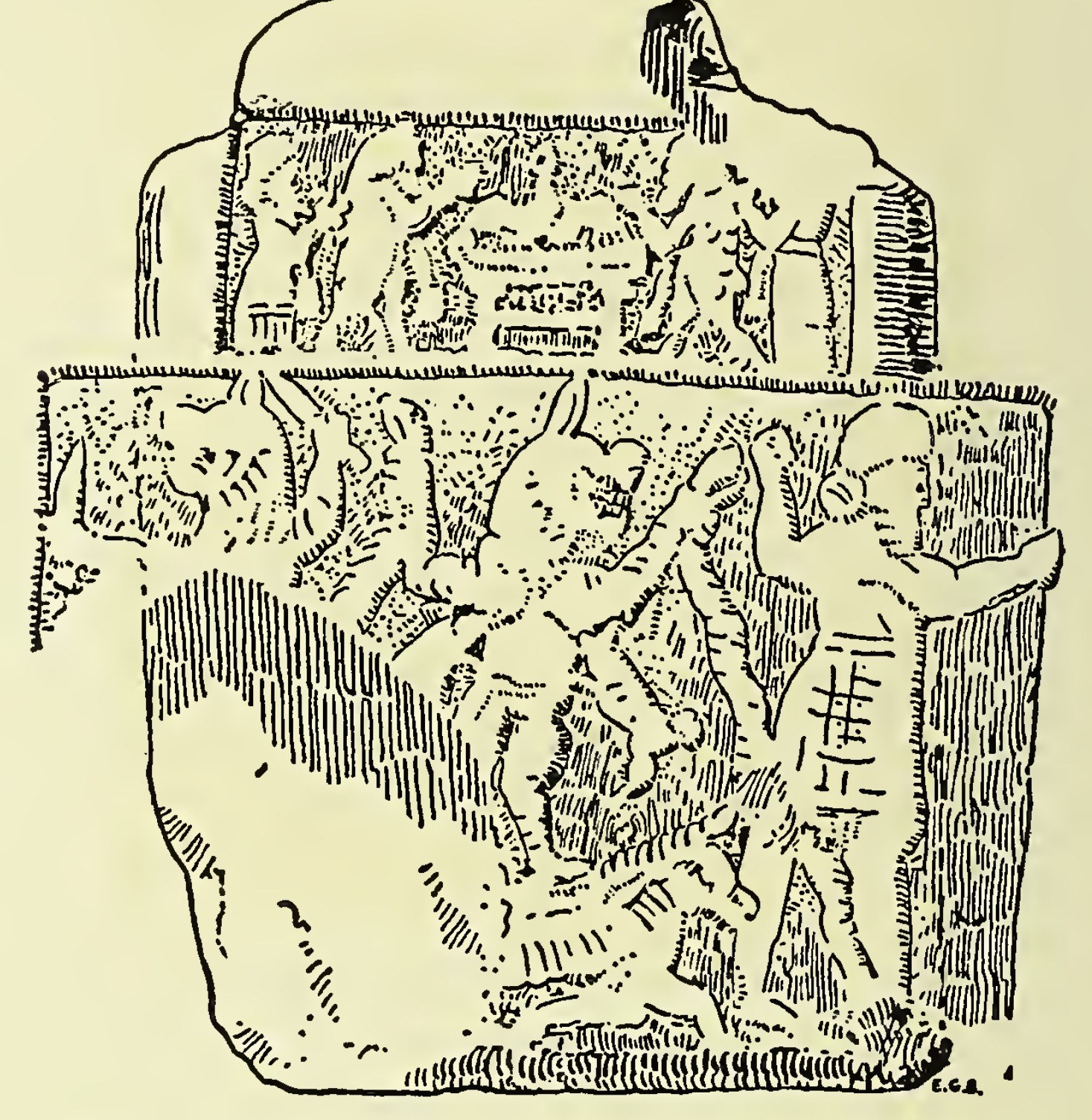
Line engraving of a Babylonian bronze exorcism amulet shown from the back: a tall arched plaque whose upper edge is overhung by the horned, dog-headed face of a demon peering down; below, stacked horizontal registers of ritual figures and vessels, and at the base the underworld, where the demoness Lamashtu with lifted arms is driven off across the water toward the land of the dead.
Mesop.

Kur, the Land of No Return

Dust for bread, mud for meat, and feathers for clothes: the great below of the Sumerians and Babylonians, a house with a bolt on the door and a queen who lets no one out.

8 min*Inana's Descent to the Nether World*
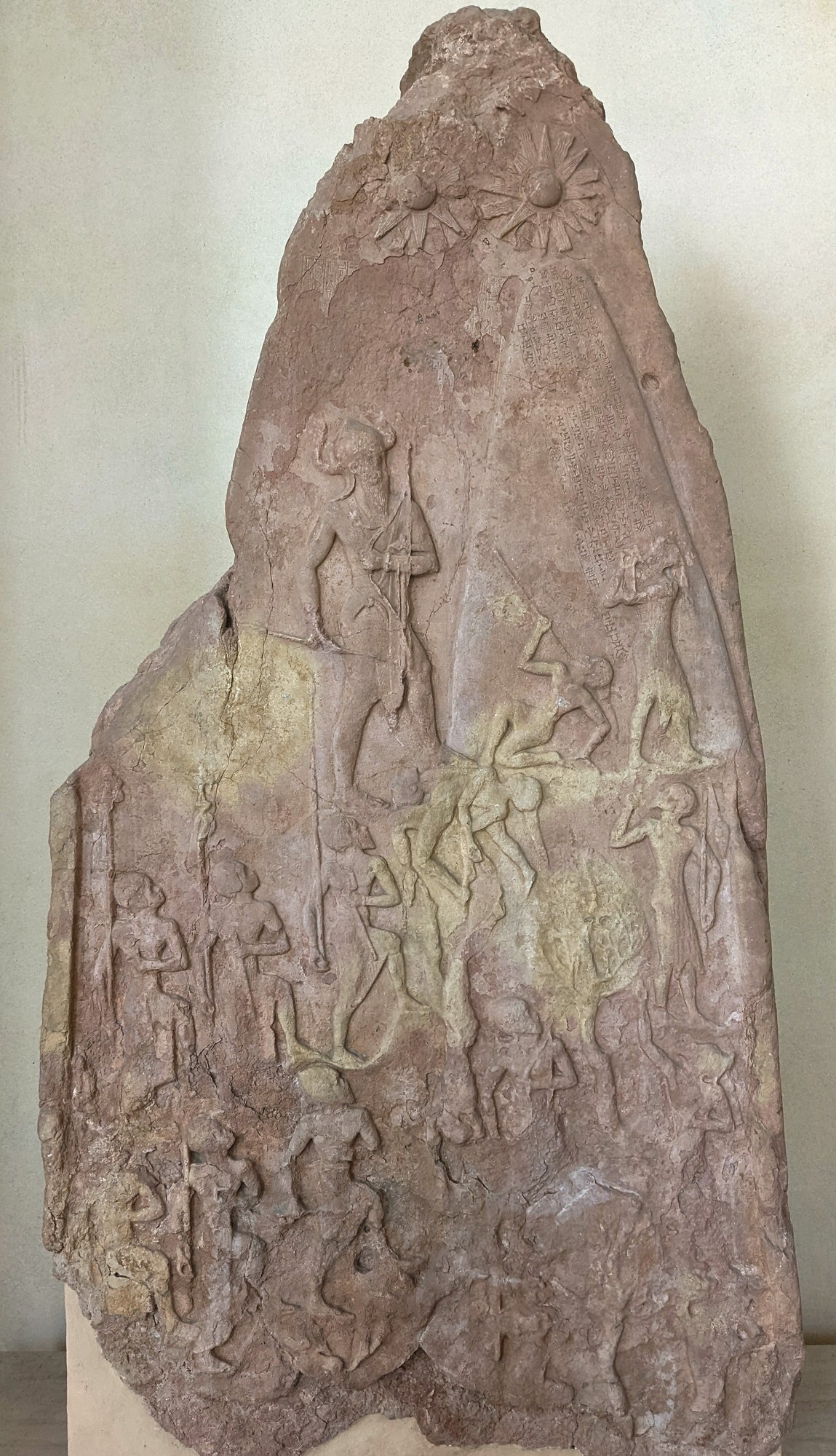
The Victory Stele of Naram-Sin: a tall pink-sandstone monument carved in relief. The Akkadian king Naram-Suen, wearing a horned helmet of divinity and carrying a bow and spear, climbs a wooded mountain above his soldiers, who advance in file; his defeated enemies fall, flee and beg beneath him, and sun-and-star glyphs of the gods shine over the peak.
Mesop.

The Curse of Agade

A king took axes to the god's own house, packed the temple's gold into leather bags, and loaded it onto ships. So the poets, four centuries after the city fell, explained why Agade vanished from the earth.

6 min'The cursing of Agade'
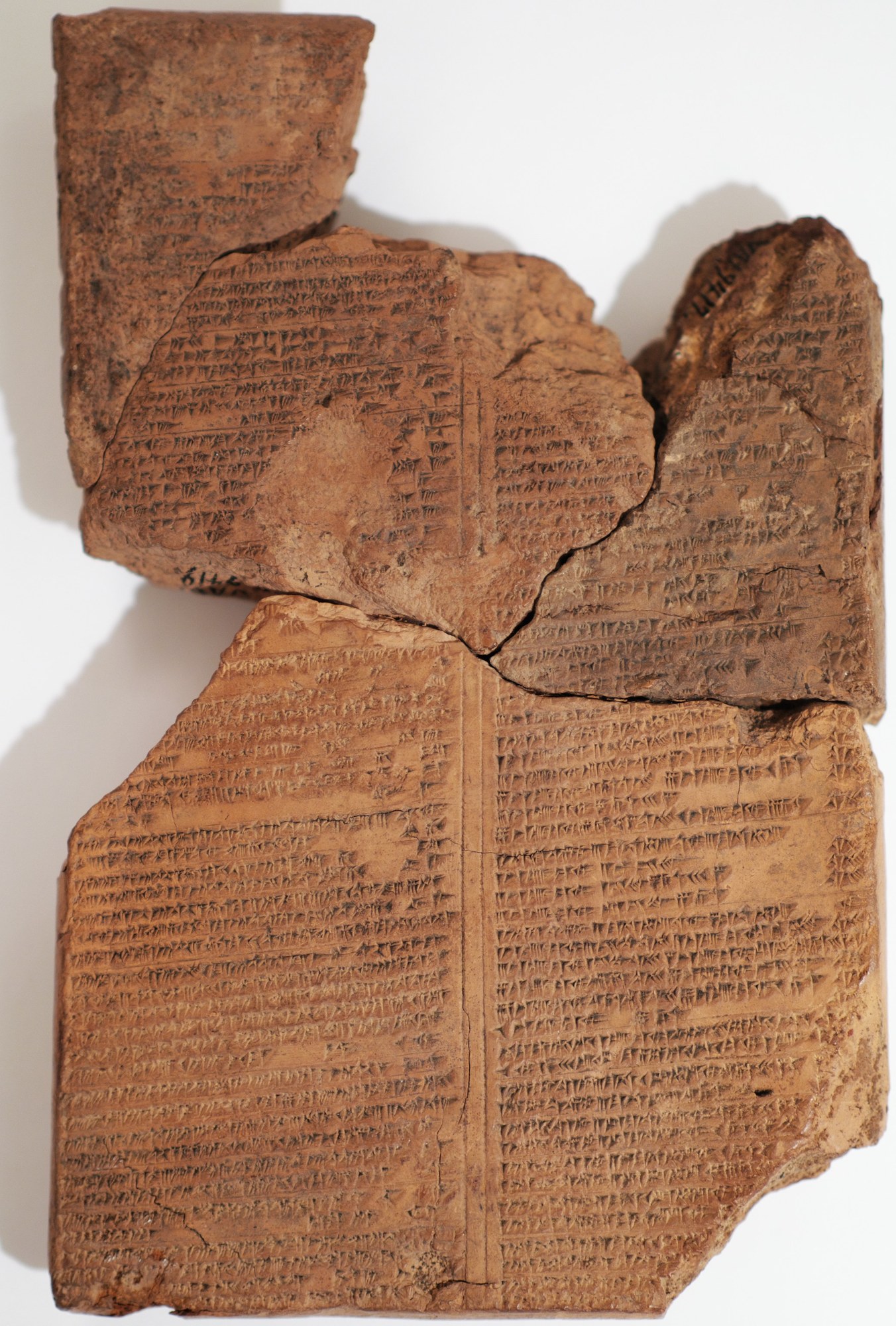
A large fragmentary Babylonian cuneiform tablet, joined from several broken pieces, its surface ruled into columns of dense cuneiform — a copy of the astronomical compendium MUL.APIN, the standard Babylonian handbook of the stars, the paths of the sky and the calendar.
Mesop.

Marduk Founds the Year and Sets the Moon in Its Course

With the sea dead beneath his foot, the champion turned to a quieter labour: fixing the stations of the sky, dividing the year, and handing the moon a monthly work-order. This is the creation of measured time, spoken into being at the world's first dawn.

7 min*Enūma Eliš*
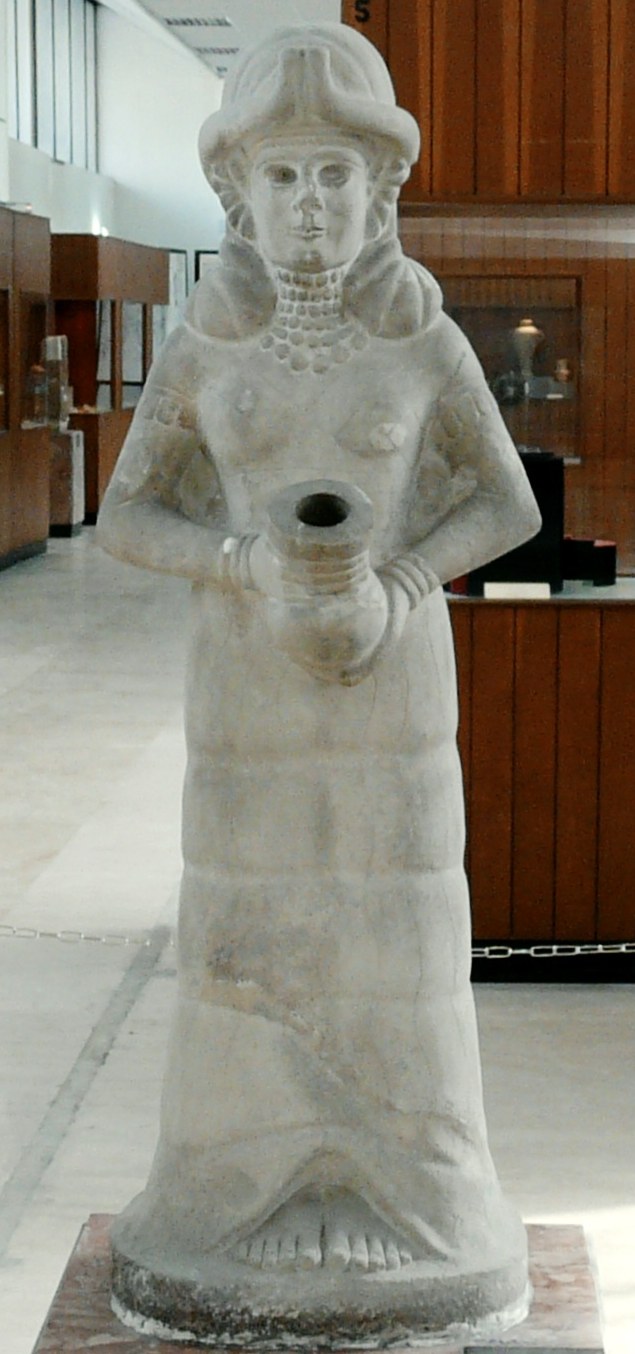
Weathered ancient limestone statue of a standing goddess in a horned headdress and a long flounced robe, a tiered bead choker and necklace at her throat, holding at her belly in both hands a round vase pierced through its centre — the vessel from which the life-giving waters were made to flow; displayed on a plinth in the National Museum of Aleppo.
Mesop.

Nammu: The Primeval Sea Who Bore Heaven and Earth

The gods are digging canals and weeping over the work when their oldest mother carries their tears down into the deep to wake her sleeping son. What she is called, and what she made, is a question two thousand years of clay cannot quite settle.

7 min*Enki and Ninmah*
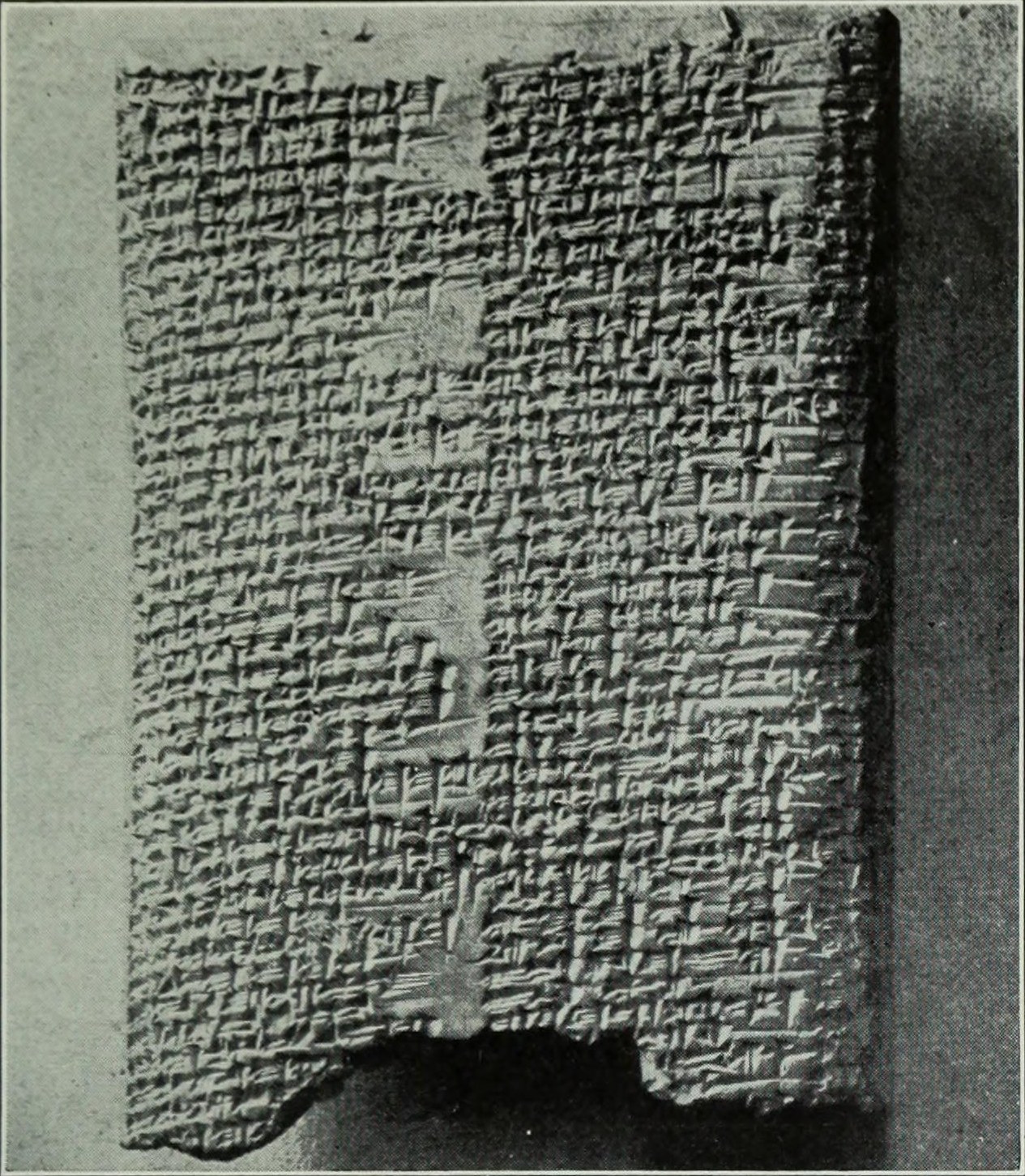
A photograph of the actual ancient clay tablet of the Fourth Tablet of the Babylonian Epic of Creation (Enūma Eliš), British Museum 93016: a broken rectangular fragment densely covered in columns of impressed cuneiform wedges, lit to cast a shadow on a plain ground.
Mesop.

The Tablet of Destinies and the Ordering of Fates

A single clay writ, sealed and laid over the heart, carried the right to decree the fate of the whole created order. Whoever held it ruled the universe, so the history of Mesopotamian kingship is the history of who held it next.

7 min*Enūma Eliš*
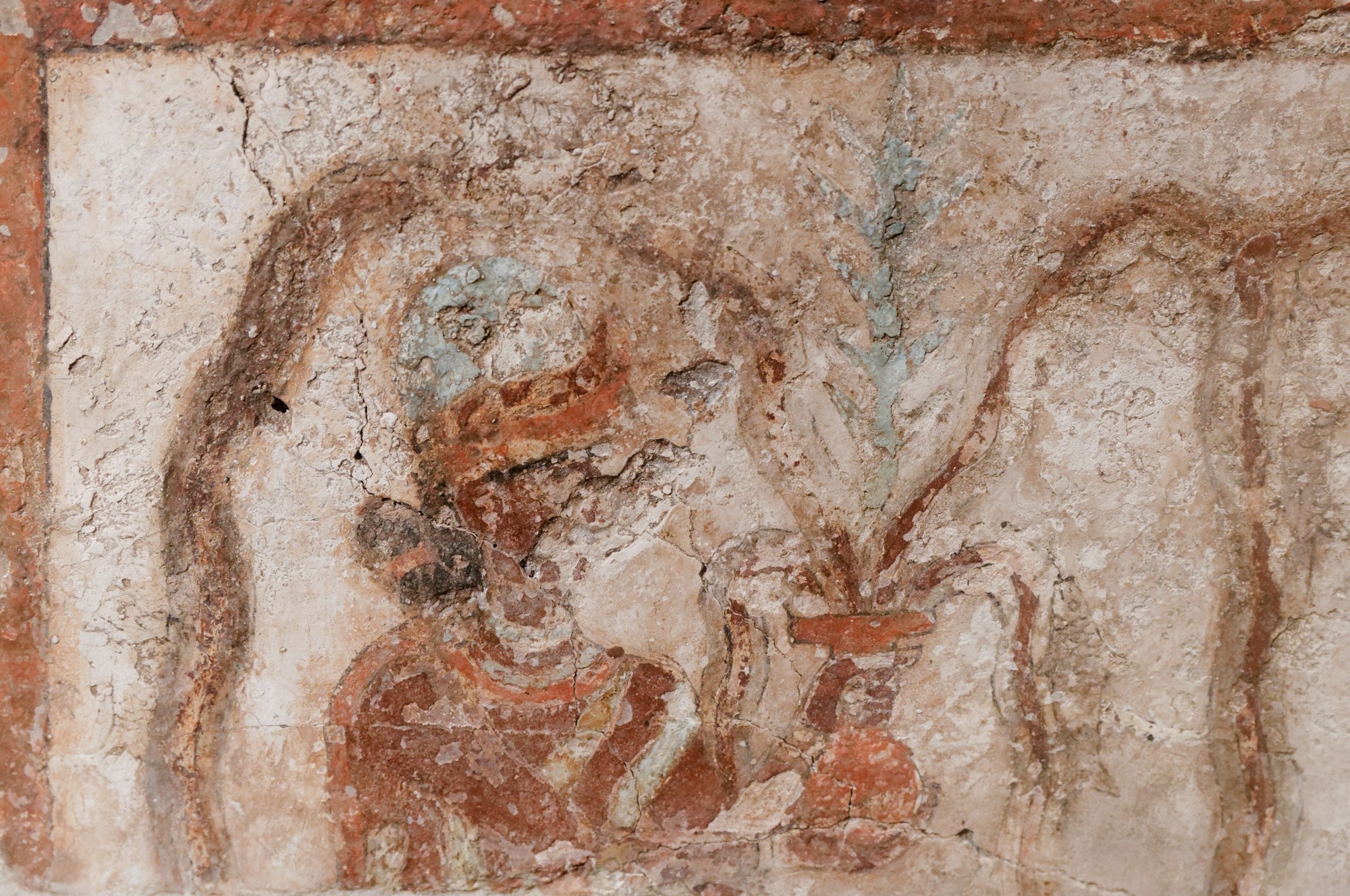
Detail of the Mari palace wall painting known as the Investiture of Zimri-Lim: a goddess in a blue-crowned headdress and a red-and-blue flounced robe stands within a painted red frame, holding a globular vessel from which a leafy plant and streams of water rise — the flowing-vase goddess who embodies the life-giving sweet waters, the abundance of the water-god Ea. The surface is a cracked, fragmentary tempera-on-plaster ground in ochre, red and turquoise.
Mesop.

Atrahasis: The Making of Humankind

Forty years the lesser gods dug the rivers by hand. Then they burned their tools and surrounded their master's house in the dark, and the only way to end the strike was to build a creature that could take the work off them.

7 min*Atra-hasis*
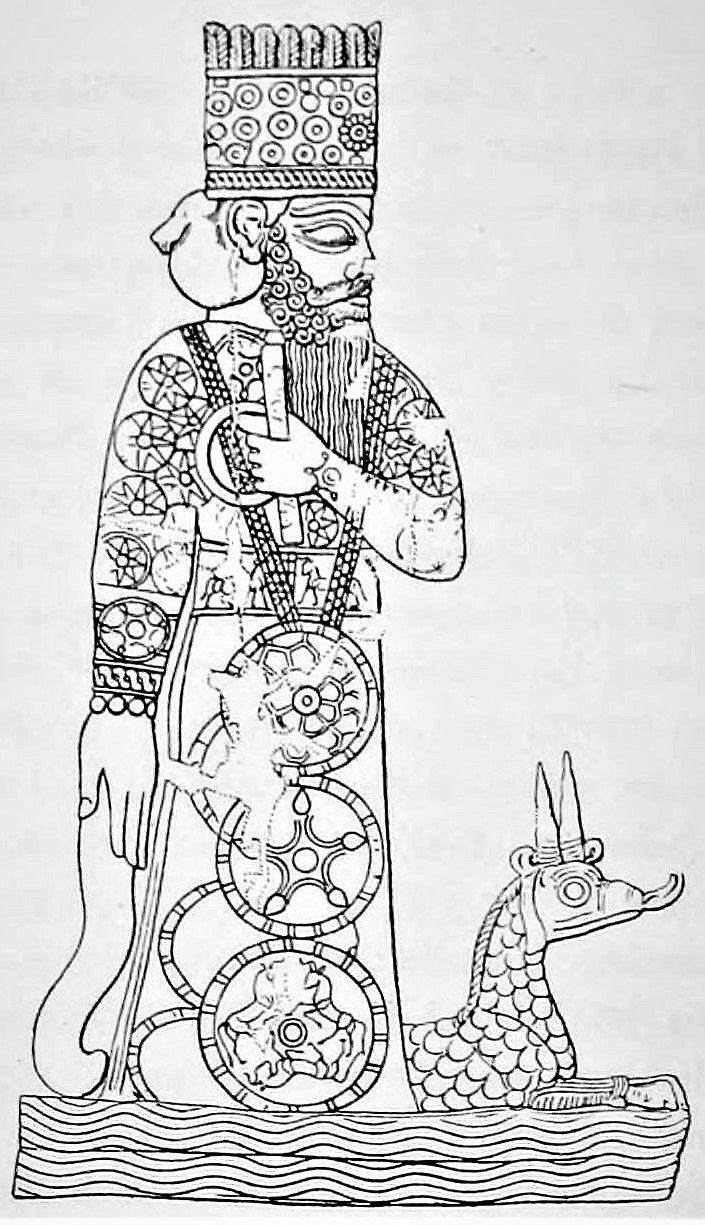
Line drawing of the Statue of Marduk: a bearded god in a tall crenellated horned crown and a long fringed robe covered in rosette-discs stands frontally, holding the ring-and-rod of kingship at his chest, while his scaled, horned snake-dragon (the mušḫuššu) crouches at his feet; both stand on a plinth of wavy lines — the split waters of the vanquished Tiamat.
Mesop.

Marduk, Champion of Babylon

The young storm-god who alone dared face the salt-water chaos, drove the winds down her throat and split her body into the sky, and traded a single victory for the kingship of all the gods.

6 min*Enūma Eliš*
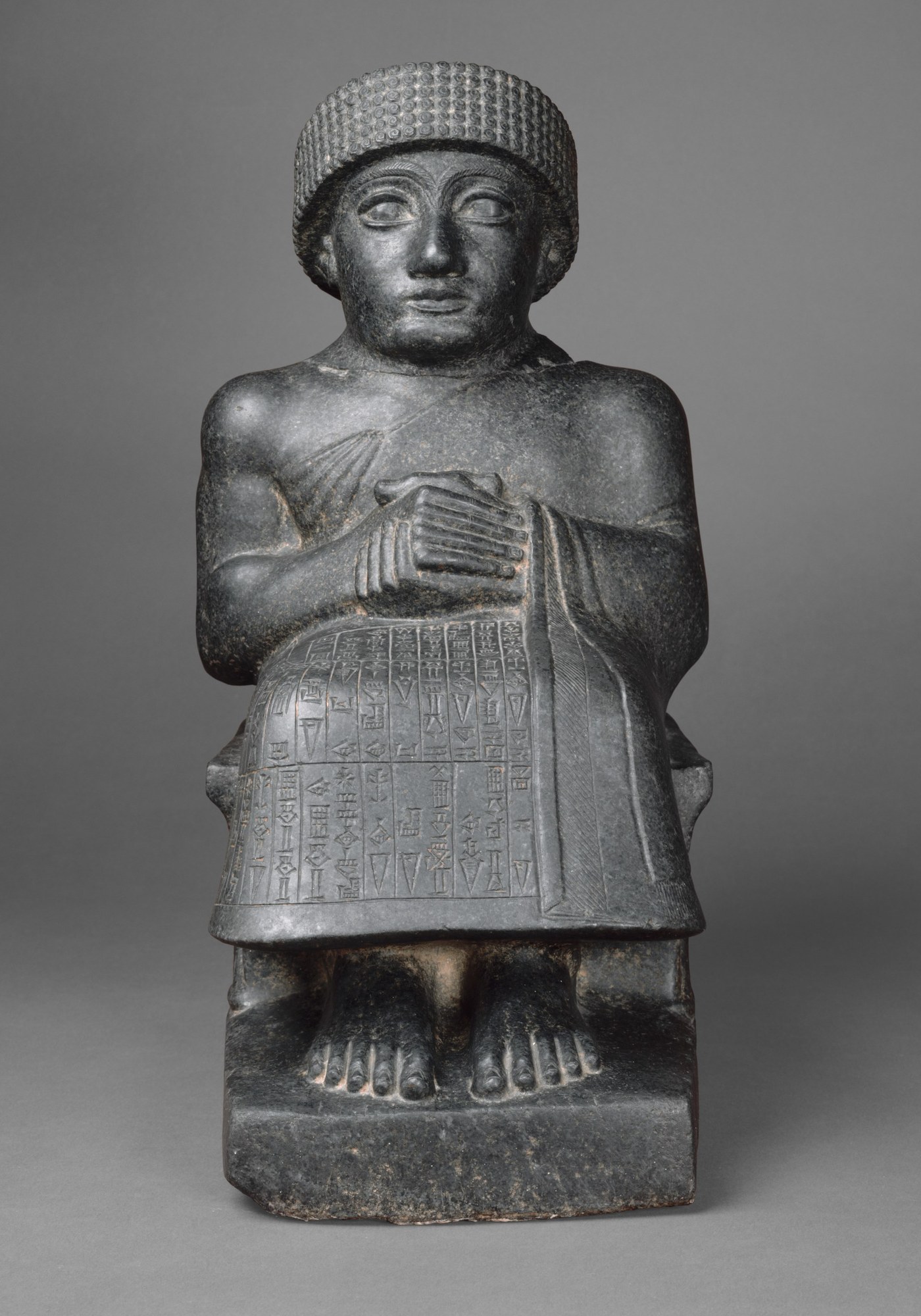
Neo-Sumerian diorite statue of the ruler Gudea of Lagash, seated with hands clasped in prayer at his chest, wearing a brimmed fleece cap and a fringed cloak over one shoulder; his lap and skirt are covered with columns of cuneiform, his bare feet resting on the base.
Mesop.

The Death of Gilgamesh

The strongest king who ever lived is dying in his own bed, and in a dream he must stand before the gods and hear them decide what a man is allowed to keep.

7 minThe Death of Gilgameš
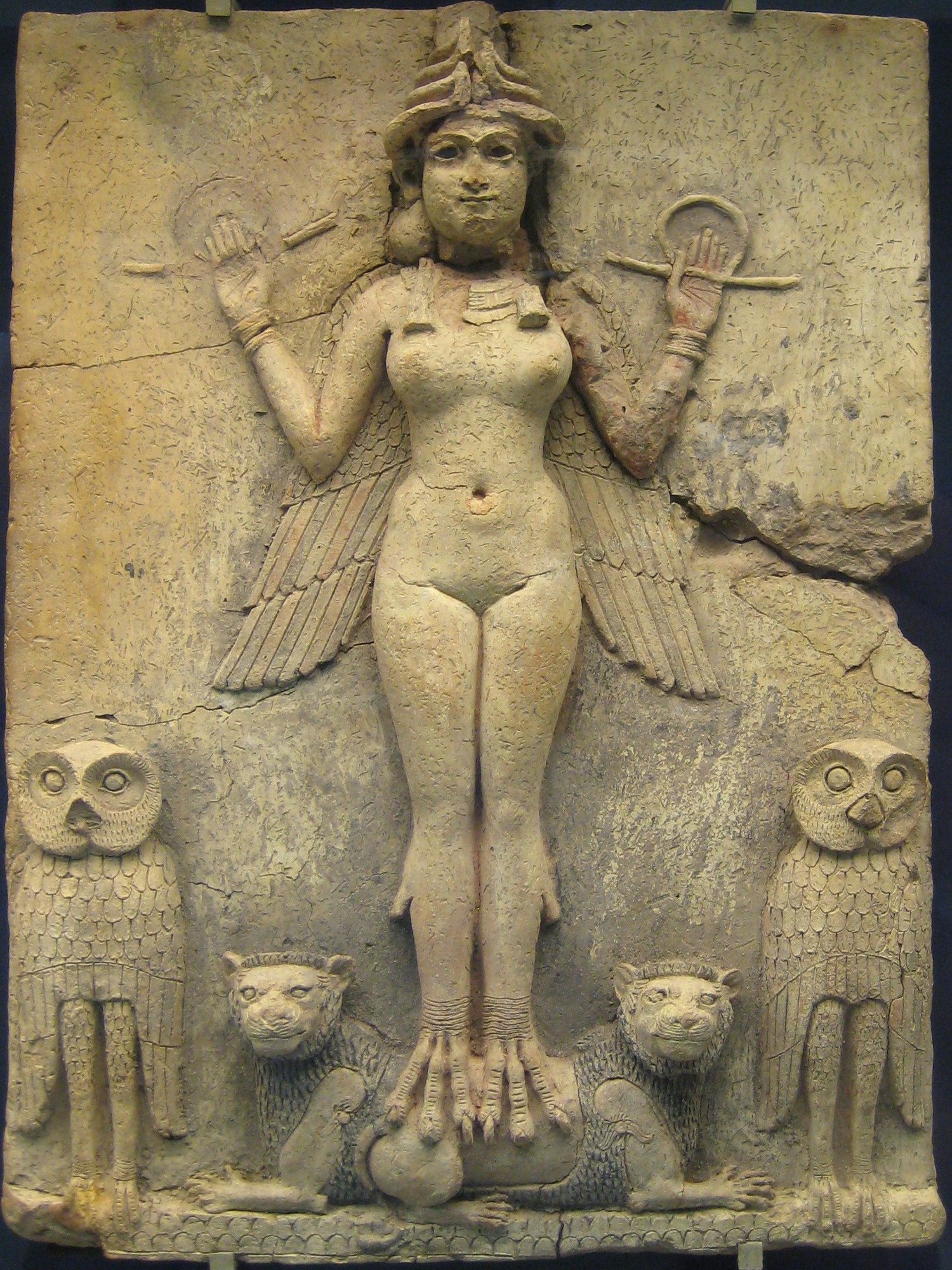
The Old Babylonian "Queen of the Night" terracotta relief: a winged nude goddess in a horned headdress, holding a rod-and-ring symbol in each raised hand, standing on the backs of two lions and flanked by two owls, with a scale-pattern mountain base below. The figure has been variously identified as Ishtar, Lilith, or Ereshkigal.
Mesop.

Ereshkigal: The Queen the Sources Kept Rewriting

A goddess so fearsome she was barely worshipped, married off to a different god in every century that told her tale, and finally borrowed by Greek sorcerers who never knew what her name once meant.

4 min*Nergal and Ereshkigal*
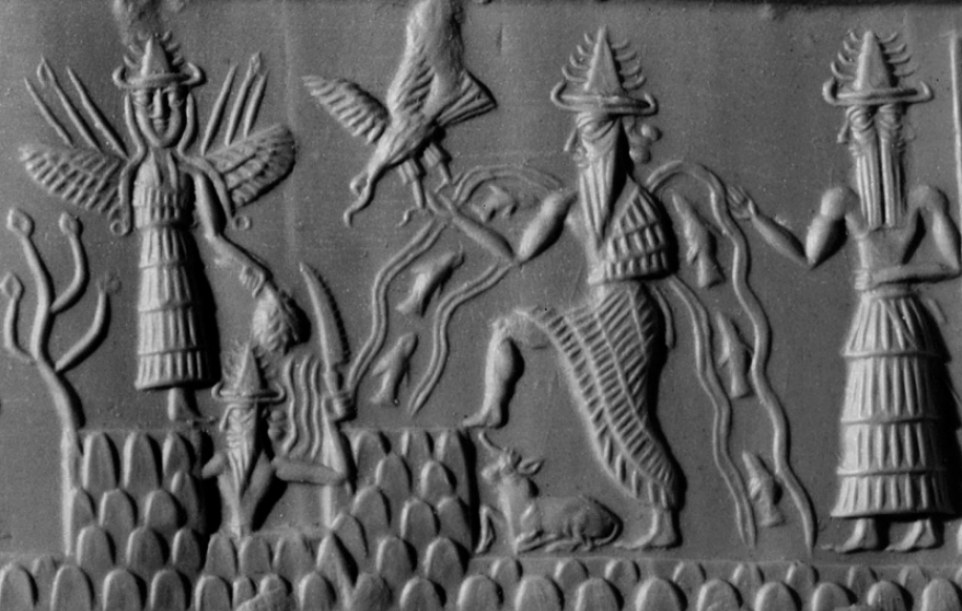
A modern grey clay impression rolled from an ancient Akkadian cylinder seal: four horned deities across a rolled-out frieze. At centre-right the water-god Ea (Sumerian Enki) strides forward with one foot raised on a mountain, two streams of water full of small fish flowing down from each shoulder; his two-faced vizier Usimu stands at the right edge, the winged goddess Ishtar at the far left, and the sun-god Shamash cuts through the mountains between them.
Mesop.

Apsu, the Sweet-Water Deep

The first being in the Babylonian cosmos was fresh water that did nothing but rest, until noise drove it to murder its own children. Then the poem killed it off the page.

6 minEnūma Eliš
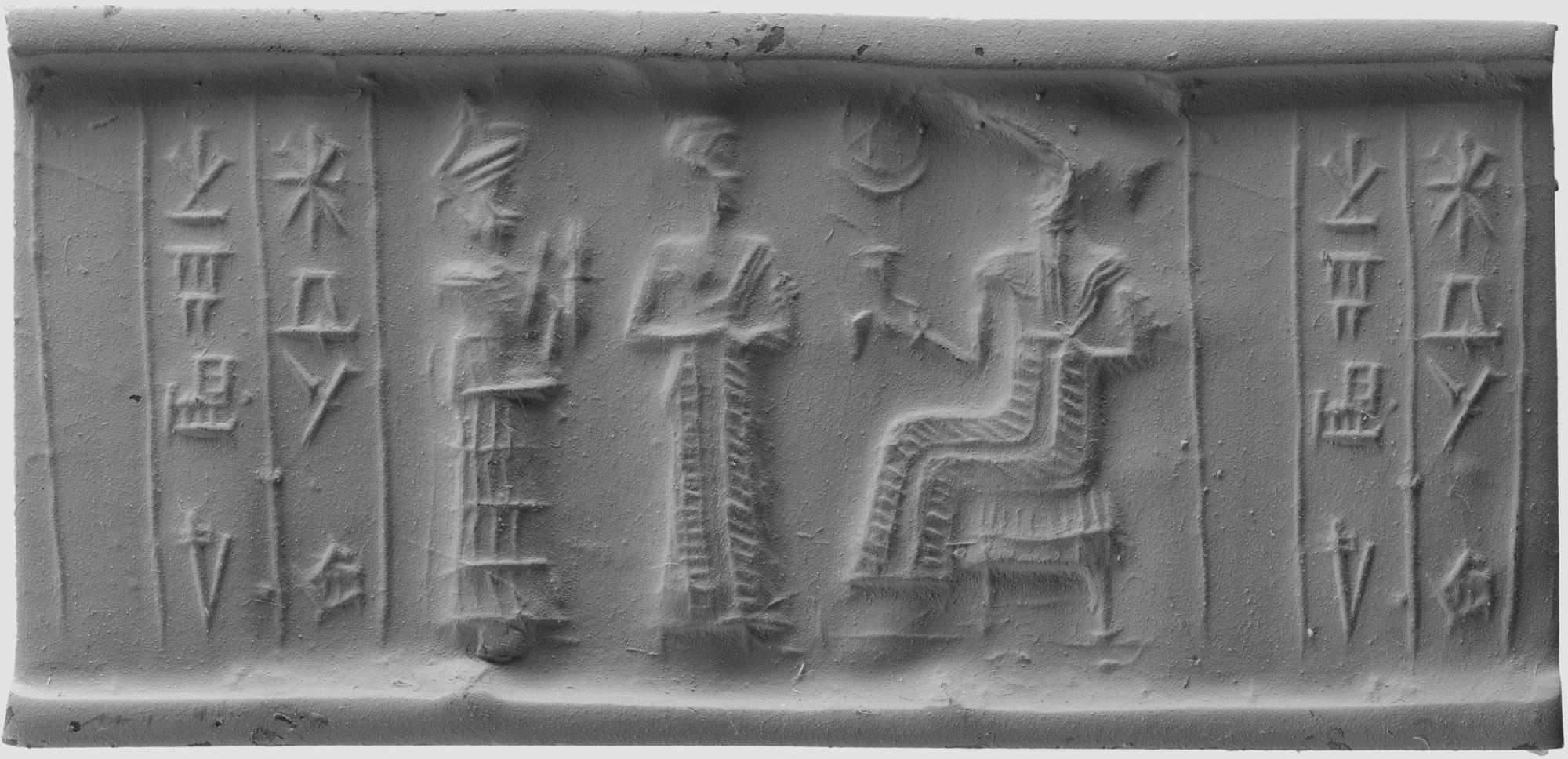
The modern grey rolled impression of a Mesopotamian cylinder seal: a standing worshipper and an interceding goddess with both hands raised approach a deity enthroned on a tiered throne, a crescent moon above, with panels of cuneiform to either side.
Mesop.

When An Carried Off Heaven and Enlil the Earth

The Sumerians never wrote the poem in which heaven and earth are torn apart. They only ever mention it, in the breath before a story begins: once, in the first days, the sky was prised off the ground and the two were shared out among the gods.

7 min*Gilgameš
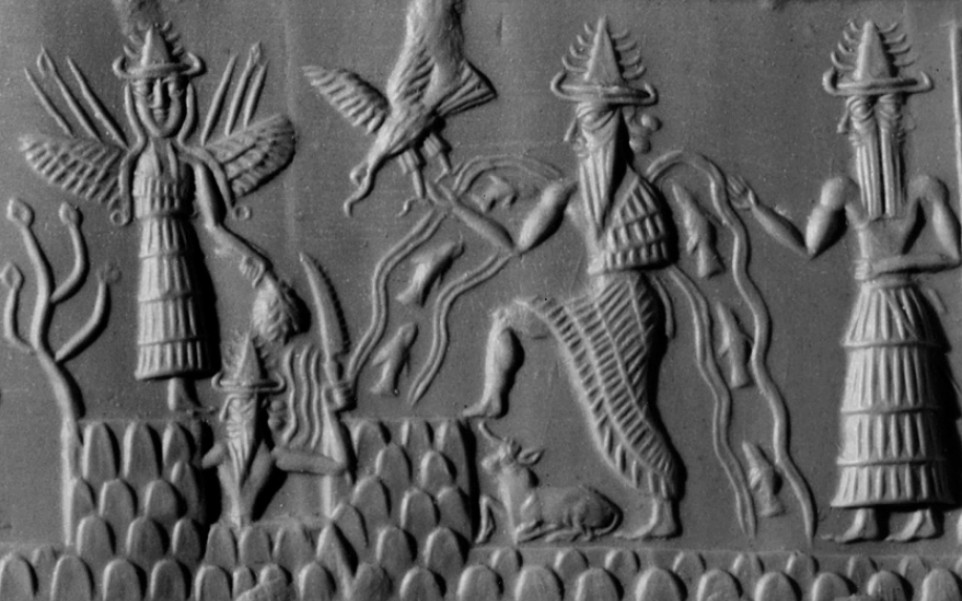
Rolled-out impression of an Akkadian cylinder seal: a file of standing deities identified by their many-horned crowns — the winged goddess Ishtar at left, the sun-god Shamash rising through the mountains at centre, and at right the god Ea (Enki), lord of the sweet-water deep, with streams of water and fish flowing from his shoulders, his two-faced vizier Usimu beside him.
Mesop.

Apsu and Tiamat: The Sweet Water and the Salt Sea

Before heaven had a name there were two waters, and they mingled. Everything that followed, the gods, the quarrel, the war that split a body into a sky, began in that first commingling of the fresh and the salt.

6 minEnūma Eliš
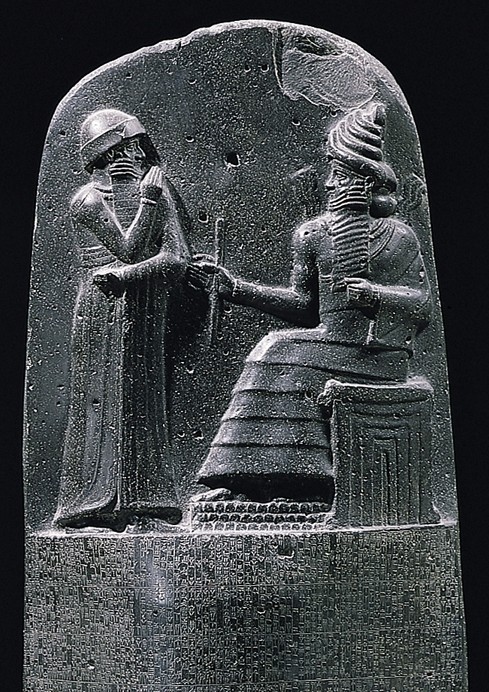
The relief at the top of the law stele of Hammurabi: at right the sun-god Shamash sits enthroned on a tiered temple-façade throne, wearing the many-tiered horned crown of divinity with flames rising from his shoulders, extending the rod-and-ring of just rule; at left the standing king Hammurabi raises one hand to his mouth in reverence to receive it. Carved in dark basalt, the figures set against a plain black ground above the opening lines of the cuneiform law-code.
Mesop.

The Decreeing of Fates at the New Year

Once a year the most powerful man in Babylonia was stripped of his crown, struck on the cheek and made to weep, so that a council of gods could settle his fate and the land's for the twelve months to come.

8 min*Enūma Eliš*
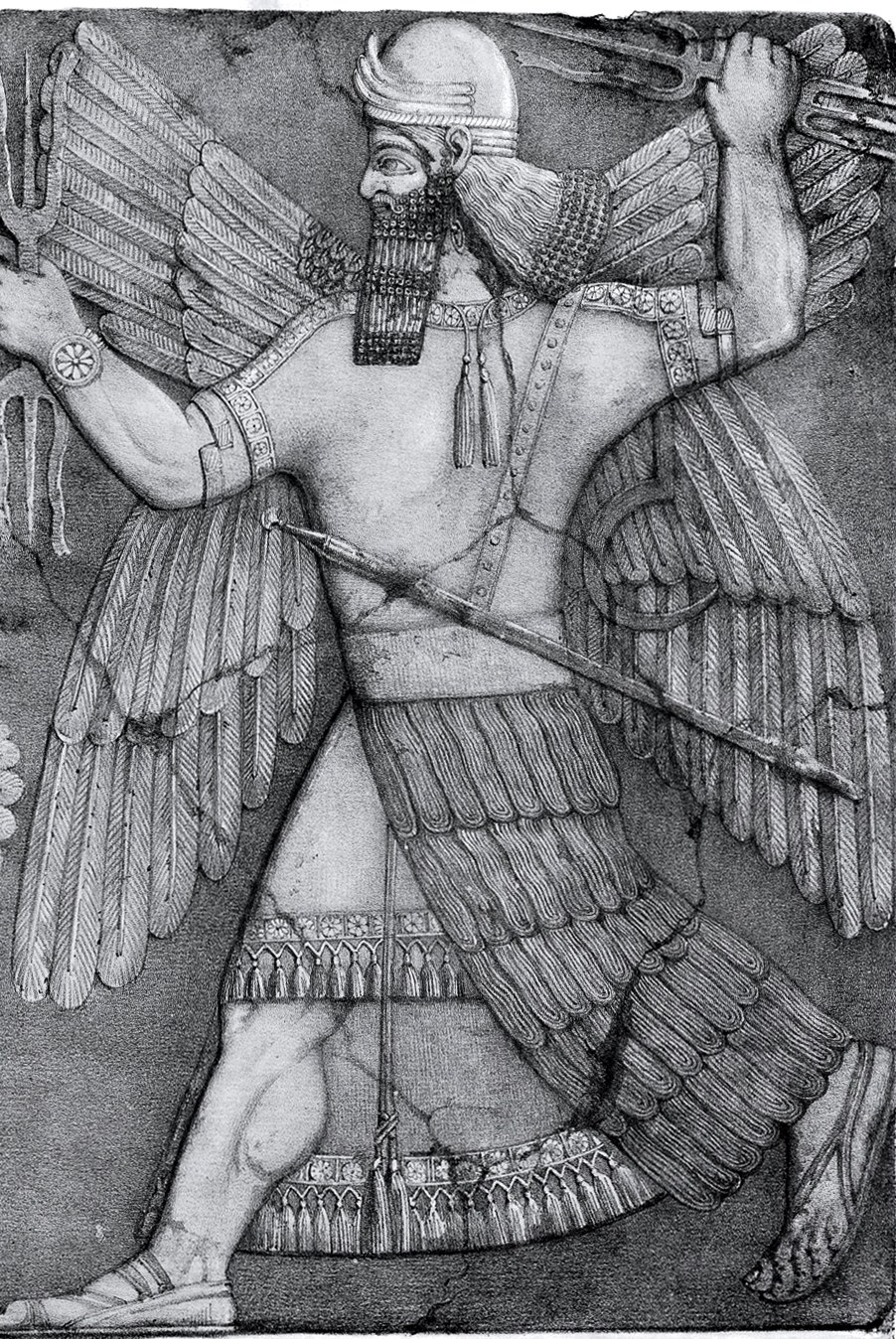
Neo-Assyrian carved stone relief: a four-winged, helmeted and bearded storm-god strides forward brandishing thunderbolts, the deity who in the tradition slays the chaos-monster Tiamat.
Mesop.

Tiamat, the Primeval Sea

She was the salt ocean before the ocean had a shore, the mother of every god, and the body a younger god would one day split open to roof the sky. This is Tiamat as a being: her names, her monstrous brood, and how her carcass became the world.
8 min*Enūma Eliš*
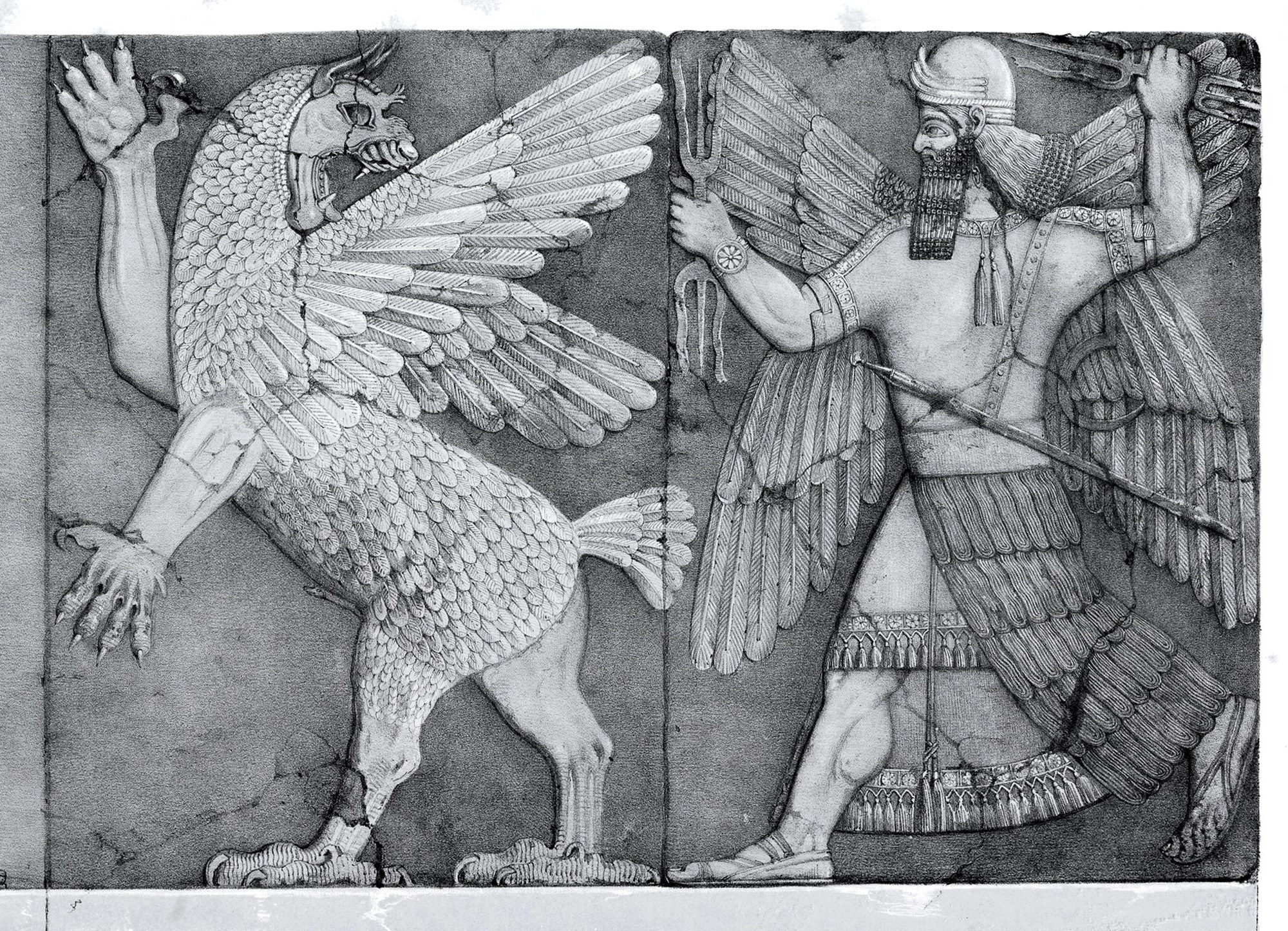
A 19th-century line engraving of a Neo-Assyrian palace relief: at right a bearded, winged warrior-god in a horned helmet strides forward, raising a weapon overhead and holding a bow, pursuing at left a winged, lion-headed and horned monster that flees with clawed hands thrown up.
Mesop.

Anzu's Theft of the Tablet of Destinies

The storm-bird has stolen the writ of fate and made his own word law, and every god the assembly names to fight him refuses. The recovery is a hunt won not by strength but by a trick that turns the thief's own magic dead.

6 minThe Standard Babylonian *Myth of Anzu* / *Epic of Anzû*
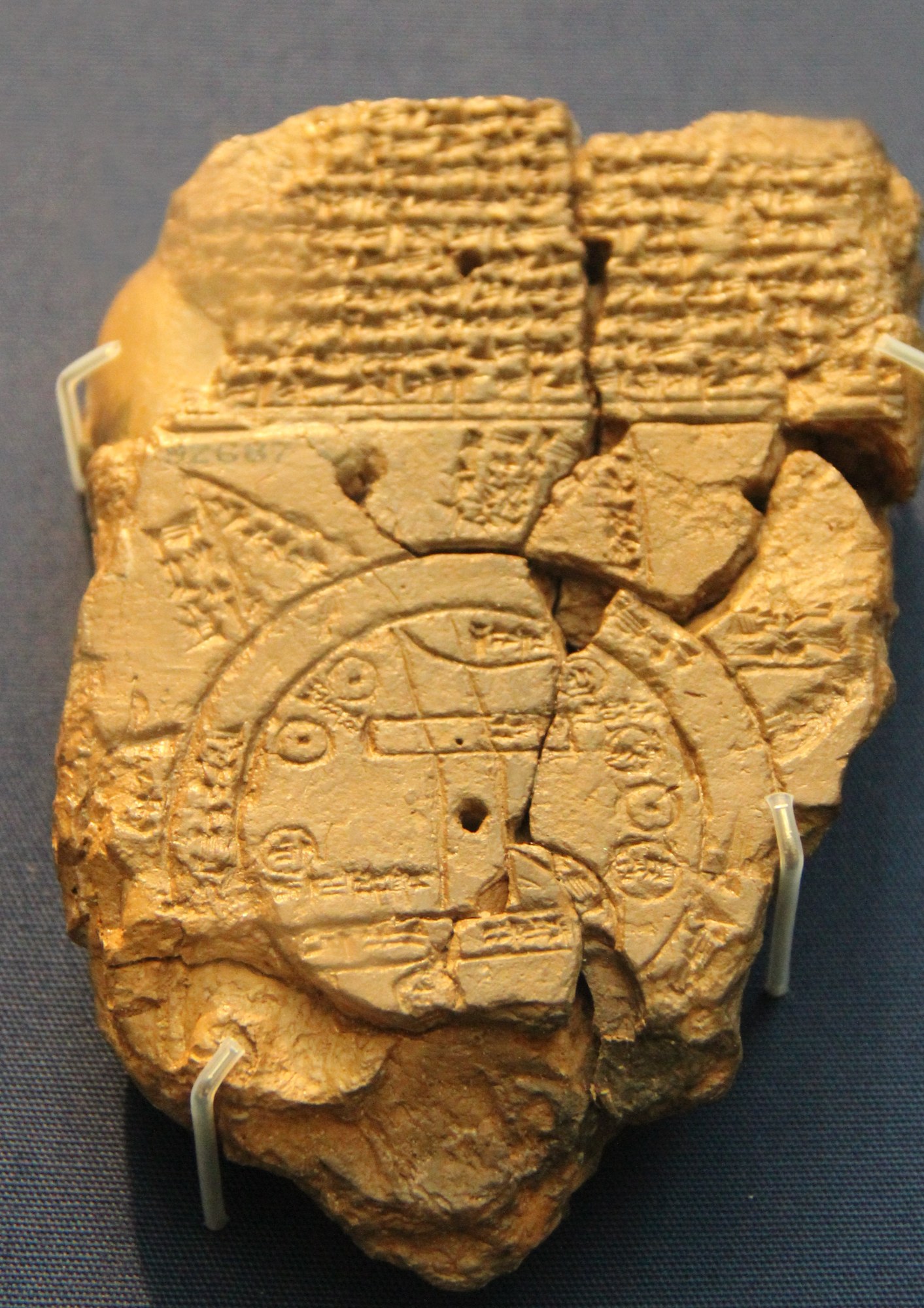
A broken Babylonian clay tablet, its upper half filled with lines of cuneiform and its lower half incised with a circular map of the world: the earth as a disc ringed by the ocean, with radiating triangular regions beyond it.
Mesop.

The Three Earths Beneath the Heavens

One short, forbidden tablet maps the Babylonian universe as six stone floors stacked in open air: three heavens above, three earths below, each a coloured slab laid down by a single arranging god. It is a diagram, not a story, and it argues with itself.

9 minKAR 307 obv. 30–38
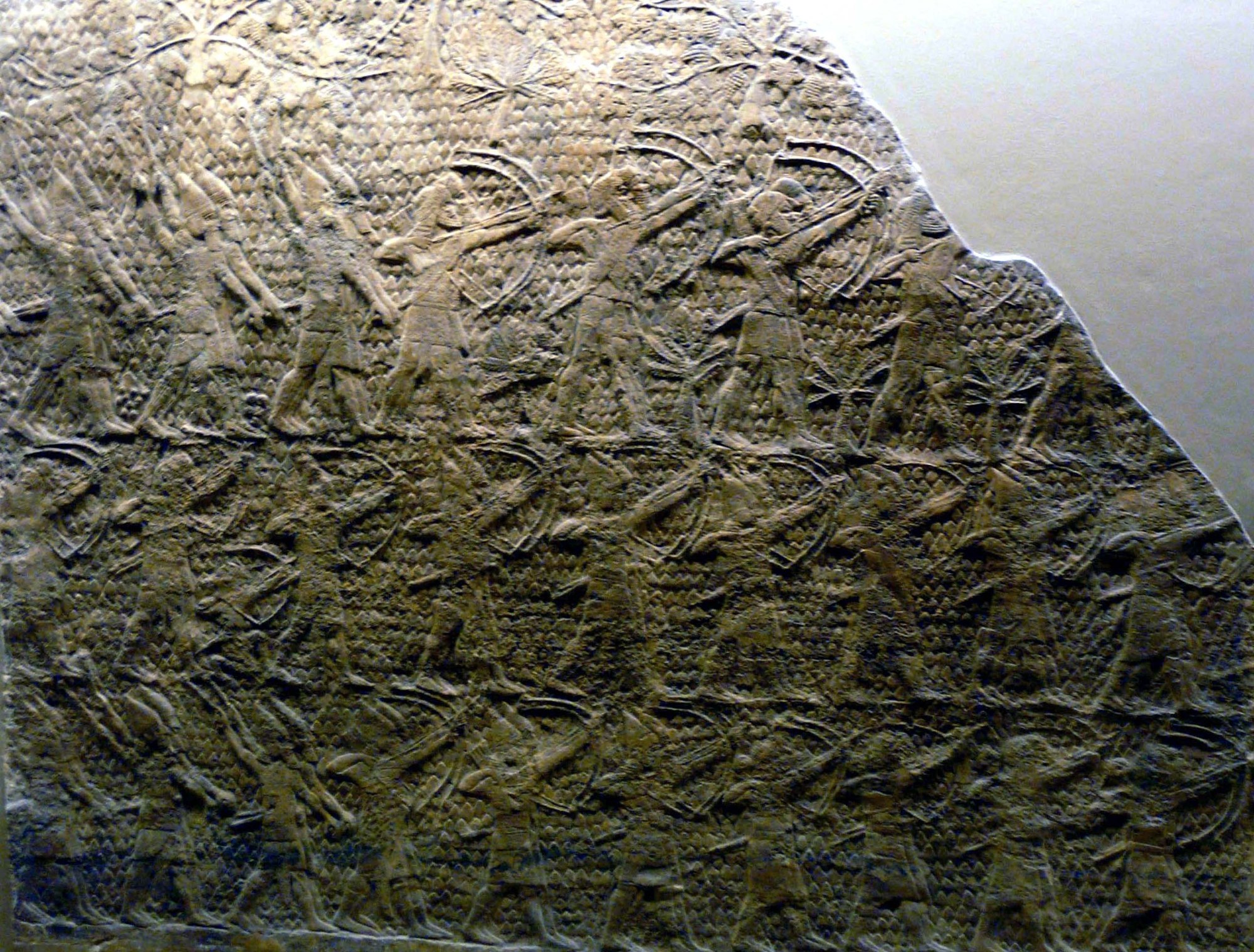
Carved Neo-Assyrian stone relief crowded with soldiers advancing uphill: archers drawing their bows and slingers whirling stones, packed in dense registers across a weathered tan gypsum panel with its broken top edge.
Mesop.

Erra and Ishum: The Wrath of the Plague God

The war-god lies too tired to rise, until his own heart and seven restless weapons talk him into a slaughter no god can call off. Only his own minister can end it, and only by making war on a mountain instead of on men.

6 minThe Poem of Erra and Ishum
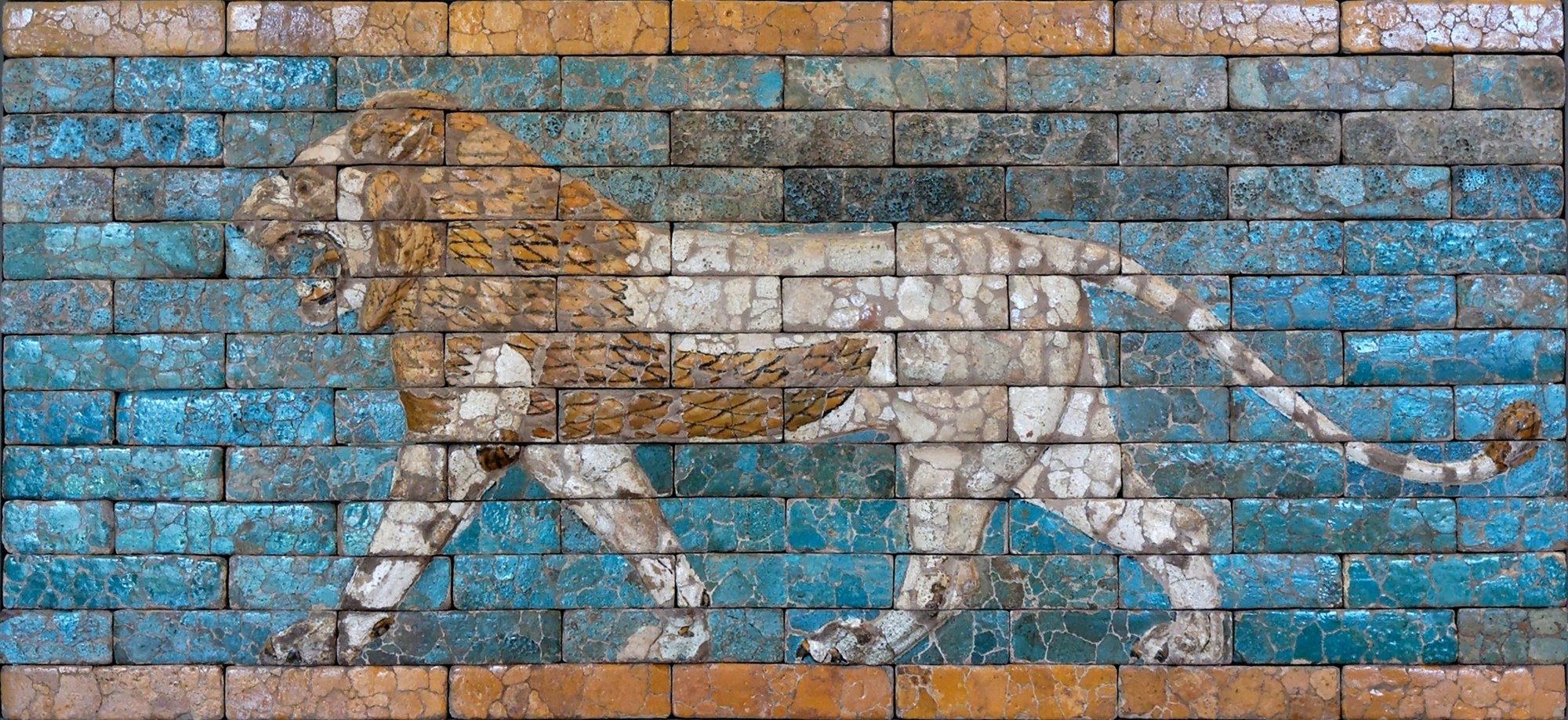
A striding, roaring lion in molded glazed brick — tawny mane, cream body, tail curling up behind — walking left to right across a turquoise-blue field bordered above and below by bands of ochre brick, from the Processional Way of Babylon.
Mesop.

The Akitu: Babylon's New Year Festival

For eleven days each spring the priests of Babylon washed a god, stripped a king of his crown and slapped him until he wept, then carried the whole company of the gods out through the glazed gate to renew the year.

8 minF. Thureau-Dangin
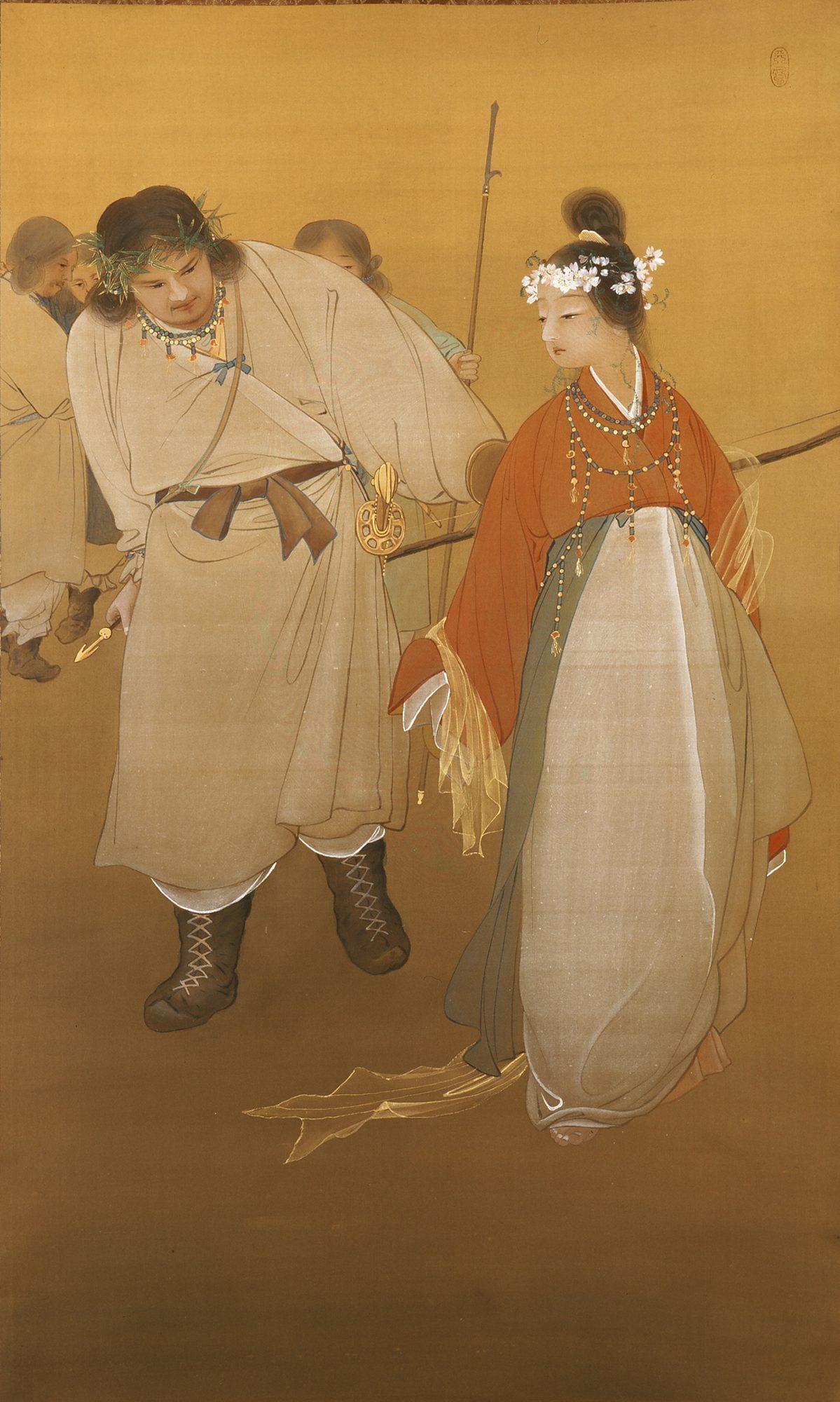
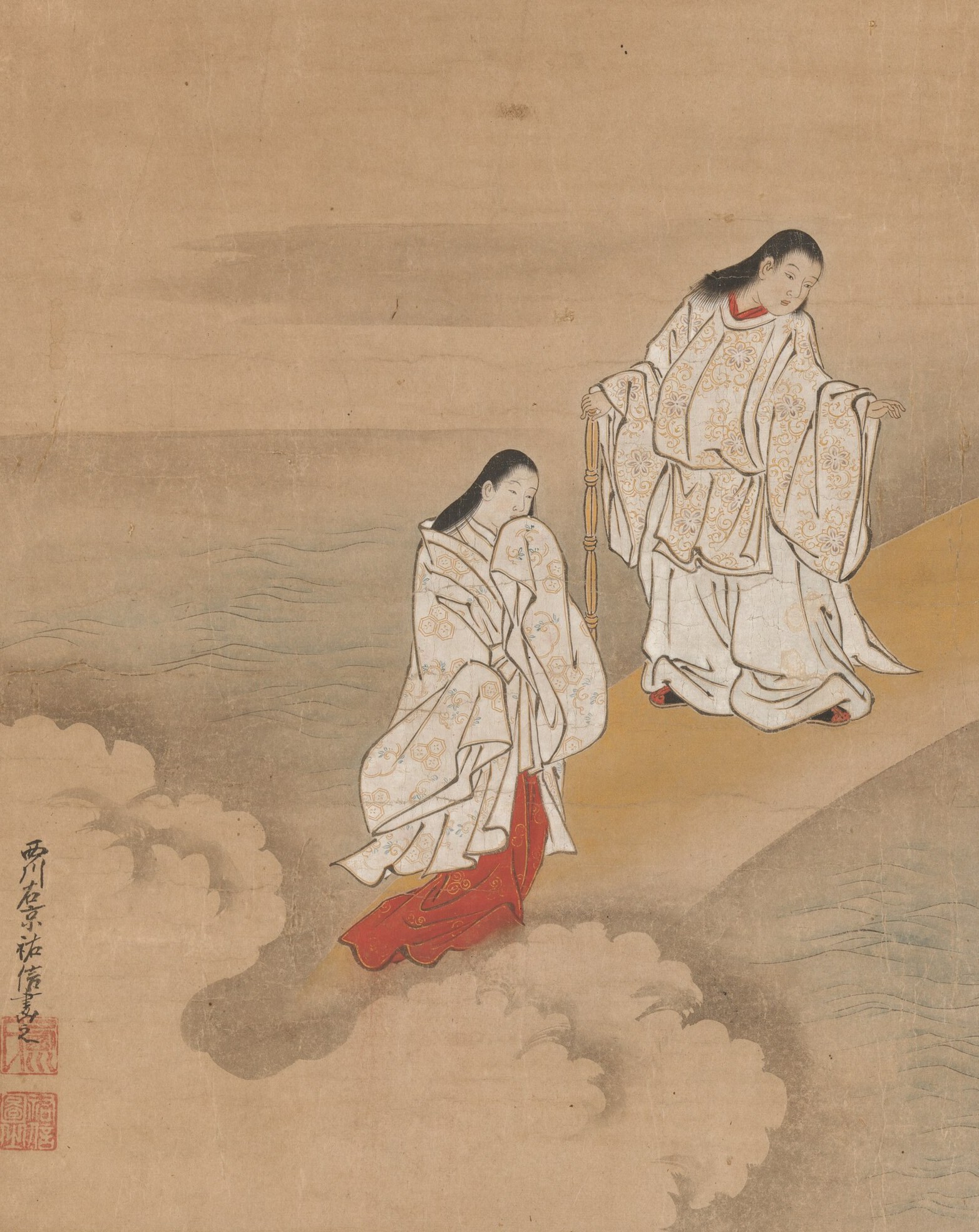
Japanese silk painting of Ninigi-no-Mikoto, the heavenly grandchild, striding in a pale robe with a leafy crown, jewelled necklaces and a gold-fitted sword, beside the blossom-princess Konohana-sakuya-hime, who is crowned with cherry blossom and robed in vermilion over pale green; attendants follow softly behind against a gold ground.
Japanese

The Descent of Ninigi

The sun-goddess hands her newborn grandson a mirror and tells him to reverence it as her own spirit, then sends him down the Floating Bridge of Heaven to rule the earth: how the imperial line came down from the sky, and why its rulers die like flowers.

7 minKojiki
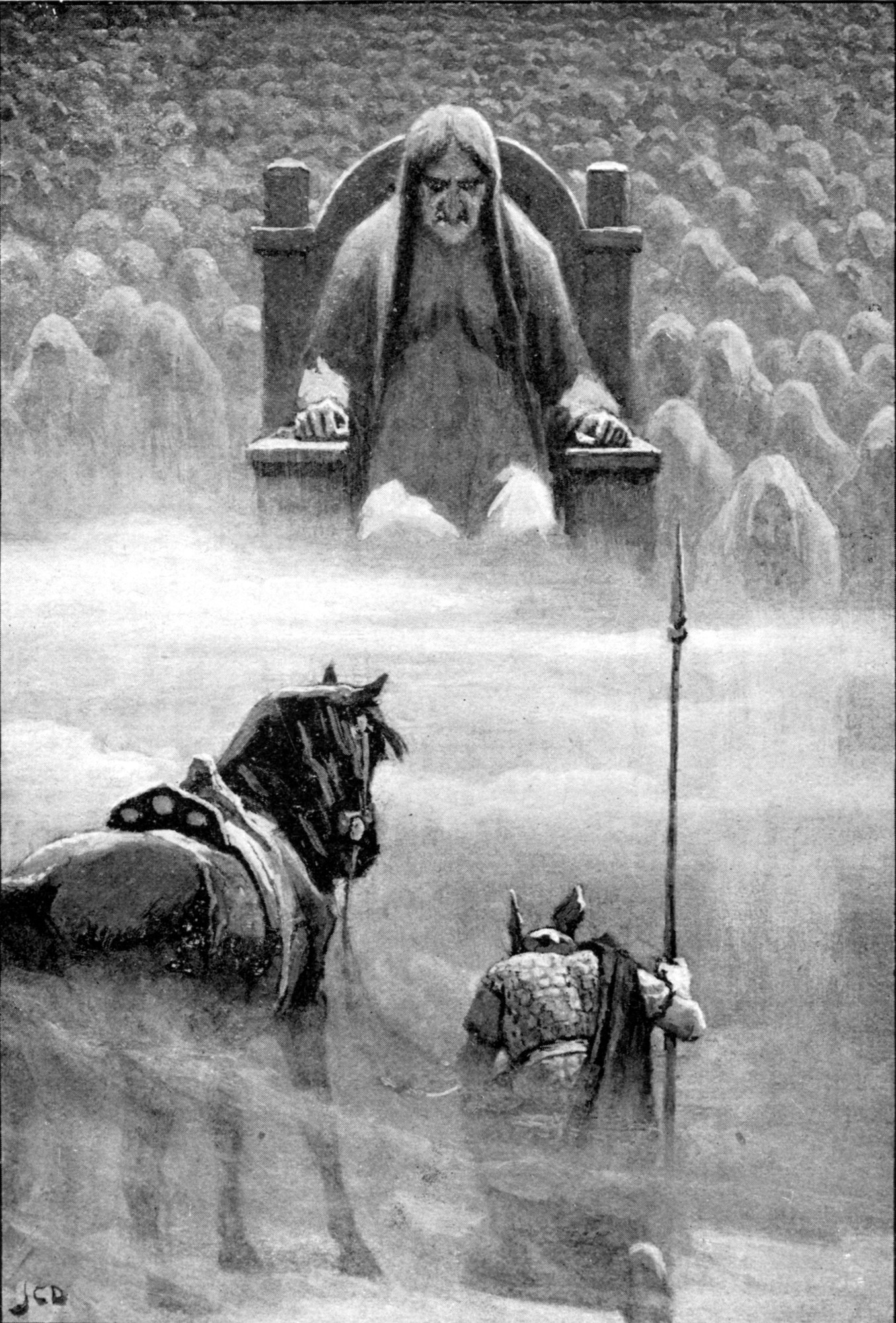
Hel, grim and stern-faced, enthroned on a stone high-seat in the misty dark of her realm, both hands gripping the throne-arms, ranks of the shrouded dead receding behind her; below, Hermóð the Nimble kneels before her with his spear, having dismounted from Odin's dark horse Sleipnir.
Norse

Hel, Queen of the Dead

Half her body the hue of living flesh, half of it corpse-blue, she keeps a hall where the table is called Famine and the bed is called Care: the daughter Odin cast into the mist to rule everyone who dies quietly.

5 minSnorri Sturluson
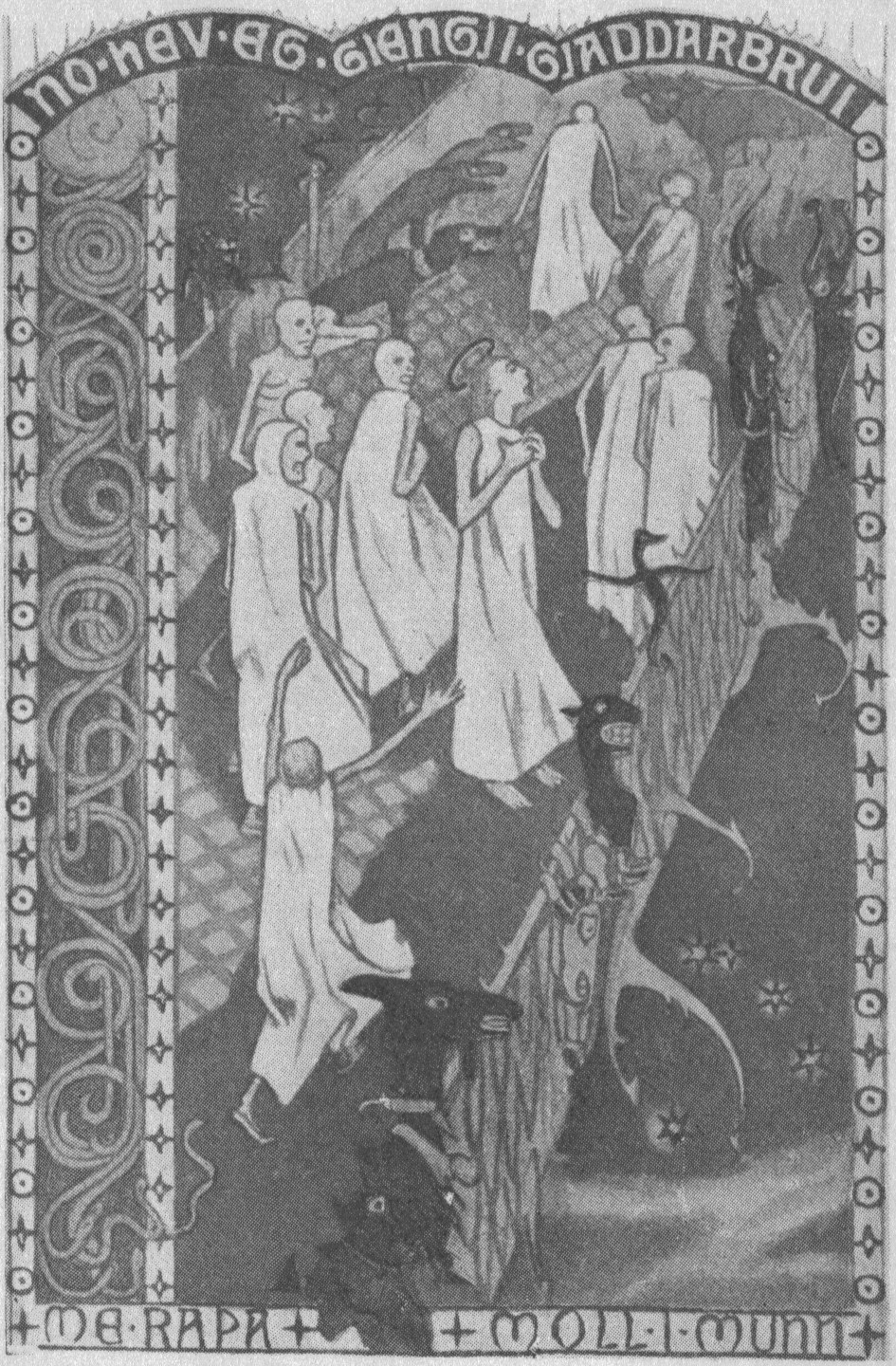
A tall decorative book-plate in the medieval-manuscript manner, worked in grey monochrome and framed by borders of interlaced serpents. A file of pale, shrouded dead climbs a narrow ledge toward a bridge at upper right, led by a haloed figure; dark horned beasts crouch in the shadowed lower reaches. A runic banner across the top reads 'NO HEV EG GJENGJI GJADDARBRUI' ('Now I have crossed the Gjallar-bridge').
Norse

Helheim, the Realm of the Dead Below

Downward and northward, under a root of the world-ash, lies the cold country that takes everyone who dies quietly: nine lightless valleys, a river that clangs, a gold-roofed bridge and a gate so high a god must leap it.

6 minSnorri Sturluson
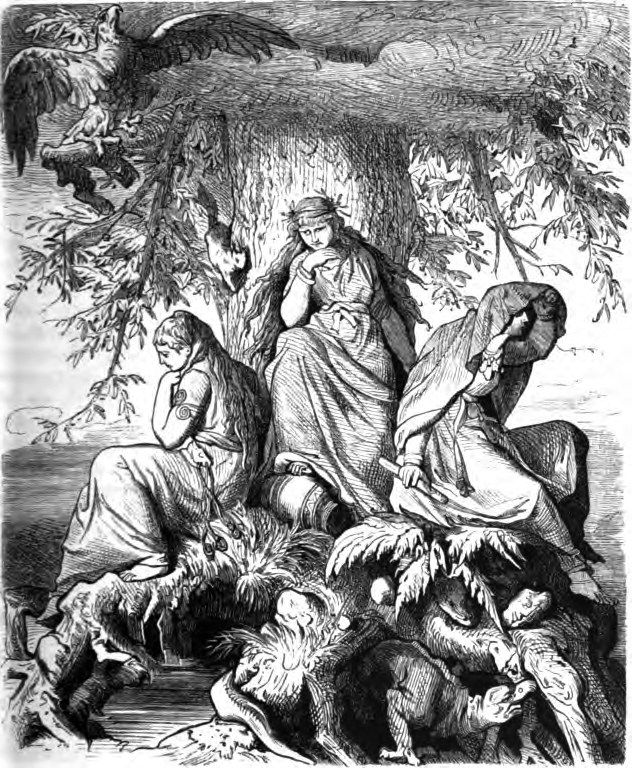
Wood-engraving of the three Norns beneath the world-ash Yggdrasil — three seated maidens in long robes under the great tree, an eagle perched in its crown above and a serpent and gnawing beasts coiling among the exposed roots below.
Norse

The Norns, Shapers of Fate

Three maidens mighty in wisdom come up from a dwelling beneath the world-ash, cut marks into wood, and lay down the lives of the sons of men.

5 minPoetic Edda
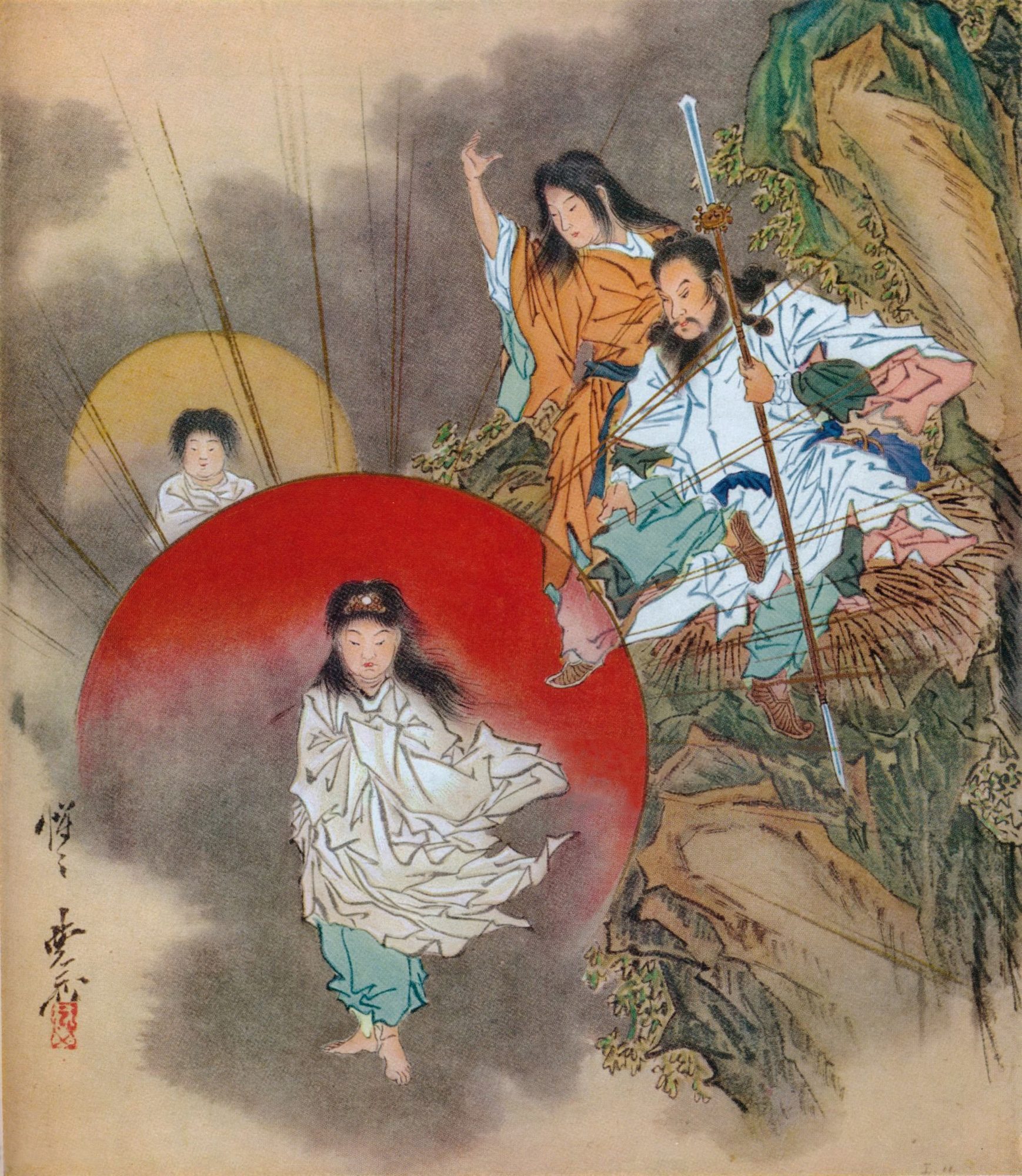
Richly coloured Japanese painting of the division of the cosmos among the first gods: the newborn sun-goddess Amaterasu rises white-robed inside a great red solar disc at the centre, a moon-child stands within a pale disc at the left, and on the heavenly cliff at the upper right the bearded creator-god Izanagi in white robes holds the heavenly jewel-spear beside the orange-robed goddess Izanami, whose arm is raised; grey cloud and streaming light fill the background.
Japanese

Takamagahara, the High Plain of Heaven

Not a mountain and not a sky-city but a plain: the celestial country of rice-fields and river-councils where the sun-goddess reigns, the cosmos opens, and the line of emperors takes its first breath.

7 minKojiki
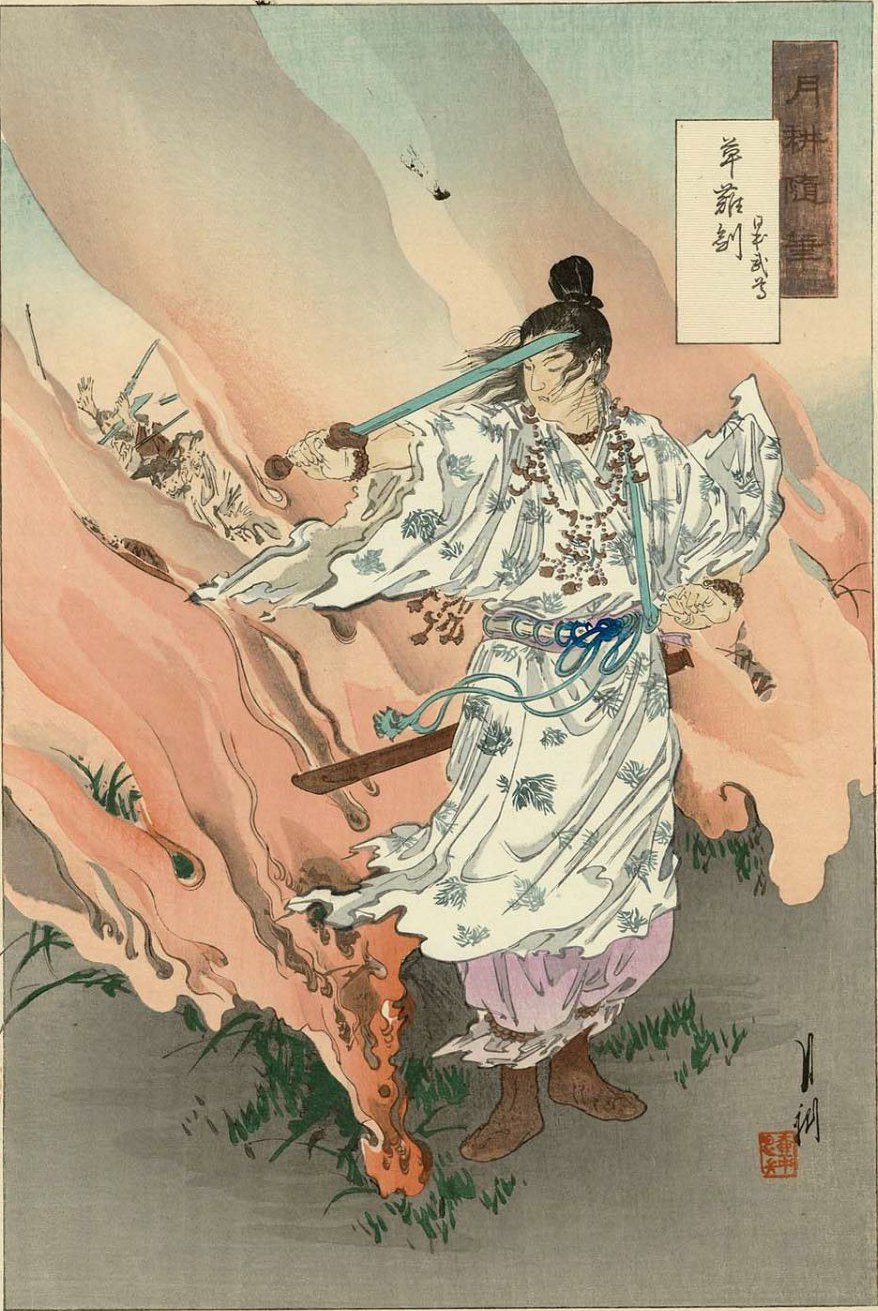
Japanese colour woodblock print of the hero Yamato-Takeru standing amid burning grass, a young man in a white robe patterned with pine-sprigs and hung with strings of curved jewels, drawing the blue-green Herb-Quelling sword Kusanagi across his body to cut back the flames sweeping up around him from the moor.
Japanese

The Three Sacred Treasures

A mirror forged to trap the sun, a sword drawn from a monster's tail, and a string of curved jewels: how three objects became the proof that Japan's emperors were born to rule.

7 minKojiki
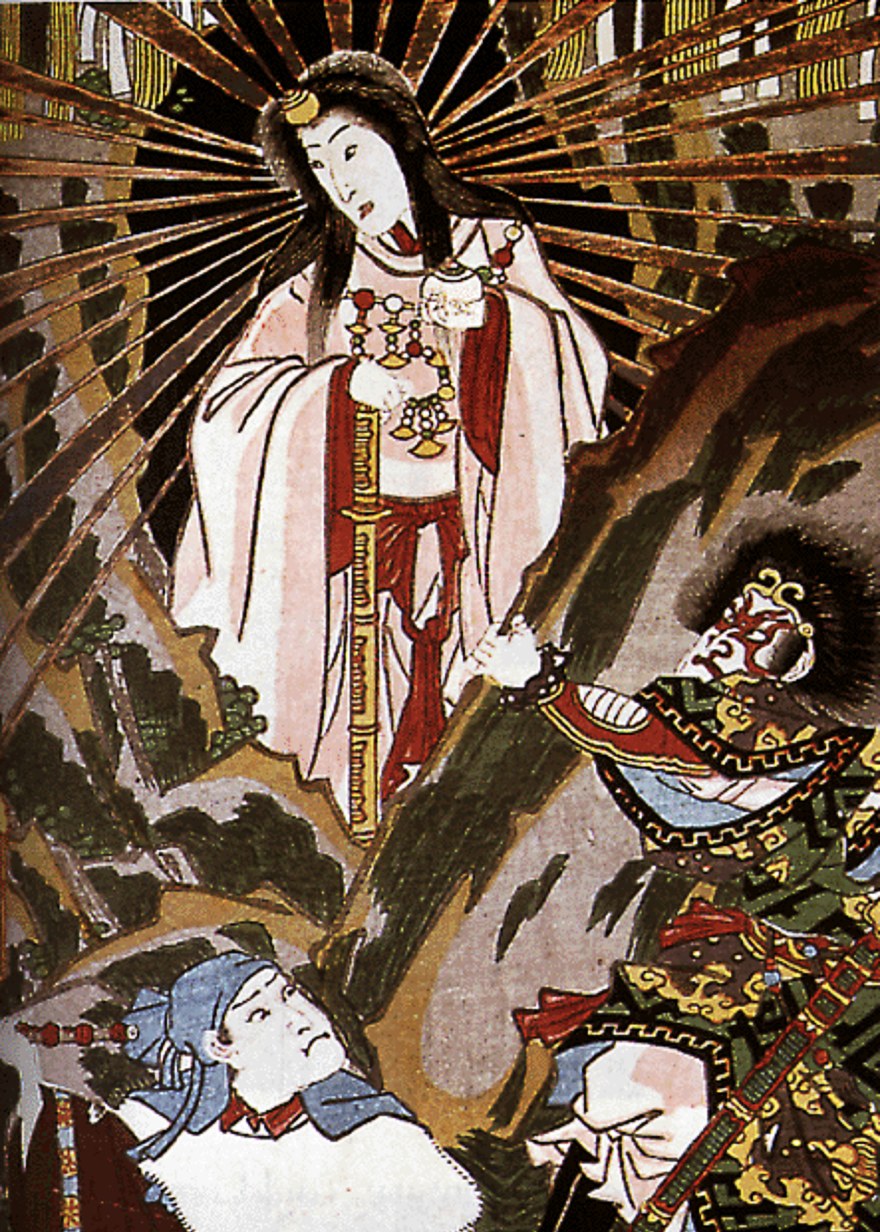
Japanese woodblock print of the sun-goddess Amaterasu, white-robed with loose black hair and gold rays streaming from her head, emerging from the mouth of the Heavenly Rock-cave; the fierce-faced strong-god Ta-jikara-wo grasps her hand to draw her out while another deity kneels gazing up at the returning light.
Japanese

Amaterasu, the Sun Goddess

The radiance that shone through all six quarters at birth, the goddess who armed herself like a warrior against her own brother and then shut the door on the world: ancestress of the emperors and light of the High Plain of Heaven.

6 minNihon Shoki
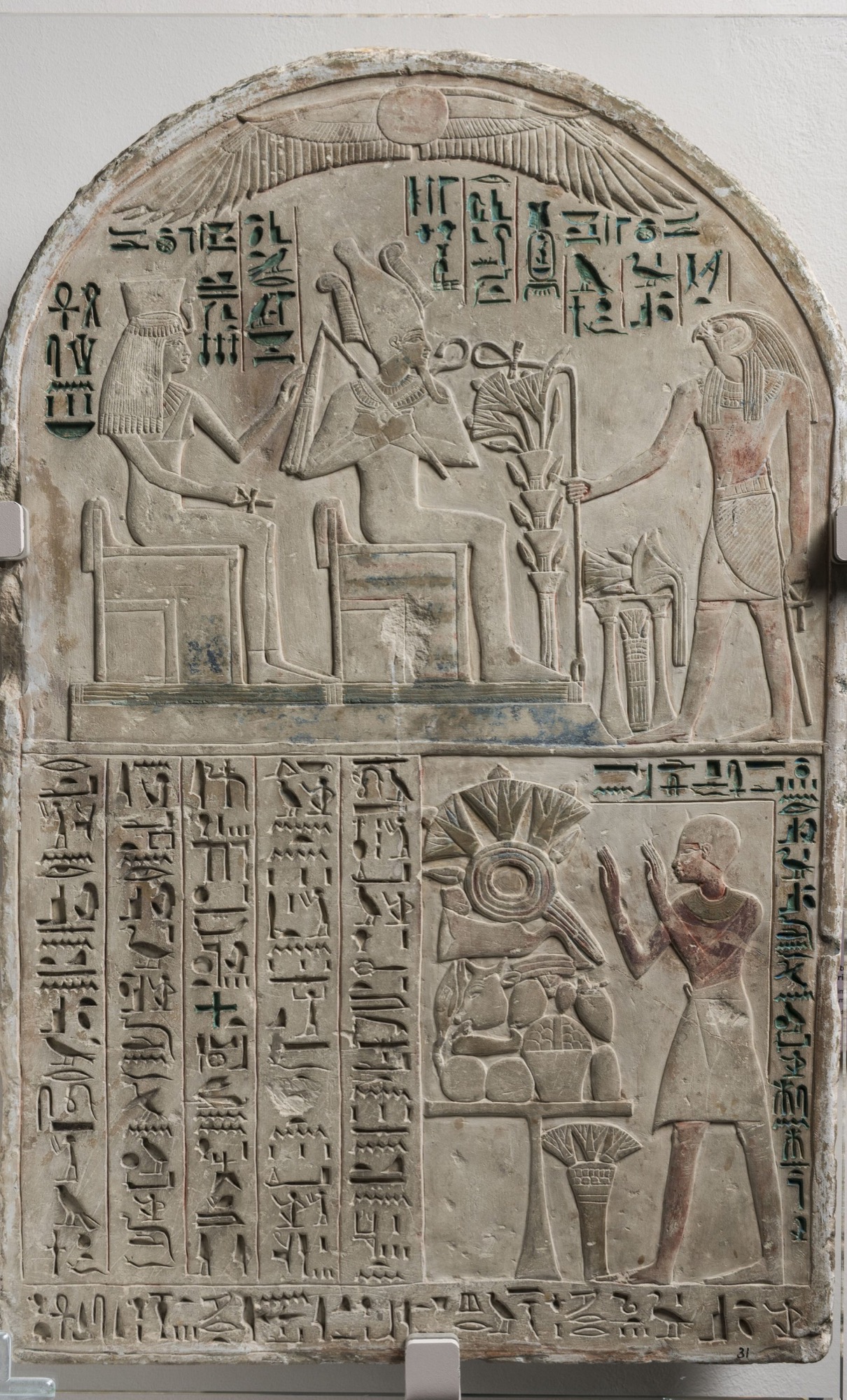
Ancient Egyptian limestone stela with an arched, painted lunette. Under a winged sun-disk, the upper register shows the god Osiris enthroned in the tall White Crown holding the crook, the goddess Isis seated behind him on a second throne, and the falcon-headed god Horus standing before them presenting lotus flowers over a laden offering-stand; columns of green-filled hieroglyphs fill the field, with a royal cartouche between Osiris and Horus. In the lower register a shaven-headed worshipper raises both hands in adoration before a heaped offering-table, beside several columns of a hieroglyphic hymn.
Egyptian

Horus Avenges His Father

Reared in the marshes until his arm was strong, the falcon-son came for the throne his uncle stole: three ancient traditions, a slaughter, a tribunal and a war, and not one clean duel among them.

6 minPyramid Texts
A hand-coloured lithograph plate of Geb (Sèb), the earth god, enthroned and crowned, from Champollion's Panthéon égyptien.
Egyptian

Geb, the Earth Beneath

To bite the ground is to bite a god. He is the floor of the world, the judge at the head of the Nine, and the father who hands the throne of Egypt down to his son.

5 minPyramid Texts
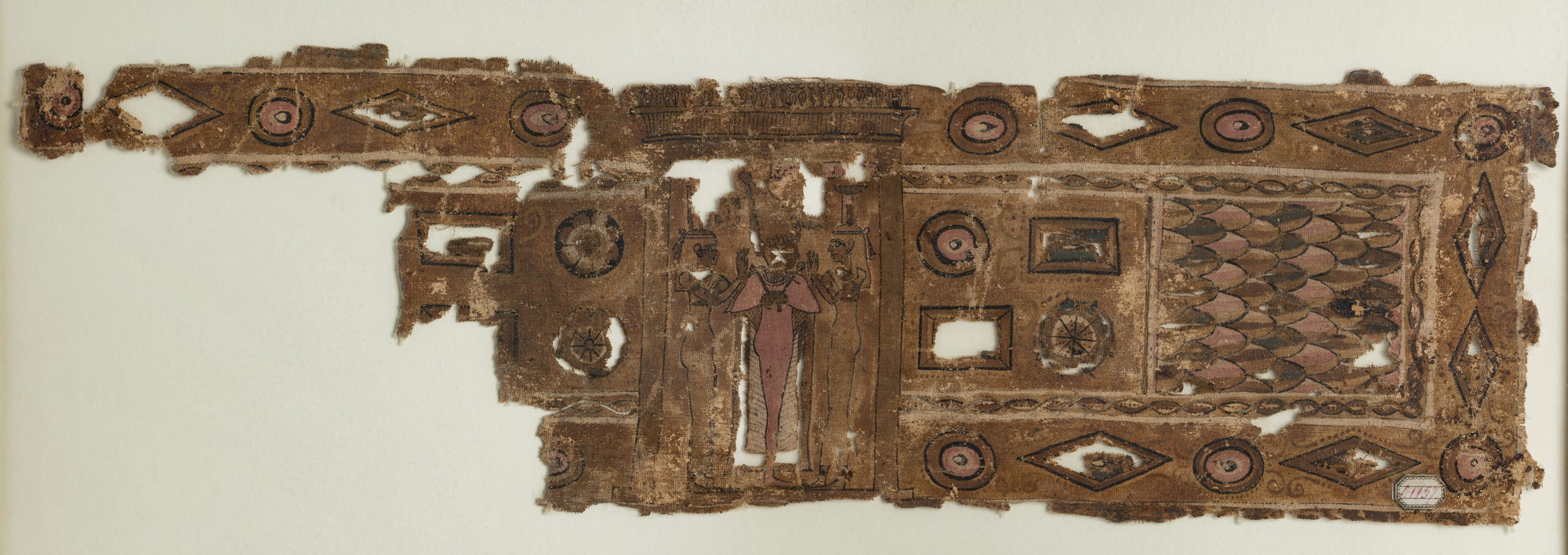
Roman-period Egyptian funerary shroud in painted linen: the mummiform god Osiris lies at the centre on a bier, green-skinned, arms crossed over his chest; the goddesses Isis and Nephthys stand or kneel at head and foot with hands raised in mourning; winged deities and columns of hieroglyphs fill the surrounding bands.
Egyptian

Isis Gathers the Scattered Osiris

A widow cuts a lock of her hair, puts on mourning, and walks out into the marshes to find a husband her brother has thrown to the water: the long search for the body of Osiris, and why no single ancient text tells it whole.

7 minPlutarch
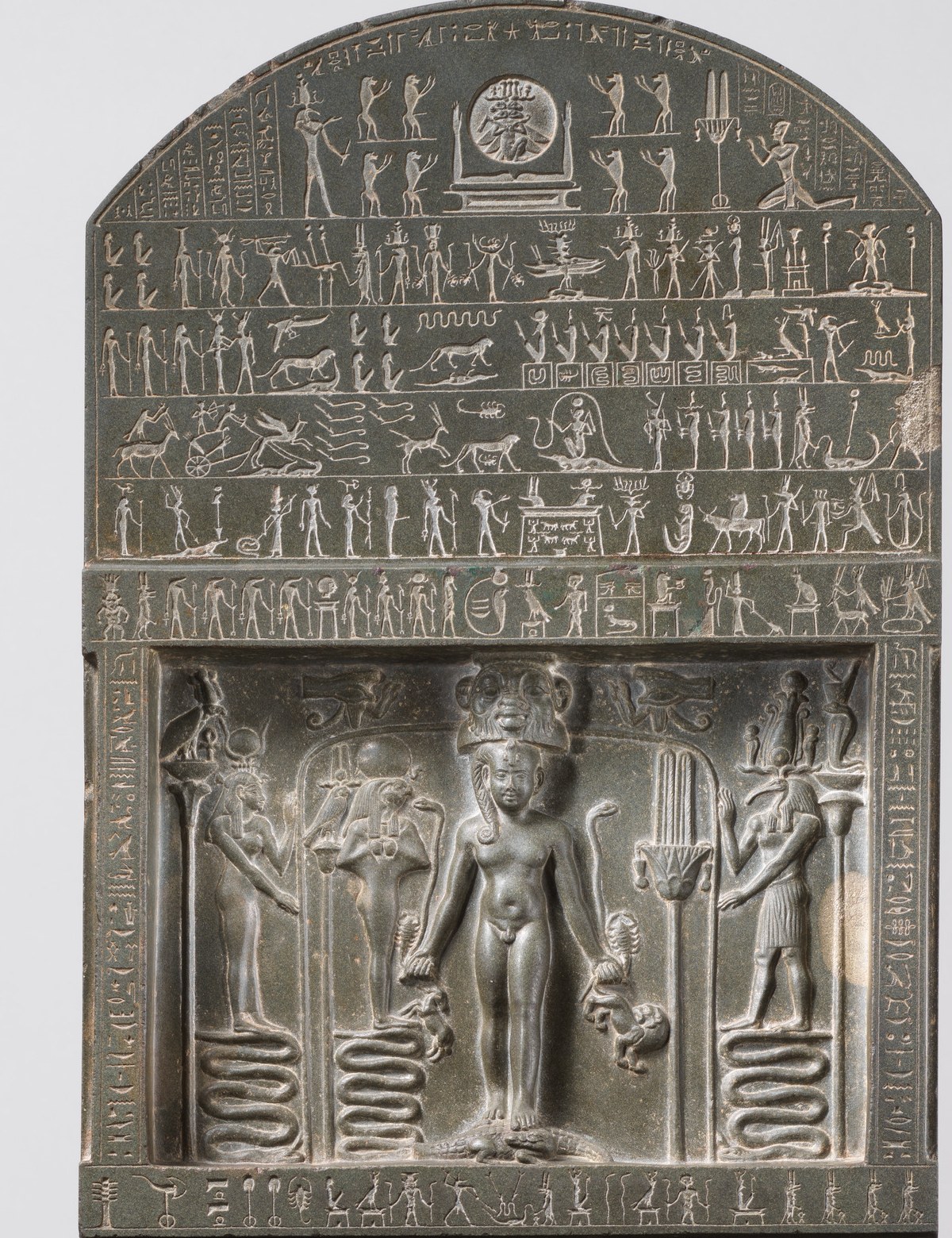
Ancient Egyptian dark-stone magical stela (cippus): in a recessed panel the nude child-god Horus stands frontally on two crocodiles, grasping serpents, a scorpion, a lion and a gazelle in his fists, crowned by the mask of the god Bes and flanked by two deities standing on coiled serpents; above, an arched lunette with registers of gods and dense hieroglyphs.
Egyptian

The Contendings of Horus and Set

Eighty years of lawsuits and duels for a dead king's throne: an uncle and a nephew, a bench of gods that cannot make up its mind, and a mother who will not let her son lose.

6 min"The Contendings of Horus and Seth
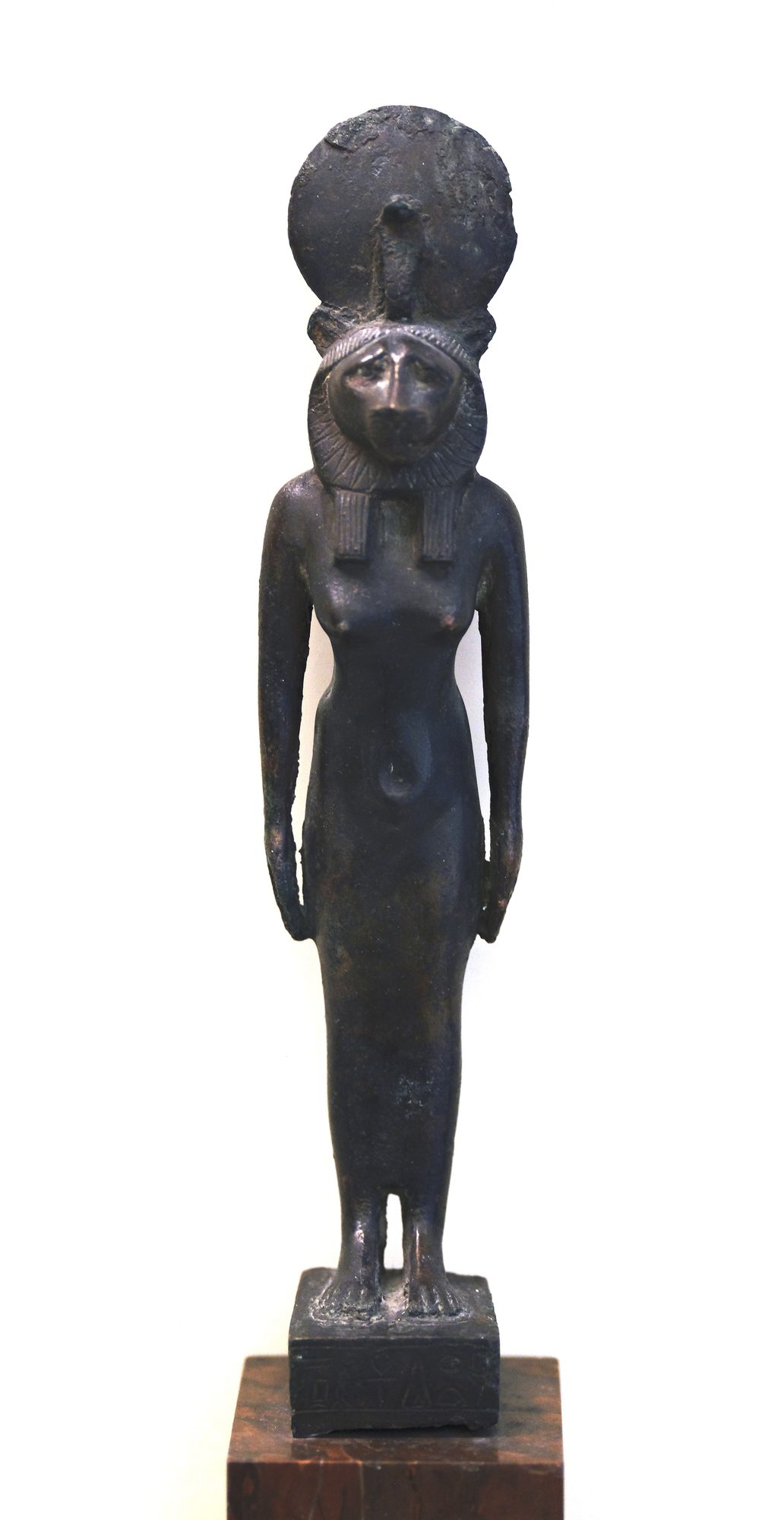
An ancient Egyptian granodiorite statue of the lioness-headed goddess Sekhmet, a slender figure with a sun disk and uraeus at her brow, holding a papyrus sceptre.
Egyptian

Sekhmet: The Powerful

A goddess carved in statues enough to face every day of the year, whose breath was plague and whose priests were physicians: the lioness the Egyptians both feared and begged.

7 minPyramid Texts
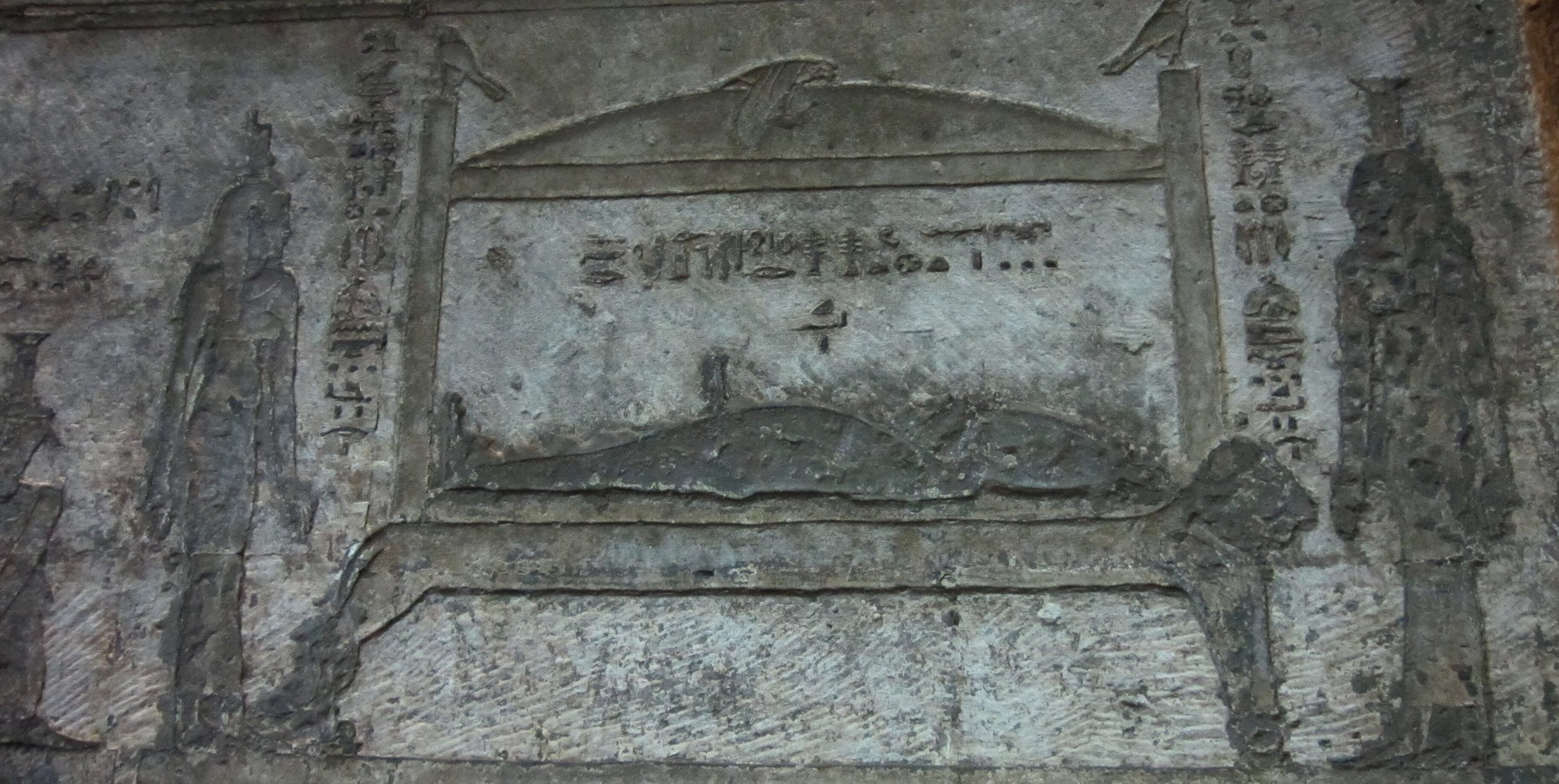
An ancient Egyptian sunk-relief scene carved in stone: the dead god Osiris lies wrapped as a mummy on a low funerary bier beneath an arched shrine-canopy, a bird (the soul as a hawk) hovering with outspread wings over the canopy's ridge; a tall crowned goddess stands mourning at the left and another at the right, each with columns of hieroglyphs above, the whole panel worn grey temple limestone.
Egyptian

The Mysteries of Osiris at Abydos

Once a year the god was carried out to die, hunted to his grave on the desert flats, and brought home again: what a royal treasurer, a Greek philosopher and a temple archive each saw of the drama, across seventeen centuries.

8 minIkhernofret Stela
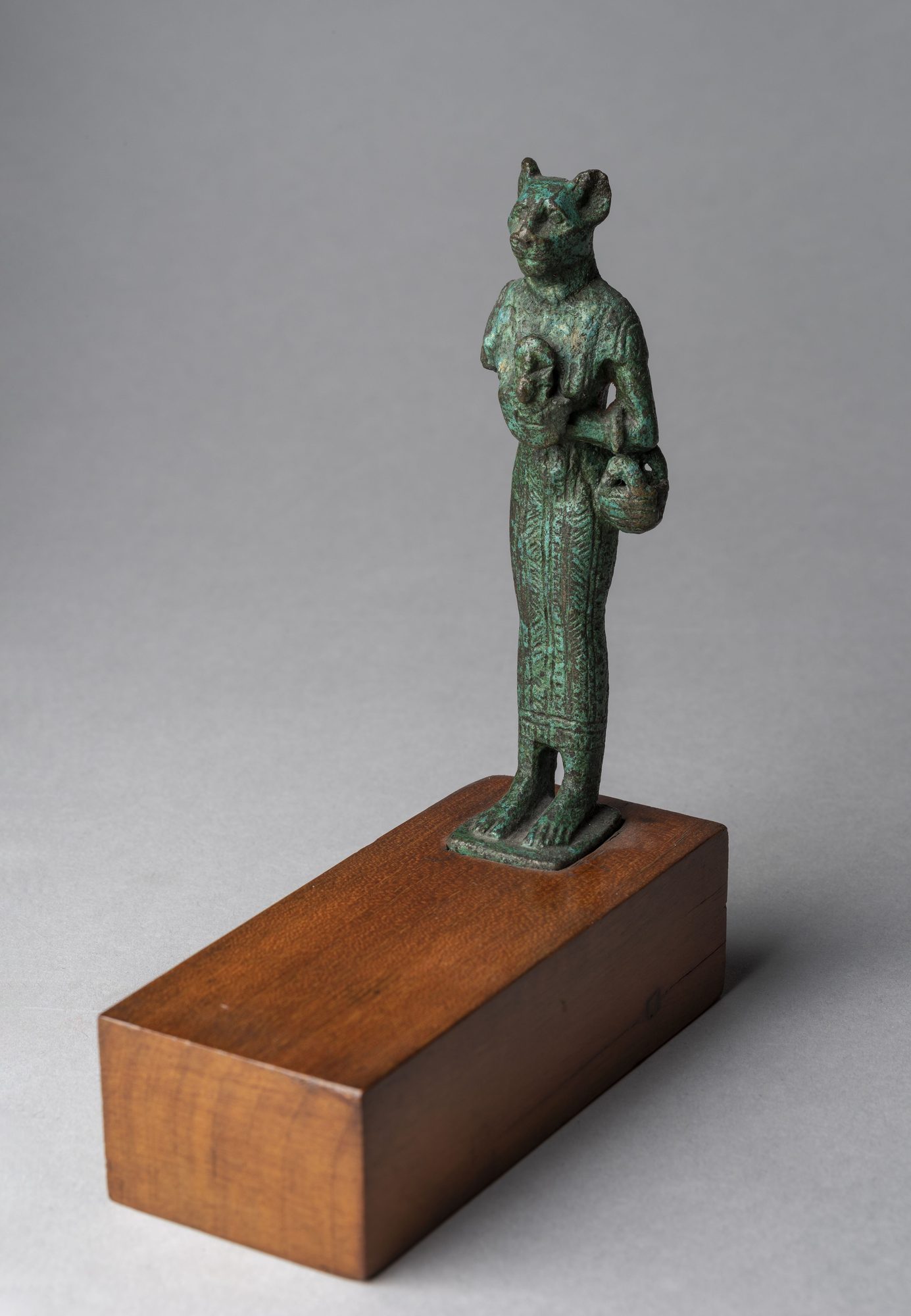
An ancient Egyptian bronze statuette of the goddess Bastet in cat-headed form, a lithe female figure with a lioness-domestic cat head and a broad collar.
Egyptian

Bastet: The Cat of Bubastis

Before she was the gentle cat with kittens at her feet, she was a lioness of the sun a dead king dared not offend. Egypt drank more wine at her festival than in all the rest of the year.

6 minPyramid Texts
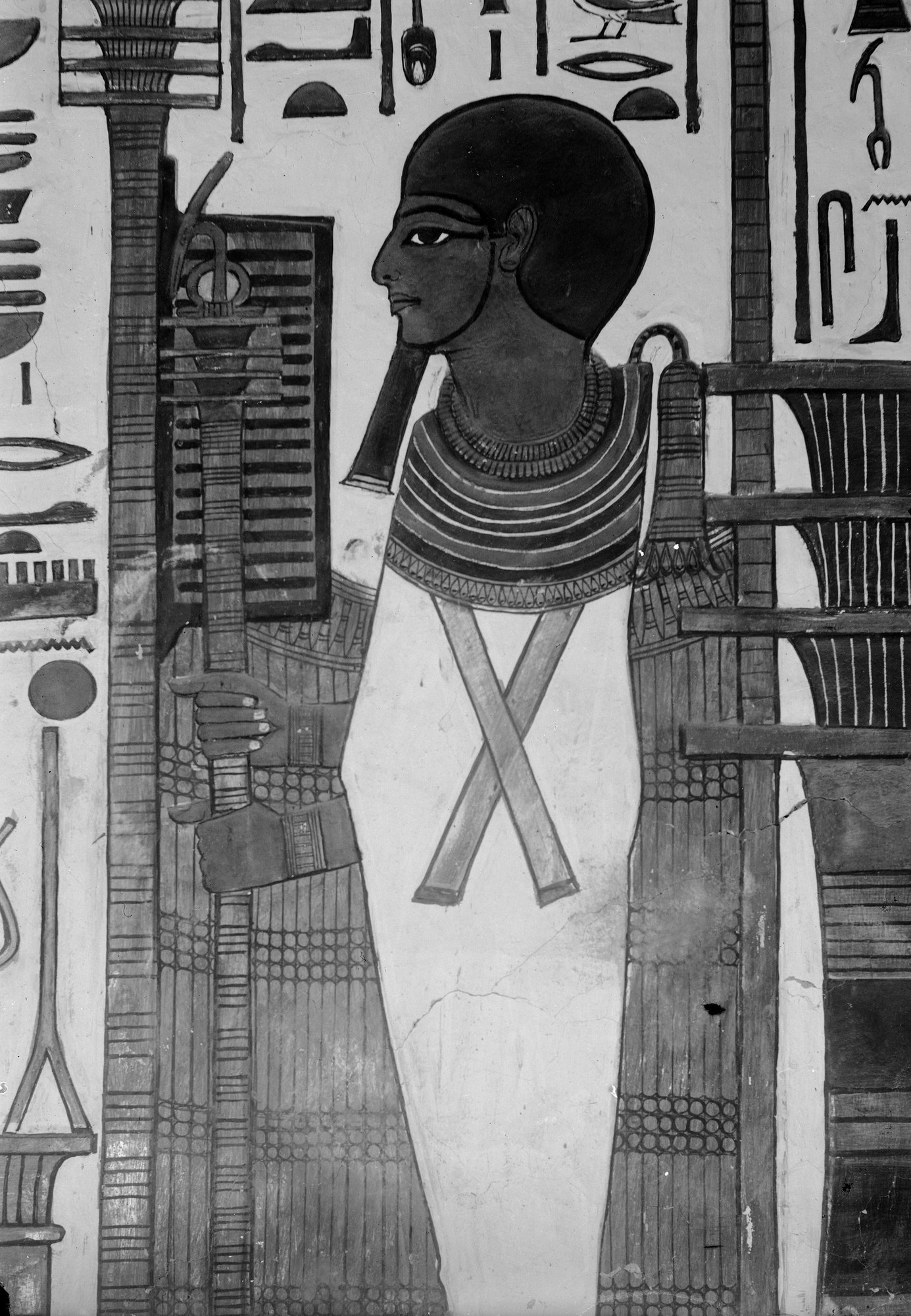
Wall-painting of the god Ptah in his shrine: a mummiform figure in a close skullcap and straight divine beard, a broad beaded usekh collar over his shoulders, his hands emerging from the wrapped body to grip a tall composite was-djed-ankh staff, standing within a kiosk framed by djed-pillars and columns of hieroglyphs. Black-and-white archival photograph of the ancient painting.
Egyptian

Ptah: The Craftsman Who Thought the World

The god of Memphis made no clay and spilled no seed. He devised the cosmos in his heart and spoke it with his tongue, then built the very bodies the other gods would live inside.

6 minMemphite Theology
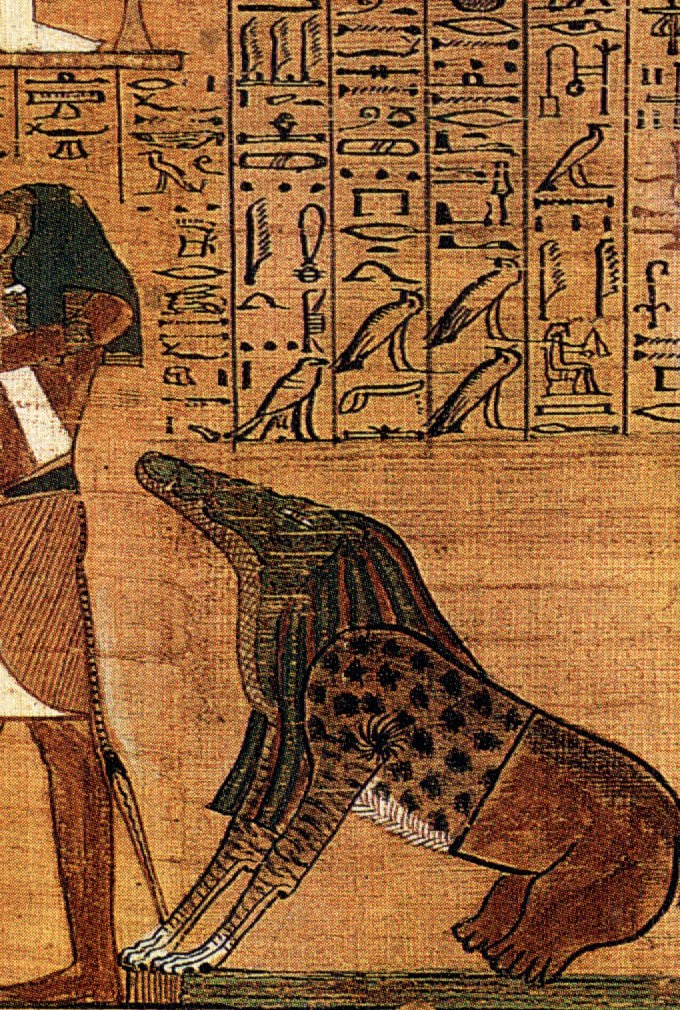
Detail from an ancient Egyptian funerary papyrus: the devourer Ammit crouched on the ground beside the judgment scene — a composite beast with the open-jawed head and scaly neck of a crocodile, the spotted-leopard mane and forequarters of a lion, and the heavy hindquarters of a hippopotamus, her four feet resting on the green ground-line; the ibis-headed scribe-god Thoth stands at left with his palette, and columns of hieroglyphs run along the top.
Egyptian

Ammit, Devourer of the Dead

She never lifts a claw and never speaks a line: the beast who crouches by the scales in the Hall of the Two Truths does one thing only, and it is the worst thing the Egyptian afterlife could imagine.

5 minThe Egyptian Book of the Dead
A hand-coloured lithograph plate of Thoth trismégiste: the ibis-headed god of writing standing in profile with a writing palette, from Champollion's Panthéon égyptien.
Egyptian

Thoth, Scribe of the Gods

Reed-pen in one hand and palette in the other, the ibis-headed god stands at the Great Balance and writes down whether a dead soul lived true: the recorder, the proclaimer, and the very word that ordered the world.
6 minThe Book of the Dead / Book of Coming Forth by Day
A hand-coloured lithograph plate of Amun-Ra, l'esprit des quatre éléments: the god in composite form with plumed crown, from Champollion's Panthéon égyptien.
Egyptian

Amun, the Hidden One

Felt like wind through feathers and never seen, the self-made creator of Thebes whose very name means concealment: how a local city-god rose to become Amun-Re, king of all the gods.

6 minHymns to Amun
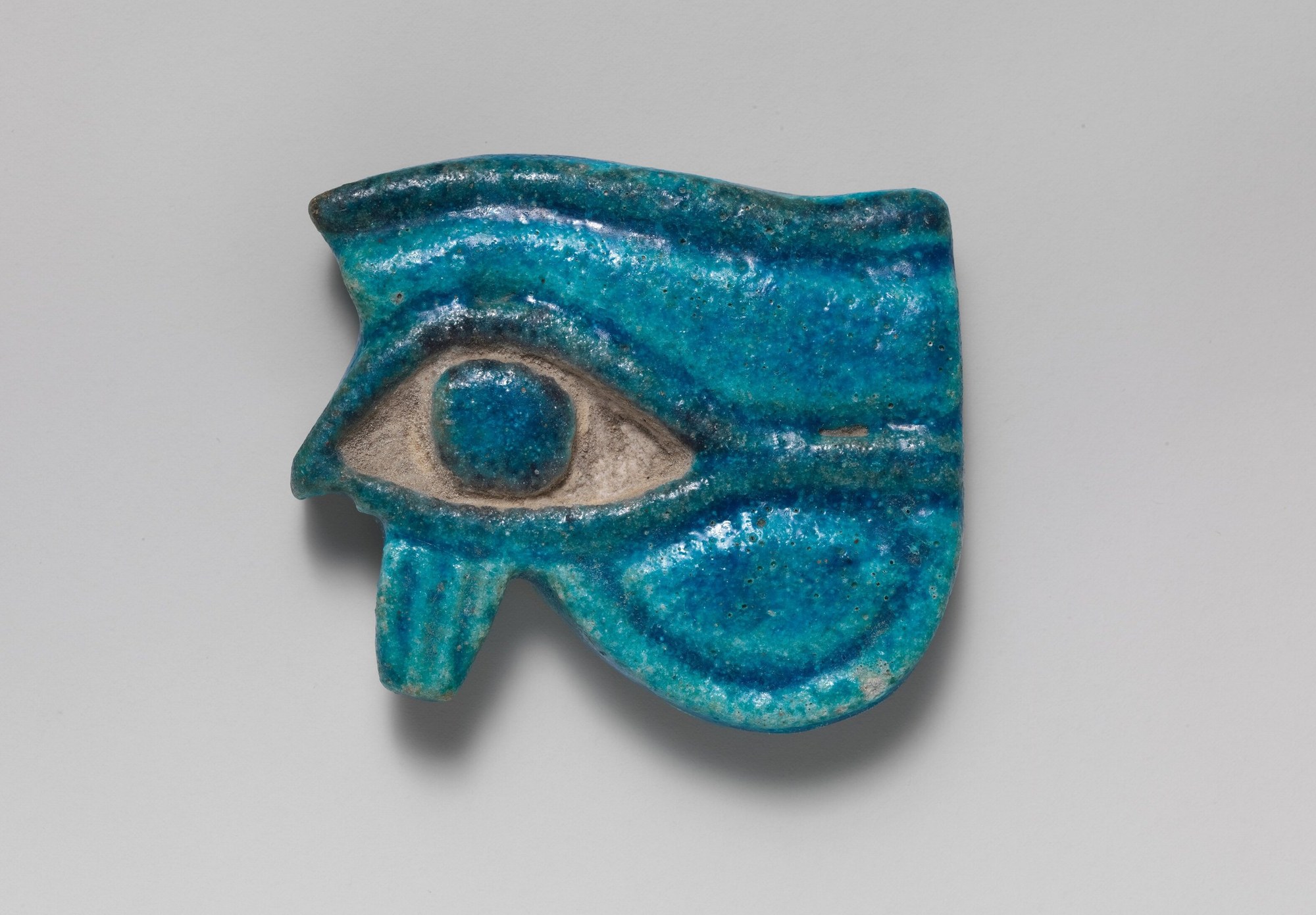
An ancient Egyptian wedjat (Eye of Horus) amulet in brilliant turquoise-blue glazed faience, photographed on a plain neutral ground. The stylised falcon-eye shows the arched brow and dark upper cosmetic-line, the almond eye with a raised round pupil, a vertical striated teardrop marking dropping straight down below the eye, and a curling spiral cheek-marking sweeping out to the right. The glaze is worn to pale matte around the eye socket; the whole amulet is intact.
Egyptian

The Eye of Horus, Torn and Made Whole

A black pig, a mighty storm, an eye put out: how the Egyptians told the wounding of Horus two ways at once, and why the healed eye became the very word for wholeness.

6 minPyramid Texts
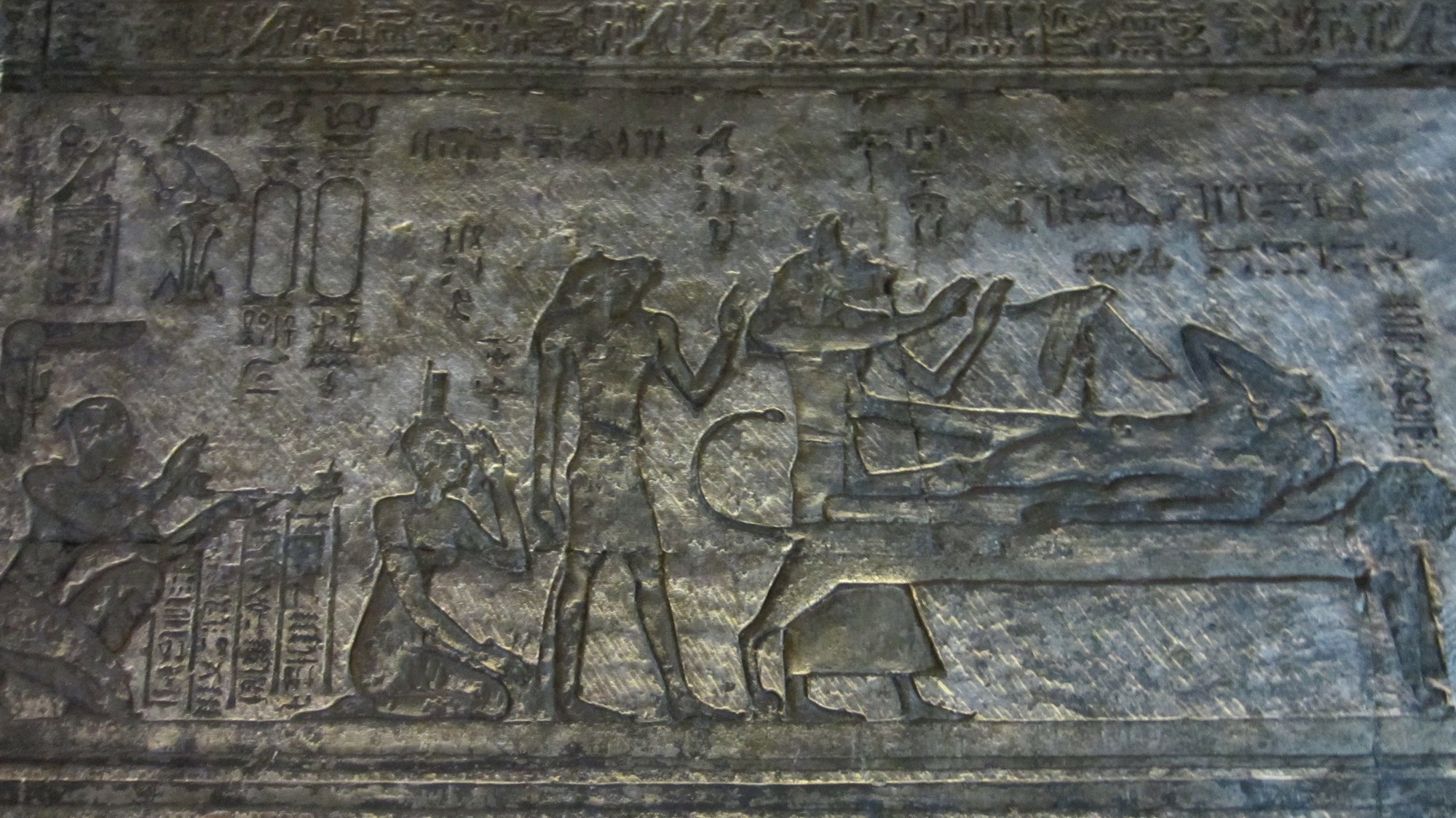
Ancient Egyptian temple relief carved in sunk relief on a chapel wall. At right the god Osiris lies recumbent and ithyphallic on a low bier; above his body the goddess Isis, in the form of a kite with outstretched wings, settles to conceive the heir. The jackal-headed god Anubis attends at the couch, and to the left a standing goddess and a kneeling goddess mourn, with a seated figure at the far edge. Columns of hieroglyphs and royal cartouches fill the field, framed by hieroglyphic border bands above and below.
Egyptian

Isis Conceives Horus over the Slain Osiris

A carrion bird settles over a murdered god at Nedit, beats life back into him with her wings, and draws from the dead body a son sharp as a star: the strangest conception in Egyptian myth, and the making of an avenger.

6 minPyramid Texts §632
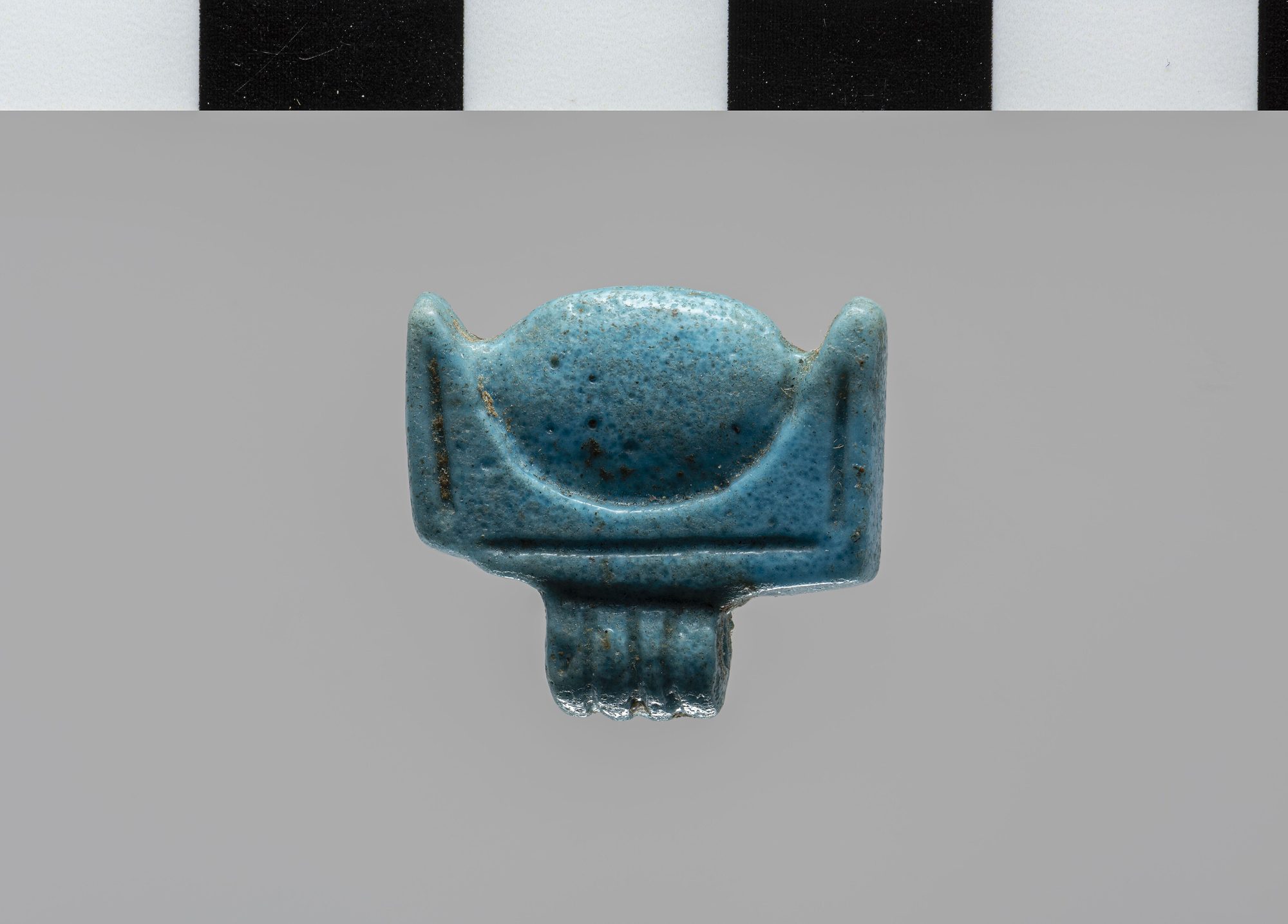
An ancient Egyptian faience amulet in the shape of the akhet — the sun disk cradled between the two hills of the horizon.
Egyptian

The Akhet: The Cosmic Horizon

A sun-disk cradled in the notch between two hills: the Egyptian sign for the horizon was also a place, the gated seam where sky, earth and the underworld meet and the sun goes in and out of the world.
7 minPyramid Texts
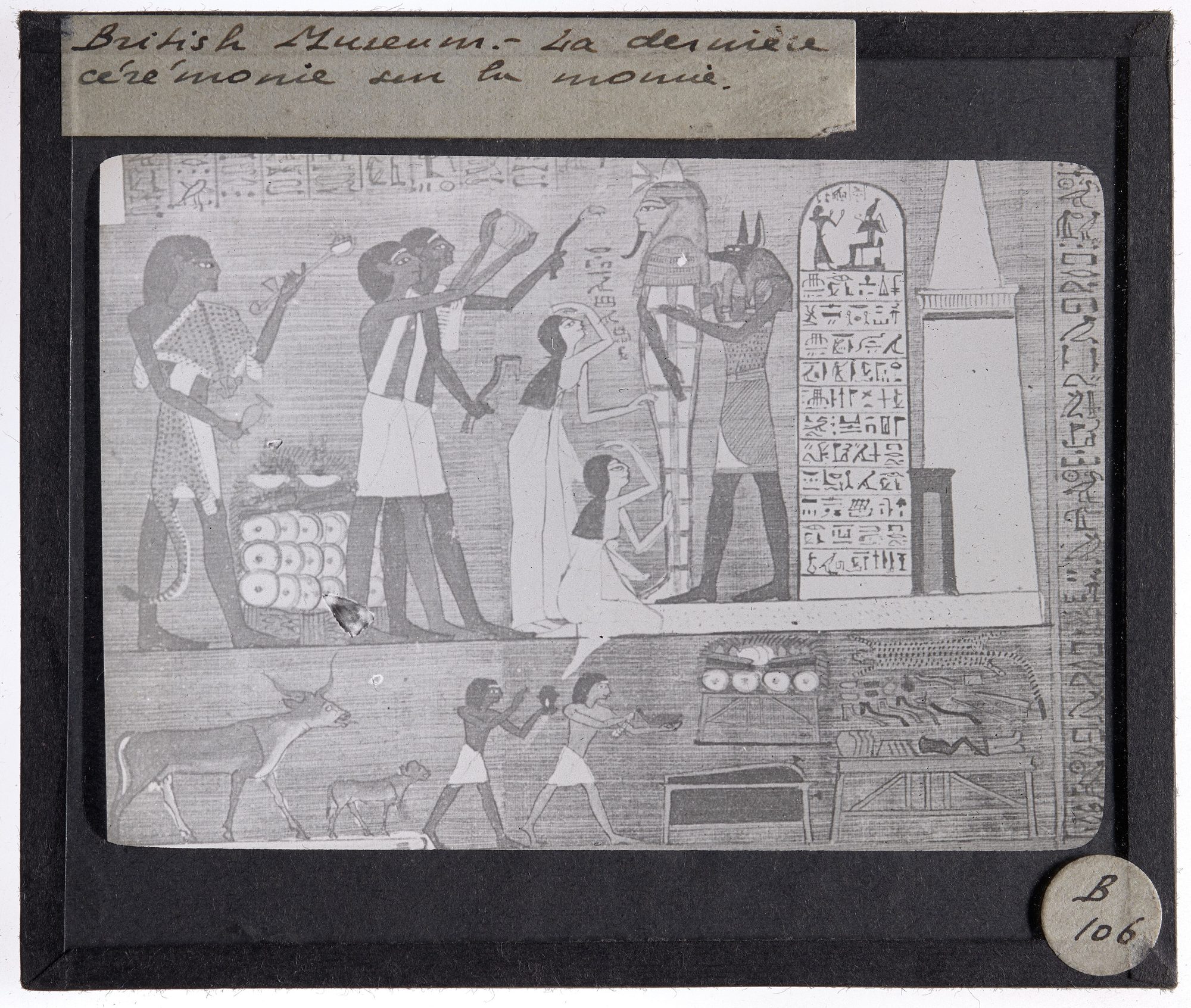
Detail from the Book of the Dead of Hunefer: jackal-headed Anubis performs the Opening of the Mouth ceremony before the tomb, steadying the upright mummy of the scribe while mourners kneel and priests bear offerings.
Egyptian

Anubis, Guardian of the Dead

The jackal on the desert ridge, black as fresh silt and embalmer's resin: the god who washed the entrails of Osiris, kept watch over the corpse through the night, and stood at the balance where the heart was weighed.
6 minThe Pyramid Texts
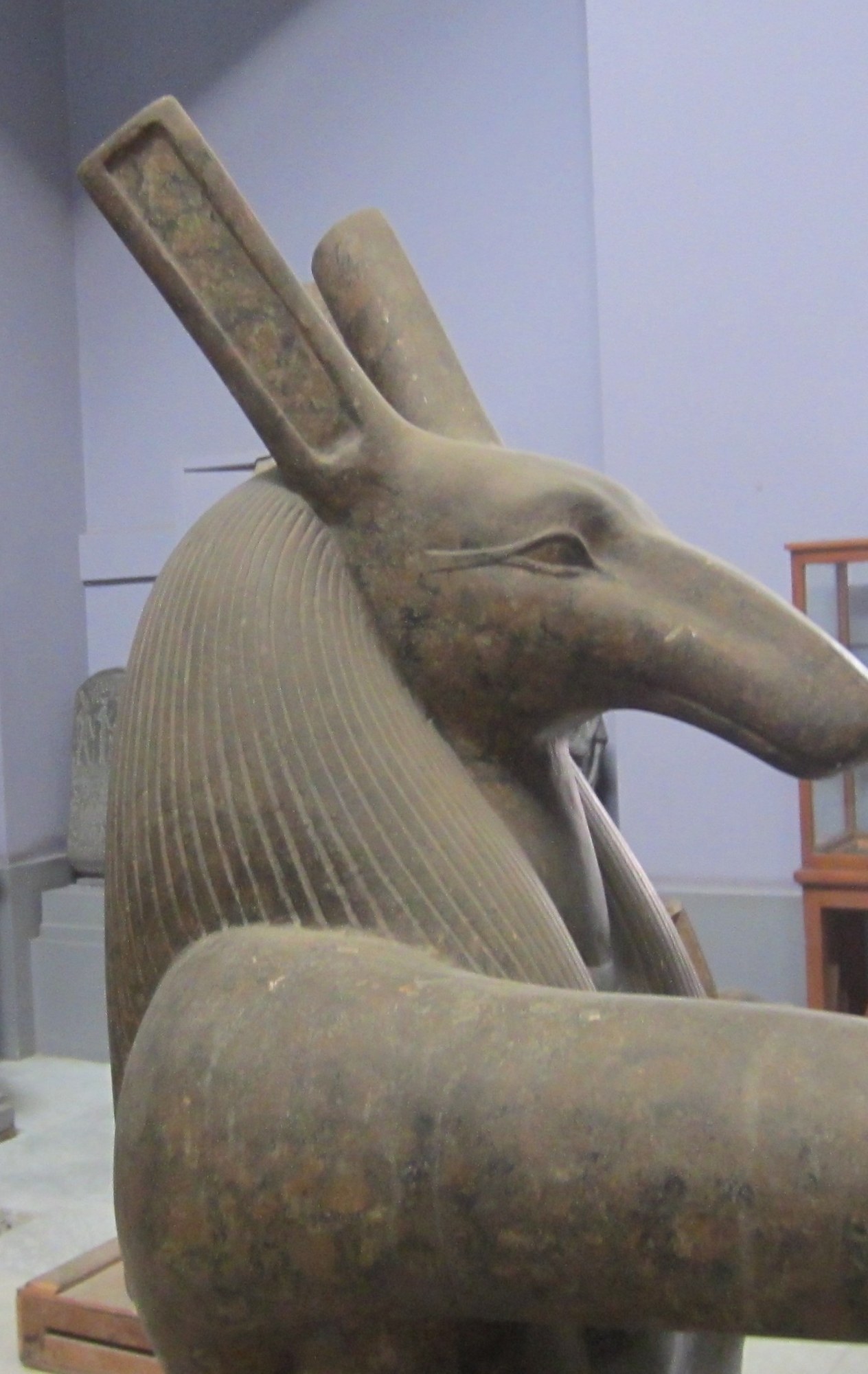
Detail of an ancient Egyptian granite statue showing the head of the god Set in profile: the composite "Set-animal" head with its long down-curved snout, tall squared upstanding ears and almond eye rimmed by a cosmetic line, backed by a striated tripartite wig, with the god's neck and one arm below, against a plain grey museum wall.
Egyptian

Set, God of Chaos

Storm-god, desert-lord and fratricide: the red god the Egyptians both needed and feared, murderer of Osiris and rival of Horus, who was never only a villain.

6 minPyramid Texts
A hand-coloured lithograph plate of Atum (Atmou), the Heliopolitan creator god, crowned and striding in profile, from Champollion's Panthéon égyptien.
Egyptian

Creation at Heliopolis

Before the world there was only dark water, and one god who made himself: how Atum rose on the first dry hill, spat the twins Shu and Tefnut from his own body, and fathered the Nine gods of Heliopolis.

6 minPyramid Texts
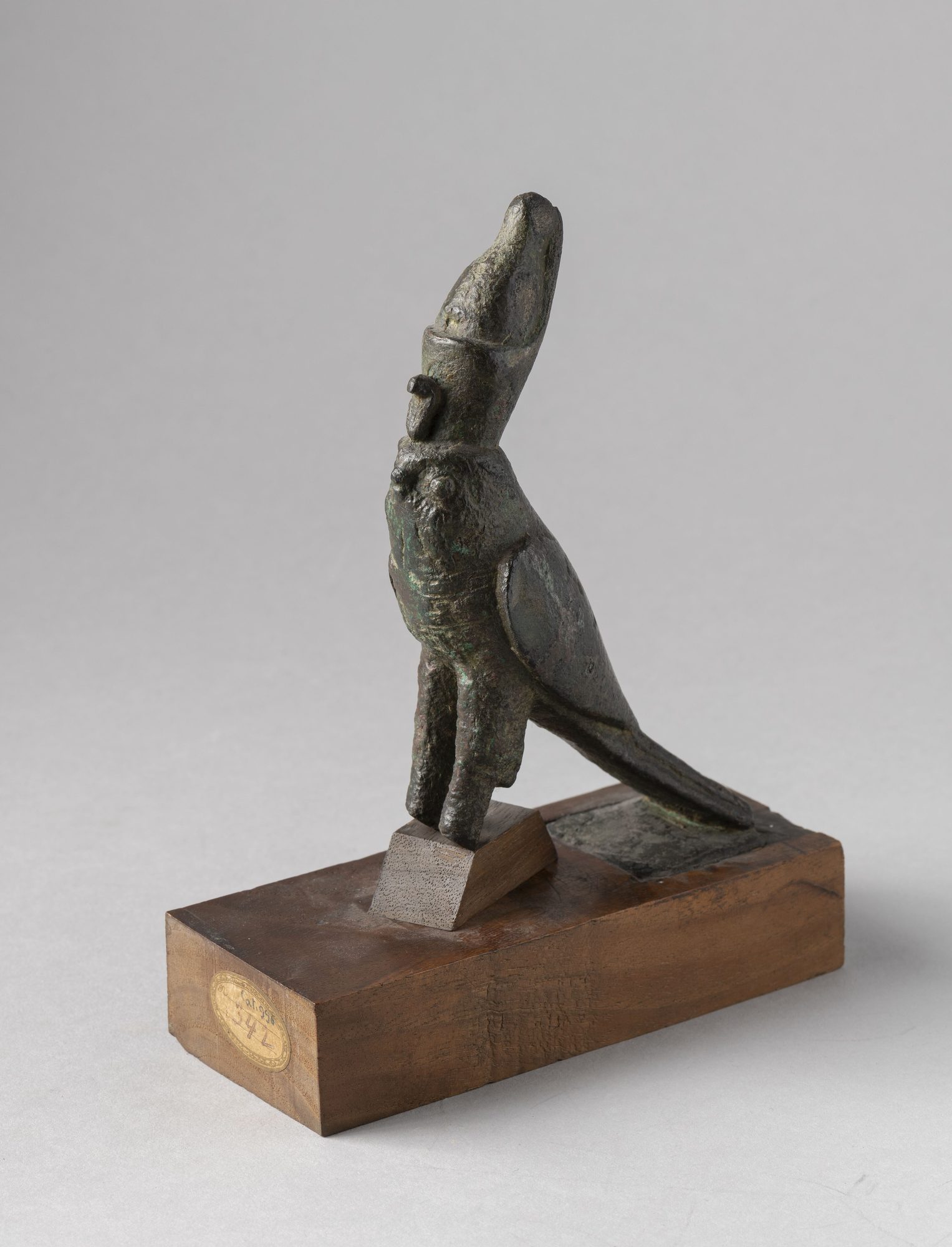
An ancient Egyptian bronze statuette of Horus as a falcon wearing the double crown of Upper and Lower Egypt.
Egyptian

Horus, the Falcon King

The falcon-headed heir who takes back a stolen throne: son of a murdered god, raised in a marsh, and vindicated before the assembled gods as the rightful king of Egypt.

6 minPyramid Texts
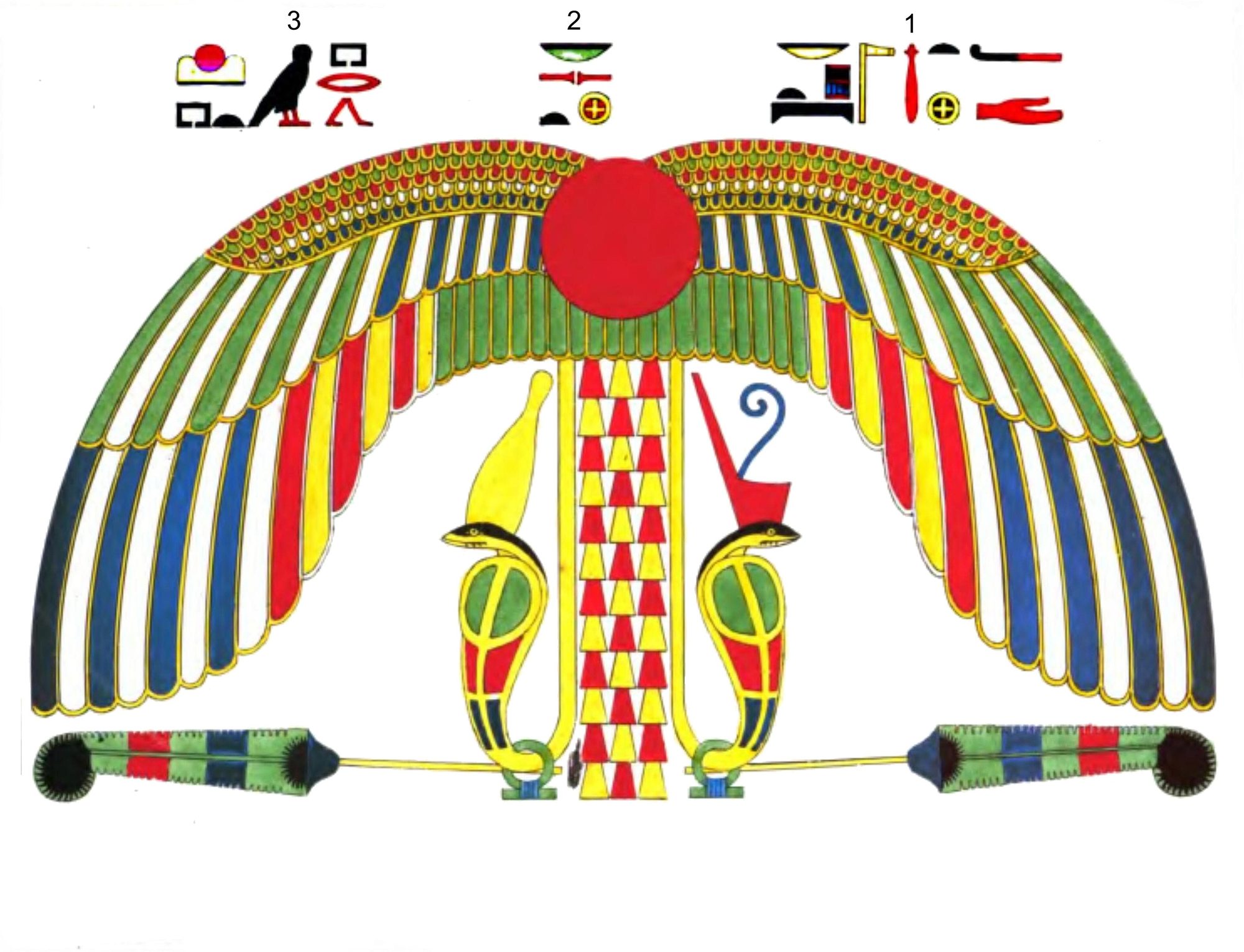
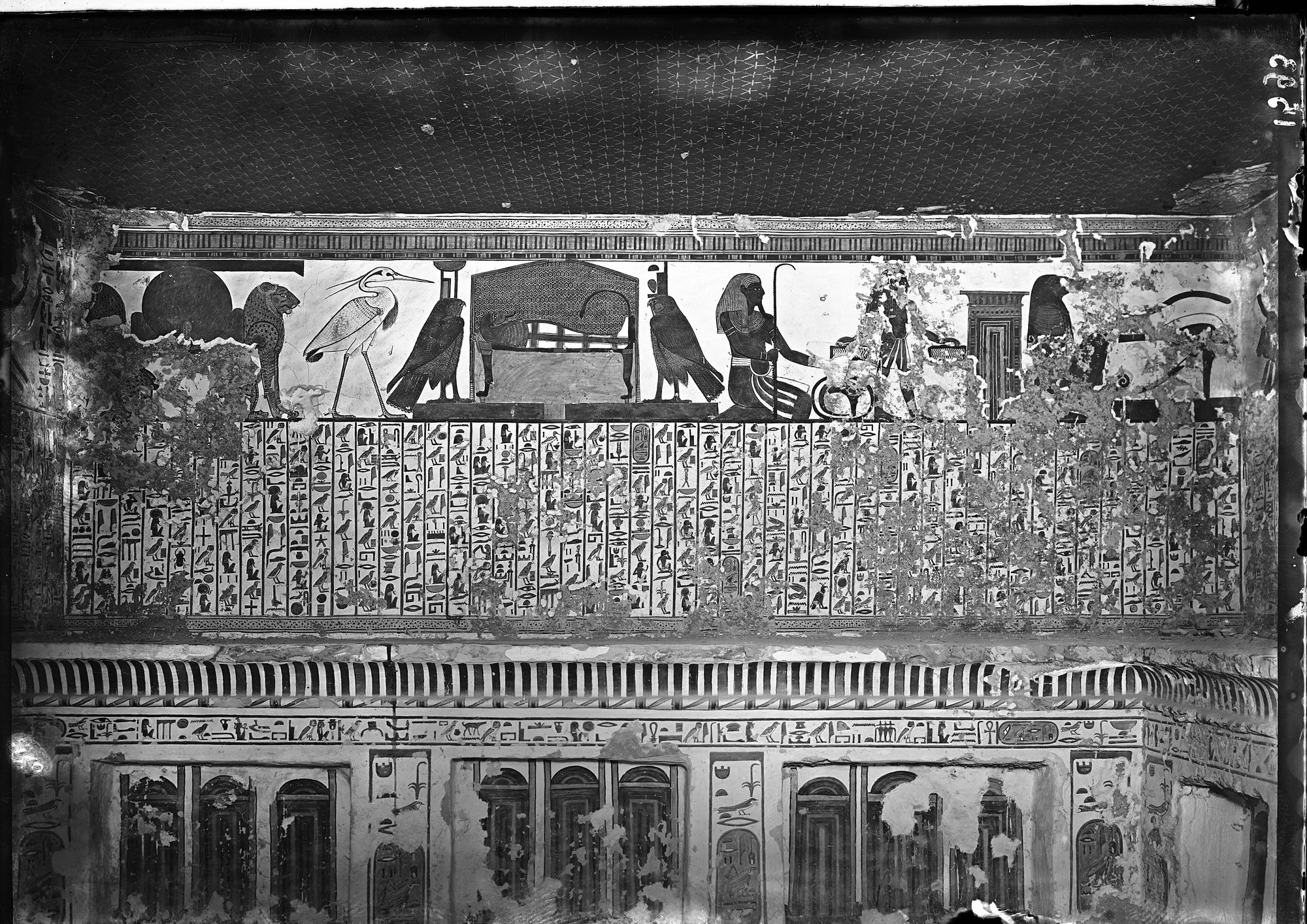
An ancient Egyptian tomb painting from the tomb of Nefertari: Atum seated between two lions with the Benu bird above, the mummy of the queen on a bed between two falcon-headed goddesses.
Egyptian

Atum: The Self-Created One

The completed sun going down, whose name means both 'finished' and 'not-be': the Heliopolitan creator drawn as a pharaoh, who lifts the dead king to the sky and will one day draw the whole world back into the flood.

6 minPyramid Texts
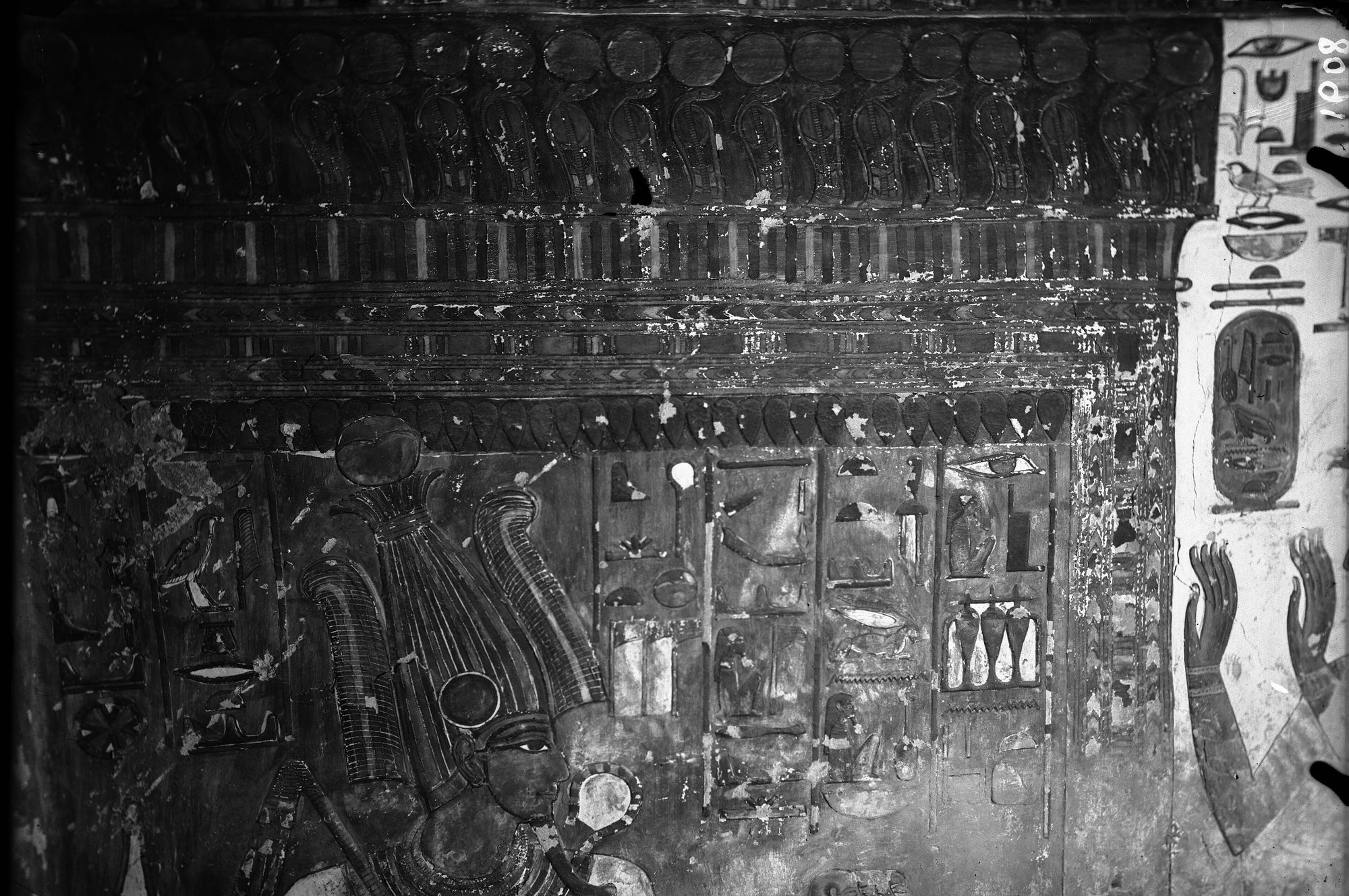
An ancient Egyptian tomb painting from the tomb of Nefertari: the god Osiris enthroned inside a sanctuary crowned by a frieze of uraeus serpents, the queen standing in adoration before him.
Egyptian

Osiris, Lord of the Dead

Egypt worshipped him for two and a half thousand years and never once wrote his story down: the green mummiform king who absorbed a jackal god, rose as Orion, and lent his name to every vindicated corpse.

5 minPyramid Texts
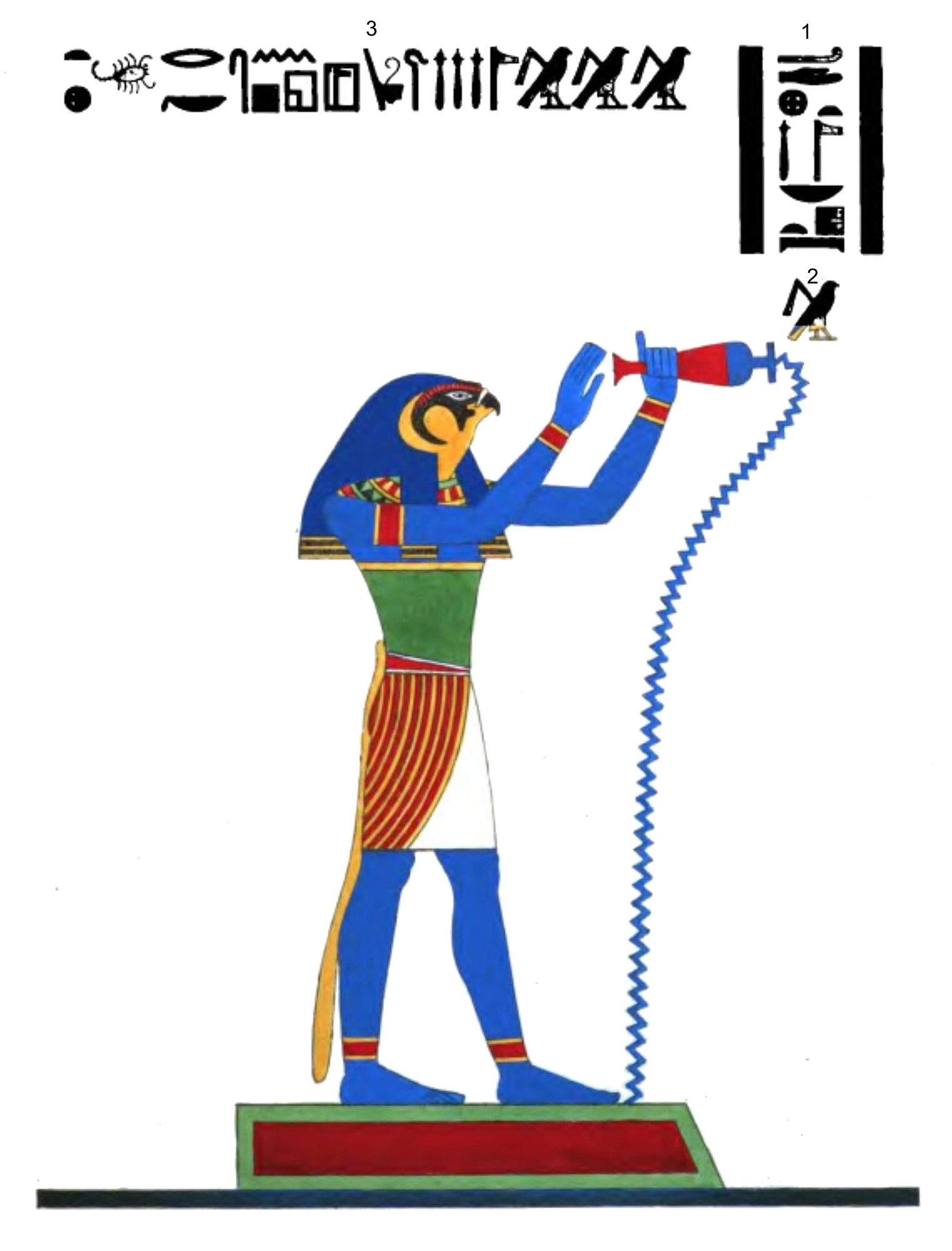
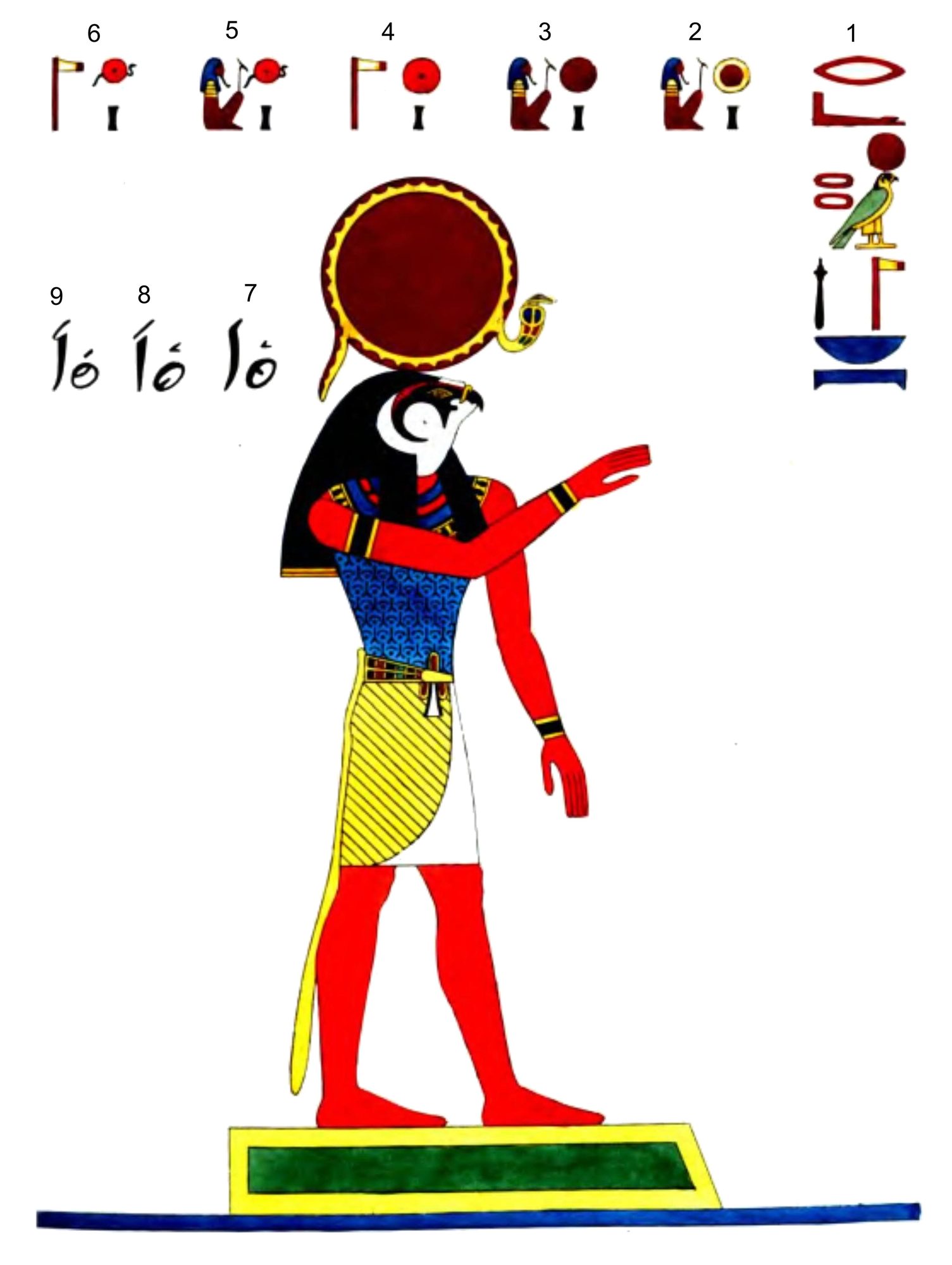
A hand-coloured lithograph plate of the sun-god Re: falcon-headed, crowned with the solar disk, striding in profile, from Champollion's Panthéon égyptien.
Egyptian

Ra, the Sun God

Beetle at dawn, blazing disk at noon, a tottering old man sinking into the west: the creator sun-god of Heliopolis who sails the sky by day and fights his way through the underworld by night.

6 minPyramid Texts
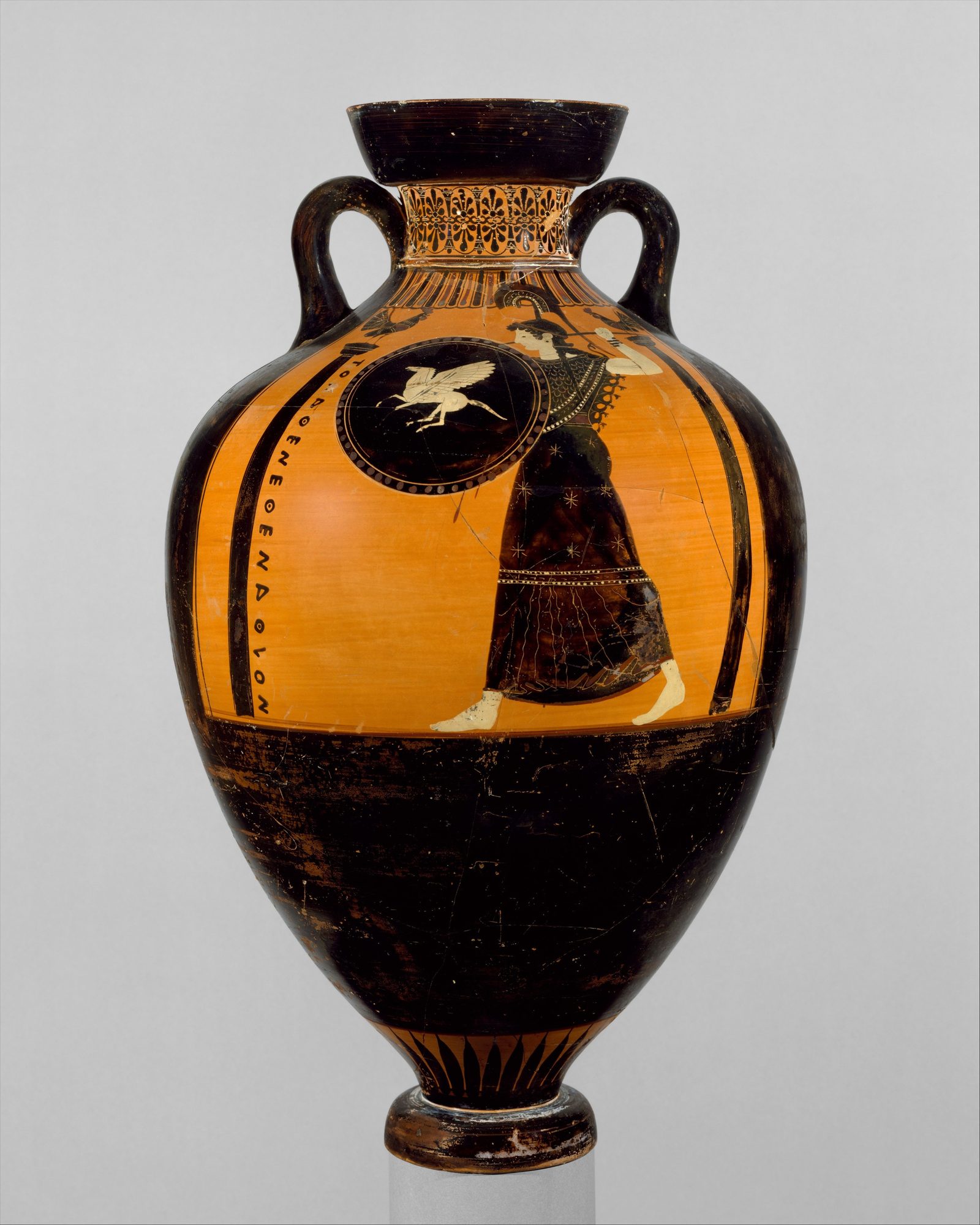
A black-figure Panathenaic prize amphora: the goddess Athena Promachos strides to the left between two columns, helmeted, brandishing a spear and holding a round shield, her aegis across her chest.
Greek

Athena, Goddess of Wisdom and War

She was born from her father's skull in full armour, spear already levelled, and the whole of Olympus reeled at the sight of a daughter equal to Zeus.

5 minHesiod
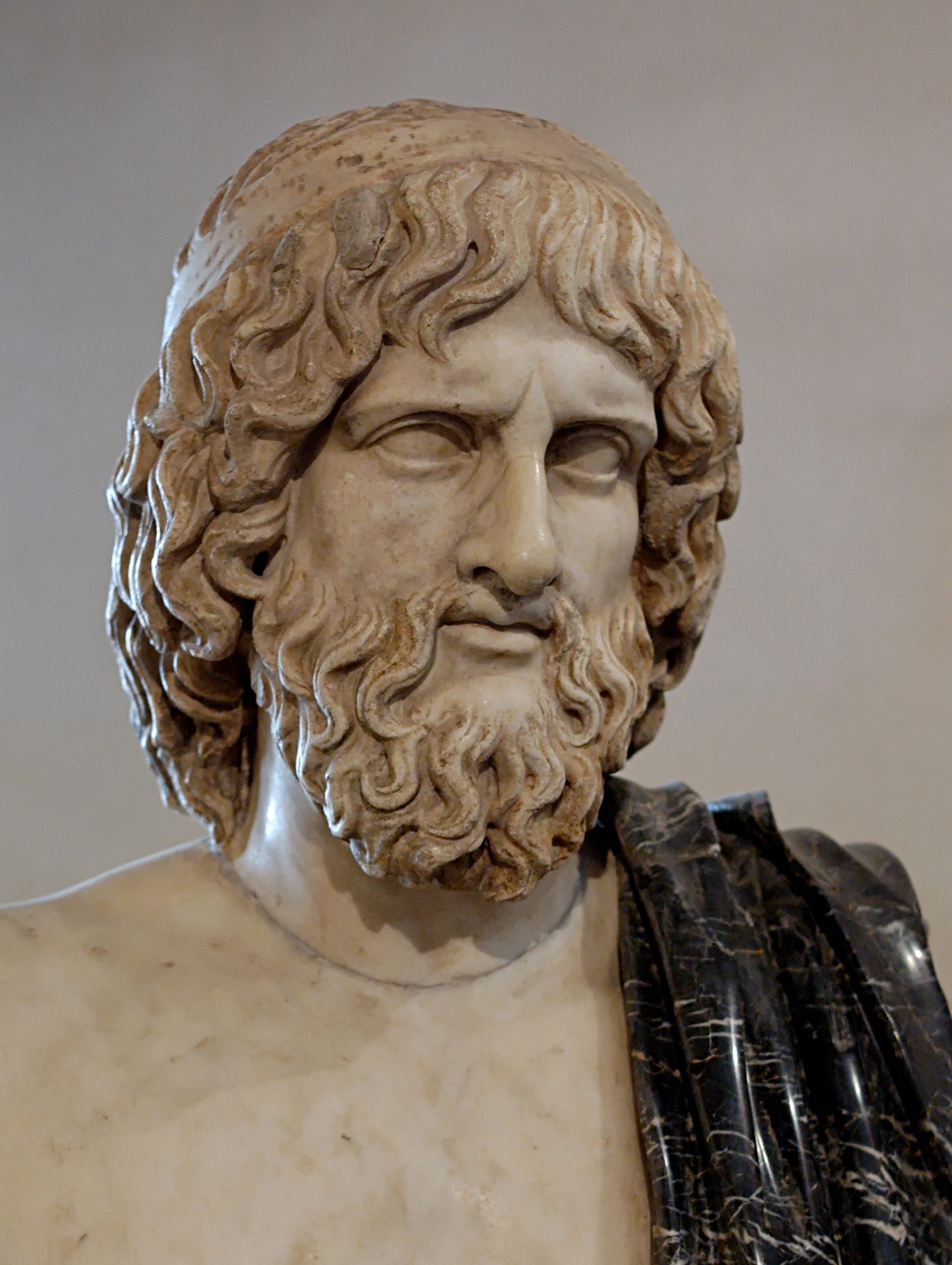
A marble bust of Hades — a mature, heavy-bearded god with thick wavy hair falling to the shoulders, deep-set blank eyes and a furrowed, stern brow, gazing off to the side. A dark near-black marble mantle (a modern restoration) is draped over his right shoulder, set against a plain grey ground.
Greek

Hades, Lord of the Dead

He drew the darkness by lot, not by choice, and the Greeks feared his name so much they called him the Rich One instead.

5 minHesiod
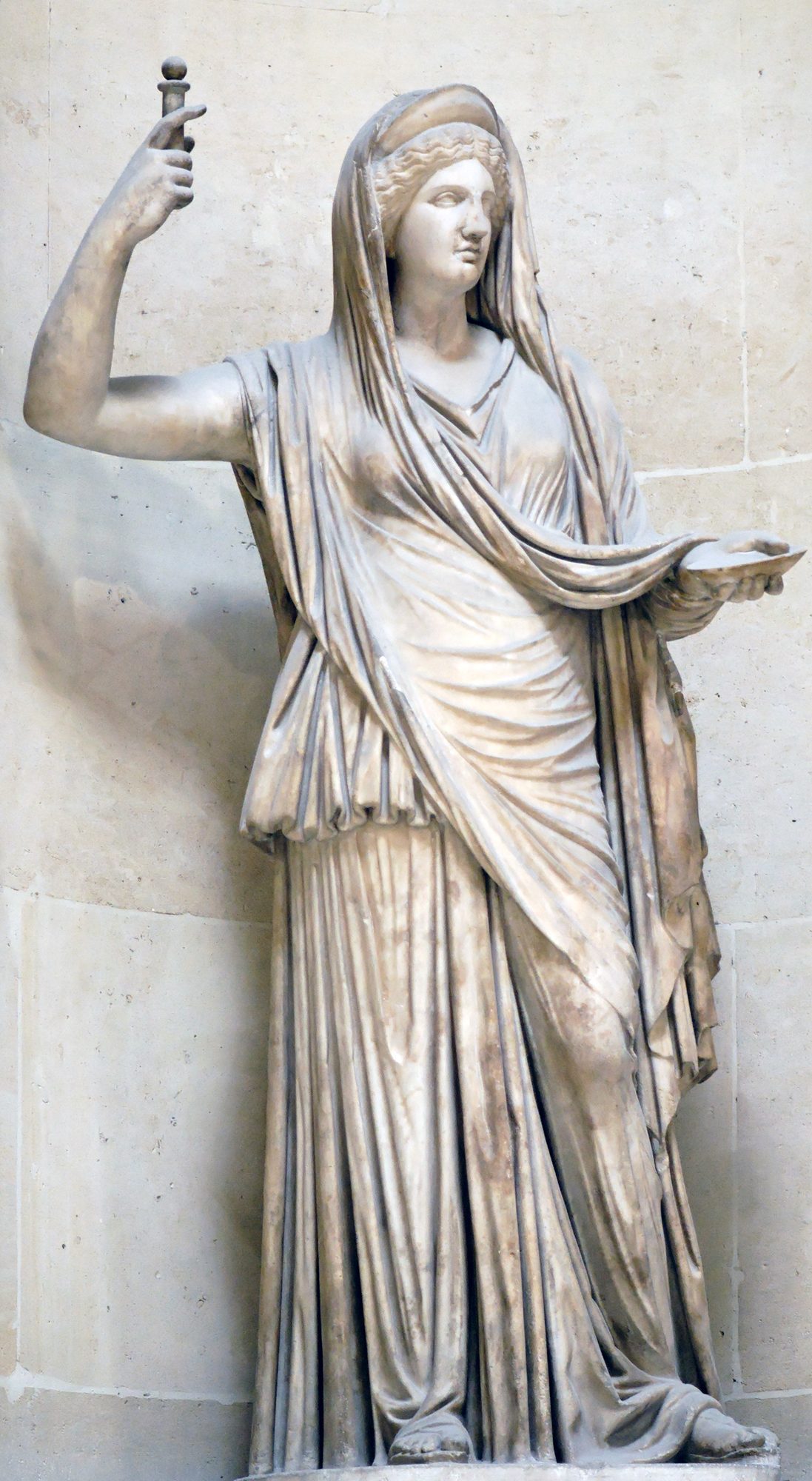
Marble statue of Hera as queen, standing veiled in a long chiton and himation with a diadem band across her brow, her raised right hand holding a sceptre and her extended left hand bearing a shallow offering dish.
Greek

Hera, Queen of Olympus

The goddess of marriage who ruled beside Zeus and warred against him in the same breath, dressing for seduction as a strategy of state.

6 minHomer
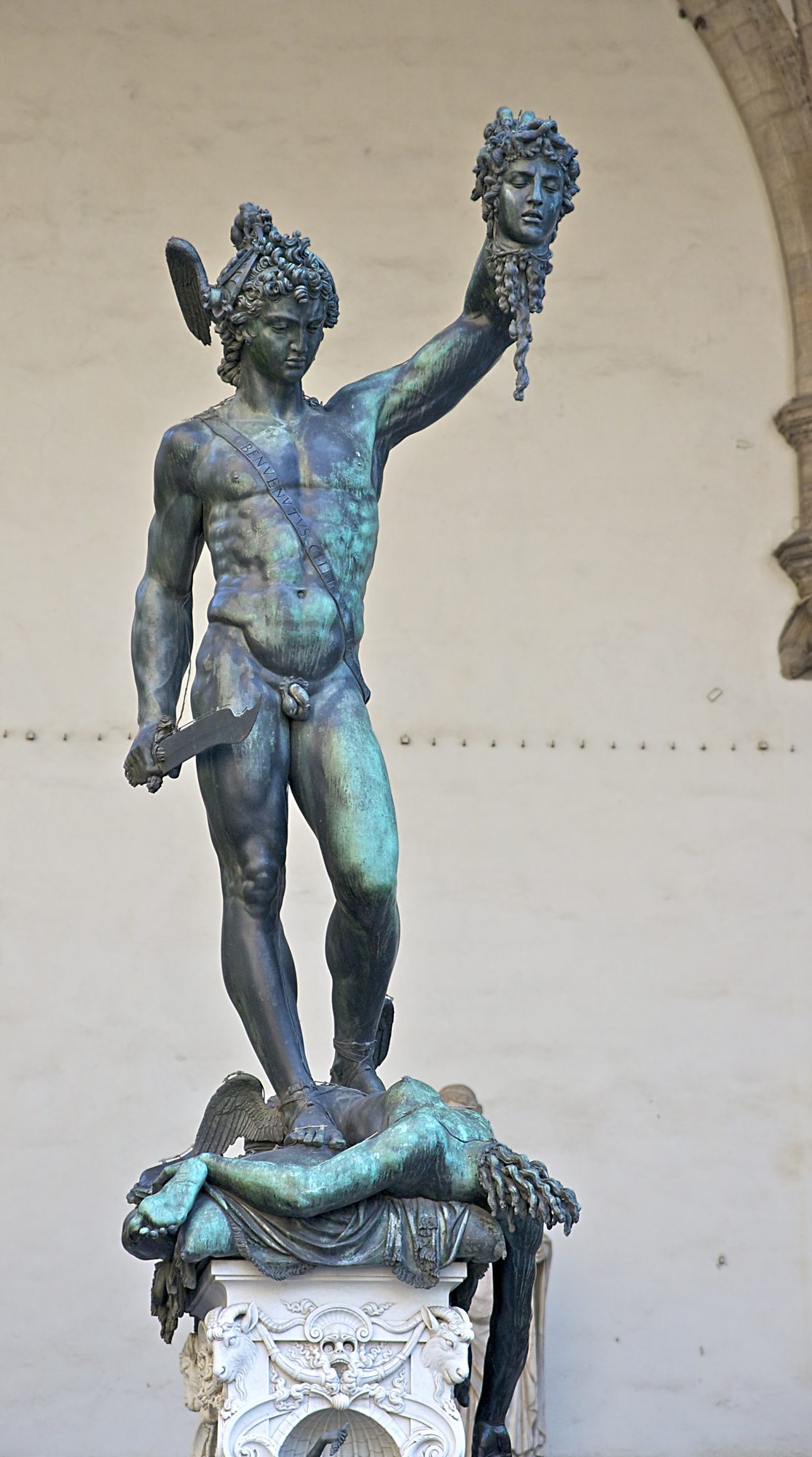
A nude young hero in a winged cap holds aloft the severed, snake-haired head of Medusa in his raised left hand and a curved sickle in his lowered right, his own gaze cast down and away from the trophy; the Gorgon's decapitated body slumps beneath his feet on an ornate pedestal against a plain pale wall — Benvenuto Cellini's bronze Perseus with the Head of Medusa in the Loggia dei Lanzi, Florence.
Greek

Perseus, Slayer of Medusa

Locked in a bronze cell, cast to sea in a chest, sent for a head no man could look at and live. The hero who won by never looking, and killed his grandfather by accident.

6 minPseudo-Apollodorus
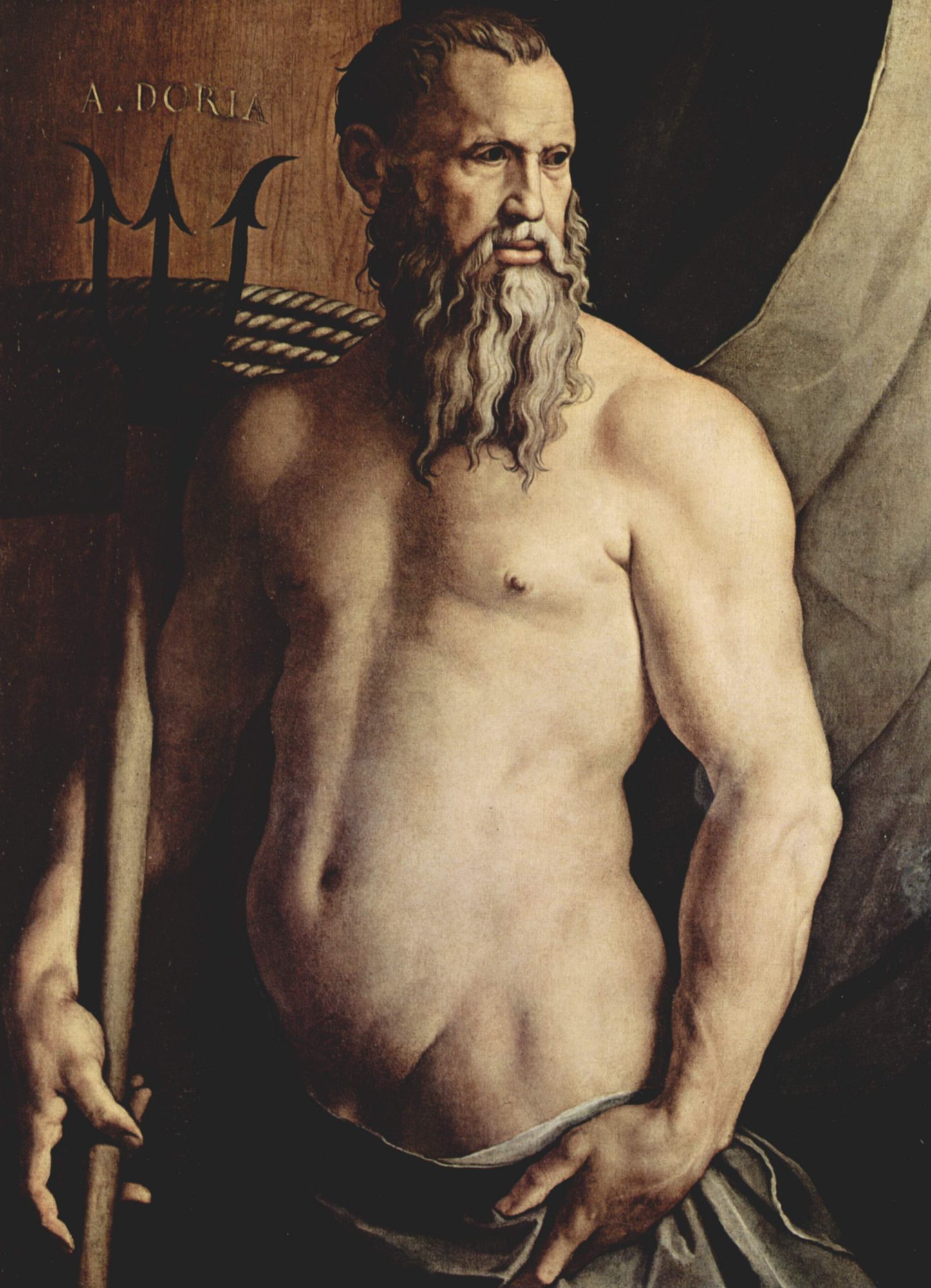
A grey-bearded, muscular sea-god shown half-length and nude to the waist, a grey-green drape at his hips, gripping a three-pronged trident in his right hand. Behind his shoulder a ship's spar wound with rope and a carved trident emblem sit against a dark wooden ground, with the incised inscription "A·DORIA" at upper left.
Greek

Poseidon, Lord of the Sea

He drew the grey sea by lot and never forgave a slight, splitting rock with his trident to raise storms, drown heroes and shake the earth itself.

5 minHesiod
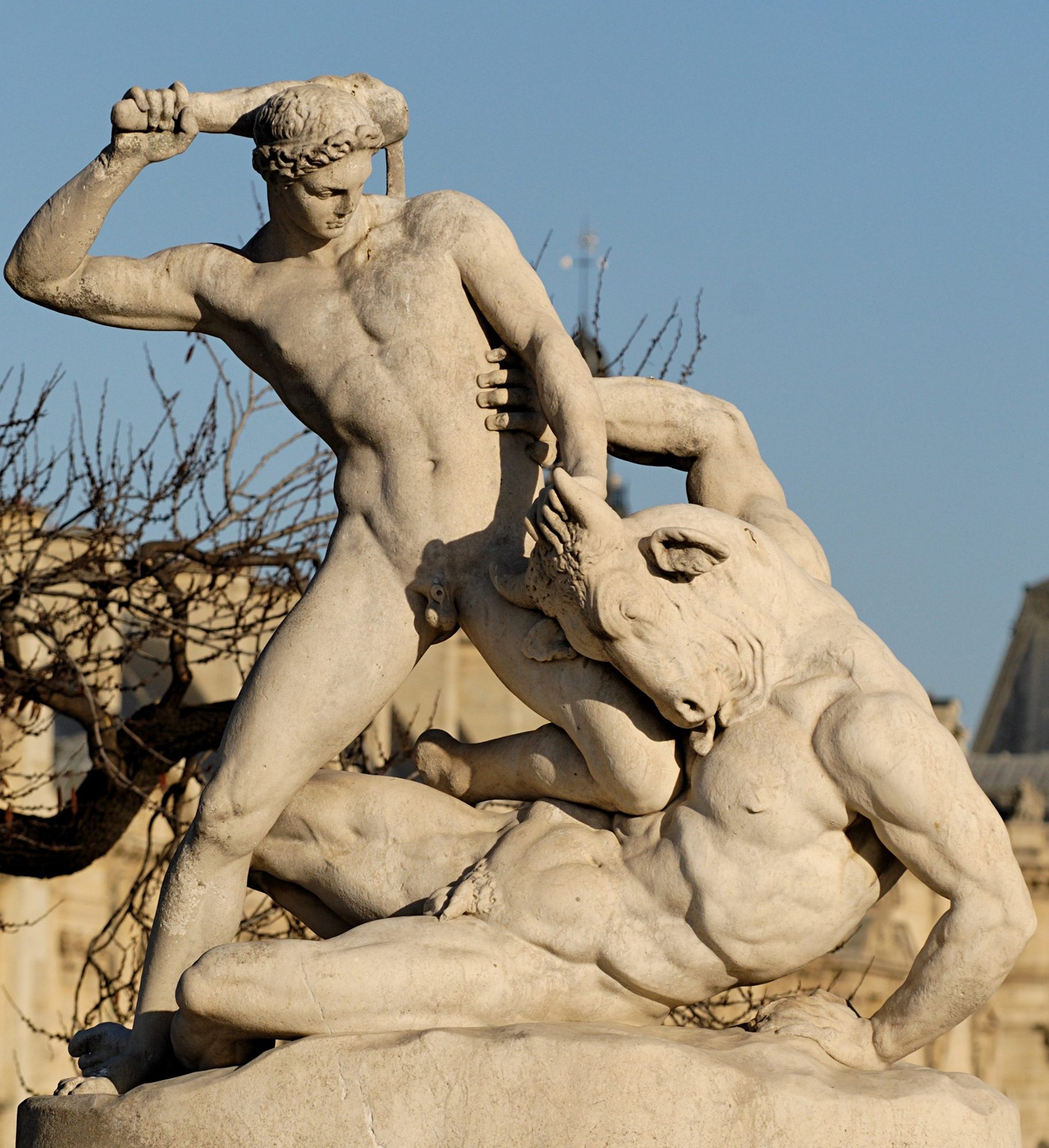
A white marble statue of a nude, laurel-crowned Theseus lunging forward with a club raised overhead in one hand, gripping the horned head of the bull-headed Minotaur with the other as the beast collapses beneath him over a fallen youth, set against a soft-focus ground of bare trees and pale stonework.
Greek

Theseus, Hero of Athens

A prince who chose the killers' road, unwound a thread through the dark to end a monster, and forgot a single sail. The founder Athens made in its own image, remembered for what he built and what he abandoned.

6 minPlutarch
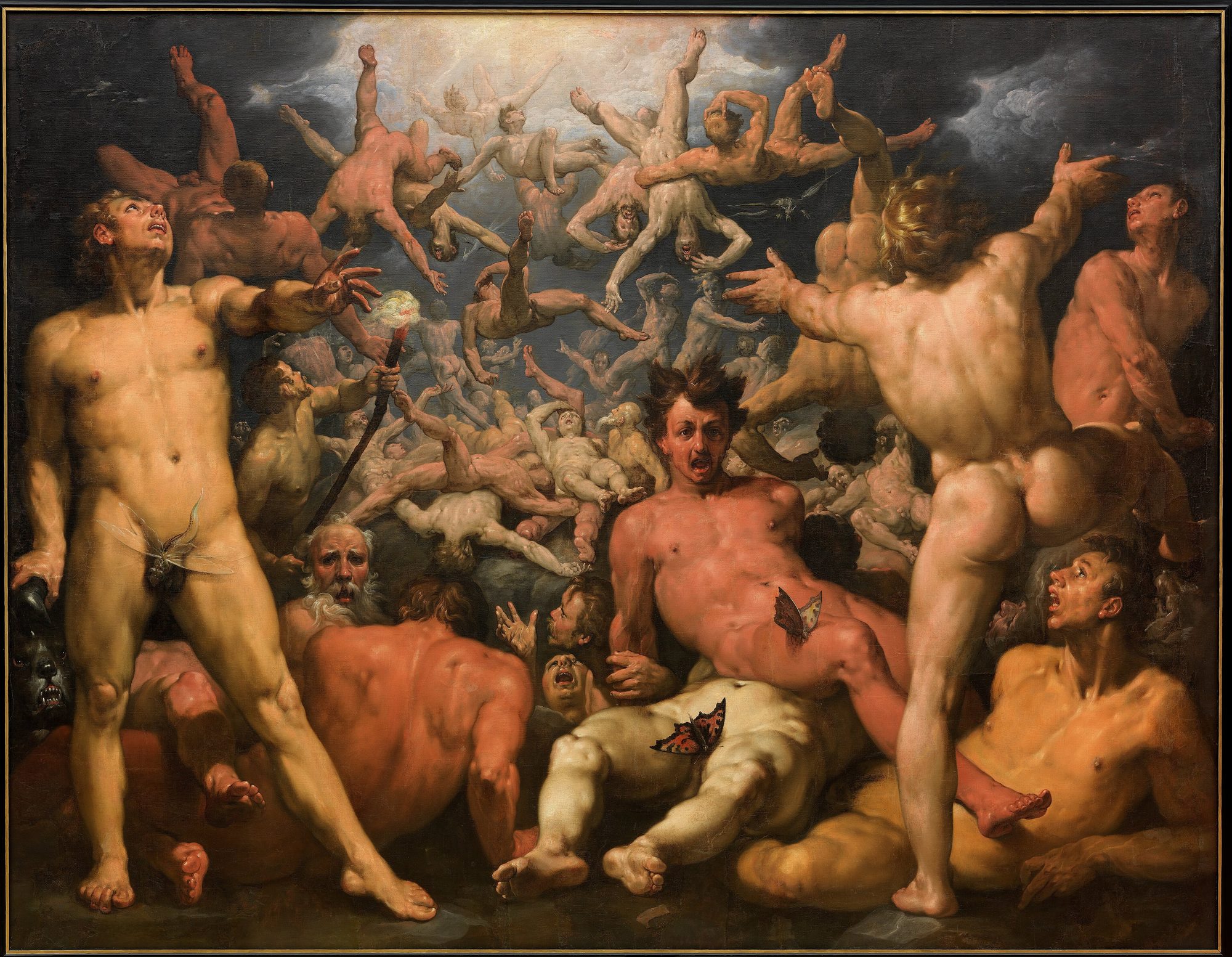
A dark, teeming Mannerist canvas of the defeated Titans hurled from the sky. From a luminous break in the storm-clouds at the top, a mass of muscular nude figures tumbles headlong and foreshortened into the depths, limbs flailing and faces contorted in terror. They pile into a heap of straining bodies across the foreground, ruddy and pale flesh tangled together; one massive figure sprawls face-up at the centre, mouth open in a scream, his hair standing on end. At the lower left a standing youth grips a burning torch while a black hound's fanged head snarls beside him, and a few small butterflies and insects — the painter's emblems of the fleeting — rest on the fallen limbs.
Greek

The Titanomachy

For ten years the sky itself hung in the balance, until Zeus loosed the hundred-armed prisoners of the deep and the world caught fire.

8 minHesiod
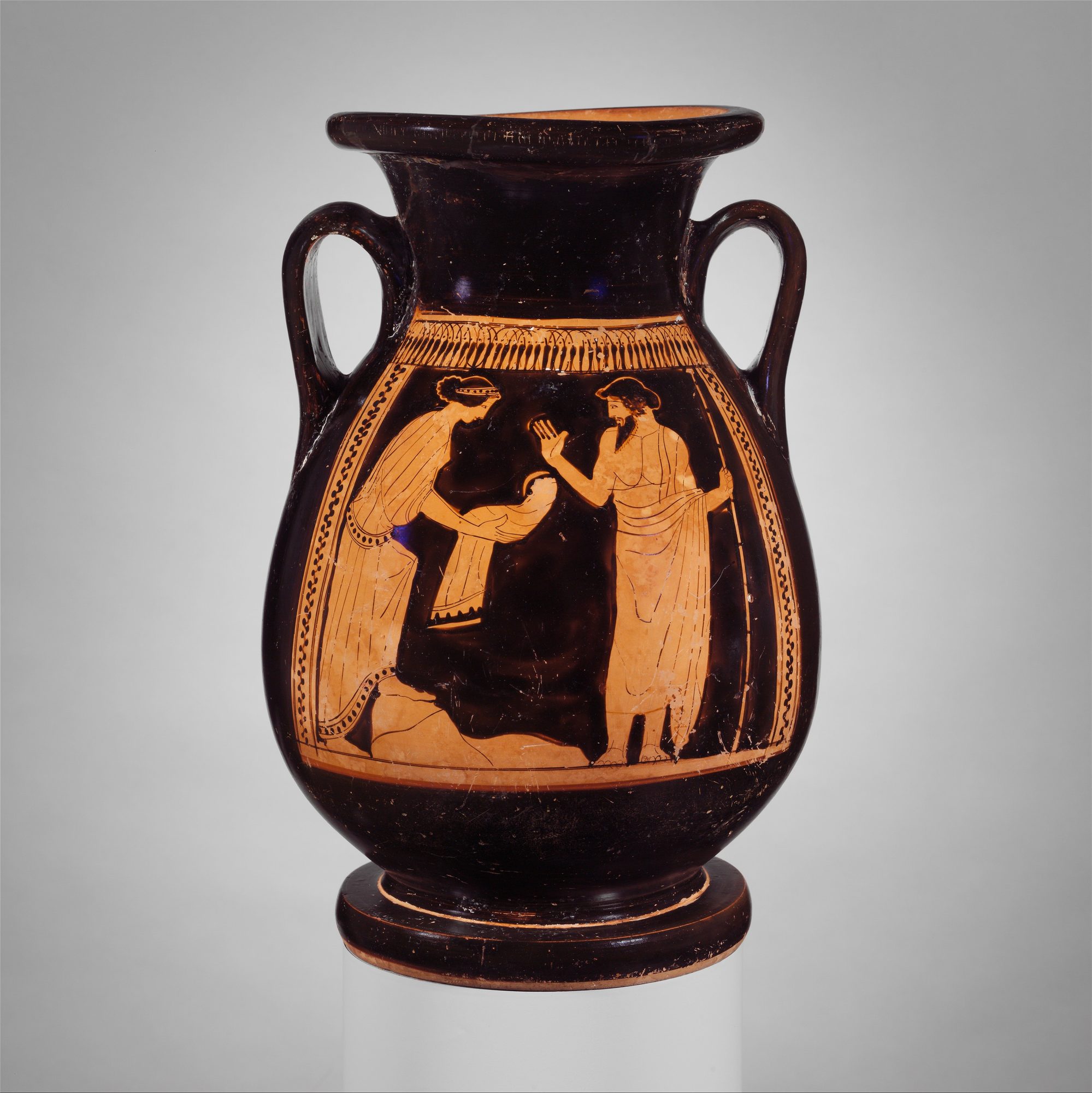
An Attic red-figure pelike, the whole black-glazed vessel standing against a plain grey ground, its belly panel bordered by a band of tongues above and running dot-chains at the sides. In the scene the Titaness Rhea, at left in a long pleated chiton and mantle with her hair bound in a fillet, steps forward and holds out in both hands the stone wrapped in swaddling clothes; facing her at right the bearded Kronos, in a himation that leaves one shoulder bare and a soft cap, grips a long sceptre in his trailing hand and raises his other hand to receive the bundle he believes is his newborn son — the swaddled-stone deception that founds the ruling family.
Greek

The Twelve Olympians: The Ruling Family

There is no ancient list of the Twelve. What the oldest poets give us instead is a household with a throne room, a swallowed generation, and a family quarrel that never quite ends.

7 minHesiod
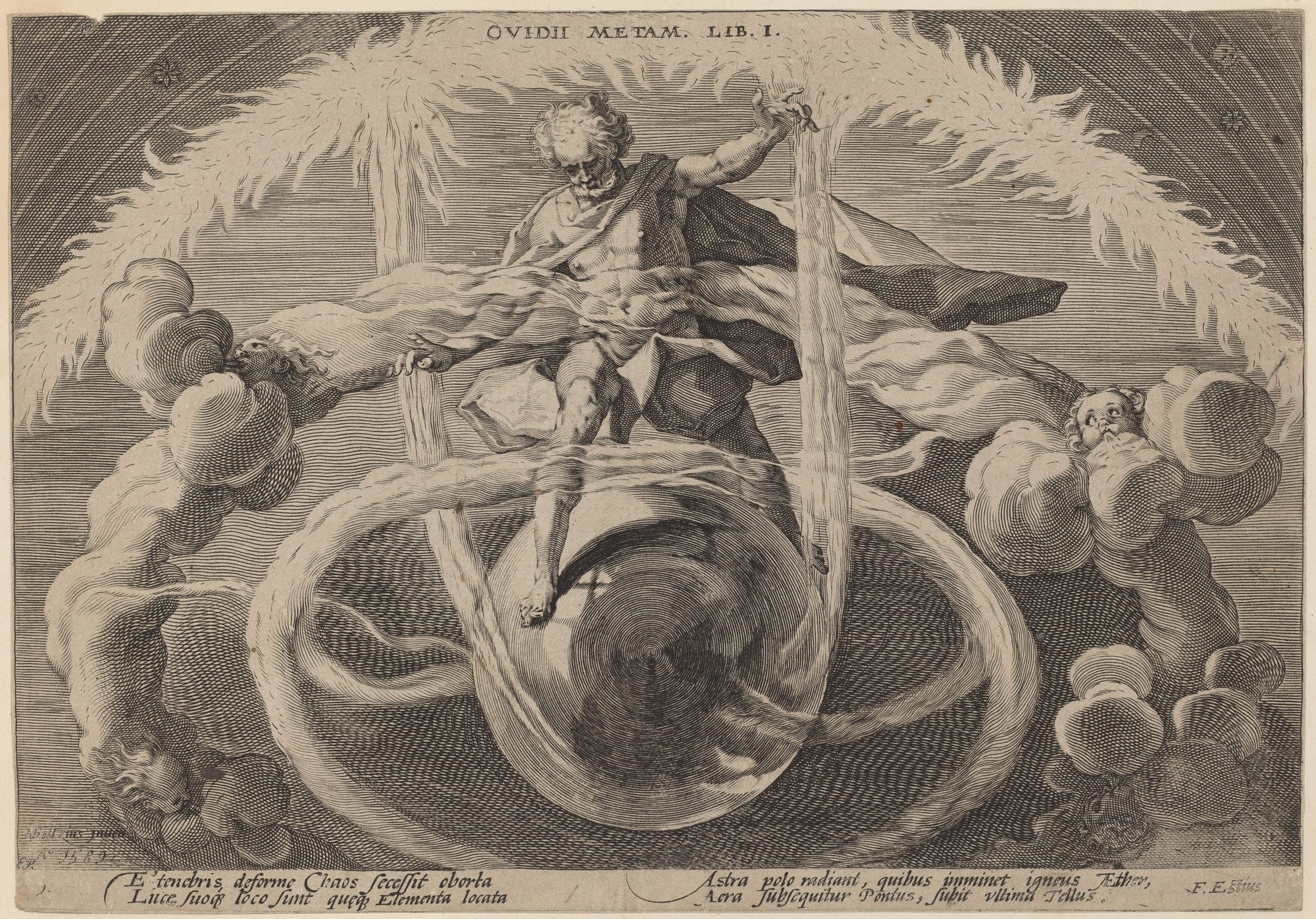
A luminous creator-figure sits enthroned at the centre of the newborn cosmos, arms outspread to draw the concentric spheres of the world out of formless Chaos, while personified winds and elements billow in the four corners — an engraved frontispiece to Ovid's Metamorphoses Book I
Greek

The Birth of the Cosmos

Before there was a world there was only a gap, and out of that yawning dark the first gods came to be.

8 minHesiod