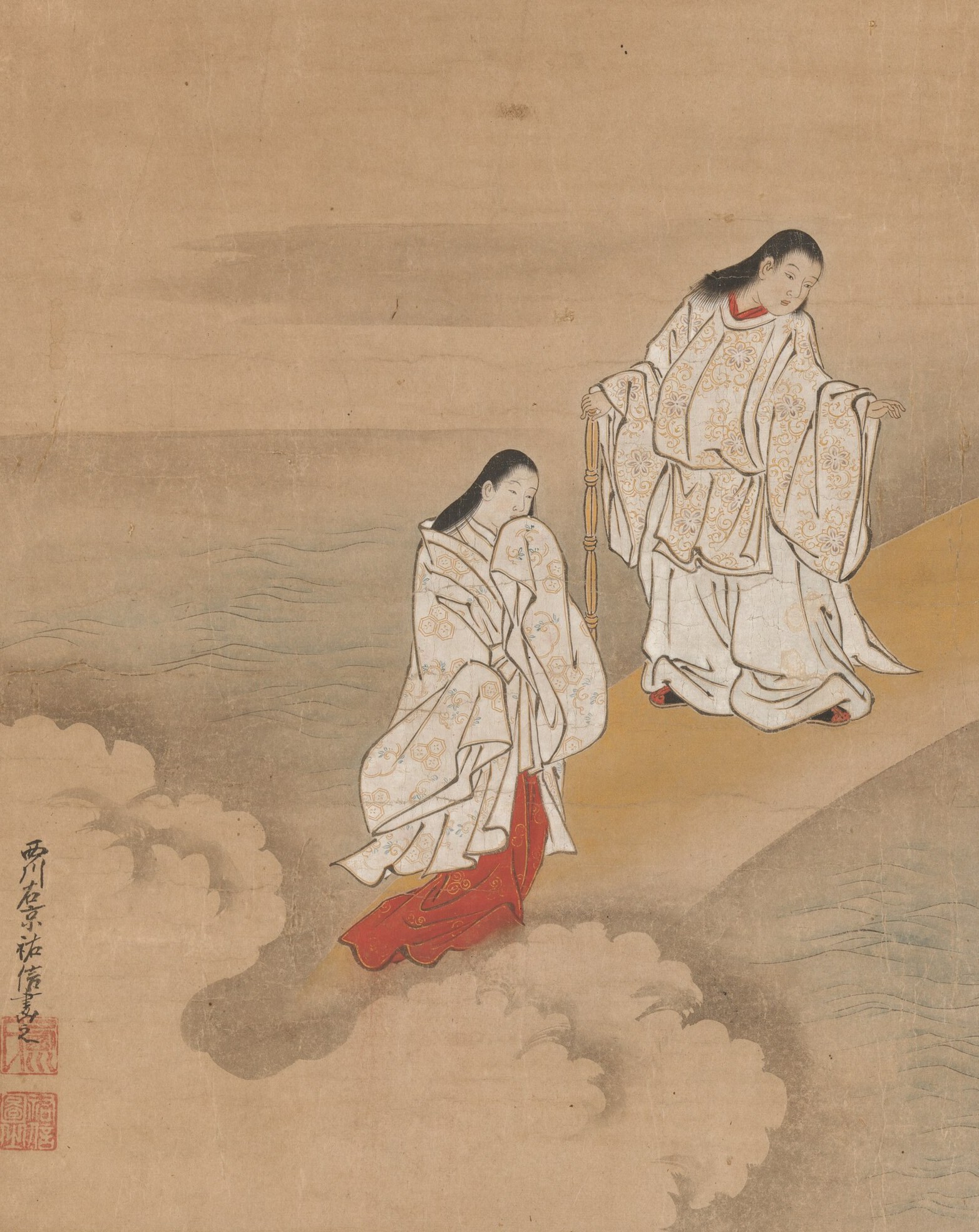
Sentence one of the older chronicle drops you at the top of the world and never explains the ladder. The gods are simply born in the Plain of High Heaven,
as though everyone already knew that Heaven was up and that there was a somewhere-below for it to be up from. The chronicles never draw the diagram. What they do instead is stage the cosmos in motion: a god is sentenced and driven downward, a husband climbs out of the dead and rolls a stone across the road behind him, the sun shuts a door and two realms go dark at once. Read those episodes for their architecture, not their drama, and a three-storey building assembles itself. Heaven on top. An earthly middle. A country of the dead beneath. And, more interesting than the storeys, the stairwells between them.
Heaven was formed first
The vertical order is not left to inference in both chronicles. The Nihon Shoki, compiled in 720, opens by physically stacking the cosmos: the purer and clearer part was thinly drawn out, and formed Heaven, while the heavier and grosser element settled down and became Earth,
so that Heaven was therefore formed first, and Earth was established subsequently,
and Divine Beings were produced between them.
This is borrowed cosmology, the Chinese In-Yo scheme of a light-above and a gross-below, and it is the Nihon Shoki’s own frame, not the older Kojiki’s, which simply starts with gods already in the high plain. But it names the principle the whole myth-cycle then assumes. Up is refined and originating; down is heavy and settled; life happens in between.
The top tier is Takamagahara, the Plain of High Heaven, where the first deities appear and from which the sun-goddess later rules. The celestial realm has its own long story, the councils and the rock-cave crisis; here Heaven matters only as the ceiling of the cosmos and the place authority comes from. What fixes it as the ceiling is a single sentence in which all three tiers are named together, and it is a sentence of banishment.
The whole ladder in one sentence
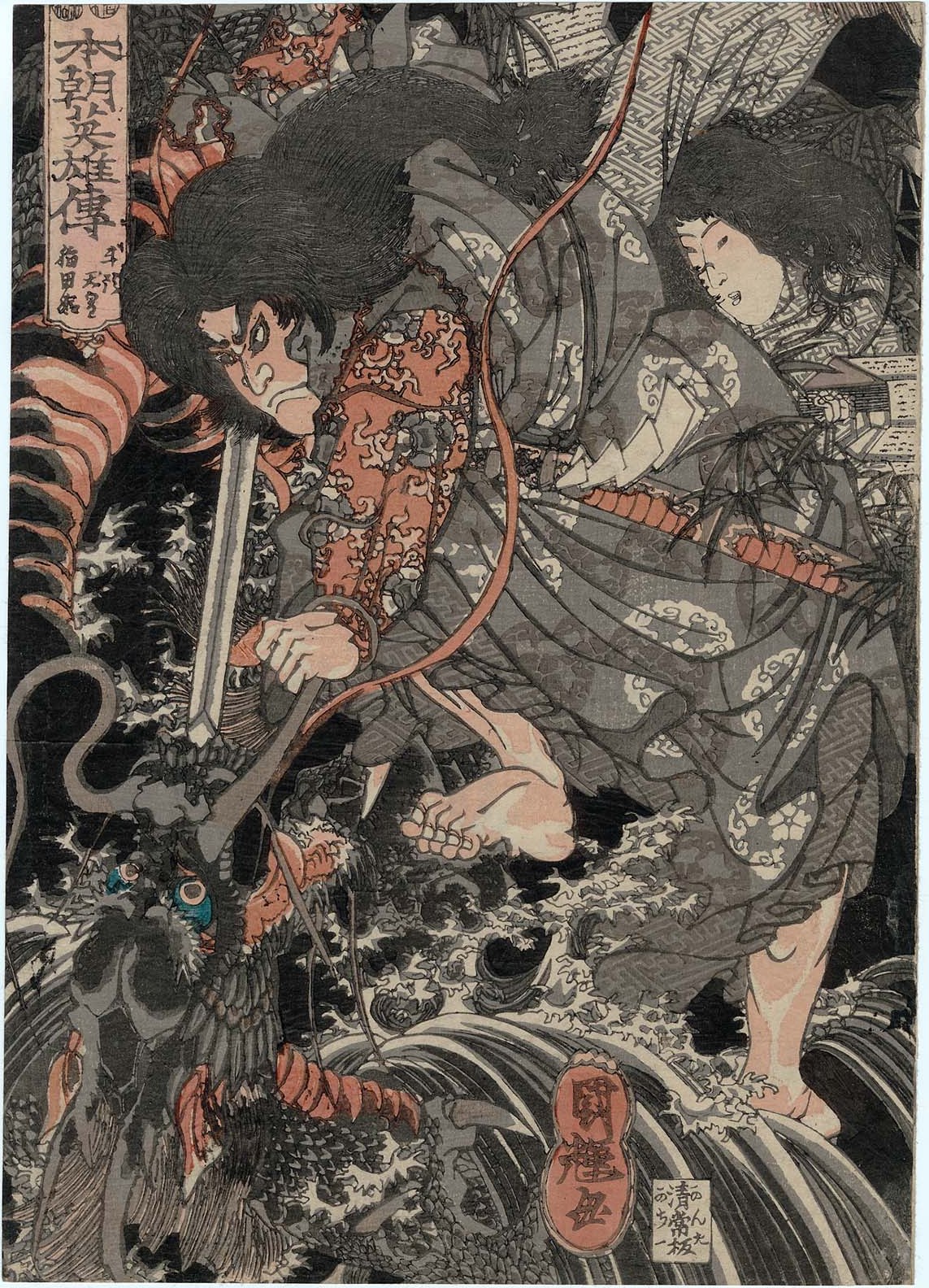
When the assembled gods pass judgment on the storm-god Susanoo, they draw the entire cosmos in one breath. Thou must, therefore, not dwell in Heaven. Nor must thou dwell in the Central Reed-Plain Land. Thou must go speedily to the Bottom Nether Land.
And then the crucial verb of direction: they drove him away downwards.
Heaven at the top, the Central Reed-Plain Land as the middle rung, the Bottom Nether Land at the foot, and expulsion runs down the ladder, never up. No passage in either chronicle states the layered world more plainly than this sentence of exile.
The middle rung has a name that is itself a claim about position. Ashihara-no-Nakatsukuni, the Central Land of Reed-Plains, carries naka-tsu, in the middle,
in the middle of its own name. Aston, translating in 1896, glossed it with a footnote as blunt as it is consequential: Ashihara no Naka tsu kuni, i.e. Japan.
The earthly world, the reed-and-rice country the heavenly gods will eventually claim and hand to the imperial line, is the middle storey. Its pacification and transfer are a story in their own right; what concerns the architecture is only that it sits below Heaven and above the dead, and is the one tier where mortals actually live.
When the sun shuts the door
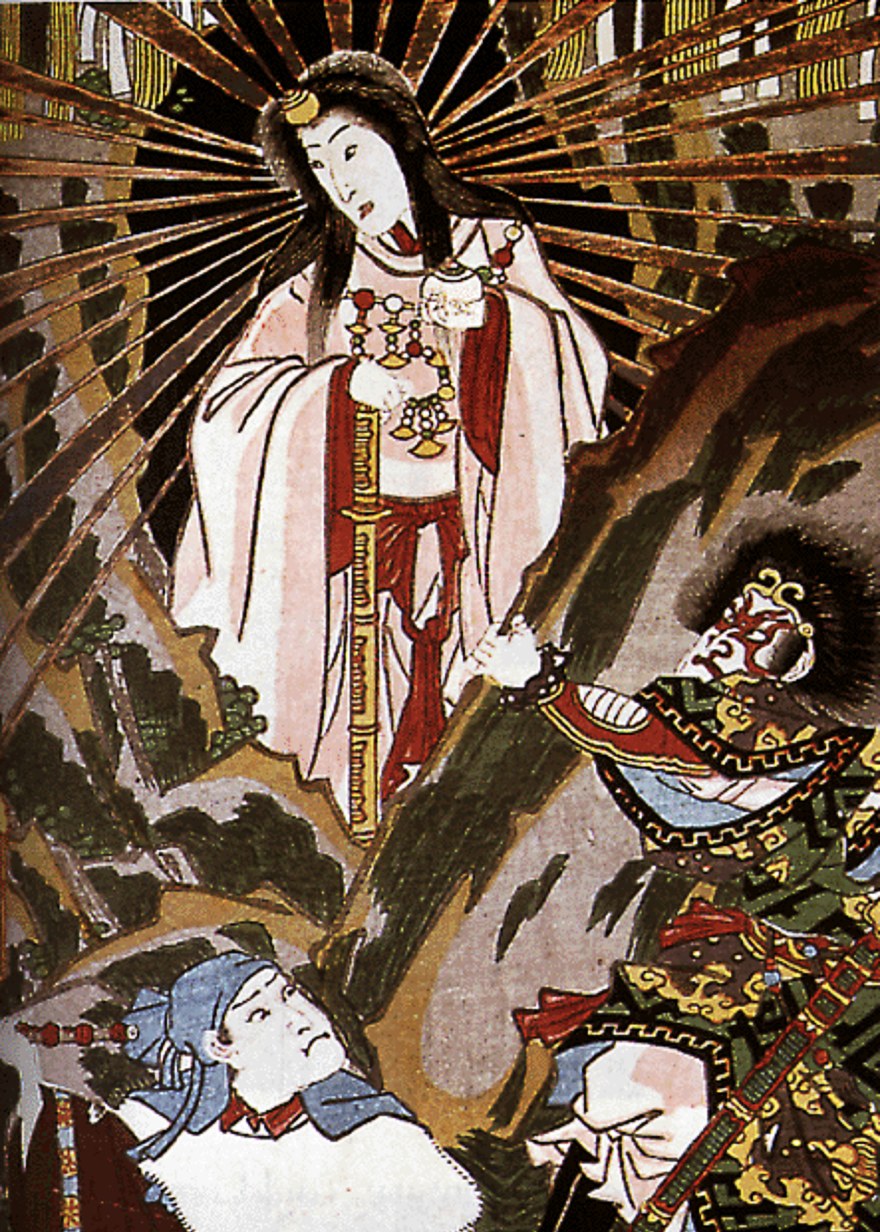
That the two upper tiers are wired together, and not merely stacked, shows the moment the light goes out. When the sun-goddess withdraws into her rock-cave, the Kojiki reports the consequence as a single failure across two floors at once: the whole Plain of High Heaven was obscured, and all the Central Land of Reed-Plains darkened.
When she is drawn out again, both of course again became light.
Heaven and the earthly middle are not two lamps but one, a single lit system in which the switch sits in the sky. The rock-cave drama belongs to Takamagahara’s own telling; borrowed here, it proves only the coupling, that the middle land takes its light from the tier above and goes dark when that tier does.
Deliberate traffic between those two upper storeys runs the same direction the light does, downward. The sanctioned crossing from Heaven to the middle land is the descent of the heavenly grandchild, who parts the eight-fold clouds and comes down to hold the reed-plain. That descent is the middle land’s own story; for the map it is enough that the traffic Heaven-to-earth is a coming-down, ceremonial and controlled, along a route the gods choose.
A stone rolled across the road
The stairwell between the middle land and the country of the dead is a different kind of thing altogether, and it is the one the chronicles describe in the most physical detail, because it is the one that had to be shut. The boundary is a named place, the Yomo-tsu-hira-sakaThe Even Pass of Yomi, the boundary between the earthly world and the land of the dead; the Kojiki places it at a real Izumo slope, while a variant in the Nihon Shoki makes it only the moment of dying., a slope you climb, and its story is the middle-to-nether hinge of the whole cosmos.
When the creator-god Izanagi flees the dead-land after seeing what his wife has become, he drew a thousand-draught rock, and blocked up the Even Pass of Hades, and placed the rock in the middle.
The full account of that descent is a set-piece told in its own place; what the architecture takes from it is the fact of the seal. The door between the living world and the dead world is a boulder in a mountain pass, and once set, it does not open the other way.
The sealing is not free. It fixes the world’s death-rate as the price of the boundary. Across the stone the parted couple strike a bargain: the goddess below vows to in one day strangle to death a thousand of the folks of thy land,
and the god above answers that he will in one day set up a thousand and five hundred parturition-houses,
so that each day a thousand die and fifteen hundred are born.
That is what the traffic through the lower stairwell actually is: the daily passage of the dead out of the middle world, capped at a thousand and always outpaced by birth. The stone itself is then deified, made into the Blocking-Great-Deity-of-the-Door-of-Hades. The very seal between the tiers is a person, a god whose whole nature is to be a shut door.
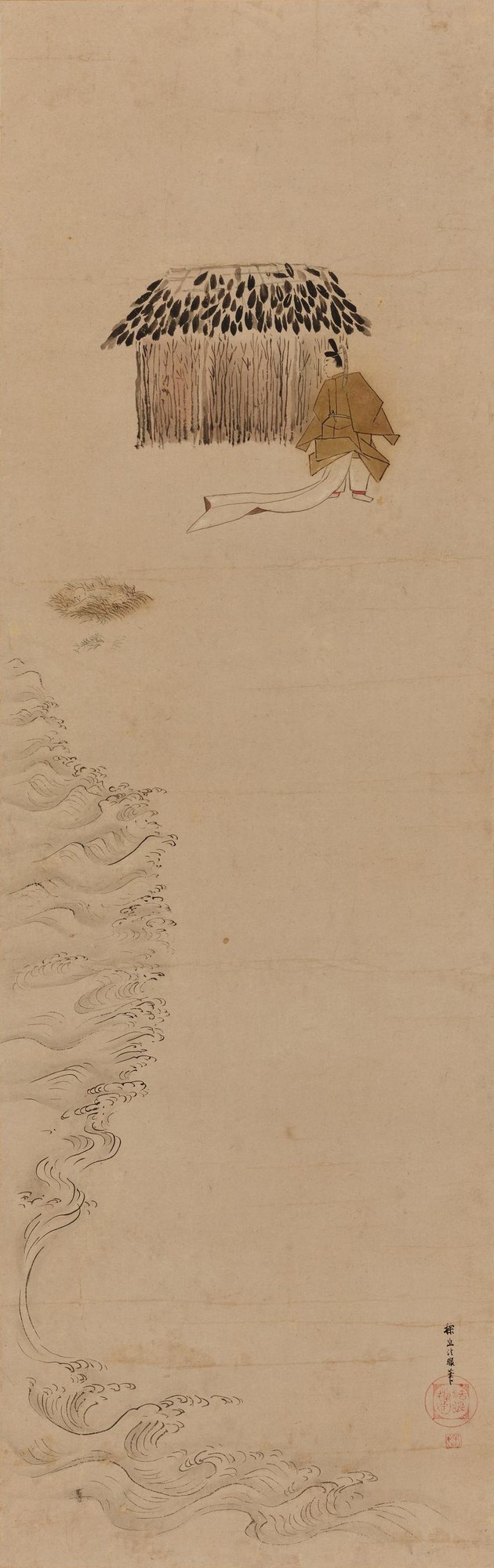
There is one more current in this stairwell, and it runs the wrong way for comfort. The storm-god, given a bright domain of his own, refuses it and weeps only to go down to my deceased mother’s land, to the Nether Distant Land,
because the dead mother of the gods lies below. Grief has a gravity in this cosmos, and it points down. The nether tier is not only where the dead are sent; it is also the mother-country that draws the living toward it.
What the liturgy knew
The two eighth-century chronicles are near-contemporaries, only about eight years apart, so their disagreements are parallel versions and not an old text drifting into a late one. Two centuries later a third and quite different witness confirms the same three-storey world from the outside, not as narrative but as ritual.
The Great Purification liturgy of the Engishiki, fixed in writing around 927 but preserving older court prayer, compresses the entire vertical cosmos into one movement of a rite. It opens at the top, invoking those who divinely remain in the Plain of High Heaven
and their mandate to tranquilly rule the Luxuriant Reed-plain Region of Fresh-young Spikes,
Heaven authorising the rule of the middle land, the descent the chronicles narrate now spoken as cult.
Then the liturgy sends the nation’s defilement all the way down and out, in a relay of four deities who trace the descent tier by tier. A Maiden-of-Descent-into-the-Current, who dwells in the current of the rapid stream that in falling comes boiling down the ravines, from the tops of the high mountains,
carries the offences out into the great Sea-plain.
There a Maiden-of-the-swift-opening will swallow them down with gurgling sound.
Then a Lord-of-the-Breath-blowing-place will utterly blow them away with his breath into the Root-country, the Bottom-country.
And a Maiden-of-Swift-Banishment, who resides in the Root-country, the Bottom-country,
will completely banish them.
Mountaintop to sea to the bottom of the world, a single one-way chute. The cult rendered the three-tier cosmos as a drainage system, authority raining down from Heaven and pollution flushed past the middle land to the nether floor. The rite as a rite is another telling’s subject; here it is the plainest map the tradition ever drew of its own vertical world.
The floor that will not lie flat
For all that, the honest reading is that the building is not a tidy tower, and the sources themselves keep it from being one. The below-realm goes by several names. It is Yomi, the country connected by Aston to yo or yoru, night.
It is also Ne-no-kuniThe Root-Country, a name the chronicles use for the nether realm and treat as bound up with Yomi, though whether the two are strictly one place the sources never quite settle., the Root-Country, and the paired Root-country, the Bottom-country
of the liturgy. The chronicles use these near-synonymously, but the identification is the translators’ inference, flagged by them as such, and later tradition sometimes prises Ne-no-kuni apart from Yomi. Say the nether realm and its several names; do not weld them into one address the texts never quite provide.
The below-ness is likewise less than absolute. The expulsion language is downwards
and the liturgy sends sins to the Bottom-country,
yet Chamberlain, defining Yomi, hedged that it is the world beyond, or rather beneath, the grave,
and the Kojiki plants the Even Pass on the ordinary map, noting that it is now called the Ifuya-Pass in the Land of Idzumo.
So the road to the dead has a real-world terminus in Izumo, reached by walking, not only by falling.
The Nihon Shoki pushes further and offers a demythologised reading entirely, one of its aru-fumiA "one writing," one of the rival accounts the Nihon Shoki stacks side by side on the page rather than choosing between them. variants: that the Even Pass is not any place in particular, but means only the space of time when the breath fails on the approach of death.
One tradition makes the boundary a hillside; another makes it the last catch of breath.
A fourth axis complicates the picture again. The sea, the great Sea-plain the liturgy routes its sins through, is a horizontal expanse the vertical scheme never fully absorbs, assigned to different gods in the two chronicles and standing off to the side of the up-and-down stack. The result is a cosmos with a dominant vertical grammar, Heaven above and the dead below and the reed-plain between, overlaid with a westward road, a moment-of-death boundary, and a sideways sea. The tiers are real and the traffic between them is real. The clean diagram is ours, not the myth’s, and the sources leave it un-drawn.
Thou must not dwell in Heaven. Nor must thou dwell in the Central Reed-Plain Land. Thou must go speedily to the Bottom Nether Land. (Nihongi, trans. Aston, Book I)
- Kojiki (Records of Ancient Matters, 712 CE), comp. O no Yasumaro, trans. Basil Hall Chamberlain (1882), read verbatim via Wikisource (Chamberlain djvu, footnotes included)Sect. I, the first deities born
in the Plain of High Heaven,
with the noteIn Japanese Takama-no-hara,
fixing Heaven as the topmost and originating tier; Sect. IX,The Land of Hades
, the whole middle-to-nether hinge, the Even Pass of Hades sealed with the thousand-draught rockplaced in the middle,
the thousand-strangled / fifteen-hundred-born bargain, the deified boundary-rock (the Great-Deity-of-the-Road-Turning-back / the Blocking-Great-Deity-of-the-Door-of-Hades), the localisation of the pass asthe Ifuya-Pass in the Land of Idzumo,
and the note defining Yomo as the underworldbeyond, or rather beneath, the grave
; Sect. XII, Susanoo weeping to depart tomy deceased mother’s land, to the Nether Distant Land
(the note Ne-no-kata-su-kuni,root land
); Sect. XVI, the Plain of High Heaven and the Central Land of Reed-Plains darkening and re-lighting together, cited here only for the light-coupling of the two upper tiers. - Nihon Shoki (Nihongi, Chronicles of Japan, 720 CE),
The Age of the Gods,
Book I, trans. W. G. Aston (1896), read verbatim via archive.org (nihongi1asto)the Heaven-first, In-Yo stratified cosmogony (the purer and clearer part … formed Heaven, while the heavier and grosser element settled down and became Earth … Heaven was therefore formed first
); Aston’s glossAshihara no Naka tsu kuni, i.e. Japan
; the three-tier sentence of judgment on Susanoo (not dwell in Heaven … nor … in the Central Reed-Plain Land … go speedily to the Bottom Nether Land … drove him away downwards
); the variant thatsome say the Even Pass of Yomi is not any place in particular, but means only the space of time when the breath fails on the approach of death
; and the notes that the written form renders the Chineseyellow springs,
that Yomi is connected with yo / yoru,night,
and thatNe no kuni, lit. the root-country,
is Yomi. - Engishiki, Book VIII (Norito), the O-harae (Great Purification) liturgy (Engishiki presented 927 CE, in force 967; the norito older), read in the public-domain verbatim English of Karl Florenz,
Ancient Japanese Rituals, Part IV,
Transactions of the Asiatic Society of Japan vol. 27 (1899) (archive.org iddli.ministry.24042)the mandate from thosewho divinely remain in the Plain of High Heaven
totranquilly rule the Luxuriant Reed-plain Region of Fresh-young Spikes,
and the four-stage relay carrying defilement down, a Maiden-of-Descent-into-the-Current inthe current of the rapid stream that in falling comes boiling down the ravines, from the tops of the high mountains
outinto the great Sea-plain,
a Maiden-of-the-swift-opening who willswallow them down with gurgling sound,
a Lord-of-the-Breath-blowing-place who willutterly blow them away with his breath into the Root-country, the Bottom-country,
and a Maiden-of-Swift-Banishment whoresides in the Root-country, the Bottom-country
and willcompletely banish them.