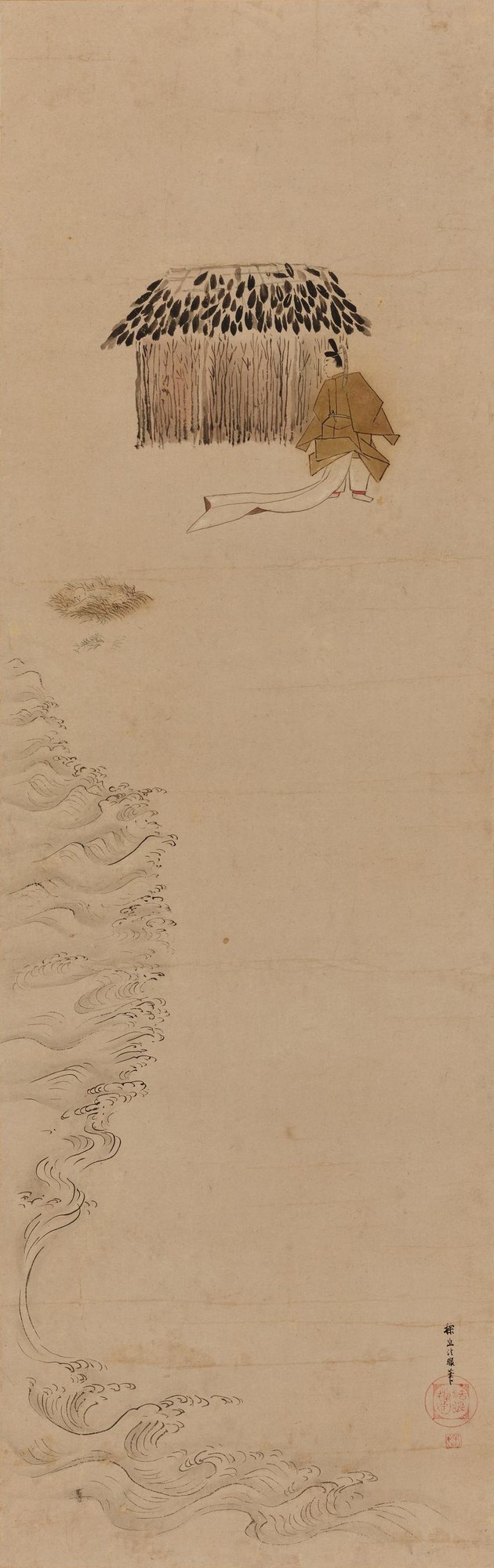
Ugayafukiaezu appears near the end of the Kojiki and Nihon Shoki, two early Japanese chronicles. His name means the cormorant-feather roof was not finished. He was born before his mother’s birth hut could be completed, and that unfinished roof became the fact that defined him.
His importance is his place in the family tree. He connects the stories of the gods to the later line of human emperors. One of his sons was the figure later called Jimmu, traditionally counted as Japan’s first emperor.
The child born too soon
Ugayafukiaezu’s mother was Toyotama-hime, the daughter of the Sea-God. After the child’s father, Hoori, returned from the Sea-God’s palace, Toyotama-hime came ashore to give birth. She said that a child of a Heavenly Deity should not be born in the Sea-Plain.
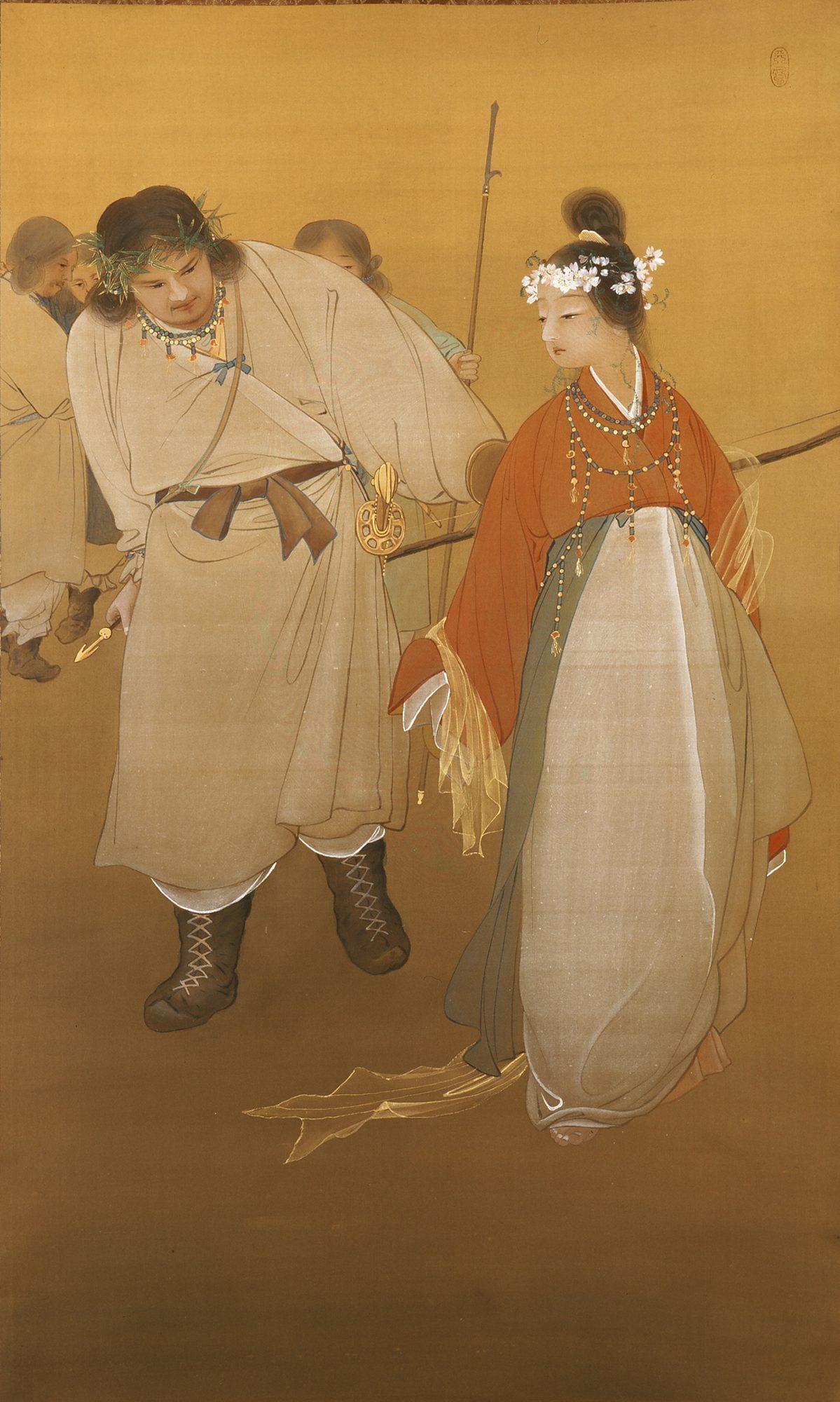
She built a birth hut at the very edge of the waves. The roof was to be made from cormorant feathers, but labour began before the thatch was finished. The child arrived beneath an opening in the roof. That is the scene remembered in his name.
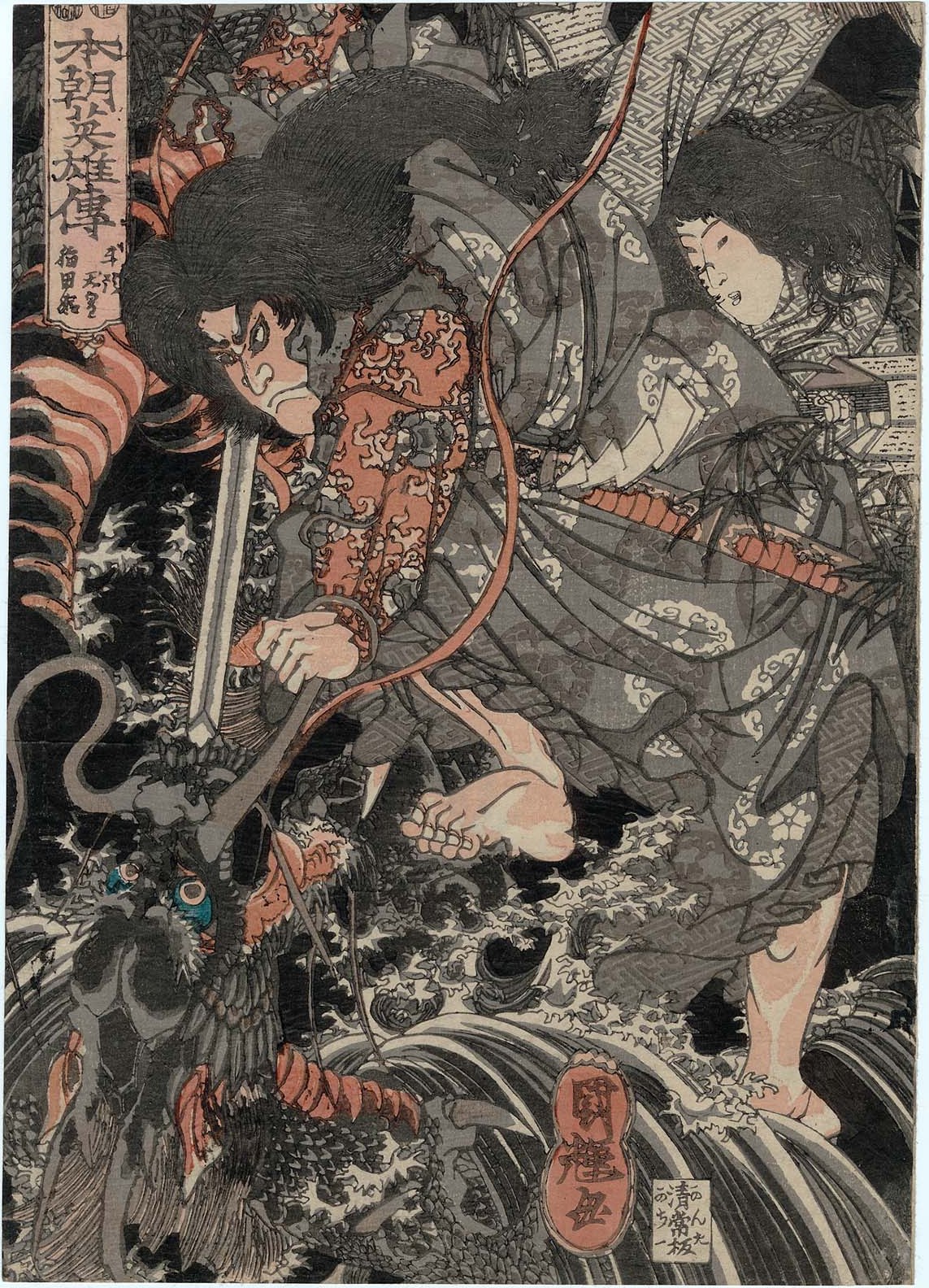
Toyotama-hime had warned Hoori not to look at her while she gave birth. Because she came from the sea, she said, childbirth would reveal her native form. Hoori looked anyway. In the Kojiki, she became a crocodile-like waniA mythic sea-creature of the chronicles, its written character meaning crocodile but old Japan picturing it as a dragon; the two books render the same word crocodile, dragon and sea-monster. eight fathoms long. In the main account of the Nihon Shoki, she became a dragon. An alternate account in the same work also describes a great wani.
Toyotama-hime was horrified that Hoori had seen her true form. She left the baby on the shore and returned beneath the waves. She still loved the child, though, and sent her younger sister Tamayori-hime to nurse him. Tamayori-hime later became his wife.
A name that remembers a gap
Once the birth scene is clear, the long name becomes easier to follow. The Kojiki gives it as Ama-tsu-hi-daka-hiko-nagisa-take-u-gaya-fuki-ahezu no MikotoA title of divine or exalted rank, roughly 'Augustness', appended to the names of gods and early sovereigns in the two chronicles.. The Nihon Shoki records a shorter form. W. G. Aston translates the name as:
Prince-beach-brave-cormorant-rush-thatch-unfinished. (Nihon Shoki, trans. Aston)
Several parts of the name are titles or descriptions. Hiko means prince. Nagisa points to the beach or the limit of the waves. Take means brave. The part that matters most is u-gaya fuki-ahezu: the cormorant-feather thatch was not finished being put on.
The broad meaning is clear, but the grammar was argued over even by the scholars who studied the old texts. Chamberlain records an older reading in which the thatch was being made to meet rather than simply failing to meet. Moribe proposed a much less accepted reading about movement between sea and land and being unable to suckle the child. Chamberlain marked that interpretation as a stretch. The unfinished roof remains the standard reading adopted by both translators.
At the tide-line
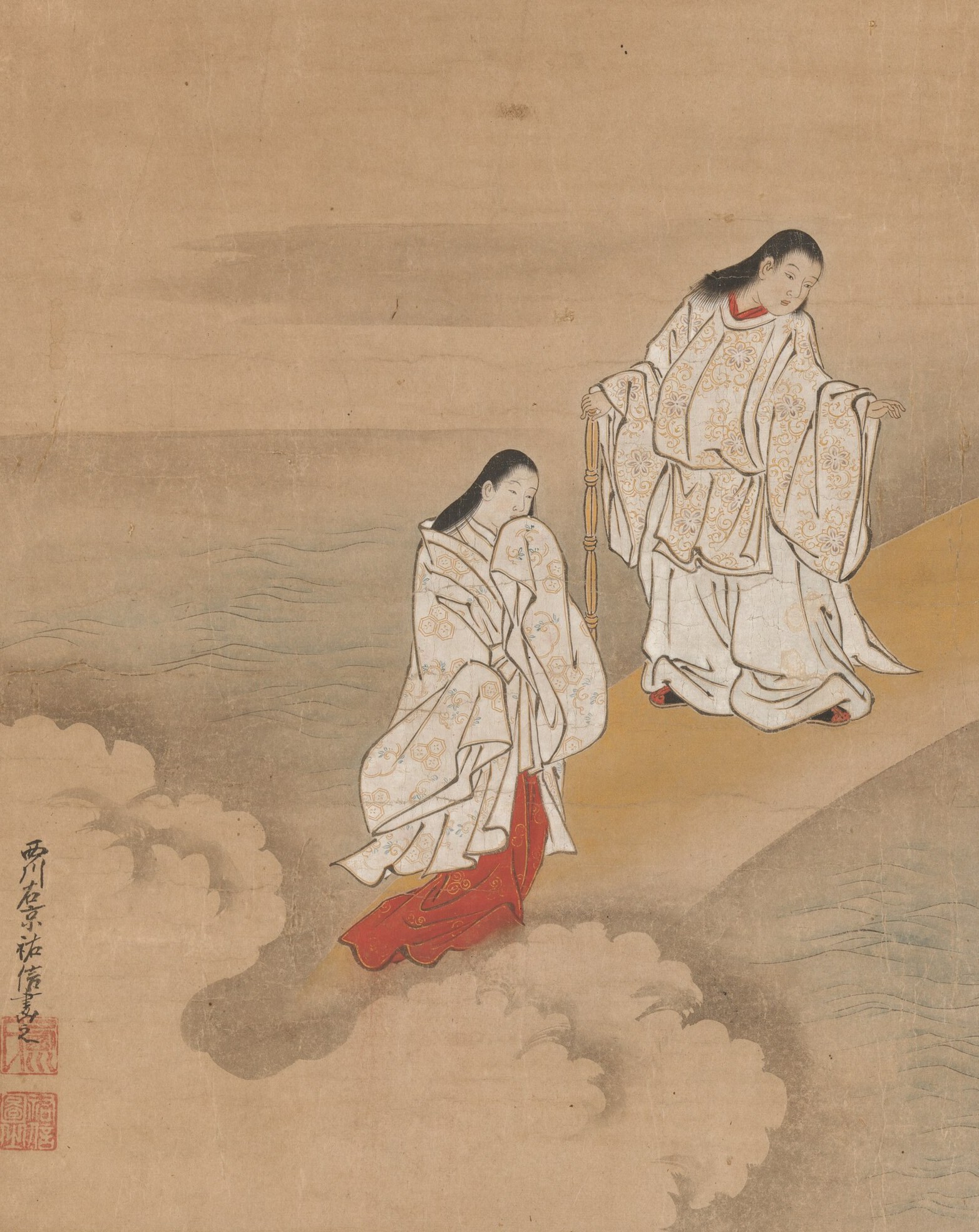
The hut stood on the shore, where the waves stopped. That location matters. Toyotama-hime belonged to the sea. Hoori came from a line descended from the sky, yet had travelled down to the sea-palace and back. Their child was born where those two worlds touched.
The cormorant also belongs to both places. It dives from air into water and returns again. The image is not just an unfinished building; it is a child born during a crossing, before either side has fully closed around him.
The Nihon Shoki preserves one small note about the feathers. It says that a woman in labour could gain relief by holding a cormorant’s feather in her hand. The unfinished roof therefore became more than a detail in a birth story. A woman could hold one of the same feathers during labour.
Four sons, several versions
Ugayafukiaezu married Tamayori-hime, the aunt who had first nursed him. They had four sons. The number is stable across the traditions, but the order of the sons is not.
The Kojiki and the main narrative of the Nihon Shoki make Kamu-yamato-ihare-biko the youngest son. Two alternate lists in the Nihon Shoki place him third or second. The names of the other brothers shift too. One point stays fixed: Itsu-se is always the eldest. So the careful version is the youngest in the main tradition, not simply the youngest as if every source agreed.
The Kojiki also follows two of the brothers after the family story ends. Mikenu crosses the waves to TokoyoThe Eternal Land beyond the sea in the Kojiki, the deathless country to which one of Ugayafukiaezu's sons crosses by treading the crests of the waves., the Eternal Land beyond the sea. Inahi goes to the Sea-Plain, described as the land of his dead mother. Two sons return towards the water and the world beyond it, while the line that remains on land moves towards a throne.
The name the myth used later
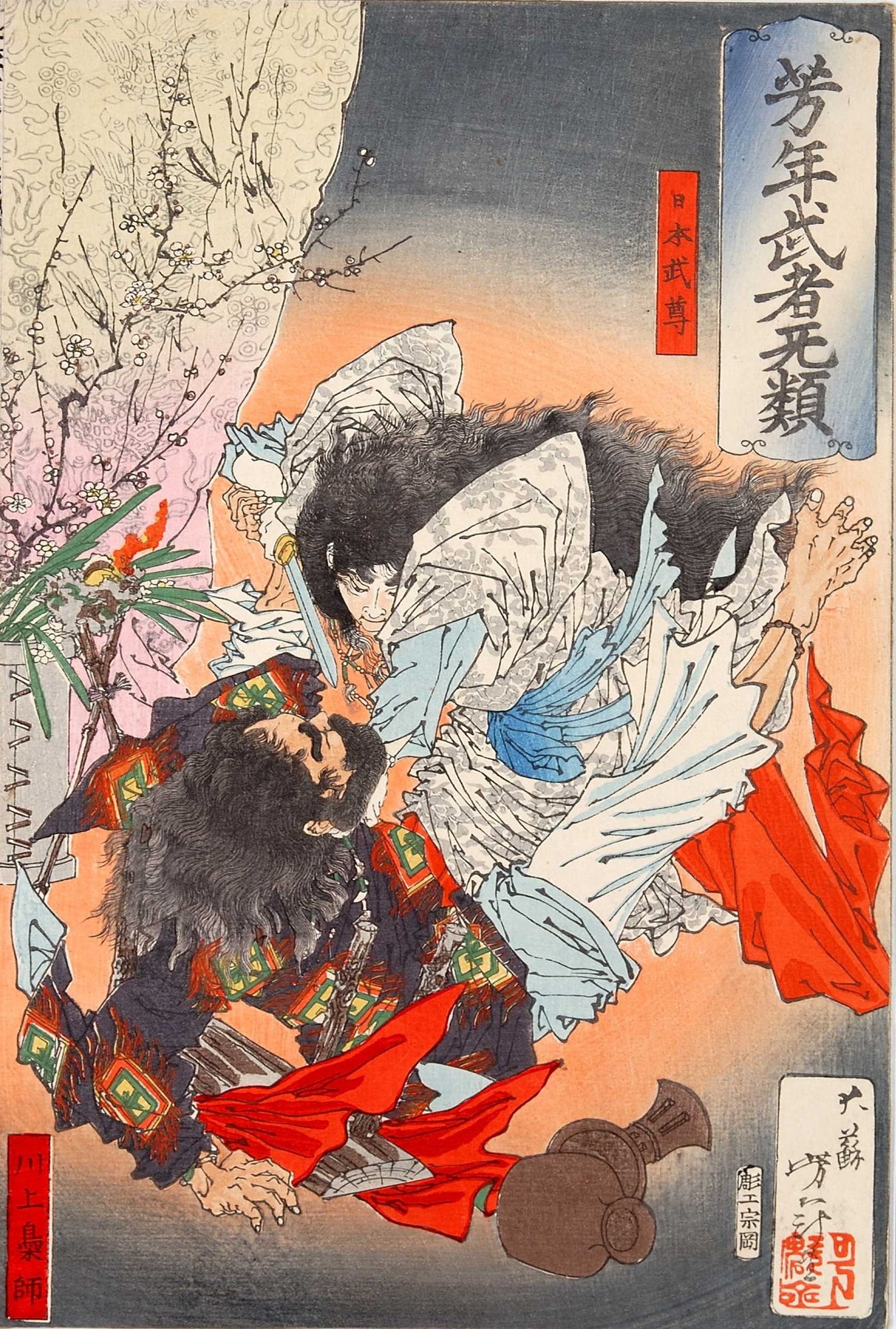
That throne is why Ugayafukiaezu is often described as the father of Jimmu, the first emperor. But Jimmu is not the name used for that son in the eighth-century texts. They call him Kamu-yamato-ihare-biko, or Sano in one passage.
Aston notes that Jimmu, meaning divine valour, was a later posthumous title. It was attached to the emperor under Kanmu, who reigned from 782 to 806, roughly sixty to ninety years after the Nihon Shoki was completed in 720. Calling him Jimmu is useful, but it means bringing a later label back into an older story.
The chronicles give Ugayafukiaezu a death and a burial. The Nihon Shoki places his tomb in the Misasagi on Mount Ahira in Hyūga. By then, the story is already beginning to look like history: a named grave, a family line, and a son who will later be counted as the first emperor.
Ugayafukiaezu’s importance is not a list of heroic deeds. It is his position in the story. He is the child born beneath a roof that was never finished, the son of the sea and the sky, and the father of a ruler whose famous name came later. He is where the divine genealogy gives way to human history.
- Kojiki (Records of Ancient Matters, 712 CE), Vol. I, Sects. XLII–XLIII, trans. Basil Hall Chamberlain (1882)read verbatim for the full name Ama-tsu-hi-daka-hiko-nagisa-take-u-gaya-fuki-ahezu no Mikoto and its footnoted parsing (the standard u-gaya fuki-ahezu,
the cormorant thatch not finished
; the older ahasezu reading; and Moribe’s flagged minority readinggoing and coming on sea and land and being unable to suckle
); the marriage to his maternal aunt Tama-yori-hime; the four sons Itsu-se, Inahi, Mikenu and the youngest Kamu-yamato-ihare-biko; and the departures of Mikenu to the Eternal Land (Tokoyo) and Inahi to the Sea-Plain. https://sacred-texts.com/shi/kj/kj049.htm - Nihon Shoki (Nihongi, Chronicles of Japan, 720 CE), Book II,
The Age of the Gods, Part II
, trans. W. G. Aston (1896), vol. 1read verbatim for the name-glossPrince-beach-brave-cormorant-rush-thatch-unfinished
; the four competingone writing
orderings of the sons, in which Ihare-biko is variously youngest, third or second; the cormorant-feather birth-charm; the burial in the Misasagi on Mount Ahira in Hiuga; and the footnote dating the posthumous style Jimmu to the reign of Kanmu (782–806 CE), after the chronicle was written. archive.org idnihongi1asto.