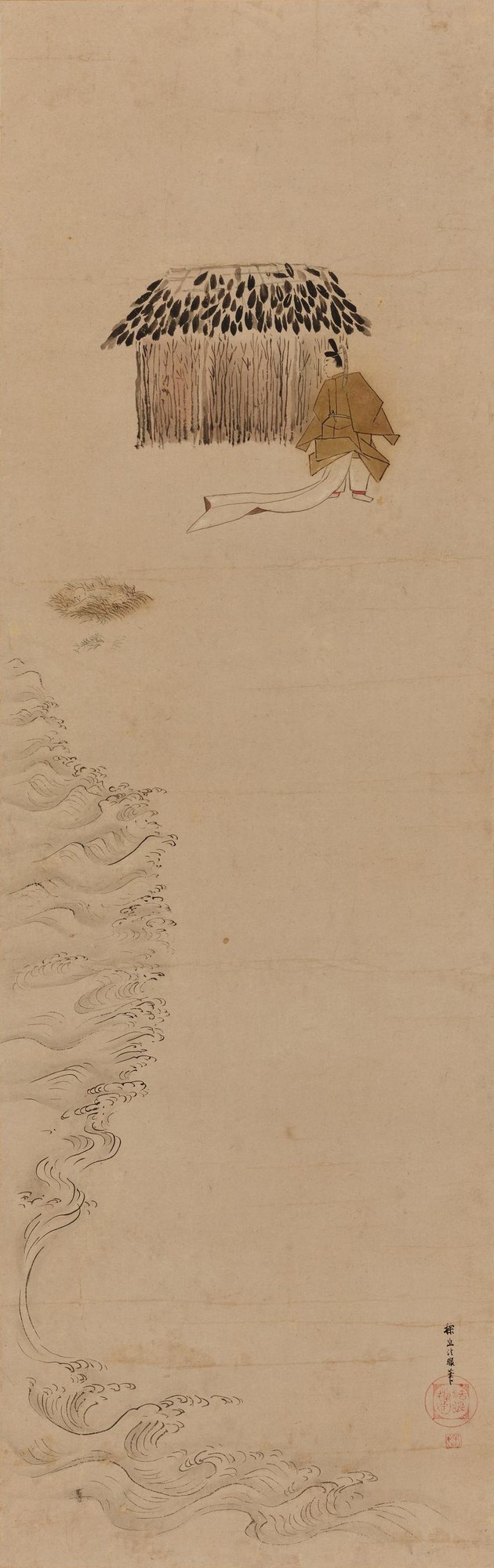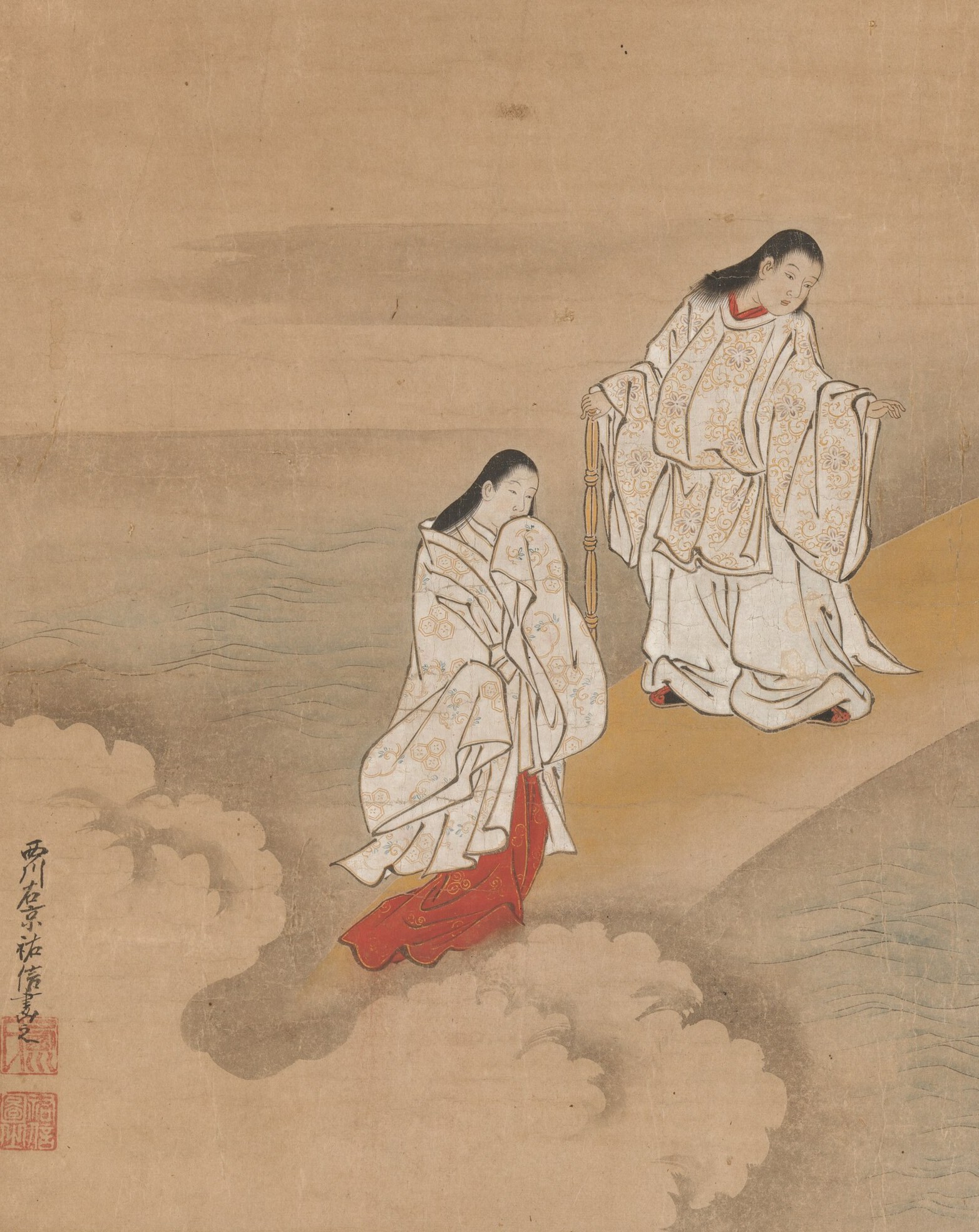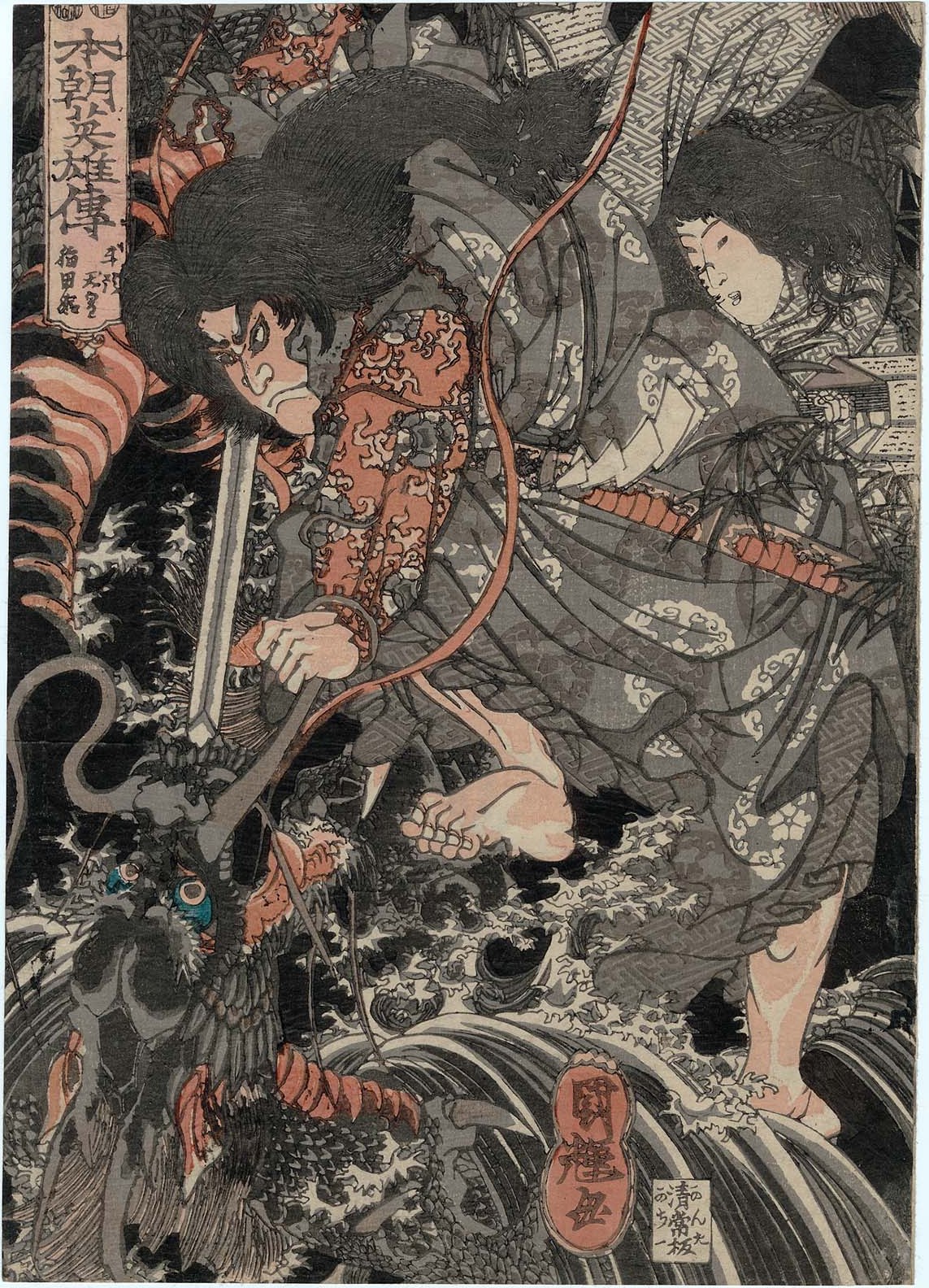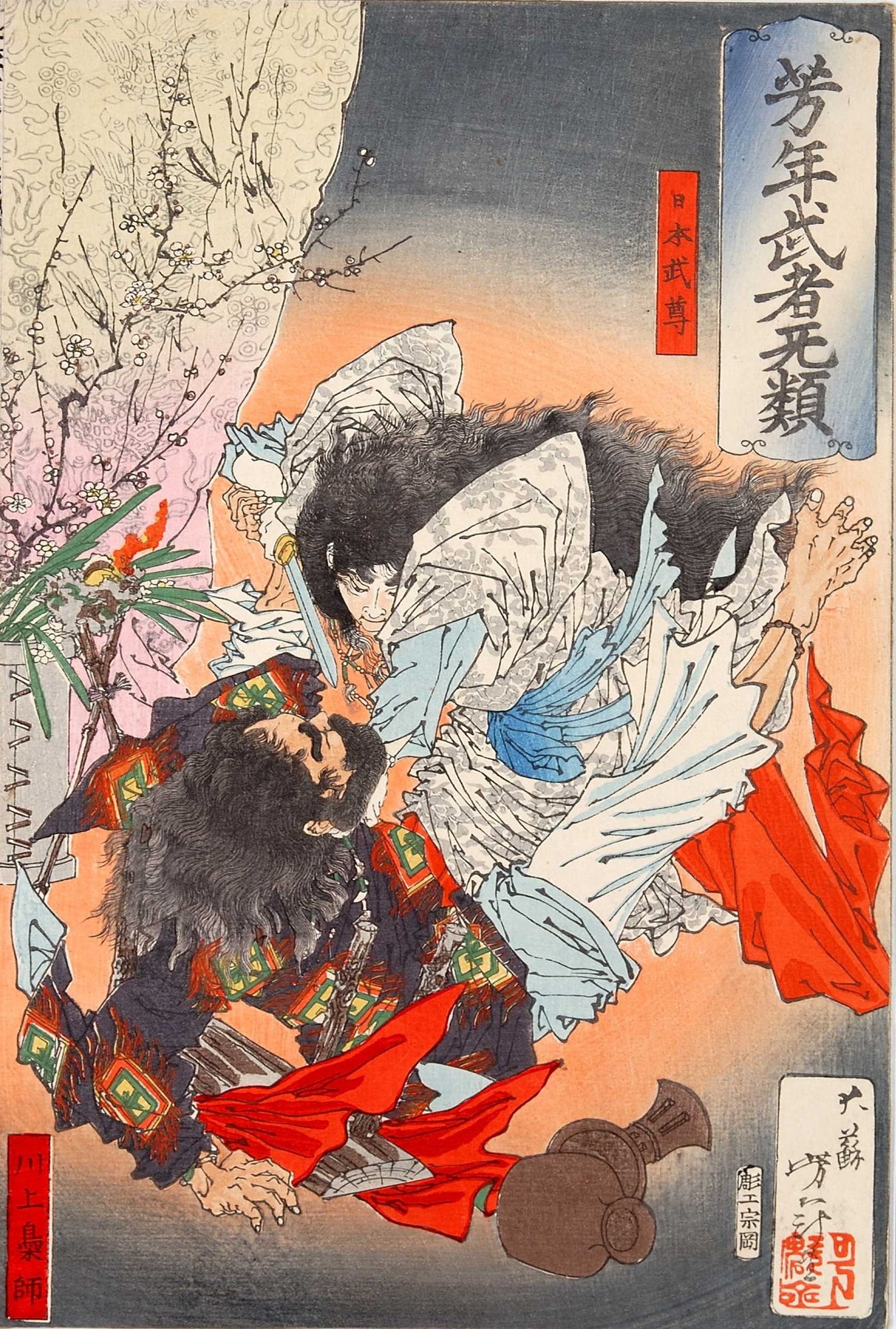
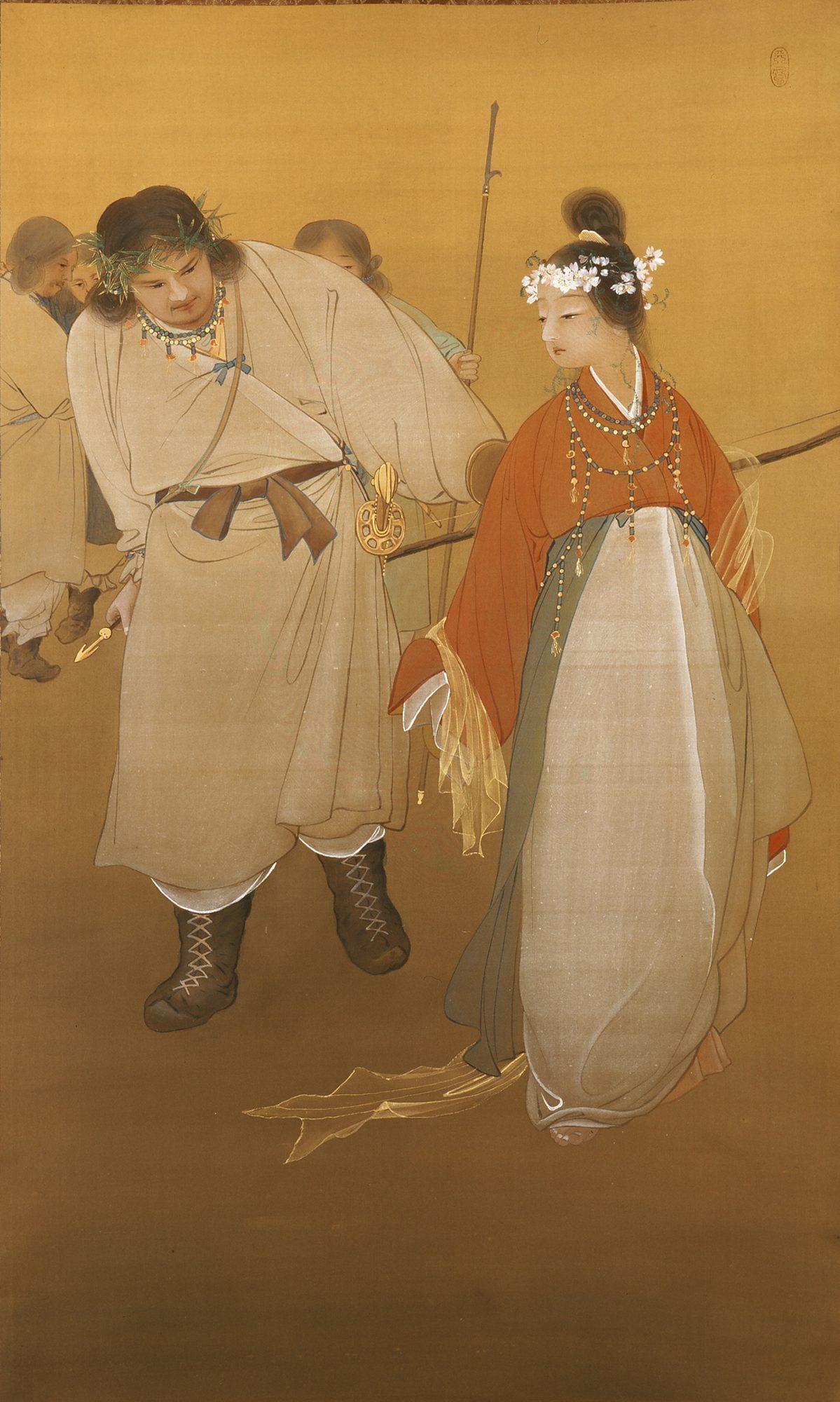
The earth below Heaven had just been pacified, wrestled quiet by a run of envoy gods sent to bring the unruly deities of the Central Land of Reed-Plains to heel, and the sky turned to the question of who would rule the calmed country. In the Kojiki the command comes from two voices at once. The Heaven-Shining-Great-August-Deity, Amaterasu the sun, and the High-Integrating-Deity, Takamimusubi, speak together and charge the Heir Apparent, Amaterasu’s own son Ame-no-Oshihomimi, to go down and take the land in hand. He does not go. A child, he answers, has just been born to him. This one should be sent instead.
So the honour skips a generation before the descent has even begun. The newborn is Ninigi, whose full name in the Kojiki runs to a whole line of syllables, Ame-nigishi-kuni-nigishi-amatsu-hi-daka-hiko-ho-no-ninigi-no-Mikoto, glossed roughly as heaven-soft, earth-soft, sun-high prince of the ruddy rice-ears. Even that gloss is uncertain: Chamberlain notes the ho may mean fire as readily as rice-ears, so the safe short form is simply Hiko-ho-no-ninigi, the August Grandchild. The gods put their command to him plainly. This Luxuriant Reed-Plain-Land-of-Fresh-Rice-ears is the land over which you shall rule. Ninigi answers as a god should: I will descend from Heaven according to your commands.
Who is really sending him
It is worth stopping on those two voices, because the chronicles do not agree on whose descent this is. The popular telling, the one where Amaterasu sends her grandson to earth, follows the Kojiki, where she and Takamimusubi act jointly, and follows a variant tucked into the Nihon Shoki where Amaterasu alone gives the command and hands over the treasures. But the Nihon Shoki’s own main narrative tells it differently.
There it is Takamimusubi, the high creator-god, who is the prime mover, Ninigi’s august grandparent, who treats the child with special affection and resolves to establish him as lord of the Central Land. In that version Amaterasu is not the sender at all. The neat image of the sun-goddess dispatching her grandson is true to the most famous text and to one strand of the other, but the second-oldest chronicle puts a different god at the head of the enterprise.
The god at the crossroads
As the descent is prepared, word comes that something is blocking the road. A deity stands at the eight-forking road of Heaven, the heavenly crossroads, and his light is not ordinary light: it reaches from the Plain of High Heaven all the way down to the Reed-Plains below. The Nihon Shoki lingers on him with relish. The length of his nose is seven hands, his back more than seven fathoms; a light shines from his mouth and from his backside; his eyeballs glow red like the aka-kagachi, the winter-cherry, bright as an eight-hand mirror.
The gods send Ame-no-Uzume, the Heavenly-Alarming-Female, the same bold goddess whose dance had lured Amaterasu out of the rock-cave. They choose her for exactly that nerve: though you are only a delicate female, they tell her, you are a deity who wins by facing other deities down. In the Nihon Shoki she meets the shining giant as she once met the darkness, baring her breasts, pushing the band of her garment below her navel, confronting him with a mocking laugh.
It works. The radiant blocker turns out to be no threat but an earthly deity, Sarutabiko, come not to bar the road but to lead the way, offering himself as Ninigi’s vanguard down to the land he is to rule. In the Kojiki it is Uzume who later escorts him back and takes his name, which is how her descendants, the Sarume, come by theirs.
The mirror that is a spirit
Then the gods equip Ninigi for the descent, and here the Kojiki and the Nihon Shoki hold the same objects but name them very differently. Five ancestral chief-deities are attached to the grandchild as his retinue, each the founder of a priestly or craft clan that served the later court: Ame-no-Koyane, ancestor of the Nakatomi; Futodama of the Imbe; Ame-no-Uzume of the Sarume; Ishikoridome of the mirror-makers; and Tamanoya of the jewel-makers. And with them go the sacred objects.
The Kojiki does not hand Ninigi a tidy set of three regalia. It gives him the curved jewels and the mirror that had once allured Amaterasu out of the Rock-Dwelling, and, separately, the Herb-Quelling Sword that Susanoo had drawn from the tail of the eight-headed serpent: three heirlooms, each trailing its own older myth, not a single named triad. It is the Nihon Shoki’s variant that first packages them as a unit, naming all three at once as the three treasures: the curved jewel of Yasaka gem, the eight-hand mirror, and the sword Kusanagi. The fixed doctrine of the Three Sacred Treasures as one sealed set is a later, institutional idea laid over old objects.
One of the objects, though, carries a charge in the Kojiki that outlasts every argument about grouping. Amaterasu turns to the mirror and gives Ninigi an instruction that would become the root of a cult: regard this mirror exactly as if it were our august spirit, and reverence it as if you were reverencing us. This is the textual seed of the mirror kept at Ise as the very presence of the sun-goddess. She does not send an image of herself to earth; she sends a surface that gives back a face, and tells her grandson to treat what it holds as herself.
Down the Floating Bridge
The descent itself is one of the great kinetic passages in the chronicles, and the Kojiki gives it in a single surging breath. Ninigi leaves the Heavenly Rock-Seat, pushes asunder the eight-fold spreading clouds of Heaven, divides a road with a mighty road-dividing, and sets off floating, shut up in the Floating Bridge of Heaven. The Nihon Shoki matches the plunge and adds a strange domestic detail: Takamimusubi takes the coverlet from his own couch and casts it over his grandchild, wrapping the god for the journey down like a child put to sleep.
Where he lands, the sources will not settle. Both name Takachiho, but they place it in different provinces and spell the sub-peak differently. The Kojiki brings him down on the peak of Kushifuru, which it calls Takachiho in Tsukushi. The Nihon Shoki’s main text sets him on the Peak of Takachiho of So in Hiuga; its variant splits the difference, the peak of Kushifuru of Takachiho in Hiuga in the land of Tsukushi. The later contest between modern claimants, the Takachiho in Miyazaki and the Kirishima peaks on the Miyazaki–Kagoshima border, is a quarrel the ancient texts never resolved. They agree on the name of the mountain and disagree on where it stands.
Wherever it was, Ninigi surveyed it and pronounced it good, in a speech the Kojiki records with a surveyor’s satisfaction: a land whereon the morning sun shines straight, a land which the evening sun’s sunlight illumines, an exceedingly good place. And there he built, making the temple-pillars stout on the nethermost rock-bottom and raising the cross-beams high toward the Plain of High Heaven, sinking a palace into the bedrock of the earth he had come to rule and pointing its roof back at the sky he had left.
The rock and the blossom
The last movement of the descent is the one that gives it its sting. At Cape Kasasa, Ninigi meets a woman of surpassing beauty, Konohana-sakuya-hime, the Princess who Blossoms Brilliantly like the Flowers of the Trees, daughter of the mountain-god Ōyamatsumi. He asks for her, and her father sends her, but he sends her elder sister with her, Iwanaga-hime, the Princess Long as the Rocks. Ninigi weds the lovely younger sister and sends the elder one back, because she is ugly to look at.
It is a small cruelty with a cosmic price. Ōyamatsumi had sent both daughters on purpose, and when the rock-princess is returned he explains what has been thrown away. Had Ninigi kept Iwanaga, the Princess Long as the Rocks, his offspring would have lived on immovable and enduring like the rocks themselves, though the snow fall and the wind blow. Because he chose only the blossom-princess, his line will flourish gloriously, like the flowering of the trees, but only for a flowering’s length.
By keeping the flower and refusing the stone, the August Grandchild traded permanence for beauty and made his descendants mortal. This is the myth’s quiet explanation for the plainest fact about the emperors who traced their line to him: that the sovereigns’ lives, in the Kojiki’s words, are not long. The gods came down to rule the earth for ever, and by preferring the beautiful to the lasting, became things that die.
Hence it is that the august lives of Their Augustnesses the Heavenly Sovereigns are not long. (Kojiki, trans. Chamberlain, Sect. XXXVII)
- Kojiki (Records of Ancient Matters, 712 CE), Sect. XXXIII,
The August Descent from Heaven of His Augustness the August Grandchild
, trans. Basil Hall Chamberlain (1919 ed.)the read-verbatim source for the charge and the departure. The joint command of Amaterasu (the Heaven-Shining-Great-August-Deity) and Takamimusubi (the High-Integrating-Deity); the Heir Apparent Ame-no-Oshihomimi’s deferral to his newborn son Ninigi (full name Ame-nigishi-kuni-nigishi-amatsu-hi-daka-hiko-ho-no-ninigi-no-Mikoto, short form Hiko-ho-no-ninigi); the shining deity blocking the eight-forking road of Heaven and Ame-no-Uzume’s challenge (though thou art but a delicate female, thou art a Deity who conquers in facing Deities
); Sarutabiko’s self-identification as vanguard/guide; the five accompanying chief-deities (Ame-no-Koyane of the Nakatomi, Futodama of the Imbe, Ame-no-Uzume of the Sarume, Ishikoridome of the mirror-makers, Tamanoya of the jewel-makers); the curved jewels and mirror that had allured Amaterasu from the Rock-Dwelling, and the Herb-Quelling Sword (Kusanagi) drawn earlier from the serpent’s tail, given as separate heirlooms rather than a named triad; and the mirror injunction,Regard this mirror exactly as if it were our august spirit, and reverence it as if reverencing us.
https://sacred-texts.com/shi/kj/kj040.htm - Kojiki, Sect. XXXIV,
The August Reign in Himuka
, trans. Chamberlainthe descent proper, read verbatim. Ninigi leaving the Heavenly Rock-Seat, pushing asunder the eight-fold heavenly spreading clouds and dividing a road with a mighty road-dividing, set off floating shut up in the Floating Bridge of Heaven, and descending onto the peak of Kushifuru which is Takachiho in Tsukushi; the good-land speech (a land whereon the morning sun shines straight, a land which the evening sun’s sunlight illumines … an exceedingly good place
); and the palace built with temple-pillars made stout on the nethermost rock-bottom and cross-beams made high to the Plain of High Heaven. https://sacred-texts.com/shi/kj/kj041.htm - Kojiki, Sect. XXXV,
The Duchess of Saru
, trans. ChamberlainAme-no-Uzume escorts Sarutabiko back and takes his name, the aetiology of the Sarume. https://sacred-texts.com/shi/kj/kj042.htm - Kojiki, Sect. XXXVII,
The Curse of the Deity Great-Mountain-Possessor
, trans. Chamberlainread verbatim for the marriage and the mortality curse. Ninigi weds Konohana-sakuya-hime at Cape Kasasa but sends back her elder sister Iwanaga-hime because she is ugly; their father Ōyamatsumi explains he had sent both so the heavenly offspring wouldlive eternally immovable like unto the enduring rocks
(Iwanaga) andflourishingly like unto the flowering of the blossoms of the trees
(Konohana), so that by rejecting the rock-princess Ninigi doomed his line to mortal, flower-brief lives, andthe august lives of … the Heavenly Sovereigns are not long.
https://sacred-texts.com/shi/kj/kj044.htm - Nihon Shoki (Nihongi, Chronicles of Japan, 720 CE), Book II,
The Age of the Gods, Part II
, trans. W. G. Aston (1896)the parallel chronicle, read verbatim for the divergences honoured above. The main narrative in which Takamimusubi, not Amaterasu, is the prime mover and Ninigi’s august grandparent, who casts the coverlet from his own couch over the child and sends him down onto the Peak of Takachiho of So in Hiuga (no explicit regalia triad); and theone writing
variant in which Amaterasu is the sender and gives the three treasures named explicitly (the curved jewel of Yasaka gem, the eight-hand mirror, and the sword Kusanagi), with the five Be-ancestor deities, Sarutabiko’s description (nose seven hands long, eyes like an eight-hand mirror with a ruddy aka-kagachi glow), Uzume’s bare-breasted mocking confrontation, and the descent on Kushifuru of Takachiho in Hiuga in the land of Tsukushi. archive.org idnihongi1asto.