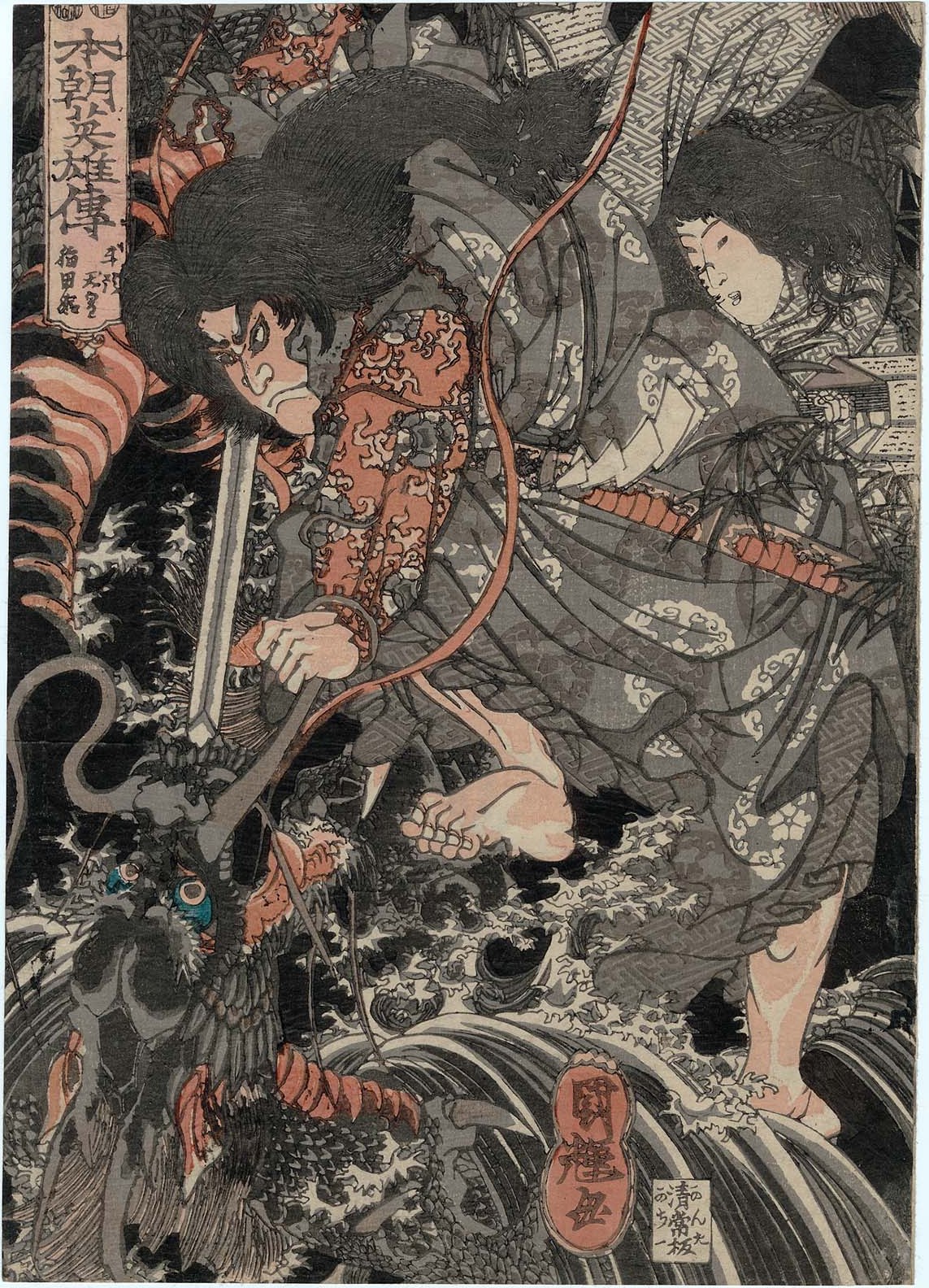
Three storm-gods, in three languages, meet the same enemy. A serpent of impossible size, tangled up with water and disorder, lies across the path of the god who commands the weather, and the god goes to kill it. In India the god is Indra and the serpent is Vritra; in Greece the god is Zeus and the serpent is Typhoeus; on the head-waters of a river in Izumo the god is Susanoo and the serpent has eight heads. Scholars have a name for this recurring shape, borrowed from the German for combat with chaos
: the Chaoskampf, the storm-god against the monster of the deep. The three fights rhyme so closely that it is tempting to call them one myth told in three places. They are not. What makes the comparison worth drawing is the place where the rhyme breaks, and it breaks hardest around a single object: a sword.
Two thousand years between the hymn and the Kojiki
Before setting the three side by side, it is worth being honest about the distance between them, because all three agree
means nothing until you know whether the texts are neighbours or strangers. They are strangers. The hymnic core of the Rigveda is usually placed around 1500 to 1200 BCE, a scholarly estimate for an oral tradition rather than a date stamped on the text.
Hesiod’s Theogony comes roughly nine hundred years later, around 700 BCE. The Kojiki, which fixes the Susanoo story in writing, was compiled in 712 CE, some two thousand years after the Vedic hymn was first sung. That last gap is enormous. The Indian and Japanese witnesses to this shared
pattern are separated by more time than separates us from the Roman Republic. Whatever binds these three fights together, it is not that their authors were in conversation.
There is a second, quieter distance to name. Every archaic-sounding phrase quoted below belongs to a Victorian or Edwardian translator, not to the ancient poet. The Herb-Quelling Great Sword
is Basil Hall Chamberlain’s English of 1882; the footless and handless
dragon is Ralph Griffith’s of the 1890s. The dignity in the diction is theirs. The events are old; the words are not.
The same fight three times
Strip the three encounters to their bones and the family likeness is unmistakable. Each hero is a god of storm or sky. Each enemy is a serpent. Indra’s Vritra is called Ahi outright, the Serpent,
and lies coiled on a mountain; Hesiod’s Typhoeus grows a hundred snake-heads from his shoulders, with dark flickering tongues and fire in every eye; Susanoo’s monster is a single body forked into eight heads and eight tails, its span crossing eight valleys and eight hills, its eyes red as the akakagachiThe winter-cherry or lantern-plant, whose husk hangs from the stem like a small red globe with a light inside; the chronicles compare the serpent's eyes to it., the winter-cherry whose husk glows like a small lantern. Three storm-gods, three chaos-serpents. So far the pattern holds.
It is when you ask how each serpent dies that the three drift apart, and the first thing to drift is the weapon.
A thunderbolt, and then a sword
Two of the three fights are won with the thunderbolt, which is exactly what a storm-god ought to carry. Indra kills Vritra with the vajraThe thunderbolt of Indra, a mace-like weapon of the storm forged by a divine smith; the standard weapon of the Vedic dragon-fight., and the Rigveda is careful to say where it came from: it was fashioned for him by TvashtarThe divine artificer of the Rigveda who fashions the gods' weapons, including the thunderbolt Indra carries against the dragon., the divine smith. He grasps the forged bolt and strikes the firstborn of dragons between the shoulders. Zeus needs no smith. He simply seizes his own arms, thunder and lightning and lurid thunderbolt,
leaps from Olympus, and burns all the marvellous heads of the monster until the earth itself melts like iron in a forge, before hurling the wreck into Tartarus. Different suppliers, same weapon: the storm made a missile.
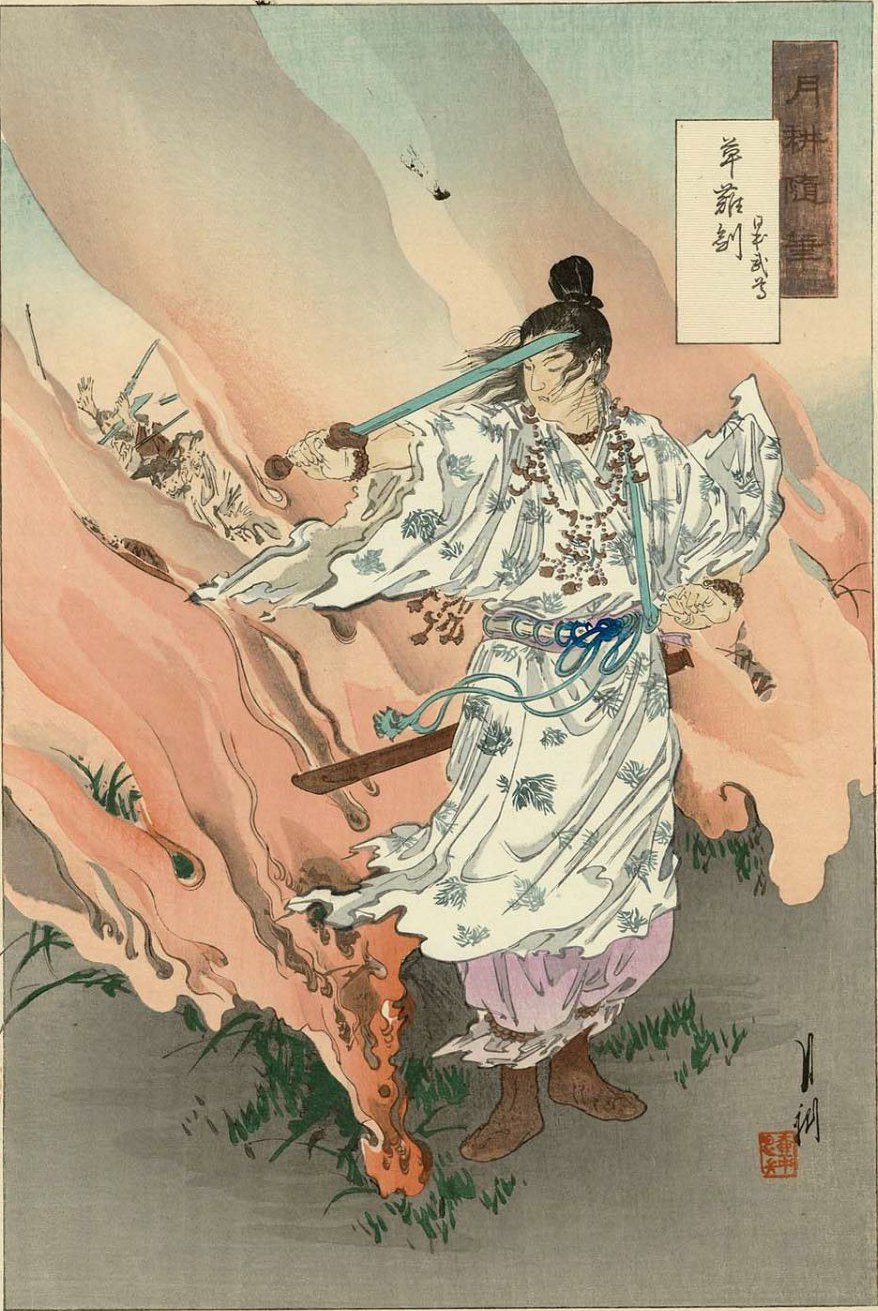
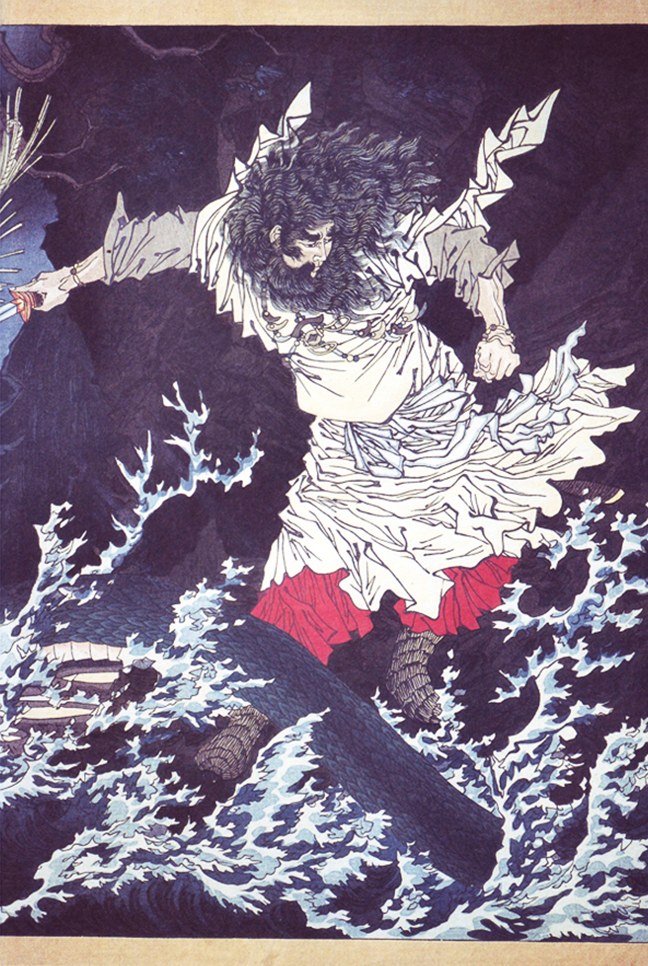
Susanoo breaks the pattern. He carries no thunderbolt and throws no lightning. He wins with cunning first and steel second, getting the serpent drunk on eight vats of refined liquor (poisonous, in one variant of the Nihon Shoki) and then hacking the sleeping coils apart with an ordinary ten-grasp sabre. Neither Indra nor Zeus stoops to a trap; both meet their serpents head-on and awake.
And where the Vedic and Greek fights end with a dead monster and nothing more to collect, the Japanese fight has one beat left that has no parallel in either. Cutting through the middle tail, Susanoo’s blade catches and chips on something buried in the flesh. He splits the tail open and finds a sword inside the beast.
The sword drawn from the beast
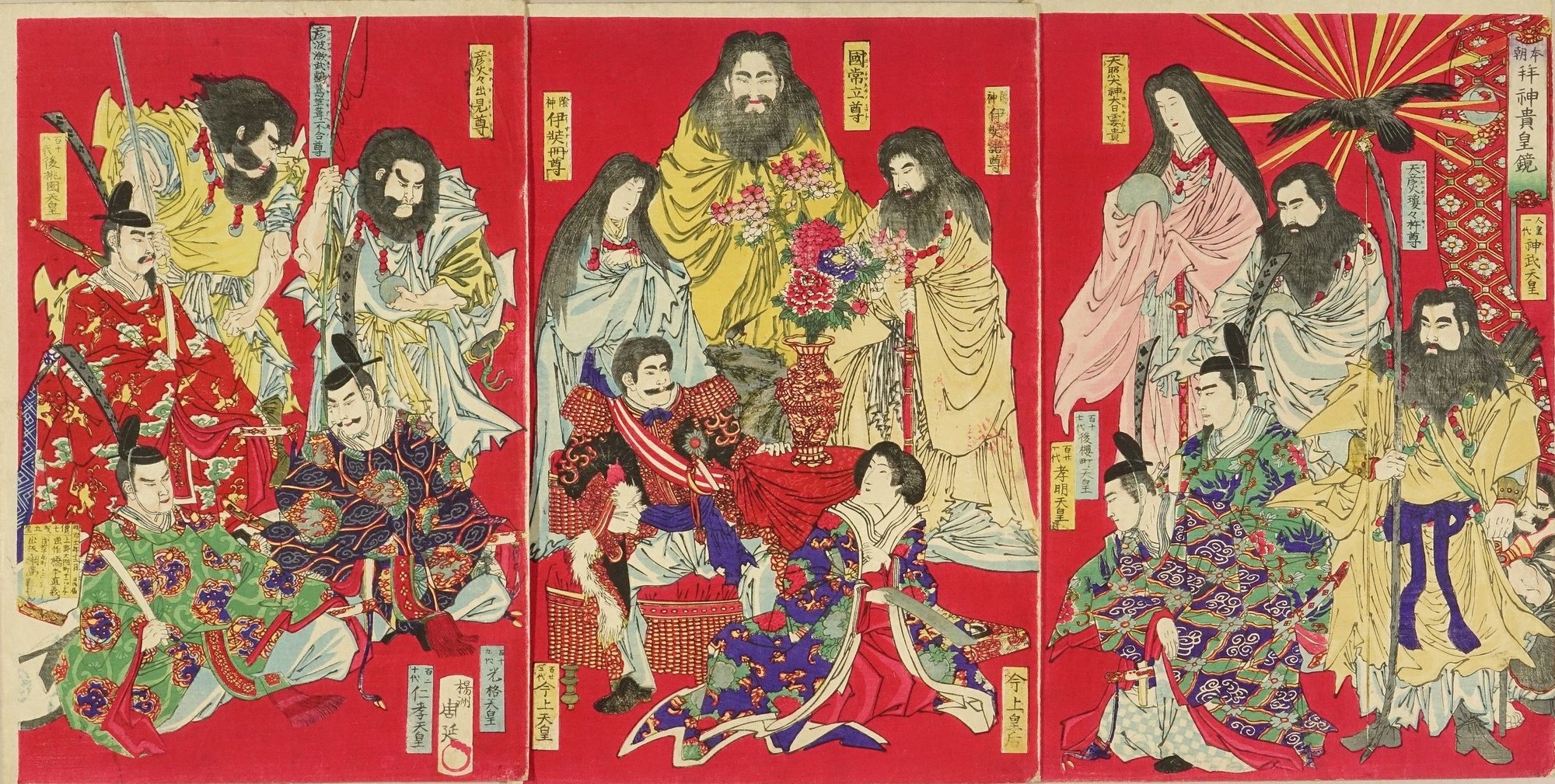
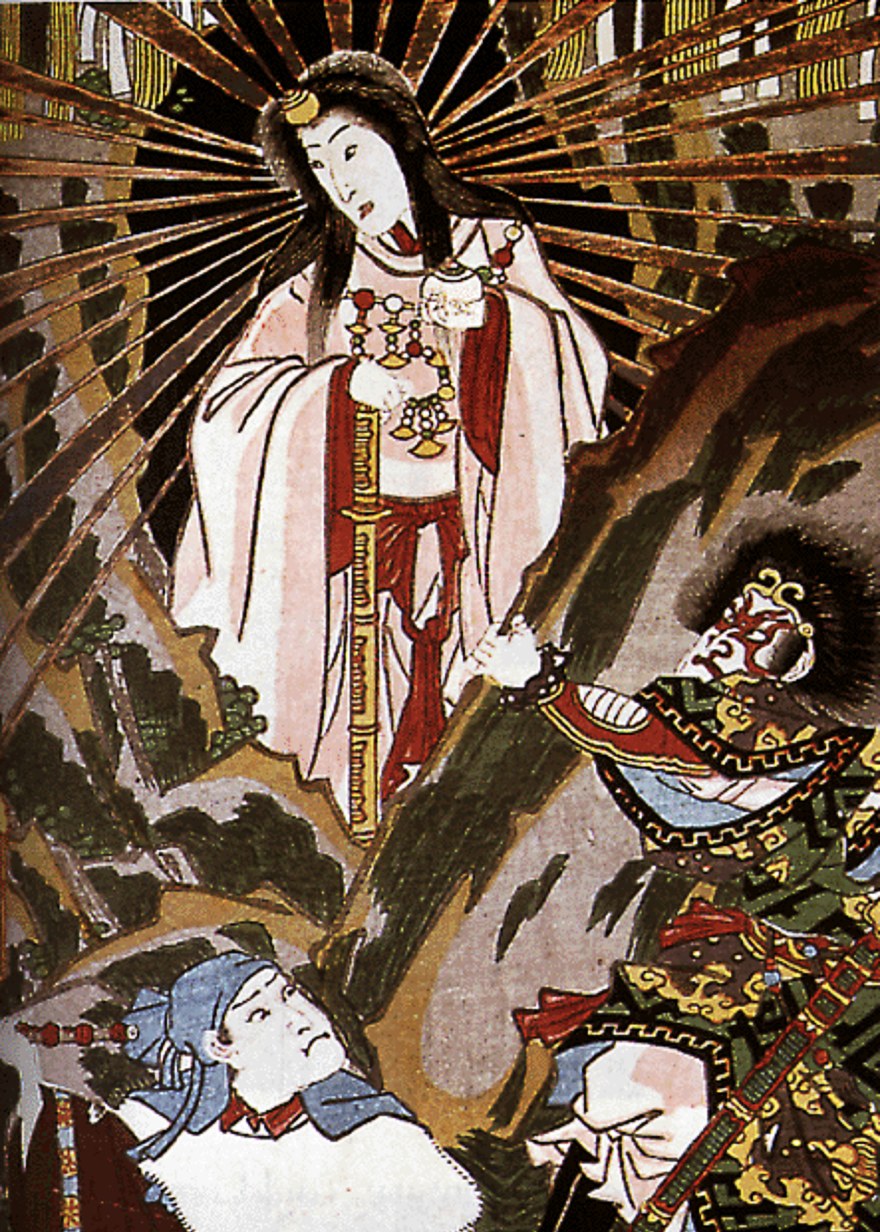
This is the detail that makes the Japanese case its own thing rather than an eastern copy of the Indo-European fight, and it is worth dwelling on because it reverses the usual direction of the story. In the standard pattern the hero brings a weapon to the serpent. Susanoo takes a weapon from it. The blade in the tail is a divine sword, strong enough to notch a god’s own edge, and he does not keep it for himself; he sends it up to his sister Amaterasu, the sun. It becomes the most famous sword in Japan, Kusanagi, the Herb-Quelling Sword, and in time one of the treasures of the imperial house.
The honest telling has to add that the chronicles cannot agree on what the killing weapon was called. The Kojiki leaves Susanoo’s own sabre unnamed and gives the name Kusanagi only to the blade found in the tail, adding that this was originally called Ama-no-Murakumo, the Sword of the Gathering Clouds of Heaven, for the cloud-bank that hung perpetually over the serpent. The Nihon Shoki multiplies the names further, calling Susanoo’s killing weapon Worochi-no-Ara-masa in one variant, Worochi-no-Kara-sabi in another, and, in the strangest telling, Ama-no-Haye-kiri after a passage through Silla.
Four names float across the versions. What is stable is not the name but the motif: a sword drawn out of the slain serpent, which is the one thing neither Vritra nor Typhoeus yields. No sword comes out of the Vedic dragon; no blade is buried in the Greek one. That single object is the Japanese fight’s signature, and importing it into the other two would be inventing what the sources do not say.
Why the fight is fought at all
The weapon divides the three; so does the reason. Ask what each victory is for and you get three unrelated answers. Indra’s fight is about water. Vritra has dammed the cosmic rivers, penning them like cattle held by a thief, and the point of killing him is release: with the dam broken, the Seven Rivers are let loose to run down to the sea. Zeus’s fight is about rule.
Typhoeus rises just after Zeus has put down the Titans, a last challenge to the new king of heaven, and burning him secures the sovereignty of the cosmos. Susanoo’s fight is about a girl. He comes upon an old couple weeping over their last daughter, Kushinada-hime, whom the serpent is due to devour, and he kills the monster to save her and win her as his bride.
Water, sovereignty, marriage. The Chaoskampf can be about the fertility of the land, the order of the cosmos, or the rescue of one human-shaped victim, and the three surviving fights happen to sort neatly into all three. A pattern that can carry stakes this different is less a single inherited story than a shape flexible enough to hold whatever each culture most needed a storm-god to secure.
There is even a divergence in where the storm itself sits. Susanoo is a storm-god who slays the serpent; in Hesiod, by an inversion worth noticing, the storm-winds are what the defeated serpent leaves behind, blowing out of the beaten Typhoeus to scatter ships. Indra’s kill releases the waters, aligning the weather with the god’s triumph. The storm is the hero’s power in one telling, the monster’s residue in another. Even the element the pattern is named for will not stay on one side of the fight.
Indra strikes with a forged thunderbolt and the rivers run; Zeus burns a hundred heads to keep his throne. Only the god of Izumo reaches into the dead serpent and lifts out a sword, sending up to heaven the one thing his fellow dragon-slayers never find in their monsters.
- Kojiki (Records of Ancient Matters, 712 CE), compiled by O no Yasumaro, Book I, Sections XVIII–XIX, trans. Basil Hall Chamberlain (1882)the Japanese beats used here. Susanoo’s descent to Tori-kami at the head-waters of the River Hi in Izumo; the weeping elders and their last daughter Kushinada-hime; the eight-forked serpent with akakagachi-red eyes that devours a daughter a year; the eight-fold refined liquor and the eight vats that stupefy it; the ten-grasp sabre notched on the middle tail; and the great sword found inside the beast, sent up to Amaterasu, named Kusanagi (the Herb-Quelling Sword). Read via Wikisource transcription of the Chamberlain edition (pages 146–152). The full sequential slaying is told in the sibling posts; only the comparison-load-bearing beats are drawn on here.
- Nihon Shoki (Nihongi, Chronicles of Japan, 720 CE),
The Age of the Gods,
Book I, trans. W. G. Aston (1896)the parallel chronicle, read verbatim for the sword-name divergences central to this piece. The main account names the found sword Kusanagi with the note that its original name was Ama-no-Murakumo, the Sword of the Gathering Clouds of Heaven; threein one writing
variants name the killing weapon differently (Worochi-no-Ara-masa; Worochi-no-Kara-sabi; Ama-no-Haye-kiri, after a passage through Silla); and one variant makes the liquor poisonous. archive.org idnihongi1asto. - Rigveda 1.32 (Mandala I, Hymn 32,
Indra
), textual core c. 1500–1200 BCE, trans. Ralph T. H. Griffith, The Hymns of the Rigveda (1889/1896)Indra’s defining deed. He slays the Dragon Vritra (also Ahi,the Serpent
),footless and handless,
with the vajra fashioned by the smith Tvashtar, striking himbetween the shoulders
; the dammed waters are released and the Seven Rivers let loose; and afterwards he flees in fearlike a hawk affrighted
across ninety-nine rivers. Griffith’s note preserving the ancient vapour-and-cloud allegorical reading (Vritra as the cloud that hoards the rain) is scholarship layered on the hymn, given here as such and not as the hymn’s own statement. The c. 1500–1200 BCE range is a scholarly estimate for the oral core, not a date in the text. Read verbatim via archive.org (in.ernet.dli.2015.47261, Hymn XXXII). - Hesiod, Theogony 820–880, c. 700 BCE, trans. Hugh G. Evelyn-White (Loeb, 1914)the third combat. Earth bears Typhoeus, a hundred-snake-headed monster with dark flickering tongues, fire in every eye, and the voices of gods, a bull, a lion and whelps; Zeus seizes
thunder and lightning and lurid thunderbolt,
burns all the heads, and casts the maimed wreck into wide Tartarus; from the beaten monster come the damp storm-winds that scatter ships (869–880). The later Apollodoran version in which Typhon briefly overpowers Zeus and cuts out his sinews is NOT in Hesiod and is not used here. Read verbatim via theoi.com. - Note on the comparison itselfno ancient source links these three combats as one lineage. The shared
storm-god versus chaos-serpent
morphology (the Chaoskampf, and the Indo-European dragon-slaying formula studied by Calvert Watkins in How to Kill a Dragon) is modern scholarship, not a claim any of these texts makes; it is offered here as a typological comparison, not a family tree. The distance in time between the three witnesses (the Rigveda’s core roughly two thousand years before the Kojiki and nine hundred before Hesiod) is whythey agree
is treated with care throughout.