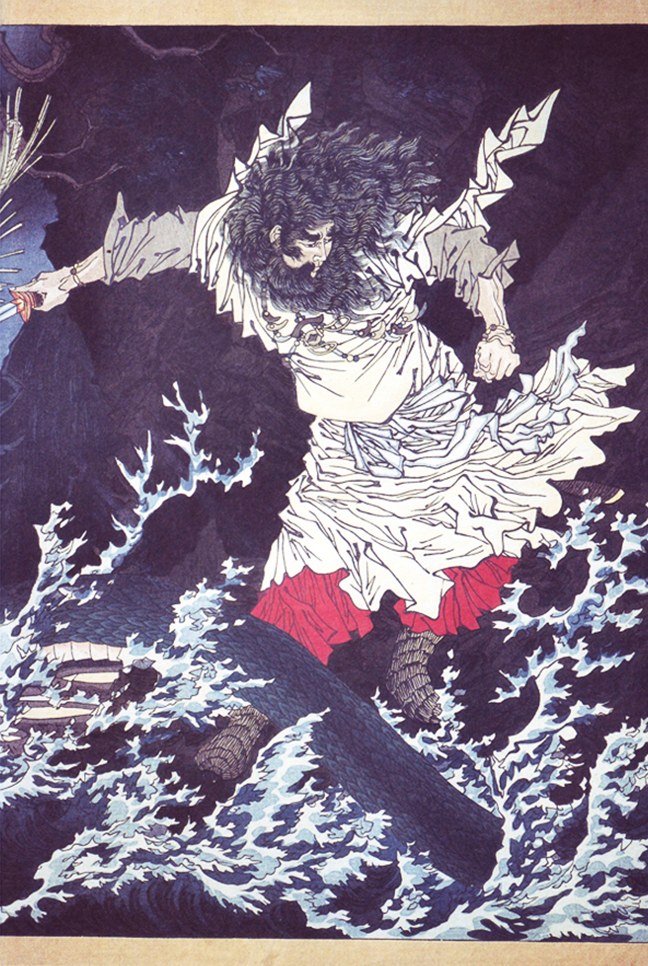
Izanagi had come back filthy from the land of the dead, and he went down to a plain by the river-mouth to wash the pollution off. As he rinsed his left eye, the Sun-Goddess Amaterasu was born; from his right eye came the moon; and as he washed his august nose, out came a third child, His-Brave-Swift-Impetuous-Male-Augustness, the one later ages would call Susanoo. His father parcelled out the universe on the spot. Amaterasu was to rule the Plain of High Heaven, the moon-god the realm of night, and to this last, nose-born son he said: rule thou the Sea-Plain. It was a kingdom, and Susanoo would not take it. Almost everything that makes him the most turbulent figure in the Japanese chronicles begins with that refusal.
The god who wept the world dry
Instead of governing his sea, Susanoo wept. He wept on and on, the Kojiki says, until his eight-grasp beard reached down to the pit of his stomach, and his grief was not a private thing. The green mountains withered to bare brown; the rivers and the seas dried up; and evil deities swarmed everywhere like flies in the fifth moon, so that the whole world buzzed with calamity.
When his father demanded to know why he ruled his charge with weeping instead of order, the answer was not defiance but longing: I wail, he said, because I wish to go away to my dead mother’s land, to the Nether Distant Land. Izanagi’s patience broke. He drove his son out with a divine expulsion, and the storm-child was homeless.
Even his name carries this ambiguity. The old reading, from a verb meaning to be impetuous, makes him the Impetuous Male and licenses the storm god
of modern shorthand. But Aston preferred a quieter derivation recorded in the Izumo gazetteer: Susa was a village, and Susa-no-Wo may mean nothing grander than the male of Susa, a local deity of that province. The sources never crown him god of thunder or command of the weather. They give him the sea to rule, and a temper that behaves like weather.
The oath by the river of Heaven
Before going down to the dead, Susanoo climbed up to Heaven to take leave of his sister. He did not climb gently. The mountains and rivers shook and every land and country quaked at his coming, and Amaterasu, certain he meant to steal her realm, armed herself like a warrior: her hair bound into manly knots, five hundred curved jewels strung about her head and wrists, quivers of a thousand arrows and five hundred on her back. Then she stamped her feet into the hard earth until she sank to her thighs, kicking the ground away like rotten snow, and waited for him.
To prove that his heart was clean, Susanoo proposed a trial by oath. Each would bring forth children, and the outcome would reveal his intent. From opposite banks of the Tranquil River of Heaven they swore. Amaterasu took the ten-grasp sabre from her brother’s belt, broke it in three, crunched the pieces and blew them out as a mist, and from her breath three goddesses were born, the deities later worshipped at Munakata.
Susanoo took the strings of jewels she wore and did the same, producing five male gods. Amaterasu judged the parentage by ownership: the gods from her jewels were hers, the goddesses from his sword were his. And Susanoo, seizing on the daughters born of his own sabre, cried that he had won. He had proved his innocence, and the proof emboldened him past all restraint.
The horse through the roof
Impetuous with victory, Susanoo began to wreck his sister’s world. He broke down the divisions between her rice-fields and filled in the irrigation ditches; he strewed excrement in the hall where she tasted the first-fruits of harvest. Amaterasu made excuses for him each time, unwilling to condemn a brother. Then he did the thing no excuse could cover.
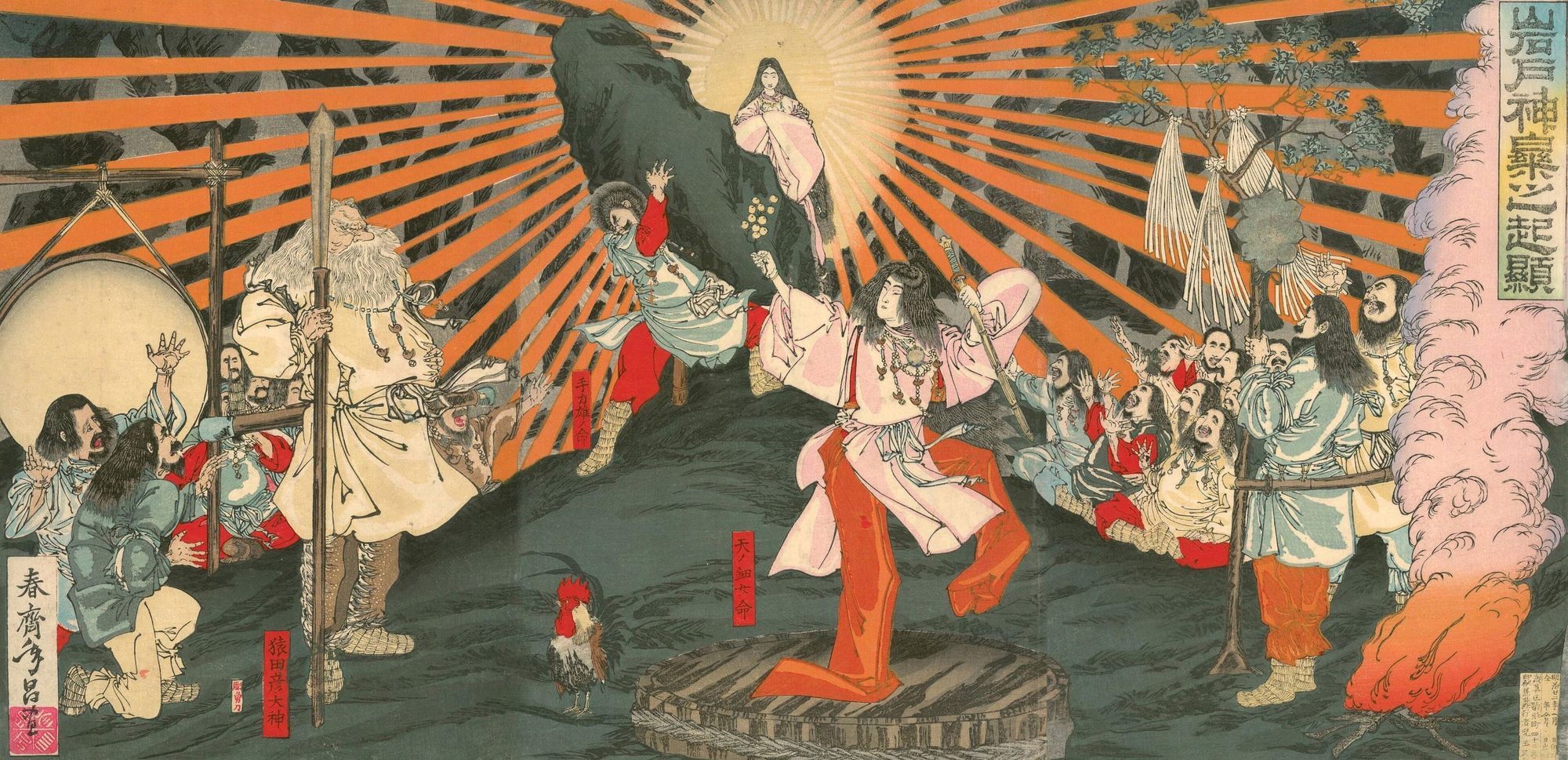
As she sat weaving the garments of the gods in her sacred hall, he flayed a piebald colt of Heaven with a backward flaying, broke a hole in the roof, and dropped the ruined animal through it. The startled weaving-woman struck herself with her shuttle and died. Terrified at last, Amaterasu fled into the Heavenly Rock-Cave and pulled the stone door shut behind her, and with the sun sealed inside the rock, eternal night fell over the world.
What follows is properly her episode. The eight hundred myriad gods gather in the river-bed, a mirror is forged, and the goddess Ame-no-Uzume dances the sun back into the light. But the darkness was Susanoo’s doing, and this remains the single most consequential act of his career: the storm-child very nearly extinguished the world’s light. When order was restored, the gods turned on him. They fined him a thousand tables’ worth of goods, cut off his beard, pulled out his finger- and toe-nails, and expelled him a second time, cast out now from Heaven as he had been from earth.
The serpent at the head of the river
The turn comes suddenly, in Izumo. Descending to the head-waters of the River Hi, at a place called Tori-kami, Susanoo saw a chopstick float down the current and knew there were people upstream. He climbed to find an old man and an old woman weeping over a young girl. They were earthly deities, Ashinazuchi and Tenazuchi, the Foot-Stroking and Hand-Stroking Elders, and their daughter was Kushinada-hime. They had once had eight daughters, they told him, but every year a monster came and devoured one, and now it was this last girl’s turn.
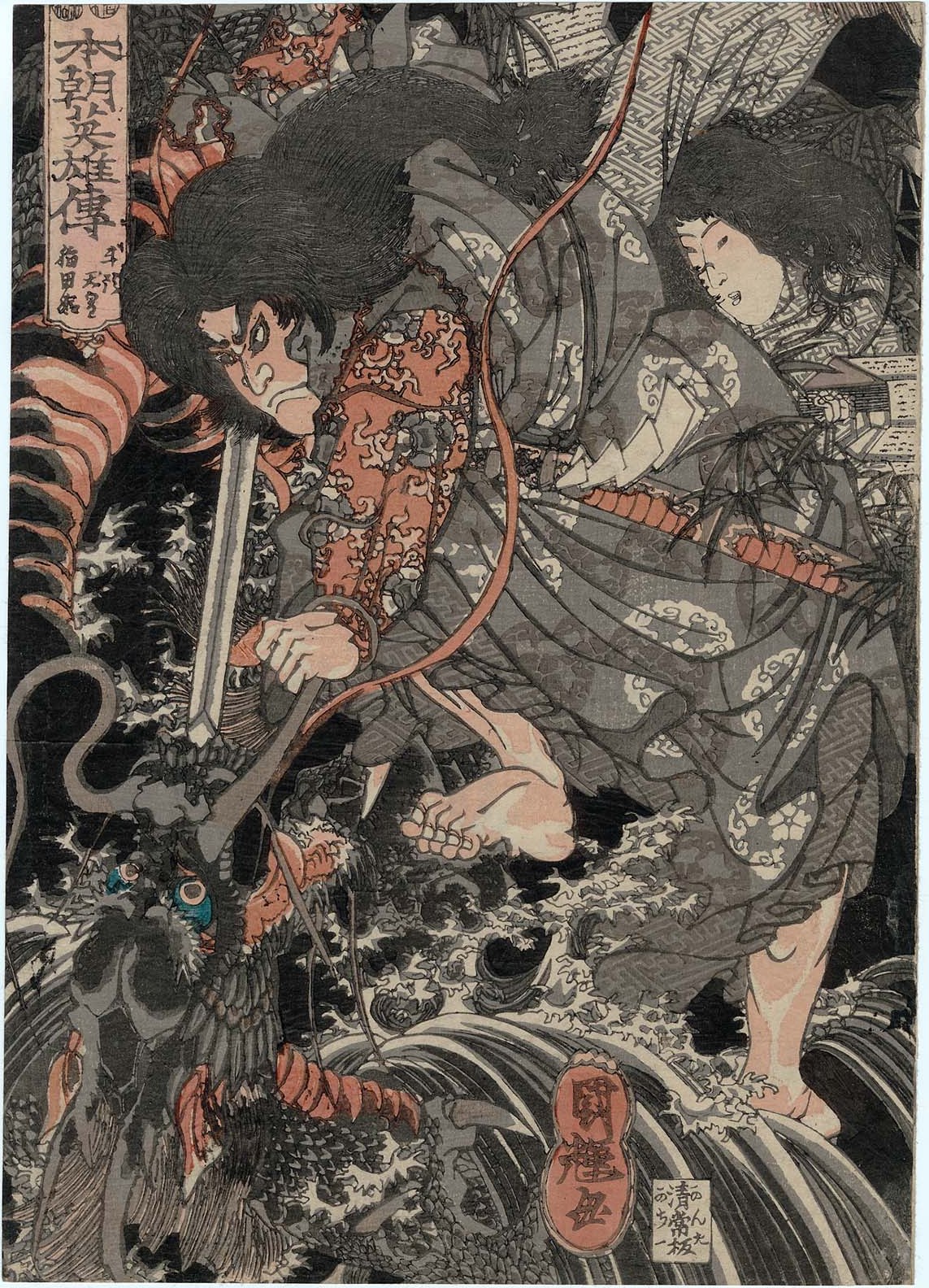
The monster was Yamata-no-Orochi, the eight-forked serpent. Its eyes were red as the winter-cherry; it had one body with eight heads and eight tails; moss and cypress and cryptomeria grew along its back; and its length spanned eight valleys and eight hills, its belly everywhere raw and bloody. Susanoo answered it with cunning. He turned the girl into a close-toothed comb and stuck her in his hair, then had the old couple brew sake refined eight times over, raise a fence with eight gates, and set out eight platforms, each bearing a vat of the liquor.
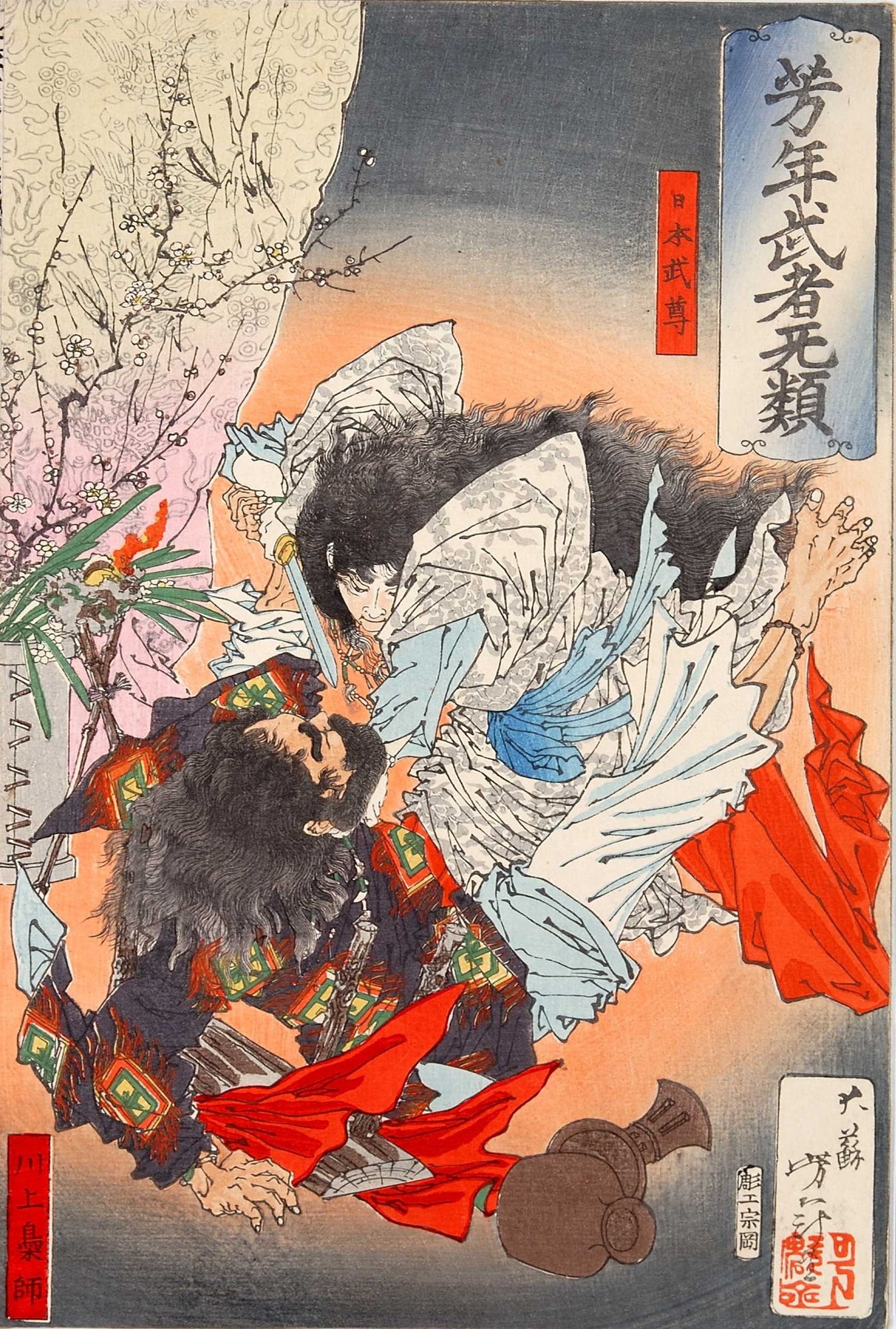
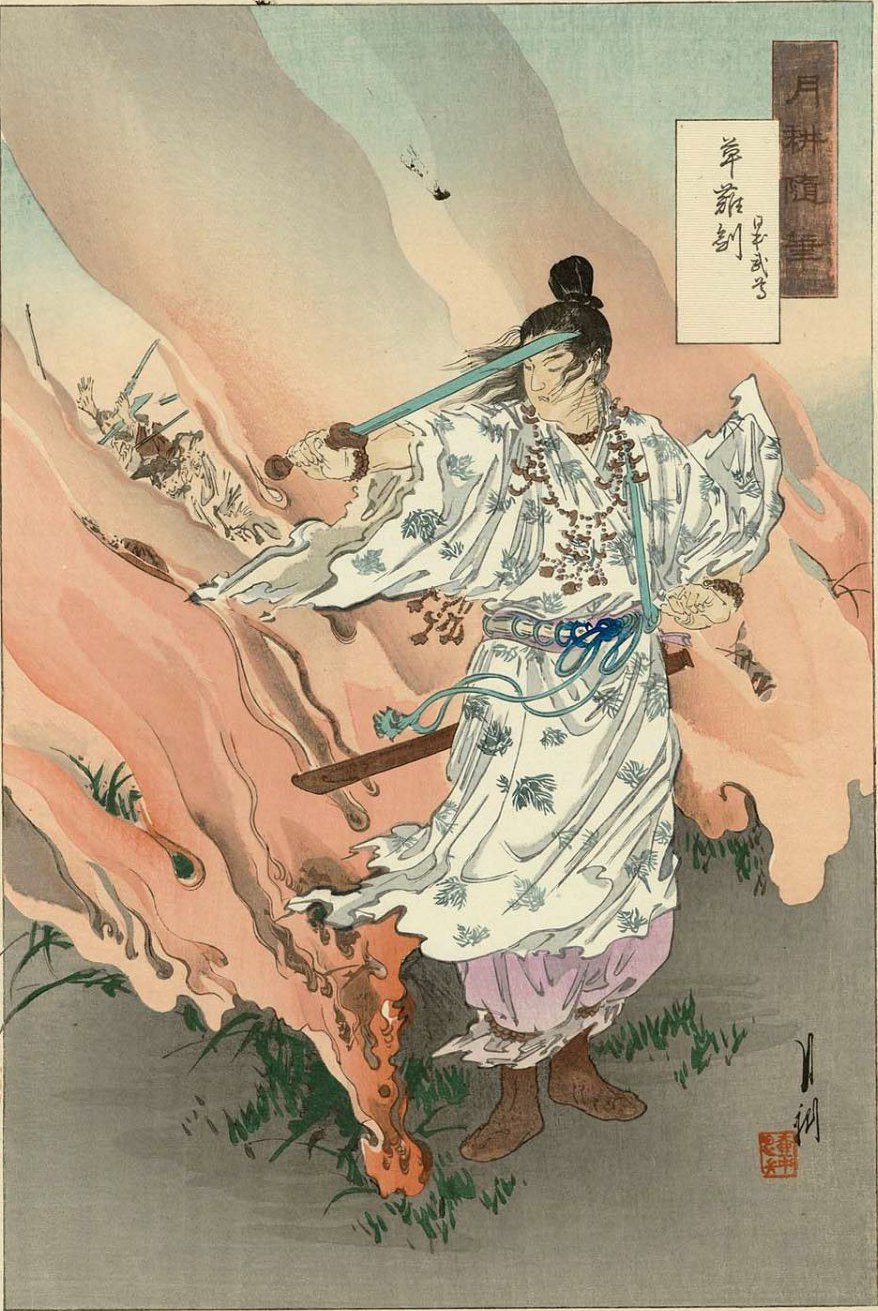
The serpent came, plunged one head into each vat, drank, and fell dead asleep. Susanoo drew his ten-grasp sabre and hacked it apart, until the River Hi ran red as a river of blood. Cutting through the middle tail his blade chipped; splitting the flesh to see why, he found a great sword hidden inside the serpent’s body. This was Kusanagi, the Herb-Quelling Sword, and he sent it up to Amaterasu as a gift. In the Nihon Shoki the blade begins life under another name, the Sword of the Gathering Clouds of Heaven, and is called Kusanagi only generations later, in the time of Prince Yamato-take.
A many-clouded fence of Izumo
With the serpent dead and the girl restored, the exile at last found a home. Searching Izumo for a place to build his palace, Susanoo came to Suga and said, here my heart is refreshed, and the place has borne that name ever since. Clouds rose thick above the ground where he settled, and he answered them with a verse remembered as the first of all Japanese poems, a many-clouded fence of Izumo raised to enclose his wife. He wedded Kushinada-hime and began a line that the Kojiki traces, six generations on, down to Okuninushi, the great god who would come to rule the land of Izumo.
The chronicles do not soften his story into a hero’s. He is a weeping, polluting outcast for the whole first half of it, expelled by his father and then by the gods, before he ever meets the serpent. Both halves are true at once, and the sources keep them side by side: the god who fouled his sister’s harvest and drove the sun into a cave is the same one who saved a girl from the monster and sang the first poem over the clouds of his new home.
Eight clouds arise. The eight-fold fence of Idzumo makes an eight-fold fence for the spouses to retire [within]. Oh! that eight-fold fence. (Kojiki, trans. Chamberlain, Sec. 20)
- Kojiki (Records of Ancient Matters, 712 CE), compiled by O no Yasumaro, trans. **Basil Hall Chamberlain, *The KojikiRecords of Ancient Matters* (1882)**: the read-verbatim source for this piece. Susanoo’s birth from the washing of Izanagi’s nose and the division of the three realms (Sec. 10–11); the weeping that withered the mountains and dried the seas, and the first divine expulsion by Izanagi (Sec. 12); the earth-quaking ascent to Heaven, Amaterasu’s arming, and the ukehi oath-contest that produces the three Munakata goddesses and the five gods (Sec. 13–15); the rampage in Heaven, the back-flayed piebald horse dropped through the weaving-hall roof, and the rock-cave darkness Susanoo triggers (Sec. 15–17); the thousand-table fine, the plucked nails, and the second expulsion (Sec. 17); the killing of the food-goddess O-getsu-hime and the birth of the five grains from her corpse (Sec. 17); the descent to the River Hi at Tori-kami, the elders Ashinazuchi and Tenazuchi, Kushinada-hime, the eight-vat trap, and the slaying of Yamata-no-Orochi with the finding of Kusanagi inside the middle tail (Sec. 18–19); and the palace at Suga, the cloud-fence verse, and the Izumo genealogy down to Okuninushi (Sec. 20–22). Read via Wikisource proofread pages, Page:Kojiki by Chamberlain.djvu/125–157.
- Nihon Shoki (Nihongi, Chronicles of Japan, 720 CE), trans. **W. G. Aston, *NihongiChronicles of Japan from the Earliest Times to A.D. 697*, Vol. I,
The Age of the Gods, Book I
(London: Japan Society, 1896)**: the parallel chronicle, read verbatim for the divergences honoured above. Susanoo as the child of both Izanagi and Izanami rather than nose-born of one parent (p. 10); the two rival etymologies of his name, the susamuimpetuous male
reading and Aston’s preferred derivation of Susa as a place-name from the Izumo Fudoki (p. 10, and note); the expulsion to the Nether Land (p. 20); the food-goddess episode, in which the Nihon Shoki assigns the killing of Uke-mochi to the Moon-god Tsuki-yomi rather than to Susanoo, with Aston’s own note that the Kojiki gives the deed to Susanoo (pp. 33–34); the serpent-slaying, and the note that the sword’s original name was Ama-no-Murakumo, the Sword of the Gathering Clouds of Heaven, renamed Kusanagi only in the time of Prince Yamato-take (pp. 52–53); and the Suga verse (p. 53). archive.org idnihongi1asto.