
HomeArchiveThemesSkyAbout

Hindu Mythology

The devas and asuras, the great avatars, and the turning cycles of the cosmos — told from the Vedas, the epics, and the Puranas, with every claim kept honest to its source.

Gods & Figures

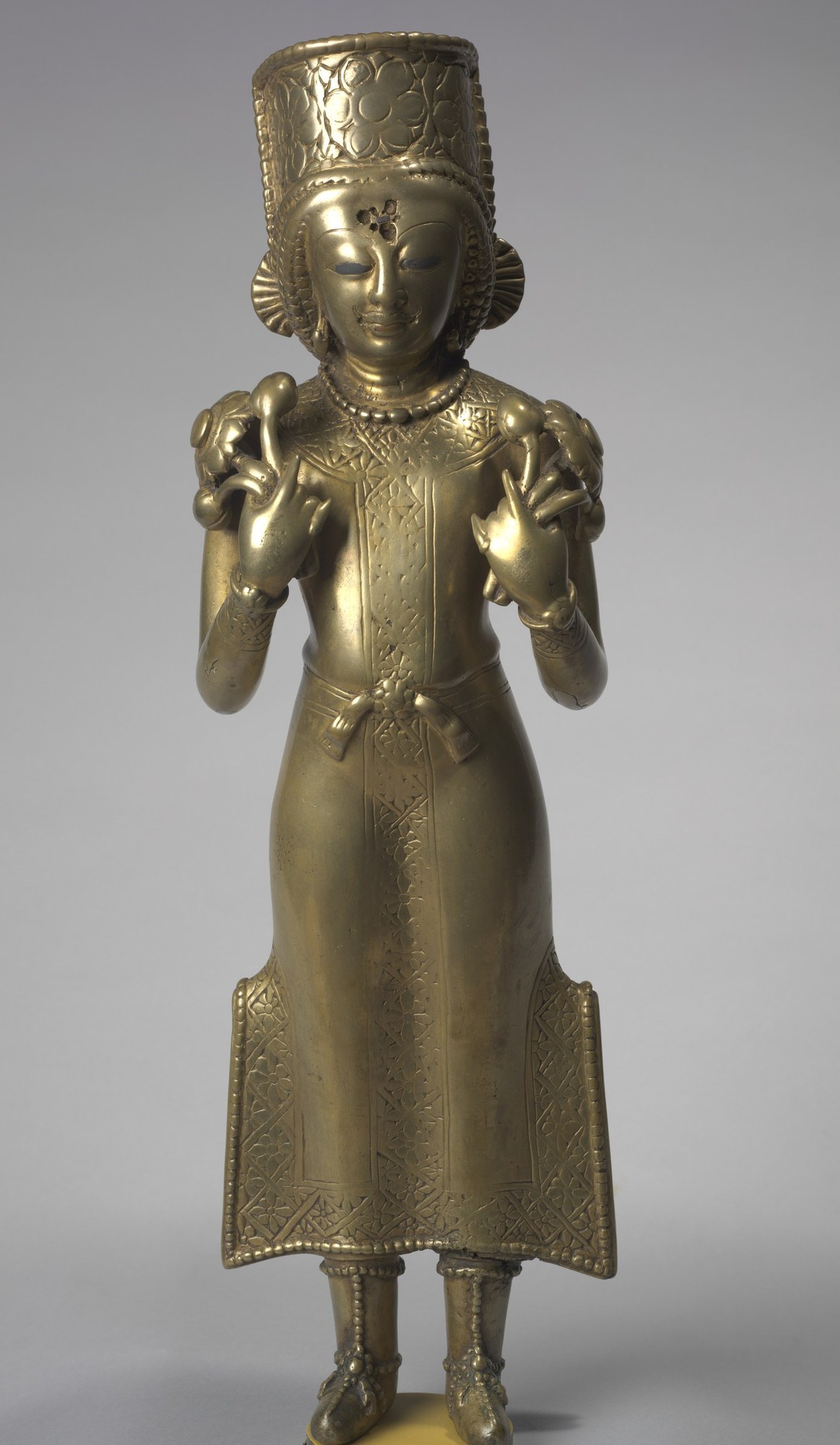
A brass sculpture of Surya, the Hindu sun-god, standing frontally in a tall floral-chased cylindrical crown, with silver-inlaid eyes and copper-inlaid lips, an incised long belted tunic and boots; both raised hands hold lotus stalks at his shoulders.
Hindu

Surya, the Sun God

Borne aloft by his own beams, the visible sun is the eye of three gods and the soul of everything that moves: an all-seer in the oldest hymns, and, a millennium and a half later, a chariot that is the machine of time itself.
6 minRigveda 1.50
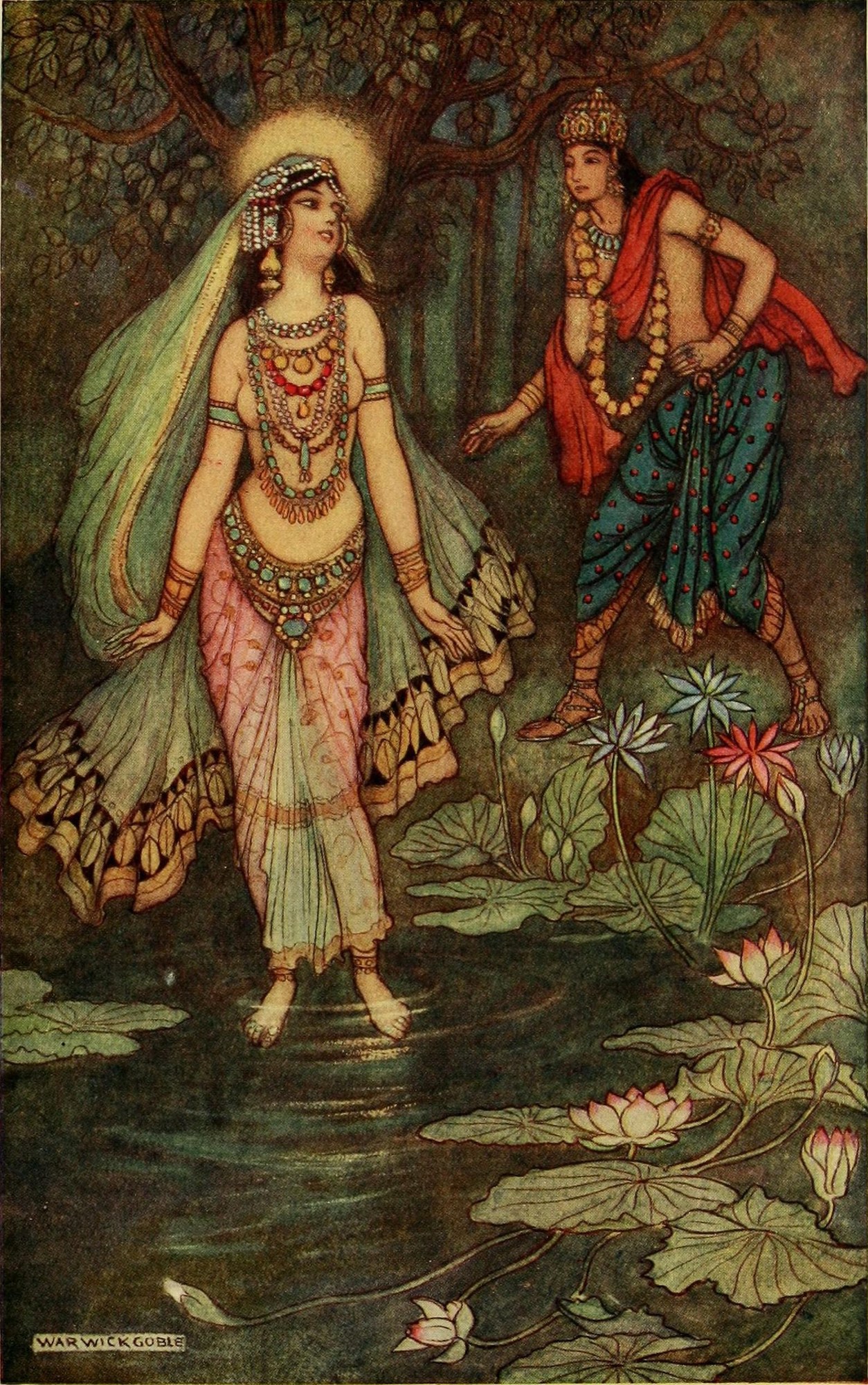
Warwick Goble colour plate: the haloed river-goddess Gaṅgā, jewelled and veiled, stands barefoot on the surface of a lotus-strewn stream as the crowned King Śantanu steps toward her from the wooded bank, one hand extended.
Hindu

Ganga, the Celestial River Goddess

A river that is a goddess and a goddess who is a river: she rises from the foot of a god, washes the moon in passing, and drowns seven of her own newborn sons with a smile.
6 minVyāsa
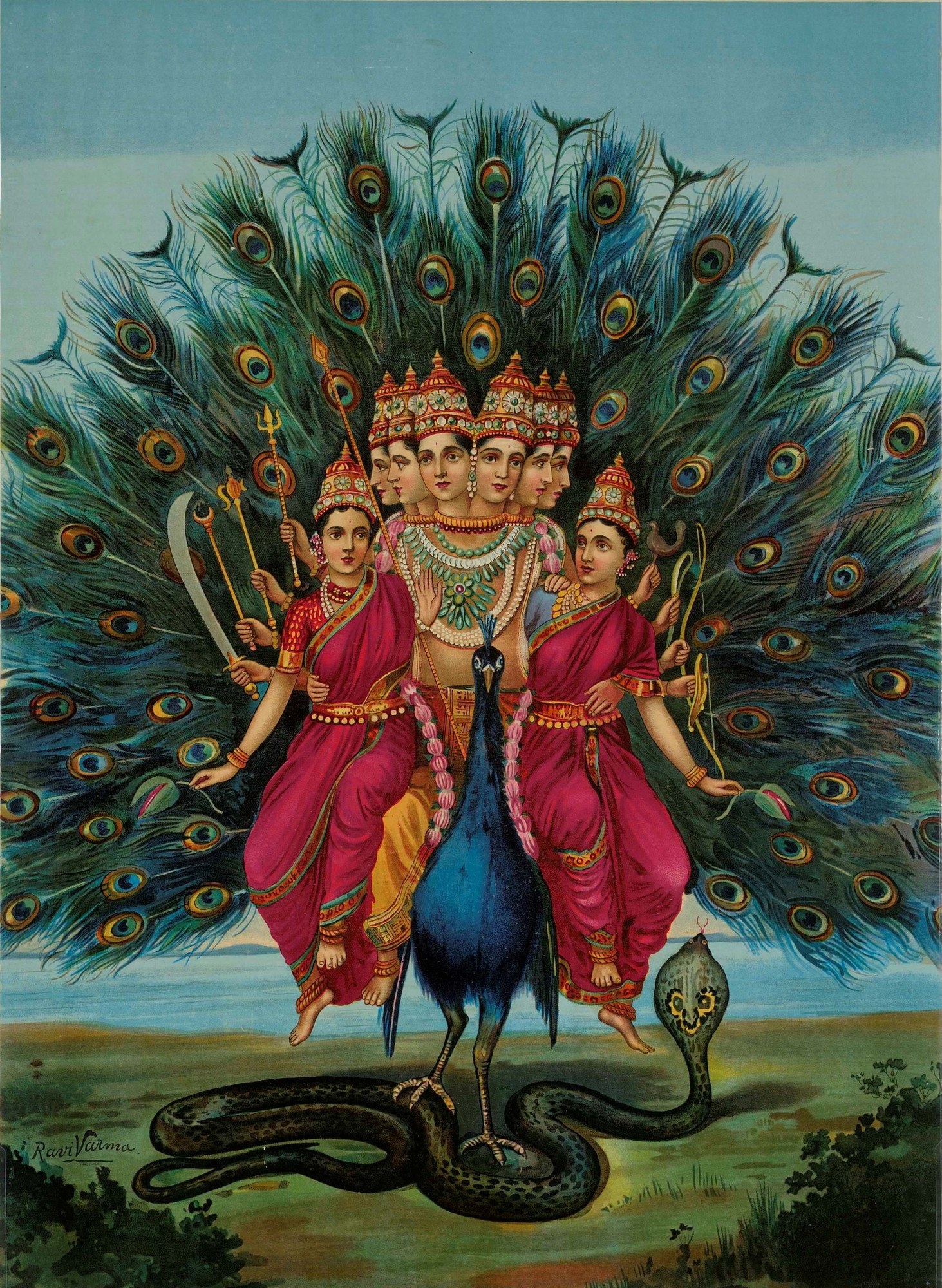
The six-faced (Ṣaṇmukha) war-god Kartikeya stands on his peacock mount, its tail fanned behind him, a spear (vel) and other weapons in his many hands, flanked by his two consorts in red saris, the peacock treading a coiled cobra on the ground below.
Hindu

Kartikeya (Skanda), God of War

Kartikeya, the six-faced commander of the divine army, has three fathers, two slain demons, and two explanations for his six faces. Two scriptures a thousand years apart preserve him differently, and the epic's own hymn concedes it.
7 minMahābhārata
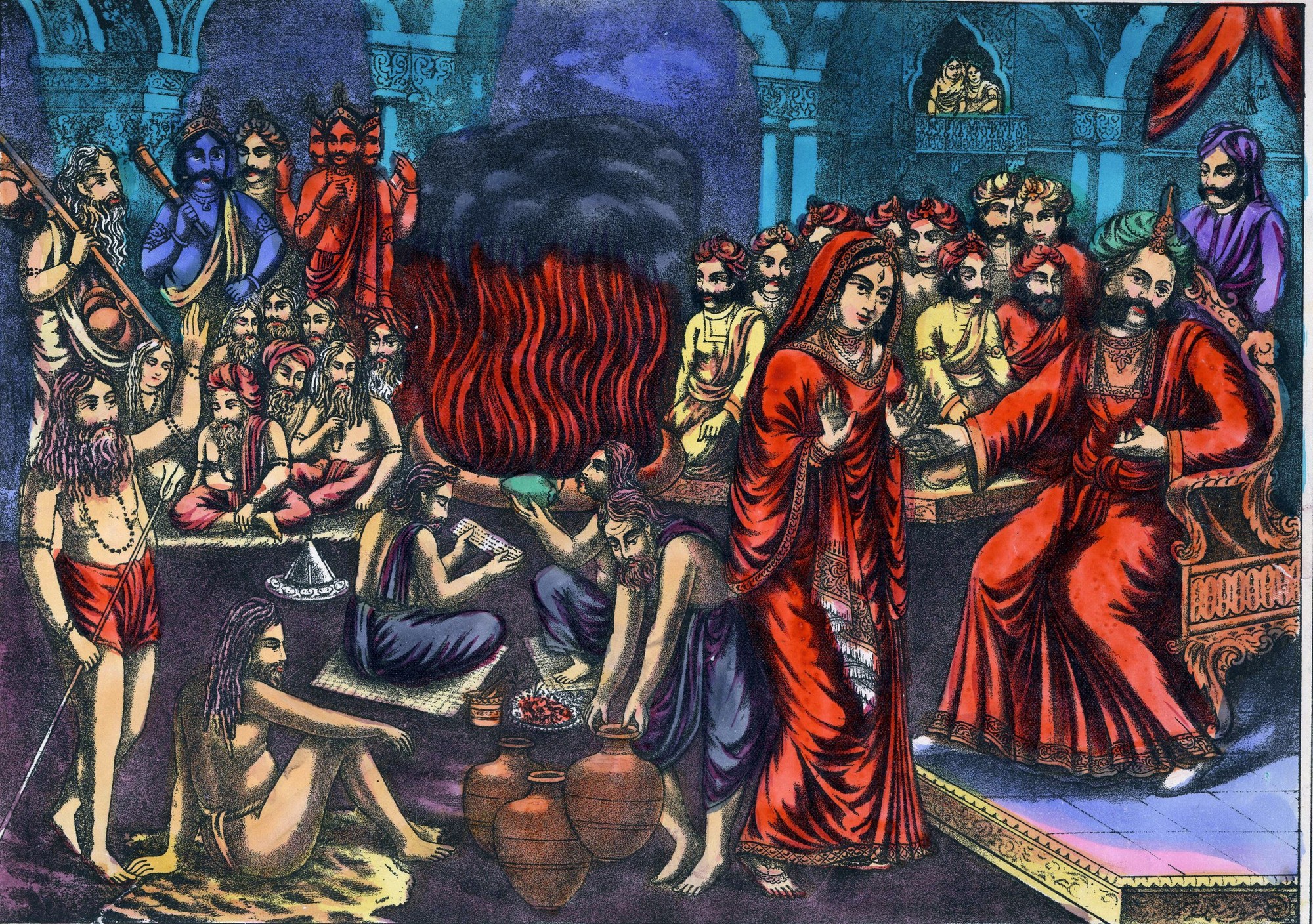
Satī, in a flowing red sari with her palm raised in rebuke, stands facing her enthroned father Dakṣa across the blazing sacrificial fire; brahmins read scriptures and pass ritual vessels, clay pots stand in the foreground, and the assembled gods — blue-skinned Viṣṇu and four-headed Brahmā among them — look on from the left.
Hindu

Sati, Shiva's First Consort

The good wife whose name became English for a rite she never performed: not a widow on a pyre, but a goddess who chose her own father, then unchose the body he gave her.
8 minBhāgavata Purāṇa
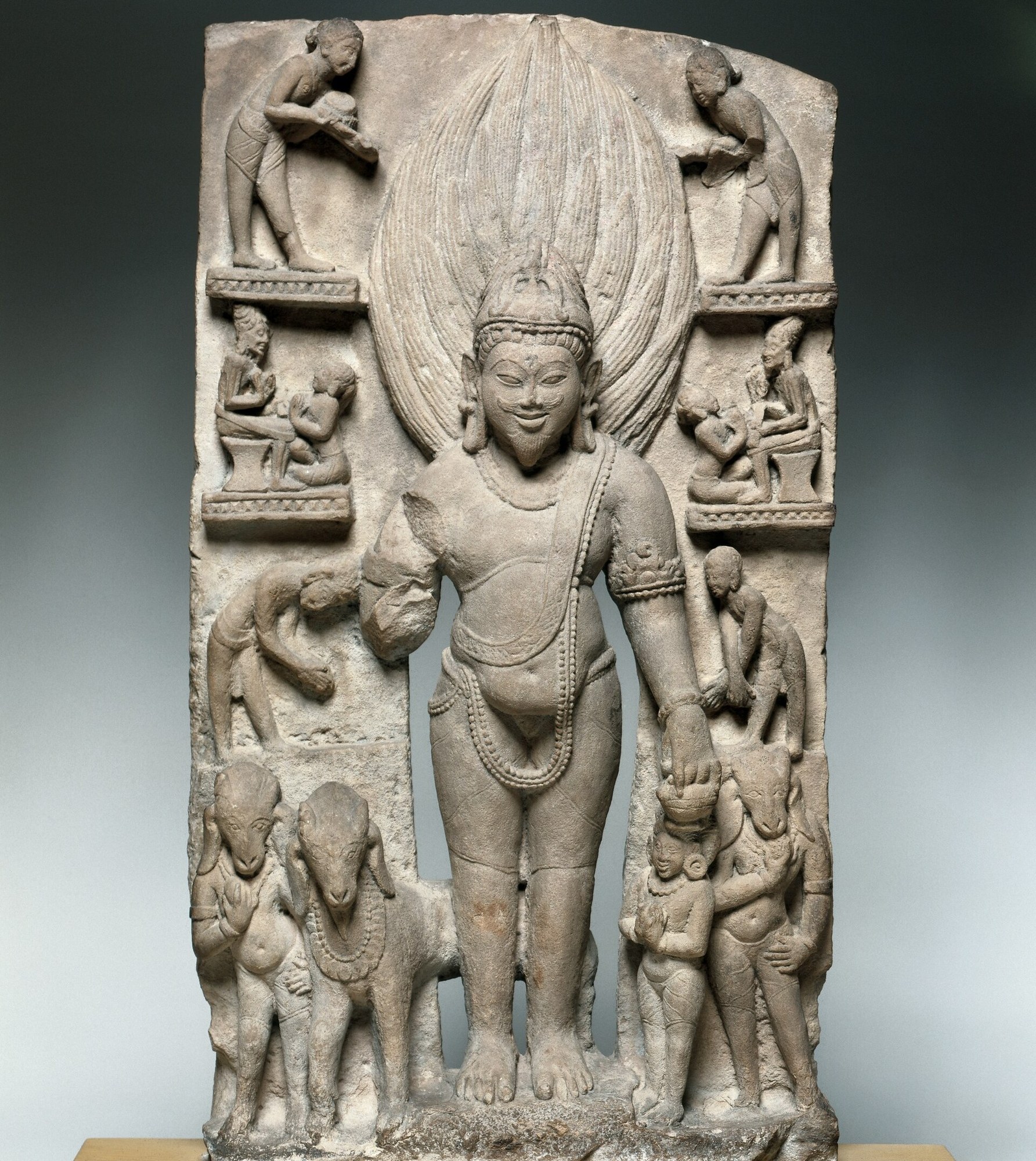
A carved sandstone stele of Agni, the Hindu fire-god: a bearded, mitre-crowned figure standing frontally against a great rising mane of flame, the sacred thread across his chest, a ram at his side and worshippers bringing offerings around his feet.
Hindu

Agni, the God of Fire

The deified sacrificial fire of the daily rite, whom the whole Rig Veda begins by naming, carries the offering to heaven with his own mouth, so that the gods eat through him.
6 minRigveda 1.1
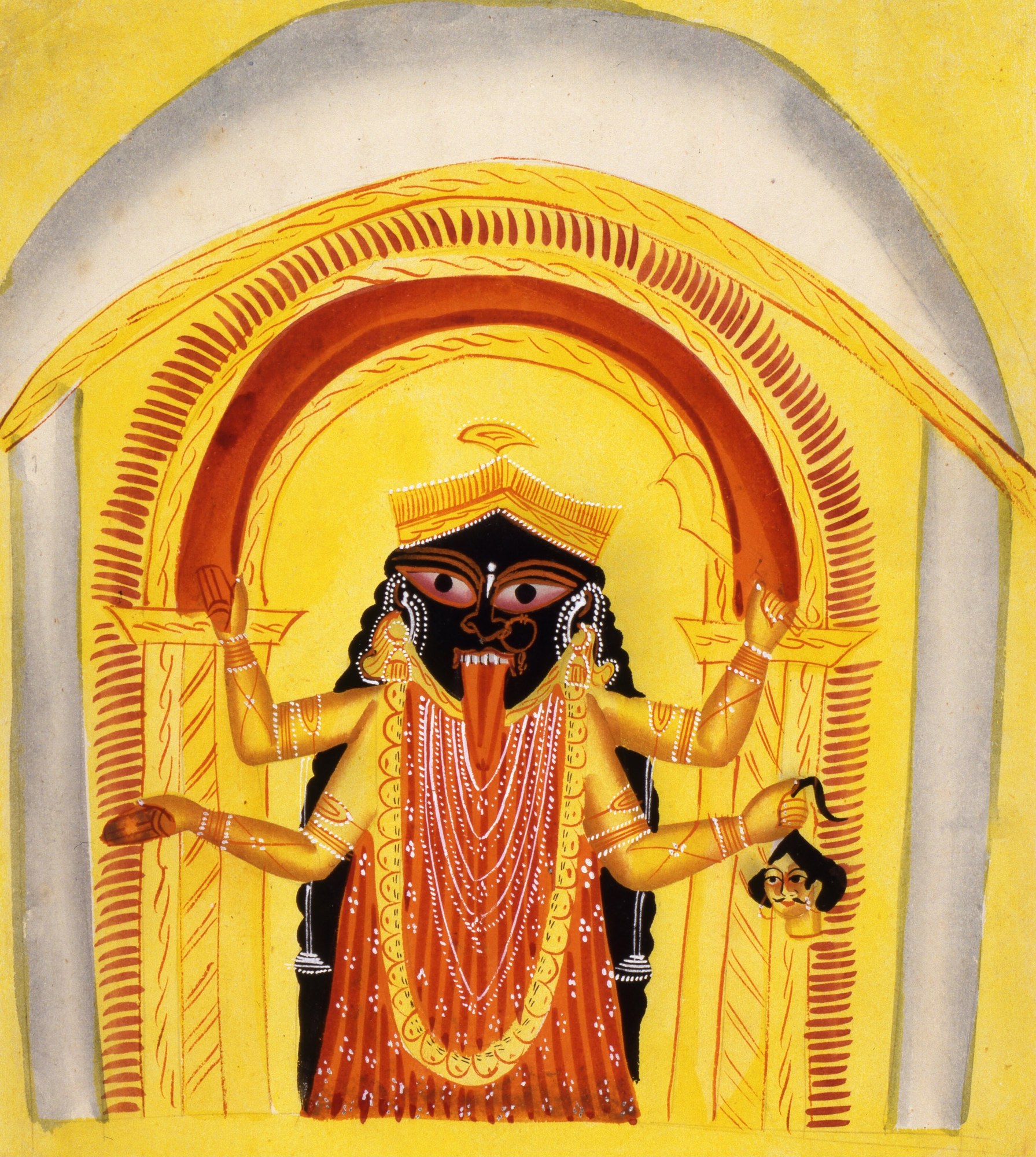
A Kalighat painting of the goddess Kali enshrined beneath a temple arch: black-skinned and four-armed, her long red tongue thrust out over a garland of pearls, a curved sword raised in one right hand and a freshly severed human head hanging from one left hand, on a warm yellow ground.
Hindu

Kali, the Dark Devourer of Time

The title calls her the eater of time, but the oldest text that names her means only one thing by the word: black. Everything else, the tongue, the corpse underfoot, the eating of the hours, was laid over a battlefield goddess across a thousand years.
6 minDevi Mahatmya
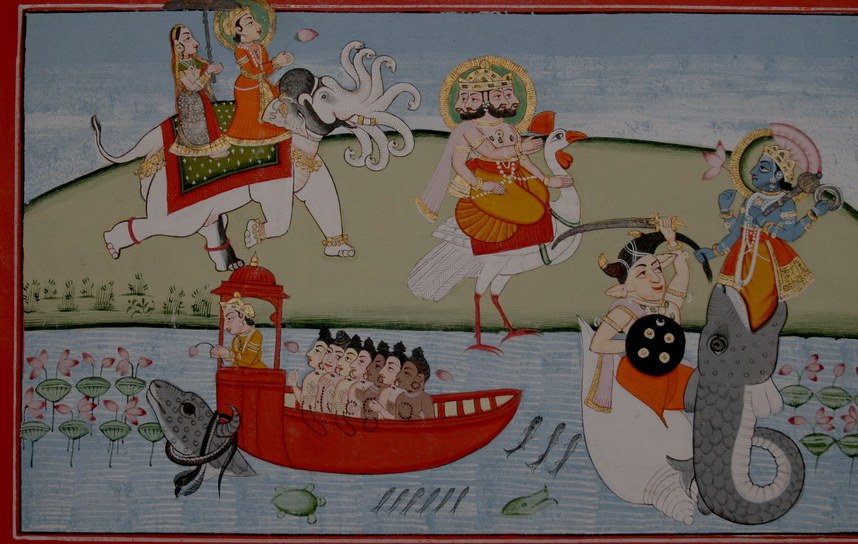
A Mewar miniature of the flood rescue: the crowned Manu stands at the prow of a red ark carrying the seven huddled sages, the boat towed across lotus-strewn water by the great fish Matsya (Viṣṇu's fish-avatar) with the serpent Vāsuki as the rope, while Brahmā on his goose and Indra on the white elephant look on.
Hindu

Manu, Progenitor and Lawgiver

One figure carries three jobs that the texts assembled across seventeen centuries: the first man, the flood-survivor who alone repeopled the earth, and the lawgiver whose name a whole code still bears.
6 minŚatapatha Brāhmaṇa I.8.1.1–11
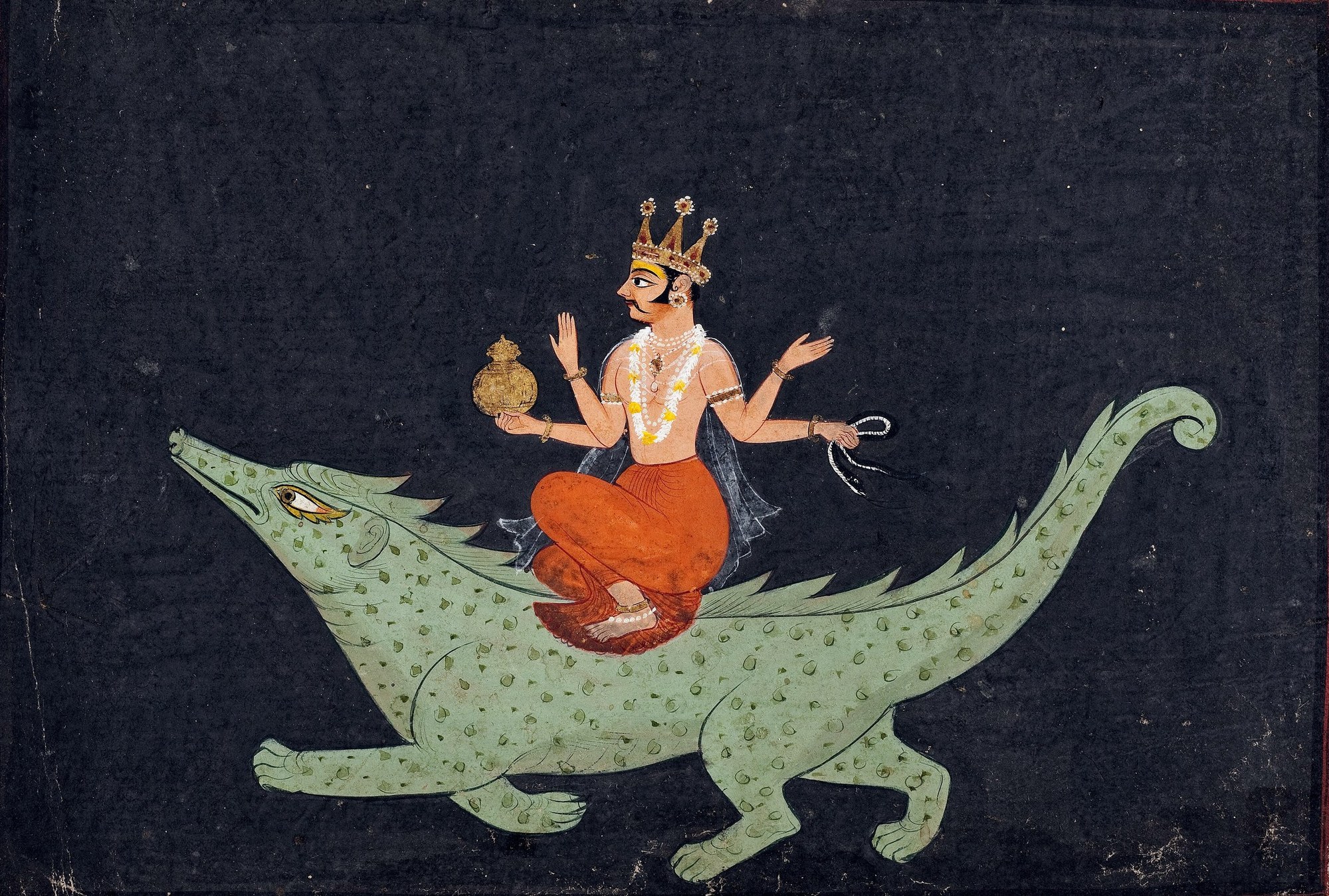
A crowned, four-armed Varuna rides a great pale-green makara (crocodile) across a black ground: he holds a golden pot in one lower hand and a black-and-white noose (the pāśa) in the other, one hand raised, in an orange dhoti, pearl garlands and a jewelled crown. An Indian miniature painting.
Hindu

Varuna, Guardian of Rita

The all-seeing sovereign of the earliest Veda counts every human blink and knows the third party to every whispered conversation. He binds the liar with a shining noose and swells his belly like a hoopless jar, then, to the penitent, loosens the same cord as a herdsman frees a calf.
6 minṚgveda 1.24
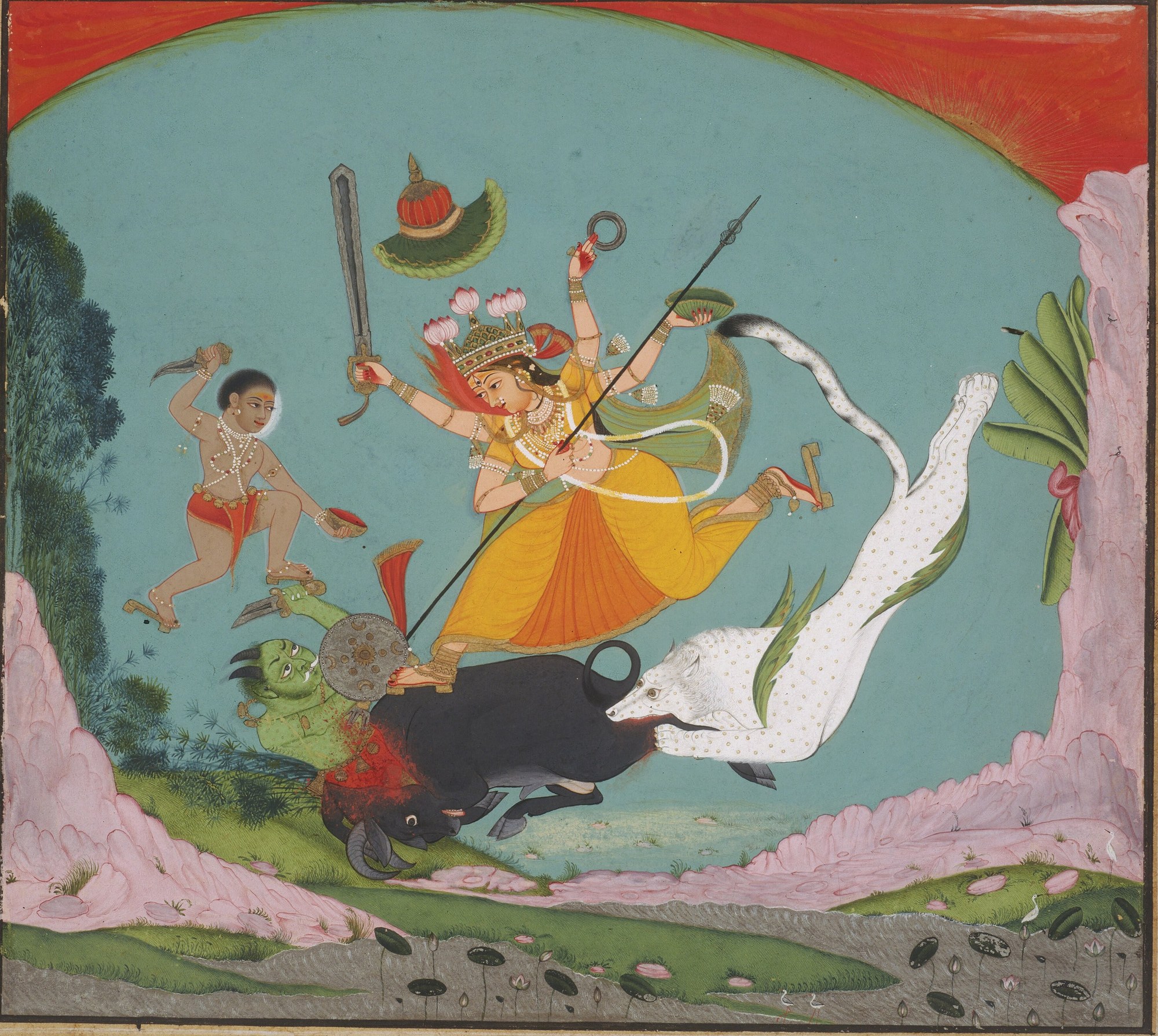
Durga as slayer of the buffalo demon (Mahishasuramardini): the many-armed golden-robed goddess, lotus-crowned, rides her leaping white lion and drives her long spear down into the neck of the buffalo demon Mahishasura, whose green human form rears up out of the falling black buffalo; a second sword-wielding demon springs in at the left beneath a red sun-arc and pink rocks.
Hindu

Durga, Slayer of the Buffalo Demon

The name the world knows her by is the last word of her own scripture, a hymn-epithet fastened to the warrior-goddess only after the killing is done, then grown over the centuries into everything she is.
6 minDevi Mahatmya
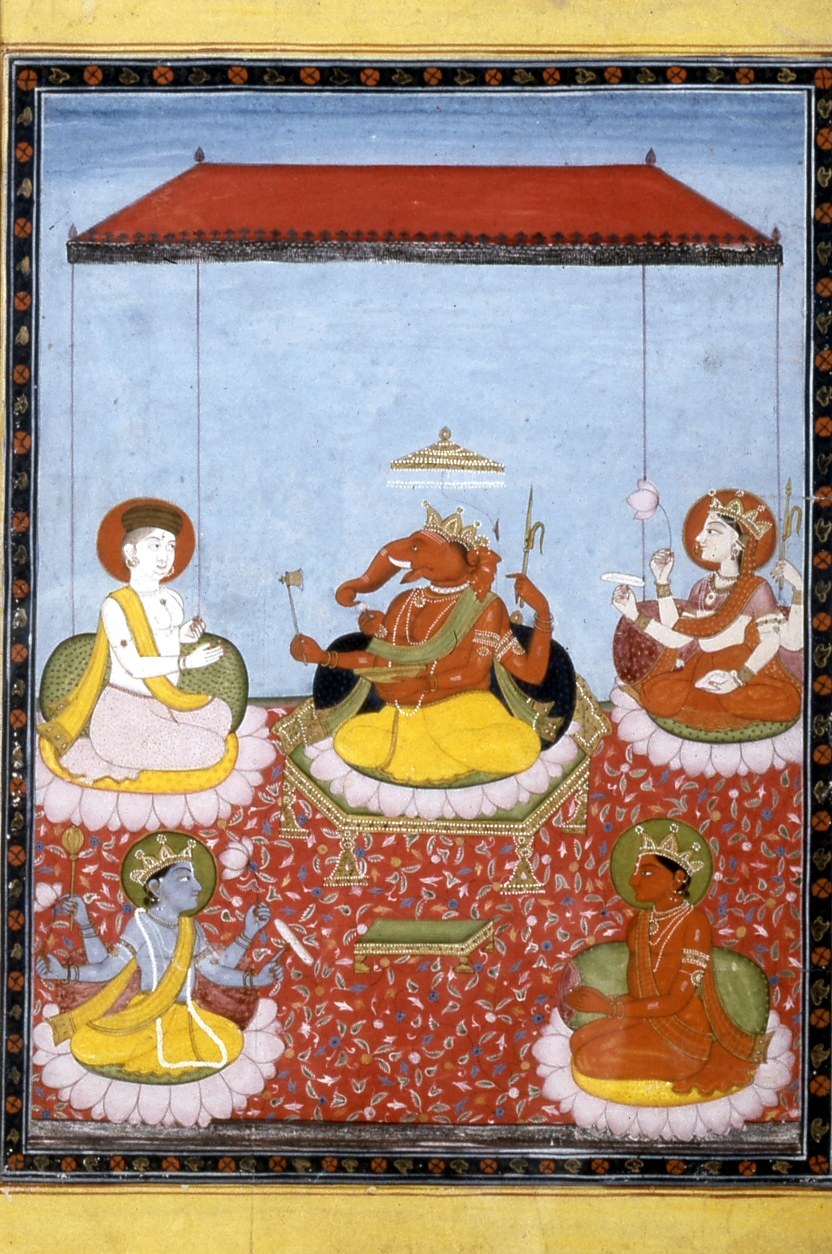
North Indian miniature of the elephant-headed god Ganesha enthroned as a ruler under a red canopy and gold parasol, four-armed and crowned, seated on a lotus over a red flowered carpet; his father Shiva at upper left, his mother Parvati at upper right, Vishnu at lower left and a devotee at lower right, each on a lotus.
Hindu

Ganesha, Remover of Obstacles

Parvati moulded a boy from the dirt of her own body. A god who did not know his son beheaded him, and he rose again with an elephant's head. The gods gave him a single, world-ordering honour: he is worshipped first, or the other gods are not worshipped at all.
6 minŚiva Purāṇa
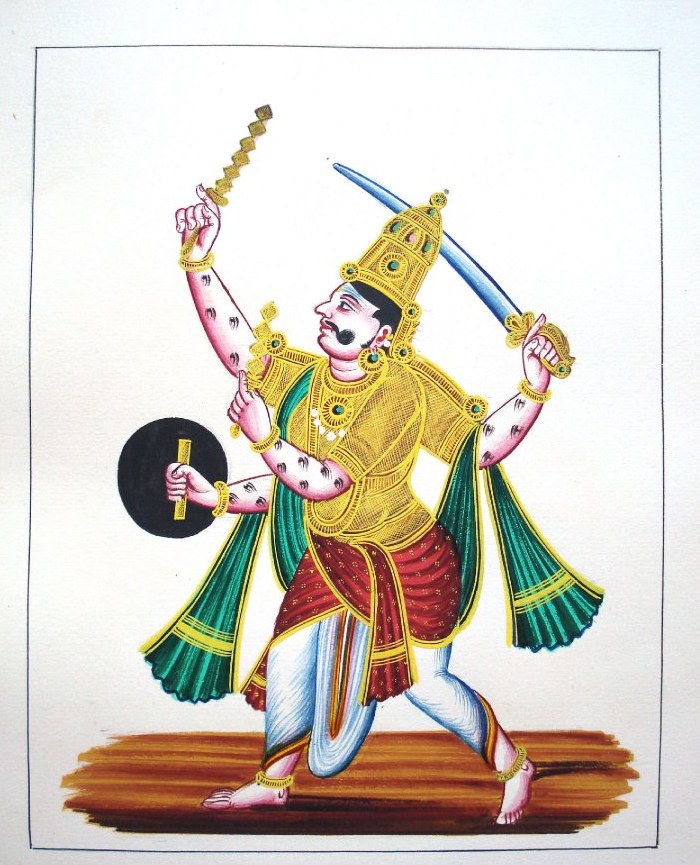
A four-armed, eye-marked Indra in a tall gold crown and golden tunic strides forward on a plain white ground, brandishing the golden zigzag vajra (thunderbolt) overhead in his upper right hand, a curved sword in his upper left, a black shield in his lower left and a second smaller vajra in his lower right; a green mantle streams behind him.
Hindu

Indra, King of the Gods

The Vedic storm-king drank the Soma in three sacred beakers. He took up Tvashtar's thunderbolt and split the dragon Vritra, loosing the seven imprisoned rivers. It was the first and greatest deed of the god the Rig Veda crowns sovereign of all that moves and moves not.
6 minRig Veda 1.32
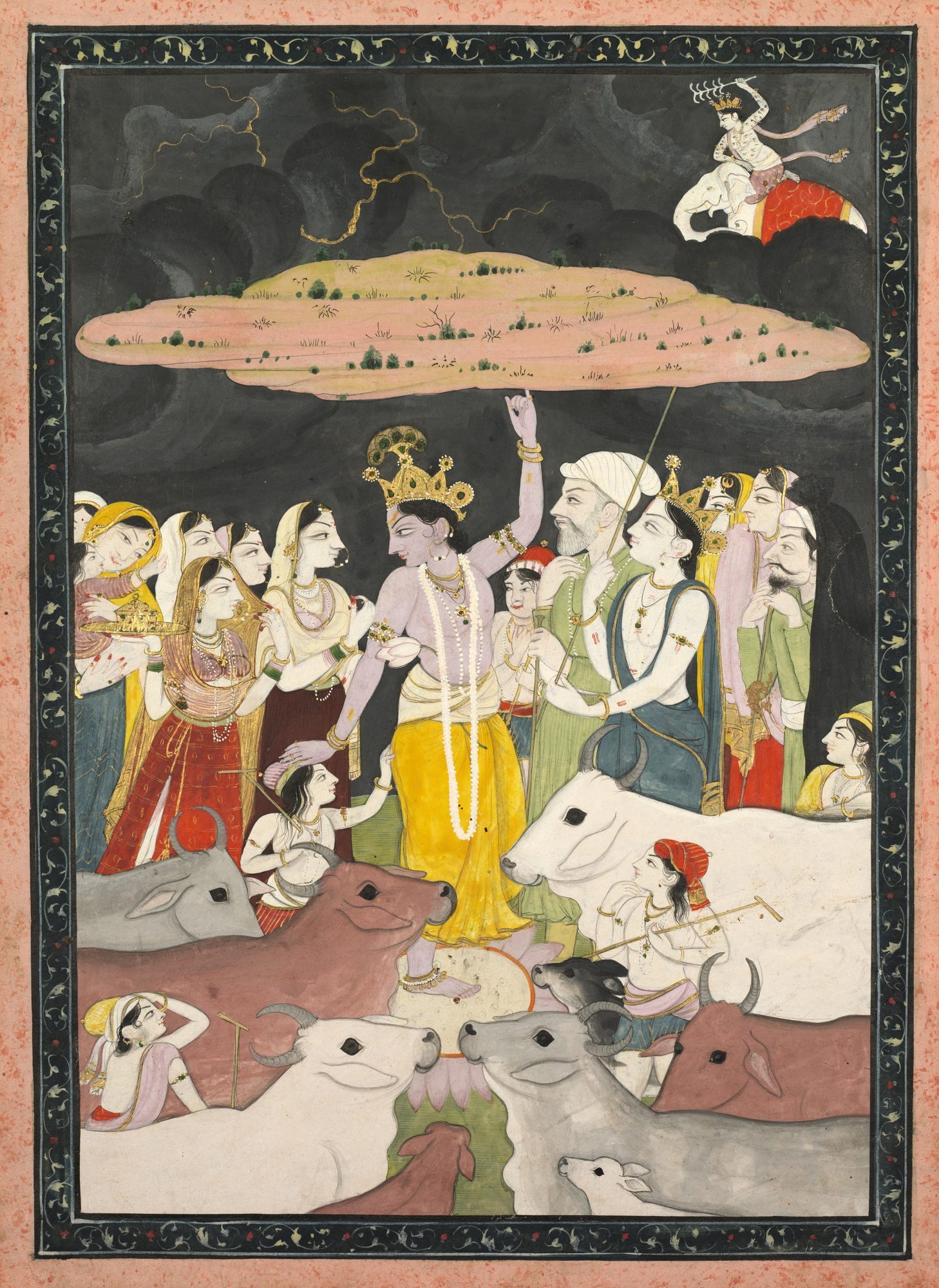
A Pahari miniature: the dark-complexioned, crowned Krishna in a yellow dhoti and long pearl garland stands amid gopīs, cowherds and cattle, his right arm raised to hold Mount Govardhana aloft as a floating green plateau against a black storm-sky; Indra rides his white elephant Airavata in the clouds at upper right.
Hindu

Krishna, the Divine Cowherd

The rain-cloud-dark child who stole butter and danced on a serpent's hoods, grew into the statesman whose peace embassy failed, and then, as a friend's charioteer on the edge of a doomed battlefield, spoke the song that became scripture.
6 minBhagavad Gītā 1.21–22
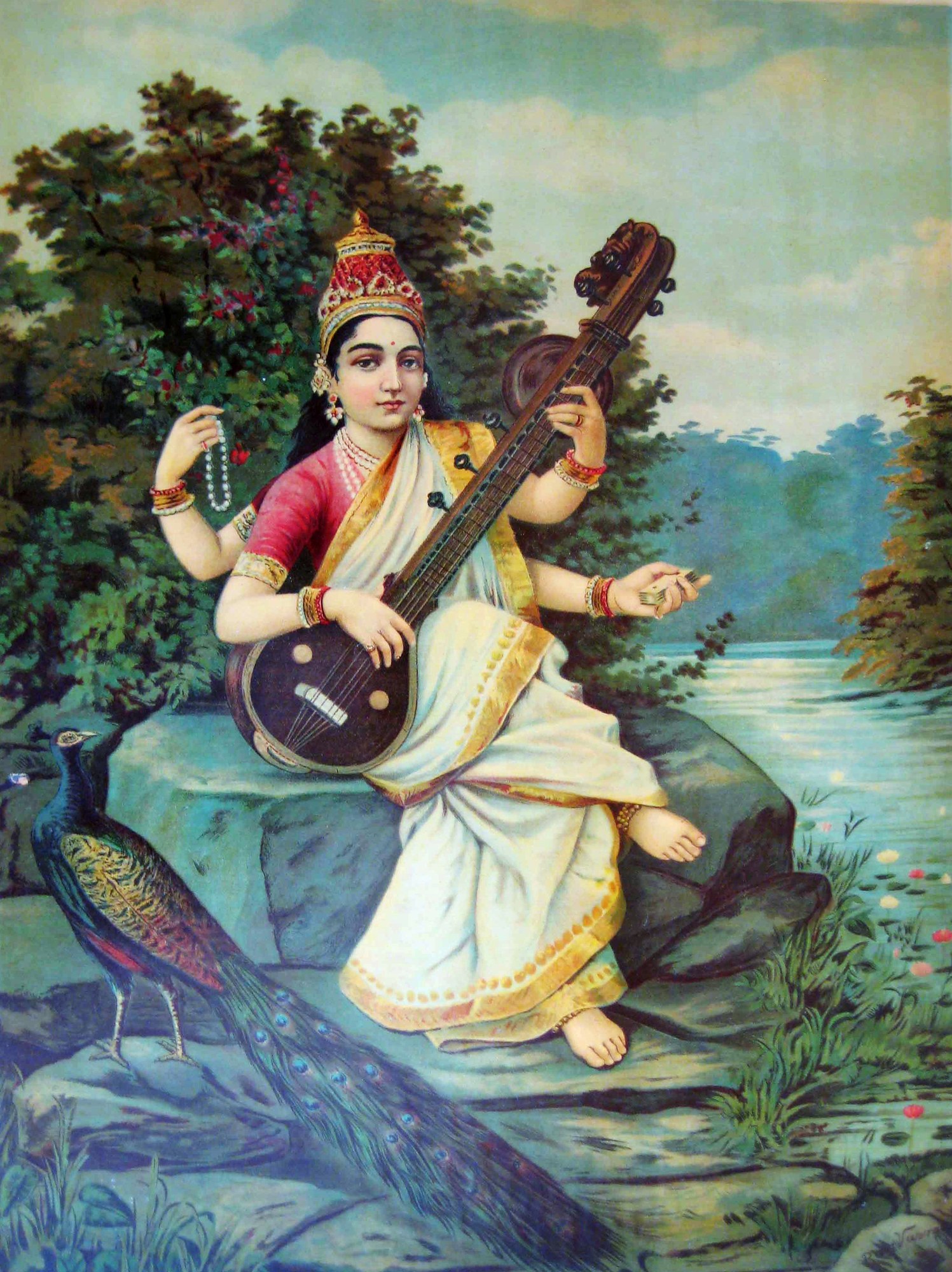
The goddess Sarasvatī seated on a rock beside a river, playing a large vīṇā, robed in a white and gold sari with a jewelled crown; a peacock stands at her feet, its tail trailing across the rocks.
Hindu

Saraswati, Goddess of Wisdom and Speech

Before she held the lute she was a flood that burst the hills: the story of how a Vedic river hardened, over two and a half thousand years, into the white-robed patroness of every author who ever found the right word.
6 minṚgveda 6.61
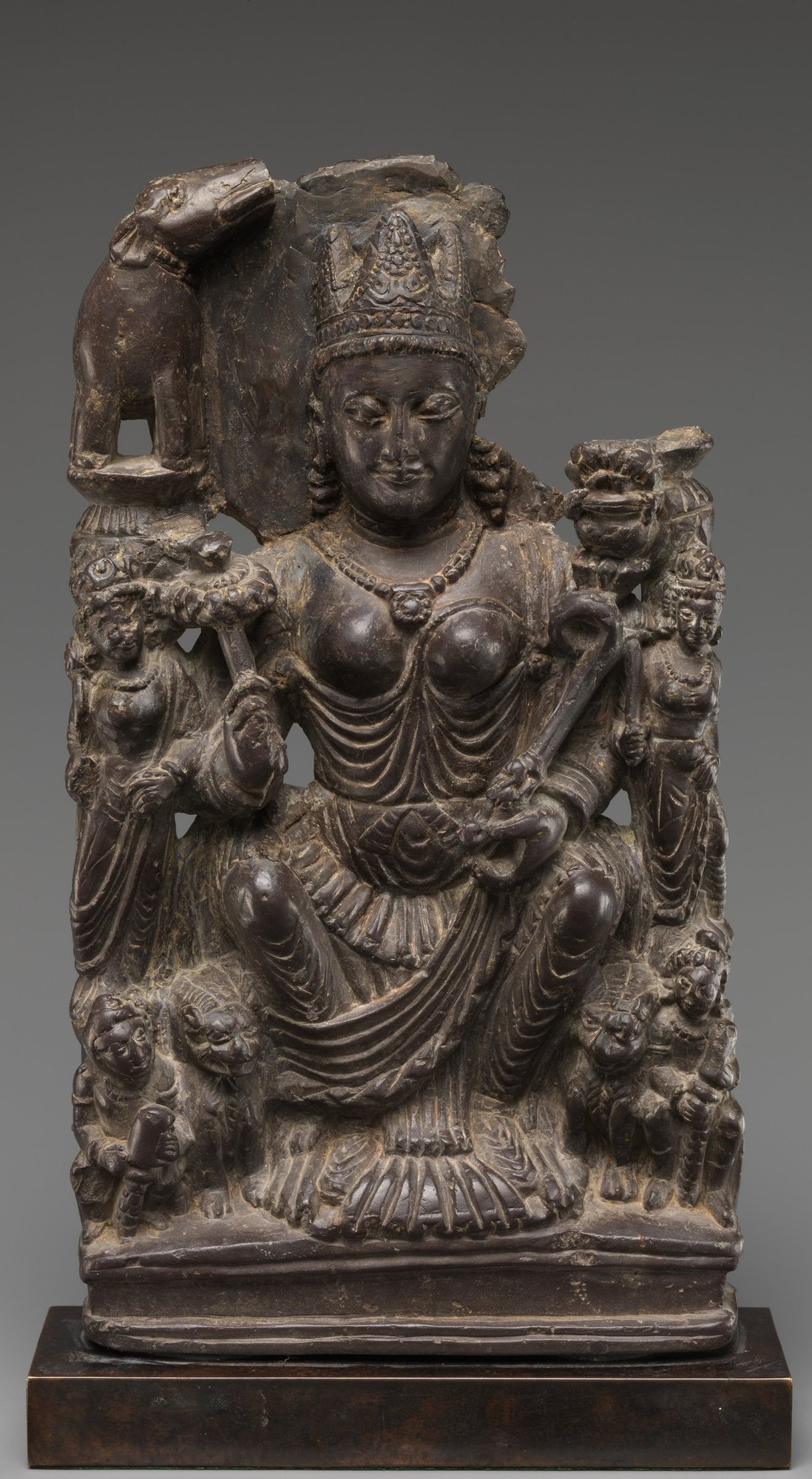
Gaja-Lakshmi: a crowned Lakshmi seated on a lotus in a carved stone relief, jewelled and lustrated by an elephant at her upper left, flanked by small attendant figures, mounted on a dark plinth.
Hindu

Lakshmi, Goddess of Fortune and Abundance

The imperishable bride of Vishnu and mother of the world, golden and lotus-seated: a goddess the oldest hymn summons through fire for cattle and gold, and the later scripture makes rise wet from the churned sea to choose her husband before the watching gods.
6 minSri Sukta
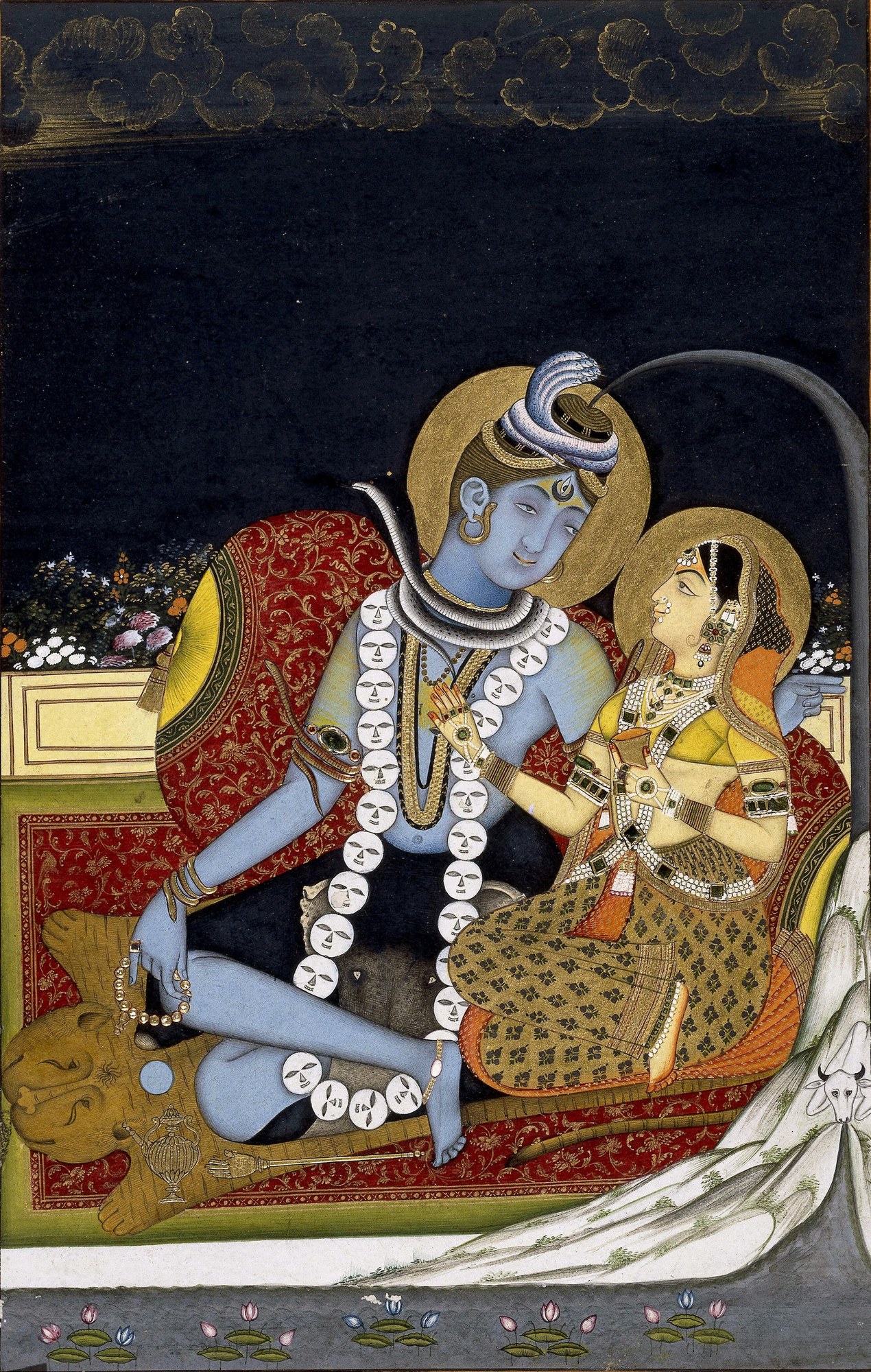
Pārvatī, richly jewelled and gold-veiled, sits close beside the ascetic Śiva on his tiger-skin: the blue god, garlanded with skulls, a cobra rising from his matted hair and the Ganges cascading from it, turns tenderly toward her, with the white bull Nandi below and lotus-strewn water in the foreground.
Hindu

Parvati, Daughter of the Mountain

Parvati did not win the ascetic god with her beauty: beauty had already failed, and the love-god had been burnt to ash for trying. She won him standing between four fires, having given up even the fallen leaf.
7 minKālidāsa
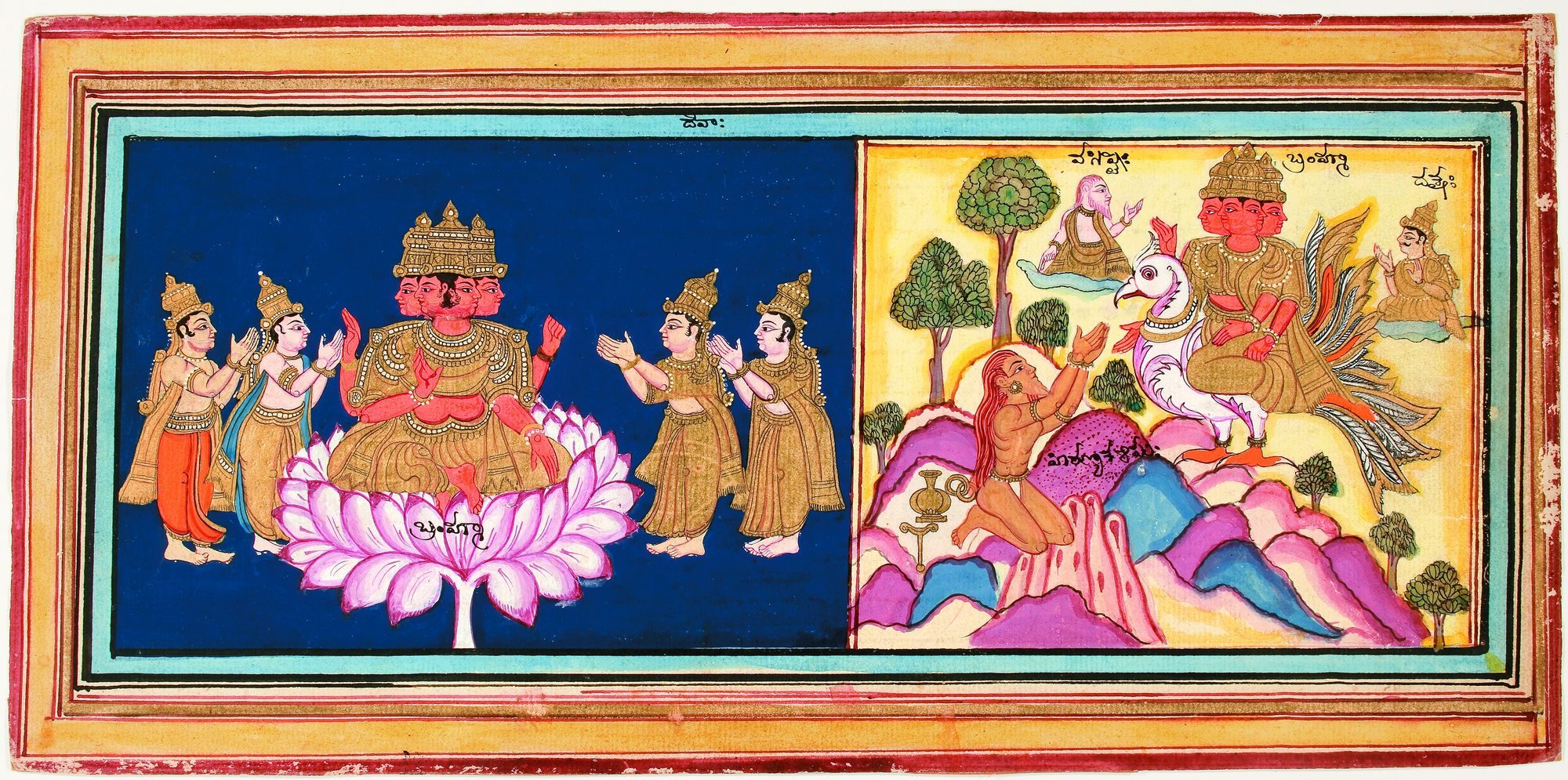
Mysore-school miniature of the four-faced creator Brahmā seated on a great pink lotus that rises on its stalk from a deep-blue ground; the red-skinned god wears a tiered gold crown and heavy gold jewellery and holds up multiple arms, flanked on either side by crowned attendant deities with hands joined in worship.
Hindu

Brahma, the Creator

The self-existent one cast his seed into the primeval waters and was born inside a golden egg bright as the sun. After a year he split it into heaven and earth. He is Brahma, the four-faced progenitor of worlds and creatures.
7 minṚgveda 10.121
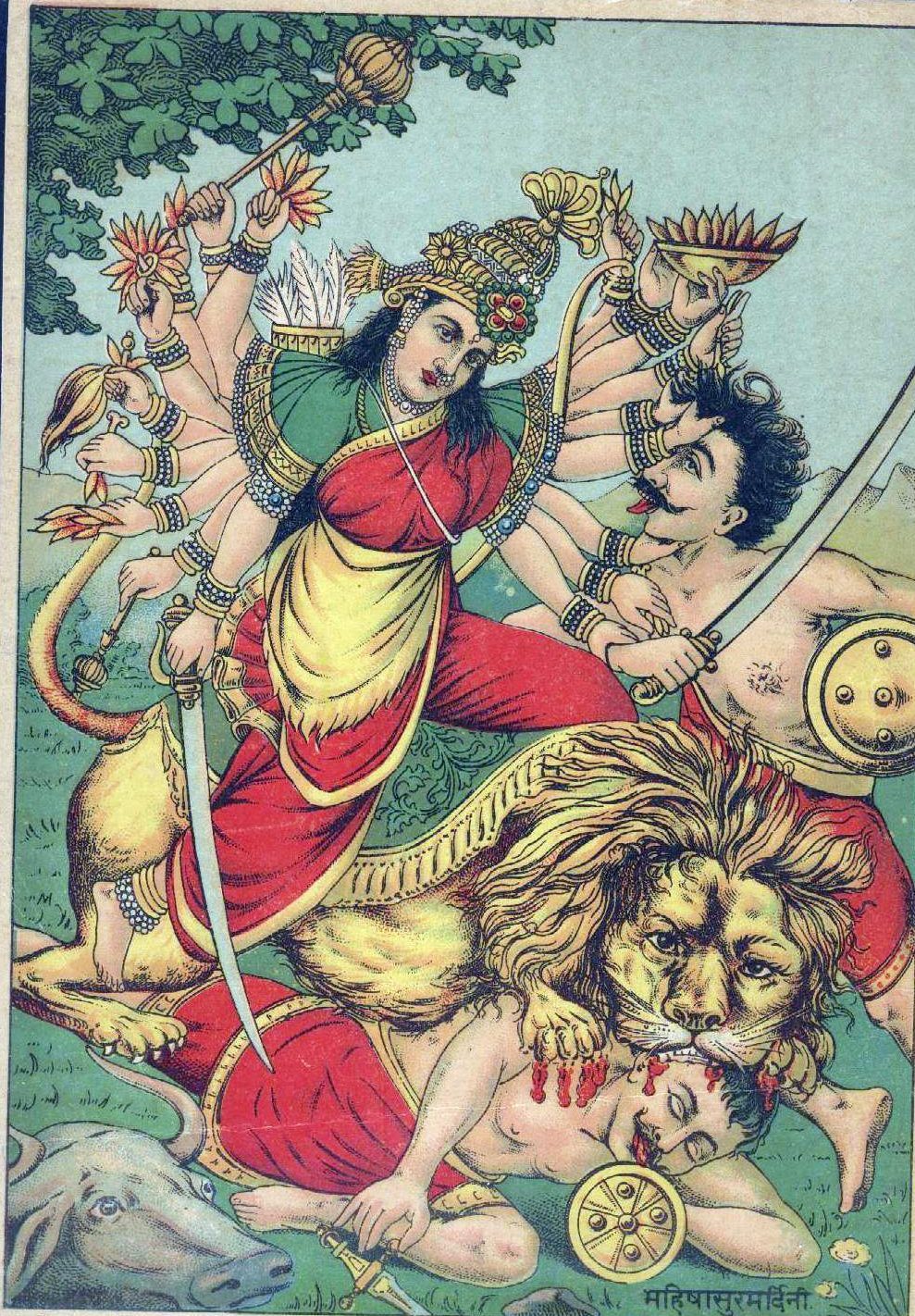
Ravi Varma Press oleograph of Durga as Mahishasuramardini: a many-armed, crowned goddess seated astride a lion, brandishing a mace, sword, discus, lotus and other divine weapons; below her the lion sinks its jaws into a fallen human-form demon while a severed buffalo head lies at lower left and a shield-bearing demon reels back at right, all on a green ground beneath a flowering tree.
Hindu

Devi, the Great Goddess

The buffalo-demon had swallowed heaven and no god could stand against him. The gods poured out their fury as light, gathered like a burning mountain, and out of it stepped a single woman onto a lion. She is the one Goddess in whom all goddesses are gathered.
8 minDevi Mahatmya
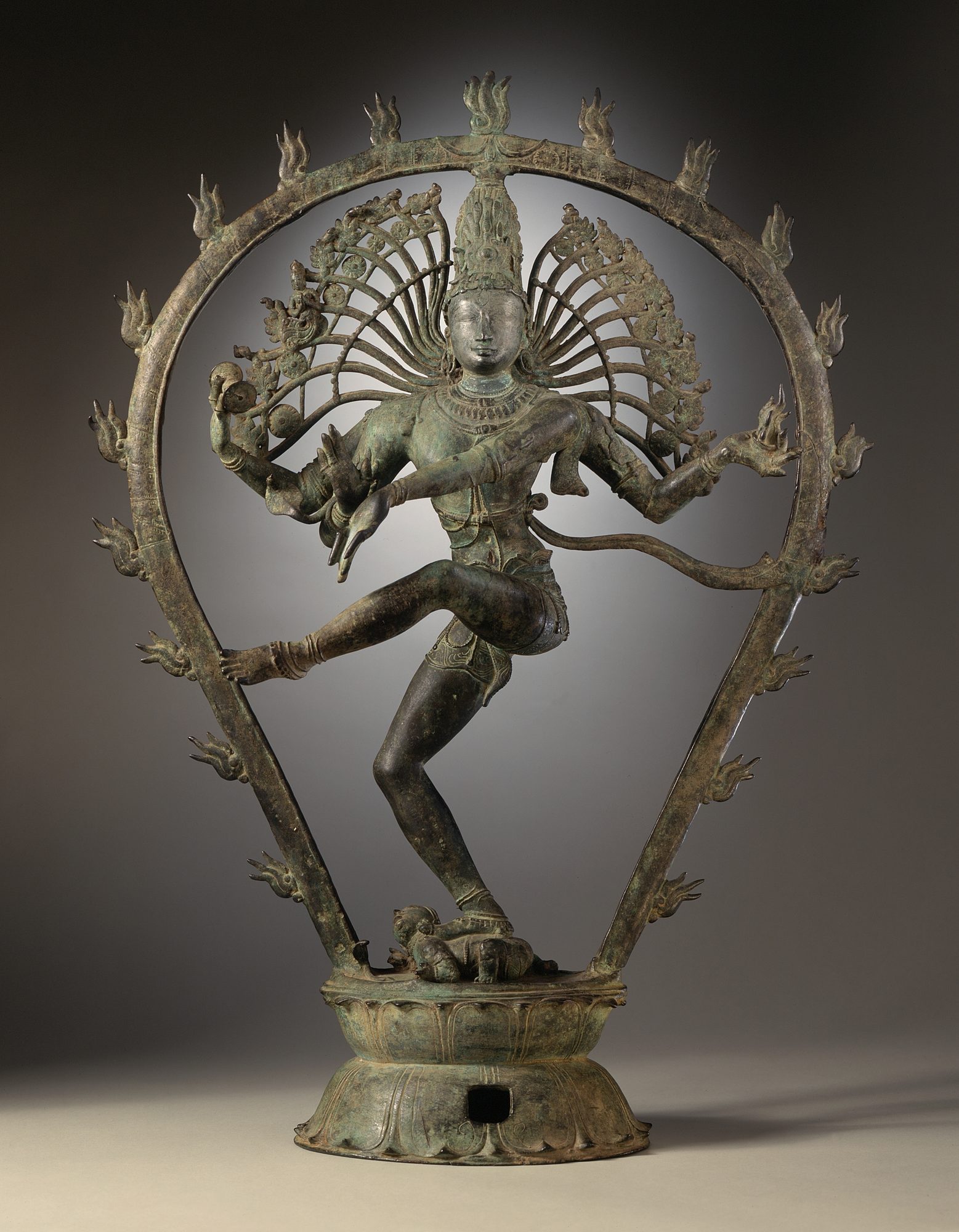
Chola-dynasty bronze of Shiva as Nataraja, the four-armed god dancing within a ring of flames, one leg raised, his matted locks fanned out, treading on the dwarf of ignorance atop a lotus base.
Hindu

Shiva, the Destroyer

The braided-haired archer of the oldest hymns drank the world-poison to save creation and burnt three flying cities with a single arrow. He sits ash-covered on Kailasa as the great ascetic, destroyer and healer in one body.
7 minṚgveda 1.114
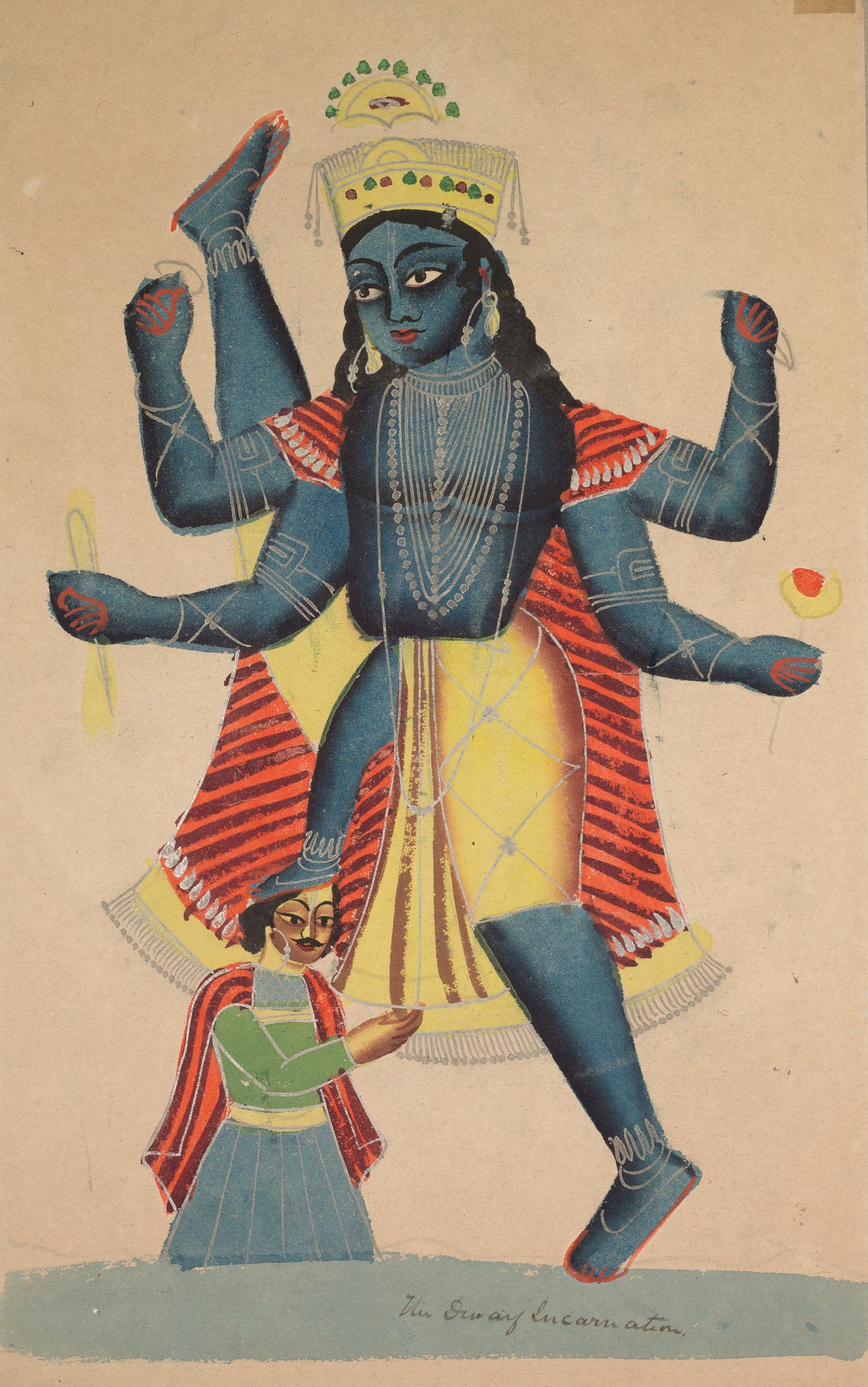
Kalighat painting of Vishnu as the Trivikrama/Vāmana avatar — a blue-skinned, six-armed crowned god mid-stride with one leg raised high overhead, wearing a yellow dhoti and red-striped scarf and heavy silver jewellery; at his lower left the small demon-king Bali kneels, offering a gift-bowl, on a blue-green ground.
Hindu

Vishnu, the Preserver

The god who measured the whole universe in three strides, then bound himself to it forever by a promise: whenever order fails and wickedness grows strong, he takes visible shape and is born, age after age, to set virtue back on her seat.
7 minṚgveda 1.154

Cosmology & Sacred Places

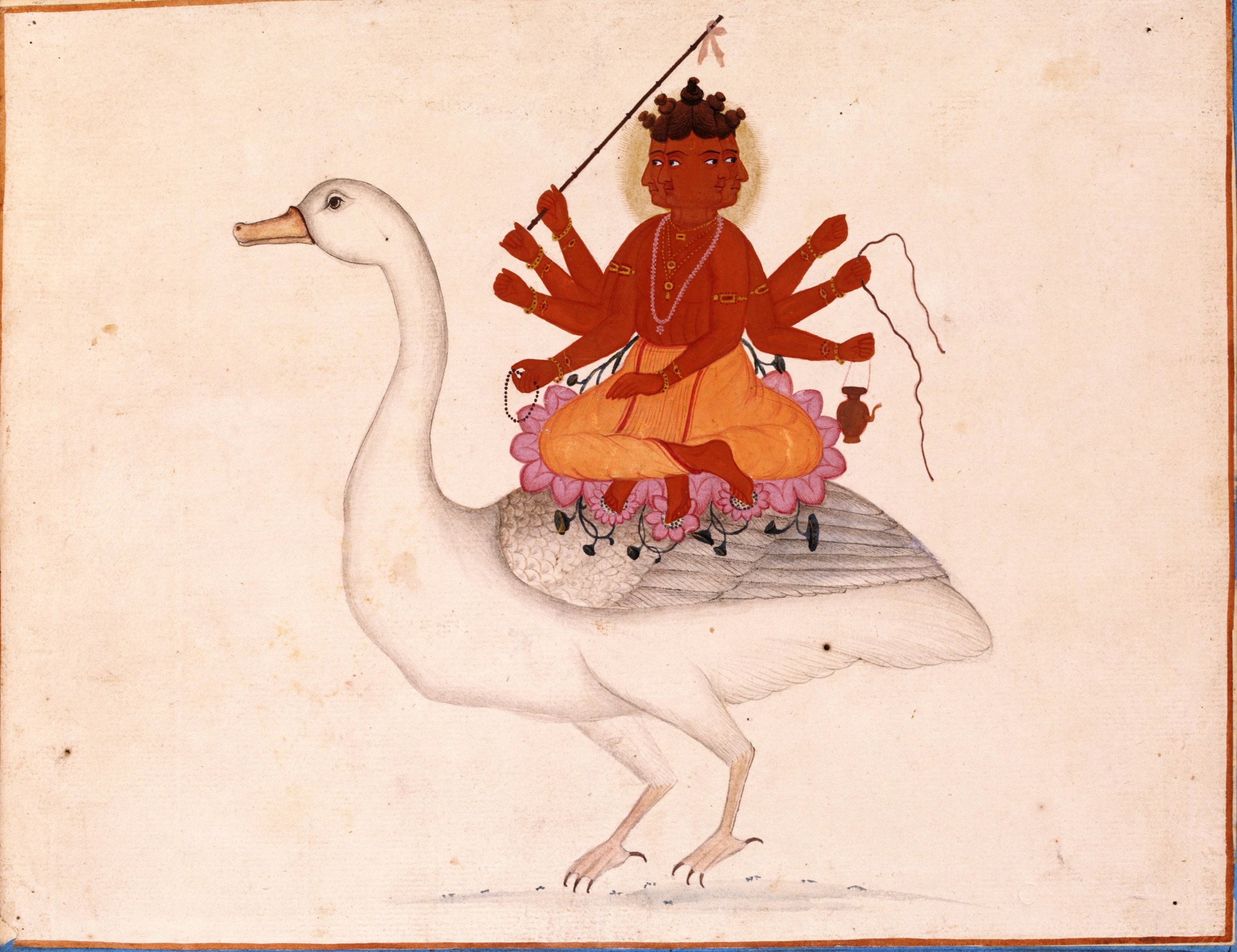
A 19th-century Indian gouache painting of Brahma, four-headed and bearded, seated on his goose-mount hamsa against a plain ground.
Hindu

Brahmāṇḍa: the Egg of Brahmā

The universe is a single vast egg, floating on the primeval water and wrapped in seven concentric skins of element, each ten times the one it encloses: a cocoa-nut of worlds with the creator folded up inside.
8 minViṣṇu Purāṇa I.2
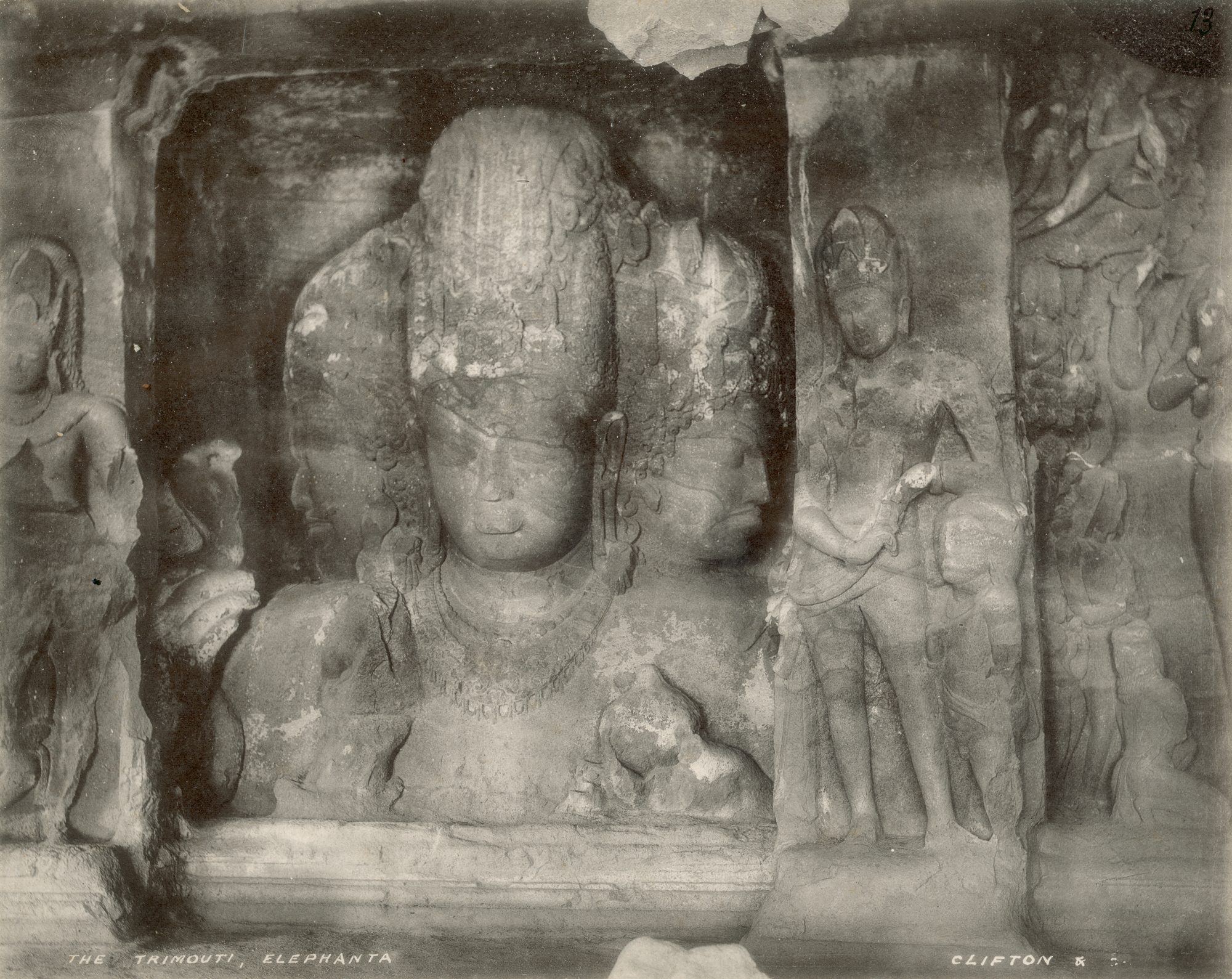
Albumen photograph of the colossal three-faced Sadāśiva (Trimūrti) rock relief at Elephanta: a serene central face flanked by two profile faces, with attendant figures on either side.
Hindu

The Trimurti

One reality wearing three faces: the same supreme god who spins the world into being, holds it steady for an age, then swallows it whole and sleeps on the water until it is time to make it all again.

9 minVishnu Purāṇa