The rope was short by two fingers. Yaśodā had caught the child red-handed, seated on an upturned wooden mortar and calmly handing out stolen butter to the monkeys through the window, and she meant to tie him to the mortar and teach him a lesson. The cord she looped around his small waist fell short by the width of two fingers. She knotted on more, and still it was short by two fingers; she added more again, emptying the house of cord, and every time it came up short by exactly two fingers, until she stood there flushed and baffled. Only then, the Bhāgavata Purāṇa says, out of mercy to his mother, did Kṛṣṇa allow himself to be bound. From that day the cowherds called him Dāmodara, the one with the rope about his belly, and the whole paradox is folded into that name: the infinite, willingly bound by a mother’s love, and only because he chose to be.
Out of the prison, across the Yamunā
He was never quite what he seemed. On the night he was born in Mathurā, in the prison where the tyrant Kaṃsa had shut up his parents Devakī and Vasudeva after murdering their first six children, he did not come as an infant at all. He appeared to his father in a four-armed divine form, dark as a dense rain-cloud and clad in blue, bearing the conch and the mace, marked with the Śrīvatsa and the Kaustubha gem.
Only then did he take the shape of an ordinary newborn, so that Vasudeva could carry him out of the prison and across the Yamunā to the cowherd village, exchange him for another couple’s daughter, and walk back into his cell to re-fetter his own feet. The god who would one day measure the cosmos slept that night in a herdsman’s house, and grew up believing himself a cowherd.
A village boy, lord of the worlds
The childhood in the pastures of Vraja is a string of such moments, where the village boy keeps turning out to be the lord of the worlds. He danced on the many hoods of the venomous serpent Kāliya in a poisoned pool of the Yamunā until the great snake vomited blood and hung senseless, and he spared it only when the serpent’s wives came to plead for their husband.
And when his playmates told Yaśodā the child had been eating dirt and she pried his mouth open to look, she saw inside it the whole moving and unmoving universe, the oceans and the wheeling zodiac, her own village and her own self looking in, before the vision mercifully faded and she was only his mother again.
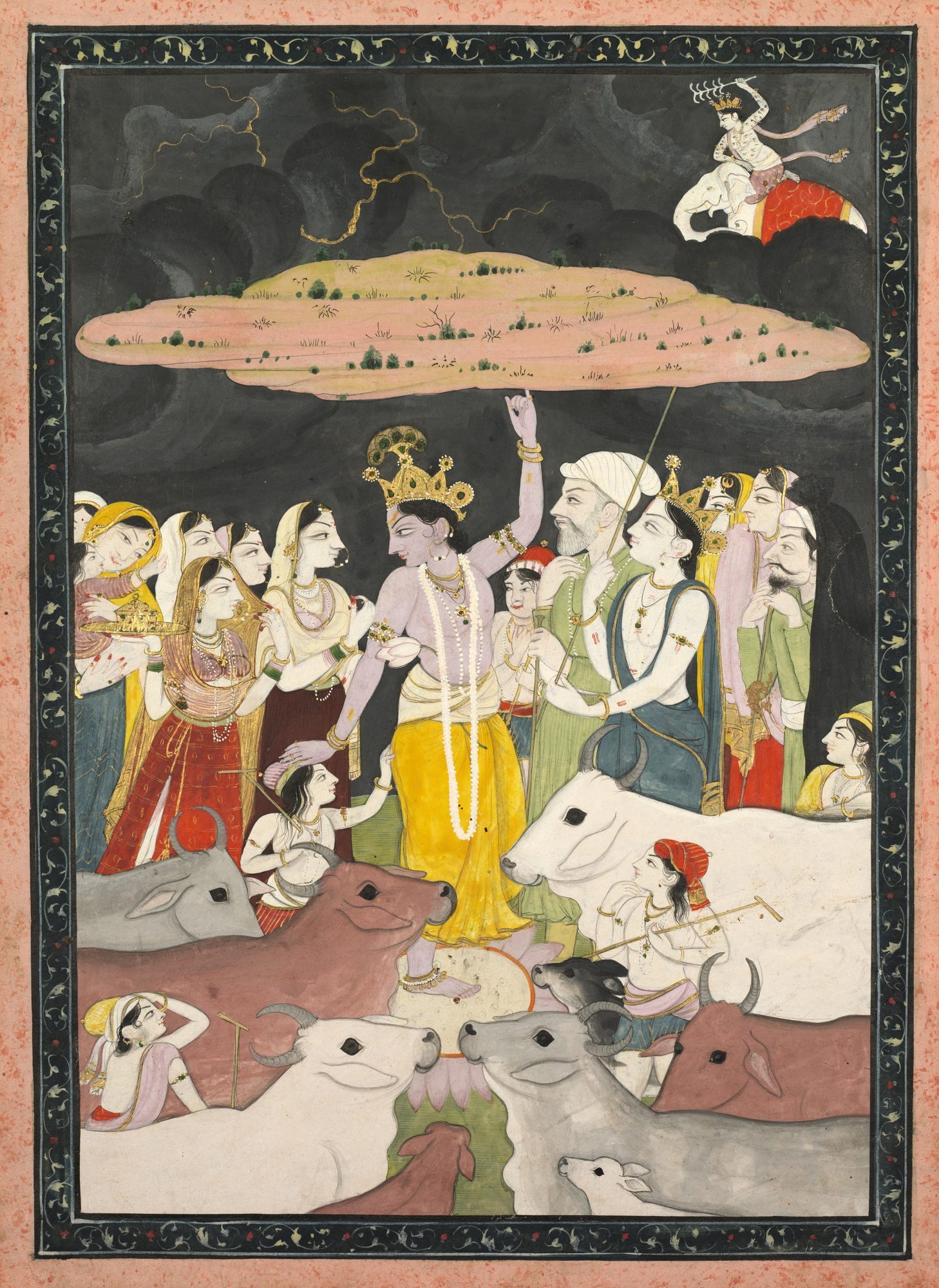
The grandest of these is the day he humbled a god. When Kṛṣṇa told the cowherds to withhold their yearly sacrifice to Indra, lord of storm and rain, the insulted god loosed a deluge to drown them and their cattle. Kṛṣṇa simply uprooted Mount Govardhana and held it up on one hand like a man holding an umbrella over his head, sheltering the herders and their beasts dry for seven days without moving a step, until Indra, beaten, called off the rain and bowed.
And there are the nights of the rāsa, the circle-dance in the moonlit pastures, when the cowmaidens, the gopīs, slipped away to him and he multiplied himself so that he stood between every two of them at once, and each believed he was dancing with her alone. In the later devotional traditions the gopīs’ longing became the very model of the soul’s love for God. (One later beloved, Rādhā, would be named and celebrated by poets such as Jayadeva centuries afterward; but the oldest source read here keeps the gopīs a nameless, yearning company, and does not single her out.)
Reins instead of a bow
The cowherd grew into a kingmaker. In the great war of the Mahābhārata, Kṛṣṇa stood as kinsman and counsellor to the five Pāṇḍava brothers, above all to Arjuna, against their cousins the Kauravas. When both sides came to him for aid, he offered a strange choice: his vast cowherd army, ten crore strong, or himself alone, unarmed, resolved not to lift a weapon in the fight.
Duryodhana, the eldest Kaurava, seized on the army; Arjuna asked only for Kṛṣṇa. And so the god who could have crushed either side chose to hold a charioteer’s reins instead of a bow: I will act as thy charioteer,
he told his friend, let thy wish be fulfilled.
His last embassy of peace to the Kaurava court failed, Duryodhana even plotting to seize him on the spot, and the war would come.
Between the two armies
It is on the threshold of that war that the cowherd becomes the teacher. Arjuna, seeing across the field the kinsmen and teachers he was about to kill, asked his charioteer to halt the chariot between the two armies, and his nerve broke. He let his bow slip and refused to go on, and Kṛṣṇa’s reply to that refusal is the Bhagavad Gītā. The soul cannot be killed, he tells Arjuna; it is never born and never dies, and weapons cannot cut it nor fire burn it nor water wet it nor wind dry it, so grief for the deathless is grief misplaced. He teaches action without grasping, the right to act but never to claim the fruits, and reveals the pattern of his own descents: whenever righteousness fails he takes birth again to protect the good, age after age.
And when Arjuna asks to see him as he truly is, Kṛṣṇa grants him divine eyes and unveils the Universal Form, all creation blazing in one body, and out of that terror speaks the line that has echoed longest: kālo’smi, I am Time, the destruction that comes to annihilate the worlds. (The famous English I am become Death
is J. Robert Oppenheimer’s paraphrase of that verse, not a translation of it; the word Kṛṣṇa uses is Time.) At the last he strips it to one instruction: abandon every other duty and take refuge in me alone, and do not fear.
A foot mistaken for a deer
His own end is quiet, and strangely small for so vast a life. After the war his own Yādava kinsmen fell to drinking and quarrelling and slaughtered one another to the last man. Kṛṣṇa withdrew alone into the forest, lay down, and sank into deep yoga. A hunter named Jara, catching a glimpse of a foot half-hidden in the undergrowth, took it for a deer and loosed an arrow.
Seeing what he had done, the god comforted the horrified man before ascending, filling the whole sky with his splendour. The one who had held up a mountain and held the universe in his mouth left the world by the arrow of a man who did not even know what he was aiming at: a death he had chosen to allow, fulfilling an old curse in his own time, as the child had once chosen to let the rope go round his waist.
Abandon all varieties of dharmas and simply surrender unto Me alone. I shall liberate you from all sinful reactions; do not fear. (Bhagavad Gītā 18.66, tr. Swami Mukundananda)
- Bhagavad Gītā 1.21–22, 2.19–2.23, 2.47, 4.7–4.8, 11.32, 18.66 (Swami Mukundananda, holy-bhagavad-gita.org, Sanskrit/IAST with English; cross-referenced with Sir Edwin Arnold, The Song Celestial, 1885)Kṛṣṇa’s teaching to Arjuna between the armies at Kurukṣetra. Arjuna’s request to halt the chariot; the deathless soul that
is neither born, nor does it ever die
and thatweapons cannot shred… nor can fire burn
; karma-yoga,you have a right to perform your prescribed duties, but you are not entitled to the fruits of your actions
(2.47, karmaṇy-evādhikāras te mā phaleṣhu kadāchana); the avatar doctrine,to protect the righteous… I appear on this earth, age after age
(4.7–8); the Universal Form andI am mighty Time, the source of destruction that comes forth to annihilate the worlds
(11.32, kālo’smi loka-kṣhaya-kṛit); and the final surrender (18.66). Note: the popularI am become Death, the destroyer of worlds
is Oppenheimer’s paraphrase, not a verbatim rendering; the Sanskrit kālo’smi isI am Time.
- Mahābhārata, trans. Kisari Mohan Ganguli (P. C. Roy edition), Udyoga Parva §VIIKṛṣṇa offers each side his ten-crore Nārāyaṇa cowherd-army or himself alone,
resolved not to fight on the field, and laying down my arms
; Arjuna chooses the unarmed Kṛṣṇa, Duryodhana the army, and Kṛṣṇa agrees,I will act as thy charioteer; let thy wish be fulfilled.
- Mahābhārata (Ganguli), Udyoga Parva §§CXXX–CXXXIthe peace embassy to Hastināpura; Duryodhana’s plot to
seize even here this Kesava
; and the court theophany in which gods issue from Kṛṣṇa’s body,each of lightning effulgence,
Brahmā on his forehead and Rudra on his breast, Agni and the Ādityas from his mouth, so that the kings shut their eyes in terror. - Mahābhārata (Ganguli), Mausala Parva §IVthe self-destruction of the Yādava race; Kṛṣṇa withdrawing into yoga and shot by the hunter Jara, who
mistaking Kesava… for a deer, pierced him at the heel with a shaft,
after whichthe high-souled one… ascended upwards, filling the entire welkin with splendour.
(Within the same section the sole of the foot is named as his one vulnerable spot; recorded asfoot/heel
rather than committing to one.) - Bhāgavata Purāṇa (Śrīmad Bhāgavatam), Book/Canto X, trans. J. M. Sanyal (public domain)Kṛṣṇa’s four-armed birth-form
beautiful like that of dense rain-cloud
and the crossing of the Yamunā (ch. 3); Pūtanā the poison-nurse (ch. 6); the whole universe seen inside the child’s mouth (ch. 8); the butter-theft, the ropeshort by two fingers
and the binding to the mortar that names him Dāmodara, with the freeing of the Yamala-Arjuna trees (ch. 9–10); the subduing of the serpent Kāliya (ch. 16); the lifting of Mount Govardhanajust like a person holding an umbrella over his head
for seven days (ch. 25); and the rāsa dance, in which Kṛṣṇa multiplies so thateach of those [gopīs]… thought that Krishna was standing near herself
(ch. 33). Standard Bhāgavata numbering places Govardhana at X.25–27 and the rāsa-līlā at X.29–33.