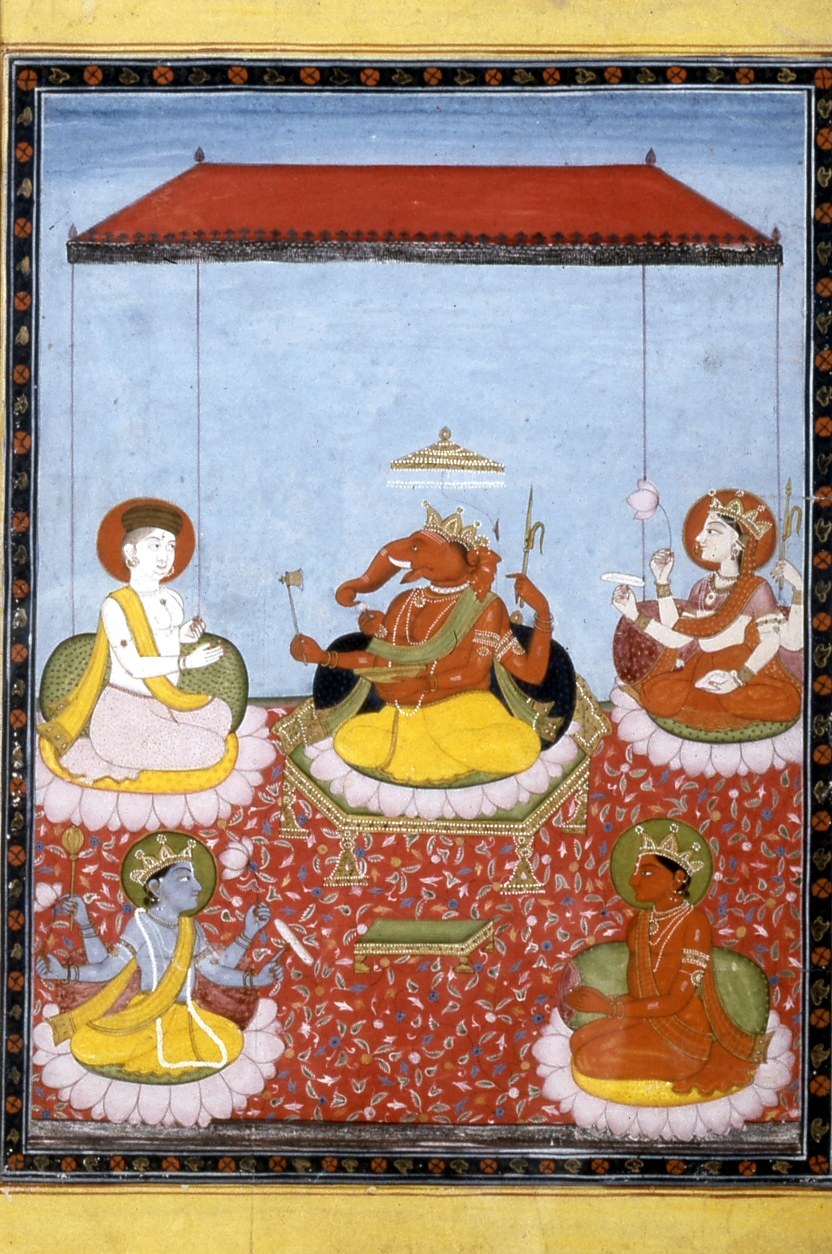
She wanted a guardian of her very own. Not one of the hosts who came running at her husband’s word and answered first to him, but a servant hers alone, and so while she bathed on the mountain Parvati rubbed the scurf and dirt from her own skin and shaped it into the form of a boy. She made him spotless and handsome, huge in size, all brilliance and strength and valour; she dressed him, hung ornaments on him, put a hard staff in his hand, and set him at her door with a single command. Without my permission, she told him, let no one enter. He knew nothing of the world beyond that threshold, and nothing of the great ash-smeared god whose house it was. He knew only his mother’s order, and he meant to keep it.
Struck with a staff, and struck again
So when Shiva came home and made to walk through his own door, the boy barred the way and would not be moved. Words failed; the boy struck the god with his staff, and struck him again. What followed was not a quarrel but a war. Shiva loosed his hosts against the child, and the child beat them back.
The gods came, and Indra and Kubera and the Sun, and Vishnu himself, and still the boy stood at the door and knocked them down with his club, so that Vishnu, watching, could only praise him as unequalled in the three worlds in brilliance and form and valour. He could not be taken by force. He could be taken only by a lie. While Vishnu threw a delusion across the boy’s mind and held his attention elsewhere, Shiva came at him from the side and swept off his head with the trident.
Parvati’s goddesses swallow the gods
Then the mountain learned what it had done. Parvati, told that her son lay dead at her own gate, turned her grief into something the cosmos could not survive. Out of her fury she brought forth hundreds upon hundreds of fierce goddesses, the Terrific and the humpbacked and the lame and the tall-headed, and they fell upon the gods and caught them up and dropped them into their own mouths, and she made it plain that she would see the whole of creation dissolved before she would be comforted.
The gods, who had won the battle, understood that they had lost. They came to her as suppliants. She named her price. Her son was to live again, and he was to be given a station of honour, set at the very head of all of them.
An elephant with a single tusk
Shiva sent his people north with an order as strange as it was simple: take the head of the first living thing you meet, and fit it to the body. The first creature they met was an elephant with a single tusk. They brought its head back and set it on the boy’s shoulders, and the gods poured holy water charged with mantras over him, and he woke, red-complexioned, his face beaming, no longer quite the child his mother had made and something larger instead.
The single tusk in this telling is no wound and no sacrifice; it is simply the tusk the elephant already wore. The tradition, honest about itself, records that the story of how he came by that head is told in different ways from one world-age to the next: in one, it is the death-glance of Saturn that burns the first head to ash; in another, Shiva’s own trident does the work you have just read. The Purana sets the variants down side by side rather than pretending to one.
Worshipped first, or not at all
What the gods gave him next is the whole reason the figure matters. One after another, Parvati and Shiva and Vishnu and Brahma laid their boons on him, and the boons converged on a single, extraordinary honour. He would receive worship before all the gods. The obstacles of anyone who worshipped him would perish without fail.
And the charter at the centre of everything he is: he is the remover of all obstacles and the giver of the fruit of every rite; he shall be worshipped first, and the rest of the gods afterwards; and if he is not worshipped first, then the gods are not worshipped at all. Shiva installed him as chief and presiding officer of all the hosts, the gaṇas, and it is from that office that his name is built, gaṇa and īśa, lord of the hosts, the one whose task is the quelling of obstacles. The god who was made to guard one door became the god who stands at every threshold.
Shiva fixed the day of his worship too, the fourth of the dark half of the month of Bhādrapada, the hour of moonrise when the boy had first drawn breath, and named the offerings that please him: blades of dūrvā grass knotted in threes, sweet modaka, vermillion smeared across that broad face in memory of the red glow of his waking. This is the scriptural root of the festival the subcontinent still keeps as Ganesh Chaturthi.
A slow circle around his parents
He is quick as well as strong, and the story of his brother makes the point. Shiva and Parvati set their two sons a contest, promising marriage first to whichever of them could circle the whole earth and return soonest. Kārttikeya, the warrior, mounted up and set off to ride the round of the world. Ganesha did not move from the yard.
He walked a slow circle around his mother and his father and stopped, and when he was asked to explain himself he answered that for a son the supreme holy centre, the pilgrimage that outweighs any river or shrine, is nowhere but at his own parents’ feet. To circle them was to circle the earth and more. He was judged the winner, and married first, to Siddhi and to Buddhi, attainment and understanding; and in time he fathered two sons, Kṣema and Lābha, whose names are welfare and gain. Even his household is a kind of blessing spelled out.
A tusk he did not break
A later and much-loved tradition seats him at another task, as the scribe to whom the sage Vyāsa dictated the Mahābhārata, on the condition that the sage’s voice never once falter, met by Vyāsa’s own condition that the scribe never write a line he had not first understood. It is a lovely image of the obstacle-god as the patron of the difficult beginning, the blank page overcome.
It is worth knowing that the episode, present in the received text of the epic, was judged a later addition by the scholars who reconstructed the poem’s oldest form and left out of their critical edition; and that the familiar flourish in which he snaps off his own tusk to use as a pen is later still, a folk grace-note, no part of the scribe passage at all. The elephant-headed god carries a single tusk in a great many images. He did not break it on the Mahābhārata.
Set the elaborations aside and the core holds, sharp and strange. A goddess makes a child out of the dirt of her body and posts him at her door. A god who does not know his own house kills him. A mother’s grief nearly ends the world.
And out of that ruin the gods agree, and bind themselves to the agreement forever, that this restored and elephant-headed boy will be the first name spoken at the start of anything worth doing, because he is the one who clears the way. Every rite that opens by invoking him, every ledger and letter and journey that begins in his name, is keeping a promise made on a mountain when the price of a mother’s peace turned out to be the ordering of worship itself.
He is the remover of all obstacles and the bestower of the fruits of all rites. He shall be worshipped first and we shall be worshipped afterwards. If he is not worshipped, we too are not worshipped. (Śiva Purāṇa, Rudra-saṃhitā, Kumāra-khaṇḍa 18.22–24, tr. J. L. Shastri)
- Śiva Purāṇa, Rudra-saṃhitā (4), Kumāra-khaṇḍa, chs. 13–20 (J. L. Shastri trans., Motilal Banarsidass, 1950; read verbatim at wisdomlib.org)the load-bearing continuous narrative. Parvati forms the boy from the scurf of her own body,
without the intervention of Śiva,
and posts him as gatekeeper with a hard staff (13.20–28); he beats Śiva twice (13.32–37); the cosmic war in which he throws down the gods and Vishnu, who counsels that he can be slainby deception,
after which Śiva takes his head with the trident (16.7–8, 16.24–27, 16.34); Parvati’s devouring Śaktis —Karālīs (the Terrific), Kubjakās (the humpbacked), Khañjās (the lame), Lambaśīrṣās (the tall-headed)
— and her threat of universal dissolution (17.6–16); the order to fitthe head of the first creature met,
a single-tusked elephant met to the north (17.47–51); the mantra-water revival,red-complexioned… face beaming
(17.54–57); the boons thathe shall be worshipped first
and isthe remover of all obstacles
(18.8–12, 18.22–24); installation as chief of the gaṇas and the name forquelling obstacles
(18.27, 18.31); the vrata on the dark fourth (caturthī) of Bhādrapada at moonrise, with dūrvā grass and modaka (18.35–41); the circumambulation contest with Kārttikeya, won by circling the parents (19.16–18, 19.41–51); marriage to Siddhi and Buddhi and the sons Kṣema and Lābha (20.2, 20.7–8). The text itself notes the head-originis told in different ways
for thedifference of Kalpas
(13.5–6). - Mahābhārata, Ādi Parva, section I (Kisari Mohan Ganguli trans., from the P. C. Roy edition; read verbatim)the scribe pact — Ganesha writes only if Vyāsa’s dictation never pauses; Vyāsa binds him not to write what he has not understood, and
knit the knots of composition exceeding close.
NB: the episode is in the vulgate/Ganguli text but was excluded from the Poona Critical Edition (Sukthankar et al.) as a later stratum, not part of the reconstructed archetype; and the popularused his own broken tusk as a pen
detail is not in this passage. - Brahmavaivarta Purāṇa, Gaṇeśa-khaṇḍathe Paraśurāma account of the broken tusk (the Ekadanta origin in which Ganesha lets Śiva’s axe strike him out of respect). Named here as a variant; not read verbatim this pass — actor, weapon and chapter to be re-verified before any specific is printed.
- Suprabhedāgama; Jayaratha, Hara-carita-cintāmaṇi ch. 18; Brahmāṇḍa Purāṇa / Lalitā-māhātmyafurther head-origin variants (born elephant-faced from the outset; born with five elephant heads, later reduced to one) and the mouse/rat mount, as aggregated with per-text attributions in the wisdomlib Gaṇeśa reference entry. Named as variants via that aggregator; the underlying texts not read verbatim.
- Monier-Williams, Sanskrit-English Dictionary, s.v. gaṇeśa; Apte, s.v.the etymology (gaṇa + īśa,
lord of the hosts
), the string of epithets (Gaṇapati, Vināyaka, Gajānana, Lambodara, Ekadanta, Vighneśvara), the invocationnamo gaṇeśāya vighneśvarāya,
and the note that he is son of Śiva and Pārvatīor according to one legend of Pārvatī alone
— the Pārvatī-alone version being the one the Śiva Purāṇa tells.