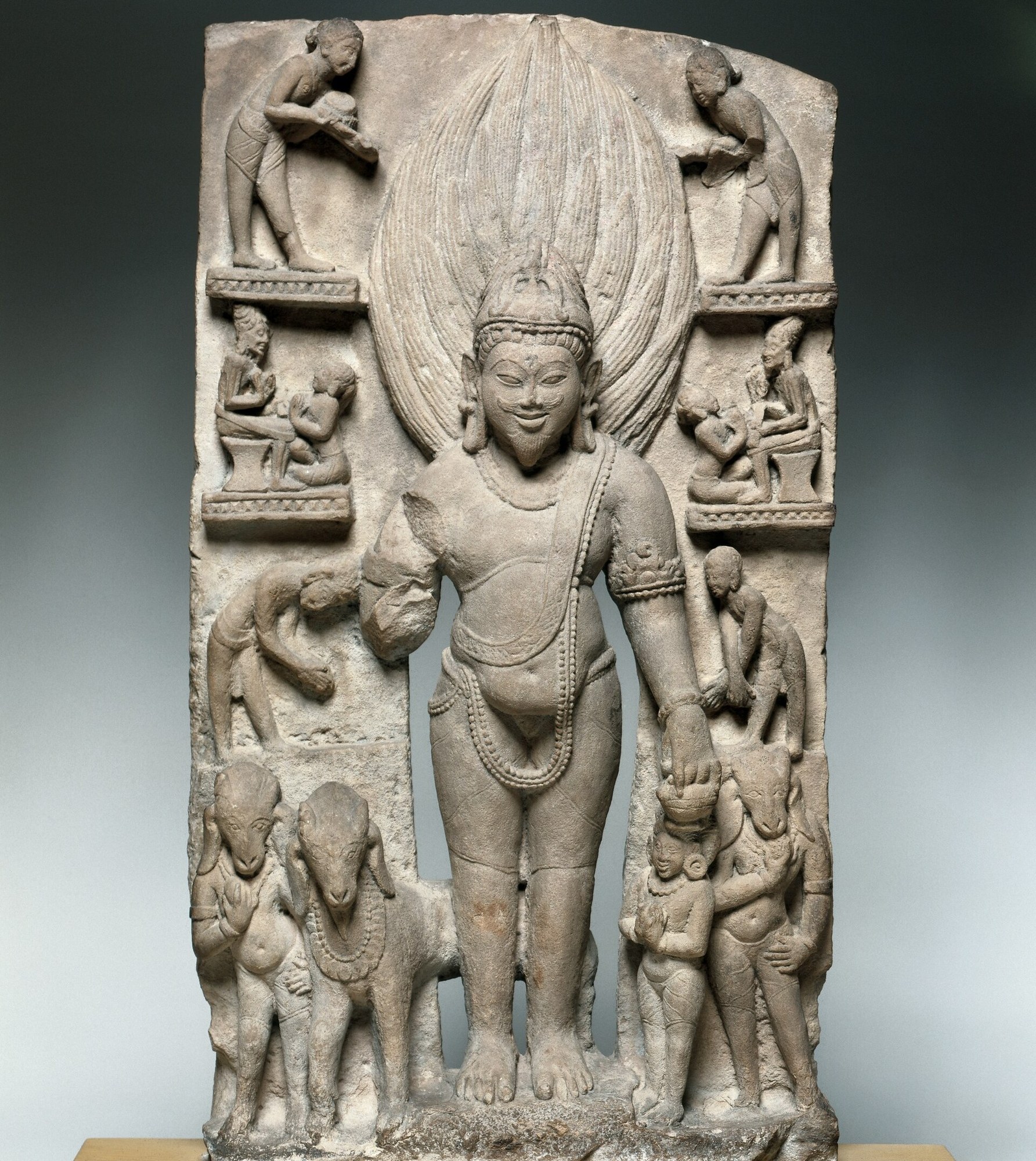
Before break of morning, in the cold dark of the household, a man rubs two dry sticks together until a small flame catches in the tinder. That flame is a god. He is born there, at that instant, from the friction of wood, and he will be born the same way tomorrow, at every hearth and altar across the whole world of the sacrifice. The Rig Veda, the oldest book of this people, opens by naming him, in the first word of its first hymn. I laud Agni, the chosen Priest, the poet sings, God, minister of sacrifice, the hotarThe invoking priest of the Vedic rite, who summons the gods to the offering; the Rig Veda gives the title to Agni himself., lavishest of wealth. Of all the gods there were to praise, the singers reached for the fire first.
Agni is not a character with a life-story. He has no birth-and-childhood, no throne to win, no enemy to kill. His myth is his function, and the function is this: he stands between earth and heaven and carries messages both ways. The oblation poured on the flame rises as smoke, and the smoke goes up to the gods; the gods’ favour comes back down as the fire’s warmth and light. Whoever wanted to reach the immortals had to send word through the fire, because the fire was the only one who went in both directions.
The mouth that eats for the gods
The Rig Veda is exact about how this carrying works, and the mechanism is startlingly physical. The gods do not reach down to take the offering themselves. They eat it through Agni, using his mouth as their own. Thee, Agni, have the Adityas taken as their mouth, one hymn says; the Bright Ones have made thee to be their tongue.
By thee all the Immortal guileless Gods eat with thy mouth the oblation that is offered them. When the ghee hits the flame and flares, that flaring is the gods feeding. The tongues of the fire are literally the tongues of the gods, licking up what mortals have set out for them, and Agni is the shared mouth they all share to do it.
This is why the fire is invoked first and why the singers call him the chosen Priest. He is the invoking priest, the hotar, the one who summons the other gods to the feast and then serves it to them. He shall bring hitherward the Gods, the opening hymn promises, and the sacrifice, once he has taken charge of it, verily goeth to the Gods. Everything the worship is meant to do passes through him, and so he is at once the most domestic and the most cosmic of the gods: the small flame in the house, and the door to heaven.
Brought down, and born from wood
Where does such a god come from? The Rig Veda gives Agni not one origin but several at once, and they are meant to be held together, not chosen between. He is brought to life from out the waters, one hymn sings, from the stone; from out the forest trees and herbs that grow on ground. The fire is in the lightning of the storm-cloud, in the spark struck from flint, in the wildfire that leaps from rubbed branches, in the glow of certain plants. All of these are Agni being born. He is called the child of two births, born once in heaven and once on earth, and re-born every dawn from the fire-sticks.
There is also a fire-bringing, though the hymn is careful to call it a gift and not a theft. The one who fetched Agni down was not the fire himself but MatarisvanThe divine fire-bringer who carries the hidden Agni down from heaven to men; whether he is a distinct being or the wind-god Vayu the sources dispute., who brought the glorious Priest as a gift to Bhrigu, the first of the fire-priests. Agni had been hidden away in heaven, and Matarisvan carried him down to earth where men could kindle him. Who exactly Matarisvan was is disputed even in the sources: the Rig Veda’s Victorian translator, Griffith, reads him as an independent divine messenger and rejects the common guess that he is really Vayu, the wind-god, as unwarranted by the text. The identity is left open, as the sources leave it.
The face that is Death
There is a darker Agni, and to meet him we have to move forward roughly five to nine centuries, from the Rig Veda’s hymns to the Shatapatha Brahmana, a prose ritual manual composed long after them. The gap matters, because the story it tells is not in the older hymns and should not be read back into them as the original conception. In this later telling, the creator-lord PrajapatiThe creator-lord of the later Brahmana texts, largely absent from the older Rigvedic hymns., alone in the beginning, generates Agni from his own mouth, and because he was made from a mouth Agni is by nature a consumer of food.
Then the newborn fire turns on its maker. Agni turned towards him with open mouth, the text says, and Prajapati, terrified, felt his own greatness drain out of him. The fire would have devoured even the creator. He saves himself only by making the first offering, the very rite that afterwards keeps the world fed, and by it he saved himself from Agni, Death, as he was about to devour him.
Same god, opposite face. The gentle priest who is easy of approach, even as a father to his son, is also the open mouth that would eat the world. Both are true, and the tradition kept both. Even the devouring is turned, in the end, toward mercy. When a man dies and is laid on the fire, the same Brahmana says, he is born again out of the fire, and the fire only consumes his body: as a man is born from his father and mother, so is he born from the pyre. The mouth that eats is also a womb.
Every god at the altar
One hymn pushes the fire’s centrality as far as it will go. As the smoke rises, Agni becomes, in turn, every great god there is. Thou art Indra, the poet tells him, thou art Vishnu of the Mighty Stride; thou art King Varuna whose laws stand fast; Mitra art thou, and Aryaman; Rudra art thou, the Asura of mighty heaven; as Pushan thou protectest worshippers; thou art God Savitar; as Bhaga thou rulest over wealth.
At the moment of sacrifice, the fire is not one deity among many. He is the point where all of them arrive, the single flame in which the whole pantheon is present at once, because he is the one through whom every offering to any of them must pass.
That is why the daily rite hinges on him. The householder feeds the fire twice, and the Brahmana fixes the times by this myth: the offering goes in the evening to Agni, and in the morning to SuryaThe Vedic sun-god; in the Agnihotra the fire receives the evening libation and Surya the morning one., the sun. Dusk and dawn, the two doors of the day, and at both of them a small flame carries the household’s food up to gods it will never see, and brings back light. The whole vast machinery of Vedic worship turns on the thing a man kindles from two sticks before it is properly morning.
By thee, O Agni, all the Immortal guileless Gods eat with thy mouth the oblation that is offered them. (Rigveda 2.1.14, tr. Ralph T. H. Griffith, The Hymns of the Rigveda)
- Rigveda 1.1 (Griffith trans., The Hymns of the Rigveda, Vol. I)the hymn that opens the entire Rig Veda, ascribed to the rishi Madhuchchhandas Vaishvamitra —
I laud Agni, the chosen Priest, God, minister of sacrifice, the hotar, lavishest of wealth
; Agni whoshall bring hitherward the Gods
and whose sacrificeverily goeth to the Gods
; and the tender close,Be to us easy of approach, even as a father to his son.
- Rigveda 1.60.1 (Griffith, same edition)Agni as
child of two births
andthe swiftly moving envoy,
and the fire-bringing —As ‘twere some goodly treasure Matarisvan brought, as a gift, the glorious Priest to Bhrigu.
Griffith’s note glosses Matarisvan as a divine or semi-divine messenger of Vivasvan who brings down the hitherto-concealed Agni, and explicitly rejects the identification of Matarisvan with Vayu (the wind-god) asnot justified by Rigveda texts.
- Rigveda 2.1 (Griffith, same edition)the hymn ascribed to the rishi Gritsamada, of the older family-book stratum — the
mouth of the gods
verses,Thee, Agni, have the Adityas taken as their mouth… By thee, O Agni, all the Immortal guileless Gods eat with thy mouth the oblation that is offered them
(13–14); the manifold birthfrom out the waters, from the stone; from out the forest trees and herbs that grow on ground
(2.1.1); and the litany that makes AgniIndra… Vishnu of the Mighty Stride… King Varuna… Mitra… Aryaman… Rudra… Pushan… Savitar… Bhaga
(3–7). - Shatapatha Brahmana 2.2.4 (
The Agnihotra
; Eggeling trans., The Satapatha-Brahmana Part I, Sacred Books of the East Vol. XII)the later prose layer, roughly 500–900 years after the hymns above — Prajapatigenerated Agni from his mouth,
so Agni isa consumer of food
andgenerated first (agre) of the gods
(the text’s own wordplay agni~agri,first,
an internal folk-etymology, not modern linguistics); Agni turning on Prajapatiwith open mouth
as Death, escaped only through the first offering; the pyre-rebirth,he is born (again) out of the fire, and the fire only consumes his body
; and the Agnihotra rule, the libation offeredin the evening to Agni, and in the morning to Surya.