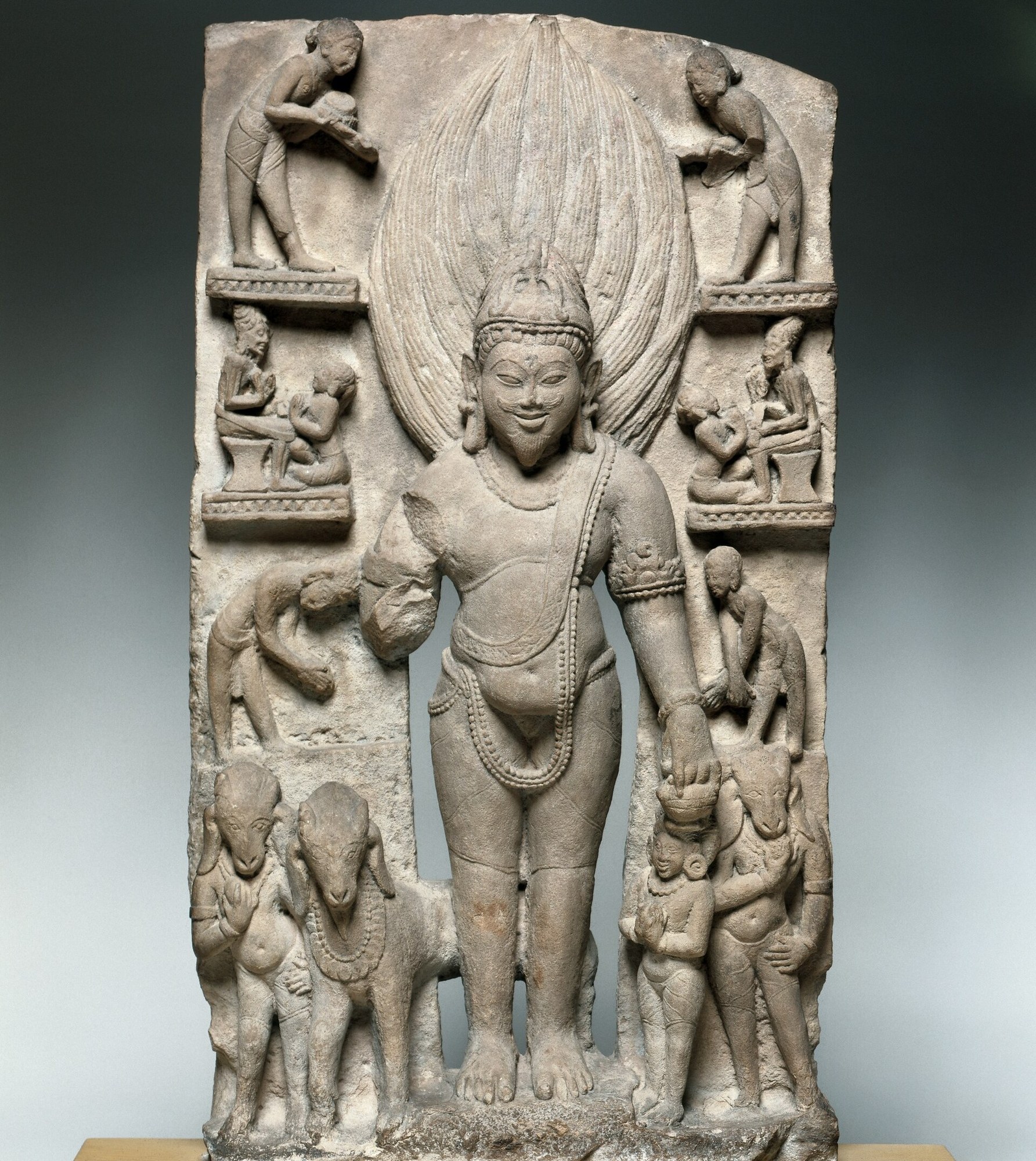
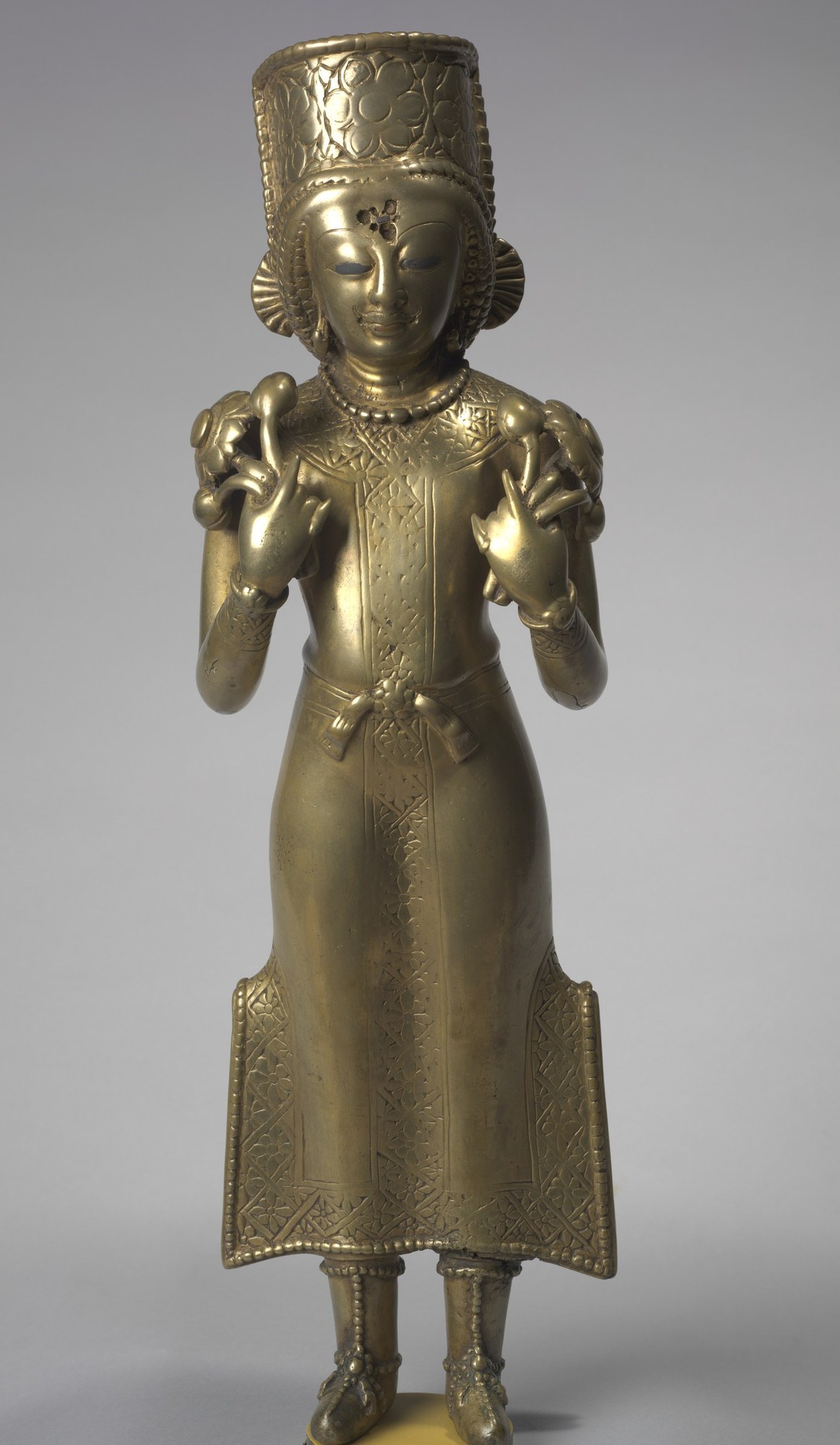
He does not climb into the sky so much as he is carried up into it. In the oldest book this people made, the sun is hauled aloft on his own light: his rays bear him up, the singer says, so that all may look on him, the God who knoweth all that lives. He is not merely bright. He is lifted by his brightness, the way a boat is lifted by water, and the whole of the daylit world is his to see at once. When he comes up the constellations pass away, like thieves, together with their beams, and his herald rays go out ahead of him like flames of fire that burn and blaze. This is the sun at his first and simplest: the visible disc, made of seeing, from whom nothing that lives is hidden.
The Rig Veda, whose hymns to him were composed somewhere between three and three and a half thousand years ago, does not give Surya a life-story. It gives him a function, and the function is enormous.
He is the eye of Mitra, Varuna and Agni, the poet sings, the single organ through which three great gods watch the deeds of men; and in the same breath he is the soul of all that moveth not or moveth, the animating self of the whole world, stone and beast alike. To rise each morning is to open the one eye the gods share and the one self the world keeps. He fills the air and earth and heaven, and there is nowhere his look does not reach.
The daughters of the car
The team that draws him is already there in the hymns, though smaller and stranger than the later pictures. He is Surya with the radiant hair, a god whose very hair is light, and he has yoked the pure bright Seven, the daughters of the car: seven bay mares called, oddly, the chariot’s own children. Griffith, translating in the 1890s, noted that the number seven answers to the seven days of the week. Each dawn the Sun rises pursuing UshasThe Vedic goddess of dawn, whom the rising Sun is said to pursue across the sky as a young man follows a girl., the goddess of the dawn, as a young man follows a girl; and each evening, when he looses his horses, straight over all Night spreadeth out her garment, and the dark comes down the instant the reins go slack.
There is a tenderer use of him too, easy to miss. The Surya hymn closes not on cosmic grandeur but on a sickbed. Its last three verses are a charm against jaundice, and the singer asks the Sun to take from him this my yellow hue, to carry the sickness’s very yellowness away to green parrots and to starlings, to yellow birds and yellow trees where it can do no harm. The all-seeing eye of the cosmos is also, at the end of his own hymn, a folk remedy you might mutter over a yellowing patient at dawn.
A gap of some sixteen centuries
Everything said so far belongs to that oldest layer. What most people now picture when they think of Surya, the great wheeled chariot pulled by seven horses across the heavens, belongs to a different world, and the distance between the two must be kept in view. The Vishnu Purana, which gives the chariot its full and famous form, reached its surviving shape only around the fourth or fifth century of the common era.
That is a gap of roughly sixteen hundred to two thousand years after the Rigvedic hymns, wider than the whole span from Homer to the fall of Rome. When the Purana speaks, it is not the ancient hymn speaking louder; it is a much later imagination elaborating the same god, and its most striking inventions are its own.
In that later telling the chariot is no longer a team of mares but a model of time itself. Its single wheel is the ever-during year, fitted with three naves, five spokes and six peripheries, though the Puranas quarrel over the count, some giving twelve spokes for the twelve months instead. The seven horses are no longer animals at all.
They are re-read as the seven metres of the Vedas, Gayatri and Brihati and Ushnih and the rest, so that the sun is drawn across the sky by the very shapes of sacred verse. A different Aditya presides over the car in each of the twelve months, and with him a sage, a celestial musician, a nymph, a serpent and a demon, a fresh company for every month of the turning year. The sun no longer merely crosses the calendar. He is the calendar, wheeled overhead.
The shadow-wife and the lathe
The same late layer gives Surya the one true domestic drama in his record, and it turns on his unbearable heat. His wife SanjnaThe chief wife of Surya, daughter of the artificer Vishvakarman in the Vishnu Purana (of Tvashtr in the Mahabharata); she flees the Sun's heat as a mare., daughter of the divine craftsman Vishvakarman, bore him three children, among them Yama, who would become lord of the dead, and Yami, the river Yamuna. But she could not endure her husband’s blaze. So she made a double of herself out of her own shadow, a woman named ChhayaLiterally "Shadow": the shadow-double Sanjna makes of herself and leaves in her place as a substitute wife to the Sun., Shadow
, left her in the marriage bed as a stand-in, and fled to the forest to practise austerities, taking at last the form of a mare on the far northern plains of Uttara Kuru.
The Sun noticed nothing for years. He fathered further children on the shadow, Saturn among them, and only when Chhaya cursed one of Sanjna’s own sons did the wrongness show: no true mother curses her child so. Finding his real wife by an eye of meditation, standing as a mare, he took a stallion’s shape to reach her, and of that horse-union were born the twin Ashvins.
Then the artificer stepped in to fix the root of the trouble. Vishvakarman clamped the blazing god on his lathe and ground off an eighth of his glare, all that could be pared away without unmaking him. The shorn splendour fell blazing to earth, and from it the craftsman forged the discus of Vishnu, the trident of Shiva, and the weapons of the other gods. The sun’s excess light became the armoury of heaven.
His herald rays are seen afar refulgent o’er the world of men, like flames of fire that burn and blaze. (Rigveda 1.50.3, tr. Ralph T. H. Griffith, The Hymns of the Rigveda)
One caution the sources themselves press. The sun-verse most people can recite, the Gayatri mantra, is not addressed to Surya at all but to SavitrThe impelling, vivifying solar power of the Rigveda: a deity distinct from Surya the visible disc, and the one the famous Gayatri mantra actually addresses., the impelling solar power the Rig Veda keeps carefully separate from the visible disc. And the seven horses are never, in any ancient text, named for the colours of the rainbow or the body’s chakras; that is a modern gloss laid over an old god. What the sources give is stranger and older: an eye borne up on its own light, and a chariot that is the wheel of the year.
- Rigveda 1.50, the Surya sukta (Griffith trans., The Hymns of the Rigveda, Vol. I)the sun borne aloft by his rays as
the God who knoweth all that lives,
so thatall may look on him
; the constellations passinglike thieves
at his rising; herald rayslike flames of fire that burn and blaze
;Surya with the radiant hair
and hisSeven Bay Steeds,
yoked asthe daughters of the car
; and the closing triplet (11–13), a jaundice-charm sending the singer’syellow hue
awayto parrots and to starlings.
- Rigveda 1.115 (Griffith, same edition)Surya as
the eye of Mitra, Varuna and Agni
andthe soul of all that moveth not or moveth,
who hasfilled the air and earth and heaven
; the Sun pursuing the Dawnas a young man followeth a maiden
; and Night spreadingout her garment
the moment his horses are unyoked. - Vishnu Purana, Book II, chapters 8 and 10 (Wilson trans., The Vishnu Purana, 1840)composed roughly sixteen centuries after the hymns above — the one-wheeled chariot whose wheel is
the ever-during year
(three naves, five spokes, six peripheries, with the Bhagavata’s rival gloss of twelve spokes for the twelve months); the seven horses read as the seven Vedic metres (Gayatri, Brihati, Ushnih, Jagati, Trishtubh, Anushtubh, Pankti); the pole-star support; and the monthly retinue of a rotating Aditya, sage, Gandharva, nymph, Yaksha, serpent and Rakshasa. - Vishnu Purana, Book III, chapter 2 (Wilson, same edition)Sanjna, daughter of Vishvakarman, mother of the Manu Vaivasvata, Yama and Yami; her substitution of the shadow-double Chhaya and flight as a mare to Uttara Kuru; Chhaya’s children (Saturn, the Manu Savarni, Tapati); the curse that betrays her; the mare-and-stallion union that begets the Ashvins and Revanta; and Vishvakarman’s lathe, grinding off an eighth of the Sun’s effulgence into the discus of Vishnu, the trident of Shiva, and the weapons of the gods.