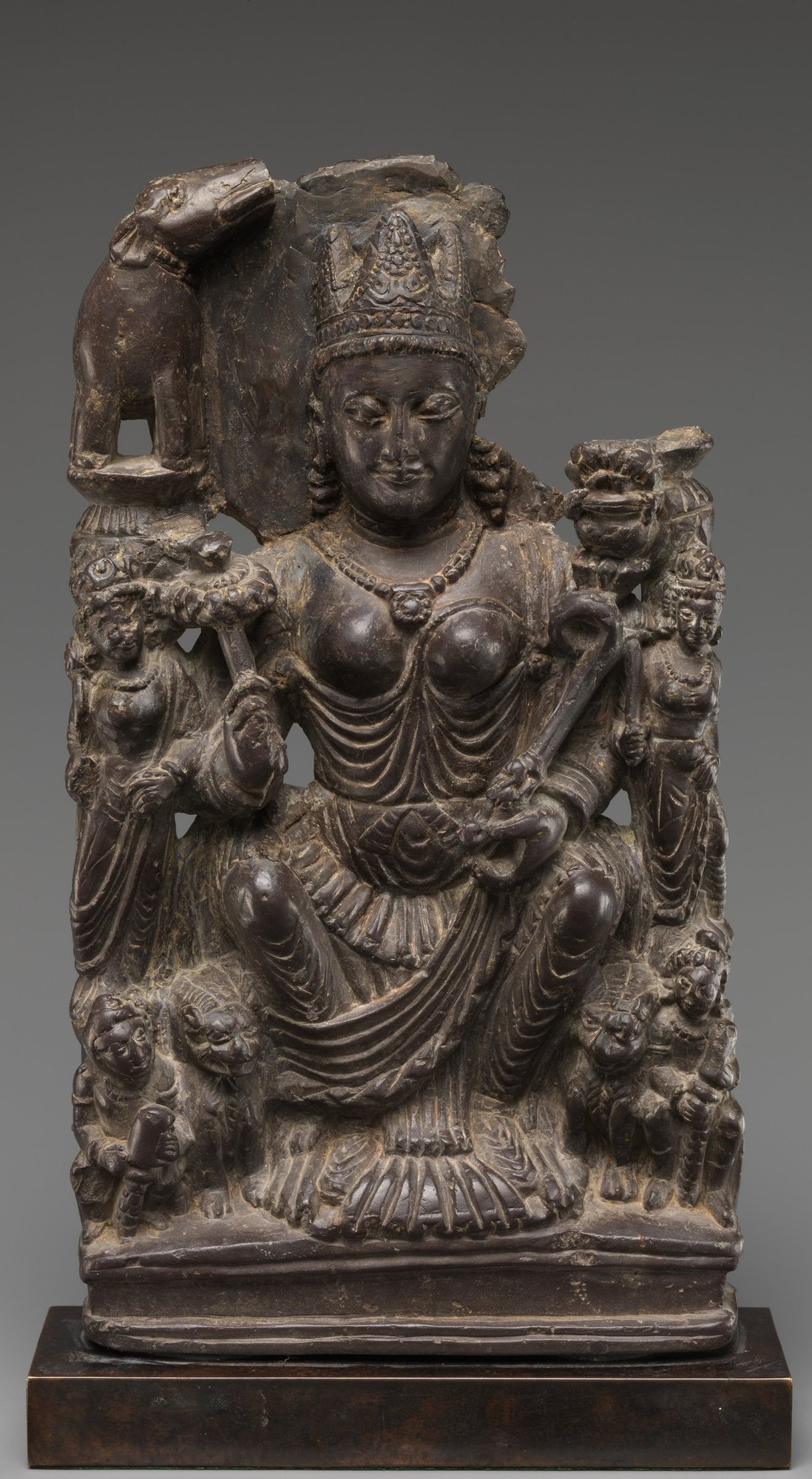
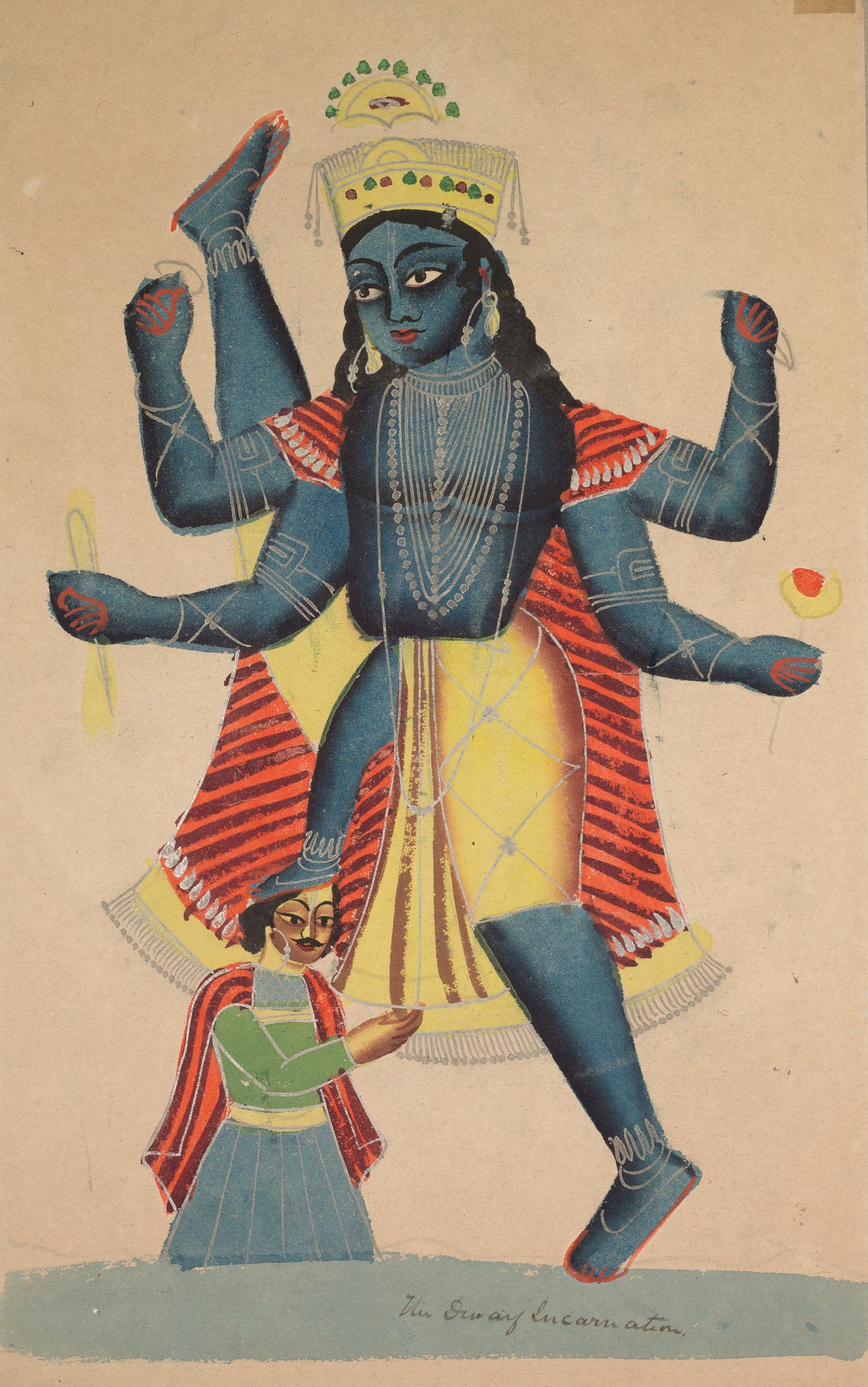
Three steps, and the universe was measured. Before he was the great god who sleeps on the coils of a world-serpent, before he was the lord who descends into flesh whenever the world tips into ruin, Vishnu was a strider. The oldest hymns of the Ṛgveda, sung more than three thousand years ago, know him mainly for a single tremendous act: with three paces he stepped out the whole of creation, planting his foot in the earth, in the middle air, and in the highest heaven, so that everything that lives has its dwelling somewhere inside those three enormous footprints.
He was a minor god then, not yet the supreme lord he would become, and it is worth resisting the urge to read the later greatness back into these verses. But the image the Vedic poets gave him never left. The whole of the world, they said, was gathered up in the dust of his footstep, and at the summit of his stride, in that highest place no eye can follow, there springs a well of honey.
The poets reach for something wild to describe him. He is no gentle keeper of order here but a dread thing, prowling and mountain-roaming, the Bull far-striding whom none can deceive, who makes three steps and by them lays down his high decrees for the cosmos. That is the seed. Everything Vishnu later becomes grows out of this one gesture of a god so vast that three of his strides contain the sky.
Soaked into every corner
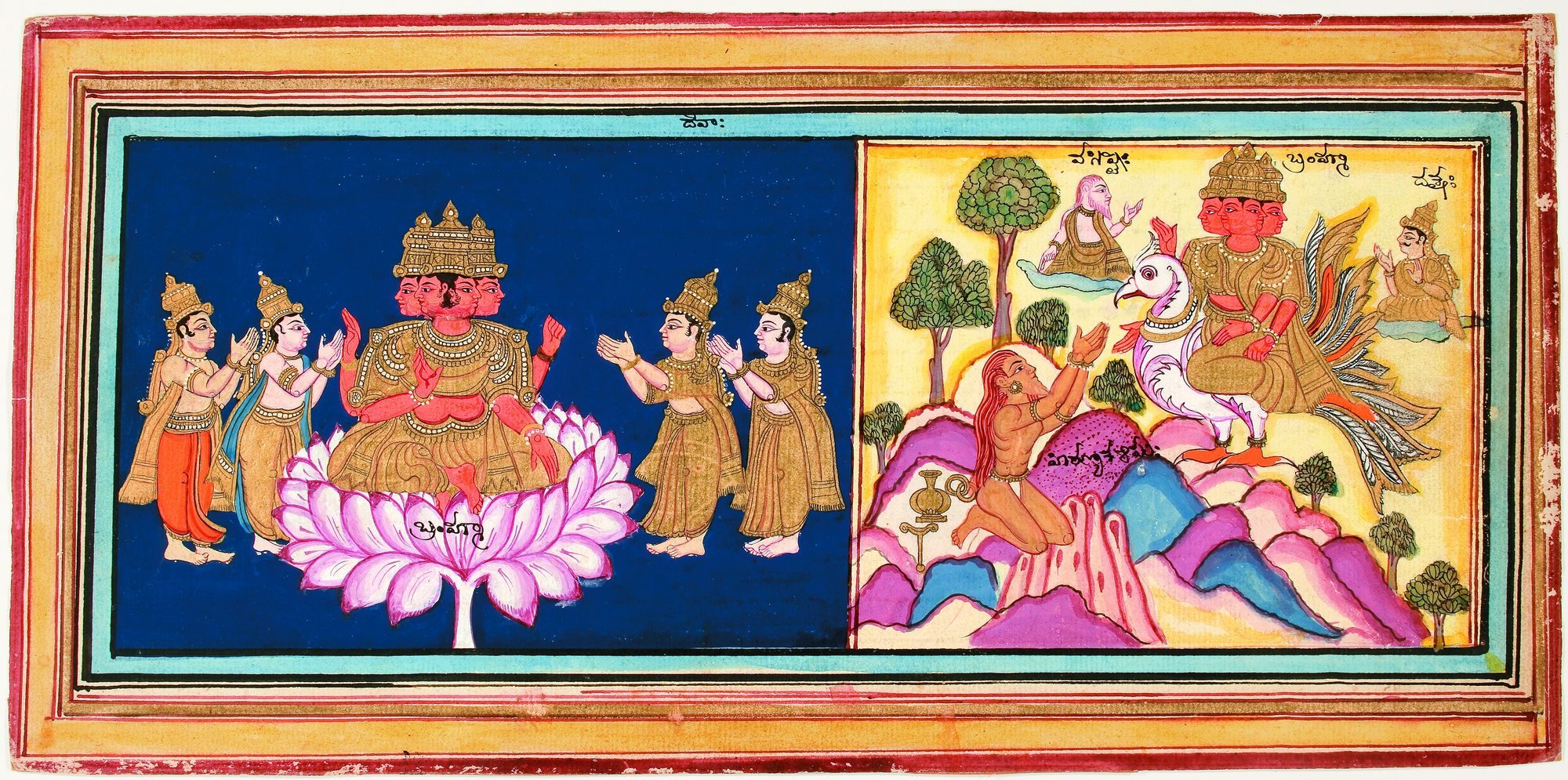
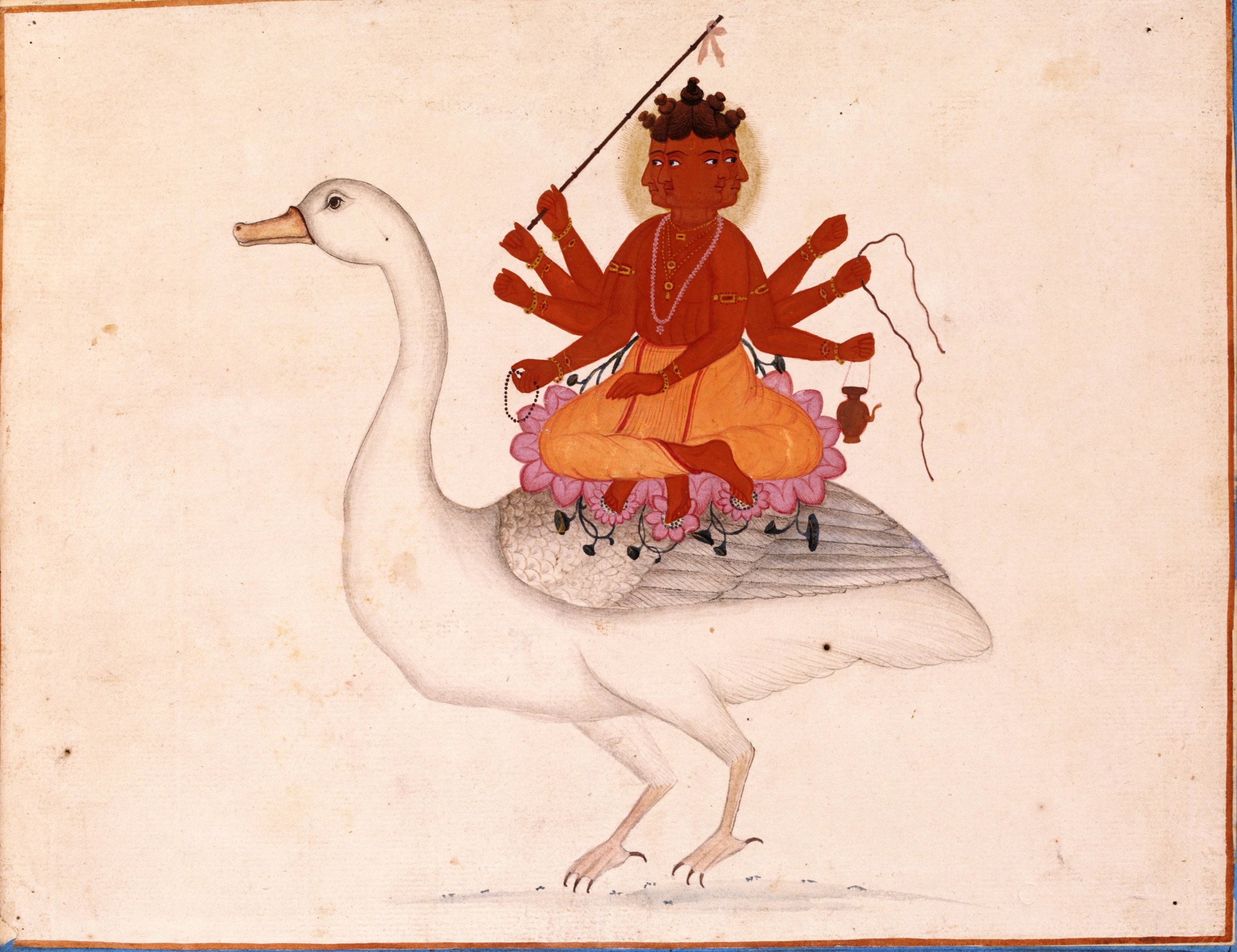
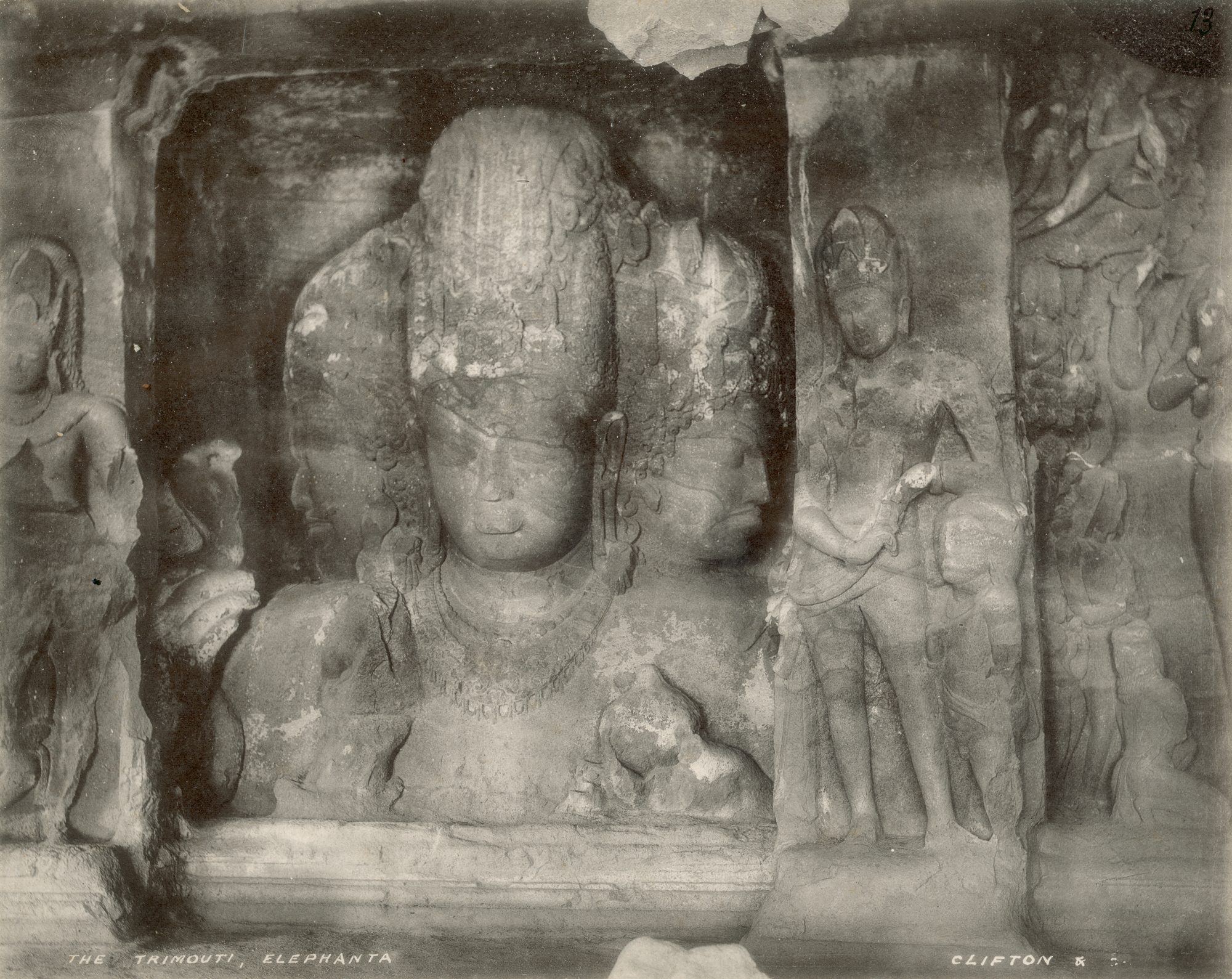
Over long centuries the minor strider rose to become one of the supreme deities of Hinduism, gathering to himself the worship of other gods and other names until he stood as the preserver of the whole cosmos. In the classical scheme he is the second of three great functions: Brahmā brings the world into being, Śiva will one day unmake it, and Vishnu, in between, holds it together and keeps it running. The Vishnu Purāṇa states the office plainly.
In a portion of his essence, associated with the quality of goodness, he is the preserver of the world, sustaining what has been created against the pull of chaos. His very name carries the claim. The Purāṇa derives it from the root viś, meaning to enter or to pervade, because the energy of the god has soaked into every corner of what exists. He is not a ruler enthroned above the world so much as the substance holding it up from within; the gods and sages and law-givers, the text says, are all of them only the impersonated might of Vishnu.
When order collapses, he comes down
To hold a world together, though, is not a passive thing, and here the tradition gives Vishnu his signature doctrine. When order collapses, he comes down. The word is avatāra, a descent: the eternal god taking on a bodily form and walking into the world to break the power of evil and set right what has gone wrong. The great statement of it comes in the Bhagavad Gītā, where the god, speaking through Kṛṣṇa on the eve of a battle, lays out the pattern of his own returns.
When righteousness declines and wickedness grows strong, he says, he rises from age to age and takes visible shape, moving as a man among men, guarding the good and thrusting the wicked back and setting virtue once more upon her seat. The paradox at the centre of this is deliberate and the tradition guards it closely. He is unborn, undying, indestructible, the lord of all that lives, and yet he takes birth, again and again, by his own power, his own maya or magic. These are not the ordinary births of a soul caught in the wheel of the world. They are the deliberate descents of a god who was never truly born at all.
The Vishnu Purāṇa maps these descents onto the four great ages of the cosmic cycle, the yugas, so that his coming answers the particular sickness of each age. In the first and best age he arrives as the sage Kapila and other teachers, handing down wisdom. In the second he restrains the wicked in the form of a universal monarch.
In the third, as Veda-Vyāsa, he takes the single unwieldy Veda and divides it into four so that a weakening humanity can still carry it. And at the end of the fourth and worst age, our own degenerate Kali age, he will appear as Kalki to end it and set the wayward back on the path of righteousness, closing one turn of the wheel so another can begin.
And then the dwarf grew
Of all these descents, one keeps the oldest memory alive, and it is a marvel of how a tradition folds back on itself. The demon-king Bali, through fierce penance, had overpowered Indra and the gods and seized dominion over all three worlds. At the gods’ plea, Vishnu was born as Vāmana, a dwarf, and came before the mighty Bali to beg a small alms: only as much ground as he could cover in three steps. Bali, amused by so humble a request, granted it. And then the dwarf grew.
He swelled until he was vaster than the sky, and with three strides he stepped across the whole of the three worlds, taking back everything Bali had won, leaving the demon-king only the underworld to rule. Look at what has happened. The three steps by which the ancient Vedic god measured out the universe have returned as the three steps by which the dwarf reclaims it from a usurper. The oldest image of Vishnu, the strider whose footprints hold the sky, is reborn as the central act of one of his most beloved descents. This is no modern scholar’s clever parallel; the through-line runs in the texts themselves.
The eighth and ninth places
Later tradition counts ten of these descents as the principal ones, the Daśāvatāra, and lists them in an order that runs from the depths of the sea up toward the human world: the Fish, the Tortoise, the Boar, the Man-Lion, the Dwarf, then Paraśurāma, Rāma, Kṛṣṇa, the Buddha, and finally Kalki, who has not yet come. But the number is a convenience, not a fence. The Bhāgavata tradition holds that Vishnu’s descents are in truth beyond counting; the famous ten are only his fullest incarnations, and many more are partial. Nor is the list itself fixed. Which figures fill the eighth and ninth places shifts from sect to sect and region to region.
The northern Bhāgavata line places Kṛṣṇa eighth and the Buddha ninth; other traditions, among them the Śrī Vaiṣṇavas, omit the Buddha altogether and set Balarāma and Kṛṣṇa in those seats. The Buddha’s very inclusion, a Hindu embrace of the founder of a rival faith, was contested from the start and remains so. And in the devotional streams that centre on Kṛṣṇa, the whole order is turned inside out: there Kṛṣṇa is not the eighth descent of Vishnu at all but the original supreme godhead from whom Vishnu and every avatar flows. These are living disagreements, not errors to be tidied away, and the tradition has always carried several answers at once.
Asleep on the coils of Śeṣa
Between the great cycles, when one creation has run its course and the next has not yet begun, Vishnu rests. Having drawn the three worlds back into himself, he becomes Nārāyaṇa and lies asleep upon the ocean, stretched along the coils of the endless multi-headed serpent Śeṣa, also called Ananta, the endless.
Through the long night of dissolution he sleeps, and when he wakes the world is made anew. It is the perfect emblem of what he is. The other gods create and destroy; Vishnu is the one who keeps, and even in the interval when there is nothing left to keep, he holds the sleeping seed of the next world safe upon the water until it is time to stride out and measure it all over again.
When Righteousness / Declines, O Bharata! when Wickedness / Is strong, I rise, from age to age, and take / Visible shape, and move a man with men, / Succouring the good, thrusting the evil back, / And setting Virtue on her seat again. (Bhagavad Gītā 4.7–8, tr. Edwin Arnold, The Song Celestial)
- Ṛgveda 1.154 (Griffith trans., Hymns of the Rigveda)the definitive
three strides
hymn — Vishnu measures out the earthly regions and props the highest heaven,thrice setting down his footstep, widely striding
; all living creatures have their habitation within his three wide paces;the whole was gathered in his footstep’s dust
; the highest footstep as a well of honey (meath
); and Vishnu likened to a dread, prowling,mountain-roaming
beast,the Bull far-striding.
- Ṛgveda 1.22.16–21 (Griffith)
thrice his foot he planted
; Vishnu the Guardian,he whom none deceiveth,
establishing his high decrees; his sublime highest station laidas it were an eye in heaven.
- Bhagavad Gītā 4.6–8 (within the Mahābhārata; Edwin Arnold, The Song Celestial)the locus classicus of the avatāra doctrine — though
unborn, undying, indestructible, the Lord of all things living,
the god takes birthby Maya, by my magic,
andwhen Righteousness declines… I rise, from age to age, and take visible shape… setting Virtue on her seat again.
Note that Arnold’s rendering is an elegant but loose Victorian verse paraphrase, quoted here for its imagery; a more literal translation of 4.7–8 runs closer toWhenever there is a decline of dharma… I manifest Myself; for the protection of the good, the destruction of the wicked, and the establishment of dharma, I am born age after age.
- Vishnu Purāṇa, Book III, ch. ii (H. H. Wilson trans., with Fitzedward Hall’s notes)Vishnu as preserver of the world
in a portion of his essence, associated with the property of goodness
; the name derived from the root viś,to enter
orpervade,
because the whole world has been pervaded by the god’s energy; the yuga-appearances (Kapila and teachers of wisdom in the Kṛta age; the universal monarch whorestrains the wicked
in the Tretā; Veda-Vyāsa dividing the one Veda into four in the Dvāpara; Kalki at the end of the Kali age, whoreestablishes the iniquitous in the paths of rectitude
); Nārāyaṇa sleeping on the serpent Śeṣa/Ananta amid the ocean between world-cycles; and the gods, Manus and Ṛṣis asthe impersonated might of Vishnu.
- Vishnu Purāṇa (Wilson)the Vāmana episode (summarising Bhāgavata Purāṇa VIII.15–23) — the demon-king Bali wins
supreme dominion over the three spheres
; Vishnu is born the dwarf Vāmana, son of Aditi by Kaśyapa, begsas much space as he could step over at three steps,
and enlarges himselfto such dimensions as to stride over the three worlds,
conceding the underworld (Pātāla) to Bali; with Vishnu’s iconographic attributes (the discus, the conch/shell, the mace and the sword;lotus-eyed
;supporter of the earth
). Wilson’s own notes tie the dwarf’s three steps to the Vedic three strides of RV 1.154. - Garuḍa Purāṇa Sāroddhāra, ch. VIII, vv. 10–11 (Wood & Subrahmanyam, 1911)the canonical ten-name Daśāvatāra list —
The Fish, the Tortoise, the Boar, the Man-Lion, the Dwarf, Parasurama, Rama, Krisna, Buddha, and also Kalki.
Obtained via a reliable secondary source rather than the 1911 edition in this pass; the content of the list is uncontroversial, but the exact quoted wording and verse numbers should be re-verified before printing verbatim. - Bhāgavata Purāṇa 1.3 and VIII.15–23the enumeration of Vishnu’s incarnations (the ten as the
full
descents, the avatars effectively countless) and the Vāmana/Bali narrative — read here in Wilson’s Vishnu Purāṇa summary, not in the Bhāgavata’s own wording, which was not consulted verbatim in this pass.