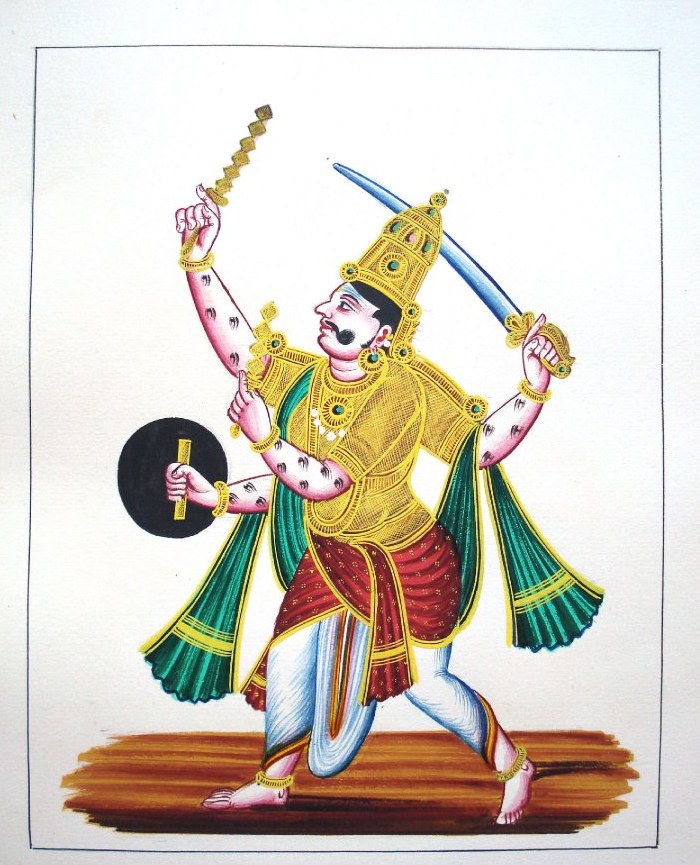
The waters would not run. Somewhere on the flank of a mountain the great dragon lay coiled over the springs of the world, and the rivers stood dammed behind him, and the earth went thirsty. Then a god drank. Impetuous as a bull he chose the Soma and drank the pressed juices from three sacred beakers, and he took up the weapon that had been made for exactly this. The divine craftsman Tvashtar had forged it: a bolt of thunder, golden, hundred-jointed, falling with a thousand points. With it in his grasp the god went up against the serpent, and the oldest hymn of his people opens on the first great thing he ever did. I will declare the manly deeds of Indra, the poet sings, the first that he achieved, the Thunder-wielder. He slew the dragon, then disclosed the waters, and cleft the channels of the mountain torrents.
Waters penned behind him
The dragon was called Vritra, the Encloser, and also Ahi, the Serpent, the firstborn of the dragons, and his whole nature was to shut things up. He held the cosmic waters penned behind him on the mountain, and while he held them nothing could flow and nothing could grow. Indra broke him. The bolt came down and split the serpent, and the imprisoned waters rushed out at once and ran, the hymn says, lowing like cattle, streaming down to the ocean. What had been sealed was opened, and that is the shape the whole Rig Veda returns to: Indra is the one who breaks open what has been closed.
The kill itself the hymns tell without flinching. Vritra, though he had neither foot nor hand, still dared to challenge his enemy, and Indra smote him with the bolt between the shoulders. Emasculate yet claiming a hero’s strength, the dragon lay with his limbs scattered and dissevered. He went down as a tree goes down: as trunks of trees, the poet says, what time the axe has felled them, low on the earth so lies the prostrate dragon.
And then the released waters, which he had held back so long, closed over him. Like a bank-bursting river they flowed above his body, and the dragon who had penned the floods lay drowned beneath them. Nor was Vritra the only one to fall. Indra cast the bolt at his mother Danu as well, and she was left lying over her dead son like a cow beside her calf.
Why the drinking comes first
The Soma-draught is the engine of the whole feat. In hymn after hymn the drinking comes first and the killing follows. The mighty flowing Soma-draught, one hymn declares, brought by the Hawk, has gladdened you, so that in your strength, O Thunderer, you have struck down Vritra. And the bolt that the draught empowers is a thing of terror in its own right. When Tvashtar turns it on his forge it comes out golden and thousand-edged, and Indra receives it to perform heroic deeds. Around the god as he fights ride the Maruts, the storm-gods, sons of Rudra, his war-band of the winds; Marut-girt, the hymn calls him, striking fierce on the trembling dragon’s back.
A fear seized his heart
What follows the victory is one of the strangest turns in all the hymns, and the Veda does not hide it. Having killed the dragon, Indra flees. A fear seized his heart the moment the deed was done, and like a hawk affrighted through the regions he crossed nine-and-ninety flowing rivers in his flight.
The old commentators explain that he ran believing he had committed some great sin in the killing: a seam of dread running through the very triumph, the slayer bolting in terror across the world he has just set free. The number should not be pressed too hard; nine-and-ninety in this poetry means simply a great many, not a tally. But the fear is real, and the singers kept it.
Spokes contained within the rim
Set against that flight is the sovereignty the deed wins him. By this killing Indra becomes king, and the Rig Veda says so in the plainest terms it has. Indra is king of all that moves and moves not, the hymn proclaims, of creatures tame and horned, the Thunder-wielder; over all living men he rules as sovereign, containing all as spokes are contained within the rim of a wheel. This is the line that makes him King of the Gods, and the crown rests on the dragon-slaying. He is sovereign not by inheritance but because he did the thing no other could, and the released rivers are his warrant.
His pedigree the hymns give plainly enough. His father is Dyaus, the Sky, of whom one hymn says that he too esteemed himself a hero. Yet a darker, marginal strand runs alongside, in which Indra is born abnormally, emerging from his mother’s side, and in which he seizes his own father by the foot and slays him. It sits oddly beside the honoured-father verses, and the Veda simply lets both stand.
One distinction the hymns keep, and so should we: freeing the waters from Vritra is one deed; splitting the rock-cave of Vala to drive out the hidden cattle and release the dawn is another. Both are Indra breaking into what was sealed, but the enemies and the spoils differ, waters in the one and cattle and light in the other.
No personified rain-cloud
It is easy, from a distance, to read this dragon-fight as a weather report, and the old scholars did. Vritra, on their reading, is nothing but the massed vapour shut up in a cloud, and Indra with his thunderbolt divides the mass so the pent rain can fall. The imagery of dammed waters and bursting floods invites it, and it has been attached to the hymn since Wilson and Sāyaṇa.
But it is a later gloss laid over the poem, not the poem’s own voice. The hymn itself gives us a dragon, coiled and footless and firstborn, dying with his limbs strewn on a mountain. The Rig Veda’s Indra is no personified rain-cloud; he is a storm-king with a forged thunderbolt and a belly full of Soma, and the thing he kills is a serpent.
One caution belongs at the end, because the name Indra carries so much later baggage. He is not yet the diminished figure of the later epics and Puranas, ranked beneath a higher trinity, remembered for his lusts and his cowardice, his body marked all over as a sign of shame. None of that moral downgrading is here. Nor does the Vedic Indra ride the famous white elephant; that mount belongs to the later tradition. In these oldest hymns he drives two tawny bay steeds, and the rivers run because he willed them to.
I will declare the manly deeds of Indra, the first that he achieved, the Thunder-wielder. He slew the Dragon, then disclosed the waters, and cleft the channels of the mountain torrents. (Rig Veda 1.32.1, tr. Ralph T. H. Griffith, The Hymns of the Rigveda)
- Rig Veda 1.32 (Griffith trans., The Hymns of the Rigveda, Vol. I)the archetypal Vritra-slaying hymn —
I will declare the manly deeds of Indra, the first that he achieved
; the dragon coiled on the mountain damming the waters;his heavenly bolt of thunder Tvashtar fashioned
; the Soma drunkin three sacred beakers
; Vritrafootless and handless
struckbetween the shoulders
and felledas trunks of trees
; the waters flowingabove him
asa bank-bursting river
; the mother Danu slain and leftlike a cow beside her calf
; the flightlike a hawk affrighted
acrossnine-and-ninety flowing rivers
; the Seven Rivers loosed; andIndra is King of all that moves and moves not… containing all as spokes within the felly.
Griffith’s notes identify Danu as Vritra’s mother (per Sāyaṇa), glossnine-and-ninety
asused indefinitely for a great number,
and preserve the tradition that Indra fledthinking that he had committed a great sin in killing Vritra.
- Rig Veda 1.80 (Griffith, same edition)the Soma-empowered slaying —
The mighty flowing Soma-draught, brought by the Hawk, hath gladdened thee, that in thy strength, O Thunderer, thou hast struck down Vrtra
; the hundred-jointed,thousand
-pointed golden bolt;Smote fierce on trembling Vrtra’s back
;Indra, Thunderer, Marut-girt, thou slewest Vrtra
; the ninety floods; and the war-shout at whiche’en Tvashtar trembled.
- Rig Veda 2.12 (Griffith, same edition)the
He, O men, is Indra
hymn —He who fixed fast and firm the earth that staggered, and set at rest the agitated mountains, who measured out the air’s wide middle region and gave the heaven support, He, O men, is Indra
; the freeing of the Seven Rivers; the cave of Vala and the cattle driven forth; the foes Śambara and Rauhiṇa; and the doubt-and-affirmation refrain,Of whom, the Terrible, they ask, Where is He?… He, O men, is Indra.
- Rig Veda 4.17 (Griffith, same edition)names Dyaus the Sky as Indra’s father —
Thy Father Dyaus esteemed himself a hero: most noble was the work of Indra’s Maker
— and repeats the Vritra deed with the cosmic-tremor imagery. - Rig Veda 4.18 (Griffith, same edition)the marginal, darker birth-strand — Indra born abnormally, emerging
from the side
and hidden by his mother, and the obscure line in whichby the foot thy Sire thou tookest and slewest
; and the Falcon thatbrought me the pleasant Soma.
Recorded here as a genuine but marginal Vedic variant, not smoothed into the honoured-father version. - Rig Veda 1.85 (Griffith, same edition),
The Maruts
the storm-gods asRudra’s Sons
/Sons of Prsni
and Indra’s war-band; and Tvashtar’s forging of the weapon —When Tvastar deft of hand had turned the thunderbolt, golden, with thousand edges… Indra received it to perform heroic deeds. Vrtra he slew
(1.85.9). - Interpretive note (Wilson and Sāyaṇa, preserved in Griffith’s footnotes to RV 1.32)the weather-allegory reading in which
Vritra… is nothing more than the accumulation of vapour… shut up in, or obstructed by, a cloud,
released as rain when Indra’s boltdivides the aggregated mass
— given here as later scholarship, not as the plain narrative of the hymn.