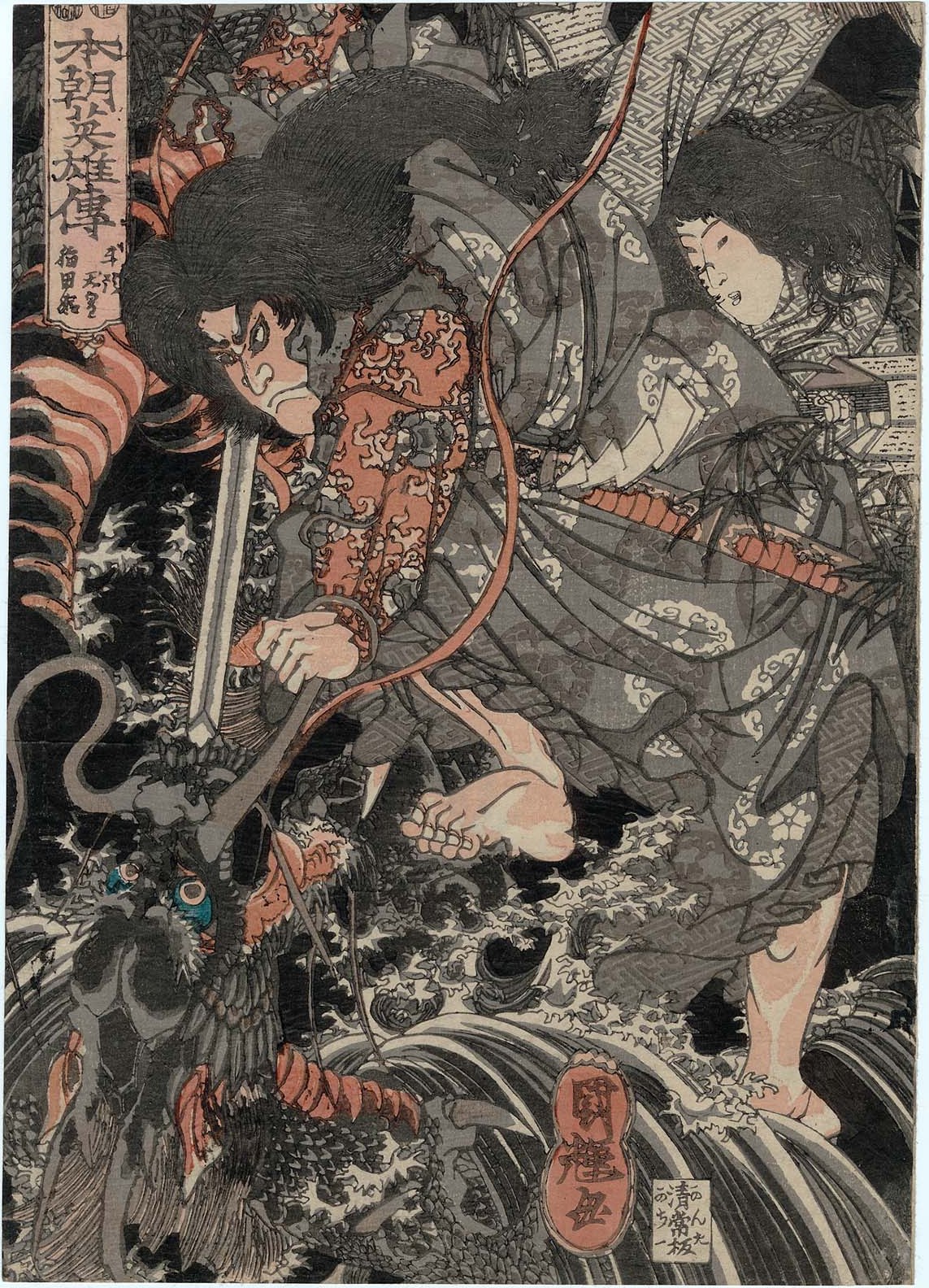
A flayed horse came down through the roof of the weaving-hall. This is the Japanese cave episode recorded in the Kojiki and Nihon Shoki: Amaterasu’s withdrawal turns a family outrage into a crisis of daylight, while the two chronicles preserve different details of the wound and the rescue. Susanoo had broken the tiles and flung it in, a piebald colt of Heaven stripped of its hide, and it landed among the looms where the divine garments were being woven. At the shock of it Amaterasu drove the shuttle into her own flesh. This last outrage of her brother’s she would not bear. The Sun-Goddess rose, walked to the Heavenly Rock-Dwelling, went in, and pulled the stone door shut behind her. She bolted it and stayed.
And so the sun went out. This is the moment the chronicles stop treating her as merely a queen who takes offence and show what she is: with Amaterasu sealed inside the rock, constant darkness fell over the whole world. The alternation of night and day was unknown. In the Kojiki’s phrase the voices of the gods afterwards were like flies in the fifth moon as they swarmed, and a myriad portents of woe all arose. There was no dawn to argue with the dark, because the dawn was behind a bolted stone.
Everything hangs, in the older Nihon Shoki tradition, on who exactly was at that loom. In one variant it is not Amaterasu but a younger sun-female, Waka-hiru-me, who is weaving when the horse falls; she tumbles from the loom, wounds herself with the shuttle, and dies, and it is only then that Amaterasu, refusing to look on Susanoo face to face, retires into the cave. Either way the loom is the pivot of the whole disaster, and either way the light is gone.
The council in the dry river
There is nowhere to hold a meeting in a world without light except by feel, and the gods gathered where gods gather in these stories: the bed of the Tranquil River of Heaven, the stony riverbed that lies dry except in flood. The Kojiki counts them at eight hundred myriads, the Nihon Shoki at eighty myriads. Neither is a census. Both are old idioms for a host beyond counting, and that is the point, a countless crowd assembled in a dark riverbed to work out how to get the sun back.
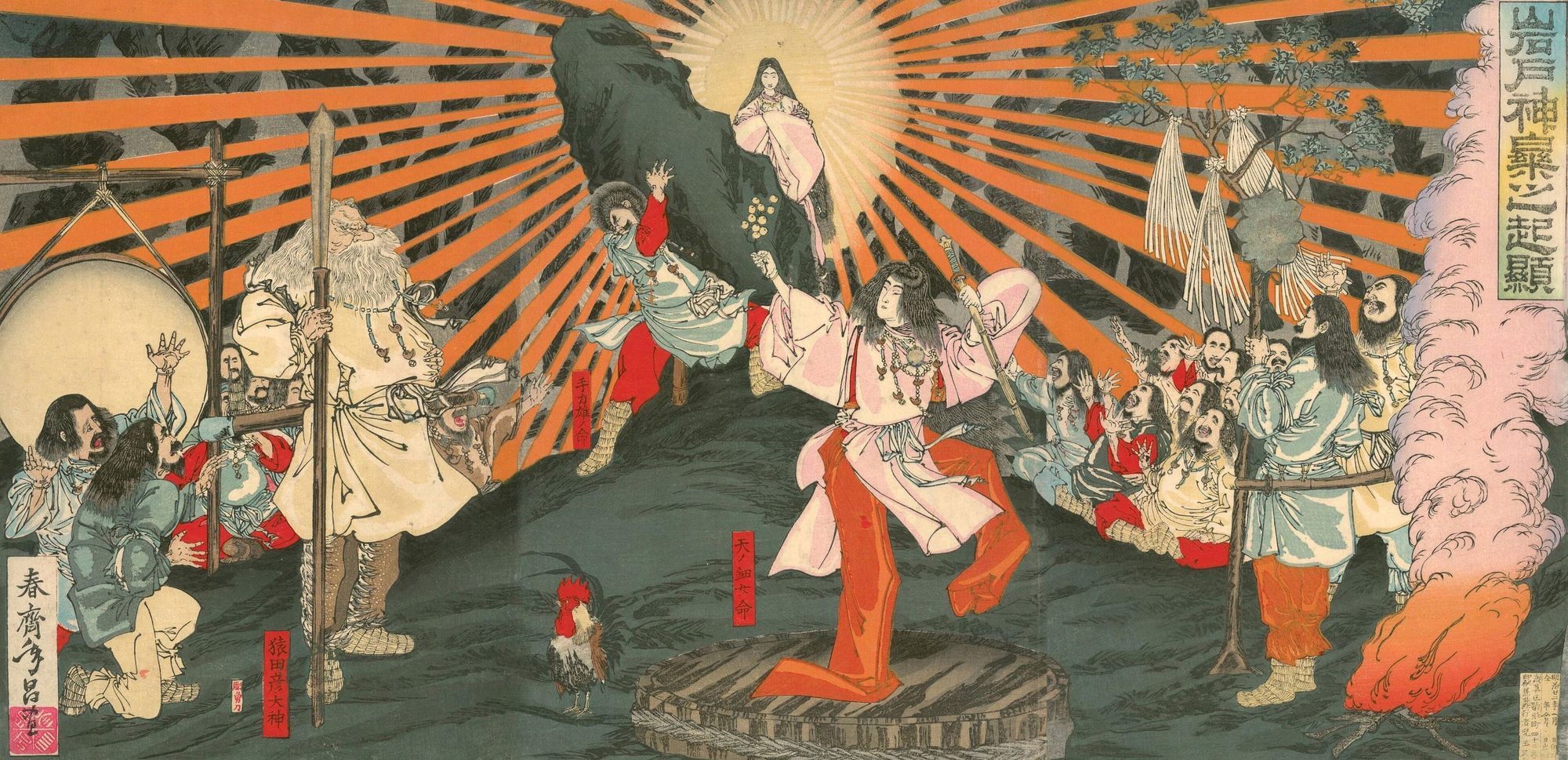
The one who worked it out was Omoikane, whose name means something like Thought-Includer, the deity of counsel. The Nihon Shoki credits him with profound device and far-reaching thought, and what he devised was not an assault on the door. You cannot break the sun out of a cave. He devised a performance, staged so well that the goddess inside would open the door herself.
First they made the dawn seem to arrive on its own. They gathered the long-singing birds of the Eternal Land, the cocks, and set them crowing before the cave as they crow at daybreak. This is the mythic root of the crowing cock at dawn: the first cock crew to summon a sun that had chosen not to rise.
The tree dressed as an offering
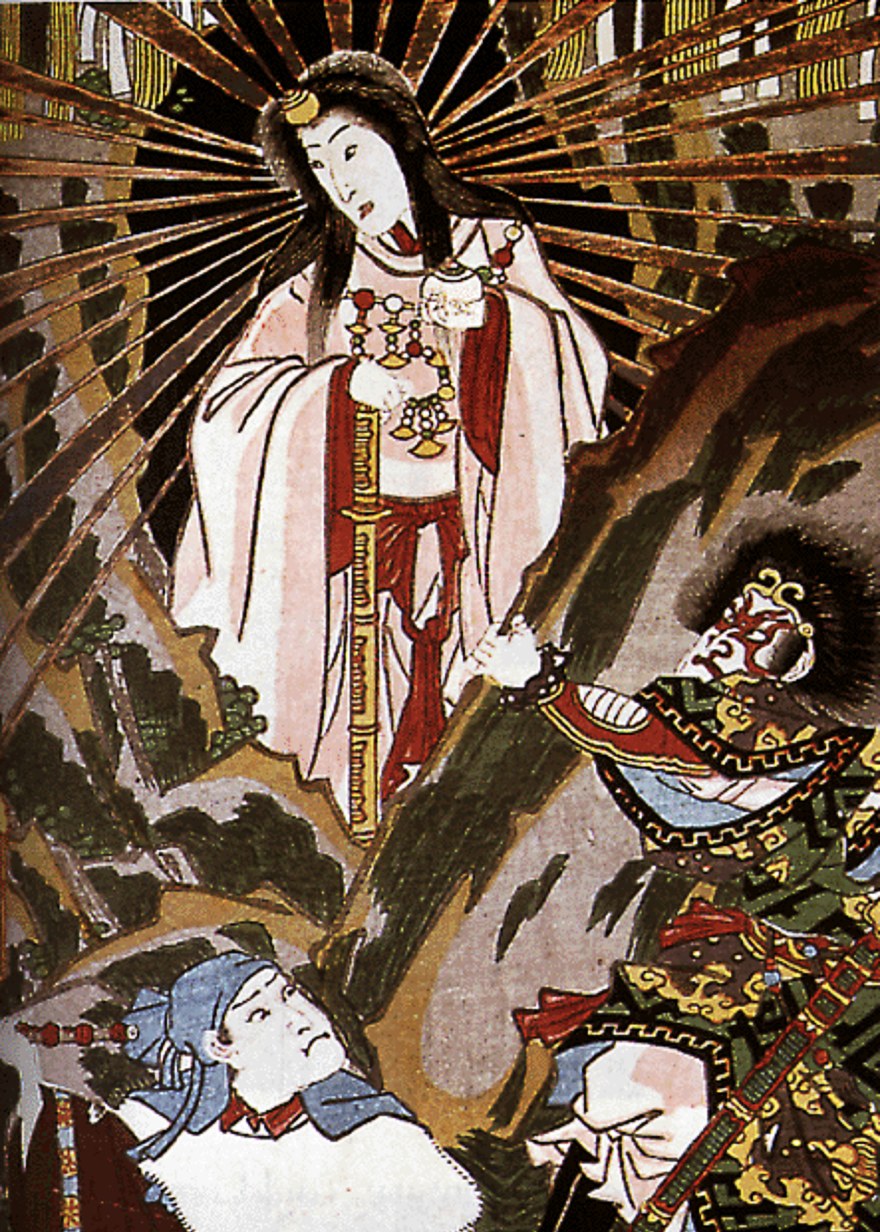
Then they built the lure. A smith was set to forge a mirror, and a jeweller to string five hundred curved magatama beads eight feet long, and the gods uprooted whole a five-hundred-branched Sakaki tree from the Heavenly Mount Kagu. They dressed it like a cosmic offering-stand: the long string of jewels on its high branches, the mirror on the middle branches, and streamers of white and blue cloth, the ancestors of the paper gohei that still hang at shrines, on the branches below. Ame-no-Koyane recited the liturgy. Off to the side, out of the goddess’s line of sight, the strong god Tajikarao, Hand-Strength-Male, took up his station beside the stone door and waited.
The mirror is worth pausing on, because the sources quietly disagree about it. In the Kojiki it is forged of iron; a Nihon Shoki variant has the smith Ishikoridome take copper from Mount Kagu and make not a mirror at all but a sun-spear, an image of the goddess. The plainer point survives the disagreement. This is the eight-hand mirror, the yata-no-kagami, the very mirror later honoured at Ise as the emblem of the sun-goddess. They forged her a face and hung it in a tree in the dark.
The dance that shook Heaven
The lure needed a performer, and Ame-no-Uzume made herself the whole show. The Dread Female of Heaven wreathed herself in the club-moss and leaves of Mount Kagu, took bamboo-grass or a spear in her hands, and turned over a tub before the cave to stand on. Then she danced as if a god had entered her.
In the Kojiki she stamps on the sounding-board until it booms, and she pulls out the nipples of her breasts and pushes her skirt-string down past all decency; the Nihon Shoki gives a mimic dance and a divinely-inspired utterance and passes over the stamping. What every version keeps is the effect. The eight hundred myriad gods roared with laughter, and the laughter shook the Plain of High Heaven.
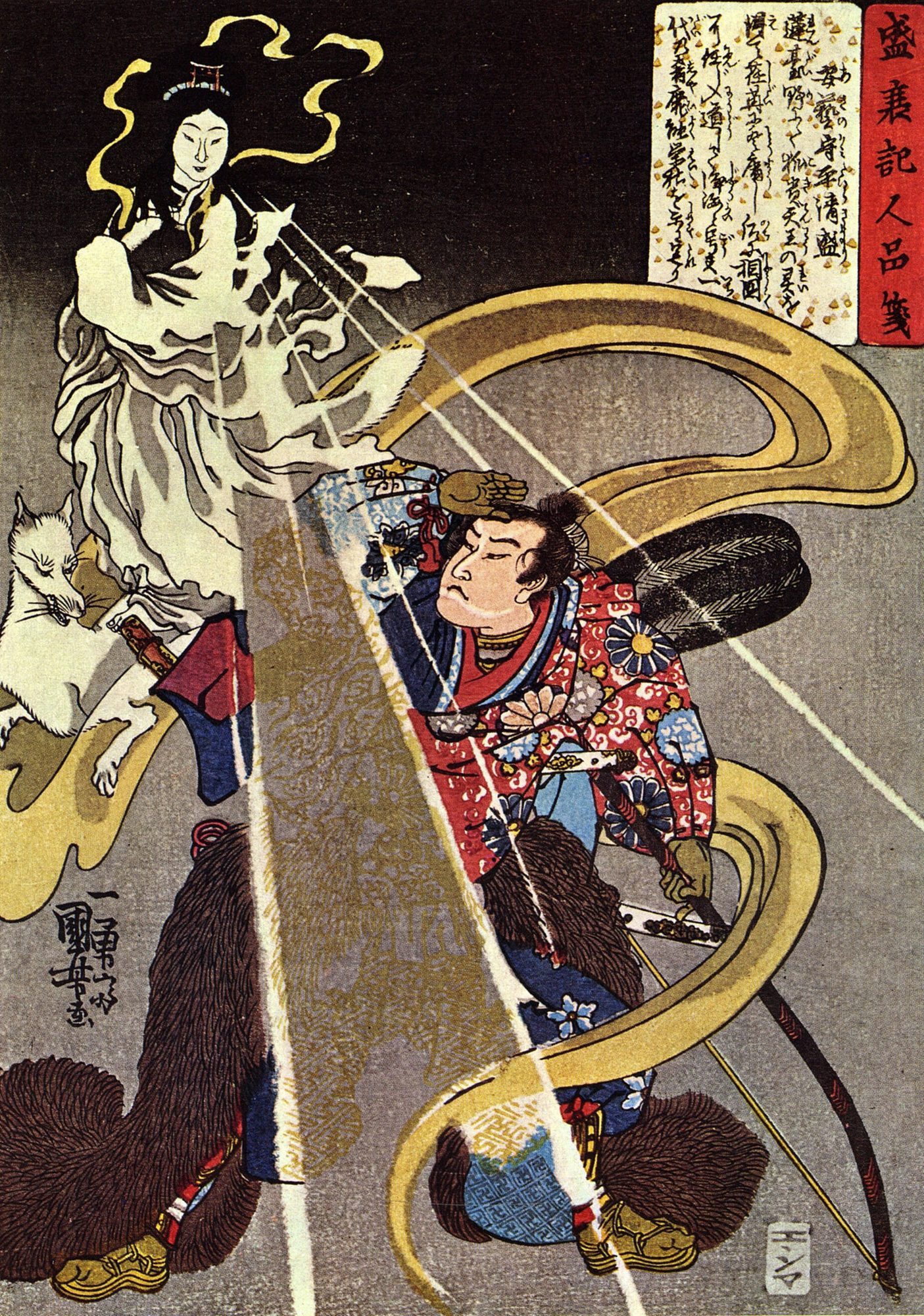
That was the sound Amaterasu could not account for. She had left Heaven and Earth in darkness, and here was the whole host of the gods roaring with merriment as though something wonderful were happening without her. Curiosity did what force could not. She opened the stone door a narrow crack and called out to ask how Uzume could be dancing, and the gods laughing, while she made the world dark. Uzume answered that they rejoiced because a deity more illustrious than Amaterasu had appeared among them.
The face in the mirror
As the goddess puzzled at that, Ame-no-Koyane and Futodama pushed the mirror forward and held it up to the crack in the door. She saw a radiant face gazing back, took it for the rival deity she had just been told about, and, astonished, came further out to look. This is the Kojiki’s ruse, and it belongs to the Kojiki: the Nihon Shoki’s main account skips it and simply has Tajikarao take her hand once she peeps out at the merriment. But in the fuller telling it is the neatest turn in the whole story. The gods defeated the darkness by showing the sun her own light and letting her mistake it for someone else’s.
The instant she was far enough out, Tajikarao seized her hand from his place beside the door and hauled her into the open. Behind her the gods drew a rope of plaited straw across the mouth of the cave, the shiri-kume-naha, the bottom-tied rope pulled up whole by its roots, and in the Kojiki they told her plainly: thou must not go back further in than this. That straw rope, both Chamberlain and Aston note, is the ancestor of the shimenawa still strung at Shinto shrines to mark off sacred ground. Light came flooding back into Heaven and over the Central Land of Reed-Plains, and the world had its day and night again.
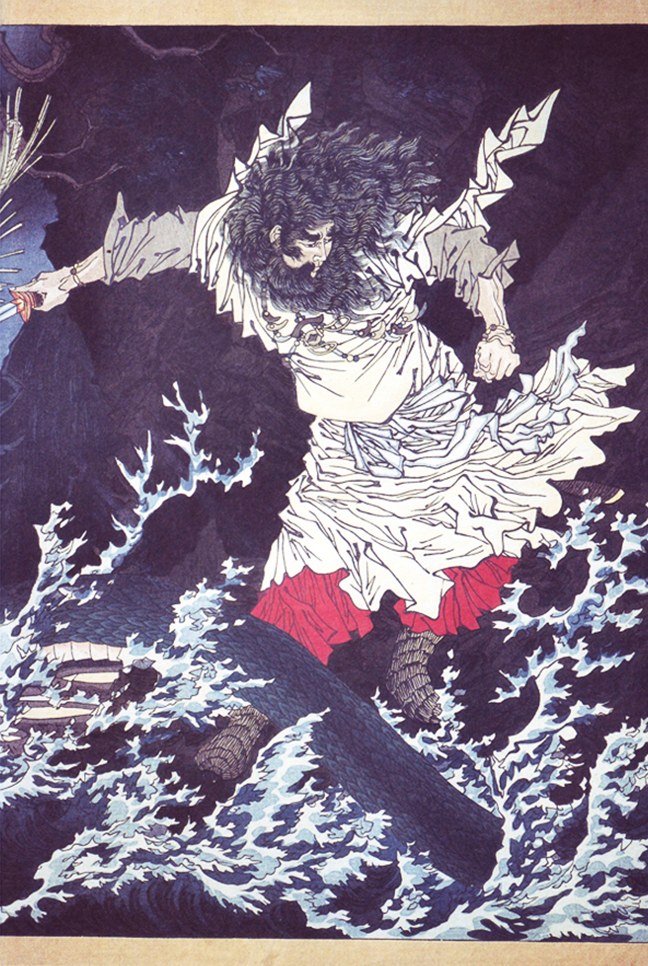
There remained the matter of the god who had started it. The assembly turned on Susanoo. They fined him a thousand tables’ worth of goods in atonement, and then, in the Kojiki, cut off his beard and pulled out his finger- and toe-nails; the Nihon Shoki plucks his hair instead, with a variant that also pulls the nails. Punished and stripped, he was driven out with a divine expulsion, cast down from Heaven. The sun kept her place in the sky. The storm that had put out her light did not.
Then she pushed forward the mirror and respectfully showed it to the Heaven-Shining-Great-August-Deity, whereupon she, more and more astonished, gradually came forth from the door and gazed upon it. (Kojiki, trans. Chamberlain, Sect. XVI)
- Kojiki (Records of Ancient Matters, 712 CE), Sect. XVI,
The Door of the Heavenly Rock-Dwelling
, trans. Basil Hall Chamberlain (1882)the read-verbatim spine of this retelling. The withdrawal into the Rock-Dwelling and the eternal night that follows; the eight hundred myriad deities gathered in the bed of the Tranquil River of Heaven; Omoikane’s plan; the long-singing cocks set crowing; the iron mirror, the five-hundred string of curved jewels eight feet long, and the five-hundred-branched Sakaki of Mount Kagu dressed with jewels on the upper branches, the mirror on the middle, and white and blue cloth below; Ame-no-Koyane’s liturgy; Ame-no-Uzume’s sounding-board dance with the bared breasts and pushed-down skirt-string; the roar of divine laughter that shook High Heaven; the mirror-reflection ruse pushed forward by Ame-no-Koyane and Futodama; Tajikarao seizing her hand; the bottom-tied straw rope (shiri-kume-naha, ancestor of the shimenawa) and theThou must not go back
line; and the return of light. Sect. XVII,The August Expulsion of His-Impetuous-Male-Augustness
: Susanoo’s fine of a thousand tables, the cut beard, the plucked finger- and toe-nails, and the divine expulsion. Read at en.wikisource.org, Kojiki (Chamberlain, 1882) Sections 16–17. - Nihon Shoki (Nihongi, Chronicles of Japan, 720 CE),
The Age of the Gods,
Book I (Aston I.38–I.47), trans. W. G. Aston (1896)the parallel chronicle, read verbatim for the divergences honoured above. The withdrawal (she straightway entered the Rock-cave of Heaven, and having fastened the Rock-door, dwelt there in seclusion
) and the darkness in whichconstant darkness prevailed on all sides, and the alternation of night and day was unknown
; the eighty myriads of gods on the bank (not the bed) of the Tranquil River; Omohi-kane’sprofound device and far-reaching thought
; the long-singing birds of the Eternal Land; the Sakaki, mirror and jewels; Uzume’s eulalia-wreathed mimic dance and divinely-inspired utterance, which the Nihongi gives without the Kojiki’s tub-stamping; Tajikarao taking Amaterasu by the hand and leading her out (the main text does not narrate the mirror-reflection ruse); the Nakatomi and Imbe gods stretching the rope and begging her not to return; and Susanoo’s punishment of a thousand tables and plucked hair, with a nail-pulling variant. Theone writing
variant (I.41 ff.) in which the younger sun-female Waka-hiru-me is wounded at the loom and dies, after which Amaterasu enters the cave. archive.org idnihongi1asto.