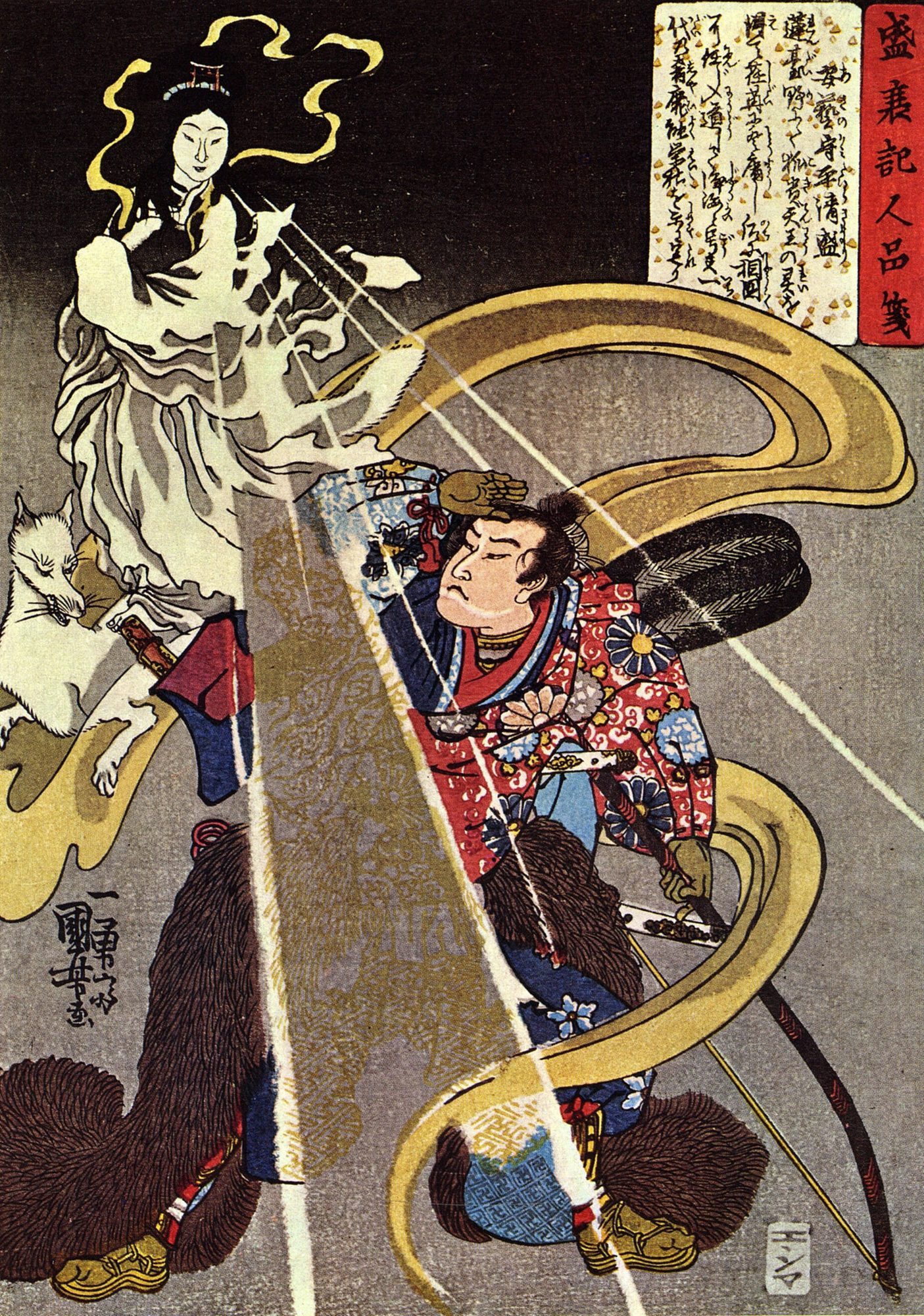
A rich man stood in a field with a bow, and for a target he had set up a rice-cake. He had grown so wealthy on rice that he could waste it, and he loosed his arrows at the white disc of pounded grain for sport. Then the mochi moved. It rose off its stand, changed in the air into a white bird, and flew up to the mountain, and where it came to rest the rice began to grow.
The Japanese word for that, the rice becoming, is ine-nari, and from it the mountain and its shrine took the name they carry still: Inari. This is the oldest story attached to the god of rice, and it is worth noticing at once what it is not. It is no myth of the age of the gods, no creation, no war in heaven. It is the tale of a shrine’s founding, told in a gazetteer, and its moral is agrarian and sharp: rice treated with contempt does not stay to be shot at.
The legend survives in a fragment of the Yamashiro no Kuni Fudoki, an early eighth-century record of the province around Kyoto. The rich man is named Hata no Irogu, ancestor of the Hata, an immigrant clan settled at Fukakusa. When his descendants came to regret the sacrilege, they uprooted a tree from the shrine and replanted it at home as an object of worship, the origin of the sign-cedar still cut at Fushimi today, by which pilgrims read their fortune: a cutting that takes root promises good luck coming, one that withers promises none.
The shrine on Inari Mountain at Fushimi has a traditional founding date of 711, though the historian Kazuo Higo has argued the Hata were worshipping an agriculture-kami here well before that, perhaps as early as the late fifth century.
The god who is not in the old chronicles
Here is the fact that governs everything else, and it is a strange one for so vast a cult. The name Inari does not appear in Japan’s earliest mythology at all. Open the Kojiki of 712 or the Nihon Shoki of 720, the two great chronicles that record the doings of the gods, and Inari is simply not there. As the scholar Karen Ann Smyers puts it flatly in her study of the cult, the name Inari does not occur in classical Japanese mythology. It belongs instead to the world of shrine and gazetteer, first anchored to the Fushimi founding rather than to any story set in the age of the gods.
What the chronicles do contain is rice-and-food deities under other names, and these were only later gathered up into Inari. The kami most often enshrined as Inari at Fushimi is Uka-no-mitama, whose name means the august spirit of food. In the Kojiki she is given a plain genealogy: a child of the storm-god Susanoo and the goddess Kamu-oichi-hime, and younger sibling to Oho-toshi, the Great-Harvest Deity.
That is nearly all the old record says of her. The rich cult-figure of later centuries is assembled around this quiet chronicle-kami and others like her, but the assembly happens after the myths were written down, not within them. To say Inari does something in the Kojiki is to say something false. The honest move is to tell the founding legend as Inari’s own and to give the age-of-the-gods rice myths under the names the chronicles actually use.
The food-goddess and the crops from her body
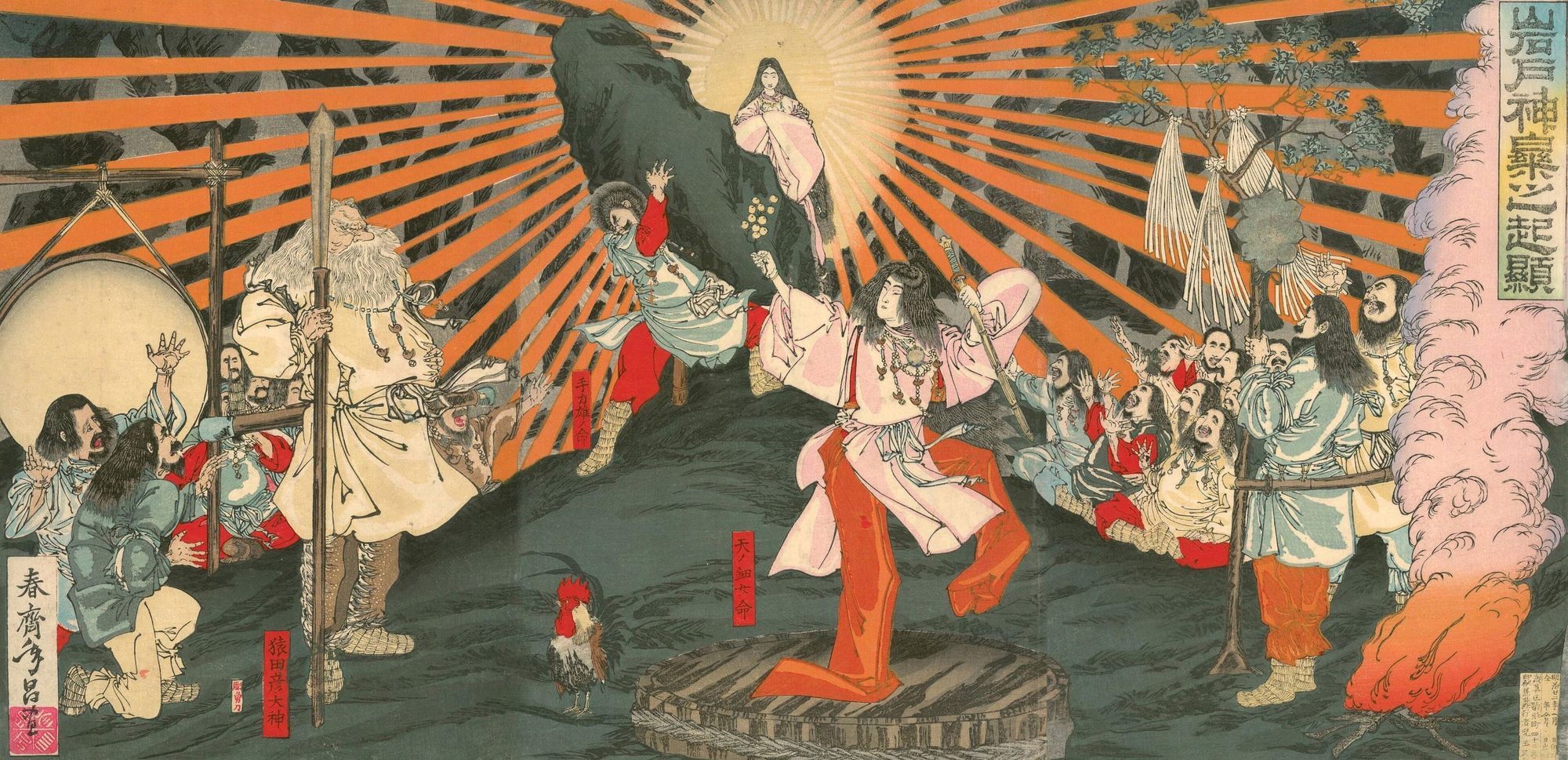
That older myth is worth telling, because it gives rice its divine, visceral origin, and it is a myth the two chronicles cannot agree on. In the Nihon Shoki the food-goddess is Uke-mochi. The Sun-goddess Amaterasu sends the Moon-god Tsukuyomi down to attend on her, and the goddess feeds him in the only way she knows: turning to face the land she disgorges boiled rice from her mouth, turning to the sea she brings forth things broad and narrow of fin, turning to the mountains she produces things rough and soft of hair, and lays the whole banquet out across a hundred tables.
Tsukuyomi sees not hospitality but filth, and kills her for it. Then her corpse becomes the world’s larder. From the crown of her head grow an ox and a horse, from her forehead millet, over her eyebrows silkworms, in her belly rice, and in her lower body wheat and beans. The first heavenly ears of that rice, the chronicle says, hung eight span long and drooping.
The Kojiki tells what looks like the same story and changes almost every particular. There the food-goddess is a different deity, Oho-getsu-hime, Princess-of-Great-Food; her killer is not the gentle moon but the storm-god Susanoo; and the crops fall out of her body in a different arrangement entirely, silkworms from the head, rice-seeds from the two eyes, millet from the ears, small beans from the nose, barley from the genitals, large beans from the fundament, the seeds then gathered up by the deity Kami-musubi.
The chronicles disagree on who dies, who kills, and which part of the body yields which grain. Even the compilers of the Nihon Shoki knew of the rival version and noted it. The rice-god’s deepest myth comes down doubled, and the deity we now call Inari inherited both strands without ever quite reconciling them.
Foxes at the field’s edge
The one image everyone carries of Inari is the fox, and it is the image most in need of correction. Inari is not a fox. The white foxes that flank every Inari shrine, paired in stone with red votive bibs at their throats, are the god’s messengers, the shinshi, and priests of both Shinto and Buddhist tradition are firm that the messenger is not the master, however readily popular belief slides the two together.
The link grew from the fields themselves: foxes seen prowling the rice-paddies at planting and harvest, appearing to inspect the crop, belonged naturally to the rice-kami. Farmers left them offerings of red rice and fried bean-curd, and that second gift is the ancestor of inari-zushi, the pouches of sweet fried tofu whose pointed corners are said to look like a fox’s ears.
The cult that grew around this god outran its agricultural beginnings almost past recognition. From the eighth century Inari acquired a Buddhist life alongside the Shinto one, conflated in her female aspect with the fox-riding Dakiniten, and the court raised her rank across the ninth and tenth centuries. By the Edo period, carried across the country by relocating lords, Inari worship had spread into every trade: patron of blacksmiths and merchants, warriors and actors, of sake and worldly success of every kind. Today something like a third of all the Shinto shrines in Japan, tens of thousands of them, are Inari’s.
A god of no fixed shape
Inari resists being pinned down, and that seems to be by design. The deity is depicted as a young goddess bearing food, as an old man shouldering sheaves of rice, and as neither in particular; read as female in the earlier tradition, masculinised later under Buddhist and state influence, and left finally androgynous. Nor is Inari reliably one god. From early on the shrine spoke of three Inari kami, the Inari sanza, expanded from the Kamakura period to five, the identities filling those seats shifting across the centuries. A single face, a single sex, a single divine person: the tradition offers none of these securely.
It is worth being plain about what is old here and what is not. The charming story that Inari once descended from heaven riding a white fox and carrying sheaves of grain to relieve a famine is not from any ancient chronicle; it is a folk legend recorded by anthropologists in the twentieth century, and it should be enjoyed as that. The equation of Inari with a fox is popular belief the priests expressly reject.
What the earliest sources actually give is narrower and, in its way, more interesting: a name that means the rice becomes, a wasted rice-cake that flew off as a white bird, a food-goddess cut down so that grain could grow from her body, and a clan on a Kyoto hillside who built Japan’s most popular cult on the memory of rice too casually thrown away.
Thereupon Uke-mochi no Kami turned her head towards the land, and forthwith from her mouth there came boiled rice: she faced the sea, and again there came from her mouth things broad of fin and things narrow of fin. She faced the mountains and again there came from her mouth things rough of hair and things soft of hair. These things were all prepared and set out on one hundred tables for his entertainment. (Nihongi I, trans. Aston, I.27)
- Nihon Shoki (Nihongi), Book I,
The Age of the Gods
, trans. **W. G. Aston, *NihongiChronicles of Japan from the Earliest Times to A.D. 697*, Vol. I (London: Japan Society, 1896)**: read verbatim for the food-origin myth later drawn into the Inari cult. Amaterasu sends the Moon-god Tsukuyomi to attend on the food-goddess Uke-mochi; she disgorges a banquet from her mouth towards land, sea and mountain across one hundred tables; the disgusted Tsukuyomi kills her; and from her corpse arise the staple foods (ox and horse from the crown of the head, millet from the forehead, silkworm over the eyebrows, panic within the eyes, rice in the belly, wheat and beans below), with the first heavenly ears of rice hanging eight span long (I.27–28); together with Aston’s note that the Kojiki assigns the killing to Susanoo rather than the Moon-god. - Kojiki (Records of Ancient Matters), Sections XVII and XX, trans. **B. H. Chamberlain, *The KojikiRecords of Ancient Matters* (1882)**: read verbatim for the chronicle’s divergent food-goddess myth and the genealogy of the rice-kami. In Section XVII it is Susanoo, not the Moon-god, who kills the food-goddess Oho-getsu-hime, and her body yields a different mapping of crops (silkworms in the head, rice-seeds in the two eyes, millet in the ears, small beans in the nose, barley in the genitals, large beans in the fundament), the seeds gathered by Kami-musubi; in Section XX, Uka-no-mitama, the deity most often enshrined as Inari, is named the child of Susanoo and Kamu-oichi-hime and the younger sibling of the harvest-kami Oho-toshi. Read via Wikisource, Kojiki (Chamberlain, 1882), Sections 17 and 20.
- Yamashiro no Kuni Fudoki (Records of the Province of Yamashiro), surviving fragment (itsubun)the founding legend of the name Inari. Hata no Irogu, grown rich on rice, uses a rice-cake as an archery target; the mochi becomes a white bird and flies to the mountain, where rice grows (ine-nari), giving the shrine its name; his repentant descendants replant a shrine-tree, the origin of the sign-cedar (shirushi no sugi). The classical text survives only as a fragment quoted in later works and is read here via a modern Japanese paraphrase (dai-i), not the verbatim kanbun; its wording is therefore summarised, not quoted.
- Ruiju Kokushi (Classified National History, c. 892 CE)cited via Karen Ann Smyers, The Fox and the Jewel (1999), p. 15, and Fushimi Inari Taisha tradition, not read verbatim, for the first appearance of the now-standard spelling 稲荷 (
rice-bearing
) in an edict of Emperor Junna dated Tencho 4 (827 CE), the name having earlier been written phonetically as 伊奈利.