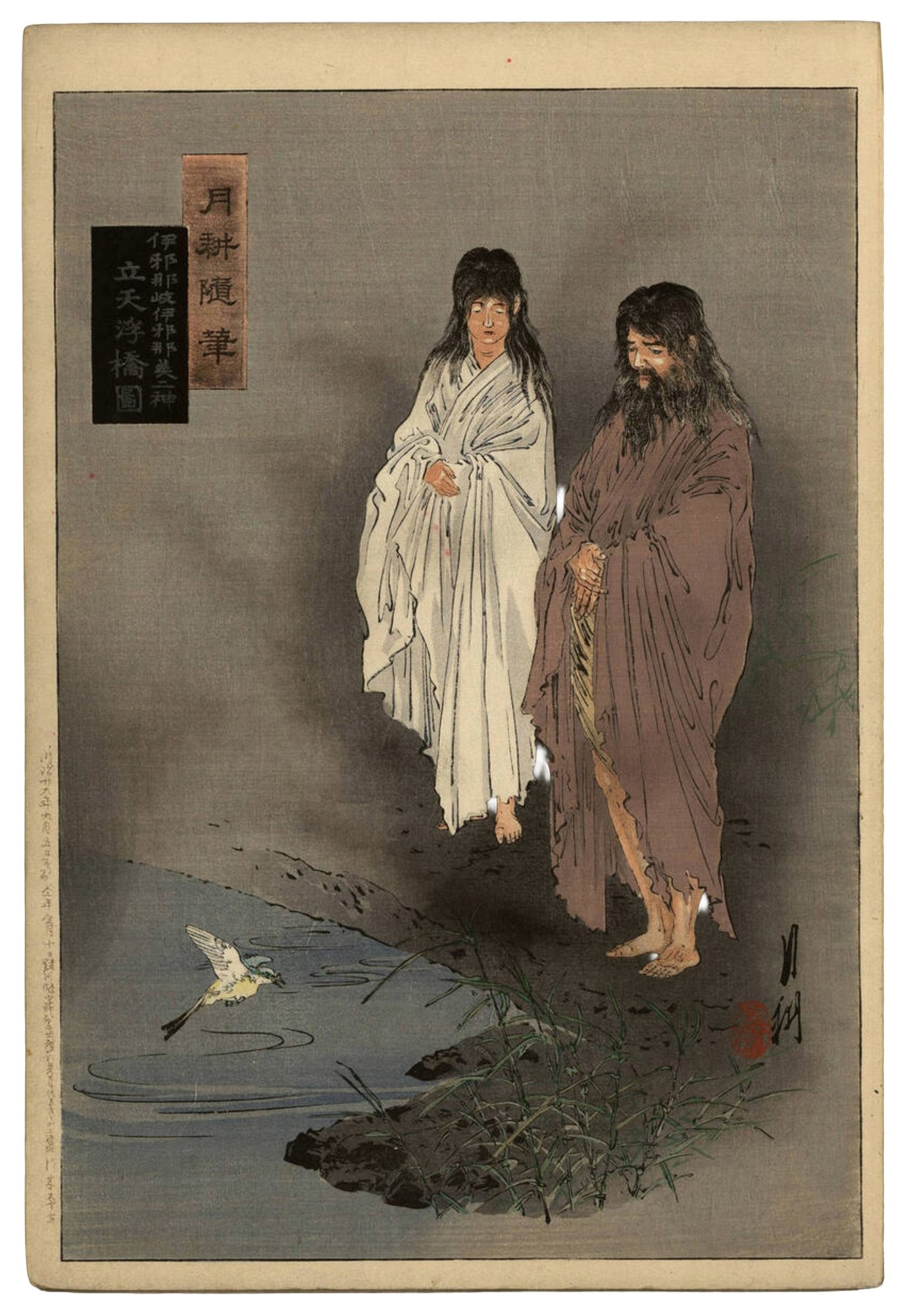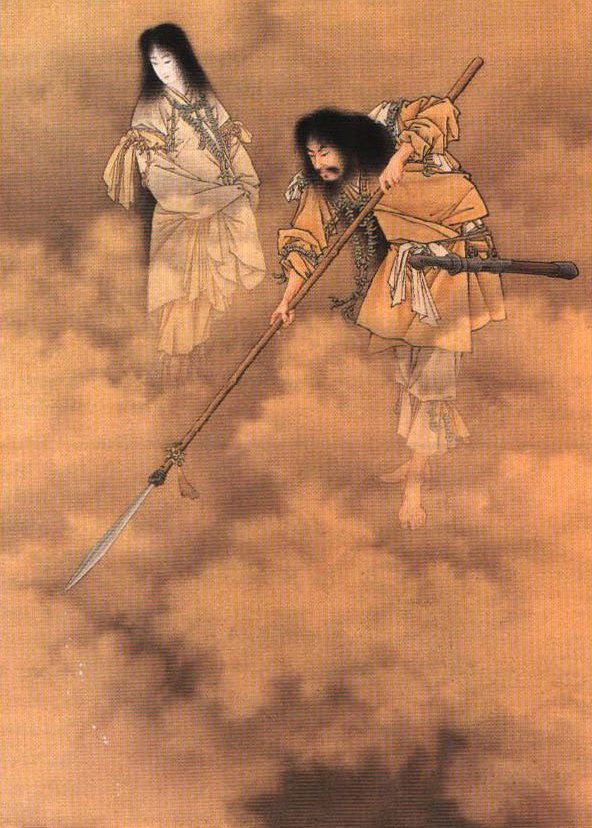
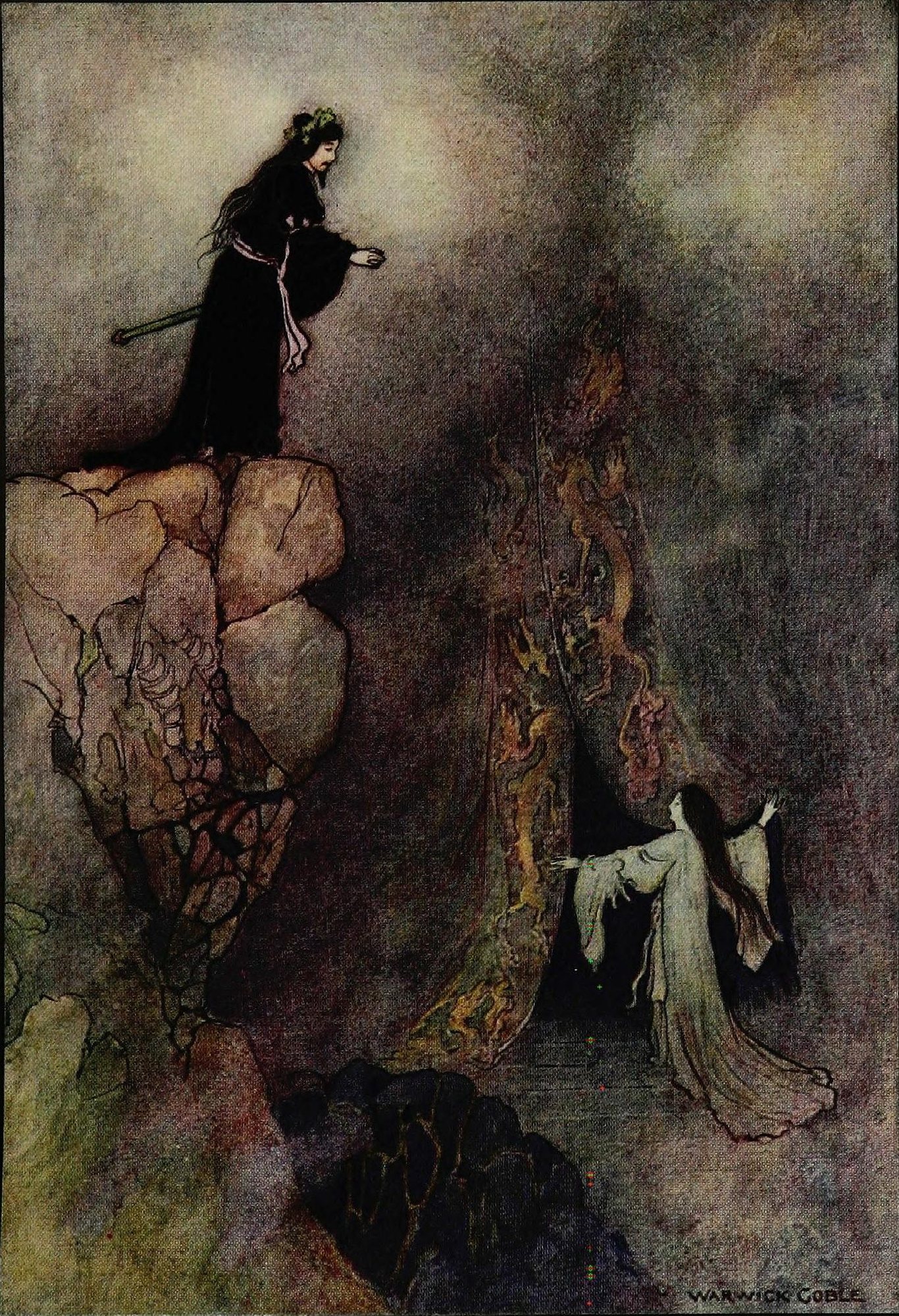
He would not accept that she was gone. His wife had died bearing the fire that scorched her as it came, and he had wept round her where she lay, crawling from her pillow to her feet and back, until a goddess rose from his falling tears. He had taken up his ten-grasp sabre and struck the head off the newborn fire-god who had killed her, and the blood on the blade and hilt had bred more gods, and the pieces of the corpse had bred mountains, and none of it had made the smallest difference. She was still dead, and buried, and beyond him. So Izanagi, His Augustness the Male-Who-Invites, did the thing that no grief since has been allowed to do. He went down after her, into Yomi, the land of the dead.
At the door of the dead
He came to the hall of that country and she came out to its door, and across the threshold he made his plea. The lands the two of them had been making were not yet finished. She had to come back. He said it the way a husband says a thing he believes cannot be refused, and for a moment the old partnership held: she answered that she grieved he had not come sooner, but she would try.
Then she told him what stood in the way. She had already eaten at the furnace of that land, taken food cooked on the hearth of the dead, and the eating had lodged her there. Still, because he had troubled the whole way down to come for her, she would go in and lay the case before the deities of Yomi and beg them to loose her. Only one thing he must promise. He was not to look at her while she went in to ask. She turned back into the dark of the hall on that condition, and left him standing at the door.
She was gone a long time. He waited in the black until he could not wait any longer, and then he broke the promise in the smallest, most human way. He reached to the comb he wore in the left bunch of his hair, snapped off one of its thick end-teeth, and lit that single tooth for a torch, one little forbidden flame to see her by. He carried it in.
Eight gods of thunder in her corpse
The light showed him his wife rotting. Maggots swarmed over her and a wet decay had taken her body, and worse than the ruin was what had grown up out of it: eight gods of thunder, seated in her corpse like tenants who had moved into an empty house. Great-Thunder sat in her head. Fire-Thunder was lodged in her breast, Black-Thunder in her belly, Cleaving-Thunder in her private parts, and one thunder apiece had taken each of her two hands and each of her two feet. The woman he had come down all this way to reclaim had become a thing crawling with the gods of the storm. He dropped the torch and ran.
He had broken more than a promise. He had seen her shame, and she knew it. From inside the rotten hall the voice of his wife came after him, and it was no longer a wife’s. You have put me to shame, she cried, and set the country of the dead loose on the living man fleeing through it.
The flight up the long slope
First she sent the hags of Yomi, the Ugly Females, and Izanagi bought his life by the road with the small furniture of his own body. He tore off the black vine that bound his hair and flung it down, and where it fell it became a cluster of grapes; the hags stopped to strip and gorge on them, and he ran on.
He pulled the comb from the right side of his hair and threw that down, and it sprouted into bamboo-shoots, and again they stopped to pull and eat, and again he gained the road. (One of the old chronicles gives him a cruder trick still: that he made water against a great tree, and the stream became a river that held the hags back while he climbed.)
She sent the eight Thunders next, and behind them a host, a thousand and five hundred warriors of Hades, and he fended them off with his sabre swinging behind him as he went. At the foot of the long slope that climbs out of the dead, the Even Pass of Yomi, a peach tree was growing, and he snatched three of its fruit and stood and hurled them, and the whole army of the dead broke and fled from three peaches.
He blessed the fruit for it there on the slope. He gave the peaches a divine name, the Great-Divine-Fruit, and charged them that whenever the living people of the world should fall into trouble and anguish, they were to help, as they had helped him.
A boulder a thousand men could barely draw
Then Izanami came herself, the last pursuer, and at the mouth of the pass her husband ended it. He found a boulder that a thousand men could barely draw and heaved it across the road of Yomi, sealing the dead from the living, and on the two sides of that stone the pair who had made the world spoke the world’s first parting. Some say she came to the rock not in fury but to speak a plainer grief, and a goddess between them said something he heard and approved before she was gone; the text keeps her words to itself.
What is remembered is the bargain. Then every day I will strangle to death a thousand of the folk of your land, Izanami swore across the rock. Then every day I will cause a thousand and five hundred to be born, Izanagi answered, and so the count has run ever since, a thousand taken against fifteen hundred given, the daily dead and the daily more-than-replaced, the arithmetic of every generation settled in a quarrel at a graveyard gate.
That is why anything dies at all. It is also why the living always outnumber what death takes. She stayed below as the ruler of the country she had entered, the Great-Deity of Yomi, and even the blocking-rock became a god where it sat. He climbed the rest of the slope alone and came out into the light.
The cleansing and the three children
He came out filthy. I have come to a hideous and polluted land, he said, and knew he had to wash it off, and this washing is the first act of purification in the world, the origin of the ablution the Japanese call misogi. He went down to the plain of Ahagi at a river-mouth by Tachibana, in the country of Himuka in the far south, and stripped.
From every garment he cast off, a god was born, from his staff and girdle and skirt, his upper robe and his trousers; and when he stepped into the stream, choosing the middle current because the upper ran too fast and the lower too slow, the very filth of Yomi came off him as two deities of calamity, the great evils of that place made flesh, and after them the gods who set such evils right.
Then came the brightest births of all, and they came from his face. As he washed his left eye, out of it was born Amaterasu, the great goddess of the sun. As he washed his right eye, the moon-god Tsukuyomi was born. And as he washed his nose there came a third, Susanoo, the storm that would trouble both his siblings’ worlds. The man who had gone down into death to reclaim one goddess and failed climbed back into life and, simply by washing the death off, fathered the sun, the moon, and the tempest. He had lost his wife to the dark for good. In losing her he had lit the sky.
He said: “Nay! hideous! I have come to a hideous and polluted land,—I have! So I will perform the purification of my august person.” So he went out to a plain [covered with] ahagi … and purified and cleansed himself. (Kojiki, trans. Chamberlain, Sec. X)
- Kojiki (Records of Ancient Matters, 712 CE), compiled by O no Yasumaro, trans. **Basil Hall Chamberlain, *The KojikiRecords of Ancient Matters*, Transactions of the Asiatic Society of Japan, Vol. X suppl. (1882)**: the read-verbatim source for this piece, Sections VII–X. The death of Izanami bearing the Fire-Deity and Izanagi’s mourning, his tears becoming the Crying-Weeping-Female, and the burial on Mount Hiba at the border of Izumo and Hahaki (Sec. VII); the beheading of the Fire-God with the ten-grasp sabre and the gods born of the blood and the corpse (Sec. VIII); the descent to Yomi, Izanami’s answer that she has eaten of the furnace of Hades, the
Look not at me
command, the single comb-tooth torch and the rotting corpse with its eight named Thunder-Deities (head, breast, belly, private parts, two hands, two feet), the flight with the head-dress that becomes grapes and the comb that becomes bamboo-shoots, the three peaches renamed Great-Divine-Fruit and charged to help mortals in distress, the thousand-draught rock heaved across the Even Pass, the parting and thethousand strangled / thousand and five hundred born
formula, and Izanami’s titles as the Great-Deity of Yomi and the Road-Reaching Great-Deity (Sec. IX); and the purification at the Ahagi plain by Tachibana in Himuka, the deities born from each cast-off garment, the two evil-deities born from the filth of Yomi and the rectifying gods who counter them, and the birth of Amaterasu from the washing of the left eye, Tsukuyomi from the right eye, and Susanoo from the nose (Sec. X). Read via English Wikisource, Kojiki (Chamberlain, 1882), Sections 7–10. - Nihon Shoki (Nihongi, Chronicles of Japan, 720 CE), trans. **W. G. Aston, *NihongiChronicles of Japan from the Earliest Times to A.D. 697*, Vol. I,
The Age of the Gods, Book I
(London: Kegan Paul / Japan Society, 1896)**: the parallel chronicle, read verbatim for the divergences honoured above. The main-narrative Yomi descent, in which Izanami tells IzanagiI have already eaten of the cooking-furnace of Yomi
, he breaks the end tooth of his many-toothed comb for a single torch, the eight Ugly Females of Yomi (Shikome,called by some Hisame
) pursue him, and the parting formula of divorce is pronounced across thethousand-men-pull-rock
; and the severalin one writing
(一書) variants drawn on above: the fire-god named Kagu-tsuchi or Ho-no-musubi and cut into three pieces (becoming Ikazuchi, Oho-yama-tsu-mi and Taka-o-kami) or into five mountain-gods; Izanami buried not on Mount Hiba but at the village of Arima in Kumano in Kii, where she is honouredin the time of flowers
with drums, flutes, flags, singing and dancing; the variant in which Izanagi makes water against a great tree so that it becomes a river delaying the Ugly Females; the mediating goddess Kukuri-hime, whose words Izanagiheard and approved
though the text does not record what she said; the parting-gods of spittle and purification, Haya-tama-no-wo and Yomo-tsu-koto-saka-no-wo; and the gloss thatsome say the Even Pass of Yomi is not any place in particular, but means only the space of time when the breath fails on the approach of death
. archive.org idnihongi1asto.