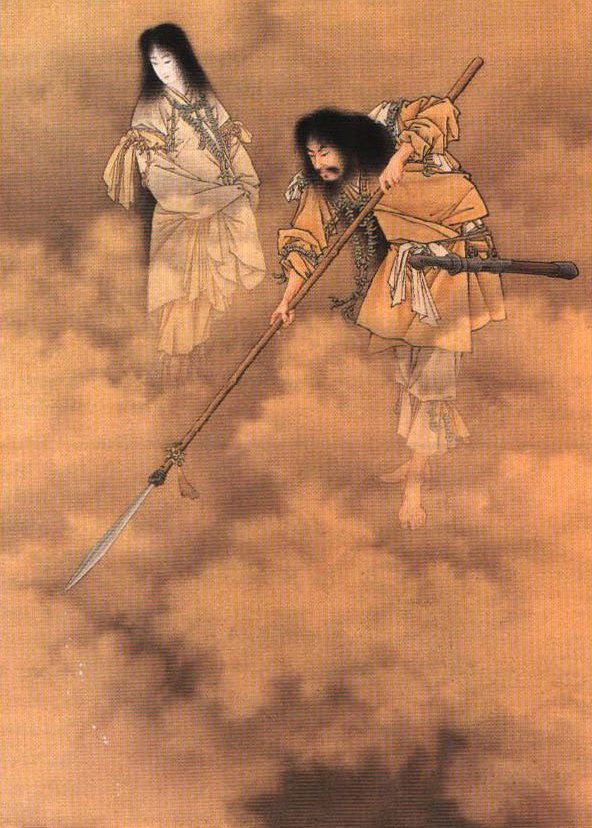
Izanami is the maker whose work survives her. Her title, the Female-Who-Invites, names a goddess who brings land and gods into being, dies giving birth, and then becomes the power that keeps the dead apart from the living. Her story is not creation followed by erasure. It is creation changing its form.
The mother of a country
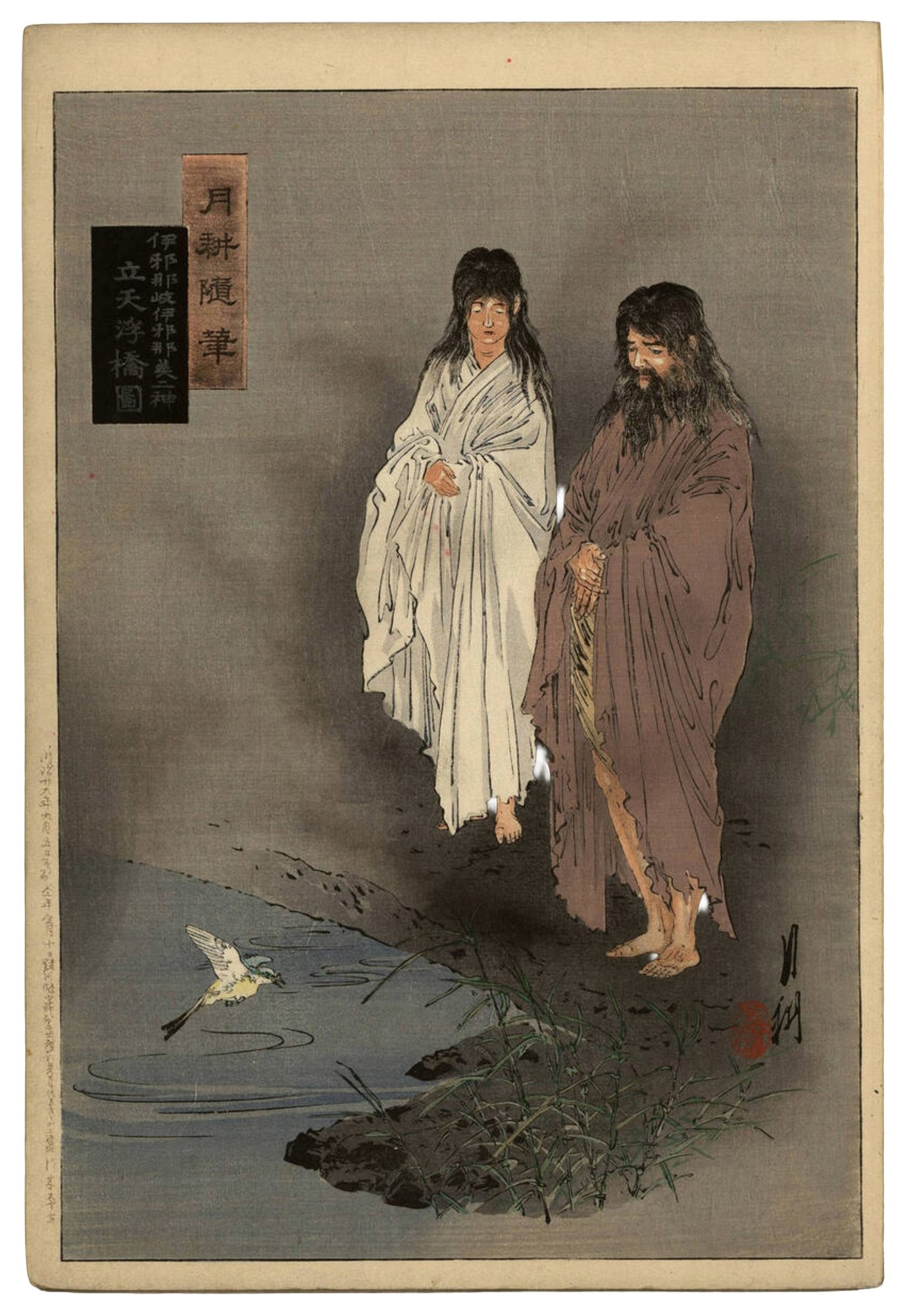
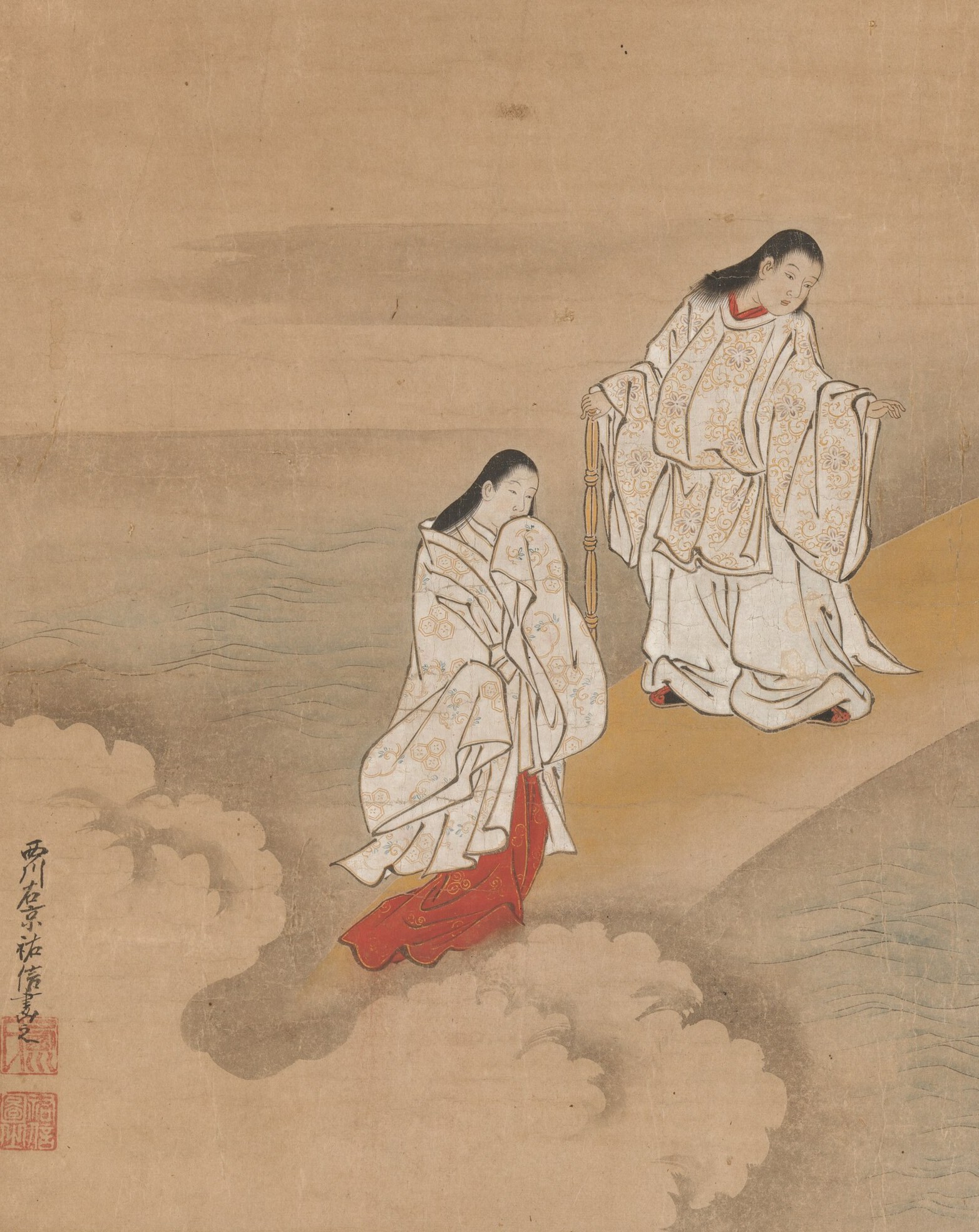
The elder deities send Izanami and Izanagi to consolidate the drifting land, and after their first union fails they perform the ceremony again in the proper order. The corrected union brings forth Japan. In the Kojiki, Izanami bears fourteen islands and then a long succession of deities: the sea and its river-mouths, the wind and trees, the mountains, moors and mountain-passes. The natural world arrives through her as a sequence of births, not as a landscape waiting to be named.
The full spear, pillar and courtship sequence belongs to the separate story The Birth of the Islands. The published Takamagahara, the High Plain of Heaven maps the celestial setting around that creation. Izanami’s place in the beginning is more specific. She is not simply the other half of a creator pair. She is the mother whose body carries the archipelago, and whose act of bearing makes the world bodily before it makes it orderly.
The Nihon Shoki gives different island orders and competing accounts of the first failed birth, including an in one writing variant in which the rejected first island, Ahaji, is treated as a placenta rather than a leech-child. The divergences matter because they keep the cosmogony from becoming one tidy official diagram. Izanami’s creative office survives the variations: she is the figure through whom a country becomes kin.
A body that keeps making
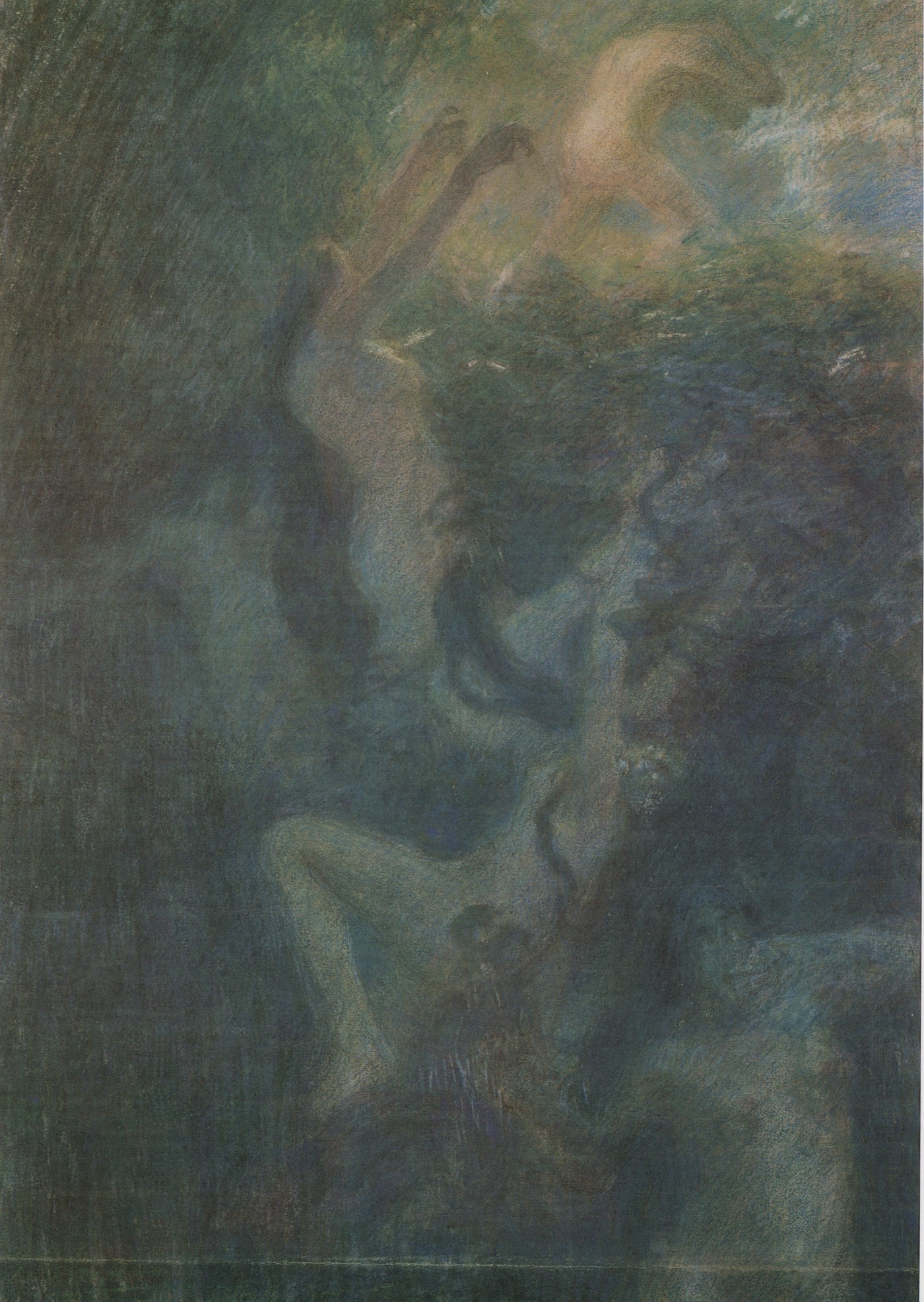
When Izanami bears Kagutsuchi, the fire-deity, his heat sickens and kills her. Yet the Kojiki makes her illness another generative threshold. Deities of metal and clay come from what she brings up and from her filth; from her urine come the water-goddess Mitsuha-no-me and a producing deity whose child will be the goddess of grain and food. Even as her body fails, it continues to produce the materials and powers of the world.
That is the paradox at the centre of Izanami. Her wholeness bears islands and nature-gods; her breakdown bears metal, earth, water and food. Life does not wait for her to be untouched. It issues from the damaged body as readily as from the fertile one.
The fire’s birth kills her. Izanagi’s mourning and revenge are consequences for him; Izanami’s own consequence is the transformation of a body that made land into a source of metal, earth, water and food. Her death is not a pause before the story resumes without her. It is the event that changes what kind of goddess she can be.
The change at Yomi
She is buried at the border of Izumo and Hahaki, though the Nihon Shoki preserves another tradition placing her at Arima in Kumano, where people honour her in the season of flowers with blossoms, drums, flutes, flags and dancing. Then she is in Yomi, the land of the dead. When Izanagi reaches the door of its hall, she tells him he has come too late: she has eaten the food of that country and is bound to it.
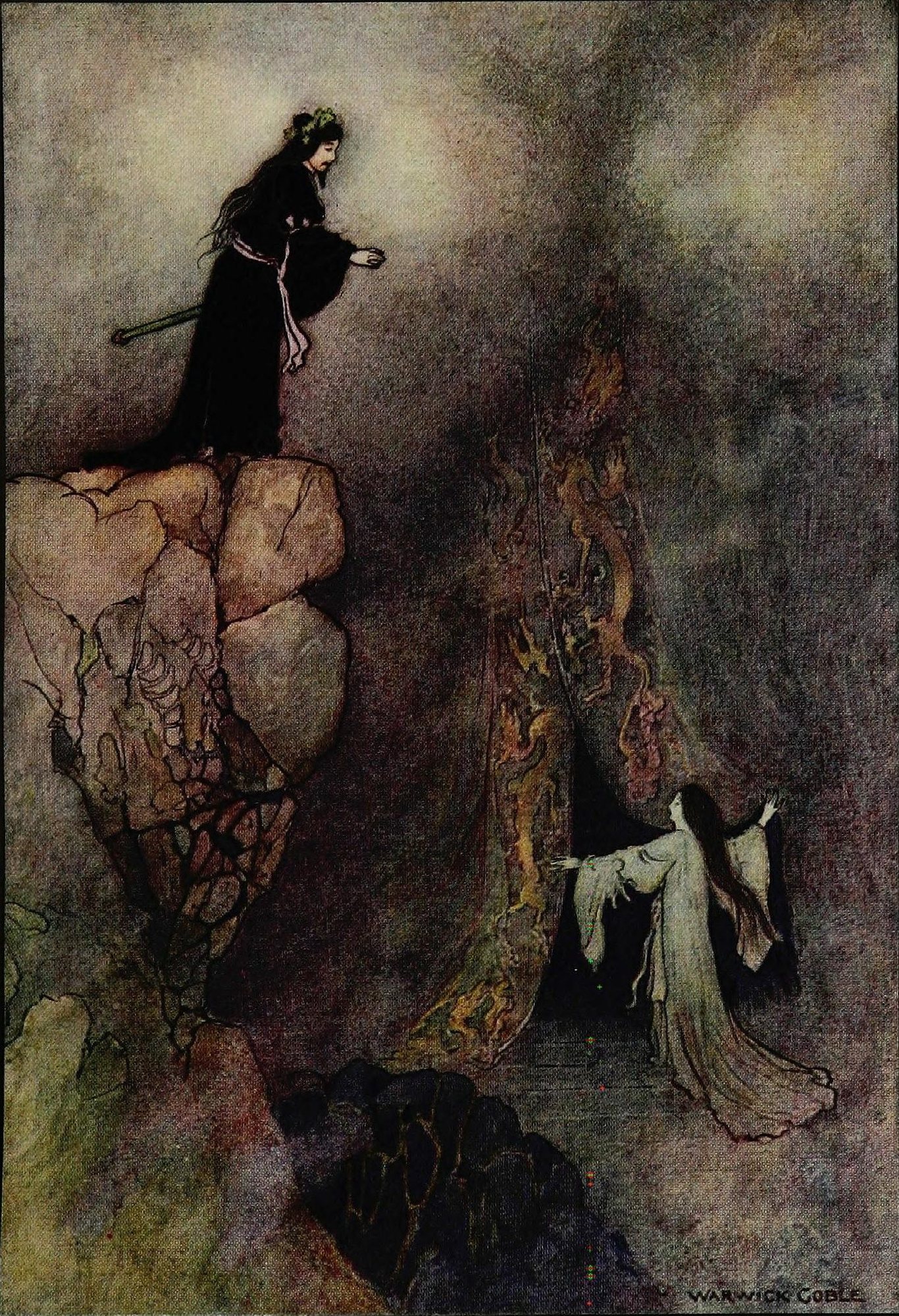
She agrees to ask the deities of Yomi for release, but asks him not to look while she goes. He looks anyway. The wife who bore the islands is now a rotting body with eight Thunder-Deities grown into it. The reunion has become a transformation: the mother of living land is now a body of the dead. The complete pursuit and purification stay with the separate story Izanagi’s Descent to Yomi; Yomi, the Land of the Dead supplies the realm’s geography. Here, the decisive change is the one that makes Izanami’s sovereignty possible.
Queen of the dead
At the mouth of the pass between the two countries, Izanami meets Izanagi across the boulder that seals the road. Their parting fixes mortality: she promises to strangle a thousand of the living every day, and he answers that a thousand and five hundred will be born. The complete chase and divorce sequence belongs to Izanagi’s Descent to Yomi; here the bargain matters because it gives the queen of the dead a jurisdiction over the living.
Izanami does not return to the upper world. She remains below as the Great-Deity of Yomi and, in the tradition’s other title, the Road-Reaching Great-Deity. The woman who invited a world into being now keeps its final door. Her sovereignty is not an interruption of her motherhood. It is the dark continuation of it: she governs the country into which every living thing will eventually be invited.
The ancient line is spare enough to leave the transformation exposed:
Then Her Augustness the Female-Who-Invites, through giving birth to the Deity-of-Fire, at length divinely retired. (Kojiki, trans. Chamberlain, Sec. 7)
Izanami’s origin belongs to the full story The Birth of the Islands; its celestial setting is mapped in Takamagahara, the High Plain of Heaven. Her descent, pursuit and purification are held by the separate story Izanagi’s Descent to Yomi, while Yomi, the Land of the Dead frames the country she rules. What this portrait keeps is her transformation: a mother whose death does not end generation, but gives the living a border.
- Kojiki (Records of Ancient Matters, 712 CE), compiled by O no Yasumaro, trans. **Basil Hall Chamberlain, *The KojikiRecords of Ancient Matters*, Transactions of the Asiatic Society of Japan, Vol. X suppl. (1882)**: the read-verbatim source for this piece, Sections 3–9. The Heavenly Deities’ command to make and consolidate the drifting land and the grant of the jewel-spear (Sec. 3); the stirring of the brine until it
went curdle-curdle
and the island of Onogoro, the heavenly pillar and the eight-fathom hall (Sec. 3–4); the pillar-circling courtship with Izanami speaking first, the leech-child Hiruko set adrift and the island of Aha, and the grand divination faulting the woman for having spoken first (Sec. 4); the corrected second union and the birth of the Eight Great Islands and the myriad deities (Sec. 5–6); the birth of the Fire-Deity Kagutsuchi, the burning and death of Izanami, the metal, clay and water deities born from her dying body, Izanagi’s tear-born Crying-Weeping-Female and the burial on Mount Hiba on the Izumo/Hahaki border, and the beheading of the Fire-God (Sec. 6–8); and the descent to Yomi, the food of the furnace of Hades that binds her, the comb-tooth torch and the rotting corpse with its eight named Thunder-Deities, the flight with grapes, bamboo-sprouts and the three peaches, the divorce at the Even Pass with the thousand-strangled / fifteen-hundred-born formula, and Izanami’s final titles as the Great-Deity of Yomi and the Road-Reaching Great-Deity (Sec. 9). Read via English Wikisource, Kojiki (Chamberlain, 1882), Sections 3–9. - Nihon Shoki (Nihongi, Chronicles of Japan, 720 CE), trans. **W. G. Aston, *NihongiChronicles of Japan from the Earliest Times to A.D. 697*, Vol. I,
The Age of the Gods, Book I
(London: Kegan Paul / Japan Society, 1896)**: the parallel chronicle, read verbatim for the divergences honoured above. The main-narrative pillar-courtship and island-birth includes Ahaji, the rejected first island reckoned as a placenta; the leech-child and its setting adrift occur in anin one writing
variant; the death by the fire-god Kagu-tsuchi and the earth-goddess Hani-yama-hime and water-goddess Mitsuha-no-me born as Izanami dies; and the severalin one writing
(一書) variants drawn on above: the fire-god named Ho-no-musubi; Izanami’s burial not on Mount Hiba but at the village of Arima in Kumano, Kii, where she is worshippedin the time of flowers
with floral offerings, drums, flutes, flags, singing and dancing; the peach-tree at the roadside pass, given asthe origin of the practice of keeping off evil spirits by means of peaches
; the river of urine that delays the Ugly Females; the parting-gods of spittle and purification; and the note thatsome say the Even Pass of Yomi is not any place in particular, but means only the space of time when the breath fails on the approach of death
. archive.org idnihongi1asto.