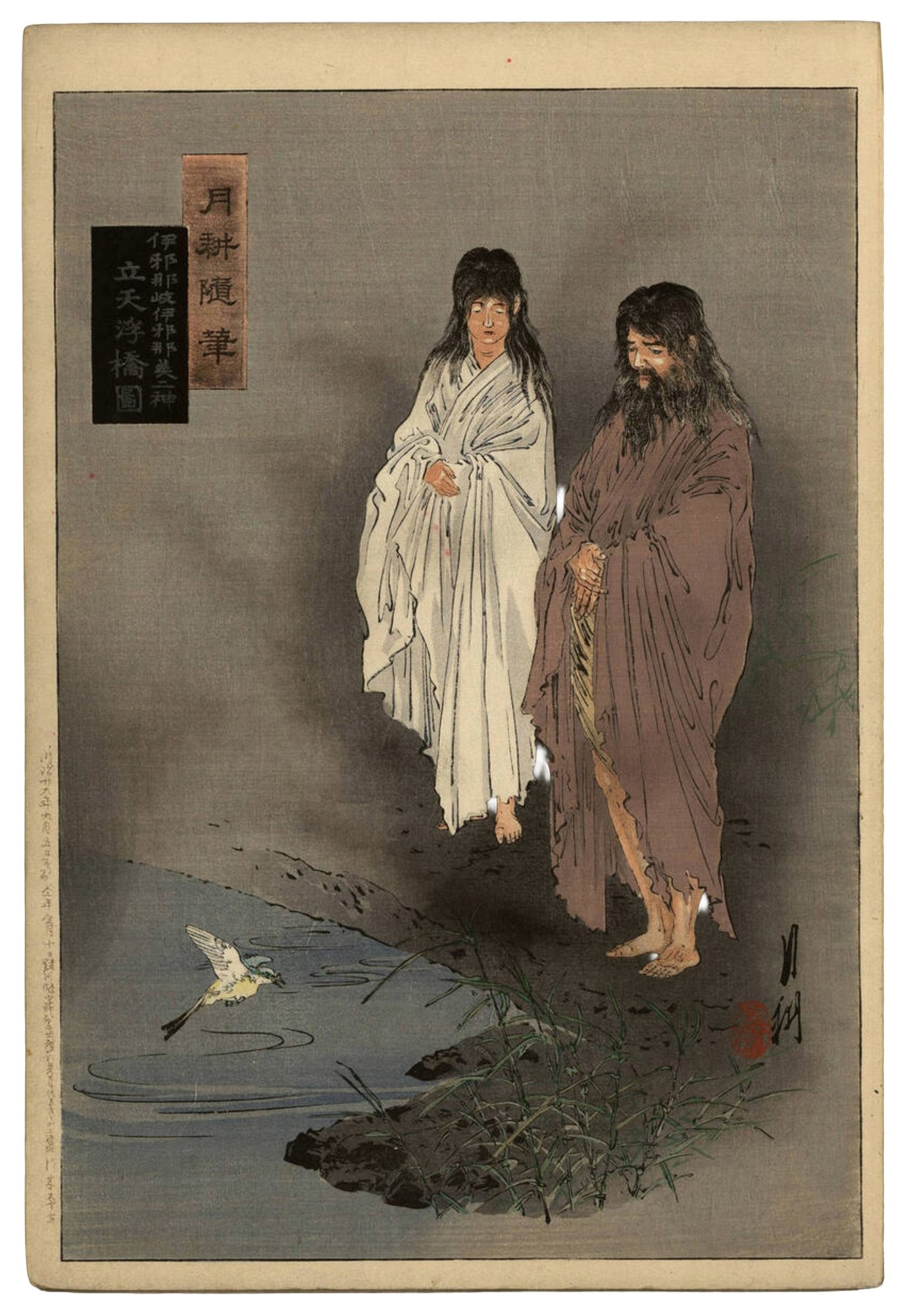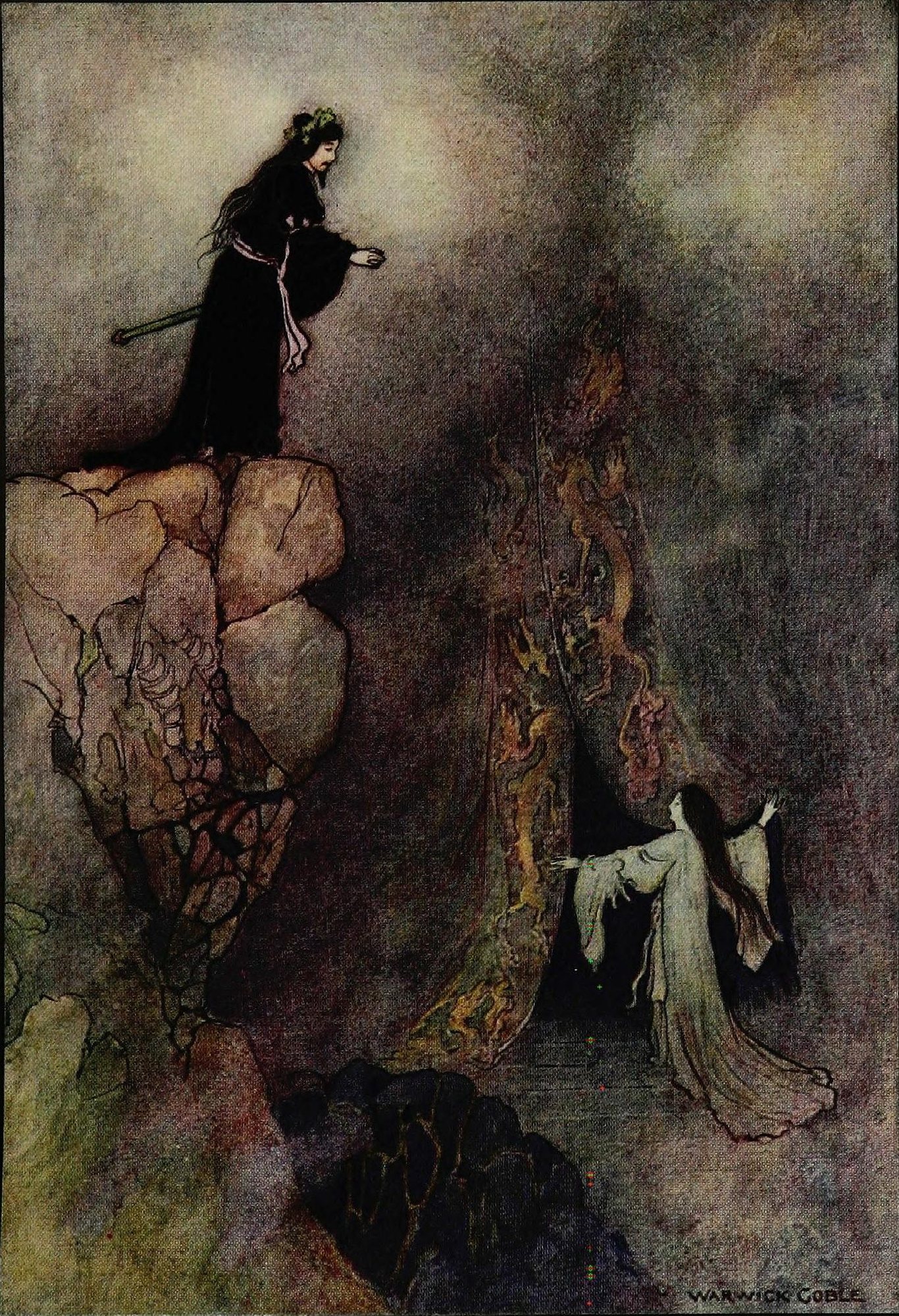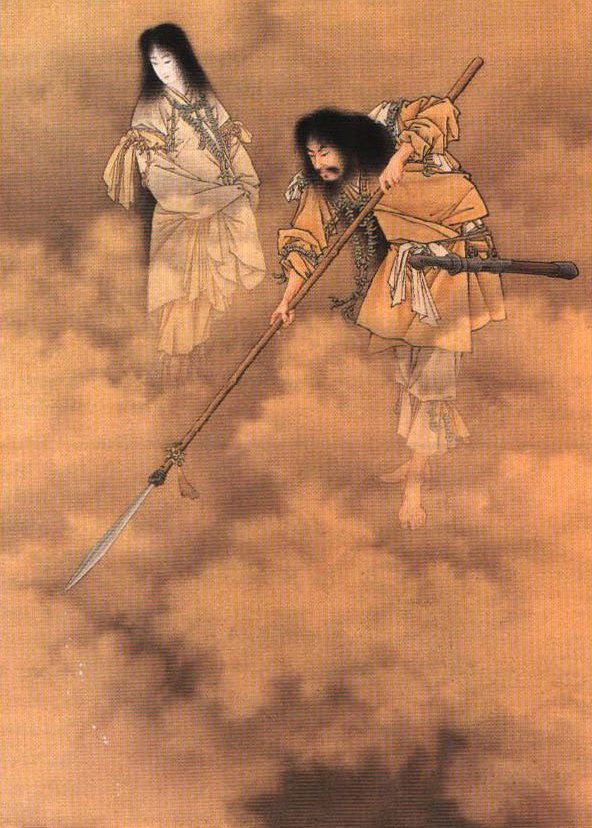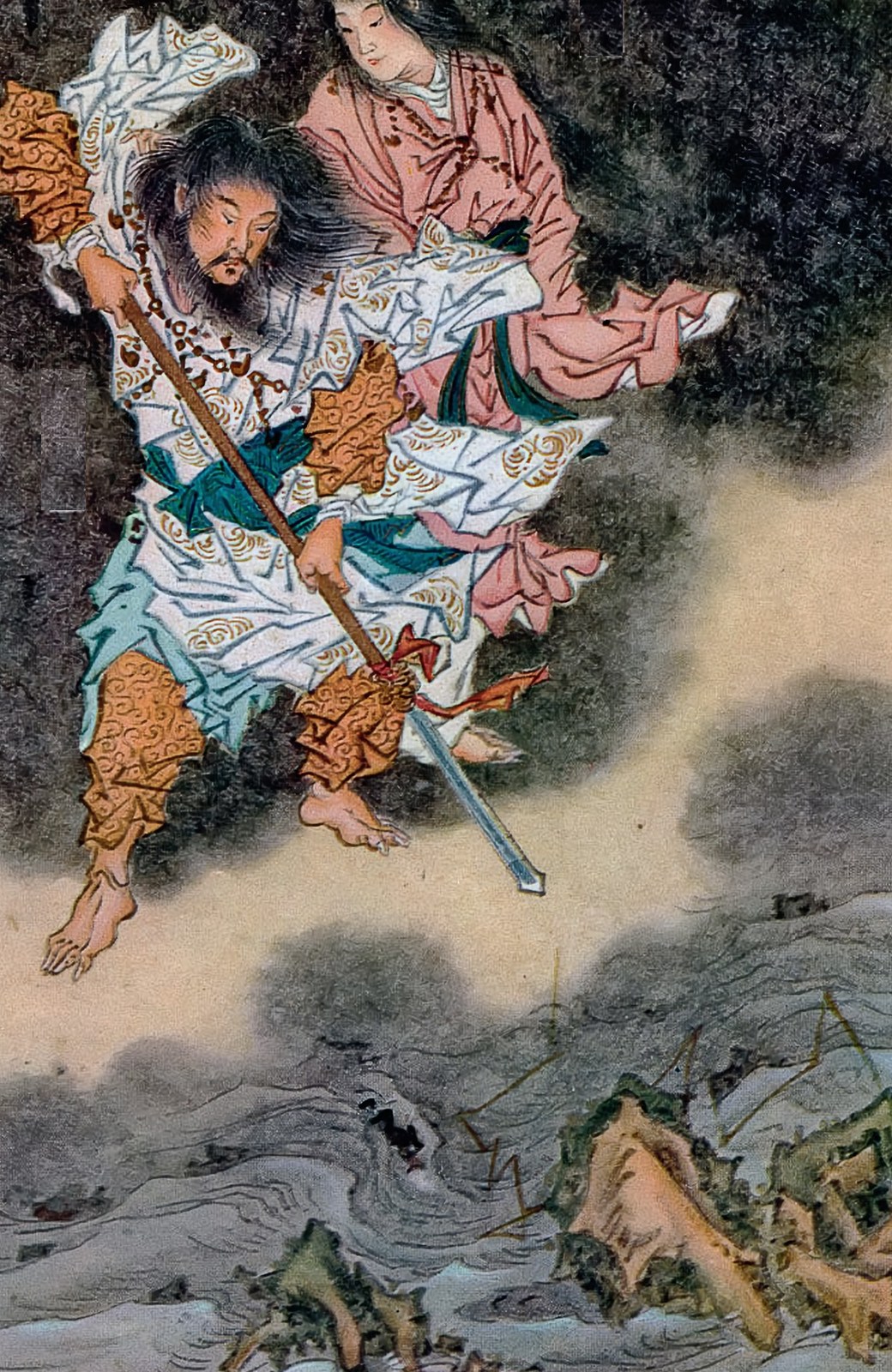
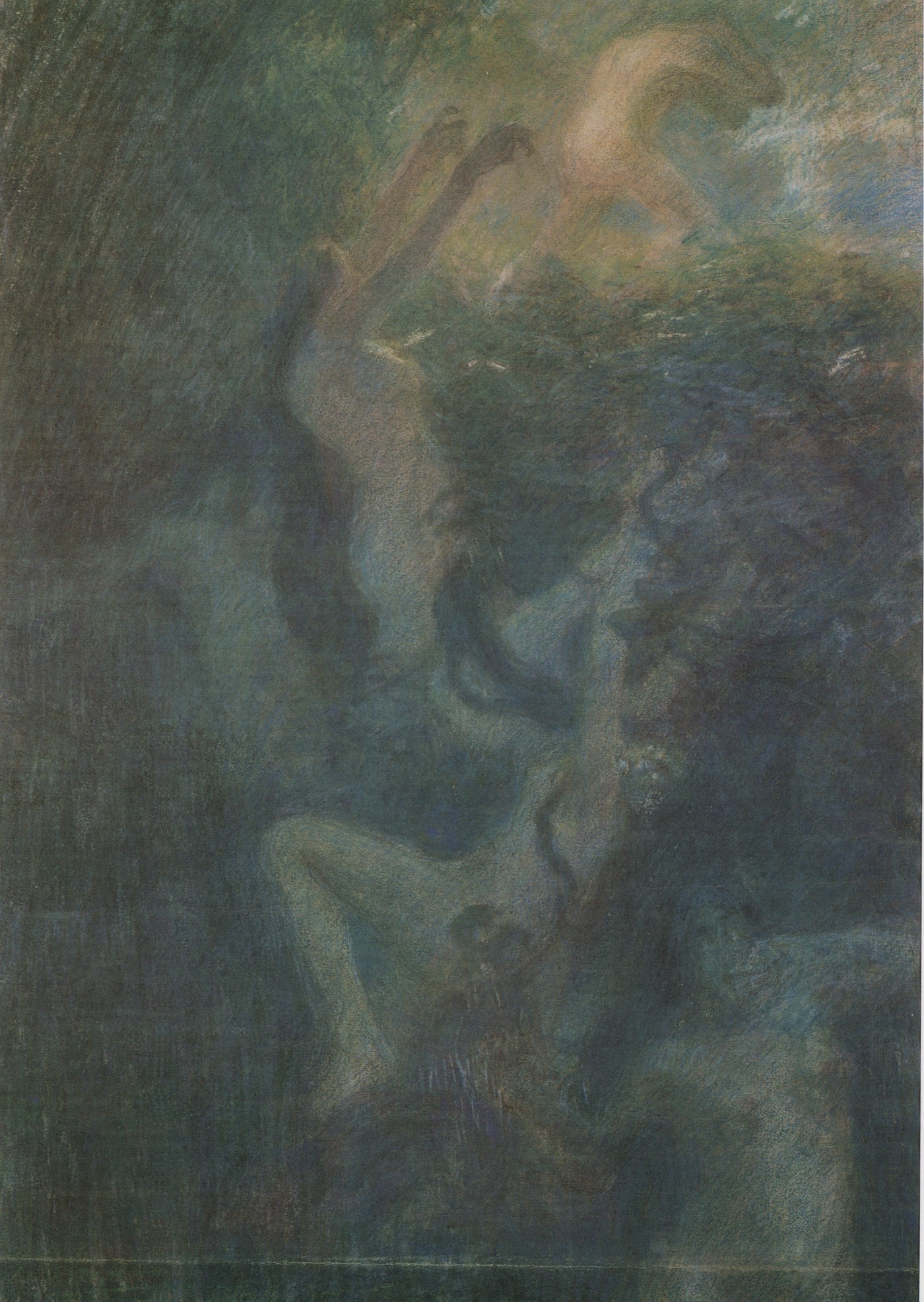
She came out only as far as the door. Her husband had chased her the whole way down, past the border of the living, into the country where the dead go, and now he stood in the dark of the hall and begged her to come back, because the world the two of them had been making was not finished. And Izanami, who had been the bright mother of islands and gods, answered him from the threshold like a woman already changed. He had come too late. She had eaten at the furnace of that land, taken food cooked on the hearth of the dead, and the eating had lodged her there. This is the first thing to know about Yomi: it is not the going down that traps you. It is the swallowing.
The place has a name that comes from elsewhere. Written with the characters for Yellow Springs,
Yomi borrows a Chinese term for the world below, and both of the men who first put these chronicles into English, Chamberlain and Aston, flag that the writing is Chinese rather than native. Strip the loan-word away and what the Japanese seems to hold underneath is plainer and darker: a derivation from yo, night,
which would make Yomi simply the Land of Gloom.
A few commentators have reached further still, for a link to the Sanskrit Yama, the death-god of India, but that is a philologist’s guess, argued over lecterns and footnotes, not a thing the myth itself ever says. The realm the old texts actually describe needs no imported god to rule it. It is a shadow-country of rot and pollution, and it already has a queen.
The food of the dead
The binding is done by eating, and the sources are careful about how little they specify. Izanami has eaten of the furnace of Hades,
in the Kojiki, or of the cooking-furnace of Yomi,
in the Nihon Shoki: the food of the dead land, cooked on its hearth, with no fruit named and no count of seeds. That restraint matters, because the reflex of a modern reader is to supply the Greek detail, Persephone’s pomegranate and her fixed tally of seeds.
The Japanese taboo has no pomegranate and no number. It is generic and total. To take anything from the kitchen of Yomi into your body is to become of Yomi, and Aston’s own footnote, comparing the Greek and Vedic parallels, is a scholar setting two myths side by side for the reader, not a line of the Japanese text.
What eating does is make the change irreversible, and the two chronicles frame the door of escape a little differently. The Kojiki leaves it briefly ajar: Izanami says she will go in and lay the case before the Deities of Yomi, the Yomo-tsu-kami, the shadowy earlier powers of the place of whom, one honest commentator admits, little or nothing is known.
She might yet be released. The Nihon Shoki’s main line is blunter, taking her as simply already bound. But the shared truth is the one that gives the underworld its whole weight. The dead who have eaten there do not come back unchanged, and when her husband finally breaks his promise not to look, he sees exactly how changed she is.
One tooth broken from his comb
He was told not to look, and to see her at all he had to make a forbidden light. Izanagi broke one thick end-tooth from the close-toothed comb in the left bunch of his hair and lit that single tooth for a torch, and by that one small flame he found his wife. Maggots swarmed over her. Her body had gone to rot, and grown up out of the ruin were eight gods of thunder, lodged in her corpse head to foot like tenants moved into an emptied house: a thunder in her head, in her breast, her belly, her loins, and one apiece in her two hands and two feet.
This is the true face of Yomi, and it is worth holding against the version pop culture prefers. There is no courtroom here, no ledger of sins, no judge, no racks of torment. Those belong to the Buddhist hells of Enma-o that reached Japan centuries later. The ancient underworld of the chronicles is not organised. It is simply the place where the bright turn foul, an undifferentiated country of decay whose horror is the swarming, thunder-ridden body of a goddess who was, not long ago, the loveliest thing alive.
The chronicles even bequeath the living two small superstitions from this instant of looking. Because Izanagi made his light from a single comb-tooth in the dark, the old gloss runs, it is unlucky to this day to light one lamp at night, and unlucky to throw away a comb in the dark. The taboo of the underworld leaks upward into the household.
Three peaches at the foot of the pass
Yomi has an edge, a place where the dead country meets the living one, and the sources give it a name and then argue over whether it is a name at all. It is the Yomo-tsu-hira-saka, the Even Pass of Hades, the long slope Izanagi climbed as the horrors of the place came up after him. He bought the road with the furniture of his own body, flinging down his black head-dress, which became grapes his pursuers stopped to eat, then his comb, which sprouted into bamboo-shoots they stopped to strip; and at the foot of the pass he found three peaches growing and hurled them, and the whole host of the dead broke and fled from three pieces of fruit.
He blessed the peaches for it, gave them a divine name and charged them to help the living whenever they came to grief, which is why, a parallel passage in the Nihon Shoki explains, peaches keep off evil spirits still. Then, with his dead wife herself the last to pursue him, he found a boulder that a thousand men could barely draw and heaved it across the throat of the pass.
That rock is the cosmology’s hinge. It is the seal between the dead and the living, and it becomes a god where it sits, the Blocking-Deity of the Door of Hades. Across it the two who had made the world spoke the world’s first parting, and struck the bargain that ordains death itself. I will strangle a thousand of your people every day, Izanami vowed from below. Then I will cause a thousand and five hundred to be born every day, Izanagi answered from above, and so the ledger has run ever since: a thousand taken against fifteen hundred given, the daily dead outnumbered by the daily born.
That is at once why anything dies at all and why the living keep gaining on the grave. And where is the pass itself? The Kojiki plants it firmly in the map, naming it the Ifuya-Pass in the land of Izumo, a real slope a traveller could walk to. The Nihon Shoki records the opposite reading, that the Even Pass is not any place in particular, but means only the space of time when the breath fails on the approach of death.
The sources leave the question open, and it is better to leave it open with them: the border of Yomi is either a hillside in Izumo or the last catch of breath, and the myth was content to be both.
The queen and the cleansing
Once the rock is set, Yomi has its ruler for good. Izanami stays below and is henceforth called the Great-Deity of Hades, sovereign of the country she was tricked into by a mouthful of its food, and also the Road-Reaching Great-Deity for having chased her husband so far up the road. It is worth being careful about her realm’s borders in the corpus, too. The Nihon Shoki elsewhere glosses Ne-no-kuni, the Root-Country, as meaning Yomi, so the two are closely bound; yet the same corpus can speak of a deeper Bottom Nether Land beneath, so it is safest to treat Yomi and the Root-Country as neighbours or near-synonyms rather than one fixed address.
For the living husband, the descent leaves one lasting mark. Yomi is not only dark and irreversible; it is polluting, and contact with it must be washed off. I have come to a hideous and polluted land,
Izanagi says on climbing out, and he strips and bathes at a river-mouth in the far south, and from that washing a crowd of new gods is born. The underworld’s final gift to the world above is the rite invented to cleanse the world above of it. Death, in these chronicles, is not a judgement to be passed or a fire to be endured. It is a stain, and Yomi is where the stain comes from.
“I have eaten of the furnace of Hades. Nevertheless, as I reverence the entry here of Thine Augustness my lovely elder brother, I wish to return. Moreover I will discuss it particularly with the Deities of Hades. Look not at me!” Having thus spoken, she went back inside the palace … he lit one light and went in and looked. Maggots were swarming, and [she was] rotting. (Kojiki, trans. Chamberlain, Sec. IX)
- Kojiki (Records of Ancient Matters, 712 CE), compiled by O no Yasumaro, trans. **Basil Hall Chamberlain, *The KojikiRecords of Ancient Matters*, Transactions of the Asiatic Society of Japan, Vol. X suppl. (1882)**, Sections IX (
The Land of Hades
) and X (The Purification of the August Person
): the fullest account of Yomi, read verbatim via English Wikisource (Chamberlain, 1882). Supplies the food-taboo (I have eaten of the furnace of Hades
), the negotiation with the Deities of Hades (Yomo-tsu-kami), the single comb-tooth torch, the maggot-ridden corpse tenanted by eight named Thunder-Deities (head, breast, belly, private parts, two hands, two feet), the flight with the head-dress that becomes grapes and the comb that becomes bamboo-shoots, the three peaches renamed Great-Divine-Fruit and charged to help mortals in distress, the thousand-draught rock heaved across the Even Pass of Hades (Yomo-tsu-hira-saka), thethousand strangled / thousand and five hundred born
formula that ordains mortality, Izanami’s title as the Great-Deity of Hades (Yomo-tsu-oho-kami), and the localisation of the pass as the Ifuya-Pass in the land of Izumo. - Nihon Shoki (Nihongi, Chronicles of Japan, 720 CE), trans. **W. G. Aston, *NihongiChronicles of Japan from the Earliest Times to A.D. 697*, Vol. I,
The Age of the Gods, Book I
(London: Kegan Paul / Japan Society, 1896)**: the parallel chronicle, read verbatim via archive.org idnihongi1asto. Supplies the main-narrative Yomi descent (I have already eaten of the cooking-furnace of Yomi
); Aston’s note that the written form renders the Chineseyellow springs
; the eight Ugly Females of Yomi (Shikome,called by some Hisame
); the appended eight-thunder list with placements and names differing from the Kojiki’s (Mountain-Thunder and Moor-Thunder for the Kojiki’s Earth/Rumbling/Couchant, and a reshuffled body-map); the separate peach-passage givingthe origin of the practice of keeping off evil spirits by means of peaches
; theone writing
mediating goddess Kukuri-hime, absent from the Kojiki and from the Nihongi main line; the rationalising gloss thatsome say the Even Pass of Yomi is not any place in particular, but means only the space of time when the breath fails on the approach of death
; and the note identifying Ne-no-kuni, the Root-Country, with Yomi.