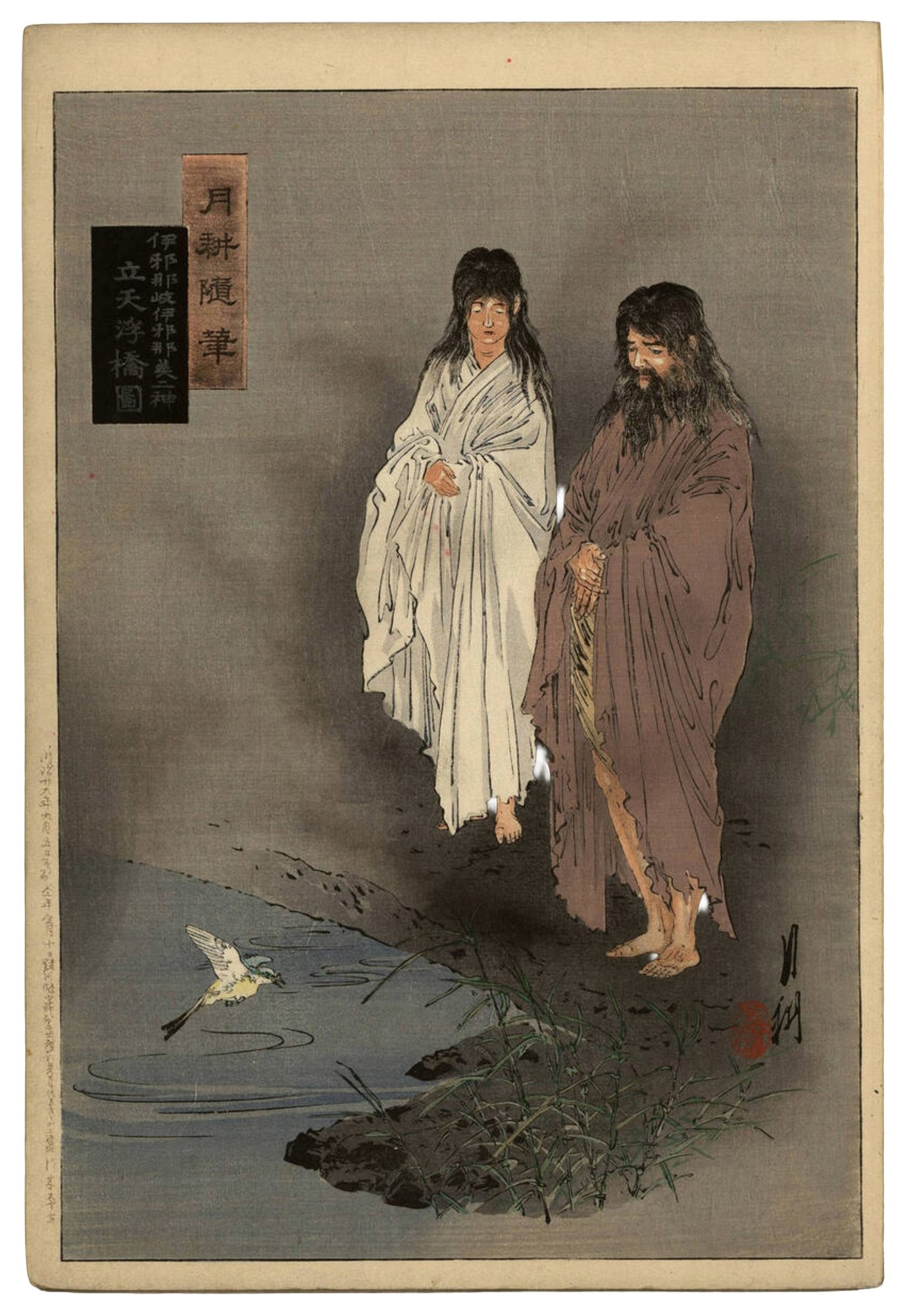
Izanagi is the god the Kojiki leaves standing after creation has already proved fragile. He and Izanami make the first land together, lose her to the fire she gives birth to, and part at the border of the dead. What belongs especially to him is what he does after each rupture: he turns grief into action, pollution into ritual, and washing into another generation of gods.
The maker is not alone
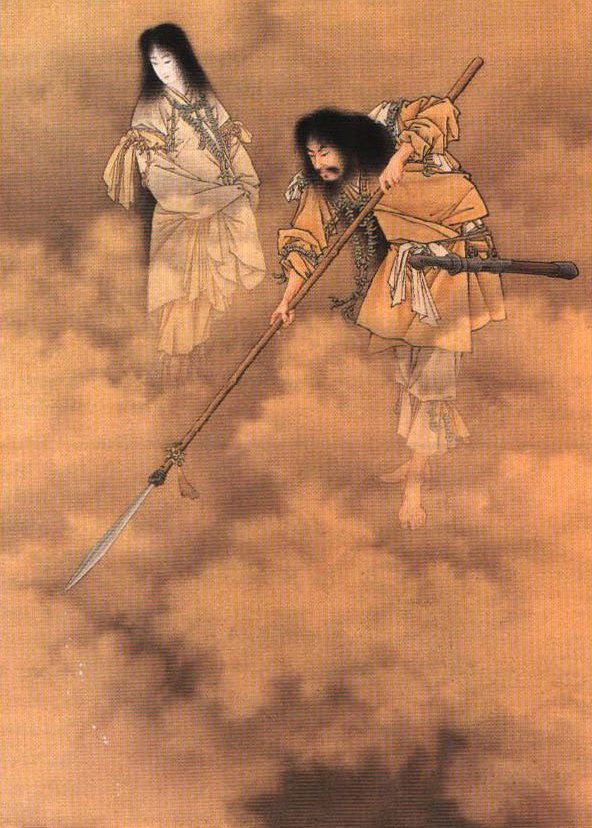
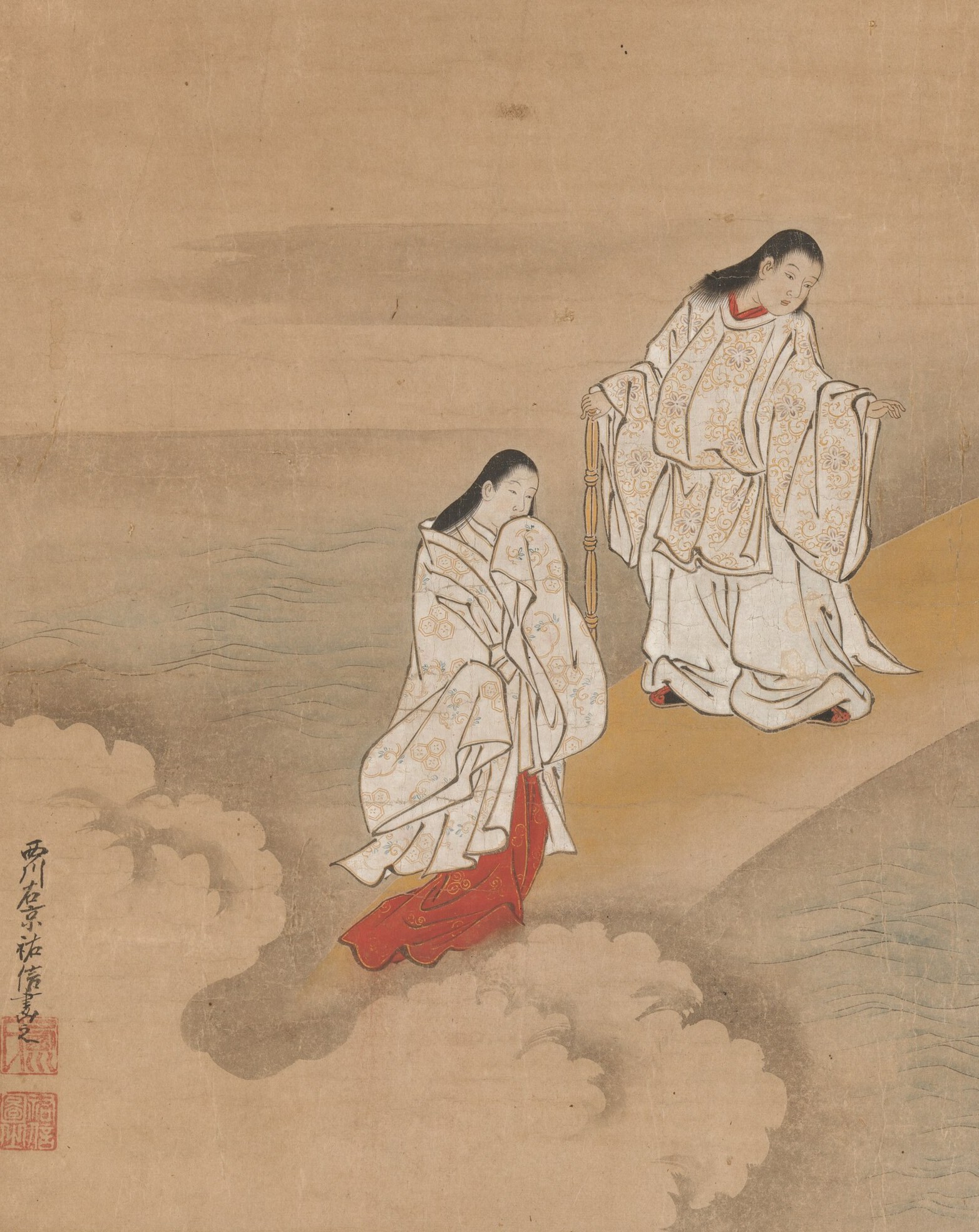
The elder deities send Izanagi and Izanami to consolidate the drifting land, and give them the jewelled spear with which they stir the formless brine. The drops that fall from its point become Onogoro, the Self-Curdling, and the pair descend to begin their work. Their first union fails, the ceremony is performed again, and the corrected union brings forth the islands and the gods of the natural world.
The complete creation sequence belongs to the separate story The Birth of the Islands, which follows the spear, pillar and island births in full. The published Takamagahara, the High Plain of Heaven maps the celestial setting where the later division of the world takes place. Izanagi’s place in that beginning is already a clue to the rest of him: he is a maker whose work is joint, whose failures are public, and whose answer to a broken order is to attempt the work again.
Grief takes a shape
The last child Izanami bears is fire. Kagutsuchi scorches her as he is born, and she sickens and dies. Izanagi crawls around her pillow and feet, weeping until his tears become the Crying-Weeping-Female. Then grief turns into a weapon. He draws the ten-grasp sabre and beheads the fire-god, and even that killing breeds further deities from blood and the dismembered body.
The sword does not repair what has happened. It gives Izanagi an act to perform, but leaves his wife dead and beyond its reach. The fuller account of the deities that emerge from Izanami’s dying body belongs to Izanami, the Female Who Invites; this page stays with the man who cannot accept that making and loss have become inseparable.
The promise he breaks
Izanagi follows her to Yomi, the land of the dead, and begs her to return because the lands they began are not finished. She has already eaten the food of that country and is bound to it, but agrees to ask its deities for release. Her condition is simple: he must not look at her while she goes.
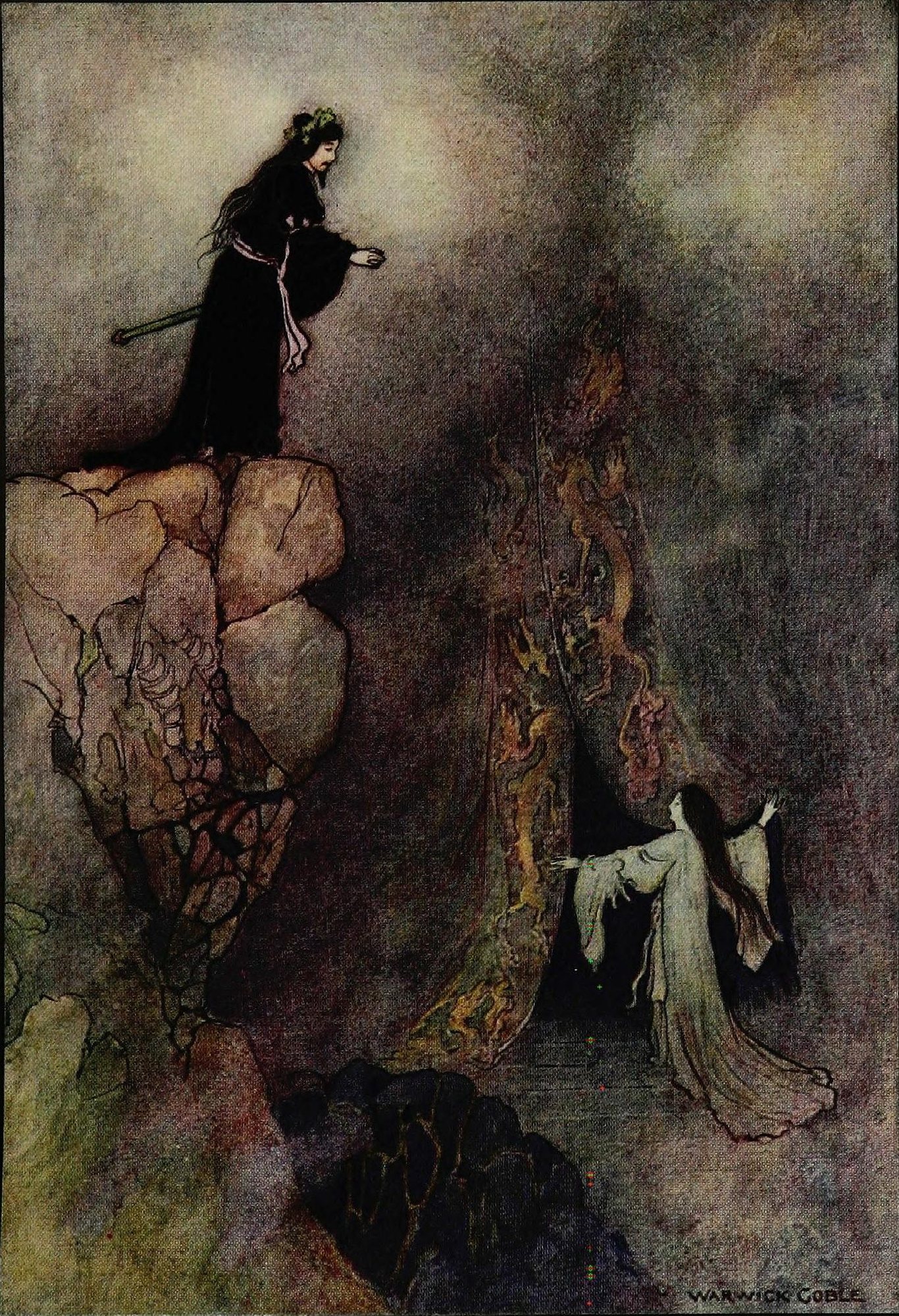
He breaks the promise. A single flame from a comb-tooth shows him the wife he remembers as a rotting body, with the Thunder-Deities grown inside her. The old partnership is over, and he flees Yomi without her. The detailed descent and chase are told in the separate story Izanagi’s Descent to Yomi; the live Yomi, the Land of the Dead guide follows the threshold he seals. Here, Yomi is the wound that drives Izanagi’s next act: contact with death has changed the terms of creation.
At the boundary between the dead and the living, Izanagi seals the road and accepts that he cannot restore the marriage. He turns home alone, carrying not a rescued wife but a task: to cleanse what Yomi has left on him.
Washing the dead world off
He returns filthy from Yomi and recognises that the pollution of the dead must be removed. At the river-mouth near Tachibana in Hyuga, he strips and bathes. In the Kojiki, the cast-off objects and the pollution become gods; purification is therefore not a retreat from creation but its new grammar. The full sequential ablution belongs to Izanagi’s Descent to Yomi; this portrait keeps the act as Izanagi’s defining response to contamination.
The Kojiki gives him the words that name the act:
He said: “Nay! hideous! I have come to a hideous and polluted land,—I have! So I will perform the purification of my august person.” (Kojiki, trans. Chamberlain, Sec. 10)
This is the origin of the ablution later known as misogi, and the point at which Izanagi stops trying to retrieve the past and starts making a future from what it has left on him.
The three births that remain
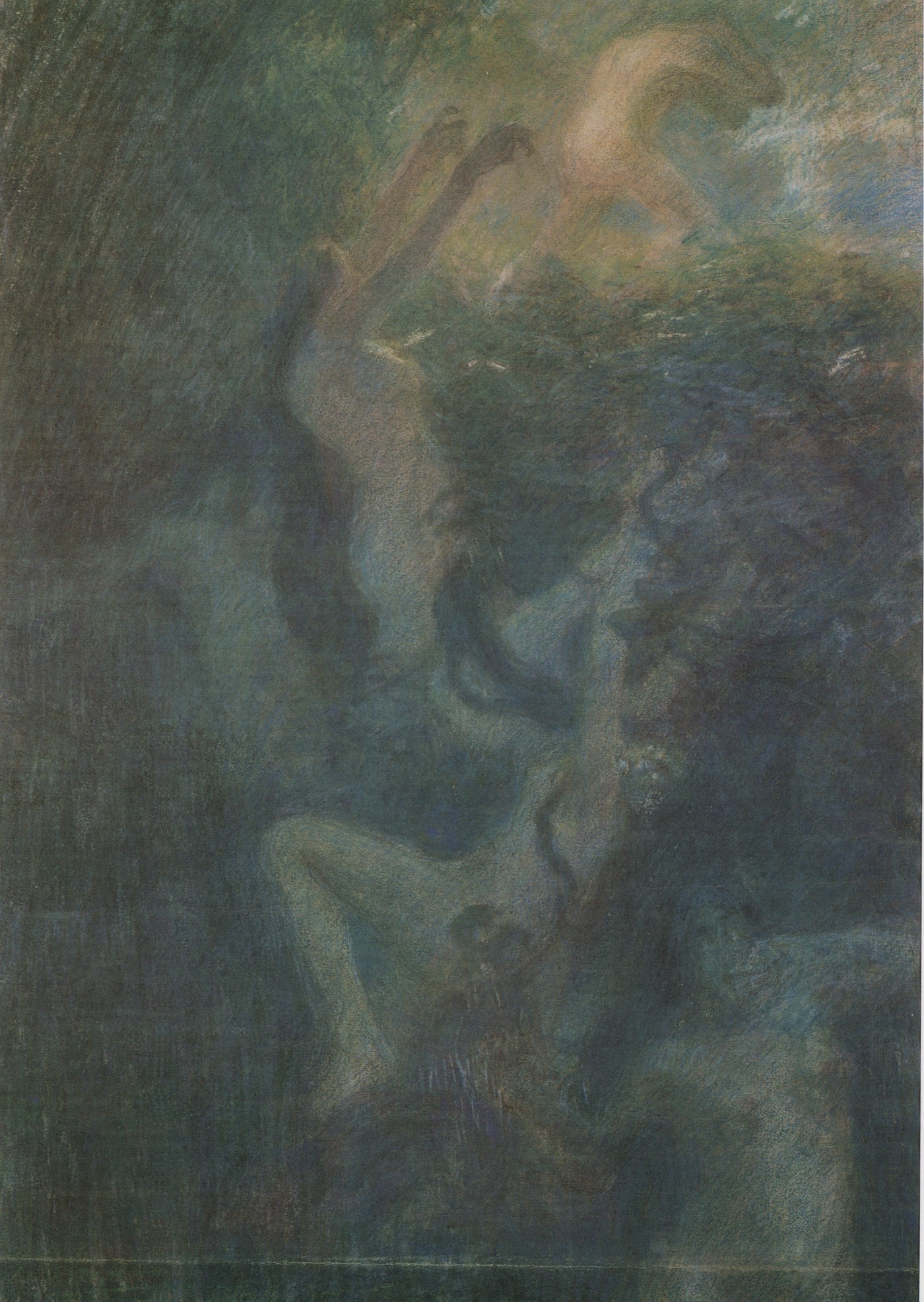
He washes his left eye, and Amaterasu, the Heaven-Shining Great August Deity, is born. He washes his right eye, and Tsukuyomi, the moon, appears. He washes his nose, and Susanoo, the storm, comes forth. In the Kojiki these three are born from Izanagi alone during his cleansing. The Nihon Shoki gives a different main narrative, in which Izanagi and Izanami beget them together before her death. Both accounts are ancient, and neither needs to be forced into the other.
Izanagi gives the children their portions: the Plain of High Heaven to Amaterasu, the night to Tsukuyomi, and the sea to Susanoo. Susanoo refuses his realm and is eventually expelled, a consequence that belongs to the storm-god’s own story. Izanagi himself retires to Taga in Afumi, leaving behind a world that is no longer formless, but is not free of grief, pollution or death.
The published Takamagahara, the High Plain of Heaven places Izanagi’s work in its celestial court. The full creation sequence remains in the separate story The Birth of the Islands, and the complete descent and chase in Izanagi’s Descent to Yomi; Yomi, the Land of the Dead gives that second story its wider frame. Izanagi’s own arc ends at the wash-water: a maker answering loss by giving what remains a new form.
- Kojiki (Records of Ancient Matters, 712 CE), compiled by O no Yasumaro, trans. **Basil Hall Chamberlain, *The KojikiRecords of Ancient Matters*, Transactions of the Asiatic Society of Japan, Vol. X suppl. (1882)**: the read-verbatim source for this piece, Sections 2–12. The Seven Divine Generations and the birth of Izanagi and Izanami (Sec. 2); the Heavenly Deities’ command and the grant of the jewel-spear (Sec. 3); the stirring of the brine until it
went curdle-curdle
and the island of Onogoro, the heavenly pillar and the eight-fathom hall (Sec. 3–4); the body-completion dialogue (veiled by Chamberlain in Latin), the first failed union with the leech-child Hiruko and the island of Awa, and the grand divination faulting the woman for having spoken first (Sec. 4); the corrected second union and the birth of the Eight Great Islands and the myriad deities, with the tally offourteen islands and thirty-five deities
(Sec. 5–6); Izanami’s death bearing the Fire-Deity Kagutsuchi, the deities born of her sickness, Izanagi’s mourning and the tear-born Crying-Weeping-Female, and the beheading of the Fire-God (Sec. 7–8); the descent to Yomi, Izanami’s warning, the comb-tooth torch and the rotting corpse with its eight Thunder-Deities, the flight with grapes, bamboo-sprouts and the three peaches, and the divorce at the Even Pass with the thousand-strangled and fifteen-hundred-born formula (Sec. 9); the purification at Tachibana in Hyuga and the birth of Amaterasu from the left eye, Tsukuyomi from the right, and Susanoo from the nose, with the division of rule (Sec. 10–11); Susanoo’s refusal and expulsion, and Izanagi’s retirement to Taga in Afumi (Sec. 12). Read via English Wikisource, Page:Kojiki by Chamberlain.djvu, djvu pp. 101–131. - Nihon Shoki (Nihongi, Chronicles of Japan, 720 CE), trans. **W. G. Aston, *NihongiChronicles of Japan from the Earliest Times to A.D. 697*, Vol. I,
The Age of the Gods, Book I
(London: Kegan Paul / Japan Society, 1896)**: the parallel chronicle, read verbatim for the divergences honoured above. The jewel-spear of Heaven and the eight-fathom palace; the plainersource of masculinity
andsource of femineity
phrasing of the union dialogue where Chamberlain retreats into Latin; the leech-child whocould not stand upright
even at the age of three years, a detail the Kojiki lacks; the Yomi flight with its Ugly Females, grapes, bamboo-shoots, thousand-men-pull-rock and the thousand-die / fifteen-hundred-born formula; the peach passage; and, most importantly, the severalIn one writing it is said
variants — chief among them the main-narrative version in which Izanagi and Izanami jointly beget the Sun-Goddess, the Moon-god and Susanoo as their children before Izanami’s death, set against the Kojiki’s birth of the three from Izanagi alone during his purification. archive.org idnihongi1asto.