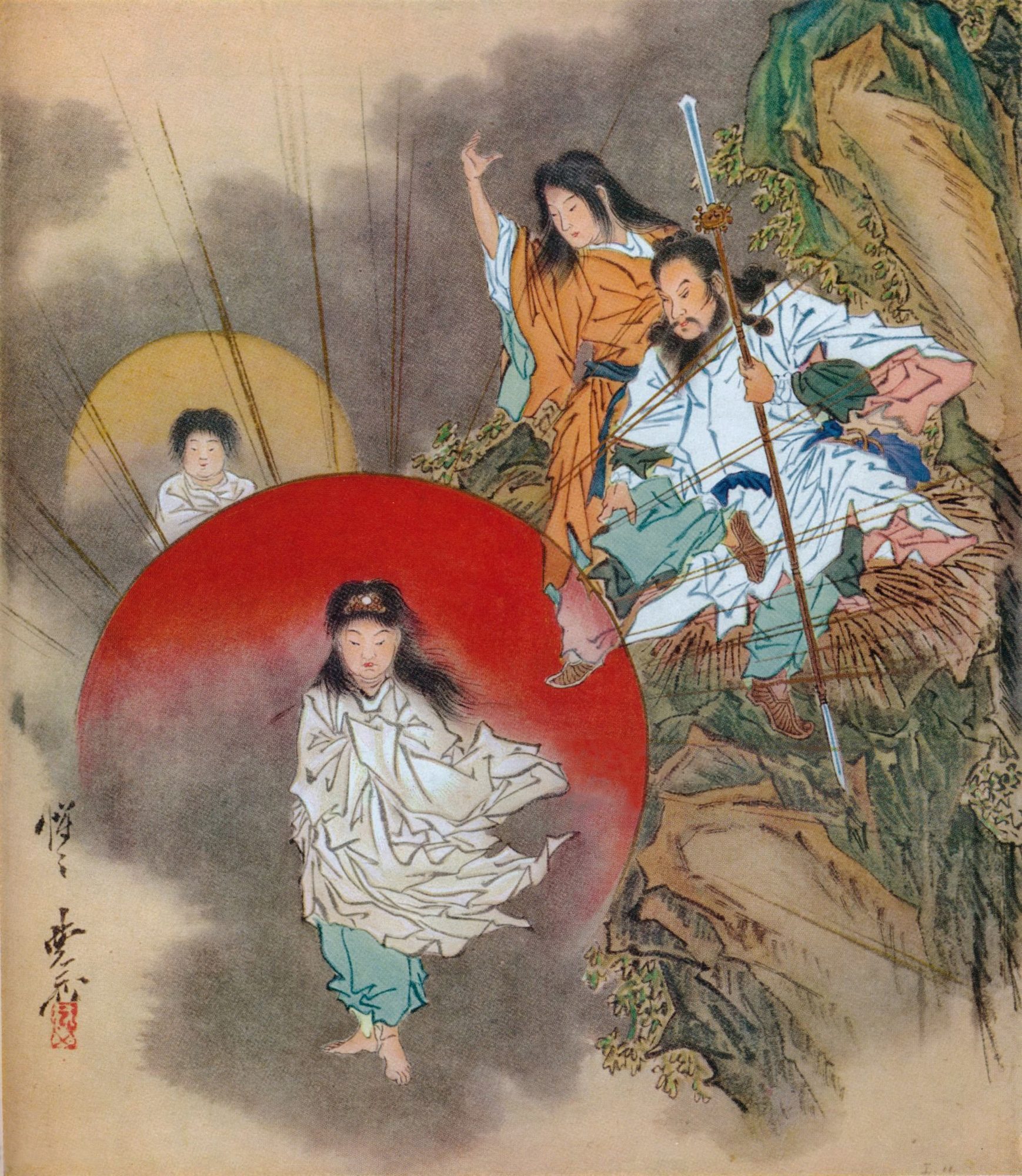
The word the old chroniclers reach for is not sky but plain. Takama-no-hara, the Plain of High Heaven: a flat country lifted above the world, and when you look for what fills it you do not find clouds and thrones but rice-fields with raised ridges and irrigation ditches, a hall where the first-fruits are offered, a weaving-hall where the garments of the gods are made, a mountain called Kagu, and a river with a stony bed where the whole host of Heaven can come down and hold a council by feel. Heaven, in the Japanese telling, is agricultural. It has fields to flood and looms to work, and its sovereign is a goddess who suspects, arms herself, and takes offence like a queen.
But whether the cosmos begins here at all is the first thing the two great chronicles refuse to agree on, and it is not a scribal slip. It is two traditions telling the beginning differently.
Where the first god stands
Open the Kojiki, compiled in 712, and the very first sentence puts you in Takamagahara. The names of the Deities that were born in the Plain of High Heaven when the Heaven and Earth began
were three: the Deity Master-of-the-August-Centre-of-Heaven, Ame-no-Minaka-Nushi, then the High-August-Producing-Wondrous Deity, Taka-mi-musubi, then the Divine-Producing-Wondrous Deity, Kami-musubi. All three were born alone, and all three, in the text’s haunting phrase, hid their persons.
The cosmos opens with a named centre of Heaven and two producing powers who appear, are named, and vanish from view. For the Kojiki the High Plain of Heaven is not a later address the gods move into. It is the ground floor of existence.
Open the Nihon Shoki, finished eight years later in 720, and the beginning is somewhere else entirely. Its main text does not start with a lord of Heaven’s centre at all. It starts with Kuni-no-toko-tachi, the Land-Eternal-Stand, produced when Heaven and Earth first pulled apart, and then, with a scholarly honesty that still startles, it stacks up rival openings one after another. In one writing,
the first deity is Umashi-ashi-kabi-hiko-ji, the Sweet-Reed-Shoot-Prince-Elder. The Nihon Shoki does not choose. It preserves the disagreement on the page, several competing first mornings of the world laid side by side.
So the tidy statement, that the cosmos began in the High Plain of Heaven with Ame-no-Minaka-Nushi, is true to the Kojiki and only to the Kojiki. Hold it as one tradition’s account of the beginning, the boldest and the most heaven-centred, rather than as the flat voice of the sources. The realm is simply grander in the Kojiki, and that difference is itself part of what Takamagahara is.
The goddess given the plain
The realm gets its ruler by a father’s gift. After Izanagi returns from the Land of the Dead and purifies himself, three shining children come into being, and Izanagi divides the cosmos among them. In the Kojiki he takes off his jewelled necklace and, jinglingly taking off and shaking the jewel-string,
bestows it on the sun-goddess with a command: Do Thine Augustness rule the Plain-of-High-Heaven.
Tsukuyomi is given the Night; Susanoo, the Sea-Plain. The Nihon Shoki gives the same charge almost word for word: Do thou, Ama-terasu no Oho-kami, rule the plain of High Heaven.
From that moment Takamagahara has a sovereign, and she is the sun.
Even that is a place where the sources branch. How the sun-goddess was born at all splits three ways. In the Kojiki she is washed into being from Izanagi’s left eye during his purification. The Nihon Shoki’s main text agrees on the left eye. But one of its in one writing
variants has Izanagi take up a white-copper mirror in his left hand, and from the mirror a deity is produced, called Oho-hiru-me, the Great-Noon-Female. Born from an eye in one telling and from a mirror in another, the sun will not be pinned to a single origin.
A country made to be wrecked
The geography of a realm shows itself best when someone tears through it, and Susanoo is the one who does. Refusing his own charge and weeping to go down to his mother in the Nether Land, he is expelled, and before he goes he climbs to Heaven to take his leave. He does not climb quietly. All the mountains and rivers shook, and every land and country quaked.
Amaterasu, certain he means to seize her realm, arms herself, and the arming is one of the most vivid passages the chronicles give us.
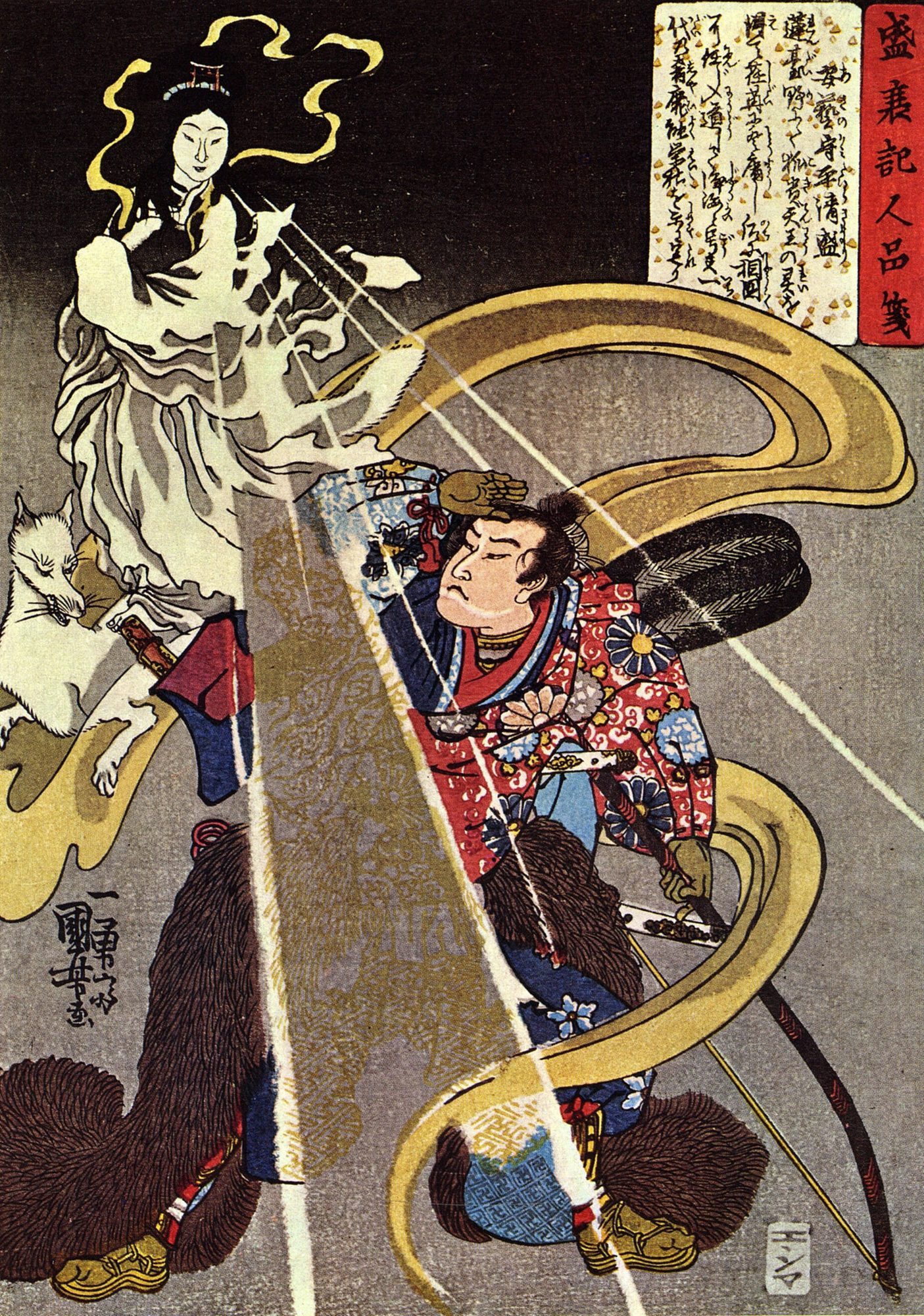
She unbinds her hair and twists it into manly bunches; into her hair, her headdress and both her arms she winds an eight-foot string of five hundred curved jewels; she slings a quiver of a thousand arrows on her back and one of five hundred at her side, brandishes her bow, and stamped her feet into the hard ground up to her opposing thighs, kicking away the earth like rotten snow,
and stood like a mighty man. The ruler of the plain is dressed for war.
To test his intentions the two conduct an oath, the ukehi, each bringing forth deities from the other’s possessions. Amaterasu crunches Susanoo’s sword and breathes out three goddesses, the deities of Munakata; Susanoo crunches her jewels and breathes out five male gods, and the eldest of them, Ame-no-Oshihomimi, is the one through whom the whole imperial line will later run. Susanoo wins the reading of the oath, and, impetuous with victory,
he turns the High Plain of Heaven into a scene of ruin.
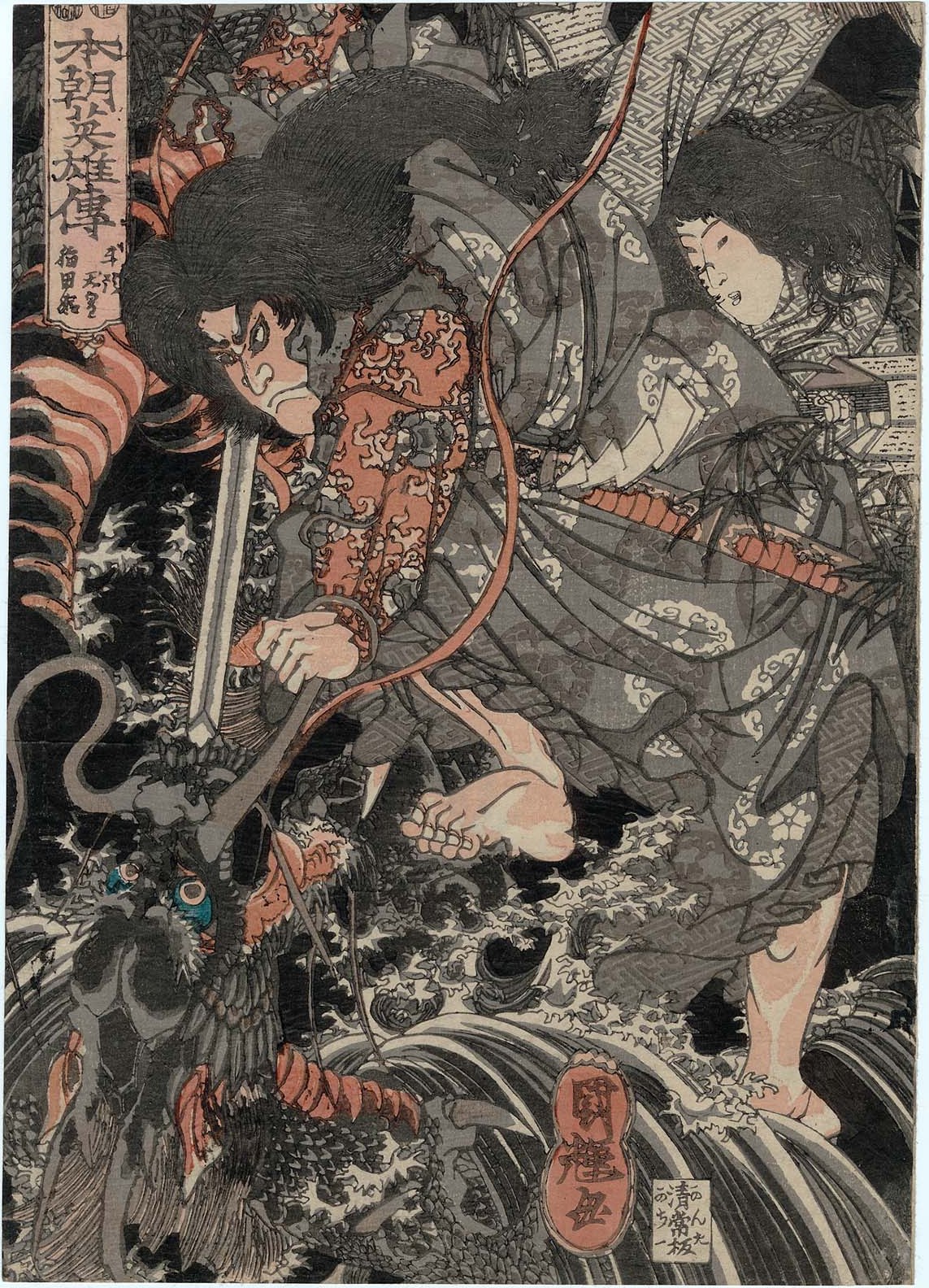
He breaks down the ridges of the sun-goddess’s rice-fields and fills up her irrigation ditches; he fouls the hall where the first-fruits are eaten. Then he breaks a hole in the roof of the weaving-hall and drops through it a heavenly piebald horse he has flayed with a backward flaying, a deliberate act of pollution, terrifying the women weaving at the looms. Every outrage tells you what the realm contains: fields, ditches, a first-fruits hall, a sacred loom. Heaven is a working country, and Susanoo defiles it piece by piece.
The plain gone dark
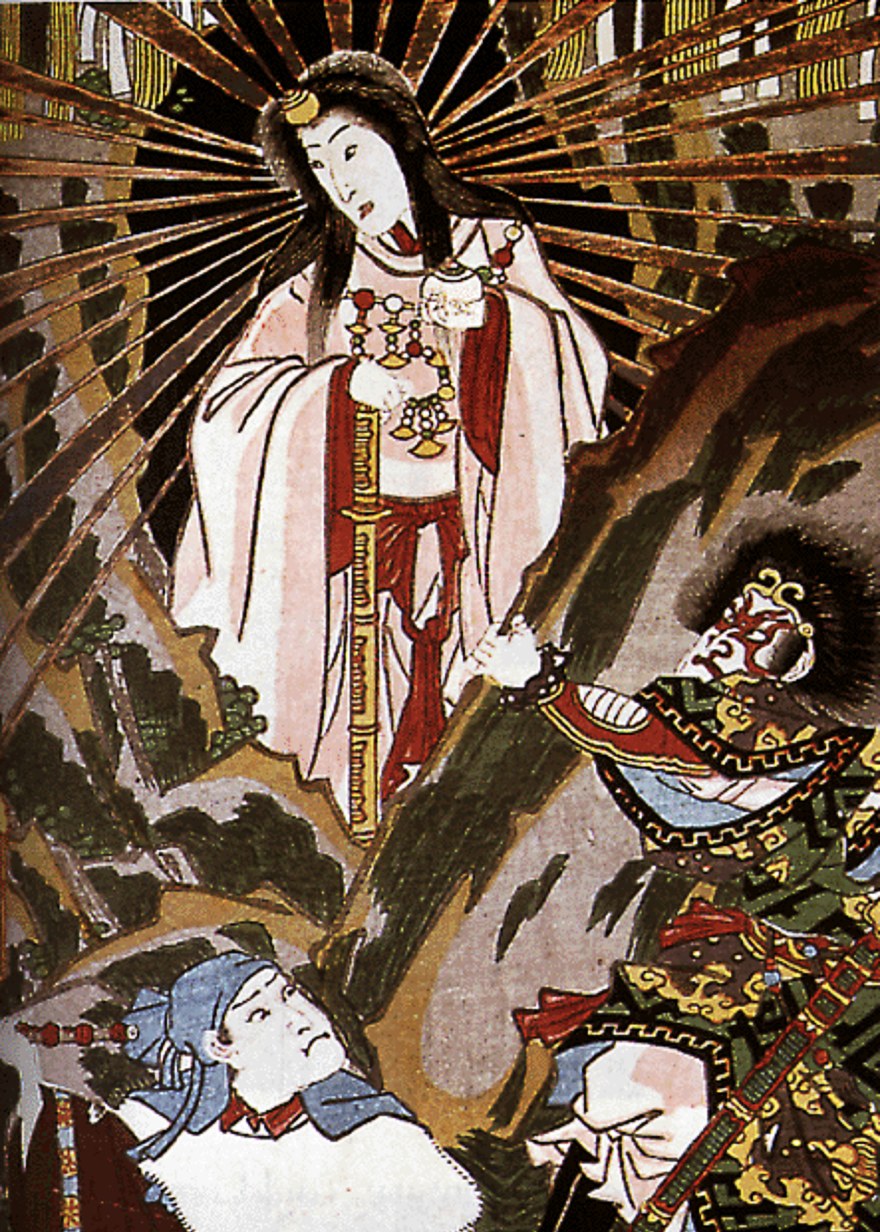
Then comes the moment the whole cosmos turns on. Terrified, Amaterasu shuts the door of the Heavenly Rock-Dwelling, makes it fast, and retires. And with the sun behind a bolted stone, the whole Plain of High Heaven was obscured, and all the Central Land of Reed-Plains darkened. Owing to this, eternal night prevailed.
Here the three storeys of the Japanese cosmos stand in one sentence: Takamagahara above, the Central Land of Reed-Plains that is the earth below it, and, elsewhere in the cycle, Yomi the Nether Land beneath that. The darkness swallows the top two at once. This is also the moment, as Aston notes, when the chronicles stop treating Amaterasu as a quarrelling queen and show what she is underneath: it is plainly the sun itself which withholds its light.
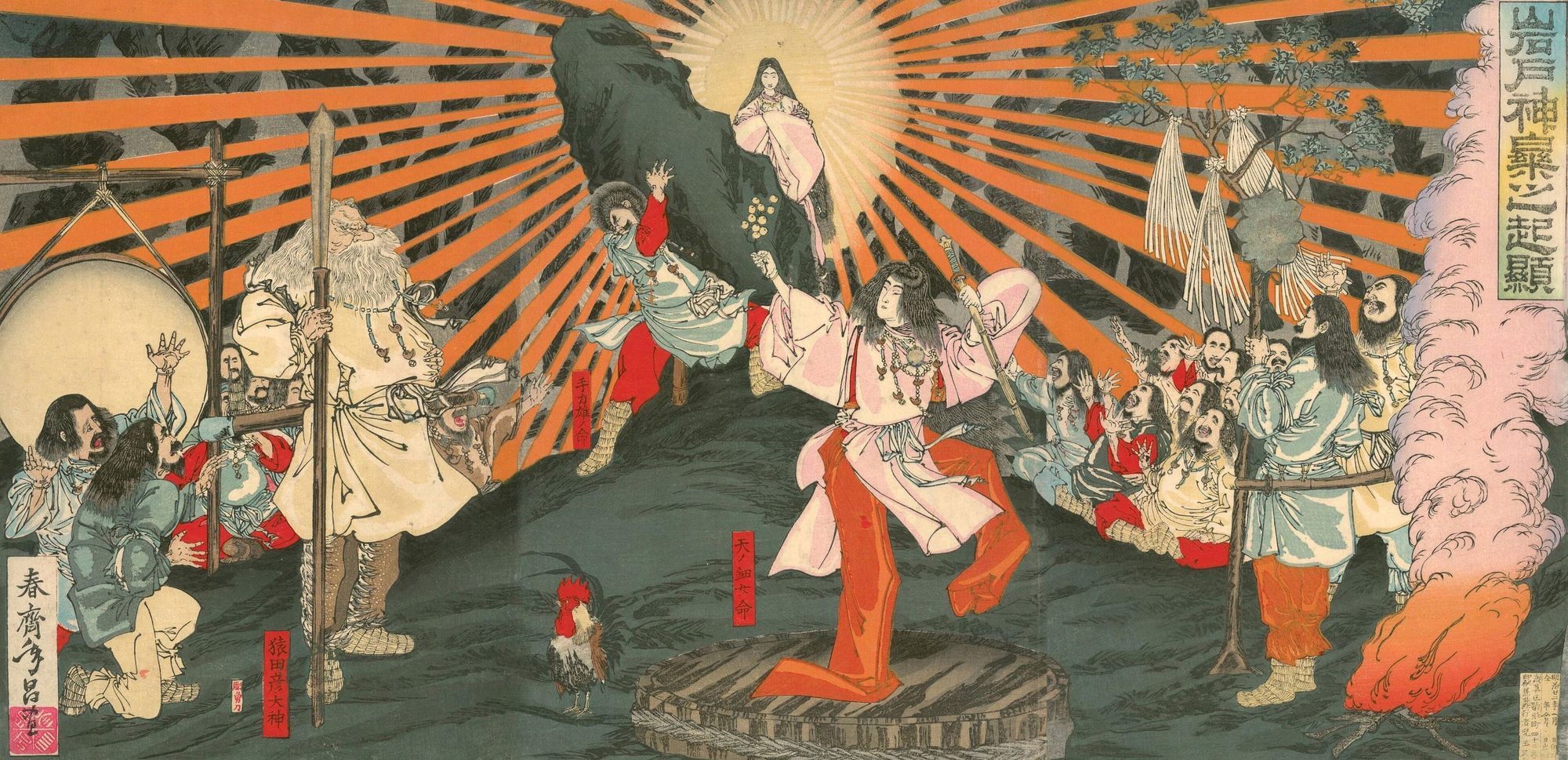
What happens next happens because Heaven is a place where the gods can gather. The eight hundred myriad deities, eighty myriads in the Nihon Shoki’s differently rounded idiom for a countless host, assemble in the bed of the Tranquil River of Heaven, the stony riverbed that runs dry except in flood, and there they hold the first council of the gods. They set Omoikane, the Thought-Includer, child of Taka-mi-musubi, to devise a plan, and the Nihon Shoki credits him with profound device and far-reaching thought.
What he devises is not an assault, for the sun cannot be broken out of a rock, but a performance.
They gather the long-singing cocks of eternal night to crow a false dawn. They uproot a five-hundred-branched sakaki whole from the Heavenly Mount Kagu and dress it like an offering-stand: the string of curved jewels on its upper branches, the great mirror on its middle branches, blue and white cloth below. Ame-no-Uzume, the Heavenly-Alarming-Female, turns a tub bottom-upward, stands on it in a headdress of spindle-tree and a sash of club-moss from Mount Kagu, and dances as if a god had entered her, baring herself until the eight hundred myriad gods roar with laughter and the Plain of High Heaven shakes.
Curious that anyone could be merry in the dark she has made, Amaterasu opens the door a crack; Tajikara-wo, hidden beside it, seizes her hand and draws her out, and a bottom-tied rope is stretched across the door so she cannot return. With that, light floods back over both the High Plain of Heaven and the earth below. That rope, both Chamberlain and Aston name as the bottom-tied rope, is the ancestor of the shimenawa still strung at shrines; and Uzume’s dance, Aston notes, the ancestor of kagura. The furniture of the realm becomes the furniture of worship.
What the plain is
Everything in the story is a fact about the place. Takamagahara is the top of a three-storey cosmos, the realm whose darkening darkens the earth, ruled by a sovereign who is at once a governing goddess and the sun. And it is the launch-point of everything that follows: the mirror forged here and the jewels strung here become, in the wider Age of the Gods, two of the treasures a later grandchild of the sun-goddess carries down to found the imperial line.
(The famous third, the sword Kusanagi, belongs to a different chapter; Susanoo only wins it later, in Izumo, after he is fined a thousand tables of goods, shorn, and expelled from Heaven for the ruin recounted here.) The High Plain of Heaven is not a backdrop the myths happen against. It is the first character in them: named before the gods have faces, wrecked and darkened and restored, and left standing at the top of the world with its rice-fields and its river, waiting for the descent.
The names of the Deities that were born in the Plain of High Heaven when the Heaven and Earth began were the Deity Master-of-the-August-Centre-of-Heaven, next the High-August-Producing-Wondrous-Deity, next the Divine-Producing-Wondrous-Deity. These three Deities were all Deities born alone, and hid their persons. (Kojiki, trans. Chamberlain, Sect. I)
- Kojiki (Records of Ancient Matters, 712 CE), comp. O no Yasumaro, trans. Basil Hall Chamberlain (1882)the read-verbatim spine of this piece. Sect. I,
The Beginning of Heaven and Earth
: the first three deities born alone in the Plain of High Heaven and hiding their persons, with Chamberlain’s noteIn Japanese Takama-no-hara.
Sect. XI,Investiture of the Three Deities
: Izanagi shaking off his jewel-necklace and charging Amaterasu,Do Thine Augustness rule the Plain-of-High-Heaven,
with the Night given to Tsukuyomi and the Sea-Plain to Susanoo. Sect. XV,The August Ravages of His-Impetuous-Male-Augustness
: Susanoo’s ascent, at whichall the mountains and rivers shook, and every land and country quaked
; Amaterasu arming (the twisted hair-bunches, the eight-foot string of five hundred jewels, the thousand- and five-hundred-arrow quivers, the stampinglike unto rotten snow
); the ukehi oath producing the three Munakata goddesses and the five male deities including Ame-no-Oshihomimi; the ruined rice-field ridges, the filled ditches, the fouled first-fruits hall, and the backward-flayed piebald horse dropped through the weaving-hall roof. Sect. XVI,The Door of the Heavenly Rock-Dwelling
: the shut door, the obscured Plain of High Heaven and eternal night; the eight hundred myriad deities in the bed of the Tranquil River of Heaven; Omoikane’s plan, the long-singing cocks, the five-hundred-branched sakaki from Mount Kagu dressed with jewels, mirror and cloth; Uzume’s dance on the overturned tub; Tajikara-wo drawing Amaterasu out; the bottom-tied rope; the return of light. Read from the Wikisource page-scans of the Chamberlain djvu (Sections I, XI, XV, XVI). - Nihon Shoki (Nihongi, Chronicles of Japan, 720 CE),
The Age of the Gods,
Book I, trans. **W. G. Aston, *NihongiChronicles of Japan from the Earliest Times to A.D. 697*, Vol. I (1896)**: the parallel chronicle, read verbatim for the divergences honoured above. Aston’s glossTakama no hara, the plain of high heaven
(p. 4 n.); the opening theogony beginning not with a heaven-centre deity but with Kuni-no-toko-tachi, theLand-Eternal-Stand,
with thein one writing
variant placing Umashi-ashi-kabi-hiko-ji first (pp. 1–5); Izanagi’s charge,Do thou, Ama-terasu no Oho-kami, rule the plain of High Heaven
(p. 18); the birth variants, the left eye and the white-copper mirror yielding Oho-hiru-me (pp. 18, 20–21); the rock-cave sequence (pp. 40–45), with Amaterasu herself wounded at the loom, the eighty myriads on the bank of the Tranquil River, Omohi-kane’sprofound device and far-reaching thought,
the Yata-kagami with itsMa-futsu no Kagami
variant name, Uzume’s mimic dance (which Aston notes as the origin of kagura), Tajikara-wo, and the bottom-tied ropealso called a left-hand rope,
together with theone writing
in which the younger Waka-hiru-me is wounded at the loom and dies. Aston’s note (p. 42 n.) that Amaterasu, anthropomorphic through most of the narrative, is in the rock-caveplainly the sun itself which withholds its light.
Read from the archive.org full text (nihongi1asto).