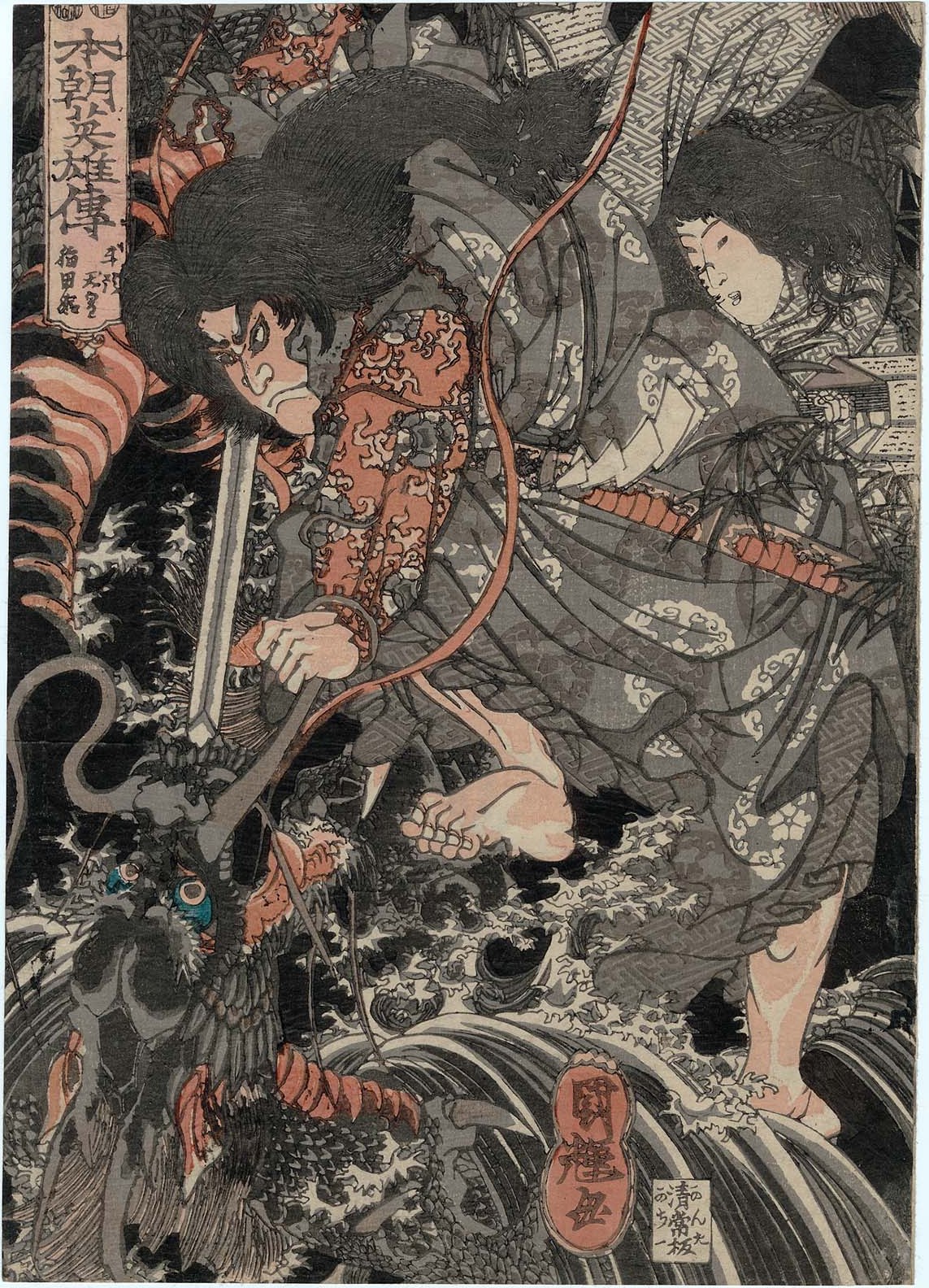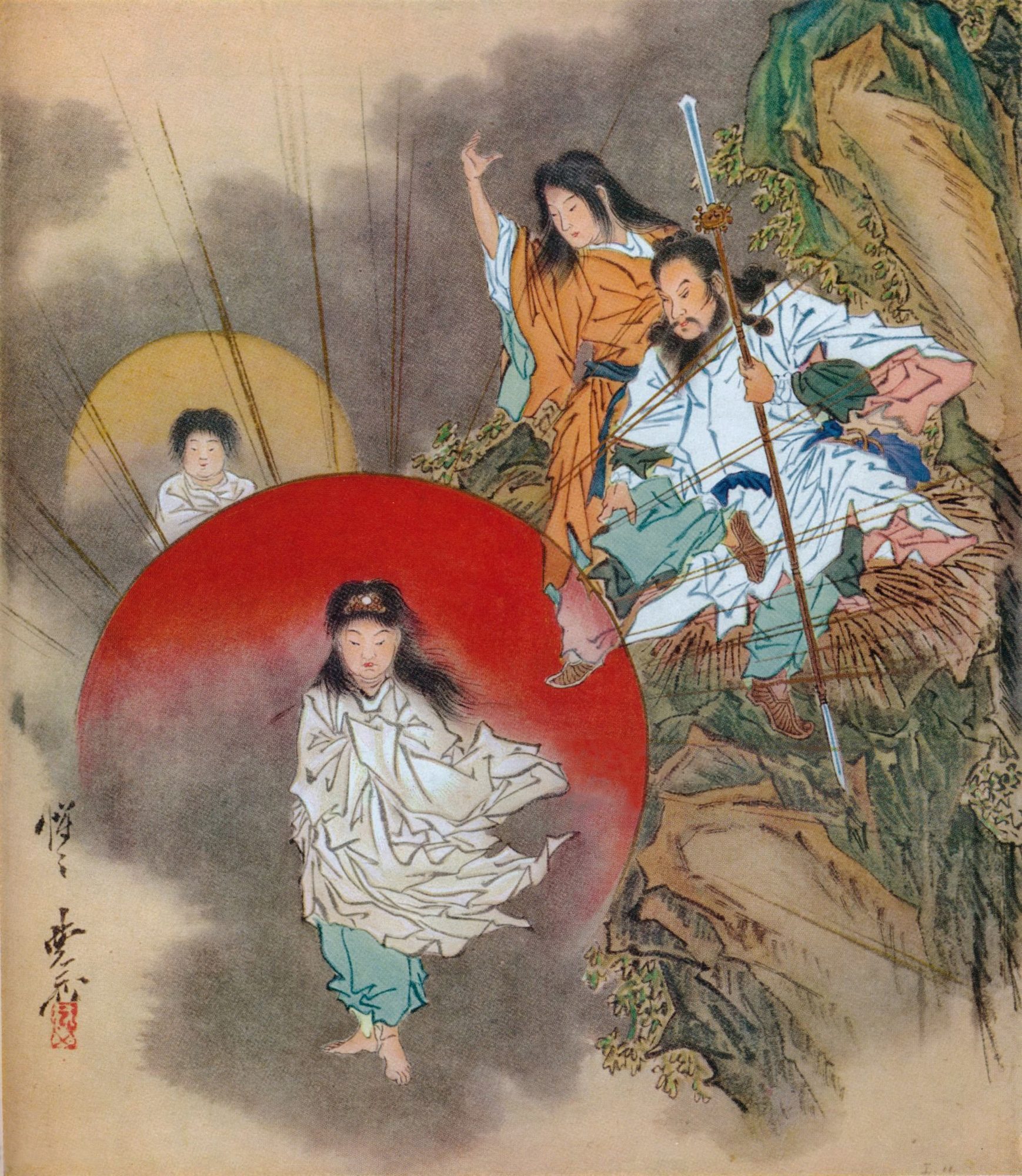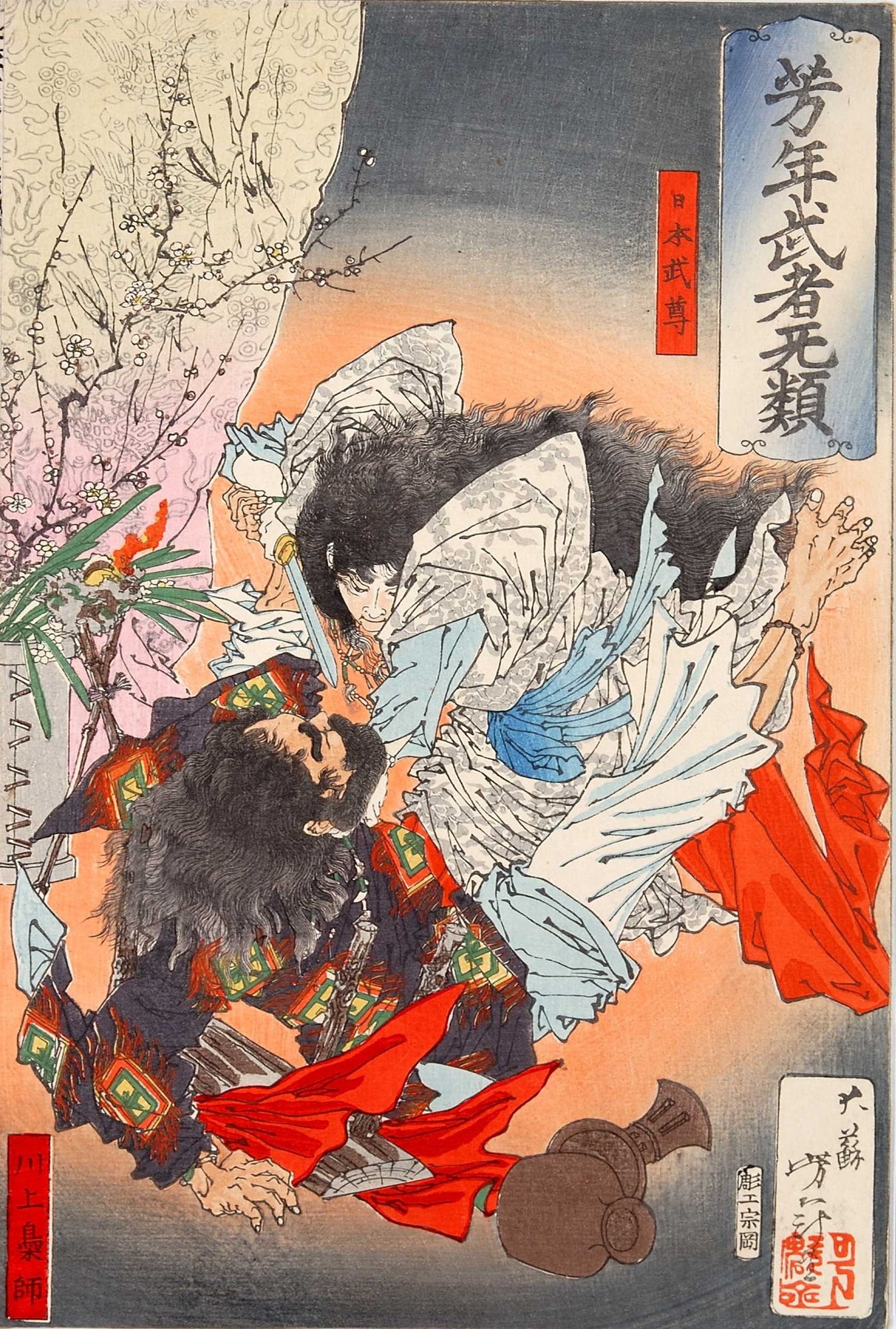
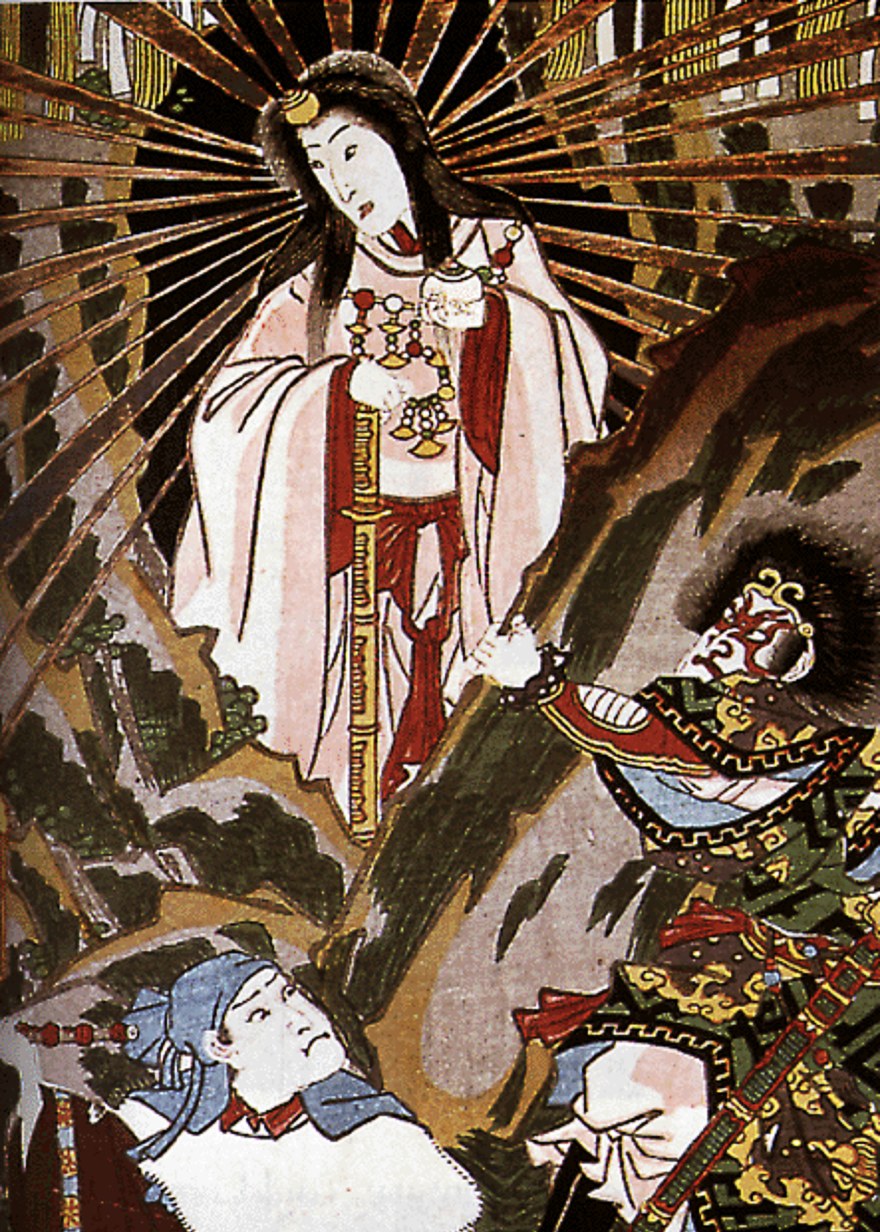
When Izanagi and Izanami had finished producing the islands and the seas and the mountains of the land, they asked a question no parents had asked before: why not now produce someone to be lord of the whole universe? So they made a daughter, deliberately, to rule. The child was the Sun-Goddess, and her lustre shone throughout all six quarters at once, so that there was nowhere it did not reach. Heaven was too small to keep her, so her parents sent her up the Ladder of Heaven (the Pillar, in some tellings) and gave its affairs into her hands.
Do thou, they said, rule the Plain of High Heaven. She has been there ever since. Her oldest name is Oho-hiru-me, the Great Noon Female, and through most of what follows she behaves less like a burning star than like a ruler: she suspects, arms herself, weaves, takes offence, governs. Only in the great crisis of her story does the text show plainly that this quarrelling goddess is also the light itself.
The armed goddess and the oath
There were other children, among them the Moon-god Tsuki-yomi and Susanoo, a storm of a boy of fierce temper and cruel acts. Before going down to the Nether Land, Susanoo climbed up to Heaven to take leave of his sister, and he did not climb quietly: as he came, the hills and mountains groaned aloud.
Amaterasu did not take this for an affectionate visit. Certain her brother meant to rob her of her kingdom, the sun-goddess dressed for war. She bound her hair into the manly knots of a warrior, tied her skirts into trousers, wound five hundred curved jewels round her hair and wrists, and slung two quivers on her back. Then she brandished her bow point-upwards and stamped her feet into the firm ground until her legs sank in as though it were powdery foam-snow. This is no gentle solar disc, but a queen ready to kill.
To prove the redness of his heart, Susanoo proposed a trial: they would produce children by oath, and the sex of the children would reveal his intentions. Amaterasu took the ten-span sword from his belt, broke it in three, rinsed the pieces in the True-Well of Heaven, crunched them and blew them out, and from the mist of her breath three goddesses were born.
Susanoo chewed the string of jewels she wore and blew that out, and from its mist came five gods. The eldest bore an enormous name, Masa-ya-a-katsu-kachi-hayabi-Ama-no-Oshi-ho-mimi, and everything the emperors of Japan would later claim runs through him. Amaterasu settled parentage by ownership: the gods born of her jewels were hers, the goddesses born of his sword his. So Oshi-ho-mimi was her son, and the three daughters became the goddesses of Munakata.
The door in the rock
The oath settled nothing about Susanoo’s temper. He broke down the ridges of his sister’s rice-fields and loosed the piebald colts of Heaven to trample the shoots; he fouled her new palace at the sacred feast of first-fruits. She excused him each time, unwilling to think the worst of a brother. Then he did the thing that could not be excused. As she sat in her sacred Weaving-Hall weaving the garments of the gods, Susanoo flayed a piebald colt, broke a hole in the roof-tiles, and flung it in.
She started up in terror and, in her fright, struck herself with the shuttle. (In one old writing it is not Amaterasu but a younger weaver, Waka-hiru-me, the Young Noon Female, who is startled, wounds herself, and dies.) Either way, she had had enough of the world. She went into the Rock-cave of Heaven, pulled the stone door shut, and stayed. Here at last the text shows her as what she is: with the sun sealed inside the rock, constant darkness fell everywhere, and the alternation of night and day was unknown.
How to lure out the light
All eighty myriads of the gods met on the bank of the Tranquil River of Heaven, and what they devised was not force but a performance. The thoughtful god Omohi-kane drew up the plan. They set the long-singing cocks of the Eternal Land crowing as though dawn were coming, and uprooted a great five-hundred-branched Sakaki tree from the Heavenly Mount Kagu, dressing it like an altar: curved jewels on the high branches, a broad eight-hand mirror on the middle, streamers of blue and white cloth below. The strong god Ta-jikara-wo, Hand-strength-male, took his station beside the door, out of sight.
Then Ama-no-Uzume, the Dread Female of Heaven, made herself the centre of the show. Wreathed in eulalia grass, a spear in her hand, she kindled fires, set a wooden tub bottom upwards, and fell into a divine possession, giving forth an inspired, uproarious utterance. (The Nihongi says only this much; the Kojiki, which gives the fuller account here, adds that she danced upon the tub until it resounded.) The gods roared with laughter until Heaven shook. This is remembered as the first kagura.
Inside the cave, Amaterasu heard it and could not fathom it. How could the gods be so merry when she had left Heaven and Earth in darkness? Curiosity undid her. She opened the stone door a narrow crack and peeped out, and in that instant Ta-jikara-wo seized her hand and hauled her into the light, while the priestly gods stretched a rope of plaited straw across the entrance and begged her never to return. Light came flooding back into the world. That bottom-tied, left-hand rope is the ancestor of the shimenawa. Susanoo was made to pay: fined a thousand tables’ worth of goods, his hair plucked out, and driven down and out of Heaven.
The mirror that is her very self
The mirror from that Sakaki tree does not vanish once the sun is out; it becomes the most sacred object in Japan. In the tellings that make Amaterasu the founder of the imperial line, she hands it down herself, with a blessing that collapses the distance between the object and the goddess. But here an honest reader must slow down, because the two great chronicles disagree on how central she is to what follows.
In the main line of the Nihon Shoki it is not she but the high creator-god Taka-mi-musubi who orchestrates the descent, casting his August Grandchild down to earth wrapped in a coverlet; the Sun-Goddess is barely in the room. It is the variant accounts, and the Kojiki, that bring her forward as the commissioning ancestress who gives the order herself. The image of the sun-goddess as founder of the dynasty is real and ancient, but it is one strand of the tradition, not the flat voice of the sources.
In the version where she commands it, she sends down her grandson Ninigi, son of her son Oshi-ho-mimi, with three treasures in his hands: the curved Yasaka jewel, the eight-hand mirror, and the sword Kusanagi. These are the Three Sacred Treasures, the regalia by which the emperors of Japan have claimed her light ever since.
And she sends him with a charter reaching to the end of time, that his dynasty should govern the Land of Fresh Rice-ears and endure, like Heaven and Earth, for ever. That mirror, tradition says, is the very one that lured her out, flawed where it struck the door as it was carried back in, and it is the great deity worshipped at Ise, where the light that once shut itself inside a rock is honoured still.
When thou lookest upon this mirror, let it be as if thou wert looking on me. Let it be with thee on thy couch and in thy hall, and let it be to thee a holy mirror. (Nihongi I, trans. Aston, p. 82)
- Nihon Shoki (Nihongi), Book I,
The Age of the Gods
, trans. **W. G. Aston, *NihongiChronicles of Japan from the Earliest Times to A.D. 697*, Vol. I (London: Japan Society, 1896)**: the read-verbatim source for this piece. Amaterasu’s deliberate creation and her radiance through the six quarters (pp. 18–19), her ascent to rule the Plain of High Heaven (pp. 28, 33); the division of the three realms among the noble children (pp. 28, 33); the Uke-mochi food-origin episode, in which Amaterasu is the cultivator who sows the first Heavenly rice and begins sericulture, never the slayer (pp. 32–34); the ukehi oath, the object-rinsing and chewing, the birth of the three Munakata goddesses and the five gods including Oshi-ho-mimi, and Amaterasu’s parentage ruling (pp. 34–36); Susanoo’s outrages and the shuttle-wound (pp. 40–41); the Heavenly Rock-cave and the constant darkness (p. 41); the luring-out, with the Sakaki tree, the eight-hand mirror, the crowing cocks, Uzume’s tub-dance, Omohi-kane’s plan, Ta-jikara-wo, and the left-hand rope (pp. 42–45); the Waka-hiru-me variant and the flawed Ise mirror (pp. 45–48); and the descent of Ninigi with the Three Sacred Treasures and the dynastic charter (pp. 70–71, 76–77, 82–83). archive.org idnihongi1asto. - Kojiki (Records of Ancient Matters), Book I, trans. B. H. Chamberlain (1882)the other early chronicle of the same tradition, which foregrounds Amaterasu (alongside Taka-mi-musubi) in the descent of Ninigi and names Susanoo, rather than Tsuki-yomi, as the slayer of the food-goddess (there Ohogetsu-hime). Not read verbatim this session; the Kojiki parallels drawn on above are reported through Aston’s cross-referencing footnotes and are flagged as such rather than quoted from Chamberlain’s own text.