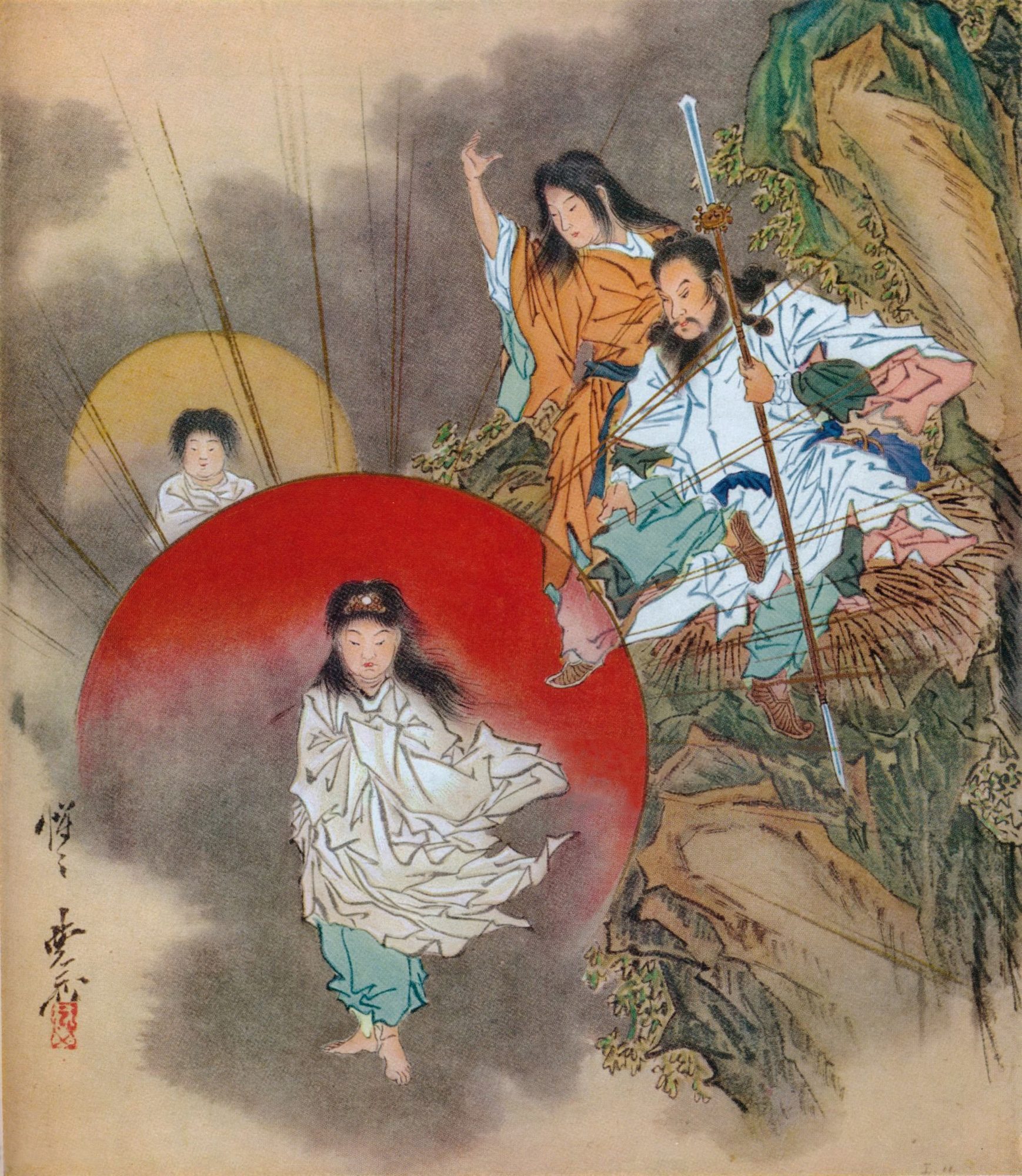
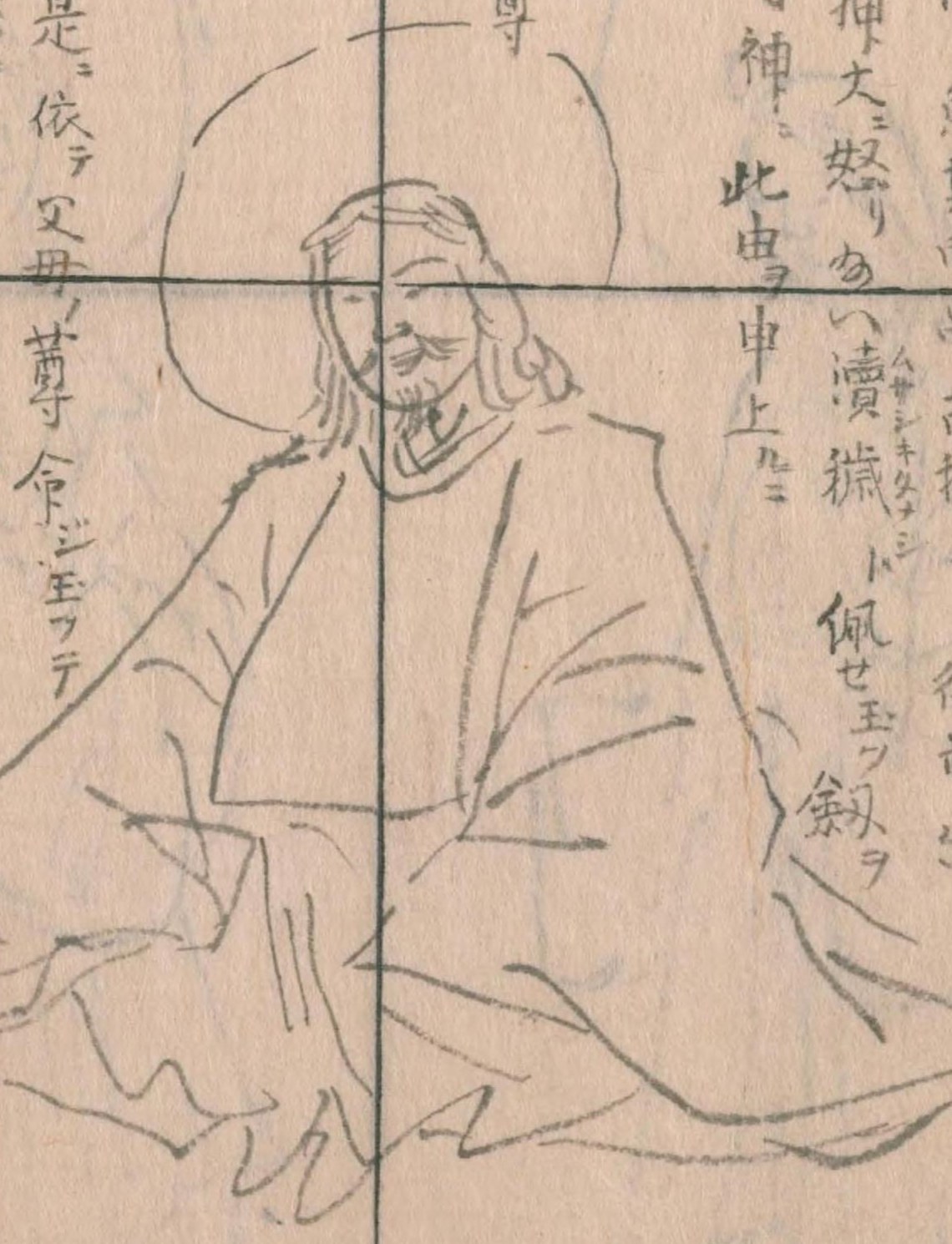
A god came up out of the land of the dead with the filth of that place clinging to him, and went down to a plain by the sea to wash it off. As Izanagi rinsed his left eye, the Sun-Goddess Amaterasu was born of it; as he washed his nose, the storm-child Susanoo; and as he washed his right eye, out of it came a third radiance, the moon. This is how the Japanese chronicles bring their moon-god into being: not fashioned, not begotten in any bed, but rinsed loose from an eye like a bright thing shaken out of water, the by-product of a god making himself clean. His name is Tsukuyomi, which Chamberlain read as Moon-Night-Possessor, twin-born with the sun from the opposite eye of the same face. The Nihon Shoki says his lustre was next to hers in splendour, and that he was to be her consort. From that beginning you would expect a great story. There is almost none.
The god who was given the night
Izanagi parcelled out his new children’s domains on the spot. To the Sun-Goddess he gave the Plain of High Heaven; to Susanoo the sea; and to the moon, in the Kojiki, a single sentence and nothing more. Rule thou, he said, the Dominion of the Night. That is the whole of Tsukuyomi’s commission in the older chronicle. He receives the night, and the Records of Ancient Matters never speak his name again. He fathers no line, fights no monster, wins no bride. Among gods who wrestle serpents and dance the sun out of caves, he is the one who is simply handed a realm and then falls silent.
The Nihon Shoki is less tidy about what he was given, offering the tides of the ocean-plain in one account and co-rule of Heaven beside his sister in another. It is also less tidy about how he was born. Alongside the right-eye washing it records a version in which Izanagi and Izanami produce him in the ordinary way, straight after the sun, and another in which he springs from a white-copper mirror held in Izanagi’s right hand while Amaterasu comes from the mirror in the left. The tradition could not settle on a single account of where the moon came from, which is fitting for a god who leaves so little trace once he arrives.
The banquet from the mouth
His one act survives only in the Nihon Shoki, and it is the reason the sun and moon are never seen together. Amaterasu, already established in Heaven, heard that a food-goddess named Uke-mochi dwelt in the Central Land of Reed-Plains, and she sent her brother down to attend on her. Go, she told him, and wait upon her.
Uke-mochi received him as a host receives a god, by feeding him, but the manner of it was monstrous. Turning her face towards the land, she disgorged boiled rice from her mouth. Turning towards the sea, she brought forth things broad of fin and things narrow of fin. Turning towards the mountains, she produced things rough of hair and things soft of hair. All of it she set out to honour him, a banquet of everything that swims and runs and grows, laid across one hundred tables.
Tsukuyomi did not see hospitality. He saw filth. Flushed with anger, he spat his verdict: Filthy! Nasty! That thou shouldst dare to feed me with things disgorged from thy mouth. And on the word he drew his sword and killed her where she stood, the one violent deed of a god who otherwise does nothing at all.
Why the sun turned her face away
The moon went back to Heaven and told the Sun-Goddess what he had done. Her answer is the whole point of the story. Thou art a wicked deity, she said. I must not see thee face to face. And so, the chronicle says, they were separated by one day and one night, and dwelt apart. This is the aetiology the brief was after, though it wants stating precisely: the text does not have the moon-god carve day out of night, or the murder create the alternation of light.
It gives a reason why the sun and moon are never in the sky together. Brother and sister, estranged over a killing, keep to their opposite halves of the day, and the moon rides the night the sun refuses to share with him. An intended husband and wife who can never again meet face to face.
The food-goddess did not stay wholly dead. When Amaterasu sent a messenger down to look, he found Uke-mochi’s corpse already turning into the world’s larder. An ox and a horse had grown from the crown of her head, millet from her forehead, silkworms over her eyebrows, panic-grass in her eyes, rice in her belly, and wheat and beans in her lower body.
The messenger gathered them all, and the Sun-Goddess made them the seed-crops of the dry fields and the wet, and took the silkworms into her mouth and drew thread from them, and so began sericulture. The killing that estranged the sun and moon also, in the same telling, sowed the fields of the world. But the two divine outcomes do not match. The food supply is reconciled; the deities are not. The crops feed the living, and the sun and moon go on dwelling apart, and that is where the Nihon Shoki leaves them.
A careful reader should hold one warning close here, because the sources themselves split. The Kojiki tells almost this same story, the food-body disgorging a feast, the offended god drawing a blade, the corpse breaking into grain, but it gives the deed to Susanoo, and the victim is a different goddess, Ohogetsu-hime, and it is not framed as any sundering of sun from moon.
In the Kojiki, Tsukuyomi does nothing after his birth at all. It is only the Nihon Shoki that puts the sword in the moon-god’s hand and makes the quarrel the reason the two lights keep apart. Aston, who translated the Nihon Shoki, judged its version the likelier original, precisely because it explains something the Kojiki’s does not: why the sun and moon are never seen together.
That is the sum of him. A radiance rinsed from an eye, a realm handed over in one line, a single furious killing, and an estrangement that hangs the moon on the far side of the day from the sun. Beyond it the two great chronicles fall silent. The elaborate moon-god of later imagination, with his moods and romances and powers, is a much later invention. What the ancient records preserve is stranger and thinner than any of that: a beautiful, near-wordless god who was given the night, killed once, and was never spoken to face to face again.
Thereupon Ama-terasu no Oho-kami was exceedingly angry, and said:—“Thou art a wicked Deity. I must not see thee face to face.” So they were separated by one day and one night, and dwelt apart. (Nihongi I, trans. Aston, p. 32)
- Nihon Shoki (Nihongi), Book I,
The Age of the Gods
, trans. **W. G. Aston, *NihongiChronicles of Japan from the Earliest Times to A.D. 697*, Vol. I (London: Japan Society, 1896)**: the read-verbatim source for the quarrel that sets the sun and moon apart. Tsukuyomi’s birth variants and his characterisation as of a radiance next to the Sun’s and as her intended consort (pp. 18, 25); the white-copper mirror birth (p. 27) and the right-eye washing the Kojiki also gives (p. 28); the tides-of-the-ocean-plain domain (p. 28); and, in full, the Uke-mochi episode: Amaterasu sending Tsukuyomi to attend on the food-goddess, the banquet disgorged towards land, sea and mountain on one hundred tables, theFilthy! Nasty!
insult and the sword-killing, theseparated by one day and one night, and dwelt apart
aetiology, and the crops-and-sericulture aftermath grown from the corpse (pp. 32–33); with Aston’s footnote flagging the Kojiki’s divergence (Susanoo as killer) and reporting that the Kujiki agrees with the Nihon Shoki’s version (p. 33). - Kojiki (Records of Ancient Matters), Sect. XI and XVII, trans. **B. H. Chamberlain, *The KojikiRecords of Ancient Matters* (1882)**: the read-verbatim source for Tsukuyomi’s birth from the washing of Izanagi’s right eye and his one and only commission,
rule the Dominion of the Night,
after which the Kojiki never mentions him again (Sect. XI, pp. 128–130), together with Chamberlain’sMoon-Night-Possessor
rendering and his footnote on the disputed name-etymology (p. 129); and Sect. XVII (pp. 145–146), where it is Susanoo, not Tsukuyomi, who kills the food-goddess (there Ohogetsu-hime), and where the parallel corpse-into-crops catalogue appears, confirming Tsukuyomi’s near-total absence from the Kojiki. Read via Wikisource, Page:Kojiki by Chamberlain.djvu/128–130 and /145–146.