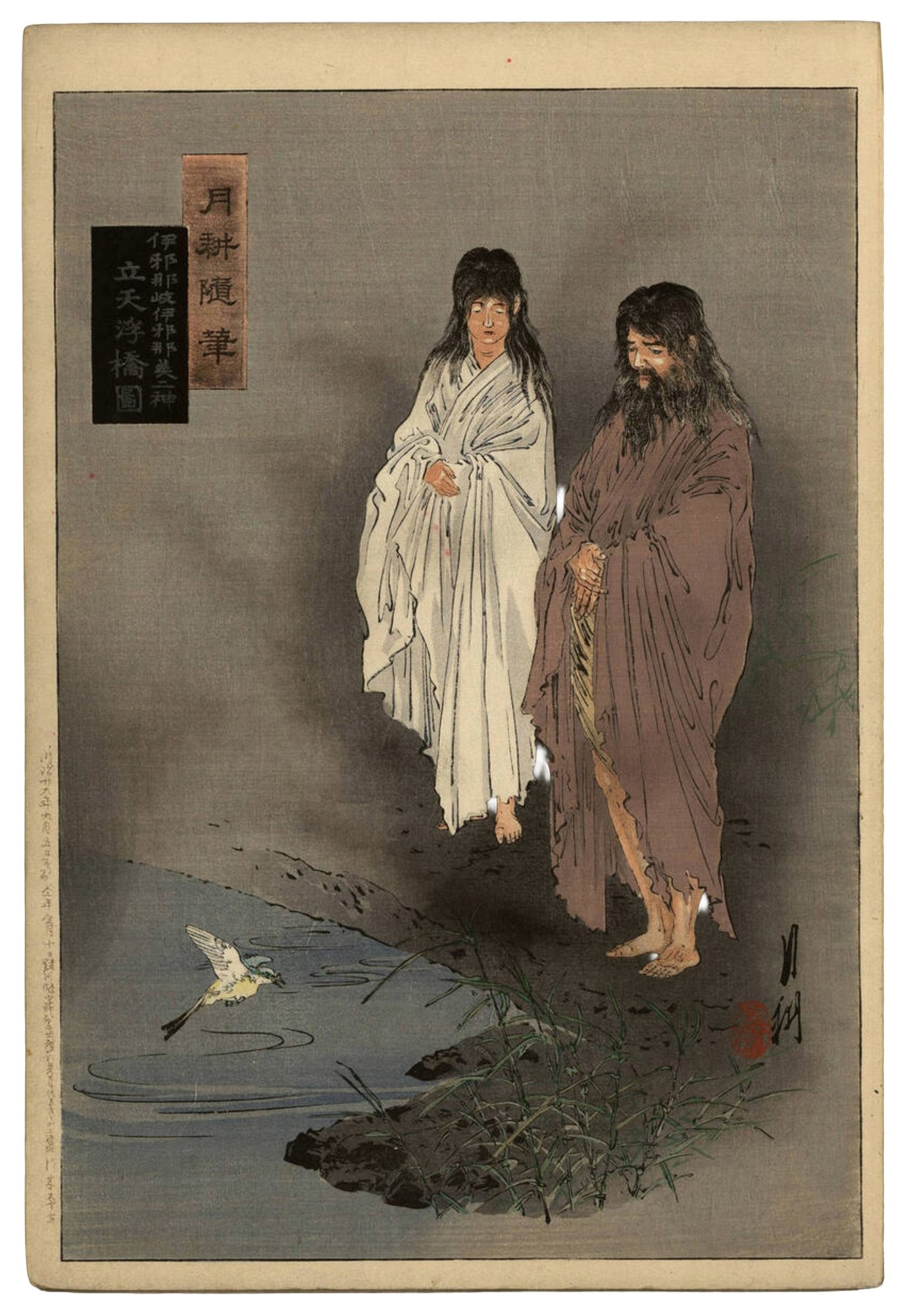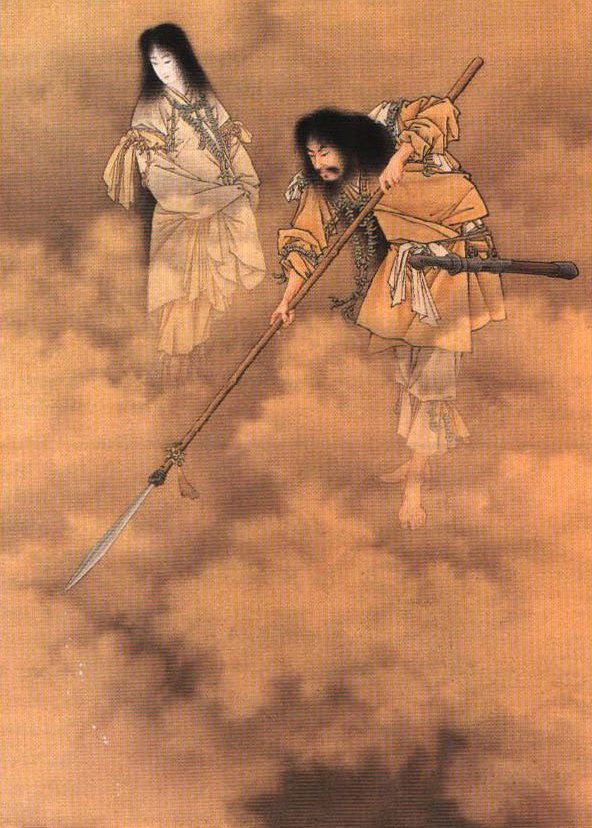
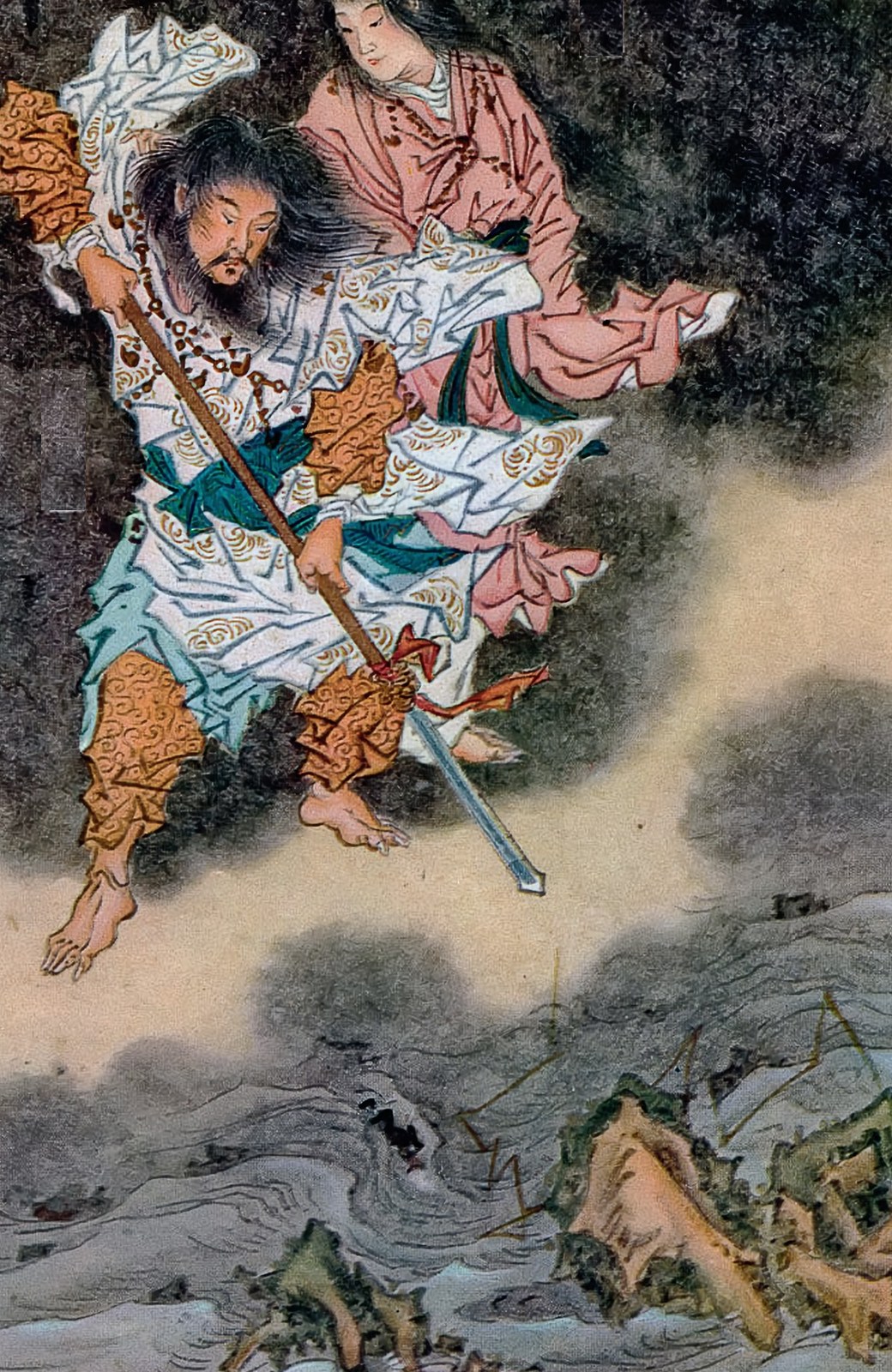
There was a bridge, and below it a sea that was not yet a sea, only a drifting brine with no land in it anywhere. On the bridge stood two gods, a brother and his younger sister, the last of the seven generations that had come and gone since the beginning. The elder deities of Heaven had set them a task no one before them had managed, and had put a tool in their hands to do it with: make this drifting land, they said, consolidate it, give it birth. Then they handed down a spear, long and heavy and jewelled at the head, and left the two of them there on the Floating Bridge of Heaven to begin.
Izanagi, His Augustness the Male-Who-Invites, and Izanami, Her Augustness the Female-Who-Invites, reached the spear down together from the bridge until its point touched the brine, and they stirred. What they were standing on the old text does not settle: the Floating Bridge of Heaven has been read as a literal bridge, a heavenly rock-boat, even a natural spit of coast, and the scholars who have argued over it have never agreed. What they did on it is plain enough.
They pushed the point down into the shapeless water and turned it round and round, and the sea began to thicken and answer, until it went curdle-curdle. That is the actual word the Kojiki uses, an onomatopoeia for the glutinous, curdling sound and feel of brine going from water to something almost solid, and no cleaner image survives for the first act of making: not a word spoken over the deep, but a spear stirred in it until it clotted.
Then they drew the spear up. The brine that had gathered on its point ran off the tip and dripped back down, and where it fell it did not spread and vanish. It piled. Drop on congealing drop, a small heap of set sea built itself up out of the water and became an island, and because it had curdled and condensed of its own accord they called it Onogoro, the Self-Curdling.
The Nihongi, telling the same moment, has the gods grope about with the spear until they find the ocean, and the brine coagulate into an island of the same name. On this first heap of hardened sea the two of them came down out of Heaven to stand, and everything that followed happened here.
Onogoro was never counted among the great islands of Japan. It was the platform, not the country: the small solid place from which the whole generative act could be performed. On it the pair raised a pillar reaching up to Heaven and built themselves a hall eight fathoms wide, a fathom being an arm-span, so that eight-fathom
says simply that the hall was large, not that eight was a holy number. There, in that first house on that first ground, Izanagi turned to his sister with a question about the way their two bodies had been formed.
Her body, she told him, had grown with one place left unclosed. His had grown with one place formed in excess. He proposed the obvious remedy, to bring the one to the other and from the joining give birth to lands, and she agreed. (Chamberlain, translating for a Victorian readership in 1882, lost his nerve at exactly this point and rendered the exchange into Latin; Aston, blunter, lets the god speak of uniting the source of masculinity to the source of femininity.)
They settled how it should be done. They would walk around the great heavenly pillar from opposite sides, and greet each other when they met on the far side. In the Nihongi the man goes by the left and the woman by the right. They circled, and they met, and Izanami spoke first: how lovely, she said, a fine young man. Izanagi answered her, how lovely, a fair maiden. Then they joined, and the making came out wrong.
The child that was not counted
What the flawed first union produced is one of the places where the two great chronicles part company, and the fact-sheet is firm that the split should not be smoothed over. In the Kojiki the firstborn is a leech-child, Hiruko, a thing so ill-made that they set it in a boat of reeds and pushed it out to drift away. After it came a second failure, the island of Awa, whose name means Foam. Neither the leech-child nor the foam-island was reckoned among their true children. (Chamberlain notes that the resemblance of Hiruko to the word for leech
is a chance of sound, and that the child was disowned simply because he was a failure.
The much later, medieval identification of this castaway with Ebisu, the fortune-god, is no part of the ancient text and is not made here.) The Nihon Shoki tells it differently: in its main narrative there is no leech-child at this moment at all. Instead the first island born is Ahaji, the future Awaji, and because the gods took no pleasure in it they treated it as a placenta, an afterbirth cast off before the real children came, its very name glossed as the island that will not meet,
or, punningly, my shame.
A discarded child in one telling, a discarded afterbirth in the other; the reader is owed both, and neither is the single truth.
Whichever way the failure is figured, the cause is agreed. The two gods went back up to Heaven and laid the matter before the Heavenly Deities, who performed a grand divination to read the fault. The method the tradition attaches to this is the old one: scorching a deer’s shoulder-blade in a clear fire and reading the cracks that split across the bone. The verdict came out plainly. The union had miscarried because the woman had spoken first. Go down, the elder gods said, and say it again, in the right order.
The eight great islands
So they descended to Onogoro once more and circled the pillar again, and this time Izanagi spoke first and Izanami answered him, and now the births came right. Out of the corrected union came the Eight Great Islands, and because there were eight of them the country itself took the name Oho-ya-shima, the Land of the Eight Great Islands.
Here, too, the chronicles diverge, and again the fact-sheet insists a version be chosen and named rather than blended. Following the Kojiki: first was born Awaji; then Iyo, which is Shikoku, described as one body with four faces, each face a separate named country with its own deity, Iyo and Sanuki and Awa and Tosa; then the triplet islands of Oki; then Tsukushi, which is Kyushu, likewise one body and four faces, Tsukushi and Toyo and Hi and Kumaso; then Iki, then Tsushima, then Sado; and last of the eight, the great luxuriant island of the dragonfly, Oho-yamato-toyo-akitsu-shima, which is Honshu, the country’s heart.
After the eight, six smaller islands followed. The Nihon Shoki orders them otherwise, puts Honshu second and not last, and makes Oki and Sado a single twin-birth that it calls the very prototype of twins among mankind; in its account the outermost small islands, Tsushima and Iki among them, are not counted among the primary births at all but formed afterward from the coagulation of sea-foam, the same congealing that raised Onogoro in the first place, running on at the edges of the world.
The land was made. Having finished giving birth to the islands, the Kojiki says, the two of them began afresh to give birth to deities: gods of the sea and gods of the river-mouths, gods of wind and tree and mountain and moor, a long generation of the powers of the natural world, brought forth one after another by the same pair who had just stirred that world’s first ground out of the brine. That is where this beginning ends, with the archipelago laid down and its gods starting to come. What waited further along that road, the birth of fire and the death it would cost the goddess who bore it, belongs to another telling.
The brine which dripped from the point of the spear coagulated and became an island which received the name of Ono-goro-jima. (Nihongi, trans. Aston, Book I)
- Kojiki (Records of Ancient Matters, 712 CE), compiled by O no Yasumaro, trans. **Basil Hall Chamberlain, *The KojikiRecords of Ancient Matters*, Transactions of the Asiatic Society of Japan, Vol. X suppl. (1882), Sections III–VI**: the read-verbatim main source for this retelling. The Heavenly Deities’ command to
make, consolidate, and give birth to this drifting land
and the grant of the heavenly jewel-spear Ame-no-nuboko (Sect. III); the Floating Bridge of Heaven, the stirring of the brine until itwent curdle-curdle
(the onomatopoeia koworo-koworo, glossed by Chamberlain as the thick, glutinous, curdling sound) and the self-curdled island of Onogoro,the Self-Condensed
(Sect. III); the heavenly august pillar and the hall of eight fathoms (a fathom an arm-span,eight-fathom
meaning simply large), the body-completion dialogue (which Chamberlain renders into Latin for propriety), the circling of the pillar and the woman speaking first, and the resulting leech-child Hiruko set adrift in a reed-boat with the island of Awa (Foam
), neither reckoned among the children (Sect. IV); the return to Heaven, the grand divination faulting the woman’s having spoken first, and the corrected union (Sect. V); the birth of the Eight Great Islands (Oho-ya-shima) in the Kojiki’s order — Awaji, Iyo/Shikoku (one body and four faces
: Iyo, Sanuki, Awa, Tosa), the Oki triplet, Tsukushi/Kyushu (one body and four faces
: Tsukushi, Toyo, Hi, Kumaso), Iki, Tsushima, Sado, and Oho-yamato-toyo-akitsu-shima (Great-Yamato the Luxuriant Island of the Dragon-Fly
/Honshu) — with the six further small islands, and the beginning of the birth of the nature-deities (Sect. V–VI). Read via English Wikisource, Kojiki (Chamberlain, 1882)/Section 3. - Nihon Shoki (Nihongi, Chronicles of Japan, 720 CE), trans. **W. G. Aston, *NihongiChronicles of Japan from the Earliest Times to A.D. 697*, Vol. I,
The Age of the Gods, Book I
(London: Kegan Paul / Japan Society, 1896), djvu pp. 34–45**: the parallel chronicle, read verbatim for the divergences honoured above. The seven generations of the age of the gods and the several competingone writing
(一書) cosmogonic variants before Izanagi and Izanami; the jewel-spear thrust down to grope for and find the ocean, its dripping brine coagulating intoOno-goro-jima
(glossedSpontaneously-congeal-island
); the male-by-the-left, female-by-the-right circumambulation; the woman-first failure and its correction; the main-text version in which the botched first island Ahaji (Awaji) is reckoned a rejected placenta (their minds took no pleasure in it
) rather than a leech-child, the name glossedthe island which will not meet
or, punningly,my shame
; the differing island order, with Honshu born early and Oki and Sadoborn as twins
(the prototype of the twin-births … among mankind
); the naming of Oho-ya-shima; and the smaller islands (Tsushima, Iki and sundry islets)produced by the coagulation of the foam of the salt-water
. archive.org idnihongi1asto.