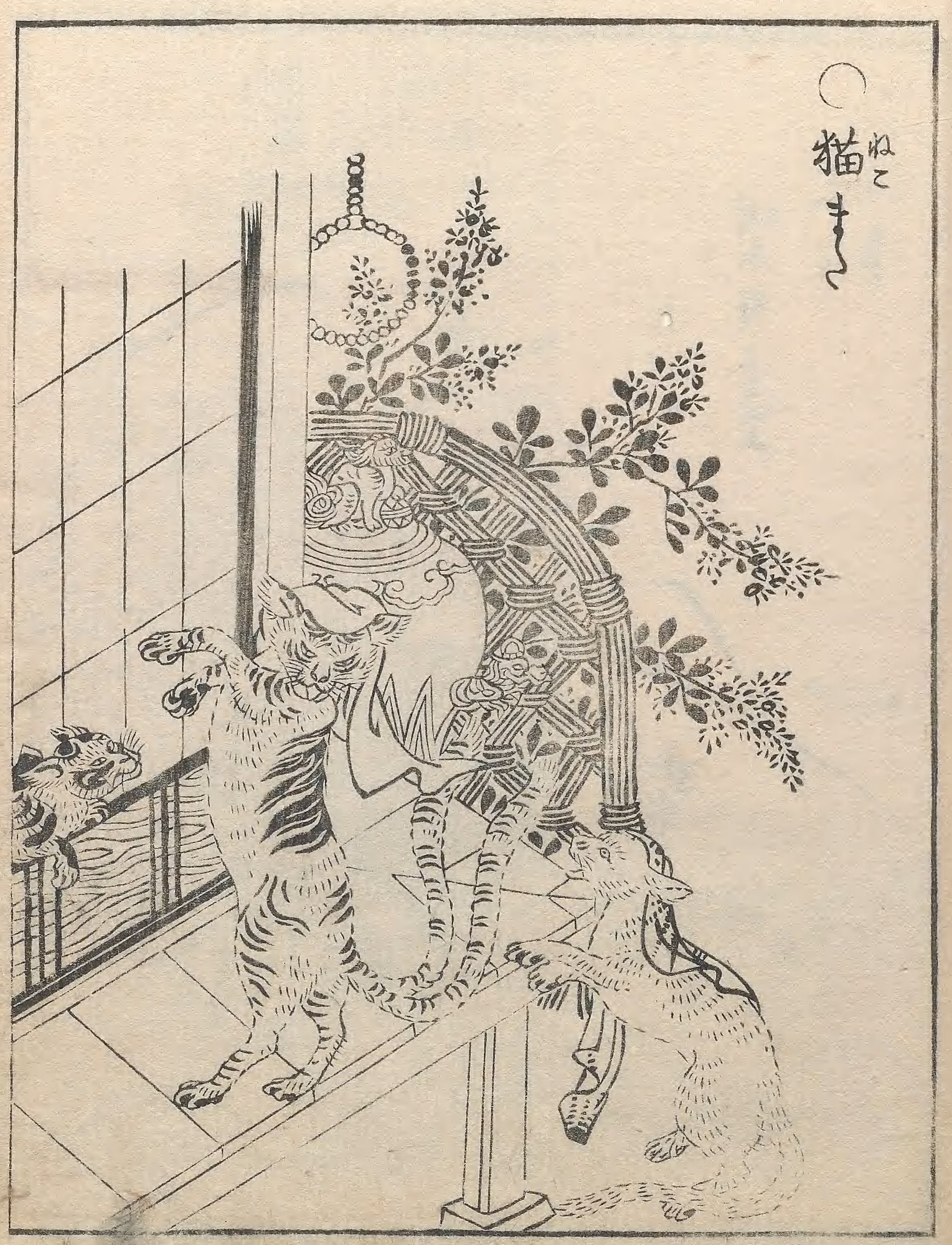
A cat rears up on its hind legs in a dark room and leans its face toward the flame of the floor-lamp. It is after the oil in the shallow dish, and to reach it the animal stands almost as a person stands, its head thrown into shadow on the paper shade behind it. That silhouette, a cat’s head cast large where a woman’s ought to be, is the oldest domestic image of the monster-cat, and it is worth holding onto before the creature climbs onto the kabuki stage and becomes a vengeful courtesan. The household monster-cat is a smaller, stranger thing than that: an ordinary cat that has lived in one house too long, and has begun to do the things a cat should not.
The trouble is the name. The word usually given this creature, bakeneko, the changed cat,
is an Edo-and-later label, and the classical texts do not use it. They say nekomata, the forked cat,
and they use it loosely, for a beast in the deep mountains that eats people and for the aged house-cat alike. The tidy modern rule that a bakeneko has one tail and a nekomata two is a yōkai-cataloguer’s convention set down in the twentieth century, and the old books do not obey it. What follows is the household branch of a single cat-spirit the sources never cleanly split: the cat that licks the lamp, walks upright, wears a towel, and haunts its own family.
In the deep mountains and here at home
The oldest layer is not domestic at all. The first datable notice comes from the diary of Fujiwara no Teika, the Meigetsuki, in an entry for the year 1233: a nekomata at Nanto, near Nara, said to have killed and eaten several people in a single night, with eyes like a cat and a body large as a dog’s. Two decades later a collection of the 1250s records cats suspected of being things transformed into demons. This is a Kamakura-period monster, thirteenth and fourteenth century, and it lives in the hills.
The clearest early statement stands in the Tsurezuregusa, the Essays in Idleness
that Yoshida Kenkō wrote around 1330. He gives both halves of the belief in one breath: that in the deep mountains there is a thing called nekomata which eats people, and that even here, among us, cats that have grown old turn into nekomata and carry people off. The second clause is the seed of the whole household tradition, and it is worth marking how old it is against what comes later.
Roughly three centuries of quiet
Because between Kenkō’s aged house-cat and the monster-cat most people can picture, there is a gap of roughly three hundred years. The domestic creature with its lamp and its towel is not a Kamakura beast at all; it crystallises in the Edo period, in books written around 1660 and after. When people quote the old Japanese belief in the monster-cat
as one thing, they are folding a fourteenth-century mountain man-eater and a seventeenth-century household haunter into a single voice, and the two are three centuries and a whole change of setting apart. The mountain nekomata is the older stratum; the oil-licking, towel-dancing cat of the house is essentially an Edo construction.
Even the earliest Edo tales keep one foot in the mountains. Ogita Ansei’s Tonoigusa, a collection of kaidanA tale of the strange and ghostly, the Edo genre of collected weird stories in which the transforming cat is set down again and again., tales of the strange, from 1660, tells of a hunter who shoots a nekomata, and finds he has shot a cat that had taken the shape of his own mother. That is a shapeshifter and a mountain-cat, closer to Kenkō than to the lamp. The purely domestic monster comes into focus only across the following decades.
The oil in the dish
The signature act of the household cat is the licking of the lamp-oil. The andonA paper-shaded standing oil-lamp of the Edo house, its shallow dish burning cheap fish oil; the lamp the monster-cat rears up to lick., the paper-shaded floor-lamp of the Edo house, burned cheap fish oil pressed from sardines, and a cat kept on a human diet of grain and vegetables, starved of the fat and protein a carnivore needs, was drawn to the reeking stuff in the dish.
To reach it the animal had to rear up on its hind legs, and a cat standing upright in lamplight is an uncanny sight. Terajima Ryōan’s great encyclopedia of 1712, the Wakan Sansai Zue, records the belief plainly: a cat seen licking the lamp-oil is an omen that some strange thing is about to happen. The rationalists and the believers were looking at the same picture and reading it two ways, one seeing a hungry animal, the other a warning.
The upright posture went further in the folk belief than a stretch toward a lamp. Old cats were said to acquire human knowledge and the art of walking on their hind legs, and to grow especially devilish with it; whoever killed such a cat, the belief ran, would be cursed for seven lifetimes. The long-lived cat also learned to speak: a late-eighteenth-century collection holds that a cat which lives ten years begins to talk like a person, and one born of a fox and a cat sooner still.
A towel round the head
The other domestic act is stranger and more theatrical. To take a woman’s shape, the folklore holds, the cat needed only a tenuguiA thin cotton hand-towel, wrapped round the head the way a working woman tied hers back, and so the cat''s prop for taking human shape or dancing., the thin hand-towel a working woman wound round her head, and to sit up on its haunches with the cloth in place. The disguise held until something broke it, and then the false wife was found to be a cat, in one telling five feet long. Cats were also said to gather at night and dance in a ring with towels on their heads, and towns kept legends of a shop-cat that stole napkins to join such a dance.
None of this is friendly. The house-cat monster is a creature that impersonates the woman of the house, that a corpse must never be left alone with, since a cat leaping over a dead body was thought able to raise it, the counter-charm being a drawn sword laid across the corpse. The old fear of the cat’s long tail, which drove people to dock their kittens and left Japan full of short-tailed cats, belongs to the same unease.
The stage-cat that came much later
Set all this beside the monster-cat of popular imagination, the beautiful vengeful ghost-cat of the theatre and the film, and the distance is even greater. The most famous of those, the Nabeshima disturbance of Saga, in which a wronged household’s cat licks its dead mistress’s blood and torments the lord in his castle until a loyal retainer kills it, reached the stage only in the middle of the nineteenth century, and the monster-cat film had its boom in the twentieth. That glamorous avenger stands some six centuries downstream of Teika’s man-eater and two centuries beyond the oil-licker of 1712. She is a stage elaboration, and she is not the animal-scale creature the old encyclopedia describes.
What the Edo books actually give is closer and quieter, and better for being so: a cat you have fed for years, that one night stands up in the lamplight where no cat should stand, and looks at you with its old, changed eyes.
Even here, they say, cats that have grown old turn into nekomata, and carry people off. (Tsurezuregusa §89, c. 1330–1331; working translation)
- Yoshida Kenkō, Tsurezuregusa (徒然草) §89, c. 1330–1331 — the locus classicus, giving both the deep-mountain man-eating nekomata and the aged house-cat that becomes one; the frightened renga-monk pounced on at a stream who screams for help against the nekomata and finds it is his own dog. Read verbatim (Kōchū Nihon Bungaku Taikei text). (~695 years old.)
- Fujiwara no Teika, Meigetsuki (明月記), entry Tenpuku 1 / 1233, 8th month, 2nd day — the first datable notice of a nekomata (there written 猫胯) at Nanto, near Nara, said to have killed and eaten several people in one night
eyes like a cat, a body large like a dog.
Cited via reference works, not read in the diary itself. (~793 years old.) - Kokon Chomonjū (古今著聞集), c. 1254 — an early Kamakura notice suspecting strangely-behaving cats of being things
transformed into demons.
Cited, not read verbatim. (~772 years old.) - Ogita Ansei, Tonoigusa (宿直草), 1660, tale
Nekomata to Iu Koto
(猫またといふ事) — a hunter shoots a nekomata that has taken his own mother’s shape; a mountain shapeshifter, not the household oil-licker. Cited (plot via Iwanami Edo Kaidan-shū vol. 1), not read verbatim. (~366 years old.) - Terajima Ryōan, Wakan Sansai Zue (和漢三才図会), 1712, cat entry (貓, vol. 37) — a cat licking the lamp-oil read as an omen of a coming strange event. Cited via the Heibonsha Tōyō Bunko edition (vol. 6, pp. 88–91); the 1712 kanbun was not read verbatim, so no direct quotation of it is printed here. (~314 years old.)
- Negishi Yasumori, Mimibukuro (耳嚢), late 18th c., vol. 4 — a cat that lives ten years begins to speak like a human; a fox-cat crossbreed sooner. Cited, not read verbatim. (~230 years old.)
- U. A. Casal,
The Goblin Fox and Badger and Other Witch Animals of Japan,
Folklore Studies 18 (1959), pp. 59–68 — the public-domain scholarly English synthesis of the folk beliefthe tenugui-round-the-head impersonation and sitting on the haunches, the unmasked catfive feet long,
walking upright withhuman knowledge,
the seven-lives curse, the corpse taboo and the naked sword laid across the body, the feared long tail and the docking of cats. Read verbatim; cited as 20th-c. synthesis of folk belief, not as an ancient named text.