HomeArchiveThemesAbout

#Trickery

Cunning, deception, the trickster archetype.

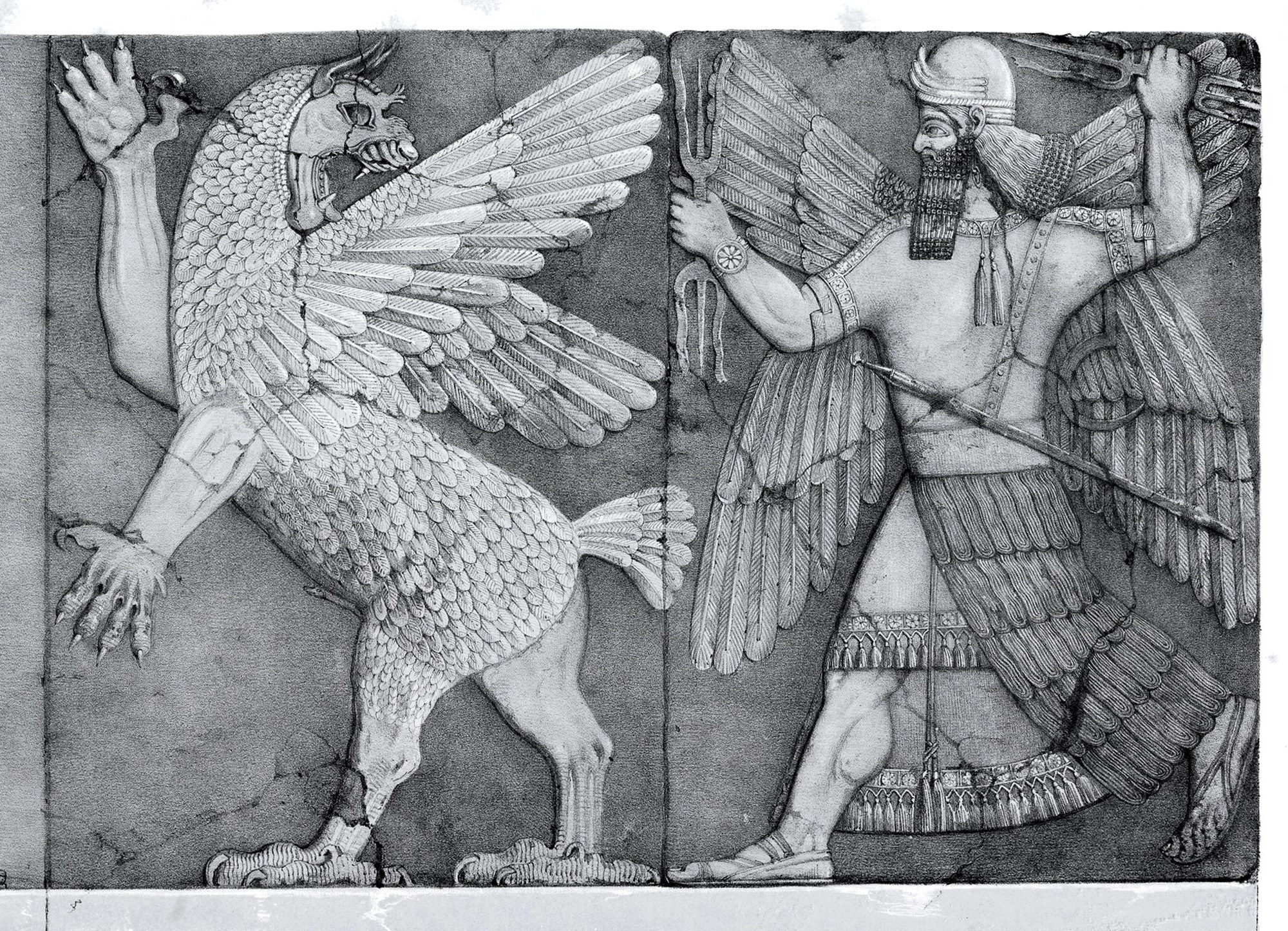
A 19th-century line engraving of a Neo-Assyrian palace relief: at right a bearded, winged warrior-god in a horned helmet strides forward, raising a weapon overhead and holding a bow, pursuing at left a winged, lion-headed and horned monster that flees with clawed hands thrown up.
Mesop.

Anzu's Theft of the Tablet of Destinies

The storm-bird has stolen the writ of fate and made his own word law, and every god the assembly names to fight him refuses. The recovery is a hunt won not by strength but by a trick that turns the thief's own magic dead.
6 minThe Standard Babylonian *Myth of Anzu* / *Epic of Anzû*
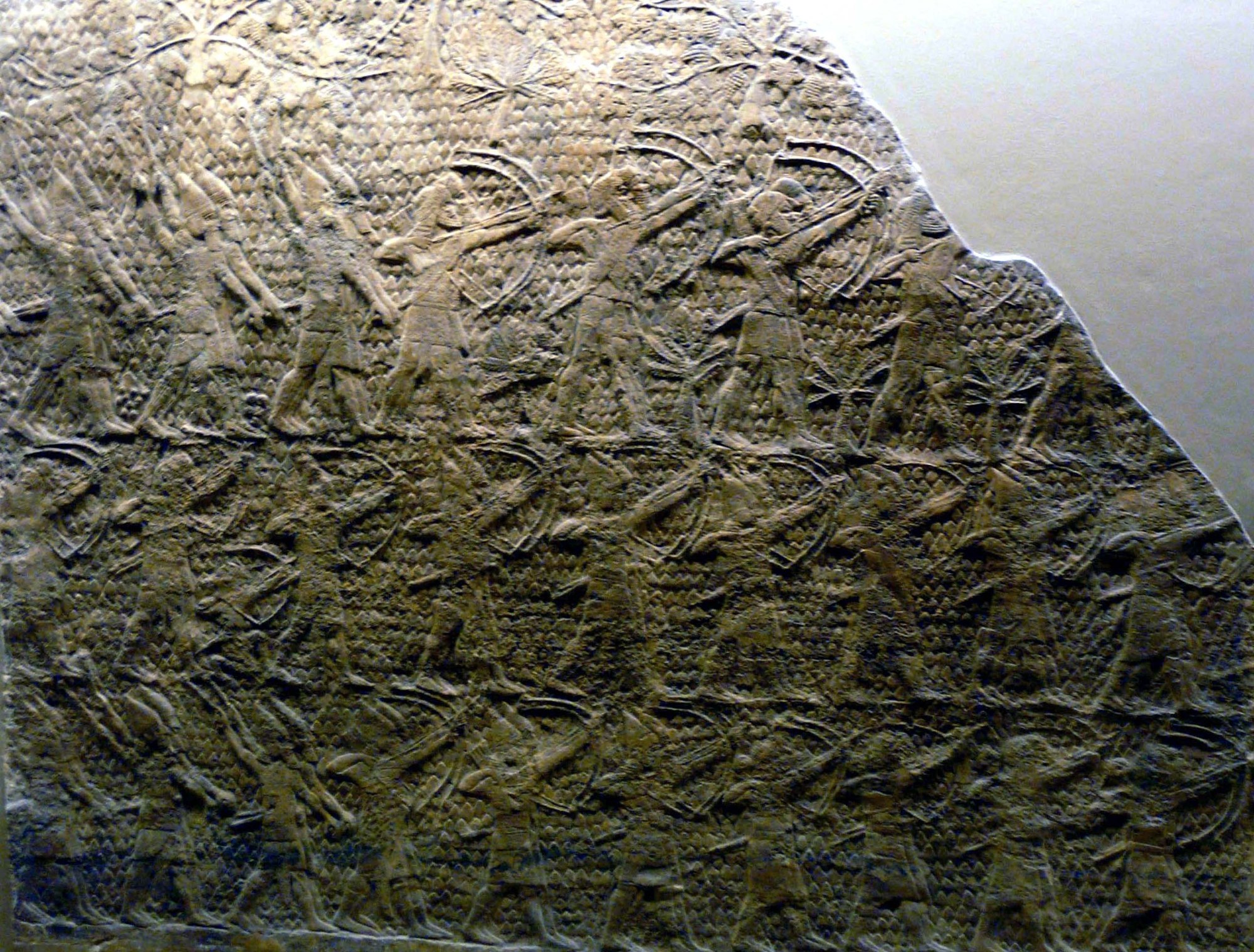
Carved Neo-Assyrian stone relief crowded with soldiers advancing uphill: archers drawing their bows and slingers whirling stones, packed in dense registers across a weathered tan gypsum panel with its broken top edge.
Mesop.

Erra and Ishum: The Wrath of the Plague God

The war-god lies too tired to rise, until his own heart and seven restless weapons talk him into a slaughter no god can call off. Only his own minister can end it, and only by making war on a mountain instead of on men.

6 minThe Poem of Erra and Ishum
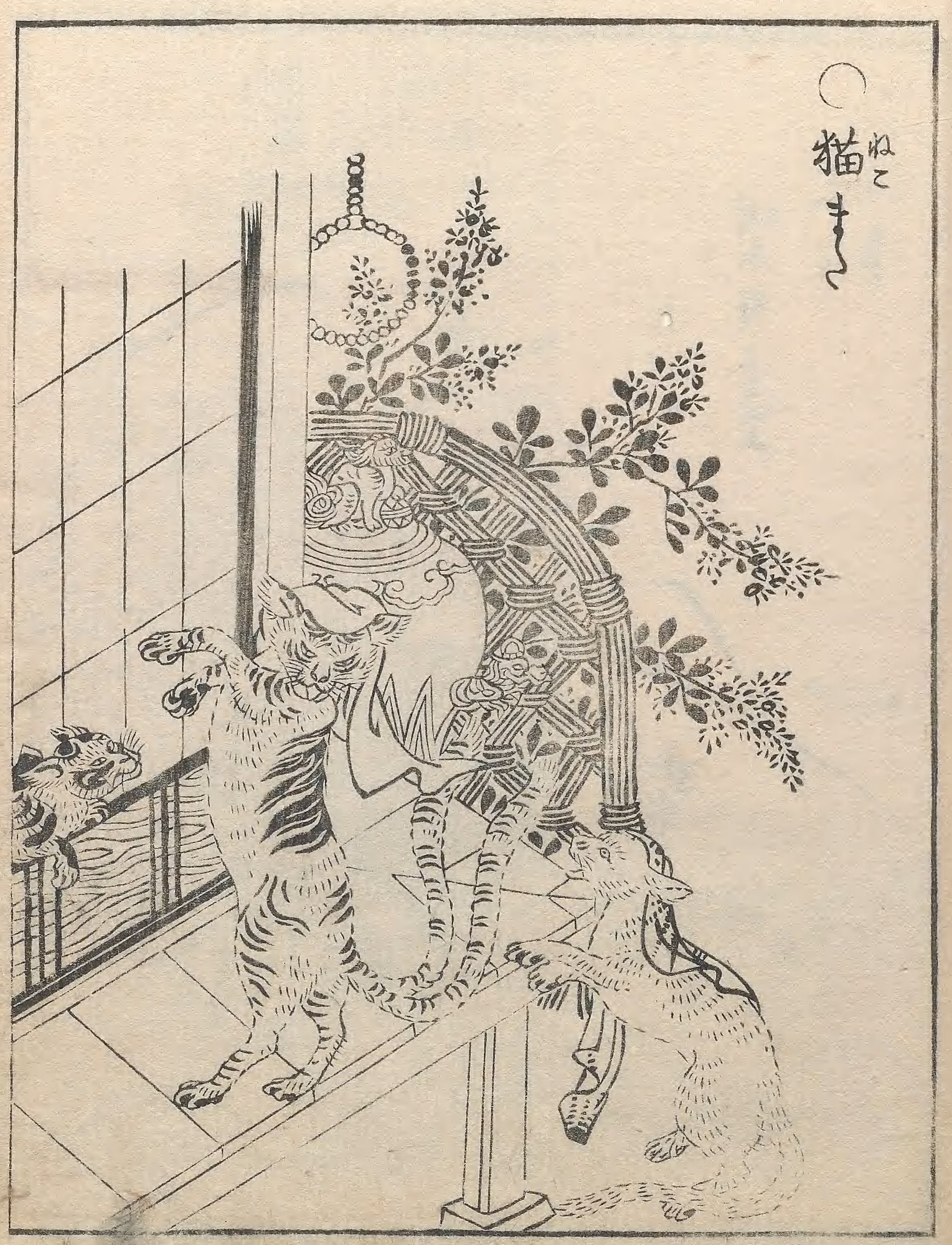
A black-and-white Edo woodblock book-plate of monster-cats on a house veranda: a striped cat rears upright on its hind legs by a latticed shoji screen, one forepaw raised, beneath a round hanging lamp; behind it a cloth-draped cat dances and a long-tailed cat-creature crouches at right, the label reading "nekomata".
Japanese

The Bakeneko, Monster Cat

A household cat rears on its hind legs to lick the lamp-oil, wraps a towel round its head and dances: the domestic monster-cat of the Edo books, one branch of a single cat-spirit the sources never cleanly split.

5 minYoshida Kenkō
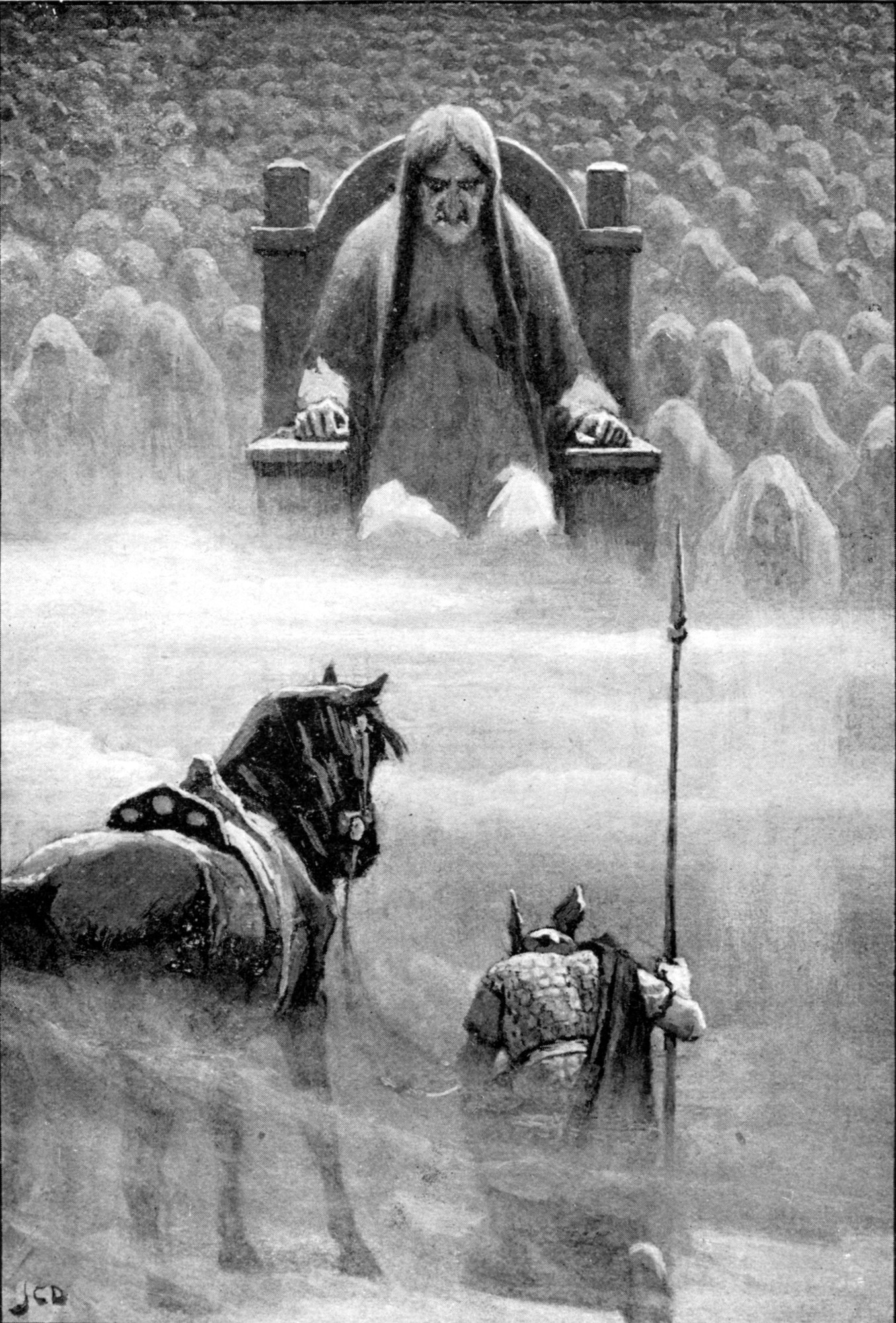
Hel, grim and stern-faced, enthroned on a stone high-seat in the misty dark of her realm, both hands gripping the throne-arms, ranks of the shrouded dead receding behind her; below, Hermóð the Nimble kneels before her with his spear, having dismounted from Odin's dark horse Sleipnir.
Norse

Hel, Queen of the Dead

Half her body the hue of living flesh, half of it corpse-blue, she keeps a hall where the table is called Famine and the bed is called Care: the daughter Odin cast into the mist to rule everyone who dies quietly.

5 minSnorri Sturluson
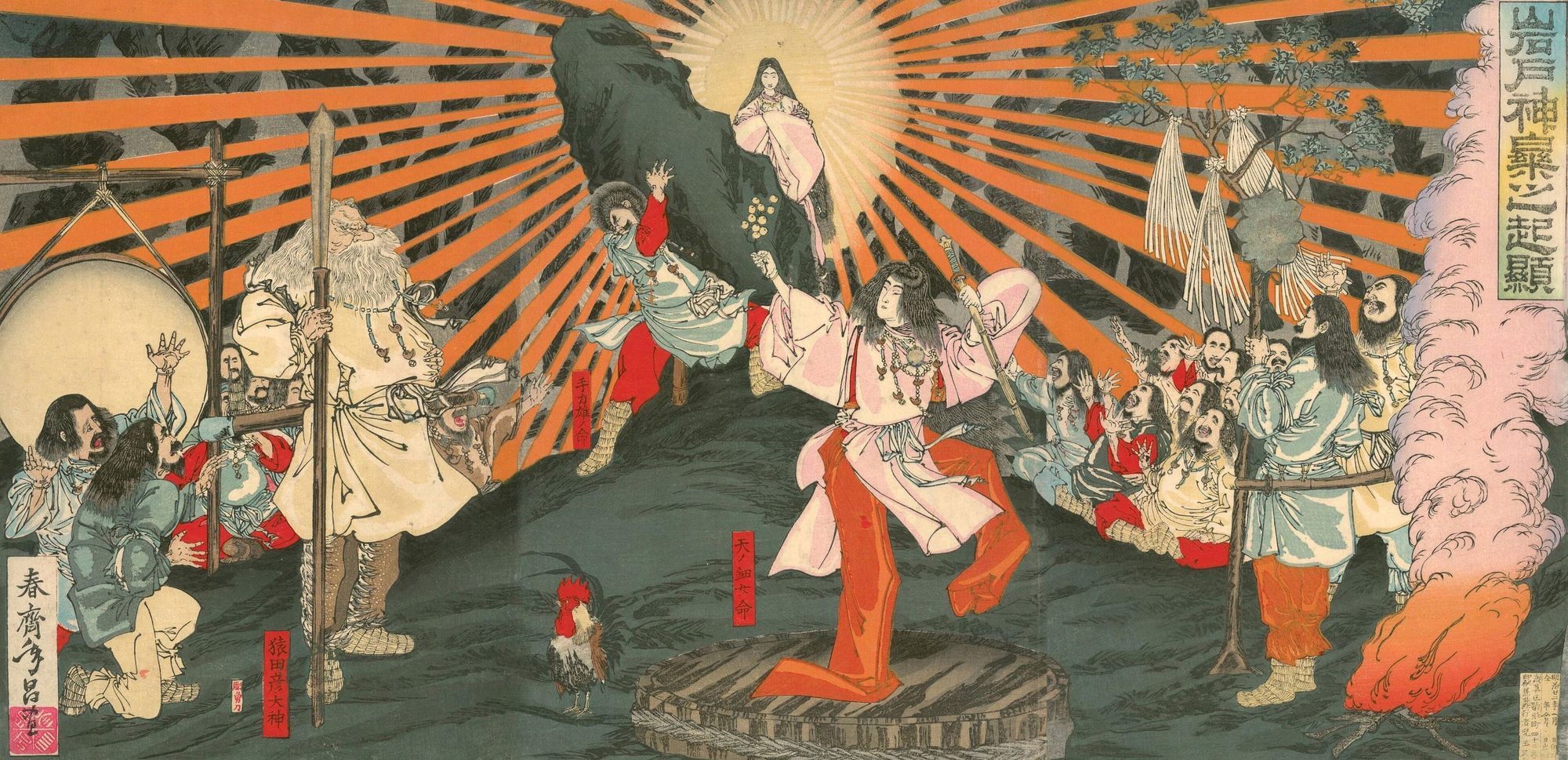
Meiji woodblock print of the sun-goddess Amaterasu emerging from the Heavenly Rock-cave, a radiant white-and-pink-robed figure haloed in a golden sunburst against the dark cliff, while below her the Dread Female Ame-no-Uzume dances wildly on an overturned tub, a red-combed cock crows at her feet, and the strong-god Tajikarao reaches up toward the cave; orange sun-rays stream across the whole scene.
Japanese

Amaterasu and the Rock Cave

The sun-goddess bolts herself inside a stone door and the world goes black; it takes a forged mirror, a ribald dance and eight hundred myriad gods laughing in the dark to trick the light back out.

6 minKojiki
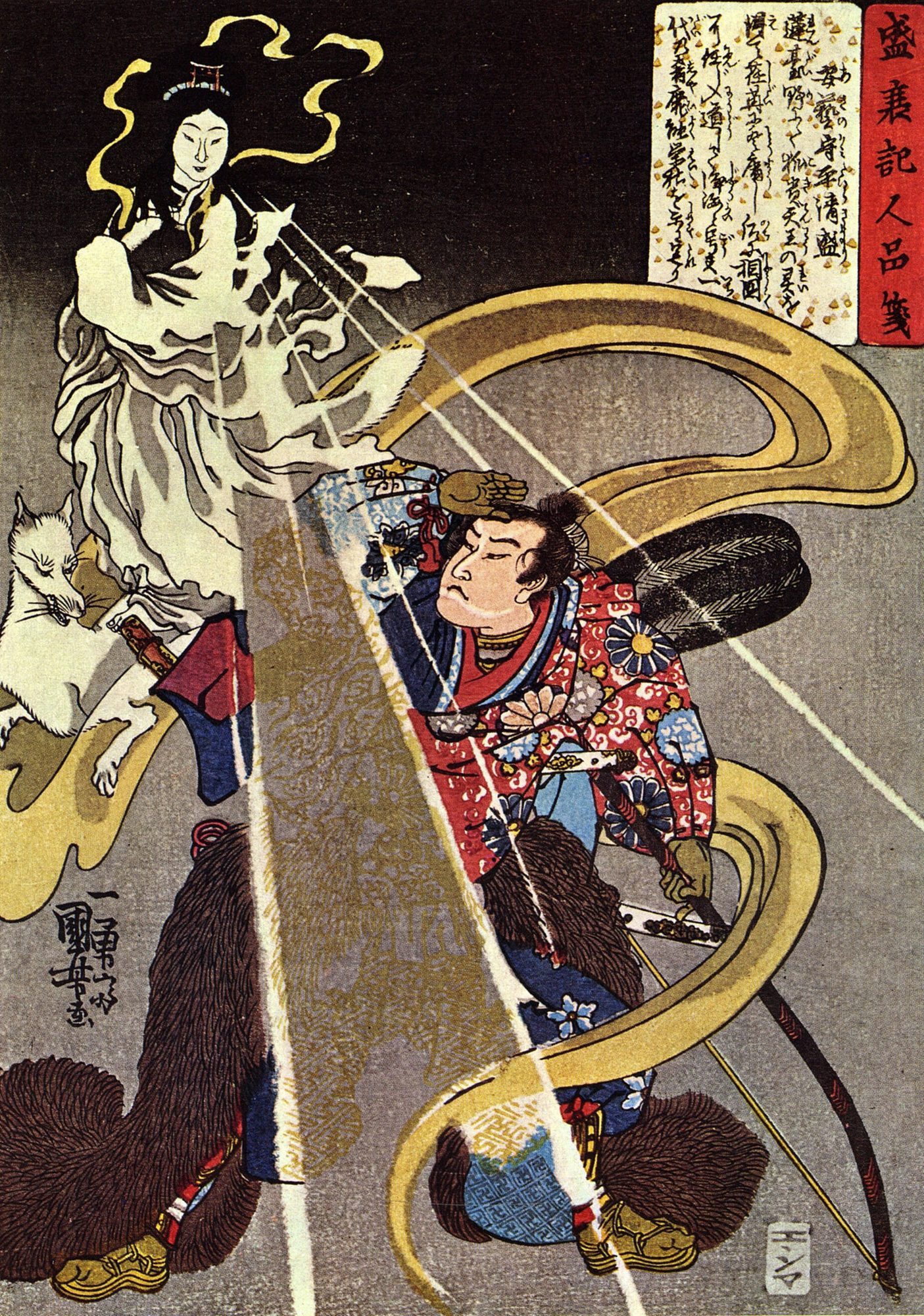
A Japanese woodblock print: a radiant white-robed fox-deity of Inari rises as a supernatural apparition, her streaming black hair haloed in golden fox-fire and a small red torii gate set at her brow, a white fox pressed to her side; before her a richly robed warrior recoils, his black-lacquer bow fallen from his hand and ribbons of gold light coiling through the dark.
Japanese

Inari, God of Rice

A rich man shot arrows at a rice-cake for sport, and the wasted rice rose up as a white bird and flew to a mountain where rice began to grow: the founding legend of Japan's most-worshipped kami, whose name means the rice becomes.

6 minNihon Shoki
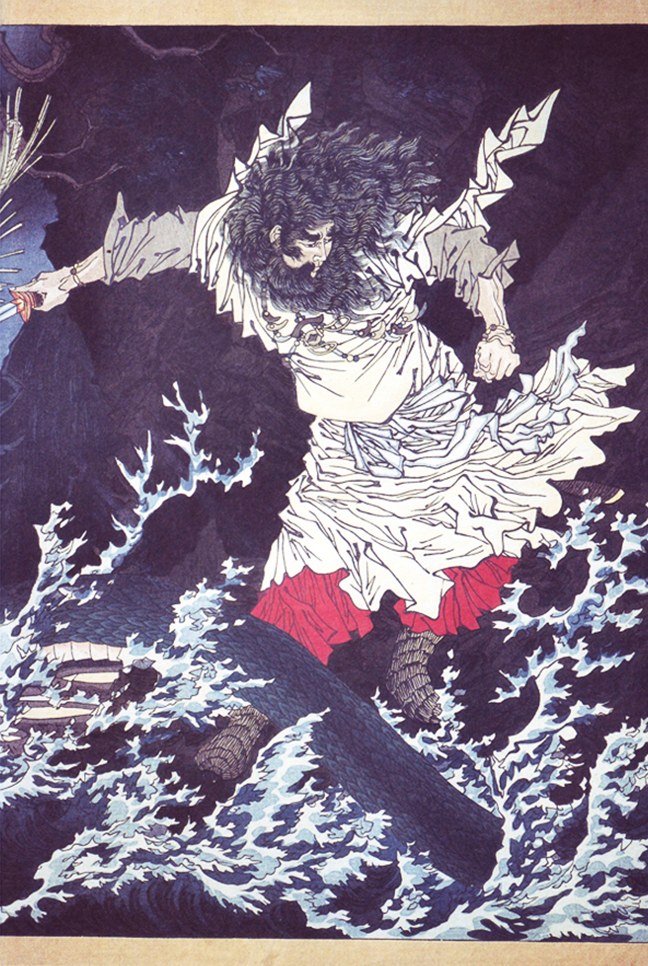
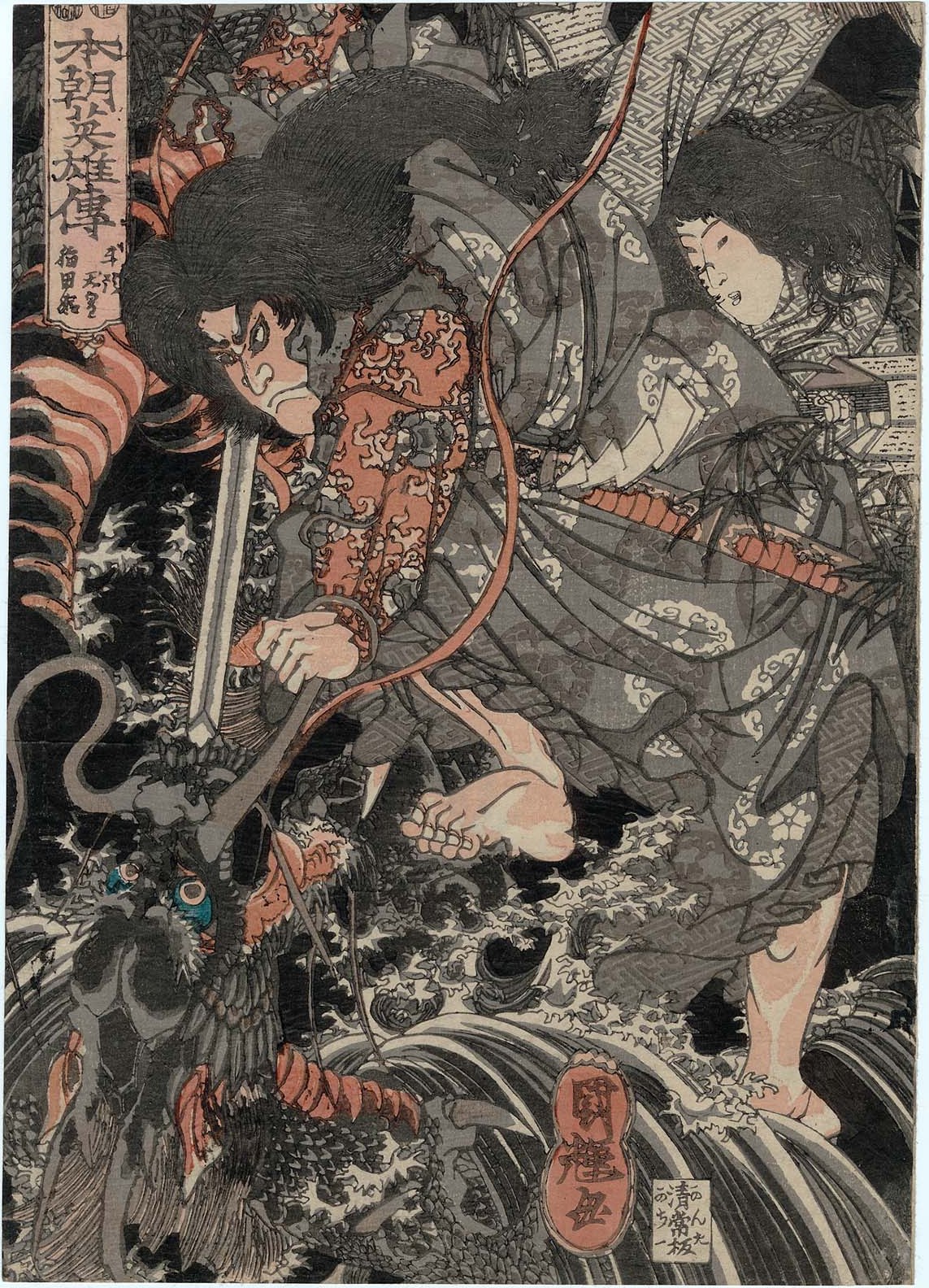
Japanese woodblock print of the storm-god Susanoo, wild-haired and bearded in a white robe over a red under-robe, striding through foaming waves with his arms flung wide and a sword gripped in his lowered left hand, in the moment of slaying the eight-headed serpent Yamata-no-Orochi at the River Hi in Izumo.
Japanese

Susanoo, the Storm God

Born from a washed nose, he wept the green mountains bare and was cast out of two worlds before he ever drew a sword on the eight-headed serpent: the most turbulent of the Japanese gods, expelled troublemaker turned culture-hero of Izumo.

6 minKojiki
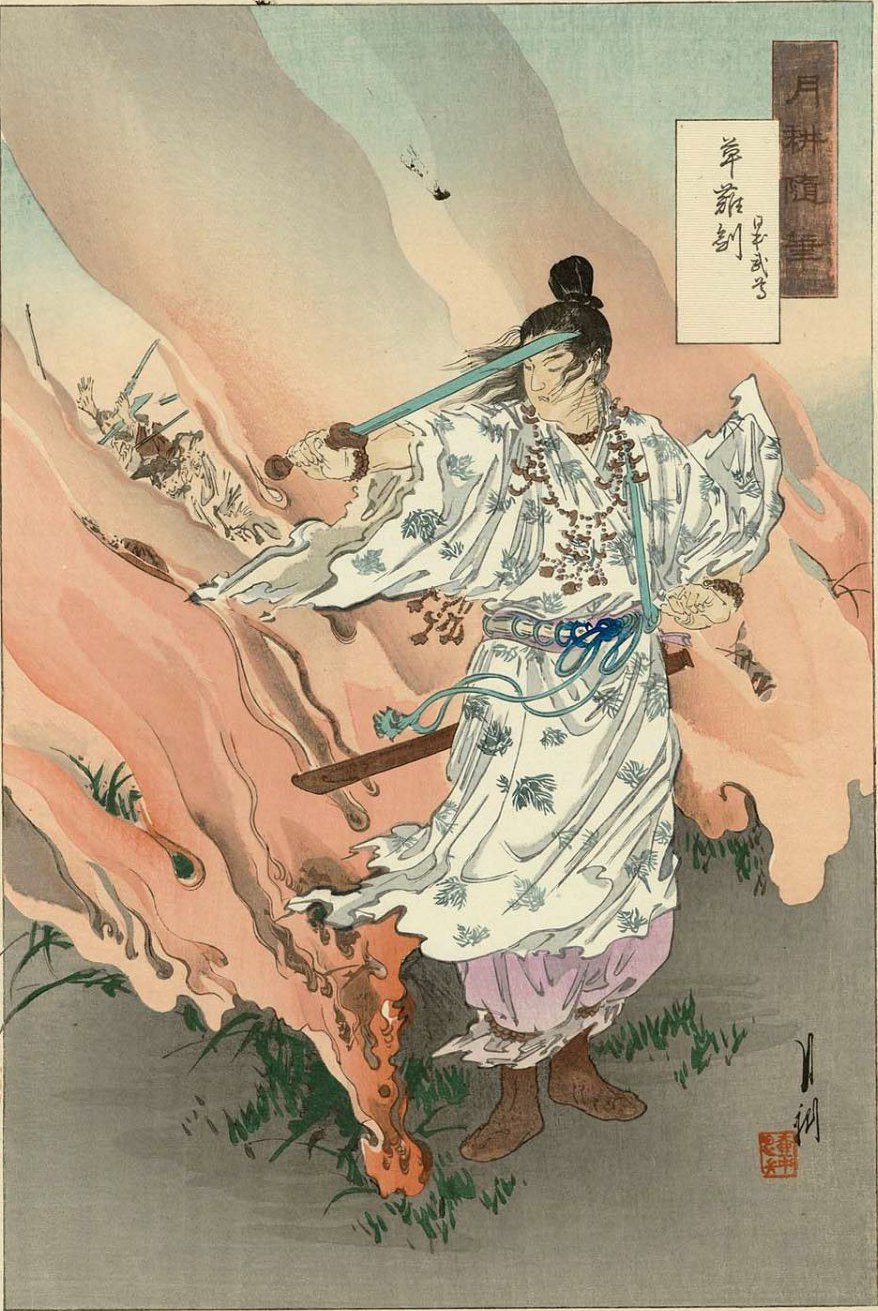
Japanese colour woodblock print of the hero Yamato-Takeru standing amid burning grass, a young man in a white robe patterned with pine-sprigs and hung with strings of curved jewels, drawing the blue-green Herb-Quelling sword Kusanagi across his body to cut back the flames sweeping up around him from the moor.
Japanese

The Three Sacred Treasures

A mirror forged to trap the sun, a sword drawn from a monster's tail, and a string of curved jewels: how three objects became the proof that Japan's emperors were born to rule.

7 minKojiki
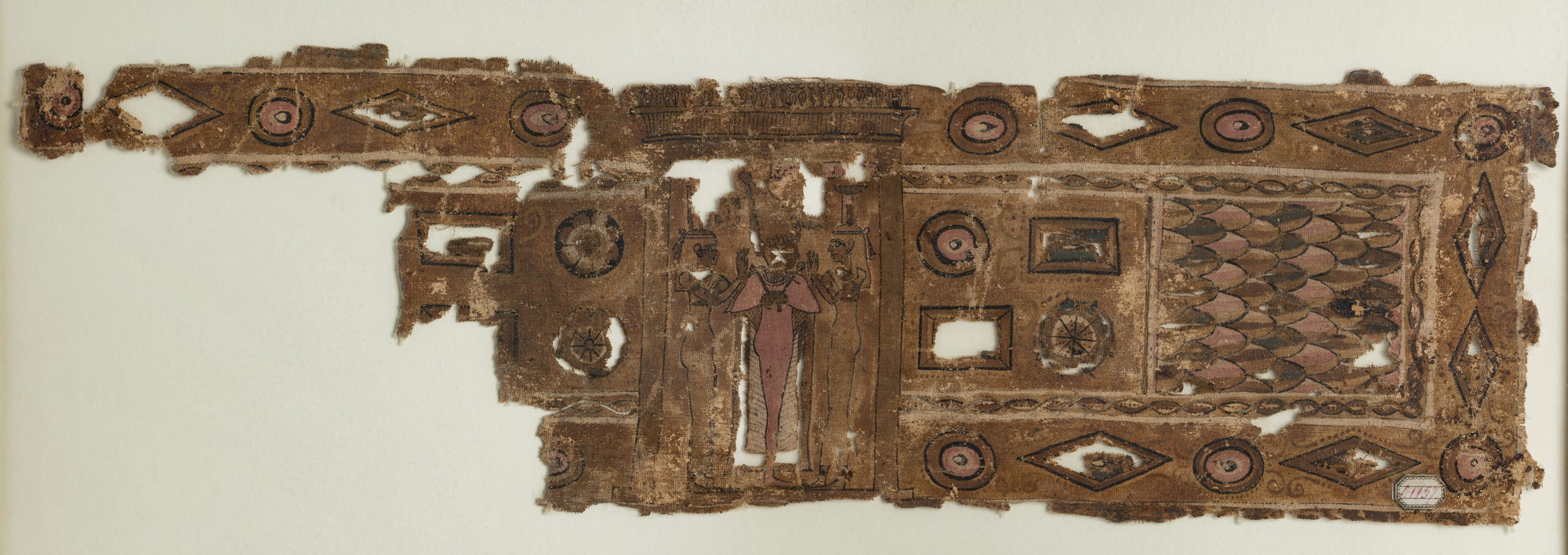
Roman-period Egyptian funerary shroud in painted linen: the mummiform god Osiris lies at the centre on a bier, green-skinned, arms crossed over his chest; the goddesses Isis and Nephthys stand or kneel at head and foot with hands raised in mourning; winged deities and columns of hieroglyphs fill the surrounding bands.
Egyptian

Isis Gathers the Scattered Osiris

A widow cuts a lock of her hair, puts on mourning, and walks out into the marshes to find a husband her brother has thrown to the water: the long search for the body of Osiris, and why no single ancient text tells it whole.

7 minPlutarch
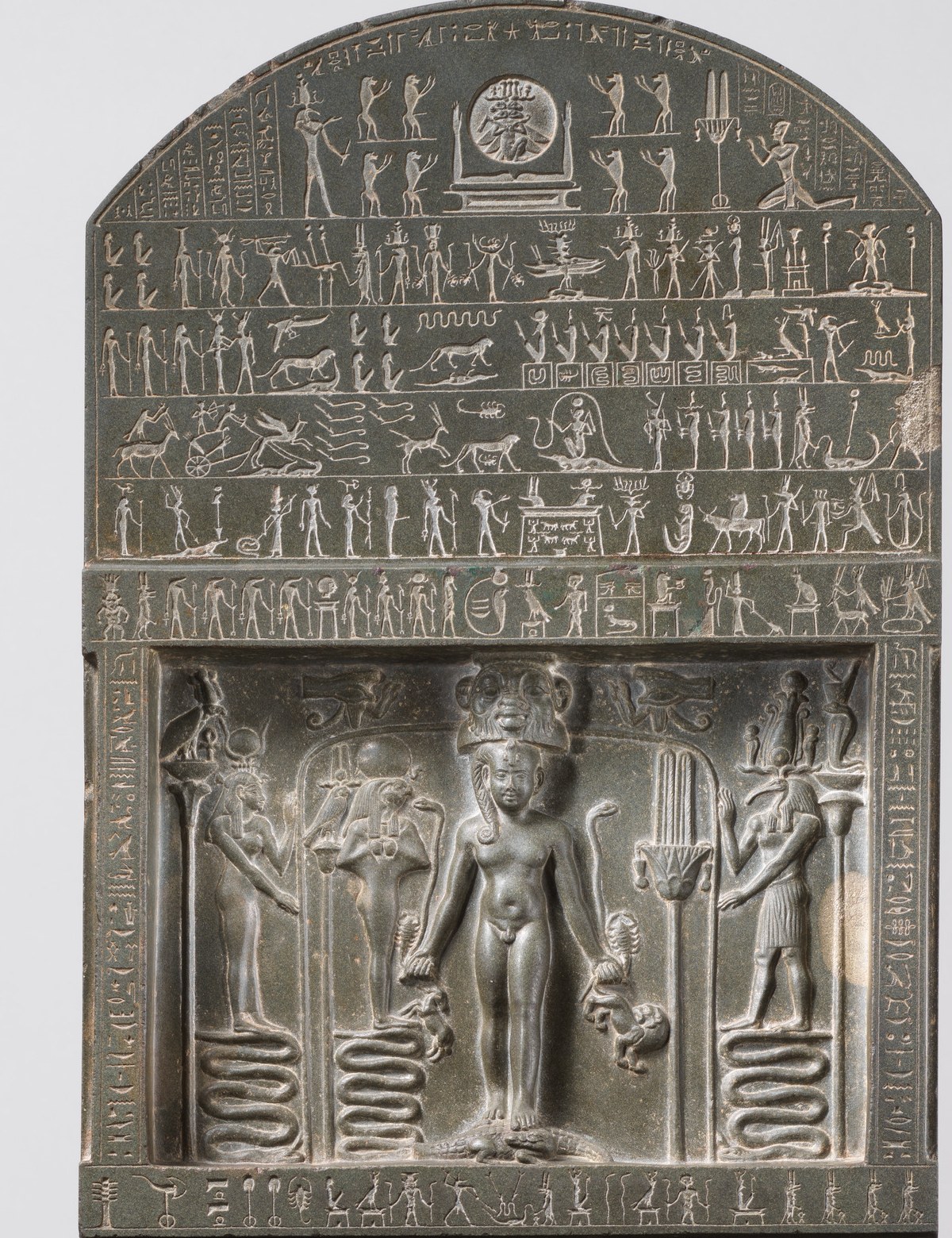
Ancient Egyptian dark-stone magical stela (cippus): in a recessed panel the nude child-god Horus stands frontally on two crocodiles, grasping serpents, a scorpion, a lion and a gazelle in his fists, crowned by the mask of the god Bes and flanked by two deities standing on coiled serpents; above, an arched lunette with registers of gods and dense hieroglyphs.
Egyptian

The Contendings of Horus and Set

Eighty years of lawsuits and duels for a dead king's throne: an uncle and a nephew, a bench of gods that cannot make up its mind, and a mother who will not let her son lose.

6 min"The Contendings of Horus and Seth
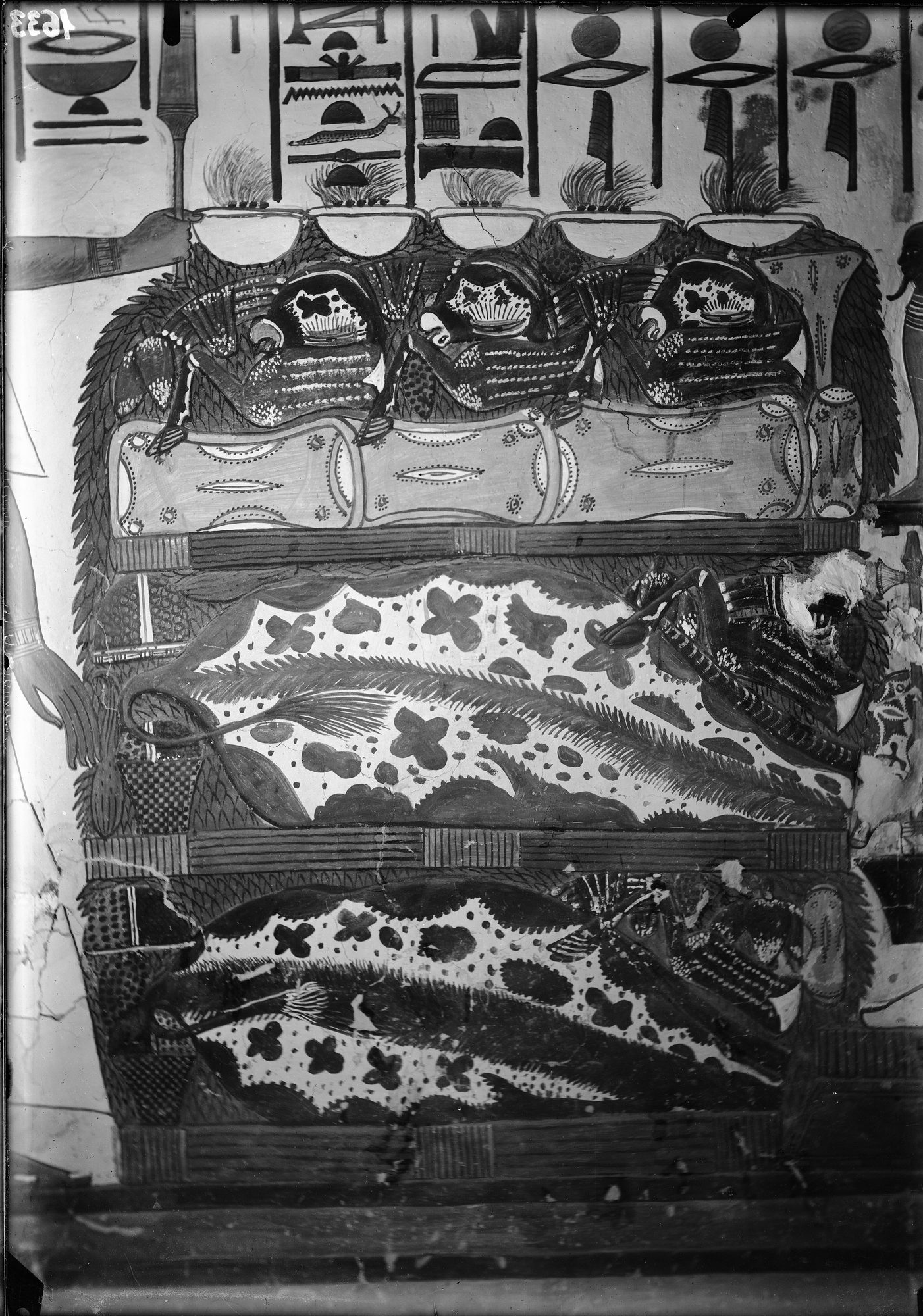
An ancient Egyptian tomb painting from the tomb of Nefertari: a great pile of offerings heaped before the seated god Osiris, Nefertari's invocation recorded in the hieroglyphs above.
Egyptian

The Death and Return of Osiris

A brother's fitted coffin, a body torn into pieces and scattered, and the magic of a wife who gathered them back: how the murdered king was made whole and got an heir from beyond death.

6 minPlutarch
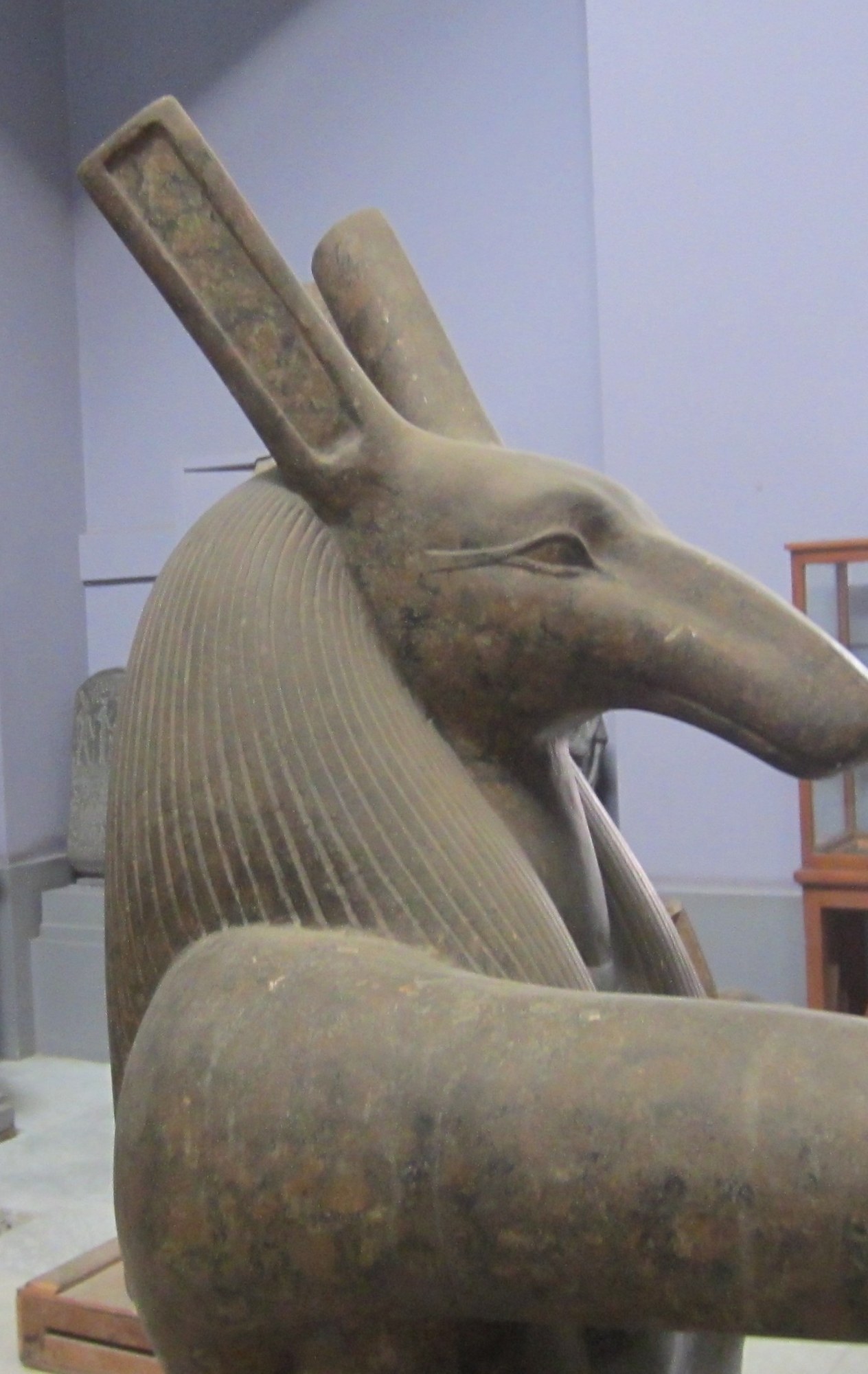
Detail of an ancient Egyptian granite statue showing the head of the god Set in profile: the composite "Set-animal" head with its long down-curved snout, tall squared upstanding ears and almond eye rimmed by a cosmetic line, backed by a striated tripartite wig, with the god's neck and one arm below, against a plain grey museum wall.
Egyptian

Set, God of Chaos

Storm-god, desert-lord and fratricide: the red god the Egyptians both needed and feared, murderer of Osiris and rival of Horus, who was never only a villain.

6 minPyramid Texts
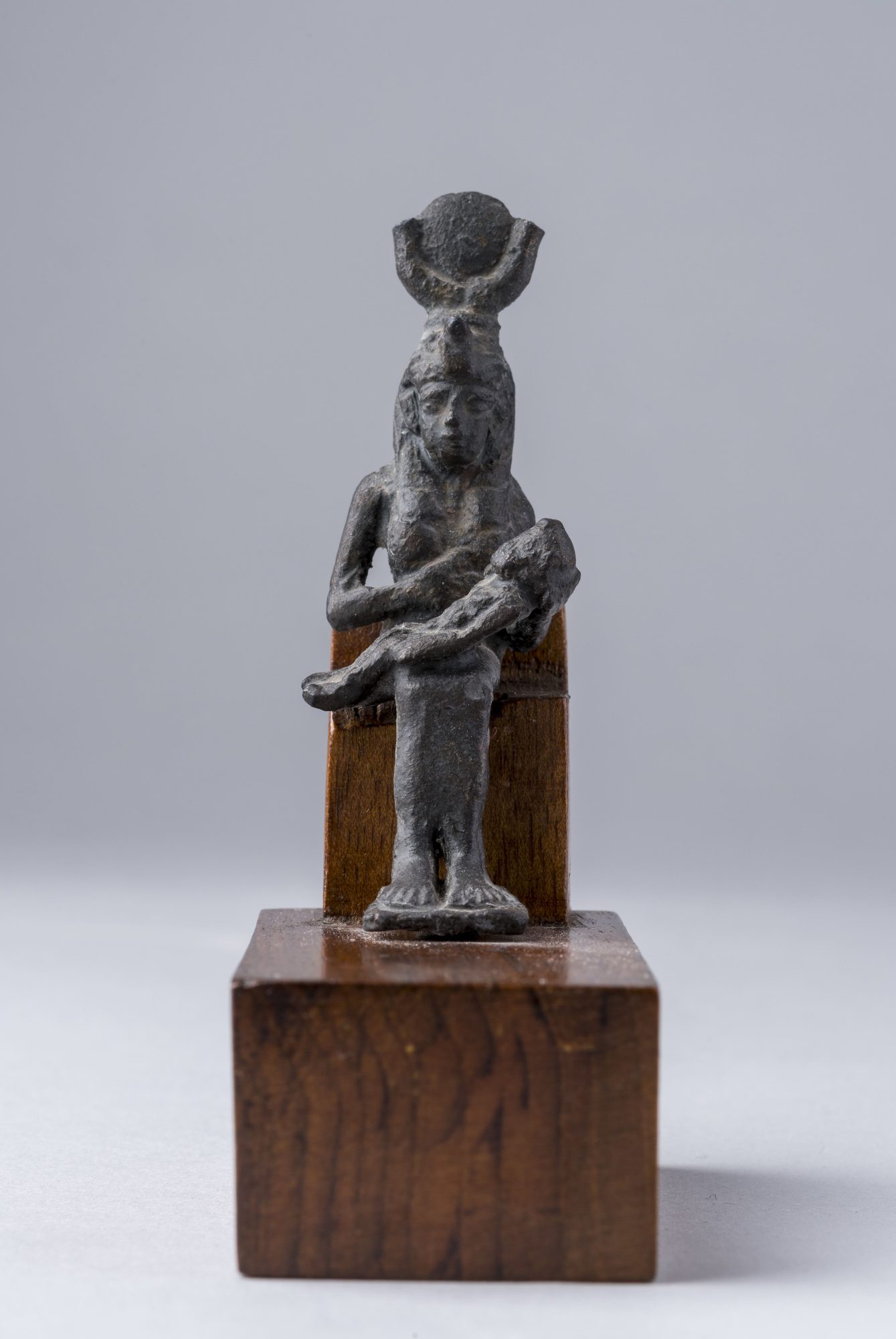
An ancient Egyptian bronze statuette of the enthroned goddess Isis nursing the infant Horus on her lap.
Egyptian

Isis, the Great of Magic

Weret-hekau, Great of Magic: the goddess who reassembled a murdered god, hid her son in a marsh, and wrung the secret name of the sun-god out of his own poisoned body.

6 minThe Legend of Ra and Isis
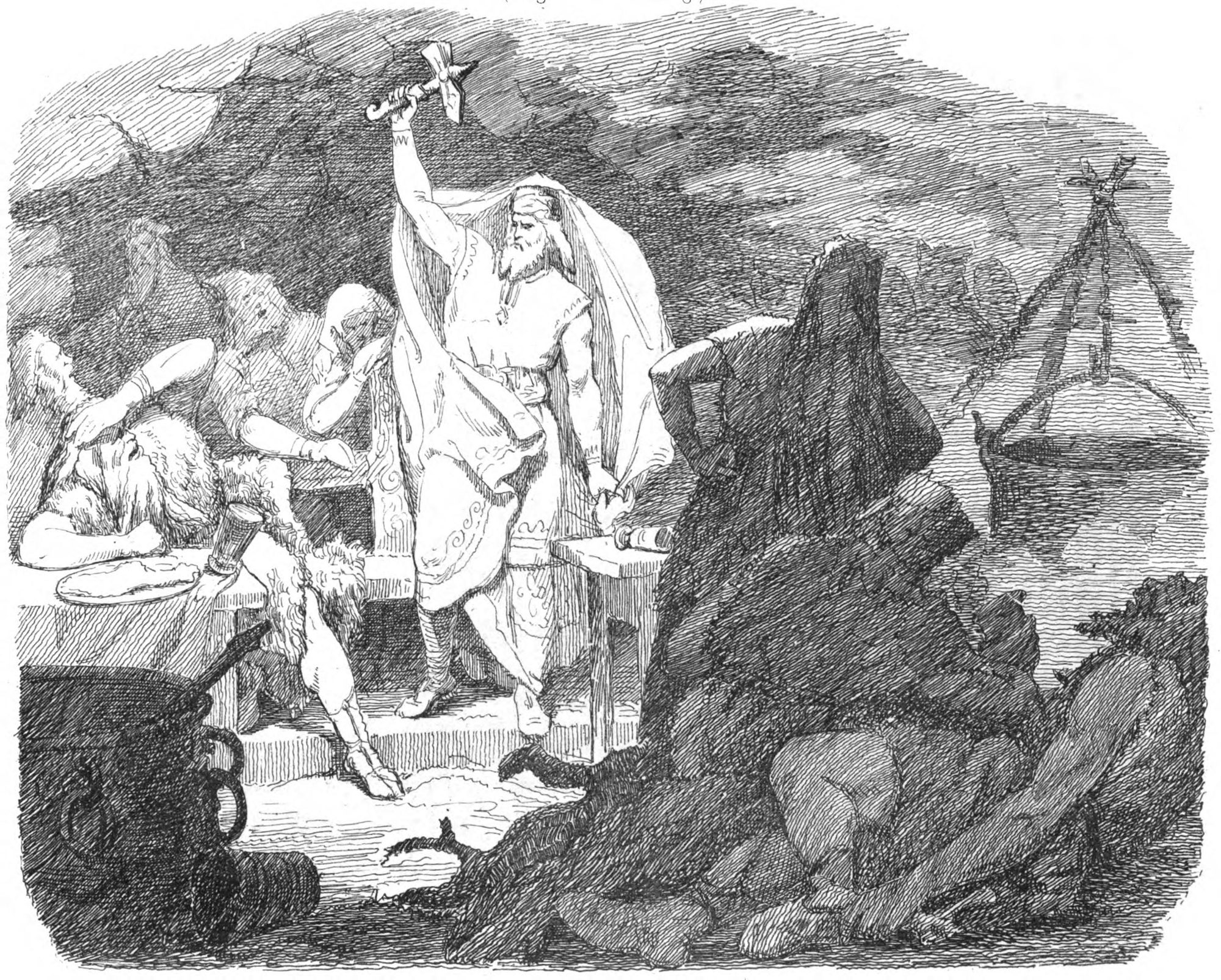
A lithograph of Thor regaining his hammer: at the forced wedding the god seizes Mjöllnir from the giant Thrym, the bride's veil still about him, Loki at his side.
Norse

The Theft of Mjöllnir

A giant buries the thunder-god's hammer eight leagues down and names his ransom: the goddess Freyja for his bride. So the strongest of the gods is bound into a bridal veil and sent to a wedding he means to end with a killing.

6 minPoetic Edda
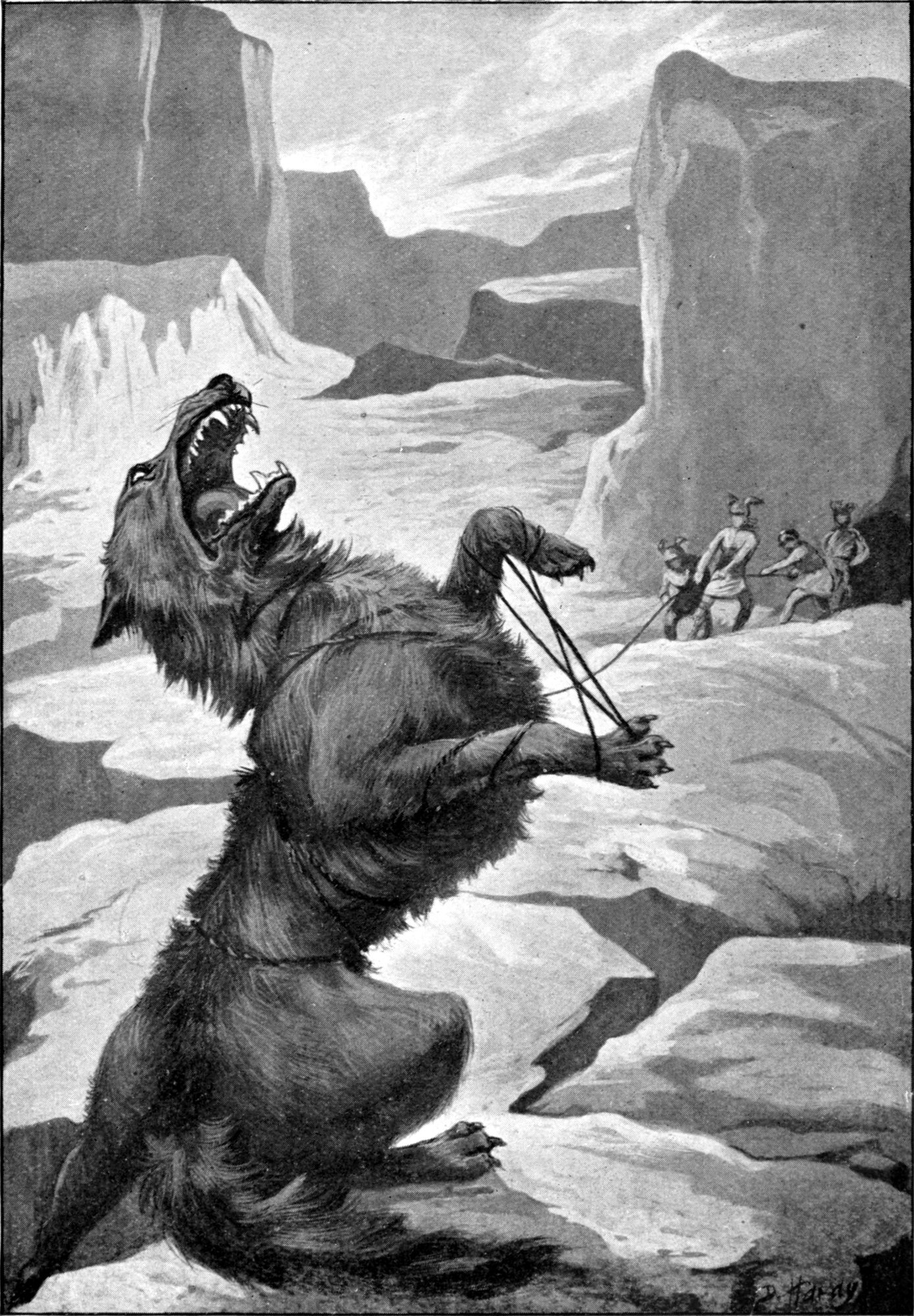
A monochrome wash drawing of the binding of Fenrir: the great wolf's jaws gaping wide around the god Týr's outstretched hand as the unbreakable fetter holds.
Norse

The Binding of Fenrir

A wolf the gods reared at home, two iron chains he snapped like kindling, and a ribbon of six impossible things: how the Aesir caught the beast fated to kill Odin, and what it cost the one god brave enough to feed him.

6 minSnorri Sturluson
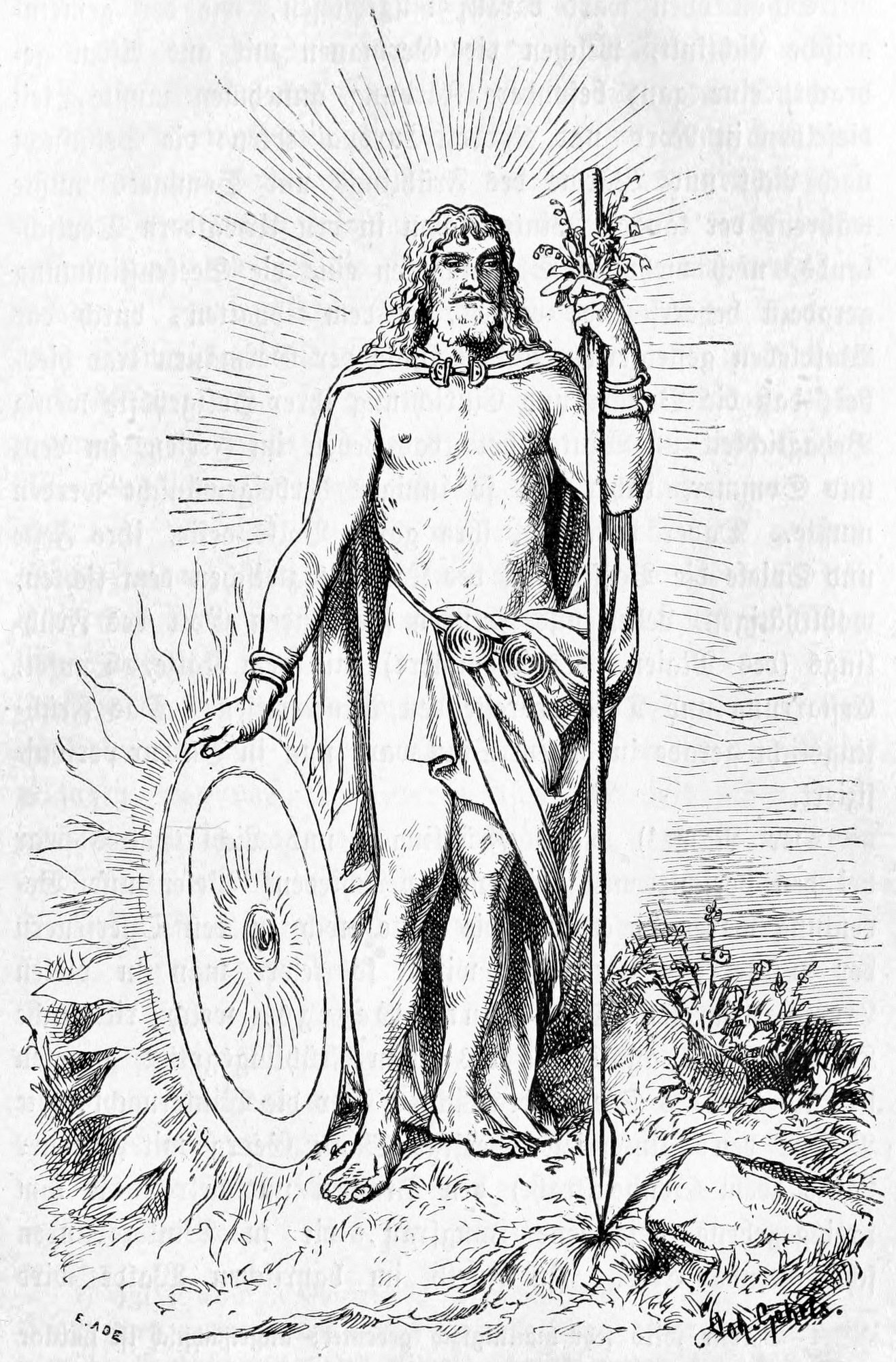
An 1888 illustration of the shining god Baldr, fair-haired and armed, standing in the hall of Walhall.
Norse

Baldr the Shining

The best of the gods, so fair that light streamed from him, at home in a hall nothing unclean could enter: the portrait of a god the myth was built to take away.

4 minSnorri Sturluson
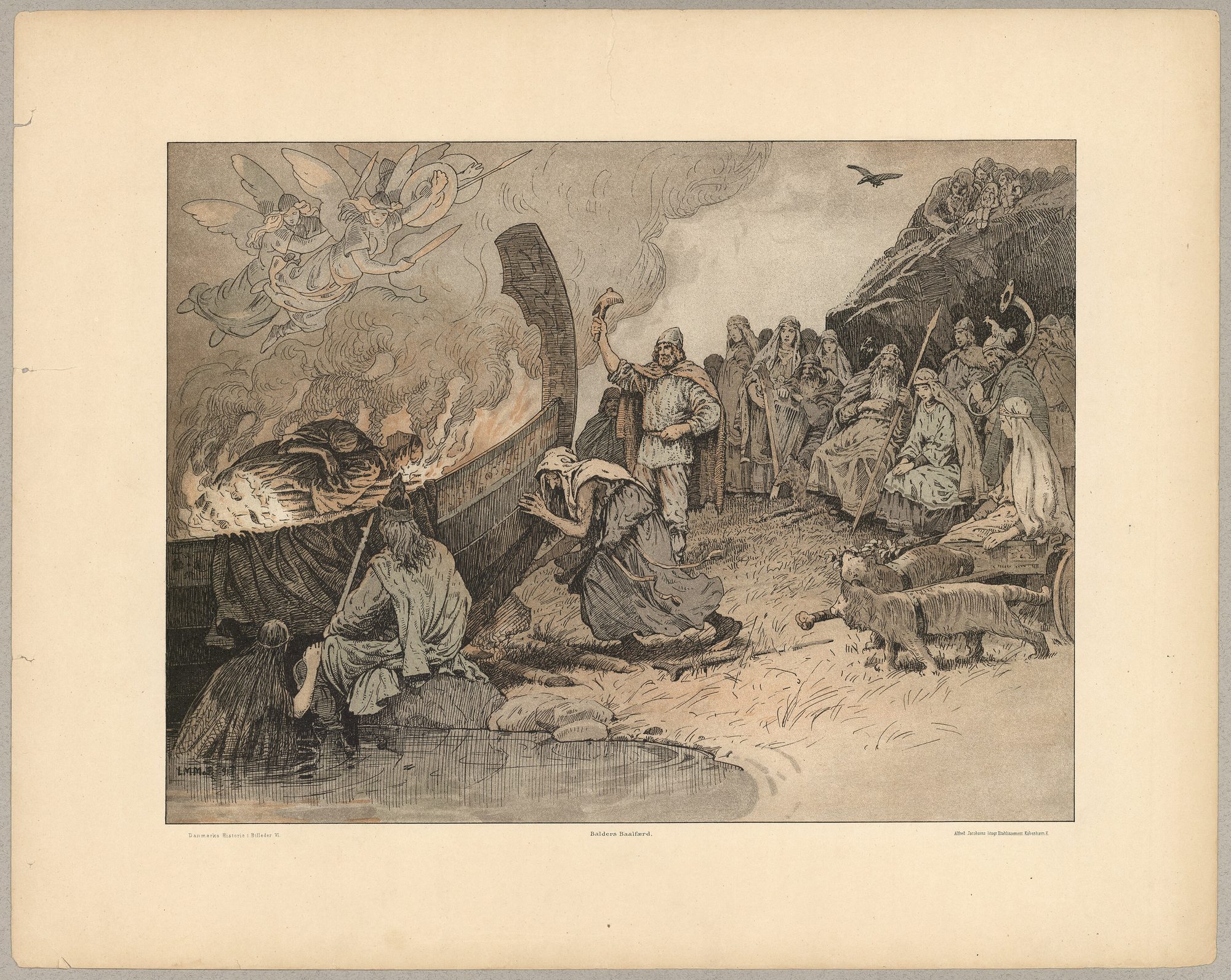
A colour lithograph of Baldr's ship-pyre funeral: the dead god laid on his burning ship, mourners gathered on the shore as flames and smoke rise.
Norse

The Death of Baldr

A god the whole world had sworn never to harm, a sprig of mistletoe no one thought to ask, and a blind brother's hand: how the north's best-loved god was murdered into Hel and the doom of the gods began.

7 minSnorri Sturluson
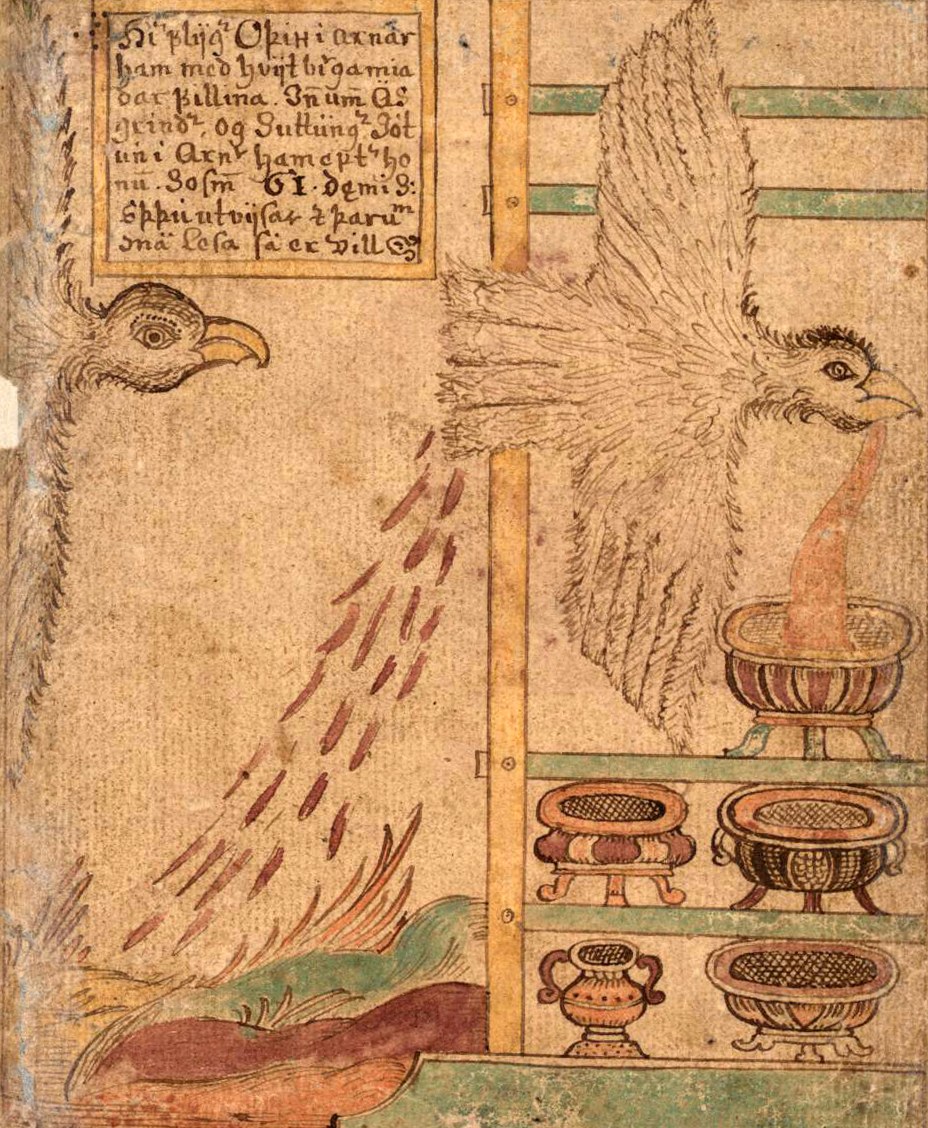
Icelandic Edda-manuscript illustration: Odin, in the shape of a great winged eagle, spews the stolen Mead of Poetry down into three ritual vessels ranged on a wooden frame, while the giant Suttung — also in eagle-shape — pursues at upper left and a stream of the escaped mead falls away below; a handwritten Icelandic caption box sits at top-left.
Norse

The Mead of Poetry

How poetry got into the world: a murdered sage, a mead brewed from his blood, and the god who slept three nights with a giant's daughter to steal it, then left her to grief.

6 minSnorri Sturluson
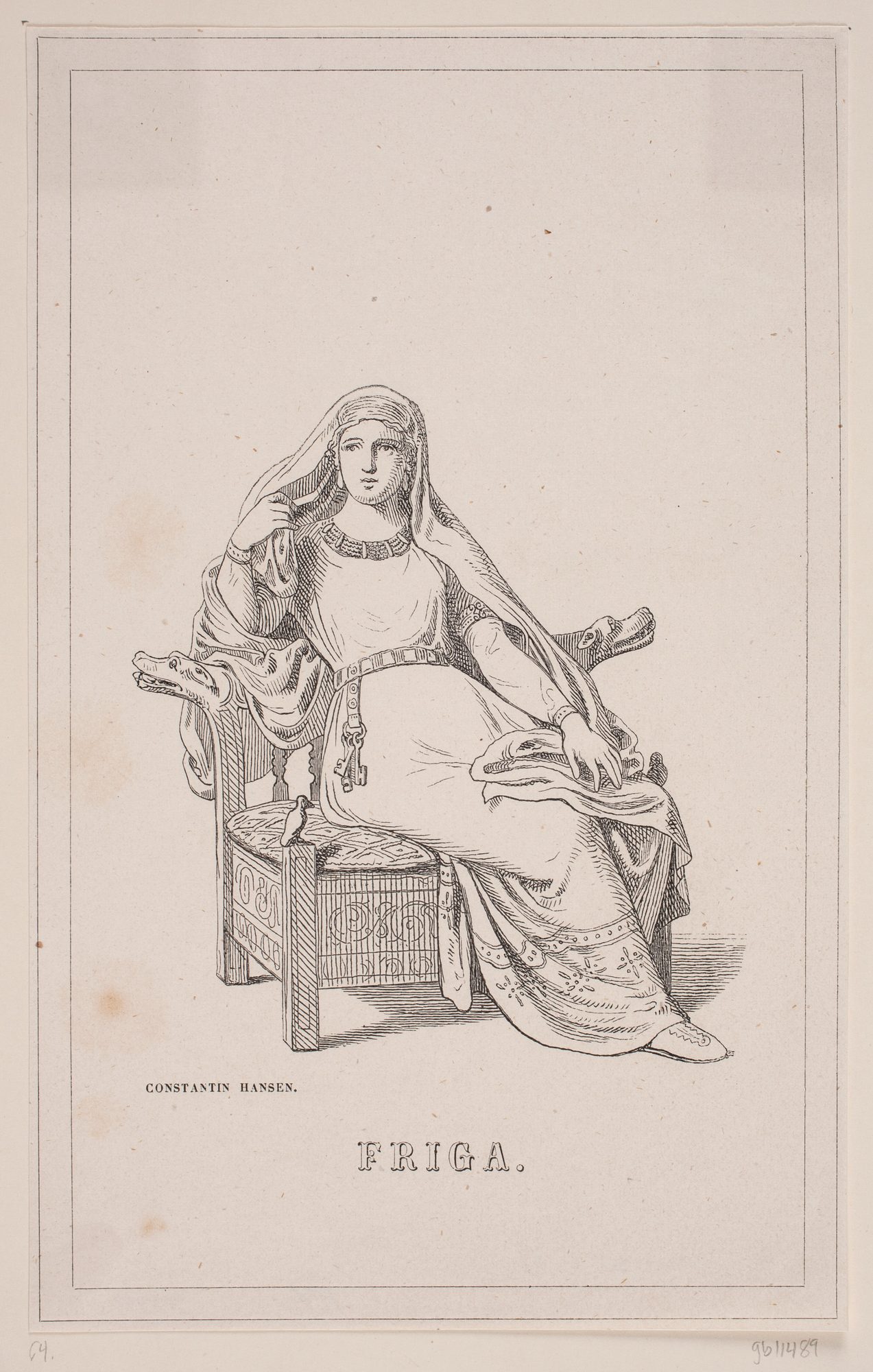
A 19th-century print of the goddess Frigg as a crowned queen, standing full-length in flowing robes, a distaff in one hand.
Norse

Frigg, Queen of the Aesir

She knows the fate of every living thing and never speaks it, and when the one doom she tried to bar comes for her son, all she can do is weep: the foremost of the goddesses, undone by a single overlooked shrub.

5 minSnorri Sturluson
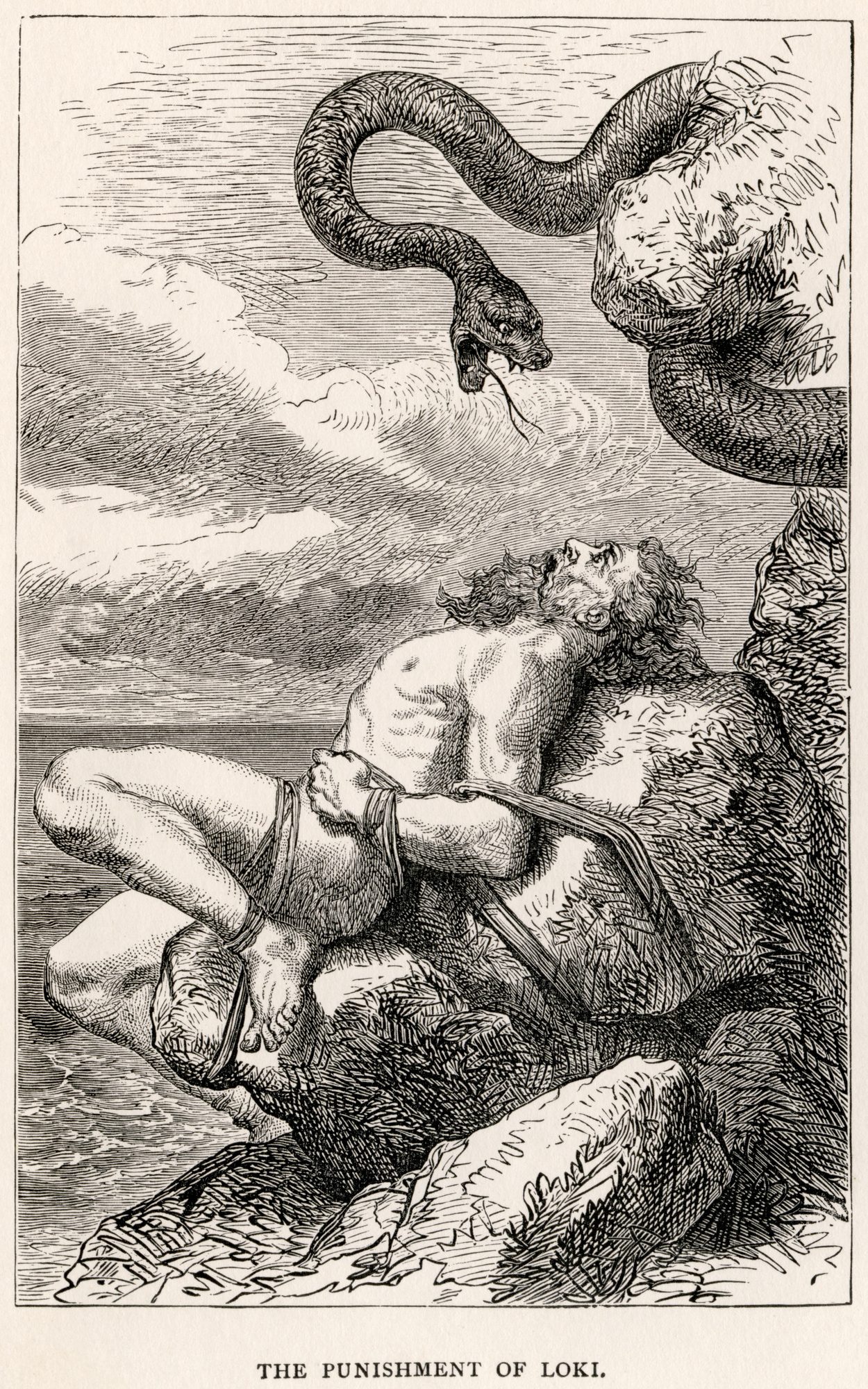
An illustration of Loki's punishment: the bound trickster lying beneath a serpent that drips venom on his face, his wife Sigyn beside him holding the catching bowl.
Norse

Loki, the Trickster

The handsome, fickle mischief-monger of the Aesir who drags the gods into ruin and then, more often than not, is the only one clever enough to haul them back out again.

6 minSnorri Sturluson
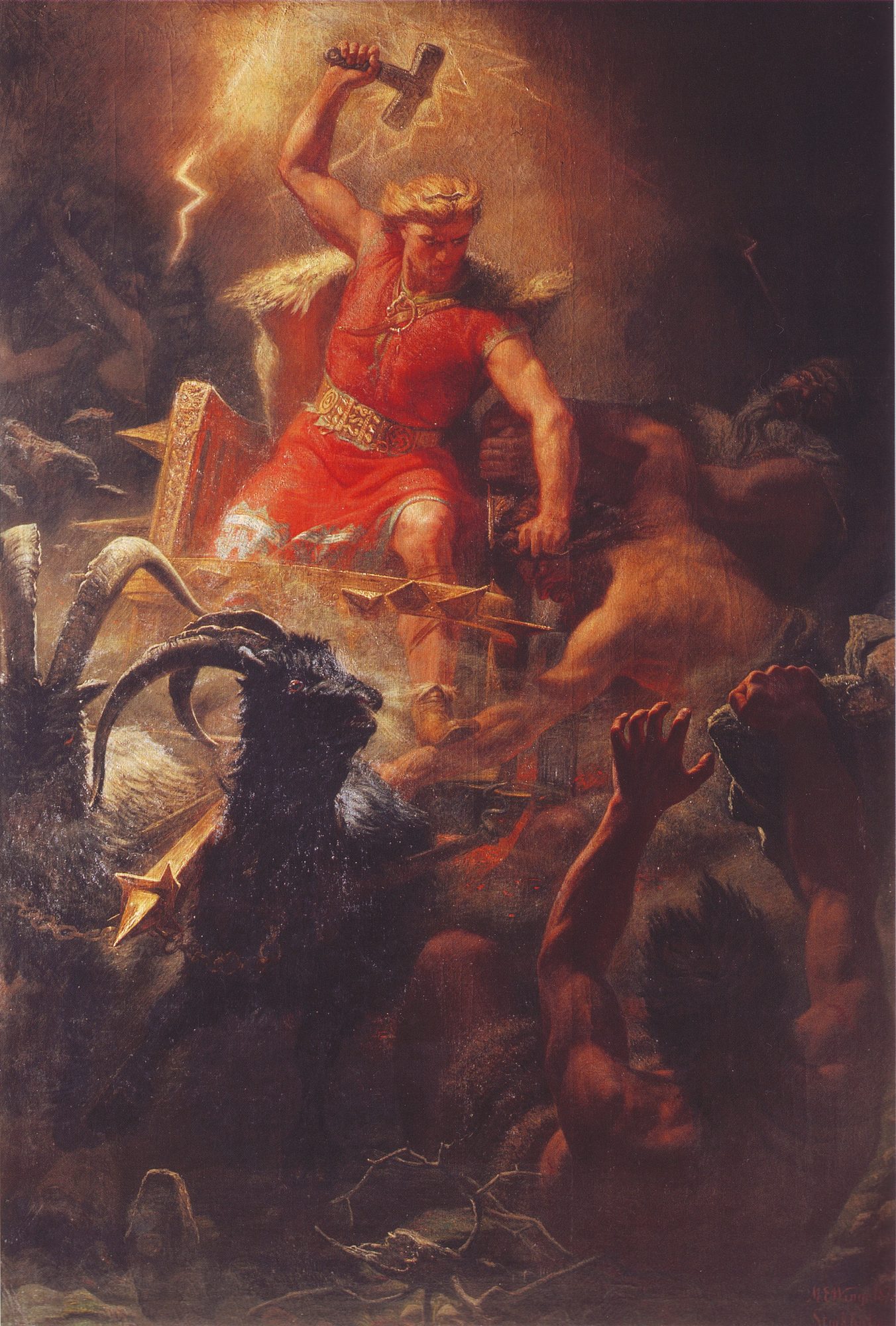
An oil painting of Thor in his goat-drawn chariot, red-bearded and mail-shirted, swinging his hammer Mjöllnir against a mass of charging giants under a storm sky.
Norse

Thor, God of Thunder

The strongest of the gods wakes to find his hammer gone, and the only way to get it back is to put on a bridal veil: a portrait of the Aesir's giant-killer at his most terrifying and his most absurd.

6 minPoetic Edda
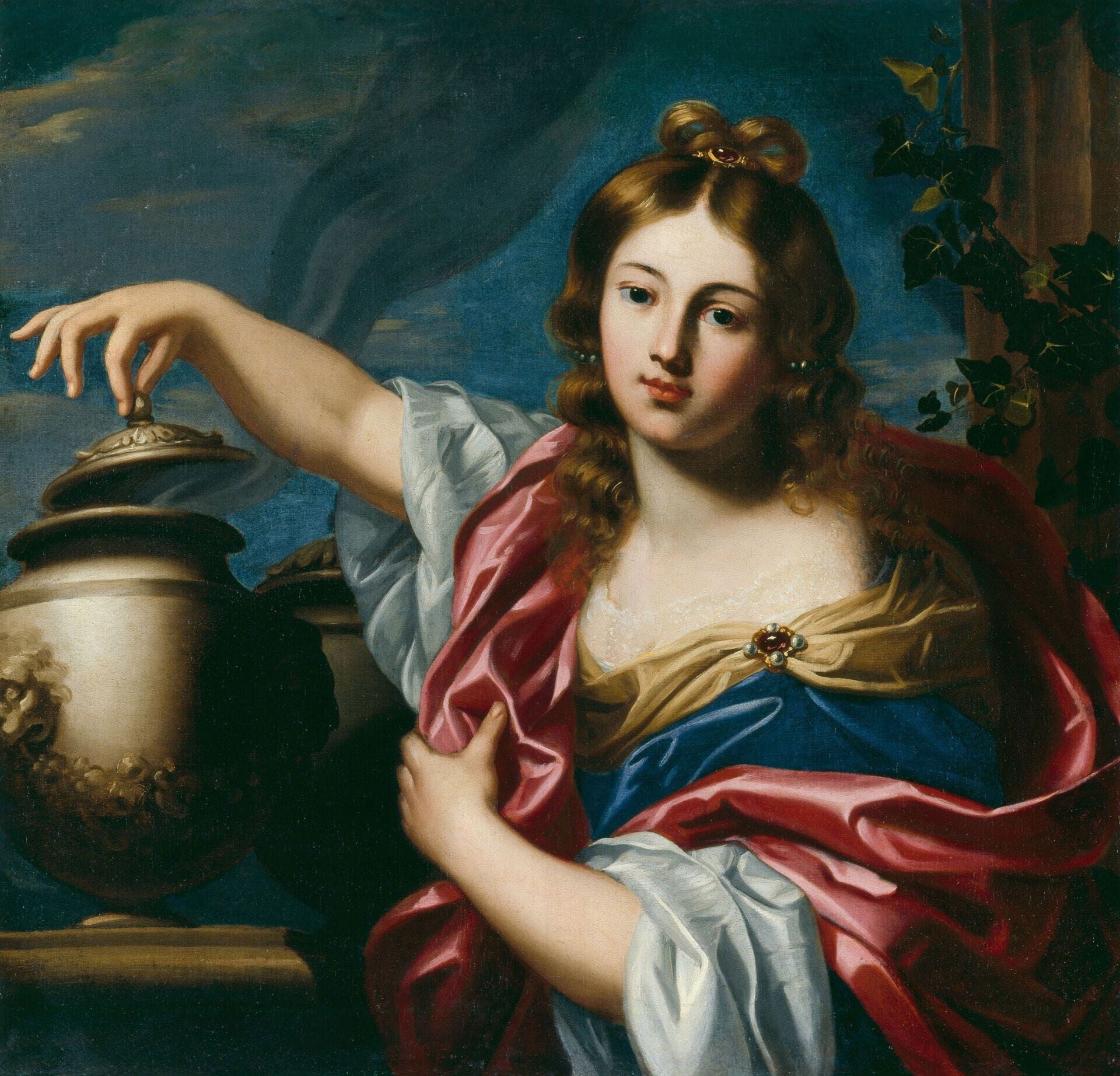
A young woman with loose auburn hair, in a blue gown under a rose-red mantle with a jewelled clasp, rests her right hand on the ornamented lid of a great lidded ceramic jar at the left — a satyr-mask moulded on its swelling belly — as if about to lift it; ivy climbs a broken pillar behind her against a stormy blue sky.
Greek

Pandora, the First Woman

The gods pooled their gifts to build one flawless girl, then handed her to mankind as a punishment; when she lifted the lid of a jar, only Hope stayed behind.

5 minHesiod
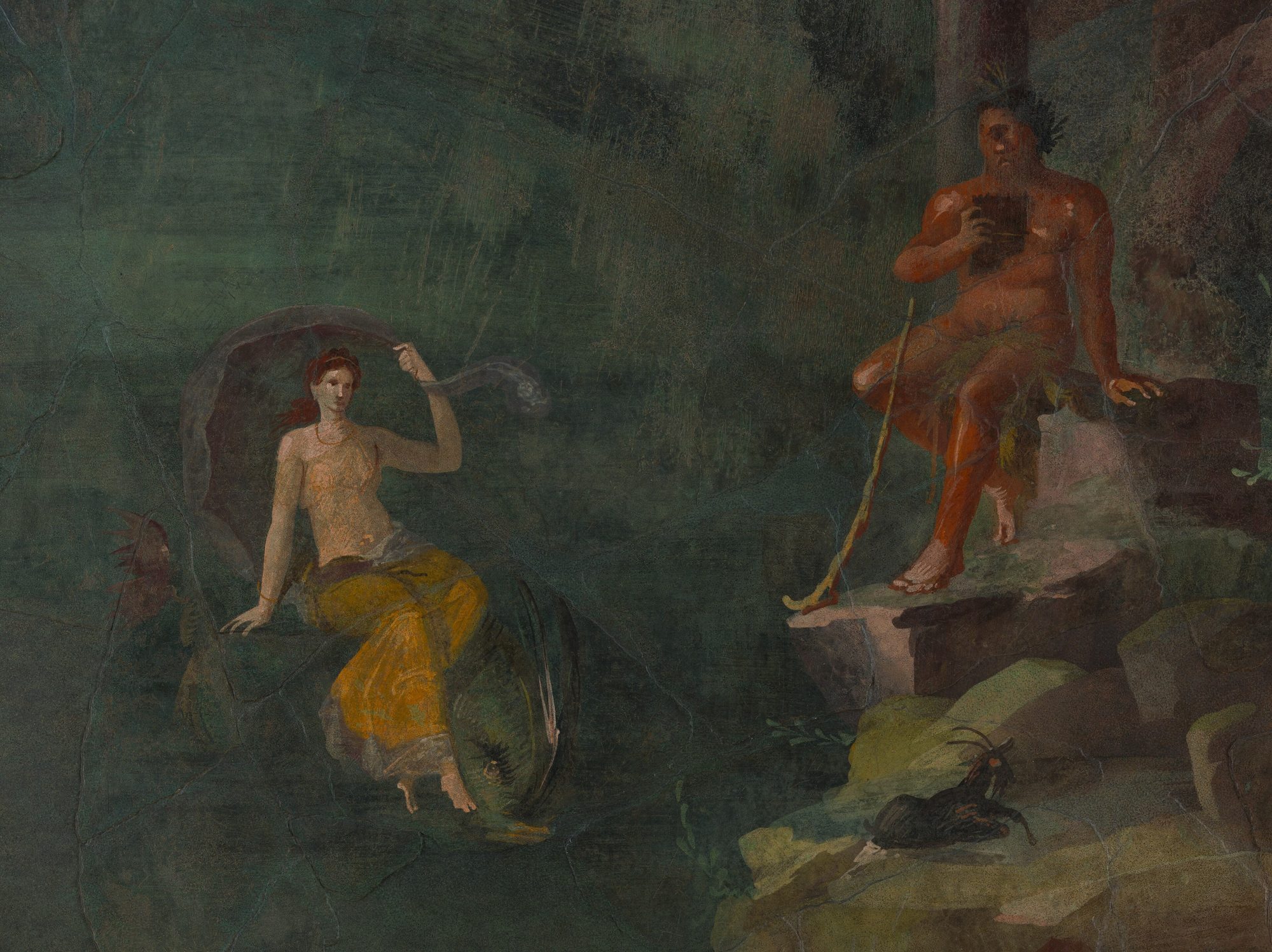
A Roman fresco in the Third Style: the Cyclops Polyphemus, a giant seated in a landscape, receives the cup of wine as the sea-nymph Galatea rides a dolphin across the sea at the panel's edge, under a violet-blue sky.
Greek

Odysseus and the Cyclops

He beat a giant with a lie and a sharpened stake, then threw it all away for the pleasure of hearing the monster learn his name.

7 minHomer
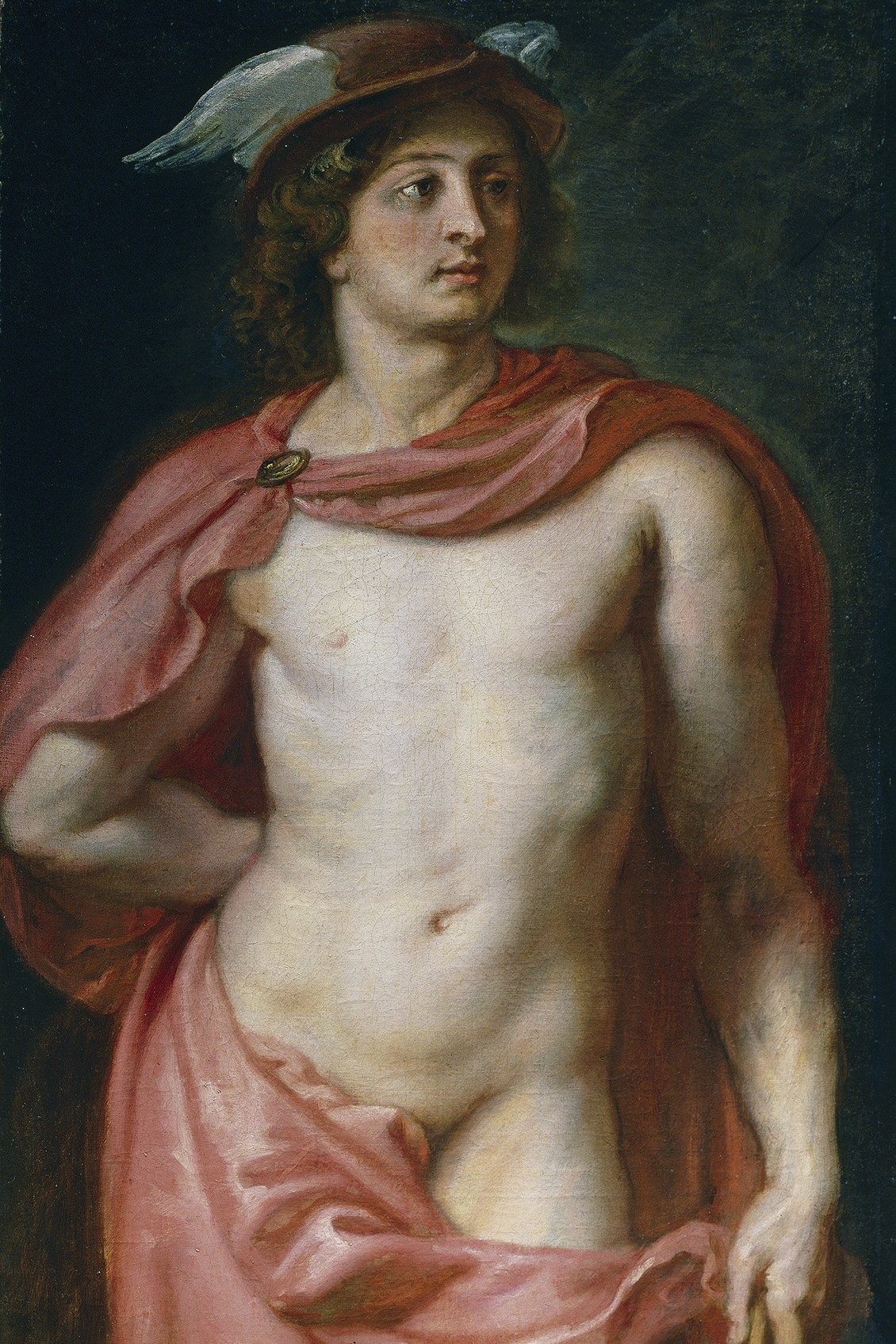
The young Hermes, unbearded and long-haired, wearing the winged traveller's hat (petasos) with its pale feathers spread at either side. A coral-rose mantle is clasped at one shoulder with a gold brooch and falls across his bare torso; he stands against a dark ground, his head turned to gaze aside.
Greek

Hermes, the Messenger God

Born at dawn, he had invented the lyre and stolen a god's cattle before nightfall. The trickster who talks his way onto Olympus and walks the dead down to Hades.

6 minHomeric Hymn 4